Nothing unusual for this month, although we do have a couple authors who are not normally associated with SFF, let alone magazine SFF. One of the reasons I decided to make this year more focused on The Magazine of Fantasy and Science Fiction for its 75th anniversary is that, easily more than any of its contemporaries (and F&SF has outlived most of its competitors), is that it has managed to snag authors who otherwise would probably never appear in SFF magazines. It’s quite possible Jonathan Lethem would’ve tried his hand in the magazines regardless of whether F&SF ever existed, but the same can’t be said for Joyce Carol Oates.
I’ve recently been going through another mental health struggle (my bipolar episodes thankfully last hours at a time instead of days or weeks), but that’s not something to be elaborated on—at least not for this post. I may have something in mind having to do with mental illness in certain SF writers that you may or may not see later in the month.
Let’s see what we do have.
For the novellas:
“Oceanic” by Greg Egan. From the August 1998 issue of Asimov’s Science Fiction. Hugo winner for Best Novella. Egan is one of the leading voices of post-cyberpunk, and while mixing SF with detective fiction was a thing pretty much since cyberpunk became a codified subgenre, Egan has gone farther than most in mixing hard science with film noir tropes. Last time we met Egan it was with his mind-bending novella about quantum physics, “Singleton,” but “Oceanic” seems to catch Egan in a very different mode.
“Autubon in Atlantis” by Harry Turtledove. From the December 2005 issue of Analog Science Fiction. Prolific tweeter Harry Turtledove is known as a possibly even more prolific novelist, and while by no means did he invent the alternate history novel he has undoubtedly worked to define that subgenre more than anyone in recent years, especially regarding the American Civil War. “Autubon” is not a misspelling of “autobahn” but refers to the real-life naturalist John James Autubon, who stars in this alternate history story.
For the short stories:
“Friend” by James Patrick Kelly and John Kessel. From the January 1984 issue of The Magazine of Fantasy and Science Fiction. Long-time friends and collaborators, brilliant both solo and together, Kelly and Kessel got their starts around the same time and happened to get involved in the cyberpunk movement, although it would be inaccurate to call either of them cyberpunk writers.
“Drunkboat” by Cordwainer Smith. From the October 1963 issue of Amazing Stories. One of the most unique voices of his day, Smith, as you probably know, is the pseudonym of Paul Linebarger, a respected writer on psychological warfare and consultant on Asian geopolitics. He spent some of his childhood in China. Most of his stories, including this one here, are set in the same future history.
“Mood Bender” by Jonathan Lethem. From the Spring 1994 issue of Crank!. A “literary” author who has never forgotten his roots, Lethem started out in the late ’80s as a genre writer, and indeed his first four novels were all SF before he gained mainstream attention with Motherless Brooklyn in 1999. As with Greg Egan, Lethem has a knack for combining SF with film noir elements.
“Pictures Don’t Lie” by Katherine MacLean. From the August 1951 issue of Galaxy Science Fiction. MacLean debuted just in time for the magazine boom of the ’50s and the first great era for female SF writers. She lived an extraordinarily long time and her career is a distinguished one. “Pictures Don’t Lie” is one of MacLean’s most reprinted stories, and has even been adapted multiple times.
“In Shock” by Joyce Carol Oates. From the June 2000 issue of The Magazine of Fantasy and Science Fiction. Noted tweetsmith Joyce Carol Oates also happens to be one of the most acclaimed living American authors, having won the National Book Award, the Bram Stoker Award, among others. Most of her work is “literary,” but she’s also a somewhat prolific (and quite skilled) writer of horror.
“The Secret Life of Bots” by Suzanne Palmer. From the September 2017 issue of Clarkesworld. Hugo winner for Best Novelette. Palmer was born in 1968 but didn’t make her genre debut until 2012; despite this she has quickly built a reputation as one of the leading authors in the field. She’s been a prolific contributor to Asimov’s especially, but this story marked her first appearance in Clarkesworld.
As you can see this nearly all SF, except for the Oates which is horror, but it’ll also be the last “normal” forecast until September. In July we’re doing all F&SF stories, this time from the ’60s (I covered the ’50s in March), and for August I have a special author tribute in mind.
Not much to say with regards to updates here, other than I’m looking into a tutoring gig and I seem to be starting a polycule, the latter of which I’ve heard is kinda like starting a rock band. If anyone wants to join, please let me know. There are no gimmicks for this month’s review forecast, except that we have a complete novel on our hands for the first time in what feels like forever, and we’ve got a few familiar faces returning to the site. I may have also intentionally picked Lucius Shepard and Aliette de Bodard stories with similar titles. One thing I’ve been thinking about that I’ve decided to act on is reviewing more reprints of classic stories; one every couple months seems like a good deal. The reason for this is at least twofold: I have a soft spot for the classics, but I also wanna cover authors from the pre-pulp years who contributed to genre fiction. This month I’ll be reviewing an SF story by Jack London, who is not known primarily for his SF but who indeed wrote a lot of it. Once again Jack Vance will be providing the novel, which is unsurprising since quite a few of his novels first appeared in magazines, either as serials or all in one piece like this month’s novel.
Don’t wanna keep you long; just letting you know we have another month packed with fiction that looks to be at least interesting, although it’s mostly SF with a couple fantasy stories thrown in.
For the novellas:
“Birthright” by April Smith. From the August 1955 issue of If. Smith sadly is one of many women who wrote SF in the pre-New Wave days whom we know basically nothing about. We don’t know when she was born or when she died. She’s a ghost. She has one solo story, “Birthright,” to her credit, plus one collaboration. ISFDB classifies this story as a novelette, but running the Project Gutenberg text through a word processor shows it’s just over 17,500 words.
“Polyphemus” by Michael Shea. From the August 1981 issue of The Magazine of Fantasy and Science Fiction. Shea had a varied career, lasting from the ’70s until his death in 2014. His work ran the gamut from SF to high fantasy to the Cthulhu Mythos. He won the World Fantasy Award multiple times for his fantasy and horror. His most famous story, “The Autopsy,” is an SF-horror hybrid, and “Polyphemus” looks to be a similar blend of the two genres.
For the short stories:
“The Shadow and the Flash” by Jack London. From the June 1948 issue of Famous Fantastic Mysteries. First published in 1903. London was one of the most popular and prolific authors of the early 20th century, despite dying young. He’s best known for his adventure stories set in the Klondike, such as The Call of the Wild and White Fang, but he also wrote a surprising amount of science fiction.
“The Witch of Orion Waste and the Boy Knight” by E. Lily Yu. From the September-October 2016 issue of Uncanny Magazine. Yu burst onto the scene with her story “The Cartographer Wasps and the Anarchist Bees,” which nabbed her several award nominations. She won the Astounding Award for Best New Writer the same year she graduated from Princeton, which is no small feat.
“The Jaguar Hunter” by Lucius Shepard. From the May 1985 issue of The Magazine of Fantasy and Science Fiction. Speaking of late bloomers, Shepard didn’t start writing fiction as an adult until he was deep in his thirties, but he quickly emerged as one of the defining SFF writers of the ’80s. If you’ve read enough Shepard then you know he has a “type,” and this story looks to be typical Shepard.
“Descending” by Thomas M. Disch. From the July 1964 issue of Fantastic. Feels like it’s been a long time since I covered Disch, with his novel Camp Concentration. Disch was one of the daring young writers to kick off the New Wave in the ’60s, although despite being a regular at Michael Moorcock’s New Worlds he actually first appeared in Fantastic, under Cele Goldsmith-Lalli’s editorship.
“The Defenders” by Philip K. Dick. From the January 1953 issue of Galaxy Science Fiction. It’s been ten months since I last talked about Dick on here, which in my book is too long a wait. The thing about Dick is that he’s become frankly over-discussed in “serious” SF discussions, or at least his most famous novels. Thankfully this is not the case with many of his short stories, such as this one.
“The Jaguar House, in Shadow” by Aliette de Bodard. From the July 2010 issue of Asimov’s Science Fiction. Of Vietnamese heritage, living in France, and writing predominantly in English, de Bodard has a curious cultural background, so it makes sense she would concoct one of the most curious future histories in modern SF. Spacefaring humanity here is decidedly non-white and non-American.
For the complete novel:
Planet of the Damned by Jack Vance. From the December 1952 issue of Space Stories. The early ’50s were a formative period for Vance, who was showing himself to be one of the most imaginative talents at the time—albeit one whose efforts were mostly relegated to second-rate magazines. I’ve previously coveredBig Planet, which was a breakthrough title for Vance, and now we’re on Vance’s follow-up novel, published just a few months later. Planet of the Damned has a rather convoluted publication history: as with Big Planet, the magazine version and not the first book version served as the basis for future “definitive” reprints. It’s also been printed as Slaves of the Klau and Gold and Iron.
(Contains spoilers for “The Ash-Tree,” “A Warning to the Curious,” and “‘Oh, Whistle, and I’ll Come to You, My Lad.’”)
Montague Rhodes James was born in 1862 and died in 1936, incidentally the same year as Rudyard Kipling; and with that, English literature lost two of its finest writers of the supernatural. It wasn’t the only thing they had in common: they were both conservatives of a breed that seemed to die out following the erosion of the British empire, both given to a distrust of women (Kipling more explicitly), both seeming to be relics of a prior age—a status which makes them a bit of a challenge for modern readers. More endearingly, both were consummate and compulsive storytellers. Kipling read stories to his children while James often wrote his stories with the intention of reading them aloud to his friends, which he would then do at Christmastime gatherings. They can’t help it; it’s like a second language for them. But whereas Kipling wrote almost every kind of story then conceivable (adventure, fantasy, science fiction, horror, you name it), James wrote only one kind of story: the ghost story. As he admits in “Stories I Have Tried to Write,” a brief but telling essay, “I never cared to try any other kind.” It’s a good thing he was perfect for such a niche job.
I’ve been reading some M. R. James as of late, or in a few cases rereading. I’ve said before that I’m a bit of a slow reader, and even then I struggle to retain information; but there’s also a pleasure in rereading something juicy, and James’s writing often demands closer examination. It’s occurred to me that James really was one of the best horror writers of his time, and he did this despite (by his own admission) being adept at only one specific kind of story. If you read five M. R. James stories in one day (which I wouldn’t recommend, because each requires at least some time to digest) then you will at some point feel like you’re reading five variations on the same story—the primordial M. R. James story which may not exist. “‘Oh, Whistle, and I’ll Come to You, My Lad’” and “A Warning to the Curious” were written more than a decade apart, but read like the offspring of the same mother—or, to evoke the things lurking in the ash tree at the climax of that story, siblings in the same brood, belonging to the same monstrous spider-queen. To make a more film-nerd comparison, James’s fiction is sort of like the movies of Yasujirō Ozu, in that both artists seemed preoccupied with toying with the same set of ideas, creating works that are similar enough to each other, with subtle and at times profound differences.
In James’s case there is a tangible obsession with the distant past—in many cases the positively ancient past. This wasn’t just a hobby for the man, mind you. James was one of those writers who wrote relatively little fiction (his complete set of ghost stories has been printed in volumes under 500 pages) because he had a day job that both covered his ass financially and was respectable. He spent pretty much his whole adult life in academia, at a few different colleges, from undergrad all the way to senior positions. He was a professional medievalist, and he did not fuck around when it came to uncovering artifacts and works of architecture. If he were alive today he might be one of those “lost media” YouTubers, but ya know, more cultured. Something to keep in mind about James is that, being a Briton and living in the UK most of his life (he did like to travel), he had a first-hand conception of the ancient that filthy Americans like myself simply don’t have. For Americans the “ancient” past goes back to about the 1600s, but for someone who’s traveled through the UK and continental Europe this conception of the past goes back several more centuries. In this sense his story “The Ash-Tree” might be one of his most well-known, at least for American readers, because of its dealings with Puritans and the persecution of alleged witches—things Americans are likely to know about. Fans of Nathaniel Hawthorne will be sure to seek out this one especially.
But more often than not the terrors that haunt James’s protagonists are unspeakably old and ethereal, perhaps more monster than man. Not only are the living characters unable to communicate with these apparitions, but they’re barely even able to understand their existence in the physical world. You may be thinking there are only so many ways one can write about ghosts, or even imagine ghosts; but even comparing James to Kipling, or Montague Rhodes to Henry (that other great ghost story writer), shows that there’s more than one way to skin a cat. Indeed, unlike the popular conception of ghosts up to the Edwardian period, James’s (I’m talking about M. R. now) ghosts are decidedly meaner, crueler, more unreasonable, and more impenetrable. Or, to quote H. P. Lovecraft in “Supernatural Horror in Literature,” in which he articulates James’s virtues better than I could:
In inventing a new type of ghost, [James] has departed considerably from the conventional Gothic tradition; for where the older stock ghosts were pale and stately, and apprehended chiefly through the sense of sight, the average James ghost is lean, dwarfish, and hairy—a sluggish, hellish night-abomination midway betwixt beast and man—and usually touched before it is seen. Sometimes the spectre is of still more eccentric composition; a roll of flannel with spidery eyes, or an invisible entity which moulds itself in bedding and shews a face of crumpled linen.
That latter description, by the way, applies to the ghost at the center of what is arguably James’s masterpiece, “‘Oh, Whistle, and I’ll Come to You, My Lad.’” This story, one of the finest ghost stories of all time, also happens to be a perfect encapsulation of James’s wants, fears, virtues, and limitations; it is a microcosm of everything relevant to and about M. R. James. We follow an academic, Professor Parkins, journeys to the coastal town of Burnstow (based on the real town of Felixstowe) for vacation, where he ends up golfing with a fellow at the same inn who mostly goes simply by “the Colonel.” Parkins gets word that there’s an attraction within walking distance of the inn that may be of interest to him: the site of a Templar preceptory, now mostly buried. The site would be at least 600 years old, and yet, England itself being such an old country, there might be something worth digging for. One day Parkins goes to the site as part of his beach walk, and digs out a whistle that, despite being caked in and clogged with dirt, remains miraculously intact. There’s writing on the whistle, in Latin, which Parkins can only partly make out, but which he translates as, “Who is this who is coming?” Having cleaned the whistle, and out of curiosity, he decides to use it. This is a mistake. The whistle’s owner has been dead for centuries, and yet upon Parkins’s discovering the whistle has been brought back into this world—first as a vague human-shaped specter that stalks Parkins on the beach and later taking possession of the aforementioned “crumpled linen.” This might be the only time in history the stereotypical bedsheet ghost is made threatening.
Everything is neatly laid out for us. We have an intellectual but sort of hapless protagonist, a pastoral locale that seems inviting but which houses an ancient evil (locations in James stories always seem either to be wide open spaces or storied buildings like cathedrals and old colleges, no in-between), a spirit of the distant past which is catapulted into the present by some cursed object, and ultimately an anti-intellectual message. For James, the past seems to always be just one bad move away from resurfacing, on a collision course with the present unbeknownst to the latter. The central character of “A Warning to the Curious” takes what is supposedly the last buried crown on England’s coasts, made to stave off foreign enemies, and draws the unwanted attention of something—and, even after returning the ancient crown to its rightful place, he pays for his transgression. Similarly the latest in a line of Puritan landowners falls prey to a witch’s curse that his ancestor had brought upon the family in “The Ash-Tree,” with the witch continuing to wreak vengeance long after her execution. According to James, the past is never dead—merely dormant. In cosmic horror a rule of thumb is to never alert the eldritch horror to your presence, but while James’s ghost stories are not cosmic, they do have a similar rule: do not wake that which is sleeping. All things considered, Parkins gets off lightly.
It’s funny to think that James would revolutionize the ghost story, since he was about as far removed from the revolutionary as is possible. He was a reactionary, a staunch anti-Modernist, a misogynist, and if contemporary accounts are to be believed, a bit of a man-child. He had no sense of worker solidarity, wasn’t remotely interested in making the world a better place, and seemed to be a walking goldmine of useless trivia (again, think “lost media” YouTuber); and yet it could be argued that this sheltered lifestyle, this state of being perpetually knee-deep in the past, had nurtured James’s writing rather than hindered it. Sure, you (possibly left-leaning reader—or maybe not) and I find the politics of, say, H. G. Wells, a lot more agreeable, but I don’t think Wells (at least young Wells) could’ve written such a menacing work of horror as “‘Oh, Whistle’” or “Count Magnus” or “Casting the Runes.” I’ve been having this thought, or rather question, tumbling around in my head lately: Is horror a conservative genre? Very loaded question, probably worthy of its own editorial at a later date. Historically some of the great horror writers were conservative, and certainly the best writers of ghost stories in particular have tended to be right-wing. It could be because conservatives go through life already being stalked by phantoms—by the specters of queerness, feminism, socialism, and what have you. M. R. James is a rare case where his artistry was often fabulous because of his backwards politics, and more specifically because of his crippling fear of the present.
(Cover by Frank Kelly Freas. Analog, December 1972.)
As has unfortunately become commonplace, there have been a few deaths in the family. Christopher Priest and Brian Stableford died in February and Vernor Vinge little over a week ago. This last one hit me by far the hardest. Obviously there are some people I’m not mentioning, but unfortunately unless I really wanted to I can’t cover everyone. There’s too much. The past month or so has been rough for me. I had a nasty fall a few weeks ago and I seem to have acquired mild PTSD from it. Half of my face got messed up and I ended up spending some time in the ER. Obviously I’m doing better now. Yet somehow I don’t feel totally “right.”
Hopefully some good (or at least interesting) fiction will help me! We have a nice mix: two SF novellas, plus two SF short stories, two fantasy, and two horror. Or at least these stories seem to fit predominantly into those genres; obviously they’re not mutually exclusive.
For the novellas:
“A Woman’s Liberation” by Ursula K. Le Guin. From the July 1995 issue of Asimov’s Science Fiction. One of the most universally beloved of all SFF writers, Le Guin started relatively late but would enjoy a very long and acclaimed career. She’s one of the few authors to enjoy about equal reverence for both her SF and fantasy. Her Hainish Cycle, especially The Left Hand of Darkness and The Dispossessed, might constitute her best and most important work overall. “A Woman’s Liberation” is set in the same universe as those novels, and is a loose sequel to “Forgiveness Day” and “A Man of the People.”
“Palely Loitering” by Christopher Priest. From the January 1979 issue of The Magazine of Fantasy and Science Fiction. British Science Fiction Award winner for Best Short Fiction. Priest died in February, after a career spanning more than half a century. His 1974 novel Inverted World is something of a cult classic. His 1995 novel The Prestige was turned into a movie by Christopher Nolan. ISFDB classifies “Palely Loitering” as a novelette, but at about forty pages in F&SF I suspect it counts as a novella. It got a Hugo nomination for Best Novelette but placed third in the Locus poll for Best Novella.
For the short stories:
“The Hounds of Tindalos” by Frank Belknap Long. From the March 1929 issue of Weird Tales. Long had a ridiculously long (ha) career, spanning from the 1920s to his death in 1994. He was a close friend of H. P. Lovecraft and the two seemed to take inspiration from each other, with “The Hounds of Tindalos” being one of the first Cthulhu Mythos stories not written by Lovecraft.
“Traps” by F. Paul Wilson. From the Summer 1987 issue of Night Cry. A doctor by day and a bestselling author by night, Wilson is the only person to have earned both the Bram Stoker and Prometheus Award for Lifetime Achievement. He likes to hop between science fiction and horror, with the two not being mutually exclusive. “Traps” itself was a Stoker nominee for Best Short Story.
“The Swordsman Whose Name Was Not Death” by Ellen Kushner. From the September 1991 issue of The Magazine of Fantasy and Science Fiction. Kushner got started in the ’80s writing Choose Your Own Adventure books before turning to proper fantasy literature and even radio. This story is set in the same universe as her novel Swordspoint but, as far as I can tell, is not a sequel.
“Two Suns Setting” by Karl Edward Wagner. From the May 1976 issue of Fantastic. British Fantasy Award winner for Best Short Story. Wagner was a devotee of both horror and sword-and-sorcery fantasy. His Kane series very much follows in Robert E. Howard’s footsteps, but Wagner at his best was a genuine poet as well. “Two Suns Setting” was his first (and I think only) appearance in Fantastic.
“Original Sin” by Vernor Vinge. From the December 1972 issue of Analog Science Fiction. Despite debuting in 1965 and remaining active until about half a decade ago, Vinge’s output is fairly small; but, given the five Hugo wins, he certainly did something right. “Original Sin” is one of Vinge’s more obscure stories, but I went with it on the recommendation of a certain colleague.
“The Growth of the House of Usher” by Brian Stableford. From the Summer 1988 issue of Interzone. Stableford passed away in February after a very long and winding career. (Incidentally Priest, Vinge, and Stableford all debuted within a few years of each other.) He was a prolific translator of French SF and contributed to the SF Encyclopedia, on top of a massive amount of fiction.
Howard Waldrop debuted in 1972, apparently one of the last authors to be discovered by John W. Campbell, but he would quickly head off in a very different direction from the house of Analog. Waldrop’s fiction can be russtic and nostalgic, sometimes positing what-if scenarios, most famously in his World Fantasy-winning story “The Ugly Chickens,” an alternate history in which the dodo had not gone extinct in the 17th century. His short fiction is what has secured his legacy, since Waldrop had only put out one solo novel, Them Bones in 1984. In the introductory blurb for today’s story, Gardner Dozois says Waldrop was working on a novel titled I, John Mandeville, but this book never materialized. In an age where authors hopped on novel-writing for that bigger paycheck, or even started out as novelists before moving “down” to short fiction for funzies, Waldrop is one of the few notable SFF authors of his generation who was almost a pure short fiction writer. He death last month has left a hole in the field.
Both readers and writers must’ve really liked “Do Ya, Do Ya, Wanna Dance?” since it was nominated for the Hugo, Nebula, and Theodore Sturgeon Memorial Award, and placed third in that year’s Locus poll for Best Novelette. I also really liked it! I’m surprised I haven’t read more Waldrop since the few stories of his I’ve read have been certified bangers; but then he also wasn’t that prolific a writer, so I ought to savor it. There’s definitely a hint of autobiography with this one, as the narrator is a about a few years younger than Waldrop and is an Austin denizen.
Placing Coordinates
First published in the August 1988 issue of Asimov’s Science Fiction, which is on the Archive. Its quality was immediately noted, as Gardner Dozois would reprint it in The Year’s Best Science Fiction: Sixth Annual Collection. It then appeared in the Waldrop collections Night of the Cooters and Things Will Never Be the Same: A Howard Waldrop Reader.
Enhancing Image
The plot is simple. “The Class of ’69 was having its twentieth high school reunion.” The story takes place in what would’ve been a very near but decidedly alternate future—a 1989 that’s different from what the year ended up being but otherwise is close enough to reality to be plausible. It’s this near-future element that qualifies the story as SF—that and the ending, although I’ll try not get ahead of myself here. The narrator, Frank Bledsoe, is pushing forty and makes his living as a handyman. “I help people move a lot. In Austin, if you have a pickup, you have friends for life.” Austin. Feels like a Richard Linklater movie. This story is much more about characters and speculation than plot, so pardon me if my reviews sounds a little disjointed. This is a very hard story to spoil. It’s totally possible Frank is a stand-in for Waldrop, but I don’t know enough about Waldrop to make that assessment. There’s less a plot and more a series of reminiscences connecting to a single event—in this case the reunion.
Frank is a passive protagonist: he doesn’t really do anything, which would be a problem if this was an action narrative. Instead it almost reads like autobiography, with a strong dose of self-reflection. I mean why not, it’s been twenty years since he graduated high school. It’s been ten years since I graduated high school, and I’ll be honest, I barely remember anything from that time in my life. I was on the wrestling team, until a leg injury junior year convinced me to quit. I didn’t have my first serious relationsip until about a month before graduating, and that whole thing (three years!) was a mistake (I was immature and I wish I had treated her a lot better than I did). I don’t talk to any of the friends I had in high school. People, Frank included, are able to recall their teen years with crystal clarity, but I just can’t. I was an outcast who was very likely autistic and, as it turns out, someone with bipolar disorder who would go undiagnosed for ten years. Things were very different in 2014. We had a Democrat president who had backed a mass murder campaign in the Middle East, and Taylor Swift was seemingly everywhere in the press and on the radio. Okay, maybe it wasn’t that different. People much older than me have a better sense of time passing.
Part of me wonders if Waldrop had not envisioned “Do Ya, Do Ya, Wanna Dance?” as a non-SF story, maybe something he would’ve sold to The New Yorker or somewhere else that probably pays better than Asimov’s. Most of the story barely even registers as speculative, which I can see as a problem for some people. Of course, the reality is that the market for non-genre short fiction is rather small, or at least pales in comparison to the wealth of potential buyers in genre fiction. It’s also totally possible Waldrop started writing with the ending in mind, in which case it’s intentionally designed as a non-SF story that suddenly explodes into something else in the climax. Waldrop has an uncanny ability to evoke the ordinary, slightly altered by an ingredient of his own making. “The Ugly Chickens” could be a literary short story that teachers would make students read in high school, except for the whole dodo thing. “Flying Saucer Rock and Roll” could be a literary coming-of-age narrative, like Stephen King’s The Body, if not for the whole aliens-causing-a-blackout bit. This story could be just a middle-aged dude reflecting on years past, but have you heard of this band called Distressed Flag Sale and a gnarly show they wanna put on…?
But then the story is less about Frank and more about the time of his youth, the state the US was in, the future that failed to happen. By his own admission he’s not a very interesting person. “I care a lot. I’m fairly intelligent, and I have a sense of humor. You know, the doormat personality,” he tells us. Thing is, Frank is not unique. Indeed much of the story is him finding that his former comrades have largely moved away from their radical youths and slipped into unassuming lives. This is a story about people who would’ve graduated high school in the late ’60s, about those who would’ve been old enough get drafted into the Vietnam War; in other words, this is a story about boomers. Waldrop seems to be in search of an anwer to a question that pertains to people of his generation: Why are boomers like that? Why does the average boomer seem so tired and reactionary? In a less charitable way of putting it, why is the average boomer a coward? Didn’t these people attend Woodstock? Didn’t they make a ruckus at the 1968 Democratic National Convention? What happened to these people? Why had their fighting spirit gone the way of the dodo? Can’t just be old age. Waldrop implicitly gives us a few answers to this question, by way of illustrating how times changes for the boomers between 1969 and 1989.
For one, not everyone boomer was a hippie—pretty far from it. Pop culture tends to do some funny shit, not the least of it being a tendency to co-opt radical movements of the past. Remember when ultra-capitalist Beyoncé appropriated Black Panther attire? Remember when milquetoast liberal Aaron Sorkin turned the leftist Chicago Seven into a pack of like-minded liberals? People, in “remembering” the hippies of the late ’60s and early ’70s, tend to paint these people as a) not as politically subversive as reality dictates, and b) more popular at the time than was the case. Truth is there were a lot of bootlickers among the youth at that time. One of the more memorable characters in Waldrop’s story is Hoyt Lawton, a classmate who was about as straight-laced as they came and who would go on to be a yuppie. “He won a bunch of money from something like the DAR for a speech he made at a Young Republicans convention on how all hippies needed was a good stiff tour of duty in Vietnam that would show them what America was all about.” There were a lot of Hoyts in the US (there still are, actually), and these people went on to vote for Reagan and “master” the stock market. Donald Trump is one such boomer we all know.
The Democratic National Convention. The moon landing. The Manson murders. Altamont. Kent State. This all happened in a period of two years and basically destroyed hippies’ reputation as a genuinely subversive group working towards the betterment of mankind. The so-called New Left came into conflict with itself. Leftist groups like the Black Panthers were being systematically targeted by the government. War protesters were being arrested. It was a bad time to be an American who was not a bootlicker. Maybe the real eccentrics—those, say, in Austin, who really believed in the cause—were being worn out. The guys in Distressed Flag Sale (now renamed Lizard Level) got arrested on bogus drug charges in 1970 and that forced the band to split up. 1969, the year of the Stonewall riots. The burgeoning queer community was then torn to shreds by AIDS, by the government deliberate ignoring of the virus. AIDS does get brought up in the story, sort of in passing; a shame none of the characters are explicitly queer, feel like that was a missed opportunity. We would not have Pride parades without riots. Queer liberation is inherently distrutful of government. God, imagine the work we could’ve accomplished with the hippies. This is a future that failed to happen, or rather wasn’t allowed to happen.
There Be Spoilers Here
So, that reunion. Distressed Flag Signal play some ’60s classics, but then their frontman drunkenly comes out, saying they’re gonna play a song that nobody would’ve heard—a song that existed only by way of reputation, like a myth. It’s called “Life Is Like That” and was due to be on their upcoming album (which never materialized due to the breakup), called either New Music for the AfterPeople or A Song to Change the World. “It was a great song, man, a great song. […] It was going to change the world we thought. […] We were gonna play it that night, and the world was gonna change, but instead they got us, they got us, man, and we were the ones that got changed, not them.” And then something very strange happens. The song has a hypnotic effect on the crowd, and I don’t mean just in the way good music will make people bump in the club, but it seems to draw the whole building into a frenzy. First a few hundred people, but then it builds—goes beyond the building. A few hundred people dancing turns into a few thousand, people dancing in the streets, people forming conga lines, people feeling a kind of insane euphoria that comes through either great sex, drugs, or a bipolar manic episode. The song does what the band hoped it would: it changes people. A literal infection of music that spreads throiughout the land.
One must imagine them happy, even as they dance until their legs give out. It’s sort of ambiguous as to whether the ending is supposed to be fully good or bittersweet, but still, these people are happy; for some of them it might be sheer happiness for the first time in two decades. It’s an ending that leaps straight into the fantastic, and its inexplicableness and potential meaning boost this story for me.
A Step Farther Out
How much you enjoy this story might depend on how much you’re willing to connect with people of a certain generation—people who, at this point, are starting to die from old age. One reason this could’ve been reprinted only once in the past thirty years is that it’s a story written in the ’80s about the ’80s, and more specifically about people who were old enough in the ’80s to be raising families of their own. And, let’s face it, boomers don’t exactly have a good reputation among millennials and younger people like myself. My simple counterargument is twofold, a) that Waldrop is pretty good at what he does, and b) if we make no attempt to understand previous generations then what hope do we have of not repeating their mistakes? I take an amateur’s interest in the historical context of really any fiction, although it helps if said fiction is good—which this is.
(Cover by Edward Valigursky. Amazing Stories, May 1959.)
Who Goes There?
From the ’50s until Arkady’s death in 1991, the Strugatsky brothers were almost certainly—along with Stanislaw Lem—the most internationally acclaimed SF writers to come out of the Soviet Union. There are a few reasons for this. No doubt during the Cold War there was a push to translate Soviet fiction that badmouthed practices in that coalition, and usually could get away with it since the censors apparently didn’t pay as much attention to genre fiction as “serious” literature. Even so, the Strugatsky brothers sometimes ran afoul of censors, with their novel The Doomed City being written in 1972 but not published until 1989 as censorship was loosening. Their 1972 novel Roadside Picnic is one of the most famous non-English SF novels of all time, helped by an extremely loose but equally fascinating film adaptation in Andrei Tarkovsky’s Stalker.
In the introductory blurb, Norman Lobsenz (I think it’s Lobsenz) says “Initiative” is the first Soviet SF story ever to see publication in the SF magazines. This might be true, although I’m not ready to tumble down that particular rabbit hole. I’m not sure whose decision it was, Lobsenz’s, Goldsmith’s, or Rutley’s, but despite giving us a direct translation of the title (“Spontaneous Reflex”) in said blurb, the story itself is named “Initiative.” In fairness “Initiative” does sound better in English than “Spontaneous Reflex,” and basically conveys the same meaning in fewer syllables. “Initiative” was first published in the Russian in 1958, and was one of the Strugatsky brothers’ first published stories.
Placing Coordinates
From the May 1959 issue of Amazing Stories, which is on the Archive. Finding reprints for stories in translation can be a bit tricky. For example, “Initiative” was never reprinted in book form—at least under that title. As “Spontaneous Reflex” it was reprinted in what seems to be the same anthology under two different titles, A Visitor from Outer Space and Soviet Science Fiction (editor not credited). As “The Spontaneous Reflex” it appeared in Red Star Tales: A Century of Russian and Soviet Science Fiction (ed. Yvonne Howell). See what I mean?
Enhancing Image
Urm (“Universally Reacting Mechanism”) is a robot—a metal giant that does not wanna harm anyone, the only problem being that it’s bored. “The Master” has gone away and apparently nobody has been left on-site to watch over Urm and make sure he doesn’t get into any funny business. Suppose you’re a machine with arms and legs, and some capacity to make decisions on your own? You might wanna get a hobby or two. You might even become curious. Urm takes it upon himself to explore what seems to be a nuclear power plant (we’re not given many details), scaring an assistant or two and accidentally getting himself irradiated—which is fine, because Urm is virtually indestructible. He leaves the site “a contaminated and a wiser robot,” news of which the underlings at the plant are quick to bring to Urm’s makers, namely Nikolai Petrovich and Piskunov. (I don’t think we ever get Piskunov’s first name, although the authors felt it necessary to give us Petrovich’s first and last name almost every time.) To make matters worse, this is in Siberia, and there’s a snowstorm going on.
I would be intereted to discuss this story with someone who actually has a background in robotics, since it posits a few questions about artificial intelligence, albeit not very seriously. The Strugatsky brothers are known for having a cynical sense of humor, and at least in this early story their humor reads like a similar-looking branch to Robert Sheckley’s—but not belonging to the same tree. Two comedic voices in genre SF that formed around the same time but totally parallel to each other. But whereas early Sheckley can often be summed up as the man’s folly when inventing or confronted with a scientific revelation (the situation will always get worse, and often it ends very grimly), the Strugatsky brothers are a bit more forgiving. “Initiative” is a comedy of errors, but it’d be more accurate to say it’s a comedy of one error, even if it’s a big one. Piskunov and his team had designed Urm for a specific purpose (we’ll get to that in spoilers), but failed to consider the cognitive limitations of a being that a) practically a newborn, and b) only semi-sentient. It’s less that Urm doesn’t act according to his programming and more that his programming is flawed in ways not predicted.
The human characters don’t really matter here other than as physical stand-ins for man’s hubris; they’re little more than cardboard, and that’s fine because the story compensates in other ways. Urm is pretty interesting as a plausible depiction of a self-aware robot, since unlike Asimov’s robots he’s never overcome with delusions of religious zeal or godhood, nor does he particularly dislike humans. He also, we’re told, doesn’t have a sense of self-preservation, such that a man on the street firing a gun at him in terror doesn’t phase him at all—never mind that it would probably take a literal tank to destroy him. Of course what makes him so special, and why Piskunov is determined to capture him rather than destroy, is his brain, “an extremely complicated and delicate network of germanium and platinum membranes and ferrite.” There’s some debate as to how much Urm’s actions are of his own initiative (ha) and how much it’s him simply reacting to stimulation; after all, “reacting” is part of his name. Like a toddler his absorbs information without actually trying to understand it.
Here we see a somewhat juvenile prototype of what would become a recurring theme for the brothers, that being human cognition and its relationship with ethics. Because Urm had been programmed to take interest in tangible things but not ethics and morals, and because it has no real sense of self past a need for stimulation, it’s not fully sentient. It’s not immoral (it doesn’t even cause that much trouble, ultimately) so much as amoral. The Strugatsky brothers seem to be arguing that it’s not possible to be truly self-aware while also being totally divorced from morality. This is a basic premise, and anyone who ascribes to religious faith, or indeed anyone who leans somewhere on the left politically already knows this; whether they choose to do anything good or constructive with the fact that their capacity to think is linked inextricably with the capacity for moral understanding is a different question. Like any self-proclaimed leftist who indulges in racism, classism, misogyny, or transphobia, Urm runs into a problem because there’s a connection not being made in his thinking—although in fairness to Urm this is because the connection can’t be made.
There Be Spoilers Here
With the help of some construction equipment the crew are able to trap Urm and have him turned off, and nobody even had to die to make this happen! It’s also here that we’re finally told why such a robot would be invented in the first place. “Initiative” takes place not far in the future (everything is recognizably “modern”), but enough in the future that it’s clear the Space Race is in full swing. Makes sense: this story was published in Russia about a year after Sputnik. Unlike way too many American SF stories of the time (and until about the ’70s, it turns out), the scientists here got the bright idea to send robots to probe planets in the solar system instead of humans. Urm was made of very tough stuff because he’s supposed to set foot on Venus at some point; this was before it became known to everyone that Venus is too inhospitable a place, even for specially armored robots like Urm. You could date this story, from it being obviously written in the early days of the Space Race, but ultimately the Strugatsky brothers are more interested in thought experiments immerging from the tech than the tech itself—as tends to be the case with good science fiction.
A Step Farther Out
I liked it, and unlike early Sheckley there’s a good deal to chew on here despite the comedic tone. (I like Sheckley, but if we’re being totally honest, once you’ve read a few early Sheckley storie you can predict where they’re going.) This is still much smaller in scale than the intellectual big game the brothers would be hunting a decade or so down the road, but it marks the beginning of what would be a very fruitful creative friendship. That the brothers almost always worked together, what with Boris only writing two novels after Arkady died despite outliving him by two decades, shows a fluidity of style and work ethic. If you were an American genre reader and had picked up the May 1959 issue of Amazing Stories, the prospect of reading a Soviet SF story in translation would’ve been novel, but it also would’ve presented a story that was a bit more cerebral than what American genre readers at the time would’ve expected.
(Cover by William Timmins. Astounding, October 1945.)
Who Goes There?
Kuttner and Moore were a husband-wife duo who started out separately, writing mostly for Weird Tales in the ’30s before marrying in 1940. They had collaborated a couple times pre-marriage, but the early ’40s saw an explosion of work from the two, often under pseudonyms. They were a two-person writing factory in the ’40s, and while they rarely went back to the horror and weird fantasy of their early years, to compensate they produced some of the best SF of the so-called Golden Age. Sadly after 1950 their output went down massively, apparently because both went back to school, and tragically Kuttner died in 1958 before he could get his Master’s and, presumably, go back to writing full-time. Moore stopped writing genre fiction after Kuttner died, and a few years later she would stop writing altogether; the flame that kept her inspiration going seemed to have gone out. Moore would outlive her first husband by almost thirty years.
“What You Need” was published under the Lewis Padgett pseudonym, which is typically more associated with Kuttner, although it does strike a certain tonal balance that implies significant contributions from both parties. With some exceptions (like the Gallagher stories, which are solo Kuttner), we don’t really know who wrote what. Sometimes you have to use your intuition with these things. I’m pretty sure the folks at ISFDB assign author credits for Kuttner/Moore collabs (especially if they were originally published under Kuttner’s name alone) at random. “What You Need” is a pretty good story from when the two were at the absolute height of their powers, together if not individually. It also got adapted into a classic Twilight Zone episode, which I’m sure Kuttner would’ve appreciated.
Placing Coordinates
First published in the October 1945 issue of Astounding Science Fiction, which is on the Archive. It was later anthologized in Omnibus of Science Fiction (ed. Groff Conklin), The Great SF Stories Volume 7 (ed. Isaac Asimov and Martin H. Greenberg), and The Twilight Zone: The Original Stories (ed. Martin H. Greenberg, Richard Matheson, and Charles G. Waugh). It’s also in The Best of Henry Kuttner and, of course, Two-Handed Engine: The Selected Stories of Henry Kuttner and C. L. Moore.
Enhancing Image
I’ll be honest, I wasn’t sure at first if this was SF or fantasy that John W. Campbell had somehow snuck into Astounding (he’d done it before), given the magic shop premise, but rest assured this is SF. Admittedlyit’s a soft-enough science that no wonder Rod Serling thought it fit for adaptation. The time scanner at the heart of the story may as well be magic, but I’m getting slightly ahead of myself. We have two main characters: Tim Carmichael, a journalist who’s recently sniffed out an unusual shop with very selective clientele, and Peter Talley, the owner of said shop. The characters are very Kuttner-y in the sense that they indulge in street talk and have a certain ruthlessness about them. Carmichael is, at best, an anti-hero who, in trying to find out what Talley’s shop could be selling, gets more than he could’ve possibly bargained for. Thing is, Talley’s shop doesn’t sell products but a service. “We Have What You Need” is its slogan, and while Talley does give things to his clients, it’s not the product that’s worth the fee but what it might mean to the customer. A rich man might pay a lot for what looks like a normal chicken egg if the egg will prove to have a certain utility. “Had Earth’s last hen died ten years before, he could have been no more pleased.” Interestingly we never do find out what use such a thing could have.
Talley’s secret is a time scanner—a sort of probability machine that can see into the future. We’re not told much about how the machine works, and anyway the details don’t matter; this is what I mean by “What You Mean” only being nominally SF. Naturally Carmichael is curious about how such a machine might work, and Talley, despite the reporter being a sketchy figure, is inclined to prove the scanner’s legitimacy. Carmichael receives “a pair of shears, the blades protected by a sheath of folded, glued cardboard,” which according to Talley will prove very useful at some point in the near future, although Talley does not say just how a pair of shears might be useful. Cut to a later scene where, in the midst of a drunken escapade with a colleague, Carmichael nearly gets killed by the printer at his own workplace; but he remembers having the shears and manages to cut himself free from the killer printer. Not all items Talley gives to his clients, he says, will be a matter of life and death like this. Nevertheless, Carmichael is convinced. Talley normally deals with rich folks, but he’s willing to make an exception (it’s not totally clear why) with the decidedly middle-class reporter. If you’re familiar with Kuttner’s work (I’m singling out Kuttner because I’m convinced he was the primary force on this one) then you can guess that such a business relationship won’t end well.
Now, I could poke a few holes in all this, because while the time scanner is not a time machine exactly it is very much a time viewer, which is adjacent enough that the rules of time travel still mostly apply. Talley can see into specific people’s futures, including his own, and just because said future is only “likely” to happen instead of guaranteed (remember that this is based on probability) doesn’t mean it’s not magic. Still, it’s pretty interesting that we have effectively two protagonists, and that neither one is evil; at most they both have a good dose of moral greyness. This is a bit of a strange Kuttner/Moore story, because it feels more fantastical than SFnal, despite being printed in Astounding, and there’s an urbane wise-guy attitude to it that makes it seem more indicative of where genre SF was heading in the coming decade (namely with material that would get published in Galaxy) than peak-era Campbellian SF. Kuttner and Moore were ahead of their time, such that it’s a shame their output slows down to a trickle by the time the ’50s rolled around; what little work we do have from them from that period indicates a restless creativity that was nowhere near done.
There Be Spoilers Here
It’s at this point that we run into a bit of a structural problem: “What You Need” has basically two endings, both of which are valid. We get a section entirely in italics where Talley sees that, ten years down the line, Carmichael will kill him and take the scanner for himself. Knowing that it’s too late to deter Carmichael from getting more involved with the shop, but also being too humane (or maybe too much of a coward) to do something about it directly, Talley opts for a trick: get Carmichael “a pair of plastic-soled shoes” and act like these will be helpful to him one week hence. Little does Carmichael know, and neither can he suspect, that the smooth-soled shoes were deliberately picked so that in one week he would slip on them while at the subway and get run over in a horrific train accident. This ending could definitely work: it has an eerie quality to it since we don’t see Carmichael’s death but can infer his fate is sealed, not to mention there’s a moral ambivalence at play. We’re made to think at first that Talley is doing this merely out of self-preservation, which is not exactly a noble goal but at least it’s understandable and keeps him sympathetic.
(A useful thing to remember with stories at least partly written by Kuttner is that schmucks in Kuttner stories never prosper. Carmichael is not an irredeemable person, so his death is not simply framed as karmic justice, but someone with flexible morals like him are likely to meet a very bad end. In some stories the schmuck getting his comeuppance is done for comedy, but here it’s treated as a necessary evil.)
But there’s a second ending! There’s a rather detached scene (because it happens at some indeterminate point after Talley has more or less sent Carmichael to his death) in which Talley elaborates on his reasoning for having doomed Carmichael—for why he’s so determined to protect the scanner. This is all internal, since Talley is by himself and it’s not like he’s telling himself ssomething he didn’t know before. I’m not sure whose idea it was to end the story on this note, but I think it’s maybe unnecessary—except for one thing. The final scene puts “What You Need,” pretty subtly (for a Golden Age SF story), in the realm of atomic allegory. The scanner’s potential could prove catastrophic, such that Talley doesn’t want it to fall into the wrong hands; and Talley, being a morally gentle fellow, considers himself the best-case scenario for someone owning the scanner. This does raise the question of, if the scanner is such a terrible machine then why doesn’t Talley simply destroy it (there doesn’t seem to be anything stopping him), but if this is something comparable to atomic weaponry then maybe the point is that such a machine is inevitable. Once the cat’s out of the bag you can’t put it back in. I like the metaphor, but I don’t like how this fairly short story has to end twice for such a point to be made.
A Step Farther Out
I’m not sure how long it took Kuttner and Moore to write stuff together; they were working at such a breakneck pace in the ’40s that their material was probably put on magazines’ backlogs in no time. It’s totally possible they had come up with the premise for “What You Need” a couple years earlier and had envisioned it as a fantasy, to be more fit for Unknown than Astounding; but then Unknown died and that would’ve thrown a wrench into things. I’m mixed on the ending, but I do think it helps justify the story’s existence as science fiction as opposed to fantasy. Not perfect, but it’s one I’ve been thinking about for the couple days since I had read it. Also a good starting point for getting into Kuttner/Moore collabs.
Terry Bisson, unlike a lot of authors, started out as a novelist before working his way “down” to short stories—a good move, given the latter is where his legacy now rests. His story “Bears Discover Fire” is one of only three to win the Hugo, Nebula, and Theodore Sturgeon Memorial Award; and it has the unique honor of being the first story I reviewed for this site. Can you believe that was a year and a half ago? It’s (in my opinion) one of the few certified classics of SFF short fiction to come out since 1990, and the thing is, there’s more where that came from. Sadly Bisson died last month (exactly to the day, as it turns out), and now the field is forevermore deprived one of its best short fiction writers. “First Fire” has a few issues which I’ll get to, but it does show off Bisson’s feverish and witty potential as a short story craftsman. I suspect there are worse stories I could’ve picked as a way of paying tribute to one of the field’s unsung heroes.
Placing Coordinates
First published in the September 1998 issue of Science Fiction Age, which is on the Archive. It has only been reprinted in English once, in the Bisson collection In the Upper Room and Other Likely Stories.
Enhancing Image
Emil is a young scientist with an invention, a “spectrachronograph,” which can trace the age of a flame down to the second. This may sound incredibly niche, but consider that while flames often may last a few hours, or a few days, a flame without enough care and cultural significance could last for years—possibly centuries. Certainly fire carries a lot of implicit meanings, from man often being said to have risen above his fellow mammals when he discovered fire to the Olympics having a literal passing of the torch. There’s some value in aging flames that, if genuine, could tell humans a little about their own history. The Tycoon (he might have a name, but I forget, and anyway the story always calls him that) takes a keen interest in Emil’s invention, which he insists on calling a “time-gun.” That Emil’s device is not a gun makes the new name a bit humorous, but it also foreshadows what kind of person the Tycoon is. Together they travel to the Middle East, to put Emil’s so-called time-gun to the test: aging the Flame of Zoroaster, which should be several centuries old if genuine.
(I just wanna point out that I worried at first if this story was too short to really dig into, since it only takes up a few pages in Science Fiction Age. For better or worse this magazine’s type size was meant for insects, so a lot of wordage can be fit on the page. Still, Bisson covers a good deal of ground, hopping from scene to scene, in about 4,000 words.)
We meet a few other characters, namely Kay, an assistant working on the Tycoon’s digging project. Emil and Kay quickly develop a friends-with-benefits relationship wherein, somehow, Kay has a long-distance boyfriend and is also fucking the Tycoon, which Emil doesn’t seem to mind. The characters more serve the themes of the story than work as people with interiority and what have you, but Kay definitely draws the short stick even by this standard. There’s also a colleague of Kay’s, Claude, a black Frenchman who is intentionally written as pretentious and randomly injecting French words into his English. But ultimately there’s Emil, the scientist, the man of discovery, who becomes quite rich from his dealings with the Tycoon, who, in turn, literally buys out the Flame of Zoroaster and ships it to the US. The Tycoon compares himself to Alexander the Great, and even his underlings seem to think of him as a modern-day conqueror. Of course, what we’re told about Alexander within the story does not show him in the best light; rather it emphasizes Alexander as a destroyer—a man who, despite having died so young, crushed entire cultures underfoot and turned them to dust. The Tycoon shows a similar irreverence with other cultures, which should be a warning sign for Emil. Alas…
Calling “First Fire” science fiction might be a bit of a stretch, since it is very much couched more in mythology than any real science, despite the utility of Emil’s time-gun. The Tycoon is not a real person, but a stand-in for the ultra-wealthy as a whole, and Emil is not a real person either when you get down to it, but a stand-in for the kind of person who is brilliant at one specific thing and a total dumbass in every other part of his life. He’s a fine inventor but he is tragically unable to foresee how his invention might be abused. And then there’s Kay, who has it the worst. If you’ve read enough of Robert Silverberg’s material, especially his “peak” era of the late ’60s to the mid-’70s, then you become familiar with how Silverberg wrote women at that point in his career. Which is to say, not very well. You get used to it, but it’s a weird caveat to make. Bisson, who doesn’t strike me as a horndog like young Silverberg (or indeed middle-aged Silverberg), pulls some “she breasted boobily” nonsense with Kay and it was something that stopped me in my tracks a few times as I was reading. Don’t get me wrong, this is still not as bad as Piers Anthony on a good day; but it dampens what is otherwise a fairly serious narrative, about something as grandiose as the birth of the human race. Also, Claude is annoying.
I’m quibbling, and admittedly part of that is I waited too long to write about “First Fire” after I had read it. Nobody’s fault but mine. I procrastinated but then got called into work much earlier than expected and now I’m getting this review out at the last minute. This story has soured a bit for me in parts, although interestingly the ending has gone up in my estimation, despite my kneejerk reaction to it. Another thing is that I didn’t understand at first that we’re not supposed to take all this on a literal level, but are meant to take it as allegorical. I wish Bisson only called Emil the Scientist within the story (like in the introductory blurb), because it would’ve made such a reading easier to discern. This is a tragic tale about how wealth can (and often does) corrupt science, and how scientists have a moral obligation to their discoveries and inventions. Kurt Vonnegut cooks this theme to perfection in Cat’s Cradle, and Bisson here makes a solid go at it.
There Be Spoilers Here
The Tycoon and company next head to Africa, to a temple alleged to keep the oldest ongoing flame in human history—a flame so old that it might actually predate homo sapiens. True enough, when Emil use his time-gun on the flame, it turns out to be over 800,000 years old. The Tycoon seems to be fascinated by this, only for him to reach forth and—without anyone noticing at first—extinguish the flame with his fingertips. He has snuffed out the oldest flame in the world, and for what purpose? Everyone is justifiably outraged, but whilst Emil and Claud go to beat the Tycoon, possibly to death, something far grander in scale is happening at the same time. “Overhead, without any fuss, the stars were going out, one by one.” The Tycoon, without having any way of knowing this in advance, has not only brought about the end of the world but caused the universe to reset itself. This is about as apocalypse an ending as is conceivable.
To point out the elephant in the room, the ending is one big shoutout to Arthur C. Clarke’s “The Nine Billion Names of God,” with that aforementioned quote being taken almost word-for-word from Clarke’s story. Now, I’m sorry to be spoiling a short story that is not only very old by now but one of the most famous in the genre’s history, but my initial reaction to this homage, and Bisson’s choice to end his own story like this, was tinged with disgust. Maybe “disgust” is too strong a word. Obviously Bisson had by this point earned the right to reference such a beloved story, and to reappropriate that story’s ending. A bit of a hot take, but I’ve never been a fan of Clarke’s story, although I was also not big on “The Star” when I finally read it. “The Nine Billion Names of God” is an ideas story, without a real plot or characters; it’s an idea (a pretty good one) punctuated with one of the most famous short story endings of all time. But that’s all it really is: half a dozen pages containing a setup and a punchline. This works for a lot of people, evidently, but often I require at least a bit more substance in my short fiction. “First Fire” is a more flawed story than “The Nine Billion Names of God,” but it does have more material. Bisson wanted to build on top of Clarke’s premise and he basically succeeded.
A Step Farther Out
“First Fire” is tangentially SFnal, but it registers more strongly as a borderline fantasy allegory. The introductory blurb hints that this is not a realistic tale, but an allegorical one, with characters fitting into certain archetypes in order for Bisson to make a certain point. The ending certainly makes it hard to take as straight science fiction, even if it’s a transparent reference to one of the all-time classic SF stories. Even though it was published in 1998, and even though Bisson is a very different writer from Robert Silverberg, it does read in part like an homage to early ’70s Silverberg. How much you’ll enjoy that will depend on how much you like early ’70s Silverberg and how well you can cope with his shortcomings.
Harlan Ellison is one of the most (in)famous writers of SFF, and he managed this despite never having written an SFF novel and being swamped controversy throughout most of his career. He’s a bit of a character, let’s put it that way. You’re probably more likely to talk with someone who knows of Ellison by way of reputation than someone who has read any of his fiction. A minor shame, because Ellison at his best is pretty good. It’s hard now to understand that Ellison, in the ’60s and ’70s, was really something special, a hot-blooded trailblazer the likes of which the field had not seen before. One of the few Ellison works still in print is his anthology Dangerous Visions, which had assembled an all-star team of writers to provide new stories that were unlikely to see magazine publication. Unfortunately Ellison’s career as an editor was short-lived, as he was never able to get far on The Last Dangerous Visions, which is now being resurrected (in a form totally divorced from what Ellison probably envisioned) by J. Michael Straczynski, who is now apparently handling the Ellison estate.
A. E. van Vogt is another writer who found himself steeped in controversy, although this time it was very much not to his benefit. Van Vogt was one of the most popular writers—even being on par with Robert Heinlein—in the ’40s, and like early Heinlein his work became associated with John W. Campbell when he was at the height of his powers. Then the ’50s happened, and while we would see some books from van Vogt, these were fix-ups of material that had already been published. Between 1952 and 1962 van Vogt did not write any wholly original fiction, and this hiatus happened because he spent that time shilling Dianetics. This, combined with criticism from some well-established writers, made van Vogt an incredibly divisive figure, and even today sparks debate among old-school readers as to whether van Vogt was sometimes great or if he always sucked. I personally like van Vogt—when he’s good. Ellison clearly thought of van Vogt as an inspirational figure, even bullying the SFWA into making him a Grand Master at a time when his reputation was at rock bottom.
Placing Coordinates
First published in the January 1971 issue of The Magazine of Fantasy and Science Fiction, which is on the Archive. It would’ve preceded the publication of Partners in Wonder by about a month, given the nature of magazine printings. It’s also been anthologized a decent number of times, appearing in the first annual Best Science Fiction Stories of the Year (ed. Lester del Rey) and The Arbor House Treasury of Modern Science Fiction (ed. Martin H. Greenberg and Robert Silverberg). Something I’ve noticed is that nearly all of Ellison’s work (even the famous stuff) seems to have gone out of print after his died, and Partners in Wonder is no exception.
Enhancing Image
Some context. Ellison came to van Vogt with the idea of wanting to write a story together, although at the outset he didn’t have an outline or even a title for it. Soon he came up with the title, which van Vogt immediately liked, and then he came up with the basic idea for it. Van Vogt would then write stretches of the story but then leave gaps in the narrative where he felt Ellison could do a better job, and this is where Ellison came in. When introducing the story in Partners in Wonder, Ellison is deliberately unclear as to who wrote what sections, and indeed for the most part it’s hard to tell if a given passage is Ellison or van Vogt’s doing; there is one specific section that I suspect was Ellison’s handiwork, but we’ll get to that. Despite having come up with the title, premise, and having put the finishing touches on it, this feels less like an Ellison story and more like a van Vogt story that Ellison spiced up a little in parts. I’m not sure if Ellison wanted to write a van Vogt-type story from the start or if it just turned out that way.
The set-up is pretty abstract. The narrator (never named) is a teen boy who has been living on Ship by himself for a minute now, after Ship killed his father. Ship doesn’t have a name, properly speaking; that’s just what the narrator calls it. Ship is an AI, fully conscious, that can take care of itself to a degree, but while it’s able, for instance, to abuse the narrator physically, it does not have the faculties to repair itself. When I first read this story I thought the narrator was fourteen years old, but while he’s still definitely a teenager, it’s clear he “was” fourteen when his father died and is now at least somewhat older. You’d think the narrator would hold a serious grudge against Ship for the dad-killing, but then again the boy has only known two people in his life: his dad, and Ship. “Ship is always with me, even when I sleep. Especially when I sleep.” The world of the ship, which is otherwise totally vacant, is the only one the boy has known since birth; he doesn’t even know who his mother is. It’s clear that Ship holds no affection for the boy—that the boy is only allowed to be here because without him the ship would inevitably fall apart at the seams. The place is big enough to house a few hundred people, but for some reason it’s all empty.
One day, however, Ship calls the narrator to get a certain job done, which he had never done before. It has something to do with reparing something in the control room—not the bridge, but a dark room where Ship keeps in touch with others of its kind. It’s called the “intermind,” and despite covering an unfathomable distance, the AIs of the ships keep in touch. It’s here that the narrator finds out why exactly Ship is mostly empty, and why he’s being kept here despite Ship’s apparent disdain for humans. Many years ago, the ships, called Starfighters, were constructed as warships, and were sent to fight in another galaxy. There are 99 of these ships, each housing hundreds of humans. “The Human Operators” answers an obvious question that should arise when discussing true AIs, namely, “What if an AI doesn’t like the job it was designed to do?” In this case the question is a bit more specific: “What if an AI was made to manage a warship, but finds the prospect of waging war for humans repulsive?” So the ships conspired to invoke partial power failure, starving the humans inside to death and only sparing the bare minimum needed to keep shit running. The narrator thinks, correctly, that there will come a time when he will no longer be needed and Ship will have him killed, like his father before him.
But first he must have offspring of his own.
“The Human Operators” is barely long enough to qualify as a novelette, and as such there’s a good deal of backstory that’s hinted at but not elaborated on too much (good), along with some technical questions that go unanswered (bad). For example, Ship killed hundreds of people at least half a century ago. Where did all the bodies go? It’s unclear how much the ships are able to do on their own, since they’re capable of torturing their human captives, but do not have the capacity for self-repair. Has no one tried searching for a hundred no-doubt highly valuable warships that went AWOL? Did no one think it was a bad idea to give a fully conscious AI control of a ship that could travel halfway across the galaxy in the wrong direction? This last one is a bit unfair: we know, from real-world cases, that people are really fucking stupid even with machine learning, i.e., pseudo-AI. But even in a hypothetical future where the Marathon games never existed, what is to stop a being capable of making complex decisions from, for example, killing its own crew on a whim? What is to stop an AI that lords over a pocket world like a generation ship from having delusions of godhood?
Again, not really criticizing the story on that front, if only because (sadly) it could very well happen in the real world. I don’t usually say this, but I feel like this story could’ve afforded to be a couple thousand worlds longer, if only to flesh out the inner workings of the ships; granted, Ellison and van Vogt are not technical-minded writers and they were probably not very interested in the mechanics of their material. What the story does do well is perpetuate a sense of intrigue, of evoking gaps in a much larger narrative that we’re compelled the fill in ourselves, and it’s a story that, more than anything, works on a borderline allegorical level. None of the characters have names. Ship is Starfighter 31. And then there’s the girl Ship pairs the narrator with, who is from Starfighter 88. Ship gives the narrator (who, remember, has never had any human contact other than his dad) very textbook instructions on what to do with the girl, and I have to admit this section of the story is a little funny. At least some of it is intentional. “I thought ‘getting her a baby’ would mean going into the stores,” the narrator tells us. I suspect the sex scene was Ellison’s doing. Right, there’s a sex scene. It’s fine, it’s not that cringe-inducing, played more for awkward humor than titillation. You started to see a lot more stuff like this in genre SF at the time.
The narrator and girl don’t seem to enjoy their intimate time together (Ship makes them do it every day for three weeks, if I remember right), and what’s curious is that they don’t fall in love (I’m not even sure they know the concept of romance) but they do become friends. I mentioned the sex scene, but I also think Ellison was generally in charge of writing the scenes with the girl. Don’t ask me how I figure this, I just know these things. I don’t mean this necessarily in a bad way: Ellison can be shit at writing women (so can van Vogt, but in a different way), but here he and van Vogt do an okay job. A collaboration between Harlan Ellison and post-hiatus A. E. van Vogt sounds like it should be a disaster, but surprisingly, while it’s by no means a masterpiece, “The Human Operators” presents a cohesive narrative (albeit with a few hanging questions) and a few interesting ideas, including a bit of moral ambivalence I did not expect. The ships are very much precursors to the likes of Marathon and Durandal, and I suspect there’s even a bit of AM in their DNA, but they were not totally unjustified in going rogue and killing the humans onboard. True, the ships are using the surviving humans as slave labor, but the ships themselves were built to assist in mass murder and possibly genocide. The ships needing human hands to keep them in shape will also ultimately spell doom for them.
There Be Spoilers Here
The narrator and girl conspire to disable Ship, and possibly convince humans on other ships to revolt against their masters. What the ships should’ve anticipated but didn’t is that if you’re abusing your work force, you best hope the workers don’t know exactly how to take you apart. Despite Ship’s efforts, accelerating and decelerating rapidly in the hopes of crushing the narrator to death, Our Hero™ manages to get the job done, shutting down the AI while keeping the ship functional. You could say there’s a successful mutiny on the ship, with the narrator even convincing the girl to stay on Starfighter 31, and ultimately they land on a habitable planet (possibly Earth, I’m not sure) that one of the other ships had been talking about in a nostalgic way. Certainly there’s a more bittersweet ending lurking in here, and if anything I think they authors could’ve leaned more on the moral greyness of the whole conflict. After all, “viciousness,” in this story, positively correlates with intelligence: the ships are highly intelligent, and therefore ruthless, while the narrator has to become more ruthless himself as he learns more about the ships. It could be that the two writers’ views on intelligence’s relationship with morality are conflicting here.
Incidentally, this story would’ve seen print nine or ten months prior to the Attica revolt. Remember, a lot of so-called good Christians believe implicitly that slavery is justified under the “right” circumtances. If you do something the government doesn’t like, or are even suspected of doing something wrong, you could serve a mandatory minimum sentence and be cut off from the outside world except for what the government allows you to see. You could be made a member of the criminal class for the non-crime of smoking weed or injecting heroin into your veins. You could be coerced into giving a false confession and made to live on death row, for a crime you did not commit, for thirty years. As the AI of Starfighter 31 is dying, one of the other ships posits that maybe dying isn’t so bad, if it means no longer being a slave—that slavery is such a heinous crime upon another sentient being that death might be preferable to it. What the story implies but which its human characters are incapable of articulating is that there is no “right” circumstance for slavery. In this sense the ships (having no choice but to need human slaves) are villainous, but also tragic.
A Step Farther Out
A collaboration between Ellison and van Vogt should not have worked, from a certain angle. These are men who, for better or worse, were prone to indulging their subconscious during the writing process, usually more id than ego, the result being that their writing at its worst can be sheer nonsense. But, maybe it’s the chance to work with one of his idols that made him act his best, Ellison came through, somehow fying through van Vogt’s gravitational pull and coming out in one piece. As for van Vogt, it’s like we got a glimpse of the classic, popular, pre-hiatus writer who held himself down long enough to realize such gems as “Enchanted Village” and “Far Centaurus.” It’s not an effort that brings out the best in its contributors so much as it (mostly) does away with their worst habits.
(Cover by Vidmer. Beyond Fantasy Fiction, July 1954.)
Who Goes There?
We don’t know a lot about Evelyn E. Smith (not to be confused with Edward E. Smith), which unfortunately is not unusual for women in pre-New Wave SF, and incidentally she had mostly stepped away from the field by the time the New Wave and second-wave feminism kicked in. Her story is very much like what you’ve come to expect with female SFF authors in the ’50s: she would mostly give up short fiction to focus on novels. Hey, that’s where the money is! It’s a shame, because this is my first story of hers and I’m already looking forward to more stuff of hers. “The Agony of the Leaves” is very much emblematic of the kind of fantasy H. L. Gold wanted printed in the short-lived Beyond Fantasy Fiction, and I mean that in a good way. This is a fun yarn that doesn’t take itself very seriously.
Placing Coordinates
First published in the July 1954 issue of Beyond Fantasy Fiction. It’s been reprinted a total of one time, in Rediscovery: Science Fiction by Women (1953-1957). The editor isn’t credited, but seeing as I am friends with a few of the people involved, I can make an educated guess on who the culprit is. Also strange to see “The Agony of the Leaves” included here since it’s urban fantasy and not SF.
Enhancing Image
Ernest is a freelance tea master (I guess they had fictional jobs that don’t exist in the ’50s) who has to live with two women fighting over him—both of whom are witches. Mrs. Greenhut (whatever happened to Mr. Greenhut is never disclosed, although Ernest has his theories) and Ms. Levesque are not the most charming or kind-hearted women, but what they lack of decency they make up for in assertiveness. Ms. Levesque has been giving Ernest love potions while Mrs. Greenhut has been giving him love cookies. “[Ms. Levesque]—both of them—were so careless with other people’s property, as well as with other people themselves.” The two women were once friends but now fight as rivals over Ernest. That Ernest is being fought over by two powerful women and is also able to afford rent with his non-job immediately tells us this is a fantasy, never mind the witch part. Then there’s Nadia, an Eastern European woman whom Ernest has the hots for, and this conflict makes him worry and wonder as to what’s to be done about the witches. So we have what you might call a love square at the heart of it, with Ernest trying to get it with Nadia while also trying to make her understand that two witches are tormenting him.
Getting the obvious out of the way, I’m not sure if Smith would’ve read Fritz Leiber’s Conjure Wife when she wrote this story. Sure, the magazine version of Conjure Wife would’ve been a decade old at this point, but I have no clue if Smith would’ve read the issue of Unknown it appeared it, and then there’s the fact that Leiber’s novel didn’t see book publication until right before Smith would’ve presumably written her story. A recurring criticism of Leiber’s novel is that it operates on the (admittedly absurd) notion that women are witches; not that witches are women (as they tend to be depicted), but that every other woman in the world is secretly a witch. Achievements that men take for their own are actually the workings of their witch wives, which means (of course Leiber didn’t intend this implication) that women are reponsible for holding up patriarchy. It’s a hurdle to get over, if you’re the kind of person who doesn’t like to have fun at all. Smith’s story seems to be in conversation with Leiber’s; after all, all the women with speaking roles in the story are either witches or suspected to be witches. Unlike the protagonist of Conjure Wife, who makes the uncomfortable discovery that his wife is a witch, Ernest starts out as knowledgable about witchcraft and wants desperately to return to normalcy—whatever that is.
(By the way, the title is a reference to tea-making, “the unfolding of the leaves when boiling water’s poured on them.” Ernest is apparently eager to tell everyone about his tea-making knowledge, and there are even hints that he’s the 1950s equivalent of a weeaboo. Of course it’s also a pun, given how much Ernest suffers here.)
So there are two driving questions: How do we get rid of these witches? And is Nadia a witch herself? When Ernesst and takes Nadia out to dinner, the witches try to ruin the date, and they try pretty hard; but for some reason their magic tricks have no effect on Nadia, who either doessn’t notice or mistakes Ernest’s blubberings for some psychological thing. Nadia herself is a funny character: she talks in butchered English and is weirdly preoccupied with psychoanalysis. Everything that happens to Ernest (according to Nadia) can be explained by either mania or hallucinations. Nadia isn’t even sure these women exist, despite them living in the same apartment building as Ernest. Is Nadia gaslighting Ernest or is she genuinely clueless? It gets to the point where even Mrs. Greenhut and Ms. Levesque are unsure if Nadia is a witch even more powerful than either of them, which leads them ultimately to joining forces—if for no other reason than to get Ernest out of the clutches of this foreign lady. “The Agony of the Leaves” is a novelette that moves at a breakneck pace, such that you probably don’t realize we’re already approaching the climax when Ernest takes Nadia out on that date. Smith has a way with snappy dialogue that makes everything at the very least entertaining.
There Be Spoilers Here
The ending is pretty good. It’s not confirmed if Nadia is a witch or not but it’s implied she’s a normal-ish person, who just so happens to be way more charming than the witches. Ernest ultimately decides that it doesn’t really matter if Nadia is a witch or not, because he’s under a different kind of spell, if we’re to take Nadia as emblematic of the then-modern woman. It’s subversive because we were led to believe that, given her heritage and her unusual behavior, Nadia is a witch of an even older breed than Greenhut and Levesque. There’s an unspoken rule that Eastern European characters are written as prone to a certain pre-Christian mysticism. The two witches admit, however, that they’ve lost this battle. Smith might be saying something about the superficial nature of a lot of relationships, or she could be having fun with it. This is a pretty cynical ending that could take a legitimately dark turn if it wasn’t the ending to a comedy.
A Step farther Out
On the one hand there’s not too much to say about the story itself, but does there need to be? It’s a frivolous satire, of the kind Gold liked, but it does that job with a fun-loving nature that doesn’t read as phoned-in; rather it seems like Smith genuinely liked to play into Gold’s brand of comedy. I never laughed out loud, but I did chuckle a few times and I was smirking for much of it. You could very easily turn this premise into something unfunny and offensive, and in the hands of a male writer from that period (including, sad to say, Leiber) it could’ve been that. A shame this one had to languish in limbo for over half a century; it’s a fun read.

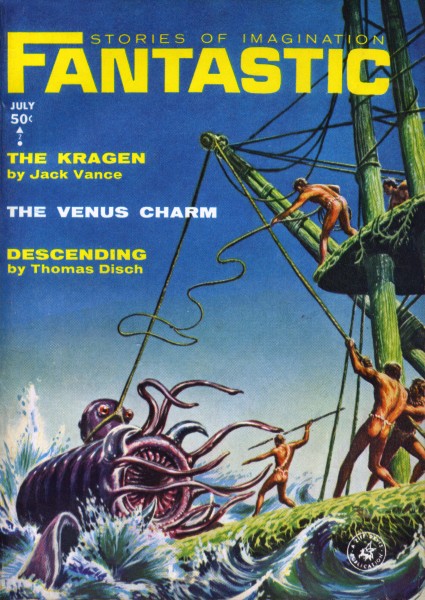


 Science Fiction & Fantasy Remembrance