Who Goes There?
Naomi Kanakia is an Indian-American writer who has written extensively about queer issues, one of many writers to enter the field in the past decade or so who could not have been as open about their views on the world even twenty years ago. ISFDB doesn’t say this because these are non-genre works, but she has a couple YA novels out with another one, Just Happy to Be Here, due in early 2024 from HarperTeen. After reading today’s story I do recommend checking out an interview she did with Lightspeed about “Everquest.” Now, prior to reading this story I was under the impression it was science fiction, but upon reading it I discovered it was fantasy, and it’s even categorized as such in Lightspeed. Discussing how it is fantasy would be getting into spoilers, though, as it at first glance it’s simply a story of one lonely person’s connection with a certain video game.
Placing Coordinates
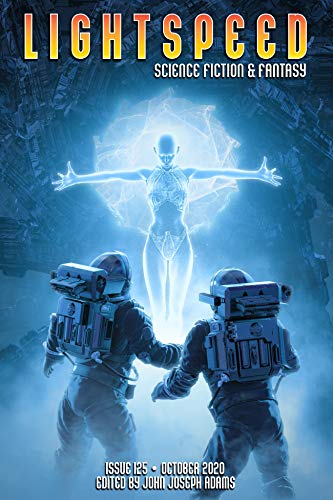
First published in the October 2020 issue of Lightspeed, which you can read online for free here. It was subsequently reprinted in the anthology We’re Here: The Best Queer Speculative Fiction 2020 (ed. C. L. Clark and Charles Payseur), which is so far its only book appearance.
Enhancing Image
“Everquest” is a short story, just over 3,000 words, so I won’t be keeping you long. It’ll take me longer for me to write this review than it would to read the story—although it certainly couldn’t have taken so little time to conceive. This is a densely packed little narrative about displacement in more than one sense of the word: being displaced from one’s home country, even displaced from one’s own body. Gopal is “a fat, acne-ridden dude” who at the story’s outset is barely in his teens and who has already accrued some online experience that one would normally regret to think about later in life, getting “married” in some online game to some random guy who would soon ghost him. “Gopal never thought about whether this made him gay or straight or trans or bi.” It’s unclear what Gopal’s orientation is and the narrative never bothers to clear it up because, really, it’s not that important; what’s more important is that Gopal does not see—or at least he does not want to see—himself as a man. Gopal plays a woman, when given the option, in every game he plays. Some would take this as merely an adolescent boy playing as girls so he can ogle them, but then—maybe not.
It becomes clear, at least early on and to the reader if not to the character, that Gopal is trans. I’m gonna be referring to Gopal as “he” here because that’s how the third-person narration refers to him, and I do think Kanakia is making a point by never having Gopal start the transition—at least not Gopal the flesh-and-blood person. Rather than try to transform himself he projects a more ideal image of himself through his game avatar—in this case Gayatri, a wood elf, in Everquest. (By the way, Everquest is never referred to by name within the story, although it’s kinda like how the spaceship the protagonist fantasizes about in James Tiptree’s “Beam Us Home” is very clearly meant to be the Enterprise.) As someone who has never played a second of Everquest and who has basically no interest in MMORPGs (for me personally it holds about as water as train simulators), I didn’t feel lost with what Kanakia was going for or what drew Gopal to the game. Anyone who has a played an RPG, or just a game that lets you customize your player character, has at least some inkling of what Gopal is going through. We’re thrown into the world of a vast role-playing game quickly and with so few words, but you don’t have to be a Gamer™ to grasp the meaning of those words.
I feel like I cheated by saying this, but reading the aforementioned interview drew my attention to something I probably would not have minded, as someone from a nominally Christian background, which is that “Everquest” is about self-actualization as mythmaking. There’s a juxtaposition between Hindu mythology and “mythology” in video games—ya know, like urban legends, memes, acts of daring do. It’s not a coincidence that Gayatri is a name from Hindu mythology, even if Gopal would say it is if you were to ask him. “He chose the name because it sounded pretty.” The connection sticks, though, and true enough Gayatri, the virtual wood elf, will become a sort of mythological figure in her own right. But more on that in a minute. It’s a strange connection because it’s like the name is an unconscious hand-me-down from Gopal’s Indian heritage, despite the fact that he doesn’t seem to be proud of his heritage, or of himself at all. Some things you can’t leave behind so easily. We attach meanings to names, whether we mean to or not. The important thing is that despite working with shitty internet, and being barely able to play the game, he does create one thing he’s proud of: Gayatri. He’s so proud of her he might wanna become her.
I sometimes reread passages of a story I’m reviewing, either because I was confused on a certain point or I found a line I thought especially memorable. There’s a lot of joy in rereading; people should do it more often. In the case of “Everquest” I was doing this a fair bit, which is easy because it’s such a short story, but also Kanakia crams a lot in here in often coloquial language. By her own admission she’s not one for lyrical prose. I can relate. At the same time this is a borderline fable whose intent is maybe a little muddled with a “modern” and at times salty lexicon. I was confused as to the time period this takes place despite it almost certainly beginning in the early 2000s, because the jargin seemed (at least to my ear) some years removed. I could be wrong. Maybe certain terminology was in use back in the kindergarten days of the internet. It’s just that I feel like by employing a style that is very of-its-time Kanakia dates the story more than was necessary; after all, why try to make it sounds cool and hip if this is just the reality we’ll be living for the foreseeable future. “Everquest” is about someone coming close to but not quite reaching a point of self-actualization in the early 2000s, when really it could be set in the 2010s, or the 2020s—or the future.
There Be Spoilers Here
For most of the story I was wondering when it might become fantastical or speculative, because up until the climax nothing strictly unusual has happened. You have a guy who gets sucked into a video game, to the point where he sees his avatar as like a reflection of his own character; then he gets taken away from the video game because his parents are concerned that he’s not in touch with the real world. You’ve heard this story before. But then Gopal, now an older man, after having been away from the game for years, gets an enigmatic email to have his account reactivated. (Because, you know, these MMORPGs are subscription-based. If you aren’t paying or you get locked out of your account, you can’t play online.) Then something very strange happens: Gopal dies. I mean he doesn’t just die, he basically starves to death, covered in his own shit, after playing the game for too long. Which is very cliche, really. I mean in the wrong context it sounds like ssomething a boomer would write for an anti-video game PSA.
But then… Gayatri keeps going. Without Gopal’s input. Without strings. Miraculously, and pretty inexplicably (hence this being fantasy and not SF, since we’re not given a rationalization for what is really a supernatural event), Gayatri becomes a real woman—within the confines of a game whose last servers will eventually shut down. It’s a finite second life. It’s bittersweet, but also a triumph in a weird way. Gopal doesn’t transcend reality to become his avatar so much as he gives up on his physical body to allow Gayatri to become real; him dying allows her to live. Not so much a transformation as a passing of the torch. I’m not sure if the final passage involving Gopal’s mom was necessary; it strikes me as a bit of sentiment, an attempt to tie a neat little bow on a narrative that could’ve benefitted from something else—maybe something more transcendent.
A Step Farther Out
In a sense this is fantasy; in another sense it’s inseparable from real life. The ending is the only thing keeping “Everquest” from being a “literary” character study, or a non-fantastical fable. While Gayatri taking on a life of her own in the game world is certainly beyond everyday reality, it doesn’t go beyond the threshold by much. Kanakia understands that people who were raised on the internet will inevitably develop online personas, and that these personas may even outlive the flesh-and-blood people who created them—figuratively, if not literally. The ending’s sentimentalism sort of downplays the eeriness of the game’s now-barren landscape and there’s this sense that a starker transhumanist narrative had been denied, so I can see why Kanakia is unsure about it. For a final criticism, and I think this is the best negative criticism one can give a story—I wish it was longer.
See you next time.





 Science Fiction & Fantasy Remembrance