Who Goes There?
As you probably don’t know, I’m voting in this year’s Hugos, which makes it the second consecutive time I’ve done this. I’ll be brutally honest and say I get the supporting membership for all the free goodies it comes with more so than to take part in the grueling and overcrowded popularity contest that is the Hugos. One major plus, aside from the free stuff and indeed the thing that comes with all that free stuff, is that I’m finally given an excuse to dip my toes in more recent SFF. See, an unspoken rule of my site is that a story has to be at least one year (twelve months) old for me to consider it, since when it comes to literature I prefer to let the art marinate in the broth of time first before getting a taste of it. It’s a weird bias of mine that goes back to when I first started reading casually as a youngling, I can’t really explain it. Eugenia Triantafyllou’s “Loneliness Universe” is a Hugo finalist this year for Best Novelette, and it had already gotten a Nebula nomination. I’d been meaning to read some Triantafyllou for a minute, but have not been able to. I don’t really have an excuse. Triantafyllou is one of the most acclaimed short story writers in the field right now (she has not written a novel, at least as of yet), and like many other authors currently working she’s the sort of talent who probably had a tough go at it a few decades ago. The internet and especially online magazines have made it easier for people from outside the Anglosphere (Triantafyllou is from Greece, as she’ll have you know) to get their foot in the door, and this is very much a good thing. Despite being born and raised in Greece, Triantafyllou has pulled a Joseph Conrad and writes her fiction in English.
Now, I did not know, when I posted my review forecast on the first day of this month, that ON THE SAME DAY James Wallace Harris would post his review of this same story, so that “Loneliness Universe” is getting covered at least twice in the span of two weeks. I can say what drew me to this story, but I can’t say what would draw other people. It’s not perfect (I spotted a malapropism, and also a factual inaccuracy that distracted me), but its basic conceit is compelling enough that I’ve been stuck thinking about it for the past couple days. It’s also only nominally SFnal, really using an SFnal premise as a diving board for allegory rather than investigating a scientific phenomenon. It’s SF of such a mushy softness that it almost feels like fantasy, but this is a human narrative about a uniquely human state of mind that is sadly becoming all more commonplace. Fair warning: I’ll be talking about my autism, bouts of depression, and suicidal ideation with this one, since it’s that kind of story. It’s less that “Loneliness Universe” is exceptionally dark or bleak and more that Triantafyllou does a good job of pinpointing something I’ve been feeling for years now.
Placing Coordinates
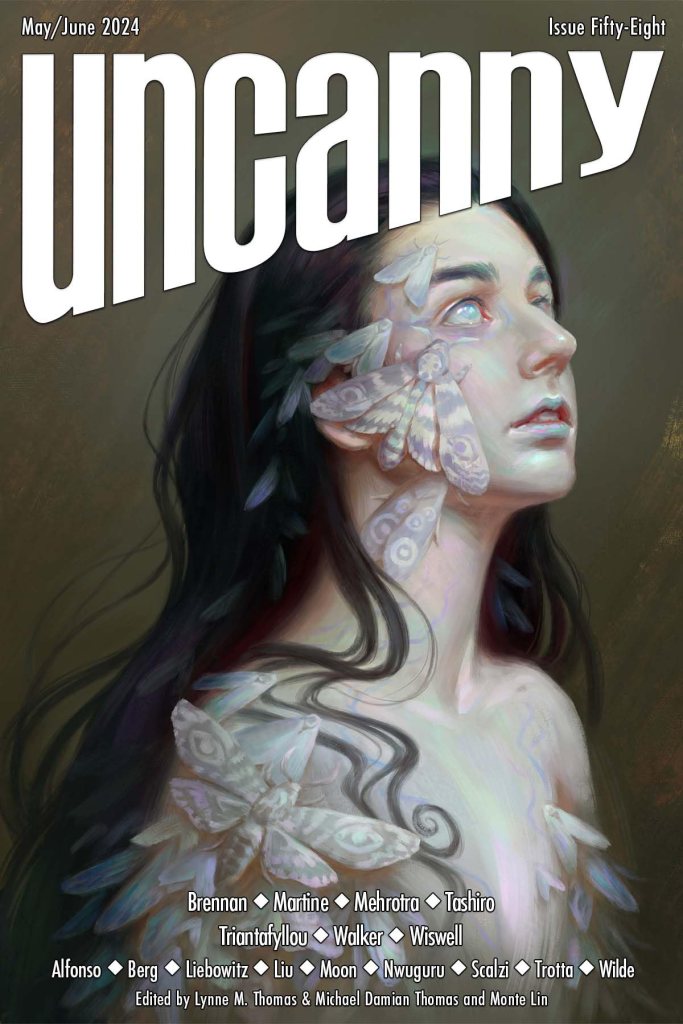
First published in the May-June issue of Uncanny Magazine, so it’s just old enough for me to have considered for review. So far it has not been reprinted anywhere, but I’m sure that’ll change soon.
Enhancing Image
We start at the ending, with an email Nefeli sends to her old friend Cara, after the two tried but failed to meet in person, after years of silence between them. Nefeli’s wondering, after the fact, if their attempt at reconnecting would’ve worked out if not for the universe quite literally preventing them from occupying the same space. “But we’ll never know. Because despite what the scientists may say, I believe I broke the universe by coming to find you.” That last part’s probably not true, but Nefeli was patient zero for what turned out to be a world-spanning phenomenon. We’re given a general idea as to how things turned out, but Triantafyllou only gives us the details piece by piece. Some stories are a whodunnit, some are a howdidit, but “Loneliness Universe” is very much a howdidwegethere. In that sense it’s a hard story to spoil since we’re told upfront that shit’s not gonna work out—the question then being how they don’t work out. There is, of course, a big difference between having a very good meal set at your table and seeing the chef and his assistants work on said meal. The process is at least as important as the result. Indeed the process of making art (which includes cooking) is the art. So how did we get here?
Reconnecting with old friends after months or years of nothing is usually awkward, because (often correctly) there’s the sense that the part wanting to reconnect also wants something in return. What is there to say after the relationship had seemingly fizzled and reached its natural conclusion. Usually people just drift apart, or maybe it was an argument that did it. Nefeli and Cara are two old friends in Greece who had drifted apart, under, it must be said, less than ideal circumstances; but now Nefeli sees a chance to rekindle their friendship. The internet was in its toddler stage before (“the pre-internet days were rough”), but since the proliferation of social media the two have reconnected in their twenties (I feel old since they’re a few years younger than me), agreeing to meet up at a spot. What could go wrong? Quite a few things, although what goes wrong is something neither of them could’ve possibly predicted. Each thinks the other has stood her up, but no, they’re at the same place—just not the same version of that place. Like layers of film overlapping when one’s in the editing room. Nefeli and Cara are sitting on the same bench, at the same time, but they’re not occupying the same space. This is a problem. Soon enough it also applies to Nefeli’s brother, Antonis, whom she’s living with. Speaking of which, this story takes place over the course of a few months in 2015, and we know this because the emails Nefeli sends are dated; but otherwise you wouldn’t know it takes place in 2015, not helped by Antonis at one point mentioning he had a PS5, which wouldn’t come out for five more years. I have to assume this was a flub on Triantafyllou’s part.
(Remember 2015? A lot has happened since then. We didn’t worry about wearing masks in public. House of Cards was the biggest show on Netflix. Louis C.K. was a respected comedian. Vine was a thing. Elon Musk was just another “eccentric” rich asshole. The apparatus of neo-liberal capitalist “democracy” in the US was on shaky ground but didn’t look like it would crumble and give way to a kind of blue-collar trade-union-endorsed fascism propped up by technocracy.)
I’m actually not sure what the purpose of making “Loneliness Universe” a sort of period piece was; it could be that setting it in the present would’ve dated it much more severely, especially given that things (by that I mean mostly bad things) seem to be happening at a much faster pace now. Time itself seems to be moving differently. The internet has been changing our perception of time for about the past three decades, only doing more so with Web 3.0 and the more drastic splintering of the web. We know this because possibly the biggest precursor to “Loneliness Universe,” although not necessarily an influence (I don’t know if Triantafyllou has seen it), is the 2001 Japanese horror movie Pulse. Without giving away the third act of that movie, the premise is basically that ghosts are making their way into the world of the living through the internet, which sounds silly on paper, but in execution ends up being quite haunting. The world becomes more devoid of human life, being replaced by these static-filled entities that wander about the landscape, forever separated from every other one of their kind. The ghosts are not happy to be here, nor are they even really malevolent, but they’re isolated. To somewhat paraphrase a line from that movie, “Death is eternal loneliness.” Nefeli is first separated from her old friend, then her brother, then her parents, then everyone close to her in her life—except through the internet. Emails, text messages, an online game called TinyCastle they play together. But she’s unable to interact with these people in-person, and this is only the beginning.
However, being an undiagnosed (it’s hard to blame me, given current circumstances in the US, for not getting diagnosed as an adult) autistic person, I’ve been living with a more mild version of Nefeli’s situation for pretty much my whole life. Indeed, anyone who’s autistic and/or clinically depressed (and I’m both of those) can tell you that they already live day to day with this weird sense of disconnection from other people—a disconnection that’s easier to cope with over text and other online activities, but which becomes unbearable in-person. It must be tempting, if you’re a neurotypical, to see the dysfunction autistics experience as a result of the internet, or some other stupid reason (it’s painfully clear to me that a lot of neurotypicals see autism as some disease that must be cured, or prevented by way of eugenics), but really there’ve been autistic people for centuries. Really the paradox of the internet (that it allows people from different countries and even continents to connect with each other, while also balkanizing the same people into little niche groups and interests) has been fostering a dissonance in the minds of neurotypicals which people with autism have had to deal with since at least the time of Shakespeare. Yeah, you people get mad at us if our tone is even a bit “off” in public spaces, and then you wonder why we retreat into online chat rooms and game lobbies for acceptance. It’s not much of a mystery, ya know. I think what gives “Loneliness Universe” its power, despite my gripes with it, is that it allegorizes something that most people would otherwise have only the faintest idea of, that being the growing entropy someone like me senses every day—the theoretically infinite drifting-apart of time and space.
There Be Spoilers Here
“The scientists” (it’s pretty vague as to what this phenomenon is, not like it needed to be specific) are theorizing that the universe is operating in a wax-wane cycle, so that hopefully, before too long, people will start living on the same dimensional level again. Assuming it happens in the first place. For all Nefeli knows the universe will just get more and more spaced out, until everyone is like the ghosts in Pulse, forever separated from everyone else. We don’t know if things get better; the story ends on a rather open note. But then of course we had already seen the ending. What had started with Nefeli is now happening with everyone else. It doesn’t really make sense if you try to look at it scientifically, but it does make sense on an emotional level, because some of us are already living through this. When I said “Loneliness Universe” is only nominally SF, that’s what I mean; it’s only SF by virtue of not being a “realistic” story and at the same time it’s not a straightforward ghost story, although it kinda is one. It’s a techno-ghost story in which the ghosts are still alive, in that they are the living dead, and so are we by extension. We’re the living dead.
A Step Farther Out
Sorry that this has been bleak. Actually I’m not sorry. I would’ve written my review yesterday, but I was busy “crashing out,” as the current lingo has it. I laid in my bed for nearly an hour resisting the urge to head to the kitchen, take out one of my knives, and harm myself. I felt completely alone in the world, and it was not the first nor will it be the last time I get this feeling. I really hate it here. For what it’s worth, I do recommend “Loneliness Universe,” but it’s a lot. It’s supposed to be a lot. Sometimes we need art that makes us feel like shit.
See you next time.
 Science Fiction & Fantasy Remembrance