The Story So Far
Holger Carlsen is a Danish immigrant of unknown parentage studying engineering in America when World War II breaks out. Returning to his homeland, Holger joins the resistance movement and one night is trapped on a beach facing certain death from the Nazis when an explosion from somewhere sends him into a totally different land. He quickly comes across a horse saddled with equipment fit for a knight, including a shield with three hearts and three lions emblazoned on it. After an encounter with a conniving witch we are introduced to our other members of the party: Hugi, a jolly if brutish dwarf; and Alianora, a maiden who can turn into a swan at will. Holger has two main goals: to find a way to return home and to figure out who he is supposed to be, since clearly he is inhabiting someone else’s body. While his mindset is initially self-centered, Holger soon realizes he has been catapulted into a conflict much larger than himself, between the forces of Law and Chaos, between order and entropy.
Being an agnostic both in faith and in his allegiances at the outset, Holger is tempted by the forces of Chaos who see him as potentially useful—first by the whores of Duke Alfric and then by the sorceress Morgan le Fay, who claims she has the key to Holger’s past. To make matters more complicated, the line between Holger’s own memories and those of his alter ego start to blur. He remembers little bits and pieces of this other self, including a fluency in Latin and something about a sword named Cortana. He suspects that he has entered a parallel world where the mythical exploits of Charlemagne were real, yet there is another piece to the puzzle he has to acquire. If he can uncover his past then maybe he can help defeat the forces of Chaos—but doing so will take the help of a wizard.
Enhancing Image
Some notes:
- While the romance between Holger and Alianora is still rather limp (Anderson was never the best at writing women), it does work on a thematic level since Alianora is supposed to be Morgan le Fay’s mirror image, or rather the other way around. You could choose between the chaste and dull but well-meaning girl or you could go with the bad bitch who will probably kill you if you turn her down. Personally I would have to sit down and think about it.
- Speaking of which, I was reminded of Jack Williamson’s The Legion of Time, which is in part about resisting fascism even as it takes on the form of a beautiful and feisty woman. The reality that a lot of liberals don’t wanna acknowledge is that fascism can sound tempting. How else can you explain millions of people falling for such a patently destructive ideology? Holger could rule the world with Morgan at his side or he could fight and possibly die on the side of good. Not quite as clean-cut as one would hope, but then this is a story about ultimately rejecting the dark side of human nature.
- Harping on the women just a bit more, much is made of the fact that Holger, who while not ugly or a wimp was not a lady’s man back home, now has to dodge female affection like it’s bullets in The Matrix. Multiple women either fall for him or just wanna jump his bones over the course of the story. Obviously this is part of the power fantasy, but Anderson tries rationalizing it by saying that while Holger doessn’t know the man whose body he’s currently in, other people sure as hell recognize him, and this knight of the three hearts and three lions is undoubtedly a big deal in this world.
- Aside from the contrivance of Holger suddenly becoming a chick magnet, much of the plot is driven by educated guesses that turn out to be correct. Holger theorizes that the world he’s been thrown into is an alternate Earth where magic is real and the legends of Charlemagne were true, and this theory turns out to be correct. The wizard Martinus later theorizes that Morgan had spirited Holger away to our Earth as an infant, and this also proves correct. What are the odds? Granted, these contrivances are not unusual for old-school high fantasy writing. At least Anderson tries to justify what he’s doing.
- This is an early example of an RPG-style party in fantasy writing—not the first, because even The Hobbit precedes it by nearly two decades, but for American fantasy it was certainly prescient. Fantasy heroes before then were typically lone wolves, or in the case of Fafhrd and the Gray Mouser a dynamic duo, but by the time we reach the back end of this story we have Holger, Hugi, Alianora, and the Muslim knight Carahue. Each member fills a certain niche in what should be a well-rounded party. Alianora would no doubt be a white mage.
- Carahue himself is a pretty good depiction of a Muslim character, given the circumstances. Holger is suspicious of him at first, not because of his race or religion but because other characters had warned him that such a knight had been looking for the man whom Holger is posing as—for good or ill, nobody could say. Turns out Carahue is buddies with the guy Holger is acting as. We’re told, once Holger regains his memories as Holger Danske, a paladin who fought for Charlemagne, that Holger and Carahue had met in battle and gained each other’s respect. There’s a religious tolerance here that historically has been sorely lacking in the US, and even today there are far too many Christian/Jewish Americans who treat Muslims—at best—like children.
- Those reading this story expecting some grand faceoff with Morgan and her army will be disappointed. The climactic battle is with a bunch of “cannibals” and “savages,” as part of the Wild Hunt. Hugi gets mortally wounded in the battle, sadly. What’s strange is that in most narratives this would serve as the end-of-second-act lowest point for our heroes before they get put to the test one last time; but no, this is the final action scene, at least in the serial version. Once Holger finds Cortana all his memories of his former life come back to him and next thing we know we’re in the epilogue. There is an epic final battle between Law and Chaos, but we don’t get to see it.
- I remembered Holger converting to Catholicism once he gets returned home in the epilogue, but I did not remember a rather strange remark the narrator makes. The idea is that Holger is a Danish paladin who fought to bring balance to the world, and the narrator says something vague about real-world conflict. “It may be that we shall need Holger Danske again.” This is the late ’40s, mind you; the Cold War was just getting started. I have to assume Anderson is referring to the Cold War here, but I’m more wondering what role Holger could play in this conflict. Anderson was a liberal when he wrote the serial version, but by the time he expanded it into a novel he had turned conservative. That the last sentence is the same in both makes me wonder what Anderson could’ve meant at either time.
A Step Farther Out
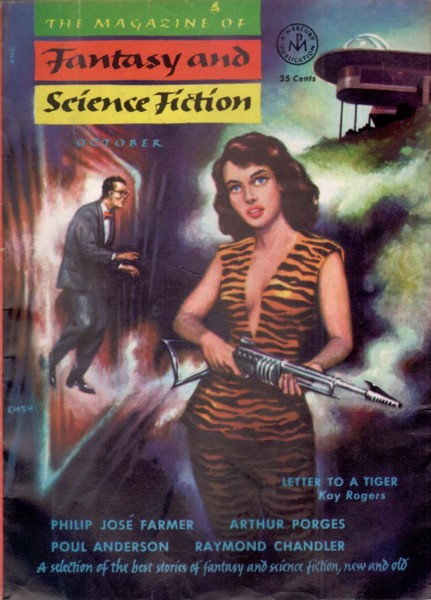
Three Hearts and Three Lions was an outlier when it was first serialized in F&SF, and even for Anderson’s body of work it stands out from other fantasy stories of his I’ve read. I had read the novel version first, then went back to the serial, and while both have issues with pacing, I do think the serial version is more tightly woven. Anderson didn’t change shit around for the novel so much as he added stuff on, much of it not strictly necessary. There’s more of a sense of scale with the novel (we get something like an epic final battle, whereas the Wild Hunt is the serial’s climax), but there’s almost a more personal touch to the serial. Here it’s not so much about war between good and evil as it is about one man’s spiritual conflict, between redicovering his true self as a Christian warrior and giving into the temptations of Chaos. I would say it’s a Christian allegory, but the conflict is more text than subtext; it must’ve been strange but also captivating for a largely irreligious audience, though it no doubt appealed to the Catholic (if liberal-minded) Anthony Boucher. Religion being wedded to fantasy was not strictly new even in 1953, as C. S. Lewis had already started his Chronicles of Narnia, but Lewis also hated rationalism, whereas Anderson did not.
See you next time.
 Science Fiction & Fantasy Remembrance
One response to “Serial Review: Three Hearts and Three Lions by Poul Anderson (Part 2/2)”
I read the novel. It was good. I liked it.
LikeLike