Who Goes There?
If Stephen King is the most famous horror writer in living memory, someone even non-horror fans are familiar with, then Robert Aickman is everything King is not; or, conversely, King does what Aickman does not do. Aickman, as far as horror writers go, has a lot more in common with M. R. James and Henry James than King. It could be because he only had one novel published in his lifetime, or that he wrote a fine but not overwhelming amount of short fiction, or that his manner and sense of humor are very English, or the fact that prior to the 1970s his work did not get printed in the US at all; but Aickman has been, both in life and posthumously, an unsung hero of horror writing. He was born in 1914 and died in 1981, and it was only in the last decade of his life that he really got any recognition for what was an impressive line of short fiction. He appeared in F&SF several times throughout the ’70s, in both reprints and original material. His first original story for F&SF, “Pages from a Young Girl’s Journal,” won him the inaugural World Fantasy Award for Best Short Fiction, and stands out as (to my knowledge) his one attempt at the vampire story. But Aickman loved the ghost story by far, and “The Same Dog” is such an example. He didn’t call his stories “horror” or even “weird,” but preferred the term “strange,” which may sound pretentious, except his stories really can be strange. Today’s story is an ambiguous look at childhood trauma and memory, one where there may not even be a ghost at work.
Placing Coordinates
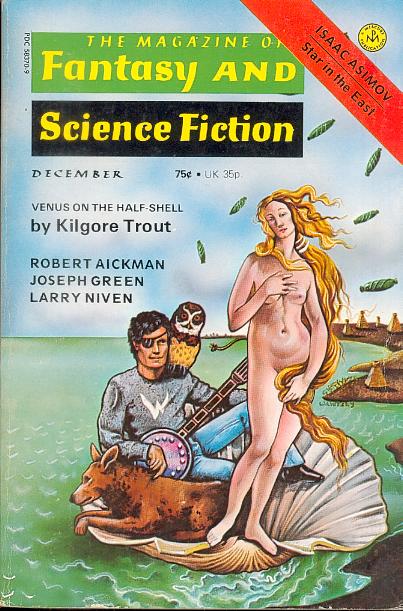
First published in the December 1974 issue of The Magazine of Fantasy and Science Fiction. It’s been reprinted in Lost Souls: A Collection of English Ghost Stories (ed. Jack Sullivan) and the Aickman collections Cold Hand in Mine and The Collected Strange Stories, Volume II.
Enhancing Image
Something that can catch people off guard with Aickman is his—maybe “candidness” is not the word, but Aickman’s stories can at times explore gender and sexuality in more depth and with greater force than is to be expected of an Englishman who was born the ssame year World War I started. Literally one page into “The Same Dog” and we already find a few things that are quite loaded. Hilary Brigstock is, despite his first name, a boy, a fact that his father seemed to resent, his father asserting “loudly on all possible occasions that the idea was a complete mistake, a product of etymological and historical ignorance and of typical modern sloppiness.” He is also the youngest of three brothers by far, being a whole dozen years younger than his immediate older brother. This is already strange, but then there’s the bit of family tragedy: Hilary’s mom died when he was very young, so he was left mostly at the mercy of his father and brothers. It’s quite possible Hilary’s parents had named him that in the hopes that they would finally have a daughter, as we’re told the Brigstocks have a history of being mostly male, or it could be his father was being honest in that he didn’t think the name would have feminine implications. Also, despite Mrs. Brigstock having died when Hilary was so young, his father would never remarry, which will strike him as a mystery well into adulthood. Even as a kid Hilary is forced to consider his own gender, and is compelled to think about the mystery that is his father’s sexuality. We usually don’t think about our parents’ sexuality, and we consider ourselves lucky that we don’t; but then Hilary doesn’t have a normal childhood.
Something that strikes me about Aickman is how he explores male sexuality, or rather an ugly side of it that most male authors wouldn’t touch—not because they’re graphic but because they explore male sexual trauma, sometimes allegorically, always psychologically it seems. I’m thinking of stories like “The Swords” and “Mark Ingestre: The Customer’s Tale,” which are about a boy or young man’s first sexual experience, which turns out to be traumatic for him. In the case of Hilary the trauma comes from a relationship with someone of the opposite sex that’s ended before it can really begin. In grade school he befriends a girl named Mary Rossiter, who ultimately will be his only friend of any significance from this period in his life, not to mention his first girl friend (not to say girlfriend). Hilary’s school being for both boys and girls might be a blessing for him, since otherwise he wouldn’t have had any girls even close to his age to interact with. “Even his younger cousins were all boys, as happens in some families.” Hilary and Mary soon become like two peas in a pod, and since this is in a time and place where parents tend to be lax about supervising their kids, they go off and have little adventures, away from the prying eyes of adults. I wanna take a second to note here that the time period of the story is sort of vague, with there being a reference to “the war” (very likely World War II), and of course cars and trains, but other than that this could take place anywhere from, say, the ’20s to the ’50s. There’s also a sort of irony to Hilary growing up in such a male-dominated family, since when Aickman was growing up he would’ve been living in an England that was still licking its wounds from World War I, with so many of its young men having been killed.
One day Hilary and Mary head off the beaten path, quite literally, and arrive at what seems to be a condemned mansion, except there’s a dog guarding the premises. The dog itself is pretty unusual-looking, at least from how Aickman describes it. Mind you that the two are just children still and that even a normal dog can prove deadly. Get this:
It was a big shapeless yellow animal, with long untidy legs, which shimmered oddly, perhaps as it sought a firm grip on the buried and slippery stones. The dog’s yellow skin seemed almost hairless. Blotchy and draggled, it resembled the wall outside. Even the dog’s eyes were a flat, dull yellow.
Something that irked me at first when I was reading this story in F&SF (aside from the many typos I noticed, maybe the magazine’s proofreader was sick that day) is that editor Edward L. Ferman basically gives away that Mary will die in the introductory blurb, as he says the story is about “the strange and tragic death of a childhood friend.” We can safely assume Mary is gonna eat shit, but the question is how, and that’s where Ferman’s introduction almost feels like a red herring. We think maybe the weird-looking dog will attack Our Heroes™ and kill Mary, but in fact Mary survives the encounter. We can infer, however, going by the title, that the dog will at some point, somehow, show up again, and this is one way Aickman leads us on. Something Aickman loves to do, and he does it in “The Same Dog” almost to a fault, is that he will leave the reader breadcrumbs, or rather the ghosts of breadcrumbs, without revealing where the hell we’re going. The breadcrumbs may lead to nowhere. There might not even be a mystery at the heart of it. As they’re leaving the premises, after the dog has mysteriously vanished (Hilary doesn’t see it leave, but Mary says she does), Hilary sees an old bald guy, possibly naked, for a fraction of a second. Maybe the mansion has not been totally abandoned? We never do find out who this man is, and neither does Hilary—just another little mytery stacked on top of a pile of mysteries from that day. It doesn’t help that this would be one of the last times Hilary sees Mary alive; not long after she is found dead, supposedly with little bite marks all over her body. The school is keeping hush about it.
Maybe Hilary and Mary would have gone on to become romantic when they were old enough. We can’t be sure. Hilary was clearly very fond of Mary, but given his age and the point at which their friendship came to a hault it’s hard to say if it would’ve turned into something else. “And Mary had been so much to Hilary that he had no other close friend in the school—probably no other friend there at all.” Aickman then goes on to say something quite cruel, if it’s to be taken at face value: “Perhaps Hilary was one of those men who are designed for one woman only.” Maybe Hilary, like his father, is only capable of having affections for one specific woman, never to be replaced; but whereas Hilary’s father at least got to enjoy marriage and raising a family, Hilary’s would-be soul mate gets snatched away by fate when both are children. It’s a scary notion, the idea that there is “the one” for you, but that fate might intervene such that you never meet each other, or that your relationship may be ended before it can blossom. You might be screwed by fate. Hilary is thus rendered functionally asexual—maybe. I’ll get more into that in a minute. As far as Aickman protagonists go Hilary is certainly a weird one: he’s introverted and “sensitive,” which is not unusual for an Aickman protagonist, but he’s also left, after Mary’s death, almost sexless and even genderless, neither quite masculine nor feminine, as if Mary’s untimely and mysterious death had shut a door closed in his self-conception. From here on there’s a part missing in Hilary’s being, and this, I think more than the dog, is what makes the story so eerie.
There Be Spoilers Here
So Hilary grows up. He even does a stint in the military, which he does surprisingly fine with, granted that this was during peacetime. His brothers have all married and moved on, except for him and his father. As if a switch had been flipped it’s suddenly been twenty years since Mary’s death, a fact which apparently Hilary doesn’t think about much—or more likely he has long since sought to repress. He’s deep in his twenties at this point, still unmarried, unlikely to marry, but he has Callcutt, an army buddy of his for company, and the two look after Hilary’s childhood home for a time. It’s unclear if the relationship between the two is strictly platonic or if perhaps there’s some casual homosexual shenanigans between them, but Aickman is certainly playing with the possibility with his choice of words. Even the way by which Hilary comes to tell Callcutt the story of Mary is phrased… a little conpicuously: “More secrets are improperly disclosed from boredom than from any other motive, and more intimacies imparted, with relief resulting, or otherwise.” Intimacies? Also, the two clearly know each other well, with Hilary calling Callcutt “Bogey,” as a kind of pet name, apparently a nickname he picked up via “some early incident in his military life” on which Aickman never elaborates. Like I said, breadcrumbs. We’re given quesstions and maybe some clues, but no answers.
Inspired by having told the story to another living soul, the two men retrace Hilary’s steps and return to the place of that abandoned mansion, although the surrounding area is no longer how Hilary remembers it. It’s worth mentioning that Aickman, from what I could gather, was politically conservative, but he was also a conservationist, in that strange right-wing sympathy with environmentalism that one finds in the UK, but which has no American equivalent I can think of. (I’m thinking of J. R. R. Tolkien and John Wyndham as examples.) Hilary and Aickman are unimpressed with how the landscape has been changed, and while the following passage I’m quoting is quite long, it’s also worth it, being an example of Aickman’s sardonic humor and power of observation:
It would no doubt be wrong to suggest that the municipal authority or statutory body or honorary trustees responsible for the conservation of an open space had in any major degree permitted the public heritage to diminish in area or beauty, but whereas formerly the conserved terrain had merged off into pastures and semiwild woodland, now it seemed to be encircled almost up to the last inch with houses. They were big expensive houses, but they had converted the wilderness of Hilary’s childhood into something more like a public park, very beaten down and with the usual close network of amateur footpaths, going nowhere in particular because serving no function.
The mansion itself has changed little; more disconcertently, the dog is still here… somehow, after twenty years. Hilary, on seeing the creature, is immediately convinced this dog is the same one as before, despite dogs not being able to live as long as this. Is the dog a ghost? It’s certainly not a hallucination, as Callcutt sees the thing as well, but there’s scarcely another explanation for it being here. The man from before is gone now, but in his place there stand a young woman in the window, high up, looking down on her visitors. Who could this be? Hilary, for nothing rational to back him up, suspects Mary is the woman in the window. Is she a ghost? Did she not die after all? Was her death faked? These are questions that must surely be tumbling through Hilary’s head, but he doesn’t get a chance to ask them before he and his buddy flee the scene. There is, however, one last curveball Aickman throws at us, another question he refuses to answer, which he only gives in the very last sentence.
The name of the property is Maryland.
A Step Farther Out
Pretty much every Aickman story is worth reading, not that he wrote too many of them. “The Same Dog” isn’t top-tier Aickman, largely because its elusiveness is confounding in ways such that it becomes almost more frustrating than unsettling; but still, this is a step above most other authors’ attempts at the ghost story. It succeeds not at scaring the reader in the conventional sense (because Aickman’s fiction aims for an effect that’s different from what we typically consider “scary,” hence, I think, why he preferred the term “strange”), but invoking a strong sense of mystery and psychological unease. “The Same Dog” can be read as deeply sad, with a few funny moments, but it’s certainly strange.
See you next time.
 Science Fiction & Fantasy Remembrance
2 responses to “Short Story Review: “The Same Dog” by Robert Aickman”
I’ve just read this story and after reading 3 compilations of his, in terms of sheer terror this was the most horrifying to me. Glad to find some analysis on it. Sorry if this ends up quite long but I would like to raise some points: my understanding is his father resents people thinking Hilary is a girls name is the way I read it not that Hilary himself was a mistake and I may have missed it as I will definitely reread but where did you get that Hilary had doubts about his father’s sexuality? Do you mean that his fathers definite views on women? Or because of the age gap he might not be his father?
As with all his tales your can’t solve them like an Arthur Conan Doyle story and you base it on your life’s experience. So the but about the lands they had I used to do that so it just made it that more real. I always prefer the Aickman stories I’m the modern day as opposed to historical settings.
My main criticism is that (and this wasn’t even the worse one compared to others)he uses a lot of obscure words, especially about architecture and some add to atmosphere but some take you away with frequent trips to the dictionary. But with this being one of the shorter ones I could tolerate it but I did want to mention it.
I’d not considered that thought that his army buddy could be homosexual but the more I think about it that is a good point.
Some points that went through my head:
For such a leafy part of Surrey and a good school a lot of the children play truant and some are receiving assistance. One teacher even acknowledges this is strange. If the official account from the older teenager who is sent to ease him back into school is correct that Mary was interfered with, bitten all over and mauled, surely the dog would’ve been put down.. Why is the dog seen again when he revisits with his army pal years later and doesn’t seem senile? What happened to the man? Why suddenly is Mrs Parker talking to him at his bedside? She seems to know where his line of inquiry is going (he wants to recover the newspapers) even though the older girl tells him it was covered up. It’s frustrating as obviously I remember at school someone had committed suicide and they didn’t want that gossiped about but to me it seemed like she was seeing what he knew.. What happened to Mary when she stared at the dog as she seemed to be possessed in some way and not her usual self, she was frightened before but then she is calm and speaks more adultly.. It is alluded to before how her eyes dart.. Notice how his army pal refers to some dodgy character as ‘old what-not’
I could go on and on but this the beauty of his best tales the ambiguity and mystery. I actually at times find him a very frustrating author and the last few stories I read I wasn’t a fan at all at I was vaguely bored but this was definitely one of the most terrifying.
LikeLike
Sorry I’m not sure how to edit but after reading more I just want to add to my previous comment.
Something that struck me at the time and that I didn’t mention is when Mary is saying: he’s only a friendly dog he won’t bite you. To me that is a flashback. She was terrified before. Also her knees are knocking before the dog barks. I take that to be he is approaching the gate.. I also read that the man and the dog could be the same person. On my second read I agree. The ‘dog’ moves ‘undoglike’ at the start by the gates. That is when I believe it is the man trying to charm Mary and get her. The but about she was mauled interfered with and bitten could all be the man and she may not have died.
As Hilary is running away I think he sees the man watching but I see what you mean about frustrating as it clearly describes them walking away which surely if she was bitten and mauled wouldn’t happen that way they’d be running for their lives unless he assaulted her she was bitten but got away and was in shock.
Although why she would then give back to that I have no idea. And also the dog is seen by Calcutt whonkind of acts as a witness. So were they the same person. That is the sort of maddening thing but most of his stories are.
But as someone else mentioned I read, these things around 40s and even later were not talked about or reported in depth at that time it was all hush hush you move on. Now it would be therapy etc but in this they ‘bluffly jolly him on! It beggars belief but that could be how it was then.
Sorry for rambling on but apart from a brief moment in Growing boys where one of the sons head pops up to her window, bits of the trains and ravisante and the ending of Cicerones I’ve found his stuff more unsettling than terrifying but this has meant I haven’t got to sleep yet. I kind of wish I hadn’t read it its that unsettling.
LikeLike