Who Goes There?
One might think at first glance that Eleanor Arnason is a relatively new writer in the field, given how prolific she’s been as a short fiction writer for the past decade; but no, she has in fact been around for a long time. Arnason was born in New York in 1942, but her family moved several times before finally settling in Minnesota. She made her fiction debut in 1973 with “A Clear Day in the Motor City,” and was one of those post-New Wave writers who brought her own idiosyncratic worldview to the table, namely feminism and a focus on labor rights that would make her at the very least a fellow traveler to leftist causes. Evidently, going by today’s story, Arnason did not give up her radical views in favor of a mellowed-out and defeated liberalism (or even worse, a shift towards reactionary politics), like so many of her contemporaries, but continues to hope for a future in which humanity is freed from socio-economic tyranny. As to why she has written more short fiction in the 2010s and into the 2020s as opposed to the previous few decades, the answer is surprisingly straightforward: she retired from her day job in 2009 and decided to focus on writing. For those of you wondering if it’s too late to start writing, just know it isn’t.
Placing Coordinates
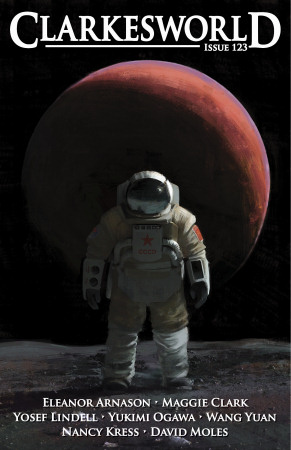
First published in the December 2016 issue of Clarkesworld, which you can read online. It has been reprinted only once, in The Year’s Best Science Fiction: Thirty-Fourth Annual Collection (ed. Gardner Dozois).
Enhancing Image
Since “Checkerboard Planet” takes place in a long-running series about location scout Lydia Duluth, we can infer that Lydia will come out of this ordeal in one piece—as to whether that applies to anyone else is a different question. The first scene is the weakest, if only because of the fact that it’s pretty much all exposition, and also Arnason refrains from describing the scene in any real detail. It could be that she expects us to know what’s already going on if we had read an entry in this series beforehand, but for the first-time reader it’s a bit confusing. Lydia converses with what appears to be an AI named Mantis—an AI in the true sense of the word, that is to say a sentient computer, rather than an LLM or something like that. The AIs have taken off to the point where they’re not only considered their own faction but have a good deal of power in intergalactic politics. Officially Lydia works as a scout for Stellar Harvest, a production company that does holo-vids set in exotic locales, but the AIs are asking her to also do a bit of corporate espionage. The planet of the story’s title has an unusual property, in that like the biomes in Minecraft (this is a stupid comparison, sorry), it has “bio-systems” that are cleanly divided into squares, and are so big that they can be seen from space. They also seem to be organic, despite this being an impossibility; they’re organic squares, but they must’ve been crafted by some sentient force. A corporation called Bio-Innovation has paid good money to explore this planet and has turned it into a “company planet,” like in the old days of the frontier where whole towns would be upraised for the purposes of farming resources, run by companies rather than government or the workers. In other words, it’s becoming a capitalist hellhole.
The idea is that Lydia will infiltrate and get her boots on the ground posing as a Bio-In (it’s usually shortened to that) employee, which is surprisingly easy to do, and once she’s there, merely to observe. Take notes. She has an AI implanted in her skull that she talks to, and which can record everything she sees and hears. Of course, when she actually lands on the planet it doesn’t take her long to get another job from company higher-ups (Bio-In, not Stellar Harvest) in which she is supposed to spy on Hurricane Jo Beijing, who runs a nail parlor but whom the top brass at Bio-In suspect is secretly a labor organizer. Unsurprisingly, the work on this planet under Bio-In is not unionized. Lydia and Jo know each other: they used to be friends, and they were even at different points in a relationship with the same man. Lydia is also well aware that Jo is an old-school labor rights fanatic who now lives on the checkerboard planet under an alias. It’s possible Jo could’ve left her protesting days behind her, but Lydia suspects not. Then there’s the mystery of what could be making the square bio-systems in the first place. There are a few threads here, and also the seed for a nice internal conflict for Lydia in which her personal loyalties are put to the test. She’s given two jobs which end up being mutually exclusive, not to mention ratting out Jo would make her a scab of sorts. Which comes first, her job as an explorer or her sympathy for her fellow workers? Then there’s her complicated relationship with Jo. One thing I feel I should point out, because it is a quibble I have with the story, is the treatment of Jo’s queerness. You see, Jo is very butch, to the point where she used to work as a lumberjack; she’s also a trans woman, although Lydia’s treatment of this is a bit more crass than prederred, saying a few times Jo “used to be a man.” This would’ve been fine a few decades ago, but now it reads as erring on the side of insensitive.
On the one hand this is an old-fashioned story about planetary exploration, about finding what could be giving the environment a single strange characteristic, but it’s also a pretty overtly left-leaning narrative about labor rights and the inhumanity of working without representation. It’s easy to tell Bio-In will emerge as the villain long before the climax, but what’s more curious is how Arnason tries, in the interim, to illustrate the connection between workers’ rights and animal rights. Lydia’s jobs are mutually exclusive because one involves observing nature while the other involves ratting out someone who cares about the same thing, and she can’t do one without compromising the other. The AIs merely want to understand native life on the checkerboard planet (so noninterference) while Bio-In is aiming to profit off said native life. (Of course, with the ongoing discussions about LLMs and such things in the past few years, “Checkerboard Planet” now reads a bit differently than it would have on publication, with Arnason’s optimistic framing of the AIs now seeming a bit overly optimistic. Funny how much a story can show its age after just a decade.) Despite that thing about the AIs, though, as well as the language surrounding Jo’s queerness (for what it’s worth, Jo herself is a totally sympathetic character) this is otherwise is a very forward-looking story, in which Lydia realizes that, though she would be endangering her own life, she must betray the company she’s come in to work for in order to keep her integrity. The conclusion is obvious from the reader’s perspective, but then, nobody said sticking it to “the man” would be easy. On paper Lydia’s choice is an easy one, but we would probably feel differently if one of us was put in her shoes.
There Be Spoilers Here
Since we know in advance that Lydia will come out of this particular pickle fine, and because it’s not hard to figure out who the bad guy is, this is rather a hard story to spoil. It turns out, however, that the native lifeforms on this planet are actually extensions of a single vast intelligence, which has been gaining (via mimicry) sentience at an exceedingly fast rate. This is convenient for Lydia and Jo, who convince the vast alien intelligence to take care of the bad guys for them. I was reminded of another short story’s twist with this one, although I won’t say what it is, only to say it’s a Michael Swanwick story that I almost reviewed but decided not to. Incidentally I feel pretty much the same about both stories, in that I enjoyed them but am unlikely to remember much about them. In Arnason’s favor, the leftist politics of “Checkerboard Planet” do make it more memorable.
A Step Farther Out
I respect Arnason’s attempt at marrying an old-school planetary narrative with a call for workers’ rights, considering that historically science fiction in the US has been quite hostile to organized labor. I can say, since we have at least one reliable source for tracking representations of labor in SF, that even more left-leaning writers like Isaac Asimov seemed to assume the worst of unions. This is unfortunate. I should read more Arnason, probably her older work since she’s been active since the ’70s.
See you next time.


One response to “Short Story Review: “Checkerboard Planet” by Eleanor Arnason”
I’ve reviewed her first three published short fictions for my series. Her third published short story, “The Warlord of Saturn’s Moons” (1974), is a pretty darn spectacular conjuration of mood and rumination the operations of writing SF. Her first two — “A Clear Day in the Motor City” (1973) and “Ace 167” (1974) — were solid.
LikeLiked by 1 person