Who Goes There?
I’m not sure if anyone can claim to have a more varied career than Frederik Pohl, who across a career of seven decades took part in the field as a writer, editor, critic, and literary agent, such that he understood basically every step of the writing and publication process. He made his debut in the late ’30s, and early on he was most active as a fan and editor, being in charge of a couple low-budget genre magazines which nevertheless acted as a training ground for some very important writers, such as Isaac Asimov and C. M. Kornbluth. Whereas some great authors specialize in one or two things, going off the rails when they deviate from their specialties, Pohl was much more of a jack of all trades. He’s one of the few people who’s won Hugos for both writing and editing. His memoir, The Way the Future Was, is a surprisingly vulnerable and self-critical account of his early days in SF fandom and making it as a professional. He was already a magazine and anthology editor of renown when he took over If and Galaxy Science Fiction in the ’60s, having already assisted H. L. Gold for some years at that point. His Hugo-winning novel Gateway is still one of the best of its kind, being a deep character study, a gripping space adventure/mystery, as well as a vicious and black-hearted critique of capitalism. Pohl died in 2013, at the age of 93, making him one of the last of the old guard to leave this realm.
Now, you may recall I was set to review a different Pohl story; actually it was a novella, called “In the Problem Pit.” Due to outside circumstances not having to do with the story itself I could barely even begin to read it, let along write a review about it. I may yet read it and write about it in the future, eventually, but that day is not today. Still, I did not want a repeat of what happened when I read C. L. Moore’s “Jirel Meets Magic” earlier this month, so I was determined to read and review a Pohl story, even if it wasn’t a novella. I dug up “The Census Takers,” which comes from a quite different period in Pohl’s career, and it was Anthony Boucher’s introductory blurb for it in F&SF that caught my attention. Boucher calls it “one of the most extraordinary jobs of effective conciseness in all of science fiction,” and I have to say I do think that praise is pretty much warranted. “The Census Takers” is brief, but it’s a dense and mean little bastard of a story, one I would consider something of a hidden gem.
Placing Coordinates
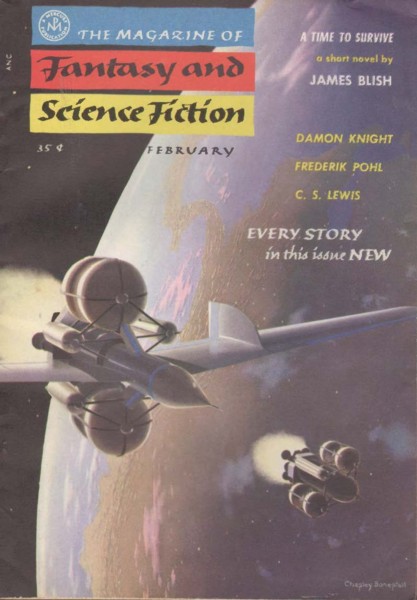
First published in the February 1956 issue of The Magazine of Fantasy and Science Fiction; incidentally this was also Pohl’s first appearance in F&SF. It was then reprinted in The Best from Fantasy and Science Fiction, Sixth Series (ed. Anthony Boucher), Nightmare Age (ed. Frederik Pohl), No Room for Man: Population and the Future Through Science Fiction (ed. Ralph S. Clem, Martin H. Greenberg, and Joseph D. Olander), and the Pohl collections The Case Against Tomorrow and The Best of Frederik Pohl.
Enhancing Image
The narrator is Area Boss of a team of some 150 Enumerators, who over the course of six weeks are supposed to take the yearly census of a given area, called a Census Area. The story takes place somewhere in the US, although Pohl is vogue as to where (Denver gets mentioned at one point, so maybe it’s Colorado), and he’s also vague as to when this is taking place. It’s definitely the future, but there are basically no references to technology, such that the story doesn’t easily date itself. The narrator is also unnamed (sort of, we’ll get to that later), but for the short time we’re stuck with him it doesn’t take long to figure out the kind of person he is: a real no-nonsense asshole type. Manager material. The story is concerned with an incident that happened with one of the narrator’s Enumerators not too long ago, Witeck, who’s also a good friend of the narrator. “We were Enumerators together, and he was as good a man as you ever saw, absolutely nerveless when it came to processing the Overs.” Of course, one day he cracked. Supposedly. The problem is that whereas in our world a census taker’s purpose is simply to help estimate a certain area’s population, the census takers of this story have to verify if a CA is Over or Under—and if there’s even one Over in a CA then it’s a problem. A CA’s population can’t be Over or Under according to Regional Control, and if someone if Over it’s implied they get executed (an Enumerator’s “processor” is actually a gun, although this is not revealed to us right away). So two problems arise, the first being that Witeck claims to have picked up a guy without an ID or blue card who in turns claims to be some ambassador—from the interior of the planet. On the narrator’s end, he has to deal with a father and his wife and five kids, who have attempted to “Jump,” i.e., move out of the CA before the Enumerators come in.
In case you couldn’t tell, the future America of Pohl’s story is some kind of Malthusian nightmare in which the government keeps the population strictly controlled on an area-by-area basis. A CA’s population should not be Under but it especially should not be Over. Having children has apparently become seen as a necessary evil, as people on the census team are not allowed to have children and the narrator, with rather open disdain, calls parents “breeders,” regardless of whether they have one child or five. (As I was reading it I kept thinking of how some queer folks, back in the day, would call people in heterosexual relationships “breeders” as a derogatory thing, although I’m not sure if this was a thing in urban queer spaces in the ’50s, complicated further because Pohl absolutely would’ve been aware of such spaces.) Malthusianism, named after 18th century economist Thomas Malthus, is basically the belief that resources cannot keep up with population growth, i.e., there ain’t enough room in this world for all of us and at some point the bottom will fall out. In the ’50s and ’60s the belief that population growth was some big fucking problem was pretty popular among intellectuals, even left-leaning ones, resulting most famously in SF novels such as Harry Harrison’s Make Room! Make Room! and John Brunner’s Stand on Zanzibar. Aldous Huxley, in the last decade or so of his life, became pretty vocally concerned about overpopulation and people took this seriously. I’ve read enough of Pohl’s non-fiction to get the impression he didn’t agree with such a worldview, but even if I hadn’t done the homework in advance, one gets the feeling just from reading “The Census Takers” that he had a bone to pick with Malthusianism. The census takers in-story are basically border patrol, or ICE, which is to say they’re inhuman monsters who, at best, split a family apart if something is out of order; so they’re border fascists, or rather population fascists. For such a short story, this is quite bleak…
Speaking of bleakness, in most stories the narrator would probably be the villain, but here Pohl puts us in his shoes and makes us walk around in them for a bit. This dude is a prick, not that he claims to be a beacon of kindness and selflessness. His treatment of Witeck is understanding, at first, but he quickly loses patience and tells the man to do his job, regardless of the possibility of his claims being true or even if he really is having a mental breakdown like the narrator thinks. Then there’s Carias, the narrator’s “right-hand man,” who doesn’t do much better, especially once he starts backing up Witeck’s claims. The narrator has no patience for such things and he’s already trying not to “process” the father who tried Jumping with his family where he stands. The narrator and Witeck have, by this point, killed or at least deported hundreds, if not thousands of people over the years of census-taking, and it seems today might be the day everything breaks. Mind you that Pohl was always to some degree on the left, certainly more progressive than the average liberal of the time—ironic, considering he would later cry out against the New Wave. Both politically and literarily Pohl gets a lot of work done with so few words, implying more often than stating things outright while also establishing the world of the story. Some points are left ambiguous, intentionally, but we get what Pohl is going for, which is to show the inherent inhumanity of playing border patrol, or playing population control. Of course, the most ambituous (indeed, the closest to mirror the world of “The Census Takers”) Malthusian project in the real world would be China’s one-child policy. One need only extrapolate a bit further beyond that accursed policy to see where Pohl is taking us. In the ’50s, the SF market was broad enough that a dark little nugget like “The Census Takers” could see print, and thank goodness for that.
There Be Spoilers Here
The situation with the “ambassador” gets to the point where Witeck feels the need to call the narrator by his first name: Jerry. “It was the first time in ten years, since I’d been promoted above him, that Witeck had dared call me by my first name.” This convinces Jerry that Witeck really has lost it, relieving him of his post and processing the so-called ambassador, who in turn, as if putting a hex on Jerry, says that the people on the surface of the globe will be wiped off the face of it. The people living at the Earth’s core will have their day. This is implied to be the case (or it could just be a few coincidences) when a series of natural disasters, from a tsunami to a volcanic eruption to geysers in Yellowstone Park, delay Jerry going on vacation. Witeck dies soon after being let go, supposedly a suicide, although as Carias points out he didn’t use his gun on himself. Strange. There are one or two loose ends, or rather dark corners that Pohl intentionally refrains from shining a light on. The effect is a little nightmarish.
A Step Farther Out
When I found this story I knew nothing about it, not least because it hasn’t been in print since the ’90s and thus remains sort of a hidden gem. I didn’t think it would read as timely as it did. Of course, it’s true that since the 19th century, even before the tightening of the US’s immigration policy in the 1920s, immigrants and migrant workers have had a tough lot in this country. The ruling class, serving patriarchy and white supremacy (what counts as “white” has expanded quite a bit over the past century), sees migrants as cheap and easily exploitable labor; and if there’s an issue, if someone were to raise a fuss, then that can be easily dealt with. Pohl was one of the great social commentators of ’50s SF, in a decade that seemed to be blessed with almost a surplus of great social commentators. “The Census Takers” is, as told from the oppressor’s (the capitalist’s, the white supremacist’s, the Zionist’s) point of view, a shot out of hell, a cry of impending vengeance on the part of the migrants and other dispossessed peoples; because at some point, sooner or later, such people will have no choice but to have their revenge or die under the oppressor’s boot. It’s only a matter of time before we too, in our world, see those we treat as subhuman, be they “south of the border” or halfway around the world, have their day of justice.
See you next time. And remember, fuck ICE!
 Science Fiction & Fantasy Remembrance
3 responses to “Short Story Review: “The Census Takers” by Frederik Pohl”
I’ve had this one on my massive list of overpopulation-themed SF (the first big social issue in SF that fascinated me post-reading Stand on Zanzibar as an older teen) for more than a decade but have not read. Speaking of which, I also need to update my list on my site….
But yes, I will keep this in mind: the author, the date, and “dark little nugget” and “a dense and mean little bastard of a story” are descriptors that immediately resonate with me.
LikeLike
I’m a bit shocked you’ve not read this before, since it’s very much in your wheelhouse and ticks all the boxes. It’s a good example of why the ’50s are probably my favorite decade of SF, to write about if not read casually.
LikeLike
There’s a lot of SF out there! And the whole writing about SF thing massively slows down my reading… alas.
LikeLike