We seem to be living in a world of shit, or at least it’s easy to think that way. The irony is that the people who think this the most are also probably (being queer and disabled I’m actually not sure how I’m gonna turn out) the ones most likely to come out of all this bullshit unharmed—in body, if not in soul or mind. But, the show continues. I thought I had more to say for this month’s forecast, and at this point I think it’s fair to say my Things Beyond posts have become like actual weather forecasts (I predict, but that doesn’t mean the thing will 100% happen); but still, aside from a couple things I’m sure we all know about already, the past month has been uneventful. I got my purchases for Worldcon at basically the last minute, so I’ll be seeing what I can see of the con virtually if not in person, and with any luck I’ll even be on a couple panels, as one of those inside-a-computer people. I’ve been slowly but surely moving “up” in the world of fandom.
Anyway, for decades we’ve got two stories from the 1920s, one from the 1940s, one from the 1970s, one from the 1990s, and one from the 1890s. As for the stories themselves, we have…
For the serial:
- Sunfire by Francis Stevens. Serialized in Weird Tales, July-August to September 1923. Francis Stevens is the androgynous-sounding pseudonym of one Gertrude Bennett, who for just a few years wrote prolifically for the pulp magazines, apparently to help pay the bills. Once her sickly mother died, she stopped writing fiction, with Sunfire being the last story of hers published. It would take more than seventy years for this story to appear in book form.
- A Story of the Days to Come by H. G. Wells. Serialized in Amazing Stories, April to May 1928. First published in 1899. Wells is perhaps the most crucial pioneer of science fiction; aside from maybe Edgar Allan Poe he stands as arguably the genre’s nucleus. This is made more remarkable since Wells wrote his most famous work over the span of only about a decade. This story comes from said decade of greatness, but I guess due to its length it remains overlooked.
For the novellas:
- “The Glowing Cloud” by Steven Utley. From the January 1992 issue of Asimov’s Science Fiction. Utley was born in Kentucky, at Fort Knox (he was a military brat), before moving to Texas (Austin), and then finally Tennessee. He wrote prolifically in the ’70s, all of it short fiction, as one of the post-New Wave generation. He then fell mostly silent in the ’80s before reemerging in the early ’90s.
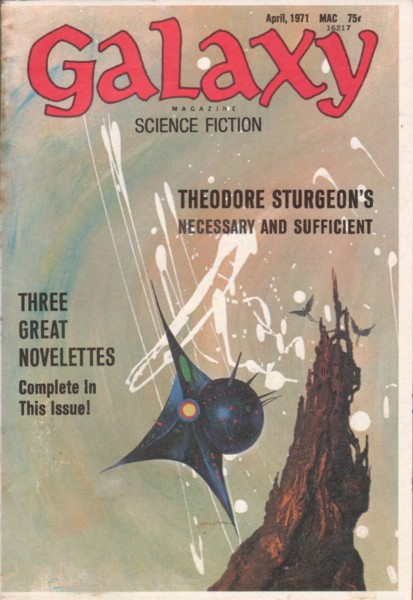
- “To Fit the Crime” by Joe Haldeman. From the April 1971 issue of Galaxy Science Fiction. Haldeman, like Utley, came about during the post-New Wave era; he had spent the New Wave years in college, and then in Vietnam, where he got damn near killed. Once his wounds healed enough he got to work writing SF. This story here is the first in a loose series, starring Otto McGavin.
For the short stories:
- “When the Bough Breaks” by Henry Kuttner and C. L. Moore. From the November 1944 issue of Astounding Science Fiction. Retro Hugo nominee for Best Novelette. I had missed the boat on reviewing Moore solo last month, and I can’t review Kuttner solo next month either; so together here they go. Kuttner and Moore were of course married, and they’re also two of my favorite writers.
- “The End of the Party” by Graham Greene. From the December 1950 issue of Worlds Beyond. First published in 1932. Greene was famous in his day as both a serious novelist and a writer of espionage thrillers, although the two were not mutually exclusive. He also occasionally dabbled in supernatural horror, with this story being one of his own personal favorite works despite its age.
Won’t you read with me?
 Science Fiction & Fantasy Remembrance