Who Goes There?
What do we know about Evelyn E. Smith? She was born in 1922 and died in 2000, so she lived a pretty long time. She was apparently a lifelong New York denizen. She had a spurt of productivity with writing short stories in the ’50s, but by the mid-’60s had given up short fiction in favor of novels. The last years of her life were spent writing a series of mystery novels, starring Miss Melville. Given that she wrote a couple non-fiction books on witchcraft and spiritualism (under a pseudonym), and that such things figure into some of her short fiction, it’s possible that like her close contemporary Margaret St. Clair she may have converted to neo-paganism. I’m not sure. Her short SF and fantasy has rarely been collected over the years, and seems to be in enough neglect that much of it has fallen out of copyright. This is all a shame, because from what I’ve read of Smith she was one of the funniest SFF writers of the ’50s, having the sharpness of wit and enough silliness that she fell right in with other satirists of the period such as Robert Sheckley and C. M. Kornbluth. It would make sense, then, that more than half of her short stories appeared in Galaxy and its short-lived sister magazine Beyond Fantasy Fiction. Being a New Yorker with an irreverence for post-war societal norms, she was just the kind of writer H. L. Gold wanted. Her work still remains to be given the reevaluation it deserves.
Placing Coordinates
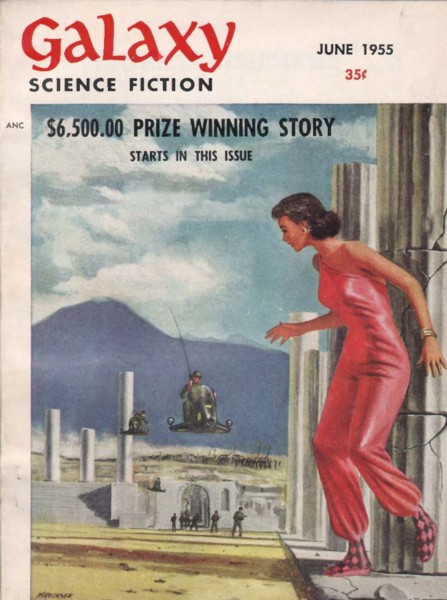
First published in the June 1955 issue of Galaxy Science Fiction. It would not appear in book form until Rediscovery: Science Fiction by Women (1953-1957) (editor not credited), in 2022. I mentioned that many of Smith’s stories have fallen out of copyright, and “The Princess and the Physicist” is one of them. You can read it on Project Gutenberg.
Enhancing Image
Centuries ago, spacefaring humans came to the secluded planet of Uxen, which had been home to only a single sentient lifeform: Zen. Zen the Terrible, Zen the All-Powerful, Zen the Encyclopedic, etc. Smith tells this story from the perspective of Zen, who is a corporeal and quasi-omniscient being who, despite technically having a body, we get few descriptions of. When the human settlers came, they struck a deal with Zen, such that the lonesome alien would basically do their bidding—a deal he ended up not being too happy about. Since then, the culture on Uxen seems to have evolved into a cross between steampunk (I’m specifically thinking the world of Final Fantasy VI) and medieval, despite the presence of spaceships. There’s a monarchy, complete with a king and the king’s beautiful daughter, Iximi, along with a religious faction. The Uxenach have only a loose connection with Earth, with an Earth ship only coming in on occasion; but still, there are murmurings of wanting independence from Earth, which Iximi is even sympathetic to. Two Earth scientists, Alpheus Kendrick Lamar and his assistant Peter Hammond, are the latest visitors, who are looking to stay for a time with their robot servamt.
Soon we have a battle of wills, between the princess, the scientists, and Zen, who as a third party looks upon the situation and wonders if there might be something for him in all this. The king explains to the scientists that Zen is “Uxen’s own particular, personal and private god,” which is his way of saying Zen is their almighty errand boy. Smith satirizes the relationships societies have with their dominant religious beliefs: she posits that had the God of Abraham been corporeal and able to speak at any time, it’s unlikely that his worshipers would treat him all too well. Tons of people being needy, and complaining about goddamn everything. And yet, it’s not all bad. Society on Uxen has, over the course of almost countless generations, built up a belief system around Zen, who after all is an alien and not really a god. Indeed he’s like one of those energy beings that show up a little too often in Star Trek; there are so many different races in the Star Trek universe that are semi-corporeal, with reality-warping powers, that one sometimes wonders how said universe has not collapsed in on itself. Where Zen came from is, perhaps wisely, never answered; he may well be the only member of his race. Something else that goes unexplained is how the Uxenach practice their religion, since they have their own little quirks and ways of respecting (or paying begrudging homage) their deity, including salutes for different contexts such as “the secular xa” and “the high xa,” which Smith does not describe. It’s a nicely set-up world wherein Smith doesn’t linger on anything not directly related to the plot. I also somehow doubt that someone who believes in an all-merciful and all-loving God would have written a story this ambivalent about religious practices.
“The Princess and the Physicist” is a short novelette, actually shorter than I was expecting, and it does fly by quickly. The plot is simple: the Uxenach sabotage the scientists’ robot so that they have no choice but to take on a local for the role, which they’re justifiably ambivalent about. Thus Iximi will pose as a beautiful local girl in the hopes that the scientists hire her so that she may spy on them. There’s a pretty funny scene in which the scientists are judging the women who’ve applied for the job, and Kendrick points out that someone as prim and proper as Iximi would probably make a poor housekeeper, since her beauty and neatness imply she is not used to doing the unforgiving work of looking after a couple of slobs. Guj, the prime minister of Uxen, tries desperately to convince the scientists to take in Iximi, which eventually works out, although it ends up not being that simple, what with Zen also having conflicting loyalties. On the one hand he admires the scientists for their reverence and lack of neediness with him, but he also figures that if the Uxenach don’t get their way then that’ll become his problem as well. One thing Zen really likes that the Earthmen have brought with them is tobacco, which if smoked provides a nice “incense.” While Zen spends much of his time as like a fly on a wall, he still has needs, ya know. There’ve been notable examinations of man’s relationship with gods and godlike figures via genre fiction, from Star Trek to (God help us) American Gods, but a more accurate title for “The Princess and the Physicist” would’ve been “God Needs Prayer.” The princess and scientists, while important, are still only secondary to the grumpy alien that watches over them. It’s a lot of fun. This is a pessimistic but not too serious satire about a petty god and his equally petty followers.
There Be Spoilers Here
Turns out the assistant, Peter Hammond, had figured out quickly that something was off about the princess, by virtue of—get this—seeing a portrait of her in the kingdom’s hallways prior to the hiring. Iximi admits her cover was a pretty easy one to blow. The good news is that Kendrick, despite his appearance of being smart and learned, is actually quite slow on the uptake. Even better news is that Hammond only mentions this after Iximi infiltrates the scientists’ lodging because he sympathizes with the people’s wish to be rid of Earth influence. In a moment that I have to admit feels implausible, and which I would take bigger issue with if the story wasn’t a comedy, the princess and the physicist admit both their love for each other and their loyalty to cause of independence. This last stretch of the story is pretty abrupt, which does make me wish it were longer, more fleshed out. Just a little bit. Zen also steps in and proposes an ultimatum with the young lovers, so that the independence of Uxen benefits him as well. What we then have is a kind of satirical recreation of bits from the Old Testament, in which God agrees with the Israelites to have six days of work, followed by a day of rest. In the case of Zen and the young lovers the idea is that the people of Uxen will have to work without Zen’s intervention for six days, and then on the seventh (actually it’s a Thursday), Zen will do whatever his followers ask. It seems like a fair deal.
A Step Farther Out
When I reviewed Smith’s “The Agony of the Leaves” last year, I bemoaned the fact that it was the first story of hers I had read, and that I ought to check out more of her stuff. Sadly I’ve not done this very much, in no small part because collections of her work (her stories were never collected in her lifetime, despite how long she had lived() are not exactly easy to find. Incidentally “The Agony of the Leaves” and “The Princess and the Physicist” appear in the same anthology. However, enough of her short fiction is on Project Gutenberg that you could do a crash course if you really wanted. And you probably should. Smith was pretty funny, in a kind of proto-feminist way that her male peers were not.
See you next time.
 Science Fiction & Fantasy Remembrance
2 responses to “Short Story Review: “The Princess and the Physicist” by Evelyn E. Smith”
Thank you for this. Evelyn Smith was definitely one of the reasons Galaxy in the first half of the ’50s was, hands down, the best SF mag on the racks.
LikeLike
“Her work still remains to be given the reevaluation it deserves.” — Yeah, I admit, she’s not been on my radar much. I own her two novels but should read more of her short fiction.
LikeLike