Who Goes There?
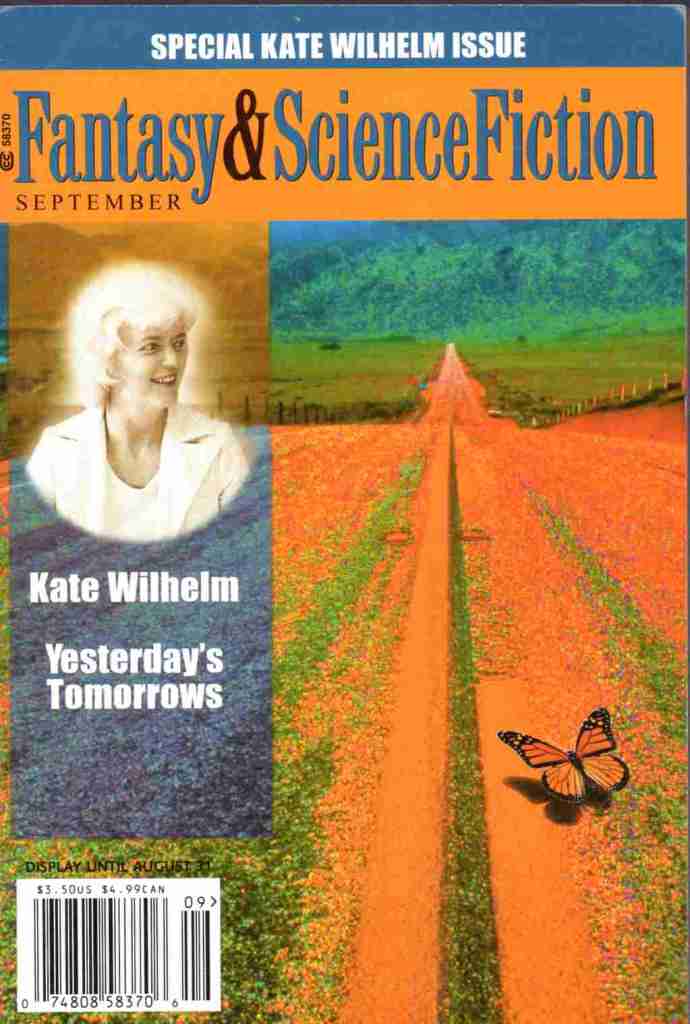
Like most of the New Wave authors who caused a stir in the latter half of the ’60s, Kate Wilhelm had actually made her debut a decade earlier, in 1956. It wasn’t until the New Wave, though, with the appearances of Dangerous Visions and Damon Knight’s Orbit series, that Wilhelm emerged as a major writer of short fiction especially. She won a Nebula for her story “The Planners,” although I never really understood the praise for this one. She appeared most often in original anthologies and especially in the Orbit series, which shouldn’t be surprising considering she was married to Damon Knight. Together they (along with Robin Scott Wilson) founded the Clarion Writers’ Workshop. In the late ’60s through the ’70s Wilhelm rarely appeared in magazines, but starting in the ’80s she made more magazines appearances; it could be because by the early ’80s the original anthology market had all but imploded, including the death of Orbit, and then there’s the high-paying science magazine Omni, which Wilhelm was a somewhat regular name in. By the time she got a special issue dedicated to her for F&SF she was a living legend in fandom, as both a writer and a teacher. Her son Richard did the cover for this issue, which I feel bad pointing out because said cover is… not very good, to put it one way. “Yesterday’s Tomorrows” is a “realistic” story with a tangentially SFnal element, showcasing a mature talent who’d been around for decades at this point.
Placing Coordinates
First published in the September 2001 issue of The Magazine of Fantasy and Science Fiction. It’s been reprinted only once, in the Wilhelm collection Masters of Science Fiction: Kate Wilhelm, Volume 1.
Enhancing Image
In a way this is a love story, as well as a road trip story. By sheer happenstance Hal Whitcomb, a divorced middle-aged guy, picks up Tilly Dunning off the side of the road. (Do people still hitchhike? I have to wonder.) Hal is 47 while Tilly is about to turn 31, although the latter looks younger than that, to where she can pass off as a college undergrad. Sparks fly between them pretty quickly, although Tilly has what you might call a troubled backstory, which forces the two to get more involved in each other’s lives than was thought possible. As Tilly says, “Last week I lost my job, lost my boyfriend, had my car stolen, and my grandmother died.” All of these things, except maybe the stolen car, tie into one men, or rather two men who knew each other once. Tilly is the granddaughter of the famous physicist Dr. Cherny, who would still be spoken of with reverence today if not for the circumstances of his death: he had apparently died while at a sex worker’s place, in the midst of an affair. He was found dead and naked, from heart failure, inside the woman’s apartment, although she claimed to have never met him before. Tilly’s grandmother suspected foul play, but there was no evidence found of such. Dr. Cherny had died shortly after speaking with one of his students, one Dr. Mandrill, who coincidentally Tilly also worked for, until she got fired. Tilly boyfriend, Peter, also works for Dr. Mandrill, but Mandrill fired Tilly and Peter dumped her. So there’s that. Mandrill fired Tilly for what amounted to insubordination, but Tilly’s suspecting there was more to it than that.
“Yesterday’s Tomorrows” doesn’t have that complicated a plot once you sort out the different perspectives Wilhelm hop between, but it’s given a smokescreen of complication by Wilhelm showing us what end up being two sides of the same corn, between Hal and Tilly. Despite being the first POV character, Hal is actually not that important, nor does he really do much. Tilly is really the focus here, between her backstory but also her conflicts, which are external as well as internal. She’s grieving for her grandmother, whom she was close with, but she’s also at odds over whether her grandmother (who had a paranoid streak, it must be said) was right about Cherny. Is Tilly really the granddaughter of a disgraced scientist, or is there more going on here than meets the eye? Like yeah, obviously there is, but this story has meat on its bones more from being a character study than the mytery behind the Mandrill Institute. Mandrill had studied in physics but switched gears to biology, on Cherny’s recommendation; but the circumstances of this recommendation, for why Cherny saw Mandrill as unfit for pursuing physics, are not made clear until much later. The thing is, this story has little to do with either biology or physics, although it does pay lip service to Quantum Physics 101. The butterfly effect. Schrödinger’s cat. You know how it is. There’s the matter of predestination and alternate futures. The SFnal connection is very faint, to the point where I wonder if at some point during writing Wilhelm panicked and realized she should probably insert a bit more stuff about quantum physics in there if she wanted to sell it to a genre publication. As with other Wilhelm stories I’ve read, “Yesterday’s Tomorrows” is more concerned with character development than it is with being science fiction.
Really this is a story about coincidences, or more specifically serendipity. Tilly just so happens to be the granddaughter of a famous (or infamous at this point) scientist, formerly employed to another famous scientist, and Hal just so happens to be working for some documentary filmmaker named Val (Hal and Val, now won’t that confuse you) who ends up being instrumental in Tilly digging into Mandrill’s past, as well as her own. Mandrill and Tilly’s famous scientist grandfather just so happened to know each other many years ago, when the former was a student, and Tilly’s grandmother’s suspicion that somebody had plotted to ruin Cherny’s reputation just so happens to have been correct. Seeing a pattern here? Wilhelm willingly violates a basic rule of good storytelling, in that “Yesterday’s Tomorrows” is like a ten-car pileup of coincidences; but then this focus on serendipity is also the point. Tilly believess herself to be weirdly unlucky, which given recent events is easy to understand, but she’s also being railroaded toward a certain revelation and a certain conclusion. Speaking of quantum physics, I’m now reminded of the first Half-Life game, which also explores predestination and railroaded sequences of events, albeit in a very different fashion. This is all better to think about after the fact than it is to read in the moment. The one review I could find of this novella that has any depth (it’s the Locus review of this very F&SF issue) described it as having elements of a thriller, but I would say it’s more like a scientific mystery. Wilhelm wants you to take part in putting pieces of the narrative together so that by the end you (hopefully) feel a sensse of accomplishment.
There Be Spoilers Here
When Tilly finally confronts Mandrill about his charlatanism and his past relationship with Dr. Cherny, Mandrill reveals that if anything he had killed the old professor by way of inaction. What happened was that Cherny had called Mandrill a fraud, and the young man didn’t like this very much. On the fateful night of Cherny’s death the man suffered a heart attack while with Mandrill, and Mandrill probably could’ve saved him, or called an ambulance, but instead he conspired to ruin the dying man’s reputation, in a way that admittedly ssounds more far-fetched than the official cause. Mandrill tries drugging Tilly and getting her to kill Peter, so as to kill two birds with one stone: get Peter out of the way so that Mandrill can take all the credit, and also to have Tilly locked away. The plan goes “wrong,” though, as Tilly reveals she had never taken the roofied drink Mandrill had given her. Peter is shot, but lives, and is able to discredit Mandrill’s attempt to frame Tilly. Everyone except for the obvious villain gets a happy ending. This all sounds like a lot for maybe the last ten pages of a sixty-page novella that’s mostly just been talking and ruminating up to this point. In one stroke Tilly gets to clear her grandfather’s name and also take her sweet revenge on Mandrill; she even gets with Hal at the end. Tilly theorizes that her grandmother, despite the shameful circumstances of her husband’s death, had a kind of That’s So Raven moment when Tilly was born, as she foresaw her granddaughter making things right again. Maybe.
A Step Farther Out
This one took longer to gestate than I had hoped. I spent two days getting through the novella itself (I don’t really have an excuse there), and then another two days spent trying to come up with thoughts about it. It’s not that “Yesterday’s Tomorrows” is bad by any means, although I have to admit that after several Wilhelm stories I’ve had to be wowed by any of them, although I’ve enjoyed a few. It could be because Wilhelm, as part of the New Wave, was one of the first in American genre SF to focus more on characters than science or even plot with her fiction, which has since become pretty much the standard for SF writing at short lengths. What was once special might now be commonplace, although there’s still a reason Wilhelm managed to stay in the game as long as she did.
See you next time.
 Science Fiction & Fantasy Remembrance