Who Goes There?
Happy Halloween, ghouls and gals!
George R. R. Martin is now one of the most famous American authors alive, but this was not always the case. When he made his professional debut in the early ’70s he was just another post-New Wave writer who wanted desperately to be published in Analog, as he idolized (and still idolizes, really) John W. Campbell. In a bit of a cruel twist of fate, Martin didn’t make his first sale to Analog until right after Campbell’s death, but that didn’t stop him from appearing in that magazine regularly throughout the ’70s and ’80s. Martin started his A Song of Ice and Fire fantasy series in 1996, but prior to that his career was a lot more winding—one might say directionless, but I prefer to think of the first couple decades of his career as showing Martin at his most versatile. He wrote science fiction, fantasy, and horror in more or less equal measure, although he’s admitted to being perhaps a horror writer by instinct. This is easy enough to believe, even for someone who only knows Martin for his big series, considering the monsters, zombies, ghouls, and remorseless killers which populate A Song of Ice and Fire. For better or worse (he has his reactionary/boomer moments), Martin is our biggest connection to an era of genre writing that is long past us, to the point where a lot of current readers have no personal memory of it and no passion to dig up its bones. He’s the one living author I know who has enough clout to make young readers check out the works of Jack Vance.
My experiences with Martin have been a bit mixed over the years, since I have to admit I’m not keen on his big fantasy series from what little I’ve read of it; but at the same time I do like his early SF and horror a lot more. This month has been kind of a wash for me, as far as getting my spooky shit on goes, with movies and also reads, even what I’ve been reviewing here as of late. The good news is that we’re going out on a high note, because “The Pear-Shaped Man” is a darn good tale of paranoia and suspense, being quite effective while also seeing Martin on his best behavior. Understandably it won the Stoker for Best Long Fiction that year, although at maybe 13,000 words it’s not that long.
Placing Coordinates
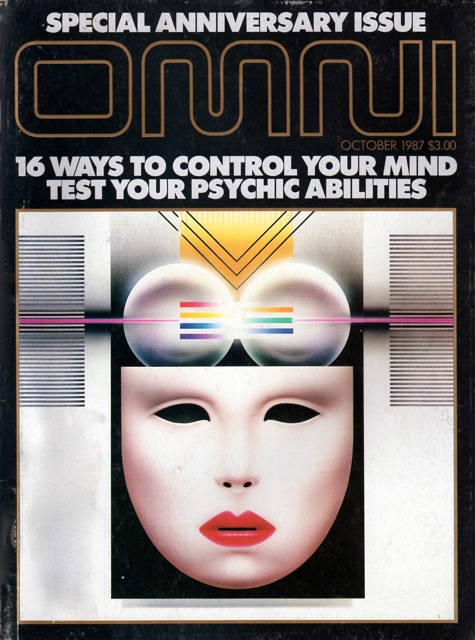
First published in the October 1987 issue of Omni. It’s been reprinted in The Year’s Best Fantasy: First Annual Collection (ed. Ellen Datlow and Terri Windling), Omni Best Science Fiction Two (ed. Ellen Datlow), The Horror Hall of Fame: The Stoker Winners (ed. Joe R. Landsdale), and the Martin collection Dreamsongs: Volume I.
Enhancing Image
Jessie is freelance book illustrator (the narrator jokes that this is not a “real” job) who’s moved into an apartment recently, and so far everything has been going about as expected. She has a few friends and she gets enough work that she won’t be homeless in a week. There is one problem, though, which has to do with the man who lives in the apartment building’s basement. The man, as far as anyone can tell, does not have a name, for even the tenants who have lived here for years don’t know what it is, despite all of them having interacted with him at some point or other. “All of them, every one, called him the Pear-shaped Man. That was who he was.” He’s a man of unusual proportions, being certainly chubby, but with his torso being (predictabtly) pear-shaped: narrow at the shoulders, yet with a real dump-truck of an ass. His head is described as like a small pear on top of the big pear that is his body. Nobody in the building really likes him, but he’s someone who generally keeps to himself, even with his strange habit of seeming to only eat cheese curls of a specific brand and drink Coke. This would be considered par for the course with YouTubers and Twitch streamers in the current year, but it would’ve been strange back in the days when people cared about balancing one’s diet. The Pear-shaped Man lives right below Jessie and her roommate Angela, but while the latter is chill about the man’s eccentricity, Jessie quickly finds a bone to pick.
“The Pear-Shaped Man” is example of what we would call apartment horror, which sounds specific but actually has some room for a variety of fun (or maybe not-so-fun) times. It could have to do with getting a roommate who turns out to be a psychopath, neighbors who are secretly murderous cultists, neglectful management (as if there’s any other kind), or some combination. Maybe there’s a Lovecraftian monstrosity lurking in the water pipes, or maybe (to take from a certain Lovecraft story) the air conditioning stops working on the worst of days. It’s a kind of horror that could’ve only sprouted in a post-industrial urban society, and the more people are packed together like sardines the better. Apartment horror stands on the diametrically opposite end of the spectrum from rural horror, since whereas rural horror often goes into a sense of isolation and what little human company there is being off, apartment horror tackles terrors that are unique to the urban experience. It’s also an example of another kind of horror story, albeit more a twist on it than a straight example: the tormented-woman story. I wish there was a better name for it, but it’s a very old and proud tradition in the genre, in which you have a woman (it’s usually a woman) of questionable mental stability who finds herself suffering at the hands of an antagonist, sometimes unseen but other times hiding in plain sight. Here, the supposed antagonist tormenting Jessie is a man whom everyone in the building already knows about, and who to all appearances hasn’t done anything except act in a way that doesn’t abide social norms; the worst thing he’s done is be kind of a weirdo.
Now, I say this is a twist on the tradition, because Jessie really ends up being her own worst enemy, to the point of being a Karen. She is clearly in the midst of a psychotic break, but she also acts entitled—not that the people around her are exactly innocent. She repeatedly has dreams about having a weirdly sexual encounter with the Pear-shaped Man, and her obsession gets to the point where she unconsciously paints his features in an illustration, which her boss doesn’t take too kindly. This is the kind of thing one would seek professional help for, but not only does Jessie fail to consider this, but her friends and acquaintances actively choose to make the situation worse once or twice. Martin walks a bit of a tightrope here, because on the one hand Jessie is not the most likable of protagonists, being bitchy, whiny, and something of a Greenwich Village-type hipster, but also she seems to be suffering from some undiagnosed mental illness. She talks with Selby, the apartment manager, in trying to persuade him to dig up the Pear-shaped Man’s lease so that he can be identified, which as Selby’s justified to point out is a big invasion of the man’s privacy; and yet the fact that he doesn’t seem to even have a lease should in itself be concerning, never mind that he only ever pays rent with cash, and single-dollar bills at that. (This feels like a plot point that could’ve only been plausible at least thirty years ago, since nowadays rent is fucking astronomical unless you live in the middle of bum-fuck nowhere.) It doesn’t help that even though he hasn’t done anything, the Pear-shaped Man stood outside watching Jessie’s place for an uncomfortable amount of time on one occasion, and during the few times they interact he wants her to come see his “things.” Nowadays this would be considered stalking and/or harassment.
There’s a sexism angle to “The Pear-Shaped Man” that goes unsaid, which is probably for the best since my experience with Martin has taught me that he can be unreliable on feminist issues. So much the better that Jessie’s plight being elevated by men who by and large don’t take her seriously is kept as subtext, then. Really, what’s impressive about this story, considering Martin’s habits as a writer the pop up now and again, is that’s both subtle in a psychological sense while also building tension at just the right pace. This is a novelette, like I said about 13,000 words, but it feels a bit shorter than that. Early in his career Martin was prone to writing mood pieces, stories in which not much actually happens and there’s a focus on character and vibes, but with “The Pear-Shaped Man” he found a right balance of character and action. Previously I’d only written about Martin early in his career, whereas this story shows someone who is both a seasoned professional and in his element. He can be as gory and erotic as he wants later, with A Song of Ice and Fire, but with his earlier fiction, mostly printed in magazines, he feels the need to restrain himself at least a little bit. The descriptions of the Pear-shaped Man as this grotesque figure, his skin unnaturally pale and his fingers like worms or maggots, spark one’s imagination and may even gross you out a bit, but Martin doesn’t overdo it.
There Be Spoilers Here
Not a negative criticism, but the ending is a very strange one. I was unnerved a bit, but also confused. I don’t even wanna give it away here, both because I’m not entirely sure what happened (it’s clearly meant to be taken as metaphorical rahter than literal, but that doesn’t help much), and because I do recommend this story quite a bit and I think a first-time reader should go into it blind up to a point.
A Step Farther Out
Recently I had read Martin’s Fevre Dream, which is one of his few standalone novels and certainly the most well-known novel of his that isn’t part of that series; and while I enjoyed it, I also kept wishing it was about a hundred pages shorter, with the third act being tightened up massively. Martin, like any writrr with two brain cells to rub together, writes for money, and the horror market in the ’80s called for novels that were unnecessarily large and horizontally challenged. With short fiction, though, one still had the restraints one needed to write something that could be frightening and chilling, sure, but also calculated. I very much recommend “The Pear-shaped Man” as an introduction to George R. R. Martin the horror writer, as opposed to George R. R. Martin the fantasist, assuming you haven’t already read “Sandkings,” which sees Martin in both horror and SF mode. I do love “Sandkings,” by the way.
See you next time.
 Science Fiction & Fantasy Remembrance
2 responses to “Short Story Review: “The Pear-Shaped Man” by George R. R. Martin”
I really liked his SF that was set in a consistent future universe. I read his “Game of Thrones” books until I waited years for the next book in the series to come out, and it all turned out to be subplot and did not advance the main story at all. I immediately sold all the volumes I owned to the used book store and never looked at another, or the tv show.
LikeLike
His Thousand Worlds stories are pretty good, it’s a shame he abandoned it by the end of the ’80s. I much prefer early-middle GRRM over the GRRM who wrote A Song of Ice and Fire.
LikeLike