Who Goes There?
Tom Godwin is one of those semi-forgotten authors whose legacy is secured by a single work, the 1954 story “The Cold Equations.” While this story’s reputation is earned, in that it is understandably one of the most controversial SF stories ever published (people have been arguing over it for the past seventy years), its creator has sadly been left in the dust. Of the many writers to debut in the ’50s, Godwin was one of the few who contributed mainly to Astounding. Why he had such a chummy relationship with John W. Campbell, I’m not sure. Godwin himself came to writing SF relatively late in life, being already deep in his thirties when his debut story, “The Gulf Between,” was published, and his life was marked by tragedy and inner demons. He had a disability that gave him a hunched back, which cut his military career short, and he struggled with alcoholism over the course of many years, never getting entirely off the wagon. His mom and sister died when he was very young, and he had a troubled relationship with his dad despite living with him for a good deal of his adult life. Godwin’s most productive period as a writer was in the ’50s, and afterwards he dropped off somewhat, hampered by health problems. When Godwin died in 1980, seemingly a broken man, his short fiction had not even been collected outside of anthologies.
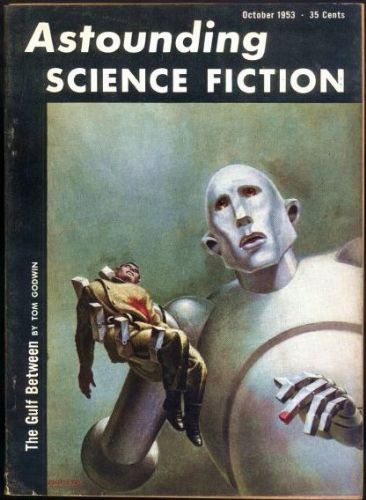
“The Gulf Between” has the rare distinction of being a debut story and getting a cover in Astounding. The only other example I can think of off the top of my head would be A. E. van Vogt’s “Black Destroyer.” Now, to bring up the elephant in the room, folks might find this cover to be familiar somehow. That’s because Queen had commissioned Frank Kelly Freas to redraw it for their album News of the World, with the only major difference being the one dead guy on the original being replaced with the band members. The album cover is leagues more famous than its inspiration, but “The Gulf Between” is a surprisingly good and brutal tale of Cold War paranoia which marked the introduction of an overlooked talent.
Placing Coordinates
First published in the October 1953 issue of Astounding Science Fiction. It was never reprinted in Godwin’s lifetime, only ever being reprinted in The Cold Equations & Other Stories.
Enhancing Image
The narrative shifts back and forth between the main plot and what seems to be flashforwards, all in italics, in which an unnamed man is dying on a ship, the robotic doctor onboard being able to prolong his life but being unable to save him. These flashforwards are deliberately vague and misleading, but we’ll get to them later. For now, the action starts in Korea, during that war which saw a ceasefire but which theoretically could go hot again any day of the week. The Korean War had just ended when “The Gulf Between” was published, but it was still going on when Godwin wrote the story. There are rumors in-story that the war will end in a stalemate, which is just what would happen in real life. Knight, a respectable soldier, is ordered along with his men to take a hill, a battle he knows will at best result in a pyrrhic victory. But his commander, Cullin, will not take no for an answer. Cullin is a genuine psychopath who sees the men under him as expendable, and who believes that human consciousness has no place on the battlefield. It’s his way or the highway. The battle is a success—at least on paper. The toll in lives for the Americans is perhaps too great. Knight makes it out alive with a fierce hatred for his commanding officer, and while he might not suspect it at the time, their rivalry will come back to play a role in world geopolitics. After all, the Cold War has been heating up.
Most of “The Gulf Between” takes place in what would’ve then been the near future, sometime in the latter half of the ’50s. In depictiing what the back end of that decade might be like, Godwin is actually not that far off. By the end of the ’50s the space race will have started, with Kennedy in his inauguration address promising fellow Americans that “we” will put a man on the moon in ten years’ time. The issue of The Bomb™ is on everyone’s minds, as well as the development of rocketry. This is a very ’50s story, although I don’t really mean that in a bad way. Following the war, Knight has become involved in robotics and rocketry, while Cullin (ironically, given his hard-as-nails military attitude) has since turned traitor and become an enforcer for “Russo-Asia,” what I have to assume is a coalition of the Soviet Union, China, and North Korea. I guess they put their petty differences aside as to what kind of socialism should dominate the world. Mind you that neither man is much of a patriot, and the first time they meet after the war it’s in Mexico: Knight’s there on siesta and if Cullin were to set foot in the US he’d probably be tried as a defector. Cullin is very interested in Knight’s work on a super-computer, called the Knight-Clarke Computer, that can think faster and more efficiently than a human being—but not of its own volition. The computer, like “AI” as we understand in the current climate, can’t think for itself; it’s a learning machine, and a very good one. It’s also (and this is the part that catches Cullin’s attention) totally obedient. A machine doesn’t lie, and it doesn’t get sentimental about orders. Such a computer could be used to guide weapons, is the idea.
“The Gulf Between” is an ambitious little story about nothing less than the necessity of human consciousness, not to mention conscience. Knight and Cullin are not deeply drawn characters, but they do clearly represent opposing philosophical positions. Knight is interested in intelligence and consciousness while Cullin finds such things to be abhorrent, his ideal army being a bunch of unthinking and subservient robots. It feels exaggerated, but it’s also not hard to believe there are people like Cullin in government or the military. It’s also worth mentioning, although it might be obvious to say, that of course Cullin would defect to Russo-Asia, what with the mindset at the time being that those dirty commies were a bunch of unthinking and mindlessly conforming stooges. And yet, putting the Cold War subtext aside, the message that each person needs to have their own intitiative and moral code still feels relevant. Hell, Henry David Thoreau wrote a whole essay on the matter, you may have heard of it. In fact I’ll quote one of the more famous passages in “Civil Disobedience,” which Thoreau wrote in the context of the Mexican-American War but which can just as well be applied to men like Cullin a century later. To wit:
In most cases there is no free exercise whatever of the judgment or of the moral sense; but they put themselves on a level with wood and earth and stones; and wooden men can perhaps be manufactured that will serve the purpose as well. Such command no more respect than men of straw, or a lump of dirt. They have the same sort of worth only as horses and dogs. Yet such as these even are commonly esteemed good citizens.
Knight has friends and colleagues, whereas Cullin doesn’t seem to have any friends and indeed barely even seems to have allies. Cullin has his job implicitly because he’s that good at it, and not because the higher-ups see him as a cuddly individual. Much to Cullin’s liking, the embrace of the Soviet and Asian commies is a cold one. I’m not sure what Godwin’s politics were (I’m not even sure what he looked like), but given his attempt at military service and his regular contributions to Astounding it’s a safe (although not sure) bet that he was a right-wringer. But if so, there’s a humanist element that muddies the waters. When reading Godwin there’s a sense that a tug-of-war between the belief in goodness in one’s fellow man and a deep pessimism, even a sadness, goes on with him. There’s more bloodshed here than I expected, but I’m getting a bit ahead of myself with that. A tour of Lab Four, where Knight and the others work, is underway. The most immediately impressive part is George the robot, which is intelligent but not really sentient. George can’t make decisions for himself, but he’s very good at following orders—regardless of who’s giving them. (I assume George is meant to be the robot on the cover, but in-story he’s about human-sized rather than giantic.) This is important to keep in mind. There’s also the robot-assisted rocket, set for liftoff with a human pilot. Would be a shame if something went wrong with other of those.
There Be Spoilers Here
The rocket has been sabotaged such that it can’t be launched remotely, but far worse is that Russo-Asian paratroopers have somehow made it behind enemy lines and launched an assault on Lab Four—Cullin being among them. The explanation is that relations between the US and Russo-Asia have been cooling down as of late, making special operations like this possible. (Remember, kids, that the commies are always waiting to strike, so don’t let your guard down.) Sure. The third act of “The Gulf Between” is logical, in that it makes sense that the rivalry between Knight and Cullin would escalate to this extent, but it also seems far-fetched. (I say this mere days after American spec ops kidnapped the leader of Venezuela and flew him out of the country quite literally overnight.) A whole fucking battle starts and some people get killed, including civilians, but Cullin taking over the rocket is not the victory he thinks it is. Turns out the dying man we’ve been following in the flashforward scene was not Knight, like you might expect, but Cullin. In an ending which is both grim and funnily literal, Cullin, the man who wanted to turn men into machines, finds himself clinging to life, strapped to the pilot’s seat, with an iron heart and an iron lung. By the end he is almost as much machine as man, but the machinery will not save him, as the rocket continues to accelerate through space.
A Step Farther Out
Why it took half a century for “The Gulf Between” to get reprinted at all is honestly beyond me, given how much middling or bad SF got treated more generously by editors. Godwin has a curious life story and career trajectory, which would already make him worthy of reading beyond “The Cold Equations,” but he was also a step or two above the average Astounding regular in terms of skill. It’s a shame he didn’t write that much. I recommend seeking this one out, although to this day you can count the number of ways to read it on one hand.
See you next time.
 Science Fiction & Fantasy Remembrance