Who Goes There?
Robert E. Howard’s career lasted only about a dozen years, from 1924 until his death in 1936, but in that time he wrote several volumes’ worth of short fiction, poetry, and a few novels. He wrote for every pulp fiction of just about every sort (except, funnily enough, science fiction, whose market was burgeoning at the time), and for every magazine that would take him. He wrote Westerns, sports stories (he especially loved boxing), non-supernatural adventure fiction, horror, and of course, fantasy. Fantasy writing, prior to Howard, was pretty much invariably rooted in the British tradition, but Howard brought a distinctly American flavor which has been a subspecies of fantasy writing ever since. He is the father of sword-and-sorcery, although he wasn’t strictly the first practitioner, nor did he coin the term. But he created a few series characters who fell into fantasy of this sort, culminating in Conan the Cimmerian, the first great sword-and-sorcery hero. With Conan, his most popular creation, Howard’s legacy was secured; and a good thing too, considering Howard would take his own life at the age of just thirty. Most writers don’t even reach maturity in their craft by that age, and some don’t even start writing until later; so it’s impressive that Howard had said all that he more or less wanted to say by that time, although he had shown interest in shifting away from fantasy and focusing more on writing Westerns. Sadly, the world will never know.
Something I didn’t bring up in my recent editorial on Howard is how his Irish heritage informed his writing, there being no clearer an example of this than with Conan himself. Contrary to what Arnie has made us think, Conan, as written by Howard, is very much a Celtic warrior, rather than Germanic. Howard’s Irish background also plays a big role in today’s story, the standalone horror year “The Cairn on the Headland,” which takes place in none other than Dublin, Ireland. The setting, as well as its use of Irish and Nordic mythology, makes for some of Howard’s most overtly Irish writing. It’s also a fun time, so there’s that.
Placing Coordinates
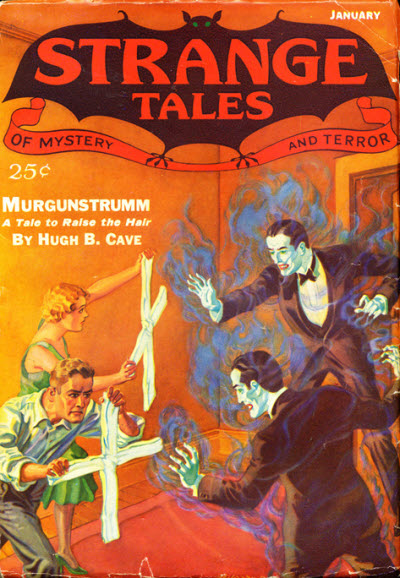
First published in the January 1933 issue of Strange Tales. As was typical, it wasn’t ever reprinted in Howard’s lifetime, only first reappearing in the 1946 collection Skull-Face and Others. It has also appeared in The Macabre Reader (ed. Donald A. Wollheim), Rivals of Weird Tales (ed. Stefan R. Dziemianowicz, Martin H. Greenberg, and Robert Weinberg), and the Howard collections Wolfshead and The Horror Stories of Robert E. Howard.
Enhancing Image
This is a tad embarrassing, but although you get what the word means just from context in the story, I did feel the need to look up the definition of “cairn” at one point. It’s not a word you see used casually, at least in modern times, and neither is “headland.”
The story itself takes place sometime in the early 20th century, in what would’ve been the Irish Free State. James O’Brien (possibly a shoutout to Irish author Fitz-James O’Brien) is our protagonist and narrator, an Irish American who has come to the land of his ancestors, and unfortunately for him he didn’t come alone. Ortali is a gaping asshole, and is here because O’Brien can’t get rid of him. I’m not joking. In a series of events that maybe shouldn’t be taken at face value, O’Brien got into a feud with a professor, and went to his abode one night with the intent of just threatening the older man. However, the professor had drawn a knife, and in a freak accident fell on it, stabbed right through the heart. This sounds unlikely. Regardless of whether O’Brien is being an unreliable narrator in recounting this story, Ortali, being an assistant to the professor, had witnessed O’Brien just after the fact, and even if O’Brien didn’t commit murder it would be hard to prove otherwise in court. Ortali, being a totally reasonable man, decided to blackmail O’Brien, and the two have been conjoined at the hip ever since. As O’Brien says, “If hate could kill, [Ortali] would have dropped dead.” If only there was a way to be rid of him.
Calling O’Brien a hero would be terribly generous, not because he has thoughts of murdering Ortali for much of the story, but in fairness Ortali (at least from O’Brien’s perspective) is shown to be worse. Scheming, selfish, condescending, and maybe worst of all, disrespectful toward Irish history. He writes off O’Brien’s interest in Irish mythology as silly superstition, but you can guess who gets the last laugh there. O’Brien spends a good portion of the story’s opening stretch explaining the lore behind Grimmin’s Cairn, a monument on the outskirts of Dublin which serves as a sign of the fallen, in the last battle between the Celts and the Vikings. In 1014 CE, King Brian and his troops drove off the Vikings for the last time, making sure the Vikings didn’t take Ireland. Literally it was a battle between an indigenous people and an imperial force, but it was religiously a decisive blow, between “the White Christ” and Nordic paganism. Nowadays certain white supremacists and fascists cling to the Nordic pantheon symbolically, but Christianity was here to stay. The strange thing about the cairn, O’Brien claims, is that it surely was not made to commemorate the soldiers fallen in battle, being a single mound and, as he says, “too symmetrically built.” It was made for something (or someone) else.
Something I really dislike about the magazine version of “The Cairn on the Headland” is that the both the illustrations and introductory quotation give away all the major spoilers, so that frankly it’s hard to be surprised by the story’s climax. There’s a strange old woman by the name of Meve MacDonnal whom O’Brien meets, their meeting itself being a bit uncanny, because Meve’s accent is a strange one. If you’ve read this in Strange Tales you could already infer, however, that Meve is a ghost, having been dead some three centuries, a reveal that’s not made in-story until later. Still, the two bond over their shared heritage, with Meve even saying O’Brien was her maiden name. Meve also gives O’Brien a special cross, a relic he assumed to be kept away somewhere, in secret. Only one of it’s kind in the world. She says he’ll be needing it. What a nice lady, never mind the whole being-dead part. Of course it’s only later that O’Brien finds Meve’s grave and understands that either he’s nuttier than squirrel shit (a possibility) or he’s dealing with the supernatural.
Whilst ostensibly a spooky story, “The Cairn on the Headland” is less effective as horror than as a classic ghost story in an exotic locale. There’s an undercurrent of tragedy, given that despite it being his ancestral homeland, Howard never lived to visit Ireland. Lacking first-hand experience of the landscape, he resorted to the imagination, of which this story is very much a byproduct. Dublin here is not the Dublin of James Joyce, but a dreamland, where a plot epiphany quite literally comes to O’Brien in a dream, and which he decides to take at face value. Even in the real world we have this funny habit of reading our dreams as sometimes being premonitions, or warnings, so O’Brien’s behavior, while a bit contrived, is not that unusual. It also helps O’Brien is narrating, from his somewhat deranged point of view, so that it’s easier to buy into the weird shit.
There Be Spoilers Here
In this kind of story it’s customary to have a character who fucks around and finds out, which in this case is not O’Brien, but the even more unlikable Ortali. Thanks to a prophetic dream and some knowledge of Nordic mythology, O’Brien concludes that the cairn is not a monument to any Irish or Nordic soldier, but to Odin himself. The one-eyed. The Gray Man. Grimmin’s Cairn turns out to be a bastardization of Gray Man’s Cairn, after centuries of neglect, a fallen god stuck in a land where nobody believes in him. The Norse gods may be gone, but they’re by no means dead. The problem is that, as tend to be the case with the heads of pantheons, Odin is a major-league asshole—a lesson Ortali learns too late, after having torn the cairn asunder in the dead of night.
It’s maybe convenient for O’Brien, already a fugitive for one unlikely death, that the awakened and grumpy Odin smites Ortali with lightning. I mean what’re the odds of such a thing happening, right? Even more conveniently for O’Brien, the ghost lady had given him that cross, and for some reason, like a vampire, Odin is allergic to crosses. I know the reason, of course, it has to do with Norse religion having been overrun and finally replaced by Christianity. This is funny coming from Howard, who was not really a religious person at all, but I get it has more to do with Christianity’s (more specifically Catholicism’s) centuries-long shared history with Ireland than with a belief in “the White Christ.”
A Step Farther Out
Howard was not the most original of horror writers; like a lot of us he learned his craft by way of mimicry. “The Cairn on the Headland” is not a very original story, in that even if you didn’t have the ending spoiled for you in advance you can easily anticipate the outcome. It has a certain vibe about it, though, like a good-but-not-great M. R. James story. The atmosphere is the key to enjoying it.
See you next time.
 Science Fiction & Fantasy Remembrance