Who Goes There?
I’ve covered Jack Williamson here a number of times before, in part because he was so prolific and also because his early writing is indicative of the spirit of ’30s and ’40s SF. He made his debut in 1928, with a guest editorial and then a short story, “The Metal Man.” He was only twenty years old at the time, but had taken an interest in writing SF in the mode of A. Merritt as a teenager and was quick to learn the ropes of pulp writing. Williamson would end up having the longest career of any SF writer, at 78 years, having only stopped with his death in 2006. The fact that he appeared in Gernsback’s Amazing Stories and lived through nearly eighty years of the field’s history is really an incredible thing. His Hugo-winning memoir, Wonder’s Child, is a candid record about his childhood, moving from place to place along the southern border of the US (he was actually born in Arizona before it became a state), along with some angst regarding romance and trying to lose his virginity as a young man. He was also candid about his limitations as a writer, namely that no matter how much he worked his craft, he could never develop the refined style needed for more “sophisticated” SF. He simply didn’t have a delicate ear for writing prose.
Said limitations didn’t stop him from staying in the game for decades, pretty much without any kind of hiatus, although his most productive period was in the first dozen or so years of his career. He became the second author to be made an SFWA Grand Master, after Robert Heinlein, and on top of the Hugo he won for Wonder’s Child he won another Hugo as well as a Nebula for his novella “The Ultimate Earth.” Not bad, given he was in his nineties. As for “The Metal Man,” which kicked off this long and acclaimed career, it’s… not very good. Which I guess is understandable, the man was barely out of his teens and this was his first professional sale, in a market that was itself rather new and untested. I can also readily believe Williamson was thinking of Merritt with this, since I’ve read enough Merritt to figure that; but while Merritt impressed a baby-faced Williamson in the 1920s, Merritt now reads as pretty clunky and whimsical.
Placing Coordinates
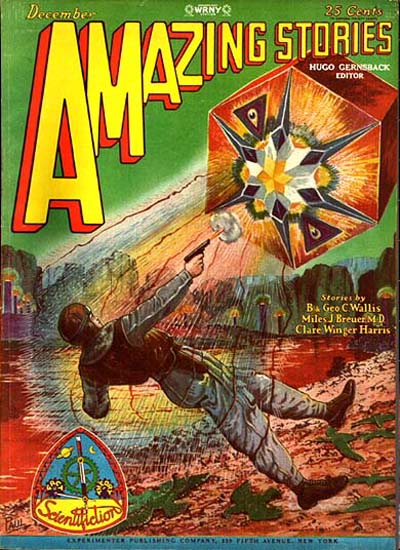
First published in the December 1928 issue of Amazing Stories. It’s been reprinted more times than should be considered reasonable for a story of middling quality, but I guess it does have some historical significance. “The Metal Man” has appeared in Avon Fantasy Reader #8 (ed. Donald Wollheim), The Best of Amazing (ed. Joseph Ross), The Arbor House Treasury of Science Fiction Masterpieces (ed. Martin H. Greenberg and Robert Silverberg), The Oxford Book of Science Fiction Stories (ed. Tom Shippey), and the Williamson collections The Best of Jack Williamson, The Early Jack Williamson, and The Metal Man and Others.
Enhancing Image
The narrator tells us of a lifelike and life-size statue of a man at the Tyburn College Museum, which despite being in a state of neglect is an object whose very unusual and tragic origin is a sort of open secret. The statue is all that remains of Thomas Kelvin, a widely respected geologist who became obscenely rich off of prospecting for radium, only to have met a slow and yet early demise. He had apparently become sick “of a strange disorder that defied the world’s specialists, and that he was pouring out his millions in the establishment of scholarships and endowments as if he expected to die soon.” Which he did. The man’s body has been encased in metal, and looking at him he seemed to have been in good health, except for a “peculiar mark upon the chest,” a “six-sided blot, of a deep crimson hue, with the surface oddly granular and strange wavering lines radiating from it—lines of a lighter shade of red.” There are disagreements as to how Dr. Kelvin met his fate and became a museum piece, but the narrator claims to have obtained the manuscript of Kelvin’s account of those fatal prospecting days, as his body was shipped in from France. The rest of the story is that manuscript, told straight from the horse’s mouth.
A year prior, Kelvin had hoped to find radium deposits in El Rio de la Sangre, “the River of Blood,” which sure sounds inviting. Now, you may be wondering why the hell a geologist would hope to find radium of all things, since nowadays we know radium to be pretty dangerous and to have only a niche use. You know how in the early 20th century cocaine was used and advertised as a medicinal drug? Similar lines. The effects of radiation on the human body had not yet been studied, a gap in knowledge I suppose Williamson uses to his advantage. Hugo Gernsback’s introductory blurb for “The Metal Man” says the story has “a surprising amount of true science.” No fucking clue what he could possibly mean by this. I guess it’s a surprising amount of true science in that there’s virtually none to be found here. Speaking of things that strain one’s suspension of disbelief, Kelvin is both a wealthy scientist and an aviator, even purchasing a private “monoplane” he pilots himself. He does a scouting run along the river and finds a huge crater, at first appearing to be a lake but actually being a pit of heavy green gas. (Something I couldn’t help but notice is Williamson relying on colors a lot, especially the primary ones, a habit that seems to crop up in his early fiction a fair amount.) Well, in Kelvin goes.
I would like to mention that the pacing of this story is very strange. Kelvin says he only has so much time to write about his adventures, and overall the manuscript is short enough, but it’s also needlessly verbose. This kind of purple (sorry about the color thing) prose is uncharacteristic of Williamson, and it’s no wonder that he would soon abandon it. Merritt wrote in such a style to achieve a certain effect, not unlike Lovecraft (who was, after all, a close contemporary), although it must be said that Merritt was not as deliberate with his word choices. Williamson, having been so young and with not much of a background in literature at this point (he would earn a BA and MA in English much later in his life), didn’t seem to consider both the readability and plausibility of the framed narrative as much as he should’ve. And of course, Kelvin’s need to attribute a color to every goddamn thing is never given any in-story justification.
There Be Spoilers Here
One of the strangest things to happen is Kelvin coming upon an eagle, which had once been living, but having since turned to metal, apparently covered in the same “bluish radiance” as Kelvin and his plane. He then finds other birds, also cast in metal, having fallen victim to the deadly magic of this area by the so-called River of Blood. There’s even a “pterosant,” which is to say an ancient flying reptile. “Its wing spread was fully fifteen feet—it would be a treasure in any museum.” It’s clear that whatever killed these flying creatures will at some point come to collect on Kelvin, but he’s able to delay the inevitable by trying out some awful tasting purple berries. The juice of the berries tastes like ass, but has the helpful ability of counteracting one’s transformation into metal. The solution, unfortunately for Kelvin, is temporary, and the problem is permanent. He’s able to escape this dark little corner of the globe, and to write about it, but he’s a dead man walking.
A Step Farther Out
I’m sort of taken aback by how many times this story has been reprinted and how many editors consider it to be essential Williamson. Is it because it’s his debut? There are major authors with innocuous or even bad debut stories that understandably get thrown in the dust bin of history. Williamson himself thought well enough of it that he went to the trouble of revising it for one of his collections some forty years after the fact. It could be the nominally SF story that’s really an adventure narrative in an exotic location had an appeal for those of Williamson’s generation, and even a generation after that, that’s lost on me now. You can certainly do worse as a twenty-year-old just learning to write sellable pulp, but Gernsback glazing it and history being kind to it is baffling to me.
See you next time.
 Science Fiction & Fantasy Remembrance