Who Goes There?
In the 1950s, an exceedingly small number of SF authors got lucky and gained some mainstream traction. These were people who gained book deals with mainstream publishers and were having their work adapted for film, TV, radio, and so on. Some, like Ray Bradbury, seemed to have spent years honing their skills and forming the right connections for such exposure, but John Wyndham becoming one of the bestselling SF writers of the ’50s must’ve come off as an unexpected development. Wyndham was born in 1903, in England, his full name being John Wyndham Parkes Lucas Beynon Harris. He had, in fact, already been writing SF for about twenty years when his 1951 novel The Day of the Triffids became a mainstream hit, with it even getting serialized in The Saturday Evening Post. This decade saw Wyndham on a hot streak, as over the next decade he also wrote The Kraken Wakes, The Chrysalids, and The Midwich Cuckoos, that last one getting adapted into Village of the Damned. Wyndham set the standard for a particular sort of SF, that being rather folksy and British, not to mention being informed by the traumas of a haggard post-war England.
While Wyndham’s novels from this period are some of the best that ’50s SF has to offer (at a time when the novel as a form was evolving rapidly in the field), his short stories are no joke. “Dumb Martian” has a title that might make you think it’ll be comedic, but this is a serious and thorny tale of racism, misogyny, and domestic abuse. It just so happens that the woman at the story’s center is an alien.
Placing Coordinates
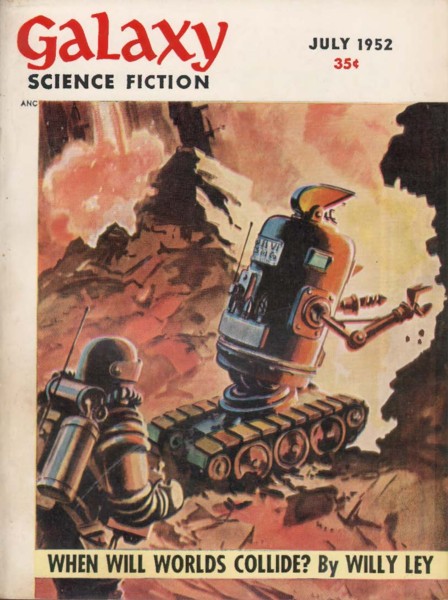
First published in the July 1952 issue of Galaxy Science Fiction. It’s been reprinted in Gateway to Tomorrow (ed. John Carnell) and the Wyndham collections The Best of John Wyndham and The Seeds of Time.
Enhancing Image
Duncan Weaver is set to work on a wayload station on Jupiter IV/II, a small satellite near Callisto. Five-year contract, tax-free, and by the end of it he’ll be looking at quite a lot of money. The problem is that it’s a one-person job and it’s totally possible to lose one’s mind in such an environment before the term is up. Before Duncan has even arrived at the station he’s run into the problem of paying for company, in the form of Lellie (no last name), a young Martian girl who legally becomes Duncan’s wife. This is all to get around red tape, though, since for all intents and purposes Duncan will be using Lellie as a maidservant—even as a slave girl. But don’t call it that. “Anti-slavery regulation,” the agent in charge of this whole transaction says. Duncan is supposed to be merely buying Lellie’s services from her parents. Lellie herself has no real say in all this, for one because her English is rudimentary and secondly because even if she had a better grasp on the language, she would still be at the mercy of her parents. Overall the “marriage” deal runs Duncan $2,310, which must’ve been a big amount to people in 1952 but which now amounts to a month’s rent.
When it comes to protagonists in old-timey SF, they range on a spectrum from decently benevolent to Mussolini 2.0, with an uncomfortable number of these “heroes” now reading as more suspect than the author had intended. In the case of Duncan there’s no question about his status: he’s a certified shithead. Of course, it also doesn’t take long to figure that he’s supposed to be a shithead, and that Wyndham has something special in mind for—well, you can’t even really call him an anti-hero. Duncan is a racist who sees the “Marts” as inherently feeble-minded and off-putting, despite them being humanoid, and thinks of Lellie as being an especially poor specimen. But it was the best deal he could get. We don’t get much info on life outside of what pertains to Duncan’s job, but we can infer relations between humans and Martians are not that unlike between white settlers and indigenous peoples in North America. There aren’t too many SF stories of this vintage that are about racism, and when they do tackle race it’s usually by way of allegory—of using aliens as stand-ins for real-life marginalized peoples. This is not necessarily a bad thing, especially in the case of “Dumb Martian” where the allegorical angle is pretty surely justified. Wyndham wants us to think of Lellie as more downtrodden woman than Martian.
The third-person limited narration puts us in Duncan’s shoes for pretty much the whole story, and Wyndham walks a bit of a tightrope by making us stick to this man like glue. It’s risky to have someone so loathsome as both your protagonist and perspective character, even if it’s on purpose. What’s uncanny about “Dumb Martian” is how Wyndham’s able to tap into the mindset of someone who is both hateful and incurious, but not cartoonishly so. There are some activities one can do at the station, to pass the time, but for instance the station’s small library is totally wasted on Duncan. He’s one of those blue-collar types who has an irrational distrust of reading—a flaw in his character that’ll come back to bite him later. He also has no interest in learning about Lellie’s own language or culture, instead trying to coach her to talk better English and to act like “a real woman.” To give some small credit he does try to play games with Lellie, with the few that are on board, like chess, but he finds that once she got the rules down she can beat him quite handily at any of them. The fact that Lellie is shown to be easily a better player than Duncan foreshadows a depth of intellect that Duncan is either unwilling or incapable to acknowledge. He thinks these games naturally favor her somehow, almost as if she were cheating. While she doesn’t say much, his “wife” is not as dumb as she appears.
All these little moments build up over the months to when Alan Whint stays at the station for a time, and while Duncan doesn’t understand this in the moment, Whint’s involvement will mark a point of no return. I thought for a second that Whint would fall in love with Lellie, as he quickly becomes more interested in her than the rocks on Jupiter IV/II, but their relationship not only remains platonic, but once Whint leaves he’s never heard from again. But his impact on Lellie is profound, as he’s an open-minded fellow who sees the Martians as worthy of basic respect, and Lellie herself as worthy of basic respect as a woman. Duncan makes no secret of resenting the scientist for “putting ideas in her head,” but there’s only so much he can do about it. Whint leaves both the station and the narrative before too long, which is a good thing because if the walking problem that is Duncan is to be solved, Whint should not be the one solving it. While he’s disgusted by the way Duncan treats Lellie, including a bruise on her cheek that has not faded entirely, the most he can do is give Lellie just the right amount of nudging so that she can take matters into her own hands. It’s satisfying, even from a modern perspective, because we get to watch Lellie dive into the same books Duncan shuns, and we watch her become rather shrewd and assertive over the course of several months.
There Be Spoilers Here
By the story’s climax Lellie has become so well versed in English and reading that she’s become a better bookkeeper than Duncan—not that he wants to admit this. He also doesn’t wanna admit that it really wouldn’t take much, being stuck here on a big rock in space, for him to die—be it in an accident, or in foul play made to look like an accident. He doesn’t consider the possibility of Lellie being both spiteful and knowledgable enough to take revenge on him. He doesn’t consider any of this, until it’s too late. And a good thing, too! What Lellie does is objectively cold-blooded, but after all the abuse Duncan’s put her through it’s hard to feel sorry for the receiving end of her business. Good for her. The perspective flip at the very end, after Duncan dies, comes almost as a shock, but it’s well earned.
A Step Farther Out
The gender politics of SF of this vintage can often be iffy, but there were some with a feminist tinge, and there were even a few of those that were written by men. (The ’50s saw a serious uptick in women writing SF, with themes and subject matter to go with this demographic shift.) I’m not sure I would call Wyndham a feminist ally, if only because despite having read a few of his novels I’m not really sure of his politics. Unmistakably there’s an anti-racism streak in “Dumb Martian,” but the feminist angle might not be as deliberate. Regardless, this is a good one. Wyndham appeared a few times in Galaxy during those early years of the magazine’s life, but it’s a shame he didn’t contribute more, as they were a very fine match for each other. H. L. Gold, Galaxy‘s editor, wanted material that was ideally both slick and socially conscious, and Wyndham provided both.
See you next time.


One response to “Short Story Review: “Dumb Martian” by John Wyndham”
Just wanted to say I discovered your site yesterday and I love it. Thanks!
LikeLike