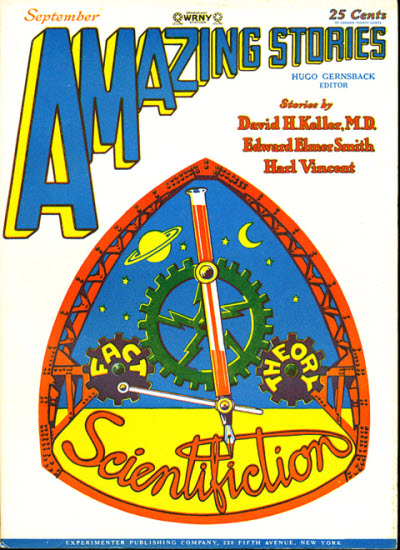
The Story So Far
Dick Seaton has discovered a desposit of the very rare and unusual metal known only as X, and has wasted no time in testing this metal. Combining X with copper and running them through an electrical current has the very strange and incredible effect of anti-gravity. The experiment damn near kills Seaton, and it was by luck that it didn’t. It’s also very lucky of Seaton that he has a small wealth of this precious metal in store and that he has the resources for working with it—first at the Bureau of Chemistry, then with the help of his rich friend Martin Reynolds Crane. Once it becomes clear that Seaton’s dreams no longer lie at the Bureau, he and Crane decide to start a business together. This is all well and good, but Marc DuQuesne, a fellow chemist at the Bureau, has been eyeballing Seaton’s experiments and has enough ambition and lack of morals to steal that research for himself. Like Seaton, DuQuesne is connected with a party that can provide the money for his machinations, this being Brookings, head of the Steel Trust, a corporation with a few skeletons in its own closet. What entails is some corporate espionage, ranging from sketchy to murder in broad daylight. Shiro, Crane’s loyal servant, narrowly survives an assassination attempt when DuQuesne flies in on the Crane estate’s airfield. I should mention here that these men are scientists, as well as trained gunmen and aviators. Between Seaton, Crane, and DuQuesne, there’s hardly a talent none of them has. Oh, they’re also handsome and charismatic.
The two parties are at a bit of a crossroads. An attempt on DuQuesne’s part to replicate Seaton’s formula for the solution failed disastrously, and even killing Seaton or Crane would not mean getting’s one’s hands on the formula. DuQuesne thinks it best to sabotage the ship Seaton and Crane have been building, with the help of Perkins, an amoral detective, but Seaton and Crane get the idea to construct a second ship that’s in full working order. This ship gets christened the Skylark. When all else has failed, DuQuesne thinks it’d be a good idea to kidnap Dorothy Vaneman, Seaton’s fiancée. (Seaton is somehow engaged, despite seeming to not have much interest in sex or even romance.) There’s also the problem of Margaret Spencer, a young woman who’s been spying on the Steel Trust so as to one day avenge her father, whose research the corporation had stolen. All of these people, including Perkins, are projected for a head-on collission with each other, as the Skylark is about ready for take-off and DuQuesne’s gotten a spaceship of his own. I had neglected to mention Perkins and Margaret when writing about the first installment before, although in my defense the latter will play a much bigger role in the second installment.
Enhancing Image
DuQuesne’s plan to kidnap Dorothy goes horribly wrong for everyone involved, as the four of them (DuQuesne, Dorothy, Margaret, and Perkins) get into a skuffle onboard and the ship takes off by accident. By all rights the absurd amount of acceleration should’ve crushed everyone to death, but not only does everyone survive, DuQuesne’s even able to retain consciousness long enough to put on the brakes. For being a chemist with a stuffy job, it seems that DuQuesne (this also applies to Seaton) keeps himself in better shape than the average man. The ship has also somehow, in a matter of minutes, ventured far enough into the cosmos without hitting anything that not only have they lost sight of Earth, they don’t even seem to be in the Milky Way anymore. This all reads now like second-rate fanfiction with how implausible and theatrical it all is, such that even by the time The Skylark of Space first saw book publication in 1946 I suspect readers would’ve had a hard time taking its science seriously. It’s only maybe marginally more scientific than the heroes of Jules Verne’s From the Earth to the Moon shooting themselves out of a cannon. At the same time it’s an incredible moment in how it juxtaposes with what was, up to this point, an earthbound narrative. We’ve gone to space in SF before, even in stuff published in Amazing Stories at this time, but not this far out.
Now, if we were to put on our thinking caps, our Literature Reviewer™ hats, there are a lot of holes one can pioke in this thing. It’s convenient that Seaton and Crane, in the Skylark, are able to track the ship the other four had gotten lost in, and it’s just as convenient that Perkins, having served his purpose in the plot, gets shot to death by an remorseless DuQuesne. So we’re down to five, then, and minus one ship, as DuQuesne’s ship gets swallowed up by what would now be called a neutron star—indeed what seems to have been be the first appearance of a neutron star in SF. Meanwhile, this misadventure leads to all five sharing space aboard the Skylark, which also, in a matter of great convenience, happens to be stocked with food and bedding for everyone. Being stuck in a cramped environment with the novel’s villain sounds like a bad time, but while DuQuesne has nefarious shit in mind for Our Heroes™, he’s also pragmatic enough to cooperate while outnumbered and outgunned. I think I brought this up in my last review, but DuQuesne might be the first great villain of magazine SF. He is intelligent, cunning, vicious, very proud of his own abilities, in a way being Seaton’s mirror image. This is not a madman who simply wants world domination or the hero’s head on a pike, but someone who comes off as a thinking individual. The other characters are not as impressive, in no small part due to the shoehorned romantic tension between Crane and Margaret. I will admit as a positive that Dorothy and Margaret are surprisingly well drawn for being women in a 1920s pulp novel: they, like their love interests, are assertice, no-nonsense, and at least one of them even knows how to handle a gun. I wonder who’s responsible for this moderate egalitarianism.
The gang scouts for planets that are not only habitable but which contain the right metals for the Skylark, namely X and copper. There’s a strange run-in with an intelligent alien who communicates via telepathy, and who also is keen on the humans “dematerializing” so that they can be absorbed into the race’s thoughts—a race that is incredibly quick-witted, if condescending, but at the expense of not being very physically imposing. Eventually Our Heroes™ (and villain) land a planet that’s rich in metals, and home to another intelligent race, this one being more benign—or so it seems. Nalboon, the leader of Mardonale, treats the humans as guests, even inviting them to a delicious dinner. Mardonale is a decadent society where slavery has apparently stuck around as the norm—not slavery based on race or skin complexion, mind you, but more slavery as in ancient Egypt and Rome. The attitude Seaton and company have to getting slaves as servants is casual to the point of being disconcerting, if we’re being honest. You might say, well, when in Rome and all that, but the issue of slavery only sparks a panic button in Seaton’s brain once it occurs to him that he and his friends may well become prisoners on this planet. This all plays out like a classic Star Trek episode, wherein Captain Kirk and his landing party are introduced to a cultured and seemingly friendly alien of the week on their home turf—only to find something malicious is brewing.
A Step Farther Out
If The Skylark of Space has aged better than its reputation suggests, it’s because it still reads compellingly as adventure fiction, if not as science fiction. Much of this installment focuses on the changing relationships between the five main characters, and this focus on character would’ve probably come off much worse without Garby’s part of the equation. It still reads at points stiffly and melodramatically for the modern reader, who is more sophisticated than Smith by a good margin, but the dialogue is surprisingly robust. It also helps that this novel is short by modern standards, such that I ended up reading the middle chunk of it in just two sessions. I have to admit I would be totally in the dark as to how this novel could end, except for the fact that it has a few sequels. There’s a degree of unpredictability here that must’ve had an intoxicating effect on readers in 1928. I’m enjoying all this more than I had initially expected.
See you next time.

