Who Goes There?
Over the half-century and change that he was active, writing whatever the hell he wanted, Harlan Ellison made some friends, many admirers, and about as many enemies. In his lifetime he was one of the more controversial genre writers in the business, not least because of his toxic personality and at times really petty grievances. He was, for better or worse, about as dramatic as his fiction, which is saying something. Ellison was born in 1934 and started writing professionally when he was barely out of his times, just in time to see the magazine boom-and-bust of the ’50s, although it wasn’t until the ’60s that he really started catching people’s attentions. 1967 in particular can be considered an annus mirabilis for Ellison, as it saw the publications of his Hugo-winning story “I Have No Mouth and I Must Scream” and the landmark anthology Dangerous Visions, as well as the airing of the Star Trek episode “The City on the Edge of Forever,” which Ellison wrote the initial draft for (it’s a long story). Had Ellison tragically died in 1970, his legacy as an important figure would’ve remained secure, but he continued to write great fiction for several more decades.
In 1958 Ellison was another young writer looking to make some money by selling to as many outlets as he could. He wrote prolifically in the latter half of the ’50s, but little of this material would eventually make it into the big Ellison volumes like The Essential Ellison and Greatest Hits, with “Are You Listening?” being one of those forgotten early stories. Unfortunately there’s a reason for this. “Are You Listening?” isn’t terrible, but it’s rather forgettable, with the saving grace being that it shows an early attempt at handling a certain theme that would become a recurring one for Ellison, namely the issue of conformity in society.
Placing Coordinates
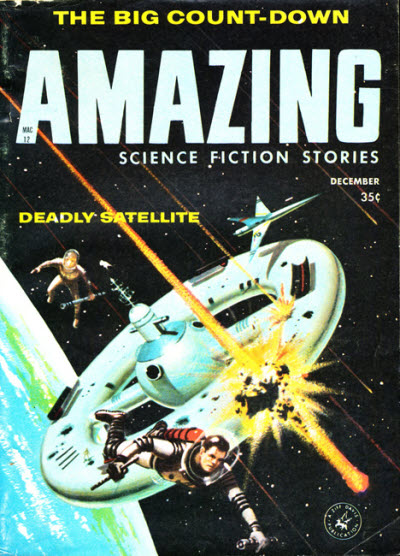
First published in the December 1958 issue of Amazing Stories. It was reprinted in the Ellison collections Ellison Wonderland and The Beast That Shouted Love at the Heart of the World.
Enhancing Image
Albert Winsocki has a problem: he seems to have phased out of existence. To be clear, Albert is alive and in the world, walking among the living, but the living don’t acknowledge him at all. Even Alma, his wife, simply started acting like he’s disappeared one day, despite the fact that he’s in the kitchen with her and trying to have a conversation. When people say they feel like they don’t exist anymore it’s just a figure of speech, but with Albert it’s quite literal. It isn’t even that Albert has become a ghost, with people and things phasing through him. Oh no, he can touch people, and even punch a guy in the nose, but he gets away with it because not only does the guy not notice getting punched, he doesn’t even feel the very real nosebleed. Suddenly it’s like no matter what Albert says or does matters. In a way this is all karmic. For the past couple decades of his life Albert’s been an unexceptional husband and an unexceptional worker, and now he’s paying for it. He’s worked at the same jewelry store for years, but his own boss doesn’t acknowledge him when he appears.
At least he’s honest. As Albert tell us:
I had been quiet all my life; I had married quietly and lived quietly and now, I had not even the one single pleasure of dying with a bang. Even that had been taken from me. I had just sort of snuffed out like a candle. How or why or when was no matter. I had been robbed of that one noise I had thought was mine, inevitable as taxes. But even that had been deprived me. I was a shadow… a ghost in a real world. And for the first time in my life, all the bottled-up frustrations I had never known were banked inside me, burst forth. I was shocked through and down with horror, but instead of crying, I did not cry.
In a metaphorical sense, if not literal, Albert’s malady is not unique to him. From the introductory blurb to the story itself it’s clear that this is about alienation and conformity in an urban post-war society. In the 1950s this was such a common theme, from Ralph Ellison’s Invisible Man to Invasion of the Body Snatchers, that it sort of became a cliche with ’50s American art, especially that which was made by educated men. Ellison was a child during World War II and just a bit too young to have been sent to Korea (although he did serve in the army later, during peacetime), but he came of age during an era when the US was emerging as one of two superpowers in the world. Yet a sense of ennui hung over Ellison and others of his generation like a cloud. Assuming “Are You Listening?” takes place in the late ’50s, Albert would actually be of the so-called Greatest Generation, but despite his age this is a story that comes off as having been written by a considerably younger person. There’s an overflowing of angst that typically belongs to the young, but also its roughness (Albert is not a very compelling narrator, which you could argue makes sense, but still) betrays the hand of someone who was doing apprentice work at this point.
Not a criticism of the story itself exactly, but I’m not sure why this was printed in Amazing Stories instead of Fantastic. I say this because while Ellison is known primarily for writing science fiction (although he rejected the label), he also wrote his fair share of fantasy and horror—indeed he sometimes wrote stories that can’t be easily categorized. “Are You Listening?” doesn’t have anything SFnal about it, as Albert problem just sort of happens to him one day and we never get a rationalization for it (I feel like I’m not spoiling anything by giving that away). The story is clearly meant to be a supernatural fable, albeit one where the “ghost” is technically still alive. This sounds more interesting on paper than in execution, sad to say; but on the bright side, at least it’s short. It also feels like a test run for “‘Repent, Harlequin!’ Said the Ticktockman,” with the overall message being that you should do whatever in your power to avoid being put in a metaphorical box. History loathes a conformist.
There Be Spoilers Here
Ehhhh…
A Step Farther Out
I’m not sure why this was printed in Amazing when it would’ve been a better fit for Fantastic. This was the first issue with Cele Goldsmith as editor, although she would’ve been sifting through stories Paul W. Fairman, the previous editor, had bought. This was also one of many stories Ellison would’ve been pumping out at the time, few of which would ever be reprinted more than once or twice. It’s possible there was too much material backlogged for Fantastic, which had more generous criteria for what could be published anyway. Then again, while it’s serviceable, I would not have bought “Are You Listening?” if I had a choice. I can’t recommend it unless you plan to dive into Ellison’s very early fiction.
See you next time.


2 responses to “Short Story Review: “Are You Listening?” by Harlan Ellison”
I’ve covered a few of Ellison’s early fictions. I have two more in the pipeline. But yeah, this one does not sound great.
LikeLike
Ellison was doing a lot of hack work at this point and you can tell he had not quite found his voice yet.
LikeLike