Who Goes There?
Harry Harrison was born and raised in the US, but would spent much of his life living abroad, to the point of living long-term in both Ireland and England, and indeed he came to be associated with the UK SF scene despite being American. It also helps that he had a decades-long friendship with Brian Aldiss, one of the great British SF writers, although he didn’t quite have Aldiss’s literary ambition. Interestingly, Harrison started out as an illustrator (he would keep working on comic strips for many years) before moving into writing prose, making his genre debut in 1951. As a writer he became primarily known as a humorist, with comedic novels like The Stainless Steel Rat (plus its sequels) and Bill, the Galactic Hero being well-liked, if also not winning any awards. He did nab a Hugo nomination for his debut novel, the relatively serious Deathworld, and his 1966 novel, the very grim Make Room! Make Room!, is still in print. That his serious fiction has survived the onslaught of time better than his comedic work isn’t surprising in itself: humor generally doesn’t age as well as drama, or at least with exceptions it doesn’t resonate as much with later audiences. “Down to Earth” is one of Harrison’s comedic stories (at least I think it’s supposed to be comedic), and unfortunately it did nothing for me.
Placing Coordinates
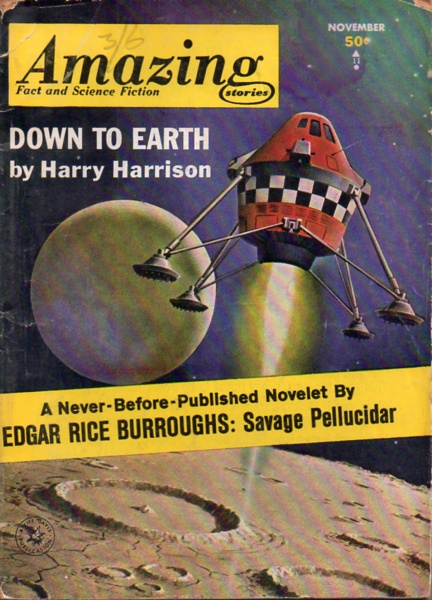
First published in the November 1963 issue of Amazing Stories. It’s been reprinted in the Harrison collections Prime Number and Galactic Dreams.
Enhancing Image
It’s 1971, the first manned mission to the moon (funny, Harrison’s anticipation of the moon landing is behind by a couple years), and quickly things are going wrong. In fact fatally wrong. One of the two astronauts, Glazer, has fallen through a crevice and there’s seemingly no way of getting him out, the crevice only deepening into a seemingly bottomless black pit as his comrade, Gino, tries in vain to keep contact with him. Glazer ends up falling presumably to his death and we never hear from him again. I feel like I’m not spoiling anything by saying that I honestly thought Harrison would bring this opening scene back, in a Chekhov’s-gun moment, but Glazer’s fate ultimately has no bearing on the rest of the story, which is an odd choice. Instead our secondary protagonist is Colonel Coye, or simply Dan, who picks up Gino on the next orbit round the moon. What happened with Glazer is treated as a minor tragedy, but then he wouldn’t be the first casualty in the Space Race and unfortunately such casualties are to be expected. What isn’t expected, and indeed what Gino and Dan can’t possibly have expected, is what the men find when they return to Earth. Houston has gone dark—indeed the whole of America seems to have literally gone dark. No lights viewable from space. Miraculously the two land safely, without Houston’s help, but this is just the beginning.
To give the story credit, I did not think we would be landing in an alternate universe where not only has World War II dragged on far past its expiration date, but that the Nazis have gained enough headway that they’ve even done what is considered nigh impossible and successfully invaded the US. This is not exactly a “Hitler wins” timeline but rather a “Hiter is about to win” one, which of course is bad news for our astronauts. It’s pretty rare to find an alternate-history narrative in which the Nazis have landed in but have not yet conquered America, so there’s a novelty factor in that. Now, on paper this sounds compelling enough, but in practice Harrison can’t be bothered to treat his own premise seriously, and despite the story’s length (it barely counts as a novelette) he speedruns through the action like he’s anxious to get to the end. In the span of just a few pages Our Heroes™ are captured by German patrol, taken in for interrogation, and then rescued by American resistance. This all happens so quickly, and the dialogue is so no-frills and on-the-nose, that it almost reads as parody. The problem is that I’m not sure what the joke is supposed to be here; it has the quick pace of a comedy, but there’s neither setup nor punchline. None of this is helped by the characters themselves being about as thin and flimsy as cardboard, with even Gino not really having a unique personality.
Harrison’s writing is very much informed by the pre-New Wave years, but even by the standards of the ’50s, when he started writing SF, “Down to Earth” is less literate and indeed more pulpy than a lot of SF from that time. It’s very much an ideas-driven story, but Harrison consistently drops said ideas and never picks them up again. Glazer’s death doesn’t play into later events at all; it barely even goes mentioned by Gino, who saw the damn thing happen. There’s a scene early on where Dan talks about this figurine he keeps that serves as a good-luck charm, but that doesn’t go anywhere either. We have scarcely an idea as to what life in the Gulf states under Nazi occupation is like, and barely any time has passed before we’re shipped off to Denver. There’s the faint implication that the Nazis were able to land in America thanks to setting up base in Central America and having connections south of the border, but Harrison makes no observations about this, and even the cultural similarities between Jim Crow America and Nazi Germany go totally unmentioned. The whole thing fails to be serious, and at the same time Harrison has maybe one joke in mind (the ending) and everything else is fluff, which is just the sort of thing that would irk me—as if Harrison wanted to push my buttons from beyond the grave. You could treat this premise seriously and easily expand the story into a novella, but Harrison did not have the motivation for such a thing.
There Be Spoilers Here
I’m not being hyperbolic when I say the character with maybe the most dialogue in “Down to Earth” is when we meet a very old but still spritely Albert Einstein. Yes, Einstein functions here as Mr. Exposition, explaining to Gino and Dan what probably caused them to shift into an alternate timeline during their return voyage. The explanation he gives reads like New Age nonsense, or at least it would if “New Age” was a thing in 1963; as such it simply comes off as silly and pseudo-scientific. I wanna mention here also that Gino and Dan are rather passive through all this, in that they do the bare minimum to avoid getting killed and end up not even being responsible for getting themselves out of this mess. The solution ends up being simple, requiring minimal imput from Our Heroes™, although as the very end reveals to us, there is a catch to all this. There’s a sort of O. Henry-style twist that I think is meant to be taken in jest, but it’s too little and too late for a story that could’ve used a lot more humor for how unserious it is. I had become just tired of it all.
A Step Farther Out
My kneejerk reaction to “Down to Earth” was that it might be the worst story I’ve ever reviewed in the four years I’ve been running this blog. I sort of detested it. Harrison is taking the piss here, but in a way that’s somehow almost utterly devoid of humor. The actual jokes seem to have gone MIA. With that said, there’s an inherent absurdity to the premise and the snap-crack pacing such that it’s mildly entertaining to think about once you’ve already suffered through reading it. The “science” is utterly bogus, but at least Harrison is barely even pretending that one ought to take the scientific aspect seriously. It’s unfortunately just not good in any sense that matters, sorry to say. The best thing that I can say, aside from the absurdity, is that it at least goes down quickly enough.
See you next time.


One response to “Short Story Review: “Down to Earth” by Harry Harrison”
BC: ‘My kneejerk reaction to “Down to Earth” was that it might be the worst story I’ve ever reviewed in the four years I’ve been running this blog. ‘
It isn’t even actually a story, as you describe it. It sounds suspiciously like a script, which maybe Harrison couldn’t sell, for a 1950s-era 8-12 page comic book short, of the kind that E.C. and Marvel — when it was still called Atlas and Jack Kirby was still drawing the monster of the month there before the superhero thing returned in the early ’60s — would publish two or three of each issue.
That way, as a short comic script, the artist could carry it, giving the kids a couple of pages of pics of the astronauts on the moon with one of them falling down the ravine there, then the trip back to Earth, then the Nazi-occupied US, then the alternate Einstein, and then the trick ending — they’ve ended up in an alternate timestream, kids!
That would explain the breakneck pace, and the fact that there’s no logical connective tissue between any of it and no actual story. It might even have been cool if Wally Wood or Kirby did the art.
LikeLike