Who Goes There?
Roger Zelazny was born in 1937 in Ohio, raised Catholic but later identifying as agnostic. While Zelazny would become irreligious as an adult, his interest in religion and mythology proved genuine, as this would be a key driving force behind his work, a career spanning a little over thirty years. Zelazny started writing for amateur publications when he was a teenager, but it was his professional debut in 1962, in Amazing Stories, that marked the genuine introduction of one of the major SF talents of the ’60s and ’70s. His relatively early death in 1995, from complications with colon cancer, came tragically after he had finally given up smoking. (Read any early Zelazny story and there’s a good chance the protagonist smokes cigarettes or a pipe.) His final solo novel, A Night in the Lonesome October, indicated a writer who was by no means running low on inspiration, even if said novel is preoccupied (albeit somewhat playfully) with death. While Zelazny’s books have never sold all that much, even with his Amber series, he’d prove hugely influential on the likes of George R. R. Martin, Andrzej Sapkowski, and (God help us) Neil Gaiman. His literary DNA can be found in many pockets of modern fantasy writing, although weirdly his influence is not as overt in the world of SF, despite his contributions.
A big reason for Zelazny gaining more traction with his fantasy than his SF (despite the latter winning more awards when he was alive) may be that he seemed more comfortable appearing in Fantastic than Amazing from the outset. Cele Goldsmith, editor of both magazines in the early ’60s, printed Zelazny more often in Fantastic, and indeed bought so much of his material in those first few years that he occasionally appeared under a pseudonym in the same issue as a story under his own name. “The Furies” is one of the few long Zelazny stories to appear in Amazing during this time, along with the Nebula-winning serial He Who Shapes. This is not quite major Zelazny, but it’s a curious experiment in narrative structure and what characters the reader is expected to sympathize with. It also, at least with hindsight, reads as unusual compared to other Zelazny stories from around the same time because of its lack of a typical Zelazny protagonist. To this day it remains a bit obscure, but it probably shouldn’t be.
Placing Coordinates
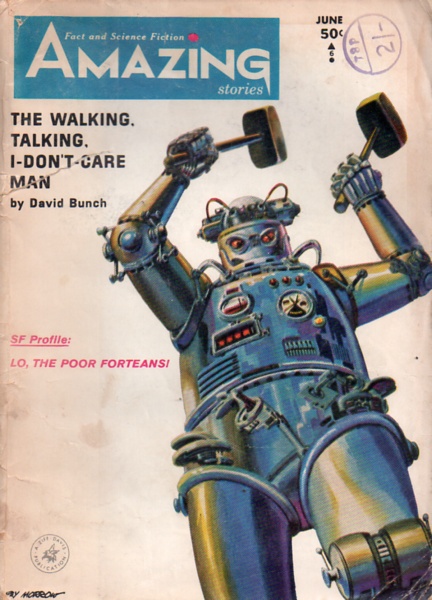
First published in the June 1965 issue of Amazing Stories. It’s been reprinted in the Zelazny collections Four for Tomorrow, The Illustrated Roger Zelazny, and The Doors of His Face, the Lamps of His Mouth.
Enhancing Image
I said that “The Furies” lacks a typical Zelazny protagonist (tortured, romantic, intellectual, sarcastic, likely a smoker), but that’s because we get three (arguably four, more on that later) for the price of one. First up is Sandor Sandor, a prodigy who despite suffering from agoraphobia and a phycail disability (he has to use prosthetics for three of his four limbs) may be the best landographer (I’ve been informed that “landography” is not a real word) in the known universe. He’s like a human GPS, in that he can calculate distances and locations on any known planet without even consulting maps by the time he’s an adult. Now, this is totally implausible, but it becomes quickly apparent that the mind powers our characters possess are not to be taken at all that literally. Benedick Benedict (I know, these names) is an empath, of sorts, who on touching people’s skin and even inanimate objects is able to gaze into thoughts and memories. Such an interaction always makes him weep—not because of emotions but more as a nervous reflex, and during these moments he can’t help but yap about what he’s seeing. With this extra-sensory ability he’s garnered a reputation as someone you’d rather not cross paths with unless you wanna use his ability for something specific. Such an ability would also pay well. Finally there’s Lynx Links, also known as “the Lynx,” now retired but formerly one of the most ruthless and successful field agents around, with dozens of humans and aliens’ heads (figuratively) mounted on his wall.
As the narrator tells us, “This is the story of how [the Lynx] came to be summoned back from Hosanna, the World of the Great and Glorious Flame of the Divine fafe, and was joined with Sandor Sandor and Benedick Benedict in the hunt for Victor Corgo, the man without a heart.” The style of the narration is sentimental, fable-like, in a way typical of early Zelazny, although said style feels even more extreme in execution here. Or maybe it’s because this is a longish novelette, although it’s not as long as the page count would make you believe. At its core it’s an adventure narrative, with maybe a moral to give at the end. The three amigos are hired to track down a once-respected Guardship captain who has since gone rogue, with the aim of taking revenge on humanity. Sounds simple, and with a rather cliched villain motivation; but this is where things get interesting. Victor Corgo is the captain of the Wallaby, once called the Happy Wallaby, but a government-backed genocide of the Drillen. an intelligent race of quadrapedal aliens whose existence proved to be inconvenient. Zelazny would take this idea of alien life as stand-ins for real-world indigenous peoples in other stories, but this might be the first time he did this theme in the context of colonialism and genocide. It’s a theme that resonates to this day, and unfortunately it’ll probably continue to resonate for the rest of my life. That Corgo has been destroying ships indiscriminately is pretty bad, no doubt, but I can think of worse reasons for doing all this.
Perspective shifts between the three heroes and Corgo, and this doesn’t always come down to a third-person narrator, as Benedict is able to read Corgo’s mind—to an extent. Ya know, Corgo had died. But then he got better. This is coming down to his real heart being replaced with a cybernetic one, which even gives him incredible healing abilities—or rather, it’s able to manage his insides better than a human heart would. Mind you that in 1965 we were still a few years off from the first artificial heart transplant. But with Corgo’s real heart in possession, Benedict is able to get glimpses into the captain’s mind, even though he might be many light-years away. This is, as you might say, kinda out there, to the point where it almost comes off as fantasy. Sandor, Benedict, and the Lynx are less people than they are representatives of certain elements, which was by no means unintended on Zelazny’s part, as the ending will have us know. Ironically the most human character here, in the Shakespearean sense, is Corgo. You may also notice, if you’re reading “The Furies,” that like a lot of early Zelazny it’s slim pickings in terms of female characters; indeed the most notable woman here is not a human at all, but the single Drillen Corgo took from the planet. Their relationship is—let’s say ambiguous. There’s a rumor that they’re in a romantic relationship (Benedict calls him a “zoophilist”), and given that the Drillen possess human-level intellect and communication it’s possible; but I don’t recall that being confirmed in-story. Well, no matter. Their relationship is shown to be a warm one.
The result is a long and yet more narratively straightforward precursor to “The Keys to December,” published just a year later but showing Zelazny making strides in maturity. Of course, the most unique thing about “The Furies” is also a bit of a structural problem, since Corgo becomes the most sympathetic and understandable character here (the “heroes” remain always somewhat at arm’s length from us), but at the same time he’s positioned as the villain. Your enjoyment of “The Furies” will depend on how you cope with this, and also the unusual style Zelazny uses. He wrote it as if it were meant for children, but it’s really not.
There Be Spoilers Here
In a way the ending is inevitable, and tragic because of its inevitability, but unfortunately it’s also corny. Truth be told, I just wish Zelazny or Goldsmith had taken an eraser to the final paragraph, since it makes the moral of the story and the nature of the three heroes too obvious. I had heard that “The Furies” was not Zelazny’s preferred title, which is not surprising (in the old days a story’s and even a novel’s title would be changed in the time between submission and publication), but even with that in mind, the ending could’ve been worded a lot better.
A Step Farther Out
We’ve reached the end of the Amazing Stories marathon for July, ending on a flawed by worthwhile Zelazny title. Zelazny was one of several notable authors whose early years Cele Goldsmith helped nurture. Incidentally the June 1965 issue was also the last credited to Goldsmith. Ziff-Davis gave up the magazine after this, and Goldsmith went with them. She got a better-paying job as editor-in-chief of Modern Bride, and rarely did she seem to look back on her short but important tenure at Amazing and Fantastic. Zelazny would also move to bigger and better things, and at an impressive speed at that. Not since Robert Heinlein a couple decades earlier had there been so meteoric a rise for a genre SF writer. He won two Nebulas the first year the awards were given, for the aforementioned He Who Shapes and “The Doors of His Face, the Lamps of His Mouth.” He’d win a Hugo for his debut novel This Immortal, and this was all by the time he turned thirty. “The Furies” not being at the top of the early Zelazny stories isn’t really a knock against it, since it had some stiff competition.
See you next time.


One response to “Short Story Review: “The Furies” by Roger Zelazny”
It’s not peak Zelazny but it’s far from the worst.
This was one of the stories adapted for “The Illustrated Roger Zelazny” and it might be the only one where I like the comic-book version better.
LikeLike