Who Goes There?
Robert Bloch is one of those rare prodigies in prose writing, having solder his first story when he was all of 15 or 16. He was born in 1917 in Chicago, although he eventually moved to LA where he became a prolific TV writer. Bloch was the youngest member of the so-called Lovecraft Circle, which saw such luminaries as Robert E. Howard, Clark Ashton Smith, C. L. Moore, Henry Kuttner, and others. He corresponded furvently with H. P. Lovecraft in the last few years of the latter’s life, with Lovecraft giving the very young Bloch feedback on his stories. The two even wrote stories for each other, each fictionalizing the other, with Bloch writing “The Shambler from the Stars” and Lovecraft responding with “The Haunter of the Dark.” It shouldn’t come as a surprise that Bloch was one of the first to expand on the then-unnamed Cthulhu Mythos, and this interest in the Mythos would show in Bloch’s fiction up until at least the 1970s. The irony is that while a lot of folks may recognize Bloch’s name, far fewer would be aware of his many contributions to cosmic horror as we now understand the term. This is not even getting into Bloch’s interviews, lectures, etc., in which he shows himself to be a pretty shrewd student of genre history.
“The Opener of the Way” is a pretty early Bloch story, although considered major enough that it served as the title story of his first collection. Bloch was only 19 when this story was published, but by this point he had already appeared in Weird Tales about half a dozen times, and indeed would continue to appear regularly in that magazine until its demise (well, first demise) in 1953. This story follows a genre trend that had been going on since at least the late 19th century, namely the Orientalist fascination with the ancient Egyptian pantheon (especially Anubis, but we’ll get to him) and The Egyptian Book of the Dead. It wasn’t even Bloch’s first story that he wrote on Egypt, but it works as a notable stepping stone for a very young and eager writer who was learning the ropes quickly.
Placing Coordinates
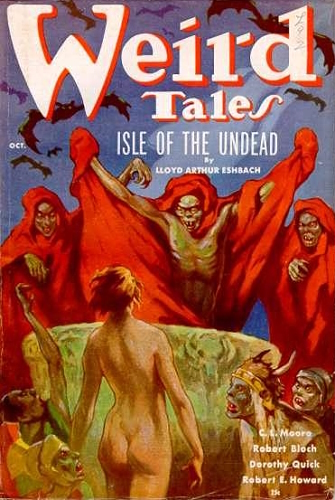
First published in the October 1936 issue of Weird Tales. It’s been reprinted in The Macabre Reader (ed. Donald Wollheim), The Boris Karloff Horror Anthology (ed. Boris Karloff [yes, that one]), and the Bloch collections The Opener of the Way and The Early Fears.
Enhancing Image
Curious choice Bloch makes right off the bat is to start “The Opener of the Way” near the climax of events, before rewinding the tape. Sir Ronald Barton and his adult son Peter have combed the deserts of Egypt with the hopes of uncovering a tomb dedicated to the god Anubis—a tomb which has not had a single human foot set in it for 3,000 years. Anubis, as you probably know already, is the god responsible for gatekeeping the afterlife, with the body of a man but the head of a jackal. The two men find the 12-foot-tall statue at the end of a passage, and we get this bit of description: “The arms of the statue were held forth in an attitude of warning, as if endeavoring to repel the passage of outsiders. This was peculiar, for to all intents and purposes the guardian figure had nothing behind it but a narrow niche in the wall.” There is nothing physically behind the statue, or so it seems; yet according to Ronald, this statue is supposed to be hiding Anubis’s original form, not the form of a jackal-man but as something even older, and perhaps more sinister. Of course, it’s only a statue—dead as the dodo. At the same time, though, the Egyptian laborers who did the grunt work of uncovering the tomb seem ill at ease about it. But Egypt has been a Muslim country for centuries, and the old gods are not coming back. Peter himself increasingly worries about his dad’s sanity, and with good reason.
We’re not told exactly how old Ronald is, but given his white hair and wrinkly skin he’s at least in his sixties, and he’s been working in Egypt as an archaeologist for the past twenty years. He’s also, maybe, just a little insane, although he was surely a normal man at some point in the past. Bloch notes that Ronald being a little haggard, mentally, would not be unusual for someone in his profession, as there is something hostile in the environment that, given enough time, might push any (white) man over the edge. Bloch doesn’t make a big deal of this, probably because he didn’t think that deeply of the racial dynamics inherent in his story, but Ronald and his son are white Englishmen in a land whose culture goes back to the time of the pharaohs. Despite the setting, the Egyptians themselves barely play a role at all, being only called “the natives,” and without there being any named Egyptian characters. This whole thing got started because Ronald took it upon himself to steal an ancient parchment, tucked alongside the mummy of a disgraced priest. In a juicy little detail, the priest’s body had long since had its limbs and even its eyes removed, yet the parchment remained. The priest had a curse put upon this tomb dedicated to Anubis, and if one wants to see what’s “beyond” the statue and live then there are several steps that must be taken. Now, because this is a Bloch story, you probably have an idea as to how things for the two men will turn out.
“The Opener of the Way” does not count as part of the Cthulhu Mythos, but it does have a strong tinge of cosmic horror, not to mention the occult. The basic idea here is that the image of Anubis we know is merely a front, or rather a form made to be presentable to human eyes, as the true form of Anubis may well drive one to insanity. Indeed, the true form of Anubis may even be pre-human. “The enchanter who had written [the parchment] alluded to gods far older than those he worshipped. There was mention of the ‘Demon Messenger’ and the ‘Black Temple,’ coupled with the secret myth and legend-cycles of pre-Adamite days.” This is exactly the sort of passage one would find in, say, Robert E. Howard’s “The Black Stone,” which is a Mythos story. That throwaway phrase of “pre-Adamite days” implies some kind of pre-human era. Well, there were giants in the earth in those days. The implicit belief among so many followers of the Abrahamic religions is that essentially God did not exist prior to the advent of mankind; or, if you wanna think of it another way, God for some reason spent some time twiddling his big thumbs waiting for mankind to arrive. Yet keeping with the tradition of cosmic horror, humans are puny compared to the power of the old gods. Anubis as a jackal-man may just be an invention, made up by humans, as a way to placate followers, for the truth (an unspeakably old truth) would be too much for them.
I mentioned before that according to Dashiell Hammett, an effective weird tale should make the reader feel that the impossible might just be possible after all, but very much undesirable, regardless of whether the reader went in already believing in the story’s notions. Nobody alive today believes in the ancient Egyption pantheon, but an effective story about said pantheon should temporarily make a believer out of the reader. “The Opener of the Way” does this quite well, in no small part because of how it uses Peter as an audience surrogate. Peter is a young man, probably in his twenties, and he starts out as totally dismissive of his dad’s belief in the old manuscript. If we remap event into a linear order, we can see Peter gradually become convinced that there’s something wrong with the tomb, the inner passageway with the Anubis status, and last but not least Ronald’s eroding mental state. The manuscript with its telling of the curse is clearly having some kind of effect on the old man, if not necessarily a supernatural one—although let’s face it, we know something spooky is up.
There Be Spoilers Here
There’s an important step to surviving the curse that unfortunately Ronald doesn’t take heed of, and that is the rule that nonbelievers will die, their souls sucked out of their bodies and merged with Anubis. Ronald gives the excuse that surely this is not meant to be taken literally and is simply meant to ward off would-be looters; but he ends up being tragically mistaken. Both father and son end up dead, the former having murdered the latter against his will. To add a little salt on the wound, when the Egyptian labors journey down 700 feet below the desert’s surface to find the slain explorers, they simply leave the bodies there to rot, writing them off as suicides. Nobody will ever know the discovery Sir Robert had come so close to making—unless, of course, some perhaps similarly ill-fated explorer discovers the bodies years or decades hence. The manuscript the long-dead priest had written will still be there. Looters might eventually come for the very clothes on the dead men’s backs, but not the manuscript.
A Step Farther Out
Pretty enjoyable, if also derivative. Bloch was a skilled writer from the outset, but like every young writer he did what was most logical: he mimicked his favorite authors. This is not a negative criticism, by the way; rather it’s a perfectly natural step a writer takes when in the process of finding their own voice. The first stretch of Bloch’s career is very much downstream from Lovecraft, but there’s a humor (especially a love of puns) and wilful irony in Bloch’s work that Lovecraft would’ve never entertained. But “The Opener of the Way” is uncharacteristically serious for Bloch, which would be a problem if it wasn’t handled deftly. I could take a fine-tooth comb and nitpick about some turns of phrase, showing a lack of refinement in Bloch’s style at this early junction; but just imagine trying to write anything remotely this good when you were 18. Yeah, I thought so. It’s spooky, it’s well-paced, the decision to tell events out of order was a neat move, and the ending has an air of grim tragedy that’s honestly stuck with me.
See you next time.

