Who Goes There?
I unintentionally took a mini-vacation from writing this month, hence why it’s been a week since my last post, and also why I ended up skipping over a couple stories I had set out to cover. The first reason is that I was feeling a strange lack of inspiration and went through a little bout of writer’s block. The second reason has more grounds in objective reality: As you probably know already, AI (not generative AI, but AI that’s nowadays commonly used in coding) detected a long-standing and long-hidden bug in PHP that would allow any amateur hacker to break into the majority of the world’s websites, including the really big ones. Numerous sites worked behind the scenes over the next 24 hours or more to fix the issue, because it’s actually a really big issue, and some sites went down entirely (albeit temporarily) because of this. As far as sites I use regularly goes, ISFDB might’ve been hit the hardest, as it was straight-up out of commission for about three days. Now, I use ISFDB to track down sources for stories, dates, credited artists, and so on; without it, running this blog would become nigh impossible. So I spent a few days twiddling my thumbs, waiting for ISFDB to go back up, and in the meantime I figured I should put Thomas Ligotti and Lucius Shepard aside for a moment and improvide a bit.
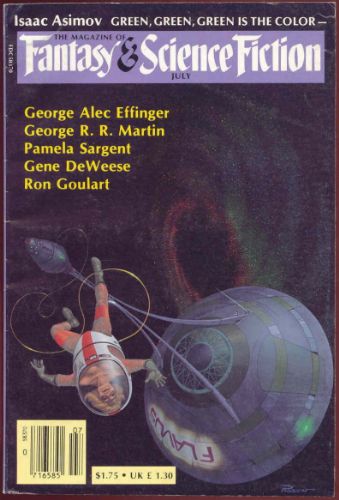
Let’s talk about Pamela Sargent, then. Sargent was born in 1948, in Ithaca, New York (I almost went to college in Ithaca, little fun fact), and as far as I can tell she’s lived more or less her whole life in New York (albeit not NYC). She made her debut in 1970 with “Landed Minority” in the pages of F&SF, although this story has never been reprinted. She’s written quite a few novels since the ’70s, including a few Star Trek novels, but fans of genre history would most know her for her trilogy of landmark anthologies published in the ’70s, the first being Women of Wonder. This won’t come as a shocker or anything, but Sargent came of age when second-wave feminism sprouted up in the ’60s. The long history of women in genre SF is a thorny one, although there had in fact been women writing SF under their own names since the days when Hugo Gernsback ran Amazing Stories. At the same time, while there were women writing in the field since the beginning, their stories were rarely collected or anthologized up until the ’70s. Sargent’s work, as both an author and editor, can thus be thought of as indicative of a major turning point in the field’s history. This is all kind of a funny lead-up, truth be told, because “The Old Darkness” is not SF, nor does it (at least explicitly) tackle feminist issues; instead we have supernatural horror of the allegorical variety, albeit with a female lead.
Placing Coordinates
First published in the July 1983 issue of The Magazine of Fantasy and Science Fiction. It’s been reprinted in The Best Horror Stories from the Magazine of Fantasy and Science Fiction (ed. Edward L. Ferman and Anne Jordan) and the Sargent collection The Best of Pamela Sargent.
Enhancing Image
It starts like an ordinary blackout, with severe weather cutting off power in the neighborhood one evening. Nina is in the middle of cooking dinner while her husband Andrew is watching a baseball game, when suddenly their evening plans get thrown out the window. Now all is dark, and worse yet the storm outside is too harsh to go driving in. At least Nina can finish dinner with the help of candlelight, but there’s still the question of what to do until the power comes back on. Nina is in a poor mood, but little does she know things are only about to get worse. Before we get into the interpersonal-drama side of things, let’s consider an early passage that hammers home what might be the story’s key theme so pointedly that it honestly might be a red herring—at least I hope:
[Nina’s] grandparents, believers in progress, had always told her things were better now. Human minds had been darker when people couldn’t read late at night, their prejudices greater when they had lacked television’s images of other places, their work harder without the appliances many took for granted. Nina was not so sure; technical civilization had isolated people from the basics of life, and had fooled them into believing that they controlled the world.
As you can tell from the title and the premise, “The Old Darkness” is about mankind’s primordial fear of the dark; it’s possibly the oldest kind of fear one can develop. Both little kids and adults are uneased, albeit to different degrees, by an unlit room or corridor. It could be that darkness per se doesn’t scare us so much as the obscurity that comes with darkness. A blackout can (and occasionally does) happen in your neighborhood and everything electric in the house you’ve been living in for the past ten years suddenly adds up to zero. If night comes, which in my experience happens often when it comes to power outages, you might set out candles you had bought months ago for such an occasion; but even with these dim pockets of light, you might not always be sure of where you are or where everything else is. Your sense of placement becomes foggy. If you’re unlucky, a power outage can last a few days instead of just a few hours.
For better or worse, Nina and Andrew are not alone in all this, as Rosalie, a close neighbor of theirs, knocks on their door and is invited in. Rosalie, unlike Nina, is a divorcee; and while she typically is on good terms with her ex-husband, it takes her all of two minutes to start complaining about him. It also takes as much (or as little) time for Andrew to start insulting Rosalie’s taste in music. The blackout seems to have everyone on edge, although in Rosalie’s case it could’ve also been because she overheard the O’Haras, her downstairs, get into a heated argument before she went over to Nina’s place. I think it’s worth mentioning here that these people all live in the same apartment complex, in what is only called “the valley,” location unknown. Soon we have three more guests with the Levitases: Jill, Tony, and their little daughter Melanie. Now it’s like a fucking party in here, but as they say, familiarity breeds contempt.
“The Old Darkness” is a short story, not quite a novelette, that can be split into two halves, the first in Nina’s apartment and the second when they go outside. It’s hard to discuss the back half without getting into spoilers anyway, but I do prefer the first half’s claustrophobia and sense of inner turmoil. You could also say the scenario depicted here is “realistic,” but I’d say that actually Sargent may have taken inspiration from stage dramas with the story’s first half. We’re stuck in one rather cramped location, with characters coming and going from “off-stage,” and to add to it, there’s this theatricality with the dialogue, a “heightened” sense of drama. People don’t really talk like this in real life, although they do talk like this on the stage and on film. If you’ve seen or read one too many domestic dramas then “The Old Darkness” might strike you as a little too familiar. At the same time, the melodramatic dialogue works in this context, since we’re stuck in Nina’s shoes and she has to deal with a somewhat irate husband and even more irate neighbors. At one point the third-person narrator rather bluntly tells us, “Nina felt trapped,” and it’s easy to sympathize with her.
Even early on there are some potential supernatural moments, albeit these same moments could be chocked up to coincidence or people’s tightened nerves affecting their perceptions. One throwaway bit of dialogue I didn’t pay any mind on my initial reading is when Nina, in attempting to entertain Rosalie, brings up “a legend that the first people who settled in this valley disappeared—just vanished into the woods.” Not very subtle foreshadowing here. Of course, Nina has been living in the valley her whole life, except for when she went to college. This is an important detail, because while she may not be as outwardly miserable as the divorced Rosalie or the bitterly married Jill and Tony, Nina has the air of someone who’s been living in her hometown for too long, like a bird that’s come to resent its cage. Like I said before, familiarity breeds contempt, and now there are six unhappy people stuck in a one-bedroom apartment. So far this could all be adapted into a one-act play, and even with what happens in the back end of the story it’s easy to imagine a stage version.
There Be Spoilers Here
The last third of the story sees Nina and Andrew leave their neighbors behind and the “stage” expand considerably. By the time we leave the apartment it’s become apparent that all hell has broken loose in the streets, with the couple’s car breaking down and the threat of getting trampled or beaten being more immediate than whatever supernatural force has caused the neighborhood to not only be without electricity but all but cut off from the rest of the world. In a way I expected it, but I don’t find this “explosive” climax to be as compelling in execution as it might’ve seemed to Sargent when writing it. Maybe it’s also the fact that while I dislike crowds, I dislike the prospect of being trapped in cramped spaces with moody people even more. The bulk of “The Old Darkness” could honestly be read as a precursor to the sort of claustrophobic horror we’d see more often post-COVID, but the climax unfortunately breaks the spell.
A Step Farther Out
“The Old Darkness” dares ask the question: Are straight people okay? The answer is: Obviously not. It’s an allegorical horror story about becoming disillusioned with one’s living situation, or in the case of Nina, being stuck married to a guy who’s sort of obnoxious and in an apartment complex with people you may or may not get along with. There’s a satirical element at play here, although I wouldn’t call it humorous. The decision to make the encroaching darkness itself so poorly defined is one that’ll inevitably turn off some readers, and even on my end I have to admit that my interest waned once the supernatural presence became more overt. What Sargent does really well here is less invoking a fear of the dark and more a fear of people. The biggest threat, ultimately, is an unruly crowd. Do I recommend it? Sort of. You could say tentatively.
See you next time.

