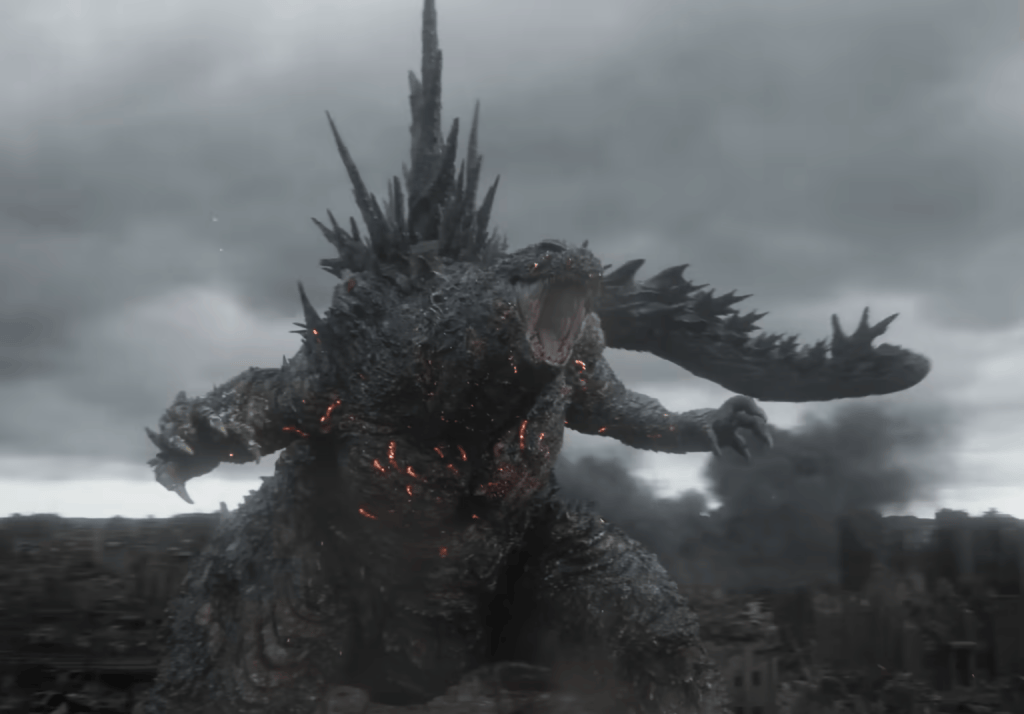
I’ll be delving into some minor spoilers for Godzilla Minus Zero, but by extension I’ll be also mentioning MAJOR spoilers for Godzilla Minus One, if you’ve not seen that movie.
Godzilla Minus One was one of the big genre surprises when it came out in 2023, and even as a lifelong Goji fan I was taken aback by how much it committed to being both a historical melodrama and a blockbuster about a giant lizard. It was one of my three or four favorite movies the year it came out, and its Oscar win for Best Visual Effects seemed to signal a new golden age for the franchise. True, there have been a few solid movies coming from the US (I still hold the 2014 movie as one of the stronger entries in the franchise, you can fight me on that), and Shin Godzilla is supposed to be pretty darn good (I’ve not seen it yet, it’s the one [live-action] Japanese Godzilla movie I’ve not gotten to), but when Minus One came out it struck a lot of people as kind of a revelation. It was the first Japanese Godzilla movie in seven years, and rather than follow up on Shin Godzilla or even the original 1954 movie in any way, it gives us an alternate origin story for the big G. Set mostly in 1947, when post-war Japan was still in the early stages of rebuilding and rehabilitating its own image on the international stage, Minus One doesn’t give us Godzilla knocking down skyscrapers (he does royally mess up a train, in what’s clearly an homage to the 1954 movie) but rather it delivers spectacle of a different sort.
Director/writer Takashi Yamazaki and his team did something pretty impressive with Minus One, with Yamazaki even winning an Oscar as VFX supervisor—something that’s unheard of for a non-English movie. Between the film’s critical and commercial success (Toho actually extended its theatricul run in the US due to very good word of mouth) and the way Minus One ends with a sequel hook, as Godzilla’s still-beating heart lurks at the bottom of the sea, obviously a sequel was gonna happen. Godzilla in this continuity has a fuckass Wolverine regeneration ability, courtesy of having survived nuclear fallout; and since he’s practically unkillable, the logic goes that for the sequel you can’t just have Godzilla as the villain again. Koichi, the angsty hero of Minus One, has also more or less finished his emotional arc from that movie, so there’s not much more you can do with him from a storytelling angle. There’s Noriko, Koichi’s semi-platonic love interest (their love life seems to be completely devoid of sex, for reasons never given), who miraculously survived the third act of Minus One. The two have taken to raising Akiko, a war orphan who’s an infant in Minus One but who has since grown into a young girl by the time of Minus Zero. Finally, there’s the amiable Dr. Noda, who it turns out is suffering from both survivor’s guilt and his part in imperial Japanese war crimes.
Taking place two years after Minus One, Minus Zero sees Koichi and Noriko living happily together with their adopted daughter, even if Noriko now dons an eyepatch 24/7. Unfortunately, the good times are not to last, since there’s a new kaiju on the horizon, a huge dragon (actually more like a wyvern, if you wanna be pedantic) that comes to be named King Ghidorah. Now, at this point Ghidorah has one head and one tail, as opposed to his usual look, but people familiar with this series are not to be fooled. There’s also the problem of the Americans, as Japan was still very much under American occupation in 1949, a tertiary but crucial fact in Minus One but pulled into focus in Minus Zero. So we have a new kaiju we’re told probably (the film is surprisingly wishy-washy about how exactly Ghidorah got here) came from outer space, a monster that can fly and which also seems to be evolving at an accelerated rate. Noda and his team come up with a rather esoteric method of maybe killing Ghidorah, but we know damn well this is not gonna work out. At this point we (or rather characters) get word that Godzilla is alive, but then the question becomes one of where the hell Goji could be—a question that goes unanswered for at least an hour of the movie, aside from a brief daydream sequence (said sequence has been shown in marketing without context, by the way).
The challenge Yamazaki made for himself with a sequel to Minus One was having both to raise the stakes and justify bringing back Godzilla himself somehow; he does the former well enough, but the latter not so much. Truth be told, part of me was hoping we would get a new set of characters with Minus Zero—maybe carry over Noda, but leave Koichi and Noriko alone. But, of course, Koishi gets roped into flying a plane again in the vain hope of taking down Ghidorah somewhat early in the movie, and just as predictably he’s the only one of his squad to survive the encounter. Having plot armor certainly helps, huh? Yet there’s no plot-relevant reason for Koichi to be in this movie, nor is there even a thematic one any longer. In Minus One, Godzilla served as both destroyer and redeemer in the context of Koichi’s arc, but that connection between the two has since been severed, not helped by the fact that Godzilla barely exists in his own movie. It’s a long-running tradition in the franchise for Godzilla to not have that much screentime, but given Minus Zero is the longest Japanese entry in the franchise at 135 minutes, the share Godzilla gets here in both screentime and plot relevance is positively dire. It’s like Yamazaki, during the screenwriting phase, struggled to come up with a justification for Godzilla appearing in his own movie, and this struggle shows in the end result.
See, an incredible thing about Godzilla as a “character” is that for being a giant radioactive dinosaur who doesn’t talk or have any kind of knowable interiority, he’s a versatile figure who’s worn a number of different hats over the decades, coming to represent a number of things and with each Goji having its own temperament. In the 1954 film, Godzilla exists as a personification of Japanese wartime trauma, representing both that country’s pain suffered at the hands of the US as well as Japan’s own bloody warpath throughout East Asia. In the bizarro world of Godzilla vs. Hedorah, Godzilla is a kind of capital-N Nature guardian who’s so revered by humans that he has action figures and other merchandise. In one of his most memorable one-off appearances, Godzilla, Mothra, and King Ghidorah: Giant Monsters All-Out Attack (what a title), he’s an actively malicious revenant with pupilless eyes, a specter of that old Japanese militarism that’s come back to tear apart the country. In Minus Zero, Godzilla doesn’t represent a goddamn thing, nor does he have any emotional connection with the main characters this time around; he sort of just exists in this one, you could say as a neutral force. Koichi doesn’t even see Godzilla at all until the third act, and in this context it’s Ghidorah everyone is far more worried about. Instead Koichi spends most of the movie sort of just moping about and getting into arguments with Noriko, who (and this is a positive for the film) conversely emerges as a heroine with some measure of interiority. A gripe one can have about Minus One is that Noriko basically existed as a satellite orbiting Koichi, but here it’s the other way around if anything.
(As an aside, there’s a twist with Noriko in this movie that I won’t give away here, but it’s such a stupid fucking plot development [in a charming way] that it reminded me of something that would happen in one of the Showa- or Heisei-era movies. Remember that one recurring character in the Heisei period who’s a telepath? It’s like that.)
Koichi unfortunately gets put on the backburner for the most part, and the crewmates/friends he made working that boating job in Minus One are treated as an afterthought here. We do get a few new characters here, most notably the “mad” scientist Dr. Murakami, who appears perfectly civil but who has a secret vendetta. It’s just that the cast in Minus One was mostly blue-collar types, people working menial jobs or just trying to find employment in the aftermath of the Ginza district getting wrecked from the war; but in Minus Zero we’re stuck with scientists, military guys, and politicians. Ew. There’s a working-class sensibility about the preceding movie that’s been all but scrubbed away here, and I can’t help but feel like something important to these movies’ (the Minus duology, that is) collective identity has been lost. Minus One is very much a crowd-pleaser, and works wonderfully as such, but that movie’s populism has been replaced by the implicit need to appeal to an even more general (and therefore less discerning) audience. Minus Zero is, even more so than its predecessor, concerned with being “a hit,” and this preoccupation with aligning with the standards of modern American blockbusters (despite, ironically, the Americans themselves being depicted as shadowy and unscrupulous in the movie) is to its detriment. Sure, it’s rated R in the US, the first R-rated Goji movie, but the extra amount of blood doesn’t mean a whole lot; honestly you could’ve appealed for a PG-13. If Minus One takes cues from Jaws, not to mention the 1954 Godzilla, then Minus Zero feels like one of the lesser Heisei- or Millennium-era movies, just with much fancier (if at times still janky) VFX.
I’ve been sounding pretty negative, because I spent about a year getting hyped for this movie, even if my expentations did simmer down some once it came out that King Ghidorah would be the “other” kaiju in the equation. Minus Zero is my second or third favorite film in the franchise, but unfortunately the way Minus Zero tries to build on top of its predecessor makes me like said predecessor just slightly less, if only because that sequel hook at the end (which admittedly you could argue was questionable from day one) now feels like a tactical error with hindsight. Minus One works best as a totally standalone movie, rather than as the first half of a duology, whereas Minus Zero can only exist as a sequel, and as a sequel that really didn’t need to happen at that. Of course, there’s some good stuff in there, and it evidently shares the same bones as Minus One; but while it’s bigger, bloodier, and supposedly more action-packed, it also does considerably less with more. It barely even counts as a Godzilla movie, given Goji himself only shows up for about five minutes, and whose very appearance reads as contractually obligated. I just hope the next Japanese Godzilla movie will be, like Shin Godzilla and Minus One, its own thing, but unfortunately that doesn’t look like it’ll be the case.

