Who Goes There?
What do we know about H. F. Arnold? We know his full know is Henry Ferris Arnold, that he was born in 1902 in Illinois, that he apparently died in 1963, and that he has a grand total of three genre stories to his name. We can infer he worked as a journalist or wire operator, but that’s just going off of what is by leaps and bounds his most famous story; and as you probably know already, trying to reverse-engineer an author’s life through their work is a hazardous maneuver. Arnold appear suddenly with “The Night Wire” and then, with a couple exceptions, fell completely off the map. “The Night Wire” is a short-story story, clocking in at just over a measly 2,400 words and published when Arnold would’ve been all of 24; yet it’s one of the most reprinted stories to ever come out of Weird Tales, especially if we’re discounting Lovecraft, Robert E. Howard, and those of their league. There are several authors who were both popular and prolific in Weird Tales at the time who have since turned to dust, yet this one story has outlived them, to the point where it exists totally separate from its own creator. That alone you have to admit is interesting. Anyway, today’s review is gonna be short and sweet, in keeping with the story.
Placing Coordinates
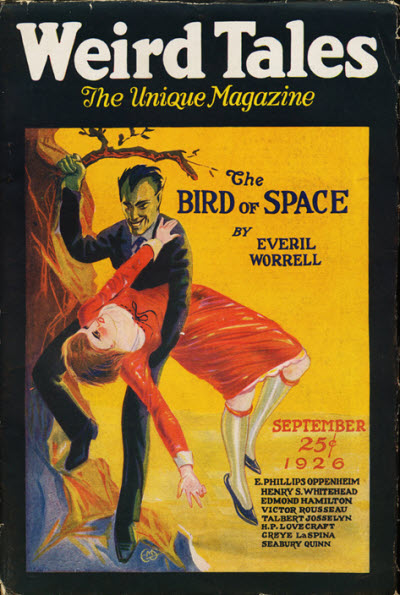
First published in the September 1926 issue of Weird Tales, then reprinted in the January 1933 issue. Its other reprints include, but are not limited to, The Night Side (ed. August Derleth), Masterpieces of Terror and the Supernatural (ed. Marvin and Saralee Kaye), 100 Ghastly Little Ghost Stories (ed. Stefan R. Dziemianowicz, Martin H. Greenberg, and Robert A. Weinberg), and The Weird: A Compendium of Strange and Dark Stories (ed. Ann and Jeff VanderMeer). Because “The Night Wire” is in the public domain, you can read it free online, including Wikisource.
Enhancing Image
Arnold had never written a short story before this, or at least never had one published under his own name, and in a way you can tell. “The Night Wire” reads less like a short story in the traditional sense and more like what used to be known as a hoax narrative, of the sort Edgar Allan Poe sometimes wrote—stories which were not advertised as fiction, and narrated in such a way that the events described can be taken as real by the undiscerning. The narrator, Jim, tells us this story as if it were true, as if Jim were a real person and the weird things recounted from here on are things that really happened. There’s the Poe-style hoax story, but then there’s what seems to me the more overt influence on Arnold’s writing, which is Rudyard Kipling’s short fiction. A good deal of Kipling’s short fiction, especially early on, reads like a journalist’s recounting of “true” events, most famously done with “The Man Who Would Be King,” but other Kipling stories that come to mind here would be “The City of Dreadful Night” and “At the End of the Passage.” Kipling was a capable horror writer, despite not being usually thought of as such, and I have to think Arnold, who may have also started in journalism, took some cues from Kipling’s playbook.
“The Night Wire” has a frame narrative and then a narrative inside that frame, first with Jim and his sole wire operator, John Morgan. [Morgan was one of the best operators I ever knew, what is known as a ‘double’ man. That means he could handle two instruments at once and type the stories on different typewriters at the same time.” Basically how this works is that Morgan has a headset for receiving radio messages, which he then transcribes via typewriter. Unusually tonight, somewhere between two and four in the morning, Morgan is working both typewriters, one in each hand, and it’s unusual because, as Jim says, “there was nothing very ‘hot’ coming in.” There’s an operator in a city called Xebico calling in, which is also strange because Jim had never heard of Xebico before, nor does it seem to be on any map. The only thing we have to do on is the date and time coming from the dispatcher. Anyway, Morgan has a grand total of two lines, one of which is him simply saying he’s feeling tired, which is yet another oddity for Jim; after this we hear no more from Morgan for the rest of the story, and there’s a good reason for this. One of the details I like about this story is how Morgan, once he goes silent, types out the Xebico dispatches as if unconsciously, being “slumped down in his chair” and having “switched his green electric light shade so that the gleam missed his eyes and hit only the top of the two typewriters.” We have this image of a silent operator, slumped over, his face obscured, in the dead of night.
The story of Xebico itself takes up maybe half of “The Night Wire,” which is already short, and through short bursts, or “takes” as Jim calls them, the operator in Xebico apparently only able to make their dispatches a bit at a time. (Arnold uses some jargon that would’ve been in use with radio news at the time, which gives me the impression he worked for some newspaper or other. Some of the jargon is not quite self-explanatory, like it’s unclear what the “CP” at the end of dispatch headings is supposed to mean, but this doesn’t interfere with one understanding the events related here.) Even so, the introduction and escalation of the mystery that starts consuming the city is done pretty well, with an unexplainable fog emerging from a churchyard, giving rise to “fog phantoms, writhing in anguish.” These phantoms are semi-solid figures, so that within the fog there seems to be something alive, and moving. First there’s an investigation party, which goes missing, and then a rescue party which goes out for that party, and they also go missing. Whoever leaves the city interior for the fog is very unlikely to return from it. And no, I don’t think I’m spoiling anything by saying we never get an explanation for the fog, which is a wise choice.
There Be Spoilers Here
The story of Xebico would do perfectly well on its own, as a tale of arguably cosmic horror, albeit as a flashfic. What really sends “The Night Wire” over the edge, though, and I think what makes it a well-respected story among weird fiction fans after a century now, is the ending. See, Morgan’s been working two typewriters from different dispatchers, one in Xebico and one in Chicago—supposedly. Once the wire from Xebico is finally cut, the fog having apparently consumed the city, Jim goes over and picks up the call from Chicago, only to find nothing had come in from there this whole time. What’s far worse is that Morgan is dead—indeed has been dead, almost to begin with. “His body was quite cold. Morgan had been dead for hours. Could it be that his sensitized brain and automatic fingers had continued to record impressions even after the end?” I’m thinking again of Kipling’s “At the End of the Passage,” which has a similar revelation at the end of it, and I swear Arnold must’ve had something in mind when writing his own story. This is not to say Arnold copied from Kipling, since otherwise “The Night Wire” and “At the End of the Passage” are quite different, but it feels like a delliberate attempt at homage. The good news is that said homage is very well done, not to mention the brisk pacing here means you can read the whole thing while on the shitter.
A Step Farther Out
“The Night Wire” is a nice little jewel of a weird tale that’s help up pretty much without aging over the decades. The technology references is certainly of its time, but otherwise this story should find no issue being printed in a horror magazine nowadays. Arnold’s style is plain, factual, sort of journalistic, with not much in the way of the melodramatics one often sees with weird fiction of this vintage. There’s also nothing (to my recollection, anyway) in the way racism, sexism, etc, which is at least one advantage Arnold does have over Kipling. If you have any interest in classic weird fiction then very likely you’ve already read some Lovecraft, which is a good starting point, but “The Night Way” is an example of contemporary weird fiction from that era that still holds up perfectly well to modern sensibilities. I guess fiction was not Arnold’s true calling, since he only wrote two more stories after this, but we at least have “The Night Wire.”
See you next time.

