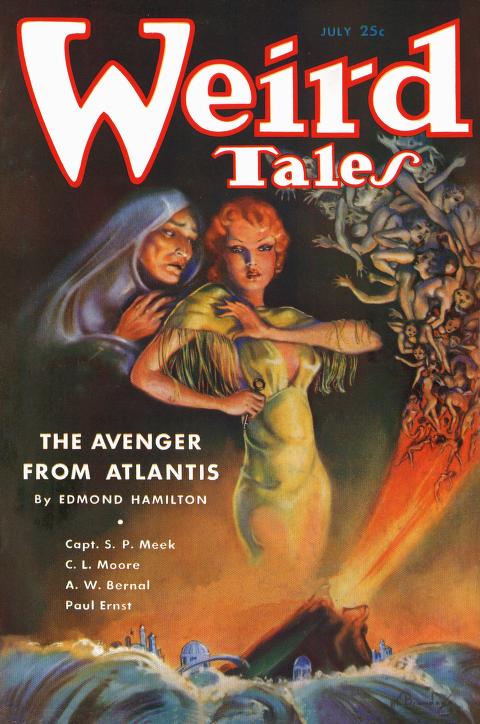
(Cover by Margaret Brundage. Weird Tales, July 1935.)
Happy New Year. Blow confetti. Get drunk. Maybe kiss and cuddle a friend or significant other of yours. Although of course you would’ve done that last night. A lot of stores are closed today, because work sucks and the reality is that with a few notable exceptions nobody really wants to work. I hope this message finds you well. There will be a couple changes to this site, which mind you does not mean bad news at all. Frankly those of you who frequent here might not even notice the one “negative” change, that being the fact that given my current life circumstances I can no longer guarantee that a post will be finished on the date I expect it to be. For two years I kept to a pretty strict release schedule with my posts, but after moving into my own place, with all the pros and cons that come with that, I would expect more posts to get delayed by, say, a day, if I were in your position. Occasionally I might not even be able to post a review that I said I would; this happened a few times actually, since November, and I think it’s time to acknowledge that while I try to be prolific, I can only do so much, from a mix of life changes and depression. Also that’s why I’m reviewing a story I was supposed to write about in November, but never got around to even reading it, that being Eleanor Arnason’s “Checkerboard Planet.”
Now, in good news…
The serials department is back, after I had announced at the start of last year that I would only be covering short stories, novellas, and complete novels in 2024. I had thought about what would be the first serial to commemorate the department’s coming back from hiatus, and ultimately I figured it had to be something big. Thus I went with a Robert Heinlein novel I’ve not read before, and truth be told Heinlein’s juveniles are a bit of a blind spot for me in my knowledge of his work; I’ve read a few of them, my favorite probably being Between Planets, but I should certainly read more. It’s also been too long since I last covered Heinlein here.
In other good news, we have another magazine to pay tribute to this year, albeit not on quite the same scale as what I did with F&SF. As you may or may not know, Galaxy Science Fiction launched with the October 1950 issue, making October (or September, depending on how you look at it) of this year its 75th anniversary. Along with F&SF, Galaxy played a pivotal role in reshaping who and what got published in genre SF following Astounding‘s near-stranglehold on the field the previous decade. Especially in the ’50s, a disproportionate number of now-classic stories and novels first saw print in the pages of Galaxy, under the ingenious (if also tyrannical) editorship of H. L. Gold. Unfortunately Galaxy had a bit of a rough history after its first decade, going through a few editors and experiencing declining sales before finally being put out of its misery in 1980. It only lasted thirty years, which admittedly is still better than what most SFF magazines get, but during that time it was arguably the finest magazine of its kind. So, in March, July, and October, as with last year, I’ll be reviewing only short stories, this time from the ’50s, ’60s, and ’70s respectively, and all from Galaxy. I’ll also be reviewing one short story, novella, or serial from Galaxy every month apart from that. This should be a good deal of fun.
Now what do we have on our plate?
For the serial:
Citizen of the Galaxy by Robert Heinlein. Serialized in Astounding Science Fiction, September to December 1957. Heinlein is that rare author who really needs no introduction, but who no doubt deserves one. He made his debut in 1939, at the fine age of 32 but having already entered the field more or less fully formed as a writer; it helps that he had already written a novel, albeit one that had initially gone unpublished, at this point. From the late ’40s to the end of the ’50s he wrote a series of “juveniles,” which helped lay the groundwork for we would now call YA SF. Citizen of the Galaxy was one of the last of these juveniles, and as far as I can tell its serialization occurred more or less simultaneously with its book publication.
For the novellas:
“The Organleggers” by Larry Niven. From the January 1969 issue of Galaxy Science Fiction. Reprinted thereafter as “Death by Ecstasy.” One of those old-fashioned planet-builders who appeared just as the New Wave was getting started, Niven very much follows in the footsteps of Poul Anderson and Jack Vance. “The Organleggers” is the first in a series of SF-detective stories starring Gil Hamilton.
“In the Problem Pit” by Frederik Pohl. From the September 1973 issue of The Magazine of Fantasy and Science Fiction. Pohl is one of those people who can claim to have taken part in pretty much every aspect of SF publication, from author and editor to literary agent. He edited Galaxy and If in the ’60s, to much acclaim, but in the early ’70s he gave up editing returned to writing fiction regularly.
For the short stories:
“Checkerboard Planet” by Eleanor Arnason. From the December 2016 issue of Clarkesworld. Judging from her rate of output you might think Arnason a more recent author, but in fact she was born in 1942 and made her debut back in 1973. She’s been an activist for left-liberal causes since the ’60s but did not start writing full-time until 2009, hence her recent uptick in productivity.
“Jirel Meets Magic” by C. L. Moore. From the July 1935 issue of Weird Tales. Moore might not be a mainstream figure in genre fiction, but she and her first husband, Henry Kuttner, have a strongly passionate following among older readers. With justification. She’s a favorite of mine. It’s been almost two years since I reviewed the first two Jirel of Joiry stories, which is far too long a wait.
Been a while, hasn’t it? By that I mean, little over a week. For some bloggers this is not unusual, to go a week or even a couple weeks without posting; but for me it’s different, as I like to think one of the things that makes this blog different is its regularity. I would post something every three or four days, or even sometimes twice in as many days, and in hindsight I’m not sure how I did that for two years while only occasionally slipping by, say, posting something a day later than I had intended. The idea was that like a magazine having a monthly or bimonthly release schedule, my posts would come out at regular intervals. As you know, I’ve spent this year covering a lot of stories from The Magazine of Fantasy and Science Fiction, which is celebrating its 75th anniversary. Unfortunately there’s been a bitter irony to my decision to go on a mini-hiatus, as F&SF has also been falling behind with its scheduling. Years ago they went from monthly to bimonthly, and this year those at the top announced the magazine would now be quarterly, with the big 75th anniversary issue presumably hitting newsstands in December. This is bad news no matter how you look at it. F&SF seems to be run by maybe five people plus a small army of hamsters on wheels, and they’ve fallen so far behind on publishing and even accepting stories that authors have had to retract their stories months after submitting and with no feedback. This has been a bittersweet year for F&SF.
It’s also been bittersweet for me, although more recently leaning toward the sweet. I’ve been through a few turbulent relationships this year, but I also started going to therapy, got a prescription for antidepressants and a hormone blocker, plus I recently got to spend time with one of my partners. I got my annual raise at my job, although it wasn’t worth much. I moved into my first apartment, living partly off of savings. It’s funny, I probably have more time (and certainly space) to myself than I ever had since college, yet I’ve found it harder to write for this damn thing. Call it a soft case of writer’s block. I talked with my therapist about this last week and she suggested that maybe it’s because I wrote for SFF Remembrance partly to get away from living under the same roof as my parents—mentally if not physically. That’s not to say my home life was objectively miserable before, but one can only be so happy living in a cage, even if it’s well-ornamented. I’m now freer than I’ve ever been—which means I also don’t have as much motivation to write now. It doesn’t come as naturally to me as it did before. There was some kind of tradeoff I was not told about in advance. I could be happier and be less productive, or more miserable but more productive—or at least that’s how I interpret it. And then there’s the fucking election. On a macro scale things are looking bad for a lot of us, on the horizon, but for me personally life has been kind to me as of late.
But, sooner or later, the show must continue.
I said months ago that for the “normal” months I’d be covering two stories from F&SF, a novella and short story, or two of either; but I neglected to mention full novels. In fairness, this is a truly exceptional scenario, as Algis Budrys’s Hard Landing might be the only instance of a novel being printed wholesale in a single issue of F&SF. I could be wrong. I’m making a bit of an exception by covering it, plus two short stories from that magazine. Why not? This is the last chance I’ve given myself to do such a thing, at least for a while. This will also be the last time I’m not covering serials, as I’ll be bringing that department back in January, with a bang. The world may go to shit, but we’ll have fun. And before you ask, the three stories I neglected to cover last month will get their due—eventually.
For the novellas:
“Code Three” by Rick Raphael. From the February 1963 issue of Analog Science Fiction. Raphael would write a small number of short stories and novellas over the next decade, but despite living to a reasonably old age (he died just short of his 75th birthday), he wrote very little fiction overall. His work is in such disarray that some of it has fallen out of copyright, including “Code Three,” which would make up the first part of the fix-up novel of the same name. So of course he “won” the Cordwainer Smith Rediscovery Award.
“Recovering Apollo 8” by Kristine Kathryn Rusch. From the February 2007 issue of Asimov’s Science Fiction. Winner of the Sidewise Award for Best Short Form Alternate History and placed first in the Asimov’s readers’ poll for Best Novella. For this final month of paying tribute to F&SF I figured I should cover another author who was at one point one of its editors. Rusch took over in 1991 and for the next six years gave F&SF a darker, one might say more gothic bent, and it helps that she was also the magazine’s first female editor.
For the short stories:
“The Phantom ‘Rickshaw” by Rudyard Kipling. From the July 1968 issue of Magazine of Horror. First published in 1885. The first and possibly only time we’ll be covering a Nobel winner on this site, Kipling wrote a good deal of SF, fantasy, and horror, on top of more realistic fiction and poetry. He wrote “The Phantom ‘Rickshaw” when he was 19, but he was already showing signs of greatness.
“The Christmas Witch” by M. Rickert. From the December 2006 issue of The Magazine of Fantasy and Science Fiction. Mary Rickert is a Wisconsin native who made her debut in 1999, in F&SF, and from then on it would remain her most frequent outlet. She doesn’t seem to have written much if any SF, preferring fantasy and horror. I needed at least one Christmas-themed story, so…
“It Takes a Thief” by Walter M. Miller, Jr. From the May 1952 issue of If. Before the phenomenon that is A Canticle for Leibowitz, Miller wrote prolifically at short lengths, with 1952 being an especially productive year for him. I find myself gradually becoming a Miller fan, helped by his writing candidly about religion, existential crises, and mental illness—things he experienced first-hand.
“A Runaway World” by Clare Winger Harris. From the July 1926 issue of Weird Tales. Harris was supposedly the first woman to write genre SF under her own name, and by the time she entered the field she had written her first and only novel, Persephone of Eleusis. Like too many old-timey female SFF writers she wrote a streak of short stories over the course of a decade, then stopped.
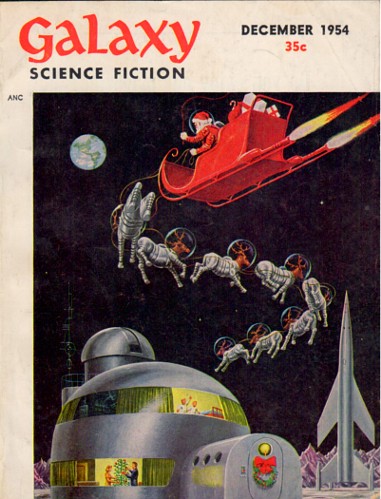
“Skulking Permit” by Robert Sheckley. From the December 1954 issue of Galaxy Science Fiction. Like Algis Budrys, and indeed Walter M. Miller, Sheckley debuted in the early ’50s and probably could not have found enough markets for his kind of fiction (often urbane satire) any earlier than that. But he contributed prolifically to Galaxy, and the two were practically made for each other.
“Strata” by Edward Bryant. From the August 1980 issue of The Magazine of Fantasy and Science Fiction. Bryant was one of the curious new talents of the post-New Wave era, having debuted in 1970, and wrote almost entirely short fiction. “Strata” is one of several stories inspired by Bryant’s childhood in Wyoming, and I have to admit I also picked it for the reason that it involves dinosaurs.
For the complete novel:
Hard Landing by Algis Budrys. From the October-November 1992 issue of The Magazine of Fantasy and Science Fiction. While Kristine Kathryn Rusch was at one point F&SF‘s editor, Budrys was a regular columnist for the magazine for about 15 years, until he stepped down from that position, incidentally around the same time Isaac Asimov stopped writing F&SF‘s science articles (on account of dying). But Budrys, who had made his debut in the early ’50s, was very much alive still, and while he no longer did book reviews for F&SF, the early ’90s were a busy time for him, as he hosted the annual (and controversial, because of the Scientology connection) Writers of the Future contest, began editing the semi-pro magazine Tomorrow Speculative Fiction, and wrote Hard Landing, which would be his final novel.
Once more into the breach before the year ends, eh?
(It seems that my review schedule for the rest of November will be a big case of “when it’s done.” I’ve had my best friend and one of my partners come visit me, both from out of state, for a few days each. Turns out it’s very hard to get work done when you’re with someone you love.)
Elizabeth Hand was born in 1957 in New York, and has been active in the field since the ’80s. She’s been a regular contributor to F&SF as fiction author and reviewer for the past 35 years. Her most recent novel, A Haunting on the Hill, is a sequel to Shirley Jackson’s The Haunting of Hill House—only not quite. “Last Summer at Mars Hill” may give the impression, going by its title, that it’s planetary SF, but it’s really a different kind of story altogether, being arguably fantasy and set on a then-present-day Earth. According to the introductory blurb in F&SF, Hand wrote this story as a change of pace, “a heartwarmer written to keep her good karma.” The tactic worked, as it would win the Nebula and World Fantasy Award for Best Novella. I don’t like it quite as much as other people did, at least at the time, but while it’s a bit overly sentimental for my taste it’s also a curious time capsule of semi-rural American life in the decade following HIV/AIDS being made public knowledge, one in which Hand plays fast and loose with genre boundaries. This was a story I had been meaning to knock off my list for a while. and I can’t say I was too disappointed.
Placing Coordinates
First published in the August 1994 issue of The Magazine of Fantasy and Science Fiction. It’s been reprinted in Nebula Awards 31 (ed. Pamela Sargent), The Best from Fantasy & Science Fiction: The Fiftieth Anniversary Anthology (ed. Edward L. Ferman and Gordon Van Gelder), and the Hand collections Last Summer at Mars Hill and The Best of Elizabeth Hand.
Enhancing Image
Moony and her boyfriend Jason are high school sweethearts who have returned to Mars Hill, a spiritualist commune founded in 1883 in Maine (that state where seemingly a lot of weird supernatural shit is prone to happen), and where both their parents live. Moony only has her mom while Jason has his dad, the latter having in the past come out as gay and who’s been living with HIV. “Two years before Jason’s father had tested HIV positive. Martin’s lover, John, had died that spring.” Ariel, Moony’s mom, is also revealed to have stage-four breast cancer, and she had not only hesitated to tell her daughter about this but had delayed in getting it treated, such that now the case looks to be terminal. So both their parents are dying. Mars Hill itself is all but the corpse of a once-thriving community; there are only two year-round residents in the commune, one being the enigmatic Mrs. Grose, a very old woman who was also a medium back in her youth, being one of the many “casualties” from Harry Houdini’s search for a genuine medium. Of course, Moony realizes that, the story taking place in the ’90s, “If it really had happened, it would make Mrs. Grose about ninety or a hundred years old. And she didn’t look a day over sixty.” And then there’s the mystery of “Them,” or the Light Children, mythical beings who lurk in Mars Hill’s environs and who were the reason the place was settled all those decades ago, though they’re more talked about than seen.
“Last Summer at Mars Hill” has a double meaning in its title, one in referring to something that happened in the past, as in last summer, and also perhaps Moony’s last summer visiting Mars Hill, the place of her upbringing and the double-edged sword that has clearly influenced her life up to this point, for good and ill. “Moony” is a nickname Jason calls her, and her “regular” name is Maggie, although her actual birth name is the rather embarrassing hippy-dippy Shadowmoon Starlight Rising. Naturally she doesn’t like to be known by that name. Moony descends from a line of proto-hippies, but she now lives in the era of flannel, of grunge music and professional skateboarding (a character wears a Pearl Jam shirt at one point), and she wants to live something close to a normal life. This is a story partly about time, but it’s also very of its time, both regarding the time it’s set in and the implicit attitude of how Hand tells her story. From what I can tell Hand is a straight woman, which seems to have influenced how she wrote Moony and Jason, who are both presumably straight, although Jason’s dad is openly gay. HIV/AIDS very much casts a shadow over the story, so it makes sense that there would be at least one explicitly queer character; but at the same time I couldn’t shake the feeling that Hand was writing about what was then a devastating epidemic from an outsider’s perspective, albeit sympathetically. Of course, there are far worse positions to take than being a cishet ally, especially since Hand wrote this story in the early ’90s. There were quite a few SF stories inspired by the AIDS epidemic in the late ’80s into the ’90s, mostly by authors who were not directly impacted by said epidemic. (Nancy Kress’s “Inertia” is a very good example of this, both as a story and as a commentary on the public reaction to AIDS and those hurt most by it.)
I suppose a quibble I have here is that while Moony’s POV is by no means invalid, I would rather read from the viewpoint of Jason, or especially Martin, since he’s a queer character who is dealing directly with impending doom. You could say it would make more sense to tell this story from Ariel’s POV since this story is more concerned with her terminal illness, but the basis of the conflict is that we’re not sure why Ariel did what she did—why she didn’t tell Moony sooner or why she waited this long to seek treatment. The history of Mars Hill is itself another point of conflict as much of it remains mysterious for Moony, a 16-year-old who has memories of the place but who clearly feels disconnected from the adults who stay there, not to mention her boyfriend feels the same way. There’s definitely a generation gap at work—in fact more than one, between Moony and Ariel, the latter being in her forties; and then there’s Mrs. Grose, who may be in her sixties or may be close to a hundred. To a degree I understand why Hand wrote from the perspectives she did, since the focus characters are all women (Moony, Ariel, and Mrs. Grose), while Jason and Martin, while important, are also men and thus relegated to supporting roles. This is a story about dealing with grief and impending loos, but it’s also a story about women of very different ages, in a place that seems to be out of step with the times. You may of course be wondering if “Last Summer at Mars Hill” is SF or fantasy, which is the story’s mystery on a metafictional level and which Hand deliberately refrains from answering clearly.
There Be Spoilers Here
The passage of time is sort of ambiguous, but Moony and Ariel have been at Mars Hill long enough that eventually the latter does get miraculously get a visit from the Light Children. Moony, not knowing what the hell the Light Children are capable of, is understandably spooked when Ariel leaves a note one day, fearing her mother might commit suicide or get into trouble; but instead she finds that her mother’s been healed. Her cancer is in recession, despite that being a medical impossibility. And if Martin still has HIV then it seems to be asymptomatic. Indeed a miracle has happened, which worried me because it made me think we might get a happy ending that would have been unearned. Thankfully Hand goes for something more bittersweet. We also are stuck with an unanswered question: Just what are the Light Children? It’s a question Hand leans into, maybe a bit too much, as if to tease us about what genre the story we’re reading belongs to; but then again it’s a question that doesn’t really need an answer.
So says Mrs. Grose:
“Well, many things, of course, we have thought They were many things, and They might be any of these or all of them or — well, none, I suppose. Fairies, or little angels of Jesus, or tree spirits — that is what a dear friend of mine believed. And some sailors thought They were will-o-the-wisps, and let’s see, Miriam Hopewell, whom you don’t remember but was another very dear friend of mine, God rest her soul, Miriam thought They came from flying saucers.”
For my money, “Last Summer at Mars Hill” is fantasy. There’s no SFnal explanation given for the Light Children being able to heal Ariel and Martin, so their healing powers may as well be magic. This does raise the question of why Mars Hill was called that in the first place, since the founders (this is the last quarter of the 19th century, mind you) could not have known where the Light Children came from, nor did they probably think much about life on other planets. The War of the Worlds was still more than a decade off. Still, not every question needs an answer.
A Step Farther Out
I do sort of recommend “Last Summer at Mars Hill,” but also reading it thirty years after publication I felt like I was gazing into a time capsule, and not entirely in a good way. The fight for queer liberation has both come a long way and not progressed nearly enough since 1994, in no small part because there are still plenty of people who believe the AIDS epidemic was basically queer people’s fault, and these same people have had their abhorrent views vindicated by those in power repeatedly. This is a story that evidently spoke to vaguely left-leaning readers when it was published, but I’m honestly not sure if it would be as warmly received now.
Brian Aldiss started out in the pages of New Worlds and Science Fantasy, those two foremost genre magazines in the UK in the ’50s, but by the end of that decade he had gained a foothold in the US, particularly finding an American home in F&SF. Given his fast-and-loose approach to genre, this makes sense. Aldiss was one of those authors who anticipated the New Wave, to the point of becoming one of its big players. (Mind you that most of the important authors involved with the New Wave, that quintessential ’60s SF movement, had debuted a decade earlier.) He had already gotten a Hugo nomination for Best New Writer (it was a Hugo at the time, don’t ask) when he wrote the stories that would comprise the fix-up novel Hothouse, one of these stories appearing every other month or so in F&SF, the resulting series winning the Hugo for Best Short Fiction—the only time in the history of the Hugos this has happened, and admittedly with good reason. I reviewed “Hothouse” a few months back with the intention of continuing the series, and so here we are with “Nomansland,” a direct sequel.
Placing Coordinates
First published in the April 1961 issue of The Magazine of Fantasy and Science Fiction. It has never been reprinted on its own, although of course you can find it as part of Hothouse.
Enhancing Image
You may recall the adults from the first story went to the moon via a network of traverser webs, grew wings, and have since ventured back to Earth to bring the children of their kind with them to the moon. Lily-yo and the others go unmentioned in “Nomansland,” as instead we’re left to focus on the young folks they had left behind, including Gren, who has emerged as the true protagonist—a position he will apparently hold for the rest of the “series.” Toy is the new matriarch of the little tribe, with the only two males of breeding age being Gren and Veggy. (The two males are probably only barely in their early teens, as the humans of this far future consider “coming of age” to be when you’re physically matured enough to be able to reproduce.) There’s obviously a rivalry going on between the males, not least because Gren is older and wiser while Veggy spends pretty much the whole story being a little dumbass. (I said, in my review of “Hothouse,” that the human characters might have personalities, but I didn’t say they would be likable personalities.) Anyway, Aldiss is still much more interested in the world of the story rather than the people in it, the few humans left feelings small both physically (they’re shorter than modern-day humans, and also have green skin) and in terms of their importance to the narrative. I get the impression that had there been no humans at all that Aldiss would find some way to make the Hothouse stories about something else.
The only one sympathetic to Gren’s plight is Poyly, who will eventually figure rather importantly into the plot (and presumably the next story in the series), but not for now. What’s important is that with “Nomansland” we’re given a couple new creatures to play with, and also a new location in the form of nomansland itself, basically the coastline of this world, the area where the single impossibly massive banyan that serves as the foundation for the world’s vegetation meets its match, the sea. It’s a case of the unstoppable force meeting the immovable object, and it’s also that line where the fight for survival is at its fiercest. Aldiss could’ve written a mean script for a nature documentary if he was interested, if the Hothouse stories are any indication. There’s a cold detachment in how he describes the actions of the humans and their surroundings, but this is also mixed with a poetic sensibility that probably meant F&SF was the only appropriate outlet for this kind of story in the early ’60s. There’s a juxtaposition between Aldiss’s refusal to give the humans a Shakespearean inner life and his loving odes to the strange yet natural world he has created. It’s science-fantasy in the sense that while the basis of this world is implausible (there is, after all, a half of the world where it’s always day and the other night), Aldiss tries to give science-fictional explanations within those parameters. My favorite example of this is “Nomansland” has to be the “sand octopus,” a large tentacled beast which lurks near the coast and catches whatever on the beach it can grab, since crabs have long since gone extinct. Seemingly everything in this world is big—except for the humans.
Since “Nomansland” is a sequel to “Hothouse,” and since both stories were clearly planned as part of a series, there’s not too much I can say about one that doesn’t also apply to the other. If “Hothouse” establishes the cutthroat nature of the world then “Nomansland” expands the boundaries a bit, quite literally as Gren is spirited away by a suckerbird (which is not an actual bird) and narrowly survives, only to land at nomansland, and here the story takes on an unexpected gothic flavor. You see, real-world termites were famous for being ingenious and productive architects; so it only makes sense that the termights, their vastly larger descendants, would produce architecture of an appropriate scale—in this case a bug-made castle that Gren takes refuge in, even meeting a cat (or the descendant of cats) along the way, showing that humans are not the last vertebrate life on the planet—although this may not be true for much longer. Up this point the narrative has been geared towards action and observation, with basically no character insight allowed, which is probably intentional given what’s about to happen. If the characters seem unintelligent it’s because they simply haven’t been granted it—ingenuity, maybe, but not introspection.
There Be Spoilers Here
Gren reunites with the rest of the tribe, which turns out to not be so happy a reunion as Toy and Veggy think Gren is unfit to be the alpha male, and a close encounter with a sand octopus results in the young member of the tribe getting killed in a rather violent fashion. (There’s a girl named Fay and another named May; I think the latter gets killed. I’m not sure why Aldiss gave two characters such similar names. Maybe a way to signal their status as redshirts?) There’s a vote among the tribe and Gren is driven to exile, presumably to meet a gruesome death, and soon. But as luck would have it he comes into contact with morel, a sentient fungus that, when attached to one’s head, can not only communicate with the host telepathically but has access to something like an ancestral memory in the host’s brain. The result is that, all of a sudden, Gren is granted a level of intelligence (here conflated with knowledge) he did not have access to before, and he even convinced Poyly to share the “gift” with him. The ending of “Nomansland” is pretty unsubtly an homage to Adam and Eve getting kicked out of Eden, although here it’s framed as ultimately for the best. Gren and Poyly give up their “souls” (their wooden dolls, you may recall) and leave nomansland together in search of a brighter future. Well, not if Aldiss has anything to say about it. We’ll see in “Undergrowth,” the next story, soon enough.
A Step Farther Out
Give me a few more months and we’ll see a continuation of this series—I mean the reviews, not the stories. I have to admit as I acclimate myself more with the world of Hothouse, I start to “get” what Aldiss is doing more. The ambition of this project is perhaps better appreciates as a series of related stories than as a novel.
I wish I could say the past month has been better for me, but it has not. A big thing is happening in my life, in that today is actually the move-in date for my first apartment. Wow, imagine, at 28, my first apartment. Been taking care of the practical side of things, with assistance: furniture, stuff for the kitchen and bathroom, and of course signing up with utilities. This has been a long time coming, and truth be told I’ve become immensely tired of living with my parents. And yet I’m not happy. Moving into my own place might prove only marginally better than my previous living situation. I don’t make enough to pay for rent so I’ll be bleeding my savings for the following months. The only reason my application even got accepted is my credit score is good. I’ll be living by myself in this one-bedroom apartment. It’ll be very lonely here, as none of my partners live close enough to move in with me, and anyway, with one exception we don’t know each other that well yet. Surely the lack of my parents breathing down my neck will do me some good, but this will be a solitary existence.
Honestly I’ve been tired all the time as of late. My work schedule as of right now is erratic and I find myself going to sleep at six in the morning and waking up after noon. As you may know I have anxiety and depression, and while the former has not been as bad lately, the latter has been worse, or rather more persistent. I’m tired of everything. I’m tired of my job. I’m tired of my imperfect body, and the fact that I can barely sleep. I’m tired of being tired. The US election is in less than a week and honestly I’m sick of this fucking immoral country, and its authorities who have been spending the past couple centuries murdering socialists, queer people, ethnic minority groups, etc. We’re only a quarter into the 21st century but already I feel like almost everything that could go wrong has already gone wrong. And will get worse. I’m normally a pessimist, so take all this with a grain of salt, but I don’t see conditions improving much.
So, go backward or forward, but don’t stay here. I hate it here. I do this blog for fun, and according to stats have written 186,000 words (or about equivalent to Great Expectations in word count) this year alone; but I also do it as a coping mechanism. I don’t do it for readers, or money, because not enough people read this blog or even know about it, despite my spreading word on a few social media platforms. Maybe when I hit 200 subscribers I’ll start a Patreon. Just know I’ve been going at this for two years now because it gives me some degree of emotional security. If not for all these words I would surely have given up a minute ago.
Now, what do we have for reviewing? We have two stories from the ’40s, three from the ’60s, one from the ’80s, one from the ’90s, and one from the 2010s.
For the novellas:
“Attitude” by Hal Clement. From the September 1943 issue of Astounding Science Fiction. Retro Hugo nominee for Best Novella. Feels like it’s been a while since we last talked about Clement, who was one of the first hard SF authors as we now think of the term. Not only was Clement a pioneer, he had a pretty long life and career, remaining active into the beginning of the 21st century. His prose is workmanlike and his human characters tend to be little more than abstractions, but his lectures-as-stories can be enthralling.
“Last Summer at Mars Hill” by Elizabeth Hand. From the August 1994 issue of The Magazine of Fantasy and Science Fiction. Nebula and World Fantasy Award winner for Best Novella. Over the past four decades Hand has taken a kind of jack-of-all-trades approach to writing, tackling SF, fantasy, and horror seemingly with equal relish, with even the occasional movie novelization to her credit. (She wrote the novelization of the infamous 2003 Catwoman movie.) “Last Summer at Mars Hill” is one of her most decorated stories.
For the short stories:
“Beyond the Threshold” by August Derleth. From the September 1941 issue of Weird Tales. Derleth was correspondents with H. P. Lovecraft and could be argued as the person most responsible for preserving Lovecraft’s legacy, as he co-founded Arkham House with Donald Wandrei in 1939 firstly to reprint his mentor’s fiction. He also wrote quite a bit of fiction in his own right.
“The Scar” by Ramsey Campbell. From the Summer 1969 issue of Startling Suspense Stories. One of August Derleth’s biggest discoveries as editor was Ramsey Campbell, whose work Derleth had discovered when he was but a teenager. Campbell’s first collection was published when he was only 18, so that he got his start in weird fiction very early. He would later become a prolific horror novelist.
“Nomansland” by Brian W. Aldiss. From the April 1961 issue of The Magazine of Fantasy and Science Fiction. Aldiss debuted in the 1950s and would remain active pretty much until his death, which was not too long ago. He would win a Short Fiction Hugo for Hothouse, which is sort of a novel but also a collection of linked stories. We already covered the first story, and now we’re on the second.
“Flowers of Edo” by Bruce Sterling. From the May 1987 issue of Asimov’s Science Fiction. Sterling debuted in 1977 when he was barely out of his teens, but he would become one of the defining SF writers of the ’80s. While typically labeled as cyberpunk, Sterling has a surprising versatility, with even early novels like Schismatrix and Islands in the Net being very different from each other.
“Soft Clocks” by Yoshio Aramaki. From the January-February 1989 issue of Interzone. First published in 1968. Translated by Kazuko Behrens and Lewis Shiner. Seeing as how the Sterling story takes from Japanese culture, I thought it only right (and perhaps a neat gimmick) to follow up with a story from a Japanese writer. Yoshio Aramaki has been active since the ’60s as an author and critic.
“Checkerboard Planet” by Eleanor Arnason. From the December 2016 issue of Clarkesworld. Judging from her rate of output you might think Arnason a more recent author, but in fact she was born in 1942 and made her debut back in 1973. She’s been an activist for left-liberal causes since the ’60s but did not start writing full-time until 2009, hence her recent uptick in productivity.
This marks Tanith Lee’s third consecutive Halloween appearnace on this site, and why not. I wouldn’t call myself a Lee fan (yet), but as I chip away at her massive body of work I do find more to appreciate. And I do mean massive. Over the span of five decades Lee wrote something like ninety novels and 300 short stories, so we’ll be here for a while. She debuted in the late ’60s, but did not gain attention until midway through the ’70s with novels like The Birthgrave and The Storm Lord. She specialized in horror and dark fantasy at a time when this only just being made possible due to the proliferation of the mass-market paperback; had Lee tried breaking through a decade earlier she would’ve been ten years old or something she would’ve surely been screwed, due to how the market was at the time. But she did get to thrive, and write some nifty fiction while she was at it. “Red as Blood” marked Lee’s first appearance in F&SF, which is weird because it seems like the two were made for each other. No matter. I feel like I’m giving the game away by saying this now, but “Red as Blood” is a pretty neat (if at times confusing) retelling of Snow White, in a way that screams Tanith Lee. Look, dark fantasy retellings were more novel in the ’70s.
Placing Coordinates
First published in the July 1979 issue of The Magazine of Fantasy and Science Fiction. It’s been reprinted quite a number of times, including but not limited to The Year’s Best Fantasy: 6 (ed. Lin Carter), Young Monsters (ed. Isaac Asimov, Martin H. Greenberg, and Charles G. Waugh), The Penguin Book of Modern Fantasy by Women (ed. Richard Glyn Jones and A. Susan Williams), and the Lee collections Red as Blood, or Tales of the Sisters Grimmer and Tanith by Choice: The Best of Tanith Lee.
Enhancing Image
Once upon a time (it’s that kind of story) there was a king and his queen. The queen gave birth to a daughter, but died in childbirth. The queen (or the Queen) was also kind of an odd woman. “She never came to the window before dusk: she did not like the day.” She had black hair and dressed in a crimson gown, and had made a blood sacrifice (her own blood, not someone else’s) to gift her future daughter with certain traits, “hair black as mine, black as the wood of these warped and arcane trees. Let her have skin like mine, white as this snow. And let her have my mouth, red as my blood.” She got what she wanted, although she wouldn’t live to see her daughter grow up. The daughter is Bianca, and for the past seven years she’s been living with her stepmother, the Witch Queen. The Witch Queen is somehow both a witch and a devout Christian who is repulsed by Bianca’s aversion to churchgoing and Christian symbols; she’d much rather spend time in her garden. The thing is that her problems only just beginning.
So, this is a retelling of Snow White, as in “Snow White” by the Brothers Grimm, although we all know the Disney animated film. Lee would do this multiple times, so much that she made a whole collection of such retellings, but this was still fairly early in her career. The idea of making Bianca (Snow White) a vampire is a novel twist on the classic story. At least in the Disney film the relationship between the Witch Queen and Snow White is unclear, as the former is indeed a queen and the latter is some girl who lives in the woods, whereas in “Red as Blood” Bianca is explicitly the Witch Queen’s stepdaughter; it’s also implied the Queen was a vampire and that Bianca is following in her “true” mother’s footsteps. This is a curious role reversal because in the normal story we would see Bianca as the protagonist and the Witch Queen as the antagonist, but now the Witch Queen is not only the POV character but has the understandable goal of wanting to do something on her vampire daughter. Yet this is not a horror story! It’s dark fantasy, but Lee is not trying to scare us.
I have some theories as to what Lee is going for with this story, because this is not just a case of “What if we told this classic fairy tale but it’s FUCKED UP?,” which makes a lot of fairy tale retellings dull. No, she clearly wrote it with thematic purpose—only I’m not totally sure to what end. There’s a surprising amount of Christian symbolism going on that only intensifies as we get closer to the end. This is also a short story, so there’s only so much ground to cover, and the fact that it’s a fairy tale everyone knows (albeit with a twist or two) means it’s hard to spoil. Lee doesn’t exactly make Bianca’s vampirism a secret, the implications she drops being so heavy as to be fucking anvils. You can’t possibly miss it. But part of the fun of reading this story, aside from the beauty of Lee’s controlled, almost Bible-inspired prose, is seeing the Witch Queen, from her perspective, realize that she has one hell of a problem child on her hands. When she asks her magic mirror what the mirror sees it says it specifically can’t see Bianca. Get it? Vampires don’t have reflections? When her mother was alive there was an epidemic of “wasting sickness” in the kingdom, which was never explained and which they never found a cure for; and when Bianca comes of age (gets her first period), the “wasting sickness” starts up again.
Well this is a problem.
The Witch Queen hires a huntsman to take care of her stepdaughter, but as with the fairy tale it takes all of five minutes for the deal to backfire—only this time Bianca outright kills the huntsman and sucks his blood (he doesn’t seem to mind too much). If I had to quibble about something I do find it concerning that Bianca is depicted (at least analogous to) sexually active and desirable… at 13 years old. This is a recurring thing in ’70s SFF writing and I don’t know if we should blame Michel Foucault or what. It makes me cringe, although for what it’s worth nothing explicit happens in this case. So the huntsman is dead and the Witch Queen has to come up with a plan B, which involves making a deal with a most unusual party: Satan himself. Or more accurately Lucifer, the fallen angel. Lucifer works up a disguise for the Witch Queen that Bianca will be certain to fall for, and we can guess well in advance that the Witch Queen will become an old hag somehow. So. As for the seven dwarves Snow White befriends they’re represented here by trees in Bianca’s garden, which come to life. The only weakness the Witch Queen knows of is that Bianca finds Christian iconography repellant, maybe to the point of it being maybe physically harmful.
There Be Spoilers Here
The climax of “Red as Blood” starts weird and only gets weirder from there, to the point where it becomes honestly mind-bending. The Witch Queen gives Bianca an apple, although it turns out to not be poisoned; instead it contained (I don’t know how, maybe through witch stuff) a wafer, “a fragment of the flesh of Christ.” How Catholic. So Bianca dies and is put in a transparent glass coffin, which may sound familiar, where she lies until a prince (just a prince, from where I don’t know) comes along and revives her. It’s implied, via a mark on his wrist, “like a star,” that he is the embodiment of Christ. (People often forget Jesus would have been nailed through the wrists, not the hands, a mistake even Christmonger and antisemite Mel Gibson makes.) The bad news is that Bianca is back, but it seems the love of the prince transforms her, into a series of birds before time goes backwards to when she was seven years old—only this time not a vampire. The prince had not only reversed time but seemingly cured Bianca of her vampirism. This is… confusing. Obviously it’s meant to be taken as allegorical, and it’s so overtly Christian that I have to wonder if it’s maybe satirical, or maybe if Lee was actually a churchgoer. I’m not sure if she was religious or not, truth be told. The Witch Queen is a Christian who ultimately is in the right, but she also had to seek Lucifer’s help to deal with Bianca’s vampirism, which is certainly odd. It could be that Lee is saying we need that bit of darkness, or that there’s some evil lurking in every one of us. Or maybe, when the chips are down, we must side with a lesser evil.
A Step Farther Out
I’m a bit weary at the idea of reading a whole collection of fairy tale retellings, but as an individual story I think “Red as Blood” is quite strong. Again it’s surprising it took until 1979 for Lee to get published in F&SF, but the pairing was perfect. The more I read Lee the more I understand what she’s going for, which actually makes me wonder if I had treated “Bite-Me-Not or, Fleur de Fleu” unfairly when I reviewed that a couple years ago. I was not as familiar with Lee at the time.
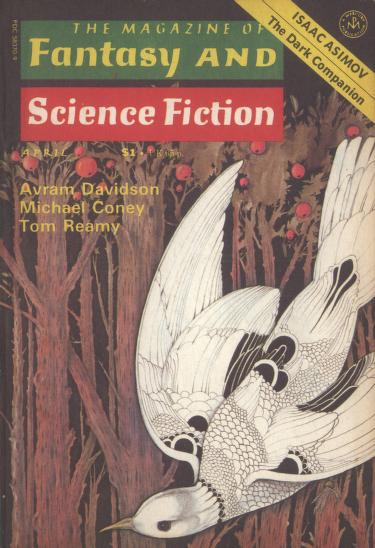
As we approach the climax of this year-long tribute to F&SF, it’s about time we cover an author who was also one-time editor of that magazine. There’ve been a few writers who also picked up the editing torch with F&SF (Anthony Boucher and J. Francis McComas, Kristine Kathryn Rusch, and most recently Sheree Renée Thomas), but Avram Davidson might’ve been the most prepped to become editor, although his tenure would be short. He debuted in F&SF in 1954 with “My Boy Friend’s Name Is Jello” and would remain a quirky presence in that magazine (among others) for many years to come. By the time he became editor in 1962 he was already a Hugo winner, for his 1958 SF-horror story “Or All the Seas with Oysters.” Under Davidson F&SF took on a rather different character from both before and after, making it something of a black sheep era for the magazine. After he stepped down from editing Davidson went back to writing regularly, with a vengeance. Known mostly for standalone stories, Davidson started the episodic Jack Limekiller series in the ’70s, of which today’s story is the second entry. “Manatee Gal Ain’t You Coming Out Tonight” shows its age nowadays, and its big twist is obvious (perhaps by design), but it does have, as Edward L. Ferman says, quite the atmosphere.
Placing Coordinates
First published in the April 1977 issue of The Magazine of Fantasy and Science Fiction. It’s been reprinted in Year’s Finest Fantasy (ed. Terry Carr), Under South American Skies (ed. Gardner Dozois and Mike Resnick), Modern Classics of Fantasy (ed. Gardner Dozois), and the Davidson collections Limekiller! and The Avram Davidson Treasury.
Enhancing Image
The first question is, who is Jack Limekiller? He’s a Canadian expat, apparently from Toronto, which goes to explain a lot. The Limekiller stories have a strong international flavor, being set in “British Hidalgo” (there’s also an independent sister country called Spanish Hidalgo “though it had not been Spain’s for a century and a half”), a fictional South American country that, despite these stories being set very much post-World War II (although not much more specific than that), is still under British guardianship. What does Limekiller do for a living? Not sure. Supposedly he deals in trading, but for the whole course of this story he’s not doing work at all; on the contrary, he spends some of it thinking of ways to avoid his creditors. He has some debt he’s not currently able to pay off. The good news is that despite the inherent exploitation required in maintaining a colony like British Hidalgo, and also the fact (this is not a spoiler really) that “Manatee Gal” will turn into borderline Lovecraftian horror down the road, things are easy-going here. Limekiller’s main creditor will probably catch up with him, but not tonight, or tomorrow either. He’s a bit of a wish-fulfillment character, in that he is too individualistic (and maybe too drunk) to work a 9-to-5 job, but he’s still very cool and sociable, and we know in advance that he’ll come out of whatever weird situation Davidson tosses his way basically unscathed. Everybody around Limekiller, on the other hand…
Something tricky Davidson does in the first few pages is set up the first of a few mysteries, the only thing being we’re unlikely to take it as a mystery that needs solving. Bob Blaine, a notorious trader in these parts, has gone missing. This will not come up again until much later, so put a pin in that one. This is less about the plot and more about the place and characters. British Hidalgo is somewhere in South America but seems as home to Caribbeans and white Europeans, including folks like Limekiller. The most elusive of these characters would have to be John Samuel, a white Creole with one eye, and Captain Cudgel, a mysterious old man who frequents the same bar Limekiller goes to. Cudgel is more of a walking mystery while Samuel is a bit of an eccentric; it’s a shame I can barely understand what the latter is saying. A problem I encountered almost immediately here is that most of the characters have some kind of “accent,” and Davidson writes them out phonetically—maybe a little too much. Davidson traveled around a lot, in fact if I remember right he edited F&SF while living in Mexico, which posed a problem; but that doesn’t automatically give one license to give non-white (or also in this case, as with Samuel, white characters who are not from the US or Canada) goofy accents that are hard to parse. He even does the “t’ing” thing for Caribbean characters, except he applies that logic to seemingly every other word, the result being a meaty novelette that’s rather chatty, and much of that dialogue is hard to read.
“Manatee Gal” has a loose plot, made up more of episodes than a cohesive narrative, so with that said my favorite part is one that is only very loosely related to the overarching mystery, in which Limekiller (seemingly because he has nothing better to do) gets taken on a ride to Shiloh, the remnants of a Confederate colony that had been founded in British Hidalgo over a century, and which still hosts a small group of people who are making a decent living. The colony “had not been wiped out in a year or two, like the Mormon colonies in Mexico—there had been no Revolution here, no gringo-hating Villistas—it had just ebbed away.” But still there’s something left. Colonialism always leaves scars. Of course, Limekiller and Davidson don’t seriously question the ghost-like presence colonialism has on the land, the past haunting the present. The idea seems to be that these expats and settlers will eventually wither away, as with Shiloh, or get killed off (burn out or fade away, your choice), but then, while the dinosaurs did go extinct, they left a certain feathered animal behind as their legacy. British Hidalgo is a scarred land, and clearly haunted, but not just by supernatural creatures. The double-edged sword of Davidson’s setting is that because it’s fictitious it also means Davidson is free to put his thumb on the scales, so to speak. There is no place on Earth quite like British Hidalgo, which does lend a surreal quality to it, perfect for supernatural shenanigans, but also it’s ultimately a white author’s exotic fantasy land.
There Be Spoilers Here
Manatees get brought up from time to time throughout the story. Sea-cows. They’re cute, harmless marine mammals, but Davidson also raises kind of an odd question: There are all kinds of were-animals, not just werewolves, so why not a were-manatee? Someone who is amphibious, who can change between a person on land and a manatee in the water, just off the coast. They do eventually find Bob Blaine—or what’s left of him. Something had killed him. We never see the were-manatee, but the implication is that Samuel is the killer, although he is never seen again. Limekiller connects some dots and comes to the conclusion that such a creature could exist, here, in British Hidalgo. But of course that’s not his problem. Limekiller’s debt problem also clears itself up at the last minute, as a freak accident has led to his trading position (namely his boat) becoming very sought after again. All’s well ends well, more or less. Nothing will fundamentally change. We would see Limekiller again, even I don’t.
A Step Farther Out
I’ve not read a great deal of Avram Davidson for the simple reason I find him to be a little too quirky and at times misogynistic (basically the same reason I don’t often read R. A. Lafferty), and admittedly “Manatee Gal” might be too obtuse for a story with ultimately such a straightforward reveal. I also get the impression that, given Limekiller is wearing a thick coat of plot armor with this series, there’s no real sense of danger. Limekiller comes upon a mystery or two, connects a few dots, goes “Well that’s weird,” and moves on, perhaps taking comfort in the knowledge that said weirdness won’t happen to him. I also struggle to believe the exoticism of the locale would fly as well if published today, but judging by awards attention for this and future Limekiller stories there was clearly an audience for it back in ye olden times. I’m also pretty sure Lucius Shepard read it and got a few ideas, so you could say it’s influential in kind of a niche way.
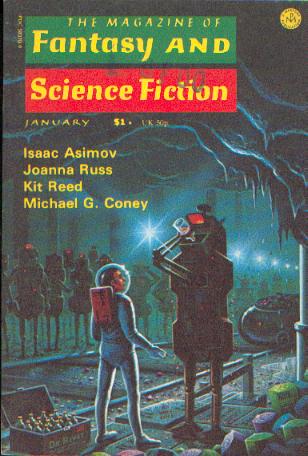
It’s been a hot minute since I last talked about Joanna Russ on this site, although it has in fact not been long since I last wrote about her period. I reviewed her 1971 story “Poor Man, Beggar Man” for Young People Read Old SFF, and I wasn’t a fan of it. I have mixed feelings on Russ’s fiction (although not her criticism, which I generally love), in part because it seems to me that she wrote her fiction with the intention of it being more studied than enjoyed; and I think fiction, if nothing else, should be read for pleasure—even if it’s a morbid kind of pleasure, like reading horror for the sake of feeling scared or unnerved. The Russ stories I like most tend to be fun, but with a venomous bite that also lurks in her criticism. It’s why I have yet to read her supposed magnum opus, The Female Man, because frankly it doesn’t look like a very fun novel. Russ’s seriousness (with some sardonic humor) paid off in the long run, though, as ten years after her death she’s now one of the most studied and lauded of the New Wave writers, even recently getting a Library of America volume. As with some of Russ’s other fiction I enjoyed thinking about today’s story more than actually reading it, which is not to say I don’t recommend it. “My Boat” is ostensibly horror and set in the Cthulhu Mythos, but while it’s a bit of horror and a bit of fantasy, it could be described more accurately as fantastic metafiction. It’s a story about a story, more about the Mythos than set in it.
Placing Coordinates
First published in the January 1976 issue of The Magazine of Fantasy and Science Fiction. It has been reprinted in The 1977 Annual World’s Best SF (ed. Arthur W. Saha and Donald A. Wollheim), The Best from Fantasy and Science Fiction 22nd Series (ed. Edward L. Ferman), Sorcerers! (ed. Jack Dann and Gardner Dozois), Tales of the Cthulhu Mythos (editor uncredited), and the Russ collection The Zanzibar Cat.
Enhancing Image
Jim is a down-on-his-luck screenwriter on the phone with Milt, his agent, about a story—not a script story but something from Jim’s early life which for some reason he is compelled to share now. “It’s something that happened to me in high school in 1952 and I just want to tell someone. I don’t care if no station from here to Indonesia can use it; you just tell me whether I’m nuts or not, that’s all.” Two decades earlier, when Jim was 17, his high school became one of the first in the state to integrate; segregation had been the norm up to this point, and would continue to be the norm for most of the country for the coming decade. In 1952 the civil rights movement was still in utero; it was the year Ralph Ellison’s Invisible Man hit store shelves, but otherwise there was no MLP, no Malcolm X, James Baldwin had not yet broken through as a novelist, the “race issue” was talked about but there was no mobilization yet. Emmett Till was very much alive (he would be 83 today). Jim recalls that when his high school integrated only a handful of black kids came in initially, and Cissie Jackson was one of them—a scrawny 15-year-old girl who seemed like she wouldn’t amount to anything but who was, almost in spite of her physical limitations, a gifted actress. She was a drama club regular. She was also supposedly crazy. Her father had been murdered, which if anything made her more world-weary.
You know Malcolm X saw his father killed by white men when he was four and that made him a militant for life? Well, Cissie’s father had been shot down in front of her eyes when she was a little kid—we learned that later on—only it didn’t make her militant; it just made her so scared of everybody and everything that she’d withdraw into herself and wouldn’t speak to anybody for weeks on end. Sometimes she’d withdraw right out of this world and then they’d send her to the loony bin; believe me, it was all over school in two days. And she looked it; she’d sit up there in the school theater—oh, Milty, the Island high schools had money, you better believe it!—and try to disappear into the last seat like some little scared rabbit. She was only four eleven anyhow, and maybe eighty-five pounds sopping wet.
Then there’s a white friend of Jim’s, Alan, who was a bit of a weirdo, being into Lovecraft at a time when this was very much not a cool thing to like. Lovecraft’s legacy had already been more or less secured at this point, but Alan would’ve been almost certainly branded as an outcast, a 17-year-old boy who was into cosmic horror and weird fiction. Maybe it’s because they were both outcasts, albeit in different ways, but Alan and Cissie took a liking to each other, becoming friends with Jim as the third wheel. “She got better and better friends with Al, and when they let me tag along, I felt privileged. He loaned her some of those crazy books of his and I overheard things about her life, bits and pieces.” Cissie comes from a very religious household, with a very strict mother. Of course it’s hard to blame Cissie’s mom for being so uptight, being wife to a murdered husband and mother to a girl who is entering a newly integrated school. One quibble I have with this story, or I suppose one way it shows its age, is the way Cissie’s mental illness is discussed, or rather how it is not. It’s pretty clear Cissie has PTSD at the very least, although Jim doesn’t use that term and it wouldn’t have been part of his vocabulary. Despite being the character upon whom the plot hinges Cissie is kept totally closed off from us, as a person, which is part of the point, but it also—I guess “exoticizes” is a fine enough word for it. Her mental illness is exoticized and made to be part of the “weirdness” of the story, which I don’t think would go over well today. Some of her dialogue can also border on caricatured, although Russ means well, and anyway you could make the excuse that this is merely Jim’s recollecting of events. It’s possible Cissie did not talk like how Jim makes her sound.
I called “My Boat” fantastic metafiction, but it’s also very much allegorical, a fact that only becomes more apparent as the story progresses. Jim is telling Milt, his agent, this story as if it had literally happened, but it becomes increasingly clear to the reader (if not poor Milt) that Jim is sort of talking in code; maybe he really believes in the strange events he’s about to relate, but these events also stand in for something that would’ve happened in the normal world. The friendship sparked between Alan and Cissie might be developing into something more, which would’ve been taboo at the time, to the point where both could’ve been killed if their relationship was discovered. They trusted Jim enough to have him tag along as the third wheel, although by Jim’s own admission he was barely aware enough of racial strife at the time to understand what their relationship could’ve meant. Jim as a grown man in his thirties doesn’t seem to think fondly of his younger self, calling him a “run-of-the-mill, seventeen-year-old, white, liberal racist” who was simply not as open-minded as Alan. I wouldn’t say Jim is an autobiographical sketch of Russ, because aside from the gender difference there are too many other basic differences between the two (for one I’m sure Russ would shudder at the thought of writing for Hollywood), but he could be read as Russ criticizing her own upbringing. Russ was a leftist, but the thing is that most leftists were not brought up that way; maybe they were raised liberal, or like me they were raised conservative. Regardless adopting leftist politics is a long and rather winding process, and part of that process is admitting that the ideology of your parents is inadequate for dealing with real-world problems. Jim was raised liberal, but this did not prepare him for two of his friends falling in love.
This brings us to My Boat, which is the name of a rowboat with only one oar, a kind of secret place for Cissie and Alan, and which Jim is allowed to visit one day. Of course it turns out to be much more than a rowboat—rather it acts as a gateway into other parts of the world, across different periods of history, and even maybe to other worlds. In what is admittedly a confusing development Cissie and Alan take on different personae, becoming full-grown adults before Jim’s eyes and taking on the guises of historical figures. Cissie becomes the Queen of Sheba (although she says it’s Saba) while Alan becomes Francis Drake. A warrior queen and an explorer. Al’s fondness for Lovecraft, the way Lovecraft’s works expanded his imagination, allowed him to come along with Cissie, and in this sense Russ is celebrating Lovecraft. Mind you that even in the ’70s it was not unheard of to denounce Lovecraft as a reactionary, racist, etc., as Michael Moorcock’s essay “Starship Stormtroopers” came out a year after “My Boat.” Moorcock saw Lovecraft as massively overrated, never mind problematic, while Russ seems to understand Lovecraft’s limitations (as both a person and writer) while also showing that she’s read enough of his work out of what has to be a genuine fondness. “My Boat” is about a few things: racism, regret, memory, and of course how fiction might bleed into our reality—not as in the Cthulhu Mythos might become real but rather how the Mythos might inspire someone. Of course the Mythos wasn’t even called that until after Lovecraft’s death (courtesy of August Derleth), and “My Boat” is too metafictional (and I would say too not-horror) to be thrown in with the classic Mythos stories. It’s a story that struggles with categorization.
There Be Spoilers Here
The tragedy of the situation is that Jim turned down going along with Cissie and Alan on their magical boat. “I didn’t want that knowledge, Milt. I didn’t want to go that deep. It was the kind of thing most seventeen-year-olds don’t learn for years: Beauty. Despair. Mortality. Compassion. Pain.” The door had been closed on him, or rather he had refused to open it, much to his regret. He never saw Cissie again after that day. He did eventually see Alan again, twenty years later, the strange part being that Alan had not aged during that time: he was still that 17-year-old. (I wanna point out that there’s no science-fictional explanation for any of this, and that if what Jim says is true then this story is firmly in the realm of fantasy, not SF.) After Cissie and Alan went missing Jim got to meet Cissie’s mom, who was not the Aunt Jemima caricature he had in his head: she was scrawny and nerve-wracked, like her daughter, and very much human. Jim as an adult chastises his younger self’s unconscious racism. In recent years Jim has taken to reading up on Marxism and feminism, apparently having shifted more to the left end of the political spectrum. He’s also been reading Lovecraft. The ending is bittersweet, or rather bitter with a little ray of hope, that maybe it’s not too late for Jim to get back in touch with Cissie—wherever she’s gone. Surely she couldn’t have left him behind forever.
A Step Farther Out
Do you need to be familiar with Lovecraft’s works to “get” what “My Boat” is going for? Not really, although Russ makes references that would otherwise go over one’s head. For example I’ve not yet read The Dream-Quest of Unknown Kadath, so I’m not sure how Russ incorporates it into her narrative. I’m not exactly a fan of Lovecraft, so I mostly read “My Boat” on its own terms. It’s not really a horror story, and it isn’t scary except maybe in an existential sense; what it really does well is tell a story about an interracial couple, a mutual friend of the two young lovers, and give such an earthly story metafictional implications.
Everyone has their preferences when it comes to genre, which makes sense; there are only so many hours in the day, and time plus one’s temperament equals a preference for literature that seeks to entrance, excite, and/or titillate. We also like to be scared sometimes, or at the very least uneased. I’ll be honest with you, when someone tells me they simply have no appetite for horror I’m tempted to give them the side-eye. As far as my own genre preferences go I would put horror only behind science fiction—and not by much. The key difference is that I can enjoy SF at really any length, whereas I very much believe horror is at its best at short story and novella lengths, which is an old-school belief not least because the novel has dominated horror since at least the ’80s.
The conventional narrative (and I do think this is more or less accurate) is that prior to the ’70s, horror had at most fleeting moments of mainstream recognition. There were exceptions, but they were exceptions that proved the rule. Maybe ever few years you got a horror novel that reached bestseller status. But then, in the ’70s, what had been a once-in-a-blue-moon thing became something of a trend, arguably started when William Peter Blatty’s The Exorcist and Richard Matheson’s Hell House both came out in 1971. In the film world the influx of horror can be explained by the advent of the MPAA rating system combined with independent studios like New World Pictures pumping out exploitation cinema by the truckload, but in the literary world the rise of horror is harder to explain—except for one thing. Stephen King had been writing since the late ’60s, but his debut novel Carrie became a bestseller when it was published in 1974, and the crazy part is that noy only did King (a snotty 26-year-old at the time) gain overnight success, he managed to sustain it with more hits. The meteor shower that was King in the ’70s brought a change to horror that it had not seen before, and frankly will probably never see again. Many writers (some of whom are more elegant than King) would hop on the horror bandwagon, but none can be said to have reached King’s level.
While the horror novel was in, the short story was not so much. For most of the ’70s The Magazine of Fantasy and Science Fiction was the only genre magazine to publish horror with any regularity. Magazine of Horror did mostly reprints, and by 1972 was no more, while Weird Tales had a brief revival in the early ’70s, only to go dormant again. So it was up to F&SF to pick up the slack. For the magazine’s 75th anniversary, and in covering short stories from the ’70s, we’ll be focusing more on horror, dark fantasy, and spooky science fiction. These are mostly the usual suspects when it comes to horror, but there are one or two surprises.
For the short stories:
“Longtooth” by Edgar Pangborn. From the January 1970 issue. One of the most criminally overlooked SF writers of the ’50s through the ’70s, Pangborn wrote some pretty touching fiction that went against the rather hard-headed norm of the times. He would spend the last decade or so of his life on a post-apocalyptic continuity, but “Longtooth” is both a standalone and detour into horror.
“The Smell of Death” by Dennis Etchison. From the October 1971 issue. Etchison started writing in the ’60s, but he gained more prominence in the following decade as the horror boom for film and novels had kind of a trickle-down effect. He would also later become acclaimed as an editor, on top of writing, winning the World Fantasy Award multiple times for his horror-centered anthologies.
“In the Pines” by Karl Edward Wagner. From the August 1973 issue. Wagner debuted in 1970 and would remain a mainstay of horror and heroic fantasy until his untimely death in 1994. Last time we read Wagner it was one of his Kane stories, but “In the Pines” is an early example of his mastery of scares. I believe this also marks his only appearance in the pages of F&SF.
“The Same Dog” by Robert Aickman. From the December 1974 issue. Aickman has a reputation as a writer’s writer, with good reason, being your favorite horror writer’s favorite horror writer. He debuted in the early ’50s but remained a hidden gem in the UK until the ’70s. Aickman would appear in F&SF several times throughout this decade, with “The Same Dog” being an original publication.
“The Ghastly Priest Doth Reign” by Manly Wade Wellman. From the March 1975 issue. Wellman remained a presence in American fantasy writing for six decades, and especially in the latter half worked to evoke the rural mysteries of his adopted home state of North Carolina. For better or worse Wellman’s most authentic fiction is distinctly Southern in flavor, this story being one example.
“My Boat” by Joanna Russ. From the January 1976 issue. Known much more for her SF and criticism, a fair amount of Russ’s fiction (especially early on) was horror, such that even some of her SF oozes with a certain existential dread. She even wrote a few stories set in the Cthulhu Mythos, of which “My Boat” is one. I suspect this will be a Lovecraft pastiche with a Russ-type twist or two.
“Manatee Gal Ain’t You Coming Out Tonight” by Avram Davidson. From the April 1977 issue. This will be the first time we’ll be reading a story by one of F&SF‘s editors. Davidson was already a respected writer when he took over F&SF for a few years in the early ’60s, injecting the magazine with eccentricity. This story is actually the second in an episodic series starring Jack Limekiller.
“Hear Me Now, My Sweet Abbey Rose” by Charles L. Grant. From the March 1978 issue. Grant got his start in the ’60s and would soon become one of the moodier and more experimental horror writers of the following decade, winning awards for his efforts. Truth be told, I’ve not been keen on the Grant I’ve read, but as I’ve said before, I’m usually open to giving authors another chance.
“Red as Blood” by Tanith Lee. From the July 1979 issue. This is the third consecutive time Lee’s appearing on my October slate, although this won’t be the case next year for reasons I’ll give… in due time. But for now it’s safe to say I’ve warmed up to Lee, gradually, and can see how for decades she was a mainstay of horror and dark fantasy. “Red As Blood” marked her first appearance in F&SF.
(Cover by Gerard Quinn. Science Fantasy, February 1963.)
Sometimes I get confused by my own schedule, which is to say the rotation method I used is one I’m not sure I always abide. Do I do eight reviews this month, or nine? How many days are in September? Thirty. But that doesn’t matter now. August was a pain and a half for me, for a few reasons. I went on vacation with family, which wasn’t all sunshine and rainbows (although I at least got PTO from that), not helped by there being I guess you could say a changing of the guard in my polycule. One of my partners dumped me. We’d been together about three months, and it was a pretty intense pairing. They (I say that because they’re non-binary) ultimately didn’t feel comfortable being with someone who is polyamorous. That’s the short of it. It sucks, and I’m still feeling sore from it, although I suppose this is the kind of loss you have to accept with a polycule. But it hasn’t been all bad! We did also welcome a new member recently, and she’s very cute. She’s not used to polyamory (the last polycule she was in didn’t work out), but she’s patient and so far things have been going pretty well for us.
On to shit that matters more, the Hugos happened this past month, and I actually got to vote in them—not that it mattered too much. I only felt qualified to vote in about half a dozen categories, although I did vote in Best Short Story (the #1 on my slate didn’t win :/), and I think this was also the first time I was poised to review a Hugo nominee which then went on to win by the time my review was published (Naomi Kritzer’s “The Year Without Sunshine,” a very fine pick). Next year’s Worldcon is to be held in Seattle, which hey, that’s only on the other side of the country for me. I should get to work on attending, since I can feasibly do that. Worldcon 2026 is also gonna be held in LA, so that’s… two American Worldcons in a row. That’s a bit weird. But I can’t complain too much.
As for this months reviews, we have a few birthdays! John Brunner would be celebrating his 90th birthday on the 24th (had he not died in 1995), which is crazy considering one would think he was maybe a decade older. Stephen King (who is very much alive) is celebrating his 77th birthday on the 21st. Something I’ve started to think about is the decades I’m pulling from with my story choices, because given how the magazine market has ebbed and flowed over the years there are a few boom periods that would get more attention than others. It shouldn’t come as a surprise that I’ve had to try to not pick material from the ’50s too often, and indeed there are no ’50s stories this month! We have three from the ’60s, two from the ’80s, two from the ’90s, and one from the 2020s. A couple these would be horror outings, as a prelude to next month’s shenanigans.
Now let’s see…
For the novellas:
“Green Mars” by Kim Stanley Robinson. From the September 1985 issue of Asimov’s Science Fiction. Robinson is one of the most respected living SF writers, for his hard-science credentials but also for being one of the few openly leftist writers in the field over the age of sixty. Worth mentioning that this novella has nothing to do with Robinson’s award-winning Mars trilogy, although it does apparently share continuity with a few other stories set on Mars—just not the Mars of that trilogy. And also I heard Robinson would take some ideas from this early Mars story and reuse them for the trilogy.
“Some Lapse of Time” by John Brunner. From the February 1963 issue of Science Fantasy. Low-key one of the more tragic figures in classic SF, Brunner was something of a prodigy, making his debut while still a teenager. He also wrote full-time in the ’50s and ’60s, at a time when that wasn’t considered all too viable for genre writers, and money was an issue. Brunner wrote so much that a lot of his short fiction hasn’t been collected more than once, or at least not in my lifetime. “Some Lapse of Time” has not seen print since Lyndon B. Johnson was in office, so let’s see if it’s a hidden gem or not.
For the short stories:
“The Transcendent Tigers” by R. A. Lafferty. From the February 1964 issue of Worlds of Tomorrow. Lafferty has a reputation as something of a writer’s writer, and there’s a reason for this: nobody writes quite like Lafferty. I’m not a fan of him, because I often find him overly quirky, but I’m all for giving authors another chance. I went out of my way to pick a relatively obscure Lafferty story.
“Angels in Love” by Kathe Koja. From the July 1991 issue of The Magazine of Fantasy and Science Fiction. I’ve only read short stories by her so far (I do have The Cipher, her first novel, on my shelf), but I can already say Koja is becoming one of my favorite horror writers. She’s turned more to YA in recent years, but her early stuff is vicious, snarky, and at times genuinely disturbing.
“Craphound” by Cory Doctorow. From the March 1998 issue of Science Fiction Age. Acclaimed as both a writer and commentator on the state of tech and surveillance, Doctorow has probably kept a thumb on the pulse of the post-internet zeitgeist more than any other living SF writer. “Craphound” is a very early story, but Doctorow thinks fondly enough of it to have named his blog after it.
“Crazy Beautiful” by Cat Rambo. From the March-April 2021 issue of The Magazine of Fantasy and Science Fiction. Rambo is a no-nonsense Texan who’s been active in the field for the past twenty years, more or less. They’ve been most prolific as a short story writer and editor, but have also recently taken to writing novels. Their latest novel, Rumor Has It, is due out from Tor later this month.
“Beachworld” by Stephen King. From the Fall 1984 issue of Weird Tales. Really needs no introduction, but let’s do it. King started writing in the ’60s, a fact people tend to forget because Carrie, his first novel, didn’t come out until 1974. Then the rest was history. He’s known firstly as a horror writer, but he’s also ventured into basically every genre under the sun, “Beachworld” being SF-horror.
“David’s Daddy” by Rosel George Brown. From the June 1960 issue of Fantastic. Brown made her debut in 1958 and quickly established herself as a short fiction writer; a large portion of her fiction would be published between 1958 and 1963. In one of SF’s many lost futures, Brown could’ve gone on to fit in with the New Wave feminists, had she not died in 1967, at only 41 years old.




 Science Fiction & Fantasy Remembrance