
Who Goes There?
Kim Stanley Robinson debuted at the tail end of the ’70s, but as with William Gibson, Bruce Sterling, Connie Willis, and some others, he really came into his own in the ’80s. Nowadays he’s known for his leftist utopian novels and commentary, especially having to do with averting climate disaster, and indeed he’s one of the few living SF writers I can think of who’s over the age of sixty and also openly a socialist. He follows a lineage in the field that’s home to H. G. Wells and Ursula K. Le Guin, but he writes much more hard-nosed SF than either of them; it’s useful to think of him as the left-wing equivalent of a Poul Anderson or Larry Niven. This is to say that a good deal of Robinson’s wordage is spent on the mechanics of the worlds he builds, to the point where the mechanics can often overtake plot and character. His Mars trilogy (Red Mars, Green Mars, and Blue Mars) won major awards and stands collectively as one of the defining SF works of the ’90s. “Green Mars,” despite sharing a name with one of those aforementioned novels, has nothing to do with the Mars trilogy, other than the fact that Robinson would reuse a few ideas from this earlier novella. At this point Robinson had already shown his ambitions at novel length with The Wild Shore and Icehenge, with “Green Mars” feeling thematically akin to the latter, only on a much smaller scale.
Placing Coordinates
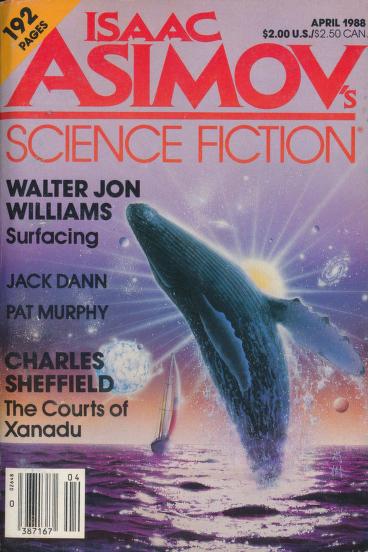
First published in the September 1985 issue of Asimov’s Science Fiction. It was then reprinted in The Year’s Best Science Fiction: Third Annual Collection (ed. Gardner Dozois), one half of a Tor Double with Arthur C. Clarke’s “A Meeting with Medusa,” and the Robinson collection The Martians. Given that it’s a solid 30,000-word novella it might be a bit too long to be reprinted more often.
Enhancing Image
Roger Claybome has had enough of politics on Mars, which is understandable given that a) he’s several centuries old at this point, and b) he’s a member of the Reds, conservationists who believe Mars’s pre-human ecological state should’ve been kept intact. The Greens, those who believe in terraforming Mars, have long since won the “war,” so to speak. It’s just taken 27 years for Roger to admit he’s lost.
Too many opponents, too many compromises, until the last unacceptable compromise arrived, and [Roger] found himself riding out of the city with Stephan, into the countryside he had avoided for twenty-seven years, over rolling hills covered by grasses and studded by stands of walnut, aspen, oak, maple, eucalyptus, pine: every leaf and every blade of grass a sign of his defeat. And Stephan wasn’t much help; though a conservationist like Roger, he had been a member of the Greens for years.
He’s become like a fish out of water, and he’ll continue to feel that way once he meets up with the rest of the time. Olympus Mons, a volcano that stands as the Mount Everest of Mars, is something that needs climbing, and for Roger there may even be remnants of the Mars he once knew up there, at the very top. Something neat Robinson does here that he also did in Icehenge is making the characters nigh-immortal, with people living a thousand years at a time; how this is made possible is not made clear, but it is the future and Robinson knows we don’t really need to know the science behind it. The result is that Roger and his contemporaries were of the generation that started colonizing Mars, back when it was like one vast desert, so rather than have a sense of nostalgia pushed on them by previous generations they lived to see the planet change before their very eyes. Despite having been part of the Martian government for three decades (a long time for us normal humans, surely), Roger looks like he’s barely reached middle age. This crunching of the passing of time is especially convenient for a novella, which doesn’t have the space of an epic novel.
Both the physical and narrative trajectory is mostly upward, and I have to say it’s pretty neat we get an illustration of the expedition, with camp locations and all that. The human members of the expedition are for the most part not as vividly drawn, sad to say, with the only exceptions being Eileen, a former short-term lover of Roger’s (it was long enough ago that she doesn’t remember their time together, although he does), and the terminally grumpy Marie, who sadly is left with that one defining trait. The other team members are basically expendable. It probably doesn’t help (although it does make the narrative more focused) that this is all told from Roger’s POV. From the start Robinson sets up Roger and Eileen’s unexpected reunion as the basis for romantic/sexual tension, but to his credit he also uses this tension to contrast our two leads, as they not only differ sharply in personalities but also worldviews. The budding romance serves a symbolic purpose which will become gradually more apparent as Roger’s character develops, which is what we call doing two things at once, i.e., good writing. Eileen herself is the closest we get to Robinson’s mouthpiece here, which is to say she vomits up what is clearly supposed to be the story’s thesis, that having to do with our perception of the past. As Eileen says, “Our past is never dead,” and then does the philosophy student thing (although chronologically she’s much older than college-age) of asking Roger if he’s read Jean-Paul Sartre. Roger says he’s much more of a Camus fan, actually. Okay, no, he just says he hasn’t read Sartre. Then she brings up Heidegger and that’s when we know we’re really in trouble. I won’t recite their whole conversation, because I’m not a philosophy major (although my Philosophy 101 professor tried hard to convince me), so we’ll move on.
Much of this story is about nostalgia and how we connect important moments in our lives, often distant memories, to places that were totally incidental. Roger has an intense fondness for Mars when it was red because he has childhood memories here that mean a lot to him, but which he is unable to recapture. He contrasts his own fond memories on the surface of the Martian desert with the minor character Pip from Moby-Dick, at the same time likening himself to the precocious and often depressed Pip of Great Expectations, two comparisons that link Roger as a literary figure but which also show a kind of latent narcissism in himself, that he should think himself comparable to characters in iconic works of literature. The comparison with the Pip of Moby-Dick does fit, though. For those of you who forgot, Pip is the cabin boy who at one point goes overboard and stays on the wide ocean, staring into its bleak depths, for an hour or so before being rescued, by which point the experience had driven him insane. (This is also a reminder that Moby-Dick is arguably cosmic horror.) Yet the two characters’ experiences could not be more different. “Someone had lived an hour very like his day on the polar desert, out in the infinite void of nature. And what had seemed to Roger rapture, had driven Pip insane.” And here Roger is again, surrounded by nature, with only half a dozen or so fellow humans for company—only this time it’s a nature that’s been perverted, a nature he doesn’t recognize. One person’s Eden is another person’s Hades. Roger wonders if his intense nostalgia and Pip’s madness are two sides of the same coin—the sensation that something has been lost, only coming from emotionally opposite directions.
The plot is simple—maybe too simple, given how long this novella is; but to compensate Robinson lovingly describes the cliffsides of Olympus Mons and the growing vegetation there, small signs of animal life, as the climbers ascend and the atmosphere gets thinner, like how it is on one of the tallest mountains on Earth. The campsites, the caves, the conserving of oxygen tanks and food supplies, it all becomes like a mountain-climbing story you might read today, or what Jack London might’ve written about. What the characters (aside from Roger and maybe Eileen) lack in depth the setting more than makes up for it, and not only that but the traversing of said setting. This is an adventure narrative, albeit an introspective one, and Robinson does his best to give the reader an impression of what it would be like to scale the tallest volcano on Mars.
Consider:
Verticality. Consider it. A balcony high on a tall building will give a meager analogy: experience it. On the side of this cliff, unlike the side of any building, there is no ground below. The world below is the world of belowness, the rush of air under your feet. The forbidding smooth wall of the cliff, black and upright beside you, halves the sky. Earth, air; the solid here and now, the airy infinite; the wall of basalt, the sea of gases. Another duality: to climb is to live on the most symbolic plane of existence and the most physical plane of existence at the same time. This too the climber treasures.
If Roger can’t take solace in a transformed Mars then at least he can take comfort in being an expert climber. There’s an incident with Frances, one of the other climbers (I wanna say she’s a redshirt, but that’s a bit mean), who gets an arm broken and has been escorted down to base for rescue, which itself is no easy feat. By this point the party has broken up into small groups, leaving only Roger and Eileen with each other as they ascend the volcano the rest of the way. Incidentally, as the human interference has lessened and the roughness of the setting has increased, Our Heroes™ find it easier and easier to communicate with each other, as if their growing isolation from the rest of the expedition is correlating with what might be a rekindling relationship. On one last note before we get to the climax, I think it’s worth reminding the both of us that the life we see on Mars is not native to it—at least not originally: the flora and fauna brought over have been given centuries of genetic engineering and adaptation. Nothing is the same anymore, but then again that means there’s room for growth, both for life on the planet and Roger’s own view towards it. The past haunts the present, but the past doesn’t have to mean just one thing to everyone; it’s possible to revise it, or at least to gain a different understanding of it.
There Be Spoilers Here
Just one line from Eileen: “Maybe I do remember you.”
A Step Farther Out
It’s a bit overlong, and I have to question the logistics of turning Mars green in just a few centuries; but still, it’s riveting, as personal as it is political. One of Robinson’s career-long obsessions has been our relationship with history, and the capacity for revisionism. Needless to say he agrees with Sartre, that history, or rather our understanding of it, is not fixed. This is unsurprising given Robinson’s leftist sympathies and academic background (he had recently earned his PhD when “Green Mars” was published), but what’s more surprising is how he’s able to synthesize his views on history with a planetary adventure narrative which has, within its confines, at least one character in the Shakespearean sense. That Roger is the only character here with a sense of an interior life would be a problem if this were a novel, but thankfully the novella mode is right for such a thing.
See you next time.





 Science Fiction & Fantasy Remembrance