(Cover by H. W. Wesso. Strange Tales, January 1932.)
Let me tell you about monsters.
I love monsters of all sizes, although I have to admit I tend to prefer the giants that stalk whole landscapes. The bigger the better, but then “bigger” doesn’t always mean physical size. I love Frankenstein’s monster, especially Boris Karloff’s mildly talkative and rather emo depiction in Bride of Frankenstein, with his hungering for both love and death. I love Max Schreck’s Count Orlock in Nosferatu, who despite being modeled on Dracula seems to be almost more rat than man. I love the blob, especially in the 1988 version of The Blob—a mindless eating machine that digests people while they’re still alive. I love Godzilla, Mothra, Rodan, King Ghidorah, and even Hedorah, the walking turd that might be the strangest of Godzilla’s foes. I love the zombies of George Romero’s Dawn of the Dead and Day of the Dead, the shambling corpses who walk the earth in search of something they can’t put a rotted finger on. I think the creature from the black lagoon deserves a break (which he finally gets in The Shape of Water, a Best Picture winner!) and I think werewolves are SEXY.
Fantastical horror always involves monsters, even if they’re the theoretical ghosts of Henry James’s The Turn of the Screw. As such the stories I pick for review every October (and it will be every October for the foreseeable future) always seem to be monster tales at their core. It’ll be Halloween soon and we’re putting up the decorations. We’ll be seeing vampires, ghosts, zombies, werewolves, witches, black cats, and things from beyond that cannot be easily classified. Because I believe horror, more than any other genre, benefits from brevity, we’ll be doing all shorts again. These are rapid-fire terrors that hopefully will ignite the imagination.
We have the usual suspects: Weird Tales, Twilight Zone Magazine, The Magazine of Fantasy and Science Fiction. Certain outlets have served as safe havens for short horror fiction through the decades, and admittedly I would feel weird if I were to not include a selection from something as foundational as Weird Tales. Some traditions ought to be respected.
Here are the stories:
“Not Our Brother” by Robert Silverberg. From the July 1982 issue of Twilight Zone Magazine. We’re starting with someone who probably doesn’t come to mind when one thinks of horror, although Silverberg’s work can sometimes evoke existential dread. Having made his debut in the early ’50s and still active in fandom, Silverberg has had one of the longest careers of any writer—inside or outside the field. This is a rare example of him doing straight terror.
“Nightmare Island” by Theodore Sturgeon. From the June 1941 issue of Unknown. I consider Sturgeon one of the finest short story writers of the 20th century, and a major inspiration. Without Sturgeon and those like him this site probably wouldn’t exist. While most associated with SF, Sturgeon wrote a good deal of horror, including the stories “Bianca’s Hands,” “Bright Segment,” and the novel Some of Your Blood. This one is from very early in Sturgeon’s career.
“The Naturalist” by Maureen F. McHugh. From the Spring 2010 issue of Subterranean Online. McHugh won a Hugo for her alternate history story “The Lincoln Train,” and her debut novel China Mountain Zhang is one of the cult classics of ’90s SF; but her range goes well beyond alternate history as she has proven herself to be quite versatile over the last 35 years. “The Naturalist” looks to be a rare horror turn from McHugh, having to do with zombies.
“The Ancient Mind at Work” by Suzee McKee Charnas. From the February 1979 issue of Omni. I had a bad first experience with Charnas a couple years ago, but have been meaning to give her another shot since her reputation is solid and her devotion to the weird is unquestioned. “The Ancient Mind at Work” was Charnas’s first short story, although she already had two novels in print. It would then be absorbed into the fix-up novel The Vampire Tapestry.
“Pipeline to Pluto” by Murray Leinster. From the August 1945 issue of Astounding Science Fiction. Here we have another surprising inclusion, given Leinster isn’t normally associated with horror. He first started writing genre fiction in 1919, predating even Weird Tales. What’s surprising is that not only did he stay relevant several decades into his career, but he peaked in the ’40s and ’50s, holding his ground against writers a generation younger than him.
“Brenda” by Margaret St. Clair. From the March 1954 issue of Weird Tales. I covere St. Clair only a few monthss ago, but she’s back already. She wrote a lot in a relatively short span of time (mostly from the late ’40s to the late ’50s), and during that time she was arguably one of the best short story wrriters in the field. Not one to be tied down to any single genre, or even any mode of writing, St. Clair swerved effortlessly between pulpy and more refined prose.
“Jedella Ghost” by Tanith Lee. From the September 1998 issue of Interzone. One of two returning authors from last October, because honestly I wanna taste more of what Lee has to offer before forming a real opinion; that and she’s such a prolific and consistently spooky writer that her well never runs dry. I’ve read one or two of her stories since our last encounter (which admittedly did not enthuse me) and I think I’m starting to get what her deal is.
“The Door to Saturn” by Clark Ashton Smith. From the January 1932 issue of Strange Tales. The other returning author from last year’s Spooktacular, and this time it’s because I do love me some Clark Ashton Smith. While he can sometimes phone it in, Smith’s writing is often vibrant, poetic, and deeply enchanting—like a wizard casting a spell. Here we have a story set in his Hyperboria universe, a land where sorcerers and dark gods are in charge.
“The Last Feast of Harlequin” by Thomas Ligotti. From the April 1990 issue of The Magazine of Fantasy and Science Fiction. We’re ending with what has to be the longest story of the bunch, but it’s by one of those rare modern masters of horror. Ligotti is not the most popular writer in his field, but those who read him hold him in the highest regard. A devout student of Lovecraft, Ligotti’s fiction can be disturbing by way of implication, as opposed to violence.
(Cover by Frank Kelly Freas. Amazing Stories, May 1983.)
Who Goes There?
William F. Wu is almost certainly one of the first Asian-American authors to contribute to genre SFF with any regularity, although despite this he’s now a pretty obscure figure; it probably doesn’t help that he’s written little fiction since the turn of the millennium. Wu got started in the late ’70s and would come out a decade later with some big awards nominations, including a Hugo, Nebula, and World Fantasy nomination for “Wong’s Lost and Found Emporium.” He got another Hugo nomination for his 1985 vignette “Hong’s Bluff,” which I reviewed for Young People Read Old SFF. Thus this is not my first run-in with Wu, and my little exposure to him tells me we share a fondness for Westerns and the romanticized image of the American frontier. I may have to find Hong on the Range.
This is now the second story I’ve covered to get turned into a Twilight Zone episode—this time for the ’80s series.
Placing Coordinates
First published in the May 1983 issue of Amazing Stories, which is on the Archive. It was first reprinted in The Year’s Best Fantasy Stories: 10 (ed. Arthur W. Saha), and collected in the Wu volume Wong’s Lost and Found Emporium and Other Oddities. Since it got adapted for The Twilight Zone it’s only natural that it would appear in New Tales from the Twilight Zone (ed. Martin H. Greenberg). These, sadly, are all out of print, and despite its awards attention this story has not been collected in anything since the ’90s; and mind you, it’s Wu’s most popular story.
Enhancing Image
Wong is a dock worker for a New York Chinatown who also happens to be—let’s call him the substitute overseer of a very strange shop. Of course, Wong didn’t ask for this job and he’s not getting paid for it; the real owners of the shop have gone missing and Wong, for reasons unclear to himself, decided to take their place until they return. If they return. It’s a big place that expands to accommodate its stock seemingly endlessly. “The shop was very big, though crammed with all kinds of objects to the point where every shelf was crowded and overflowing.” There are crates everywhere, even ones hanging from the ceiling, filled with all kinds of junk.
True to what the title would make you think, it’s indeed a lost and found center where people can find lost items—and even belongings of theirs that are far more abstract. The story starts out with Wong helping out a much older woman (she has a name, but it doesn’t matter) look for a lost chance at becoming an artist in her youth—a lost opportunity that has taken the form of a bottle’s contents. The way it works is that if it’s a physical item that has been lost then it can found as a solid or liquid object in one of the many boxes; but if it’s an idea, like a decision not made or a part of one’s personality, then it would take the form of a gas that must be inhaled to take effect. The latter is harder to get a hold of, as once the bottle is opened and the vapors come out, the person has only one chance to capture it. Sadly for the old lady she fumbles her bottle and fails to take in the vapor. This all sounds pretty high-concept, although I have to admit Wu doesn’t do a lot with it in the story itself.
There’s not a lot of plot to go over, as this is little more than a vignette, but let’s talk about the mechanics of the shop since I suspect that’s the reason readers took such a liking to it. Wong has been working and basically living in this shop off and on for the past couple months, living off of food scraps, which would be impossible considering his responsibilities to his real job if not for the fact that time moves differently in the shop. “The dual passages of time in here and outside meant that I had spent over two months here, and I had only spent one week of sick days and vacation days back in New York, on the other side of one of the doors.” Even with that time dissonance, though, he’s just about at the end of his rope, losing his patience with people he helps but also knowing he only has so much time he can spend here. The real problem—the internal conflict, since there’s not much of an external one—is that Wong is a bit of an asshole, despite his “job.”
This comes to a head when Wong gets another “customer” in the form of a nameless young woman (Asian-American, like Wong) who has apparently been hiding out in the shop for some time now, watching Wong and judging (correctly, in all fairness) him unworthy of his position. It’s here that we’re given a reason for why Wong is so callous: growing up a victim of racism made him stone-hearted. On the one hand it now reads as cliched that a person of color gives childhood racism as the reason for their trauma, but it would’ve been novel at the time in magazine SFF to have that background be written by someone who almost certainly experienced the same thing in their own life. This story is a whole forty years old now and having two of the three main characters be non-white was certainly uncommon then, although in that sense it now reads as unexceptional.
One more thing about the shop. You may be asking, “How do you find anything here?” The idea is that there’s a customer and an overseer, and the customer would not be able to find what they’re looking for on their own; but the overseer is guided by a ghostly light which shines on the object of the customer’s desire. In other words, if you wanna find anything, you need a partner. The young woman is looking for something herself—a part of her personality that somehow she had lost, and while she disagrees with Wong’s attitude, she does need his help. The lost part of her personality, as it turns out, is her sense of humor, which makes her a good deal more bubbly—not that that helps Wong much. The back end of the story thus sees a sort of comedic-straight dynamic between Wong and the young woman, or one could think of it as a master-apprentice thing.
There Be Spoilers Here
The roles reverse as, having been helped, the young woman decides to help Wong in return—if only to make him more caring. Wong claims to have lost his sense of compassion, and while he ends up fumbling the bottle for that (mirroring the old lady earlier), he does find two bottles containing other things lost—only he’s not quite sure what’s inside. Had this been a horror narrative it’s at this point that we might be greeted with a horrific part of Wong’s background or personality that had been forgotten, like suddenly remembering a crime he had committed long ago. But this is not horror and what Wong finds is fairly pleasant: the first is a nice memory that he had forgotten, and the other is his integrity. While he didn’t get his compassion back exactly, he did get some of it along with his integrity “in a package deal.” It’s sweet. Wong didn’t think he owned the shop before, but now he feels genuinely responsible for it, even suggesting the young woman should become his assistant. How they intend to make a living off this is anyone’s guess.
Maybe I’m also an asshole, but I couldn’t help but think about how one is supposed to make money with this place. I mean, it’s a lost and found center, but I feel like services this esoteric shouldn’t come free.
A Step Farther Out
Upon reading “Wong’s Lost and Found Emporium” I wasn’t really sure how to feel about it. It’s cute, but despite the neat premise Wu gives us the ends were more banal than I would’ve hoped. We get the slightest hint of something cosmic lurking around the corner, since while the workings of the shop are explained somewhat there is much that is left a mystery, but this is very much not a horror narrative. Admittedly if it did turn out to be horror then I probably would’ve complained that such a premise leading to horror is trite, so I suppose I’m being unfair with it. The problem may be that while I can’t say it has aged poorly, it would probably not catch people’s attention if published as a new story today without a word changed. Urban fantasy, even from POC perspectives, has really taken off since 1983, so that while it was prescient, it has since been surpassed.
The latter half of the ’60s didn’t see too many outstanding new voices in science fiction; a lot of the supposed fresh meat had actually debuted a decade earlier, including Harlan Ellison, Kate Wilhelm, Richard Wilson, Robert Silverberg, and Anne McAffrey. One of the true highlights to emerge from this period was James Tiptree, Jr., real name Alice Sheldon. Tiptree came to the field very late, already being in her fifties when she debuted in 1968, after many years across different jobs, including a stint in the CIA when it was newfangled. That Tiptree was actually a thoroughly middle-aged woman did not occur to anyone at the time, in part because her real identity was kept a tight secret, and also because nobody wrote like Tiptree when she was on the ball. You read Tiptree and you’re bound to get something that’s energized, highly colloquial, and pitch-black. Reading Tiptree is not a great idea if you don’t wanna feel like garbage.
Although Tiptree died in 1987 (in a murder-suicide with her husband), she’s considered one of the quintessential ’70s SF writers, remaining fresh even when the New Wave was on its deathbed. The early ’70s were especially a fruitful period for her, with such classics like “The Girl Who Was Plugged In” and “Love Is the Plan the Plan Is Death” winning her awards. I’m gonna be talking about a more obscure story from this period, and despite being published in Fantastic it really is science fiction, as Ted White all but admits in the introductory blurb.
Placing Coordinates
First published in the August 1972 issue of Fantastic, which is on the Archive. “Forever to a Hudson Bay Blanket” was soon reprinted in Tiptree’s first collection, One Thousand Light-Years from Home, which luckily is still in print and even got a spiffy new edition from Penguin. For anthology appearances the only recent-ish one is The Best Time Travel Stories of All Time (ed. Barry N. Malzberg).
Enhancing Image
Dov Rapelle is a 22-year-old “nice person” (he is Canadian, after all) and burgeoning scientist-to-be who lives in the snowy mountains of Calgary, Alberta. “Calgary has the tallest water-tower on the continent, you know, and all that tetra-wheat and snow sports money.” It’s Christmastime, and things have been going pretty well until Dov gets a weird call from a girl who acts like she already knows who he is, despite the two never having met before—or at least Dov is sure he’s never met this girl before. Another call later with this girl and it’s the same thing. Dov is nice, but he’s not very smart and it doesn’t occur to him that something beyond his understanding may be afoot just yet. Shit’s about to get much weirder.
Before our romantic duo even see each other in person I’m gripped, mostly due to Tiptree’s conversational style that sneaks humor into what would normally be vanilla expositional passages. Reading a Tiptree story is often like listening to someone talk, and I have to wonder what her writing process was such that her writings tend to read like they were dictated—which I mean as a compliment, of course. This would go only so far if the pace was slow, but quite the contrary this is a lightning-fast narrative and there’s a fair bit of ground to cover, what with the time travel and all.
The girl in question is Loolie Aerovulpa, a bratty 16-year-old who is fed up with being kept on a tight leash by her rich dad. Somehow she managed to take a helicopter (no, she didn’t fly it) out to Dov’s cabin, as if knowing where he was in advance. Here she is, a pretty girl Dov’s never seen before, and not only does she act like she knows him, she wants to FUCK. Badly. The consent here is a little questionable, for one because Loolie is so young and also because she is rather pushy with Dov, although the latter gives in quickly enough. (Yes, I was a little distracted by the fact that Dov sleeps with a teenager, but unfortunately if you read enough ’70s SF you have to get used to that sort of thing.) Calling it “love at first sight” may be misusing the phrase. It’s unclear how much Dov comes to feel genuine affection for Loolie, but for reasons given later this may well be part of the tragedy. Like Romeo and Juliet their affection is too strong (at least on one side) to last, and Loolie is about to fail in a noble fashion.
You may be reading the story and thinking, “I know where this is going,” and you’re probably right. This is not the most unpredictable thing ever. I went in expecting a stable time loop and that is what I got—for the most part. Tiptree has a couple little tricks up her sleeve. And again, it’s easy to get wrapped up in her style of narrating even when you’re stroking your chin, confident you know how it’s gonna end. It also helps that while we’ll get our recommended dose of tragedy at the end, the world of the story is also not a hellscape like in a lot of Tiptree stories; but then again, it is set in Canada in the ’70s, albeit with allusions to the future.
Thing is, Loolie did not travel back in time, strictly speaking, although her consciousness did. It’s okay, if you lie on your side and put beer goggles on, that Dov has sex with a 16-year-old because actually that teenager’s consciousness had been momentarily swapped with that of her 75-year-old self. So Dov has sex with an old lady who happens to be in a teenager’s body. I still don’t entirely know what to make of this. It doesn’t help that Old!Loolie tries to tell Dov something important before getting cut off and replaced with her younger self (the reason for this sudden breaking-off is never given), and of course Young!Loolie has no fucking clue what happened. Is this consensual? What does getting bodysnatched by your older self and having sex (and losing your virginity in the process, for what that’s worth) with a guy you’ve never seen before count as? This can’t be right.
Not enough time to think.
Despite what’s happened to her, Loolie grows fond of Dov in a matter of literally minutes, for a reason that’ll be given later but which for now is totally beyond Dov’s understanding. And to make matters worse, the cavalry has arrived. Loolie’s uncle (actually much older cousin) and his enforcer come down in a helicopter as well, “one small hysterical man and one large hairless man” respectively. They were supposed to get Loolie under control before she went off and did a certain something her father had anticipated, as if it were a prophecy, but it’s too late. For better or worse (it’s gonna be for worse), Loolie and Dov are tied together by fate now—a tie that will prove to be both their downfalls, albeit in different ways.
Thinking about it now, it seems that Tiptree wasn’t a big believer in the power of love. True, she married multiple times, admitted to loving both men and women (being the messiest bisexual), and seemed to think the world of her late husband despite what she did to him; but romance, particularly between the sexes, does not thrive in her fiction. More often than not it’s a non-starter. The primary reason is that, for one reason or another, women either live in fear of violence at the hands of the men in their lives or have to suffer it directly. The most stark example of this might be in her novella “Houston, Houston, Do You Read?,” which, without spoiling that story, has what has to be one of the bleakest speculations on the future between men and women in the history of fiction. In the case of “Forever to a Hudson Bay Blanket” the man and woman might be happy together, but something at the core of their relationship dooms them both.
There Be Spoilers Here
Loolie had been conditioned by her father and psychologist to find sex repulsive, as a sort of mental chastity belt. The only way to break the conditioning, as it turns out, is to bite the big toe of the man she’s with, which will not only break the conditioning but slingshot into a sort of love potion effect whereby she’ll be smitten with said man all the rest of her life. Old!Loolie bit Dov’s big toe after they had sex (which weirded him out, but again, nice guy), therefore Young!Loolie got back into her body with the urge to stay with Dov until the end of her days. Dov ultimately can’t complain about this arrangement, marrying a pretty girl from a rich family. He might even come to love her, if given time; unfortunately he will not be. Time-jumping is supposed to be safe, but there’s nothing protecting you from dying in the body of your 62-year-old self. Dov dies, as both a 22-year-old and a 62-year-old at the same time… somehow.
Loolie must be wracked with grief, naturally, but at some point she asks the same question the reader must be asking: “How the fuck did he die now if he doesn’t die for another forty years?” But the time travel experts don’t have an answer, or at least a good one. Even though time-jumping is reserved for the rich and thus only a tiny fraction of people have access to it, time paradoxes have been popping up. The easiest explanation might be that every time someone jumps they enter a different timeline, but this is just speculation, and anyway Loolie eventually goes back in time to her past self to restart the cycle. So it’s a stable time loop—sort of. Loolie knew how to break her past self’s conditioning because she remembers what her psychologist said about the trigger… because she had gone back in time when she already knew what the trigger was… which she only knew because she already had her conditioning broken…
It’s this chicken-and-egg shit that always makes time travel narratives at least entertaining for me. Nothing to get the gears in your head turning like a time loop with no apparent beginning or end.
A Step Farther Out
Well that wass… dark; although by Tiptree standards I would call it bittersweet, if putting more emphasis on the bitter. She takes what’s really a simple premise and adds her own spice to it. “Forever to a Hudson Bay Blanket” could’ve been translated to the ’50s or possibly earlier, but you would have to remove the eroticism, the language, and of course Tiptree’s of-its-time street-smart narration which often shrouds her fiction. The ending still hit me in a way, even if the general aura of tragedy is telegraphed well in advance. It’s not revolutionary, but I would say it’s an accessible entry-point for getting to know Tiptree without jumping straight into her most caustic material—which is a mistake a lot of people make.
It’s now September, or as I like to think of it, the month before October. Yeah, I don’t have anything special in mind for this. Summer is about to end, the kids have gone back to school, and I’m about to head back to work as I’m finishing up this post. As has become typical I’ve toyed around with what I’m gonna review repeatedly, right up to the last minute, because I cannot make up my damn mind sometimes. There’s so much fiction, especially short stories, to cover that I’m constantly going, “Hmm, I wanna check this out. But ohhh, what about THIS?” Much as I want to at times I can’t do everything I want in a day. I’m a slow reader and I don’t give myself the heavy loads of someone who gets paid for review columns.
Speaking of making a good use of your time, I recommend subscribing to a few SFF ‘zines; doesn’t matter too much which ones, although I’m biased and I think Uncanny Magazine and Lightspeed are very much worth supporting. Even buying the latest issues of The Big Three™ (Analog, Asimov’s, and F&SF) would be a much better use of your time and money than a no-good piece-of-shit (HBO) Max subscription.
Apparently Analog and Asimov’s now have their own digital subscription services, to compensate for the Amazon bullshit, so that’s great honestly. Not sure what F&SF is gonna do since, with all due respect, of The Big Three™ they’re the ones most “behind” with regards to adjusting to changing market forces. We’ll see what happens there.
So what reading materials do we have?
For the serials:
The Reign of Wizardry by Jack Williamson. Serialized in Unknown, March to May 1940. From a historical perspective, Williamson has to be one of the most intriguing figures in American SFF, debuting in 1928 and more or less remaining active until his death in 2006. At his best he also proves to be one of the most gripping and thoughtful “Golden Age” authors. The Reign of Wizardry was Williamson’s first attempt at writing fantasy that was not in the Weird Tales mode.
The Chronicler by A. E. van Vogt. Serialized in Astounding Science Fiction, October to November 1946. In the ’40s and early ’50s van Vogt was a star among genre readers, about on par with Robert Heinlein and Isaac Asimov—only since then his popularity has waned massively, for several reasons. A direct precursor to Philip K. Dick (by Dick’s own admission), van Vogt’s influence on the field is still discernable but now understated. He remains a divisive figure.
For the novellas:
“The Earth Quarter” by Damon Knight. From the January 1955 issue of If. As author, editor, and critic, Knight did much to bridge the gap between ’50s SF and the New Wave, with his Orbit series proving the viability of original anthologies. But in the ’50s he was one of the finer short story writers, with such classics as “Four in One” and “To Serve Man.” “The Earth Quarter” was later revised for book publication, but we’ll be reading the magazine version.
“Green Days in Brunei” by Bruce Sterling. From the October 1985 issue of Asimov’s Science Fiction. Probably the most important writer of cyberpunk whose name is not William Gibson, much of Sterling’s work is actually not cyberpunk—at least in content. If Gibson codified the tropes that would define the movement, Sterling codified the attitude of cyberpunk, emphasizing the “punk” half of that word. Will be one of two Sterling stories I review this month.
For the short stories:
“Forever to a Hudson Bay Blanket” by James Tiptree, Jr. From the August 1972 issue of Fantastic. Real name Alice Sheldon, Tiptree was one of the thorniest authors to come out of the New Wave, being much discussed for the outward feminism (and pessimism) of her work, the mystery of her true identity, and the tragic circumstances of her death. Tiptree made waves in the early ’70s, but I’m going for a relatively obscure story from that period.
“Wong’s Lost and Found Emporium” by William F. Wu. From the May 1983 issue of Amazing Stories. Surprisingly, given how obscure a name he is, this is not my first time reading or even reviewing Wu. He must’ve been one of the first Asian-American authors to partake in magazine SFF, and yet he remains to be rediscovered. This story, for one, was up for the Hugo, Nebula, and World Fantasy Award, and it even got turned into a Twilight Zone episode.
Next month is when we’ll be doing all short stories and all spooky shit, so be on the lookout for that. In the meantime my review schedule is pretty normal and I assume nothing will be replaced last-minute.
(Cover by Dan O’Driscoll. Asimov’s, February 2004.)
Who Goes There?
When Asimov’s was practically the be-all-end-all SFF magazine of the ’90s, certain authors were sitting at the very top of that tower. If you asked someone in 1995 who the most popular contributors to Asimov’s were, the two likeliest answers would be Connie Willis and Mike Resnick. Resnick had in fact been around (first as a fan) since the ’60s, but it was his 1988 story “Kirinyaga” that catapulted him to noteriety; ironically said story was published in The Magazine of Fantasy and Science Fiction, but Resnick quickly moved to Asimov’s and took the sequels to “Kirinyaga” there. He would end up with a record-breaking number of Hugo nominations, plus five wins, with today’s story being the fifth winner. This is not something you just do by accident. Resnick clearly had talent and a vibrant charisma that endeared him to readers as author and editor.
What’s strange about Resnick is that despite having died only a few years ago and being generally well-liked among the genre readership (those who still subscribe to magazines), his work reads like it’s—let’s say from a different era. Which is true. The ’90s may not seem like a long time ago in terms of how literature has evolved, but back when Resnick was at the top of his game he wrote for an audience that was damn close to lily-white, and it shows, especially in those aforementioned Kirinyaga stories. “Travels with My Cats” doess not have such a problem… up to a point.
Placing Coordinates
First published in the February 2004 issue of Asimov’s Science Fiction, which is on the Archive. You’d think winning a Hugo (never mind also placing first in the Asimov’s readers’ poll) would guarantee more reprints, but “Travels with My Cats” has been reprinted only a few times. If you want an audio reading then there’s the Escape Pod episode for “Travels with My Cats,” found here. For book reprints there’s the collection Win Some, Lose Some, which collects all of Resnick’s Hugo-winning and -nominated short fiction up to 2012; unsurprisingly it’s quite thick.
Enhancing Image
Ethan, the narrator, reflects back on what would turn out to be a turning point in his childhood, although he could not have known it at the time. As a kid he went to a garage sale, which objectively speaking had nothing unusual—not even in the books section, which like any decent person he checked. There were some fetching books, but they all cost 50 cents each, “and a whole dollar for Kiss Me Deadly,” and Ethan only had a nickel. Well, there was one book that fit his budget: a very old travel book titled Travels with My Cats, authored by Priscilla Wallace. The lack of pictures on the inside at first put Ethan off, but he checked further and saw it was a limited edition—one of only 200 copies. Any self-respecting bibliophile knows a limited edition like that would be a must-buy, especially for a nickel.
It’s here that we get some names dropped, as to be expected of a story that panders to the base. You have the usual: Asimov, Heinlein, Bradbury. Some detective fiction as well, what with Raymond Chandler and aforementioned Kiss Me Deadly. The book Ethan picked up was like none of those, but he ended up enjoying it still as it presented a different kind of adventure, about Priscilla’s globe-trotting travels with her cats Giggle and Goggle, seeing places Ethan could barely comprehend as an 11-year-old. I have to wonder if Resnick had a similar flashpoint in his childhood; maybe he picked up a book at a library, or an issue of National Geographic, and grew fixated on this idea of “seeing the world.” It goes a long way to explaining his fetish for exoticism, which now reads as problematic.
Ethan read Travels with My Cats several times in his childhood, but like all childish things he eventually put it aside, not even giving it a thought until many years later when he has a sort of madeleine-cake-in-tea moment and it all comes back to him. This opening stretch of the story (admittedly this is a story you can read in half an hour), wherein Ethan discovers and then rediscovers Travels with My Cats, is the best part. It could be that I’m a sucker for reminations of the nature of memory, but to Resnick’s credit he makes Ethan a fleshed-out person in those opening pages, perhaps with a bit of autobiography. It’s not hard to imagine Ethan as an alternate version of Resnick, some twenty years younger, who does not go on to “see the world” and become a respected author; instead he becomes a nobody. Ethan, now in middle age, lives a peaceful but unproductive existence, not being in love or fueling a passion that would get him away from his meaningless job. But finding this book again gives him a purpose.
Ethan’s life is basically a series of false starts. He reads all about exotic places but he never travels himself. He forms a sort of fanboy crush on Priscilla (who after all is just an idea to him), but never finds someone in real life who fills this role. He buys what amounts to a log cabin by a lake and that’s the most adventurous he gets—until suddenly he has a mission. How rare is Travels with My Cats actually? Whatever became of Priscilla Wallace, that author only he seems to remember? So like any good bibliophile he ventures out to the library and goes digging. Turns out the book was even older than Ethan had thought. Priscilla died in 1926, age 34. “So much for fan letters, then or now; she’d died decades before I’d been born.” In fairness, given that the current action takes place in 2004, Priscilla would be dead regardless; but the fact that she died so young is a bitter pill. Some people would have the plot be Ethan’s quest to track down the origins of this obscure book from his childhood and leave it at that, and I would even argue that, in the right hands, this might’ve made for a better story.
You may notice that nothing supernatural has happened yet, but that’s about to change when Ethan gets a special visitor at his doorstep. Priscilla is here, along with her cats, looking and acting like a real person.
I have a hypothesis that’s been slowly gaining ground in my brain, and it goes like this: Every author worth their salt will, at some point, write a ghost story, or at least something that can be construed for a ghost story. It’s actually a hard subgenre of fantasy (if you wanna call it that) to avoid. “Travels with My Cats” is a ghost story wherein we’re not sure if what we’re encountering is the supernatural or an elaborate prank the protagonist is playing on himself. Some will call it “magic realism,” but this is a useless label for my money. Anyway, Ethan is awe-struck by the visitation, especially because he had committed the one photo of Priscilla he knew to memory. Here she is, someone who’s been dead for 75+ years, with her two ghost cats, and she’s really just here to talk for a bit.
A few odd things about Priscilla, since she doesn’t act like an ordinary ghost. For one, she knows she’s dead, but she doesn’t know when or how she died. She also doesn’t know what time it is. There’s one other thing, but that’s for spoilers. She appears not once, but several times, coming to Ethan in the night before disappearing. Where she goes is anyone’s guess. In a way I don’t blame Ethan for acting the way he does, because when we meet our favorite authors we’re bound to say some embarrassing shit, like we’re cracking under the pressure of it, but I would be lying if I said his “confession” to Priscilla didn’t make me cringe. The mid-section of “Travels with My Cats” is about their quasi-romantic relationship and it occurred to me at some point that this plot wouldn’t be happening if Priscilla was a man. It could also be that I had read Richard Matheson’s Somewhere in Time only a week ago and that had basically the same problem.
You could argue that “Travels with My Cats” is not a romance, and I’d agree, except it’s obvious that Ethan’s newly revived crush on Priscilla (someone who’s been dead for 75+ years) fuels the plot; it gives his character any reason to grow at all. Heterosexual romances in fiction often strike me as hollow, as they do for a lot of queer people, and I suspect this is because we’re not given a reason for these people to be in the same room together aside from being physically attracted to each other. They would not be friends. I’ve had crushes on several male friends in my life and there’s a profound difference between crushing on someone you like being with simply for the sake of being around them and crushing on someone because your hormones are going turbo and you’re getting funny ideas. Making Ethan and Priscilla’s relationship quasi-romantic (I say “quasi-” because Priscilla doesn’t seem to love Ethan, although she does encourage his behavior somewhat) disappointed me more than a little.
There Be Spoilers Here
One day a raccoon breaks into Ethan’s cabin and tears his copy of Travels with My Cats to shreds. “Pages were ripped to shreds, the cover was in pieces, and he had even urinated on what was left.” The book cannot be salvaged. What’s strange is that while Priscilla has gone, presumably never to return without a copy of the book, her cats are still here. Giggle and Goggle not only look but feel real to Ethan, and he’s convinced these cats have somehow been brought back to life. This can all be written off easily as Ethan losing his marbles, since we never get a third party’s perspective (indeed the world does not seem to exist outside Ethan’s bubble) on the whole thing, but I assume we’re supposed to take the cats existing at face value. But still, Priscilla is gone, and even if she’s just of a figment of Ethan’s imagination, he can’t just wish her back with a thought. All is lost.
Or is it? After much digging, first trying and failing to comb online booksellers (shoutout to AbeBooks), Ethan gets in touch with a guy who knows a guy who can verify even the exitence of Travels with My Cats. True enough, it’s a real book, although it was self-published, only printed 200 copies (not even sold, printed), and didn’t even get an ISBN. To find another copy of Travels with My Cats would take years. Good thing (for him, anyway) Ethan has nothing much to lose. The non-ending of the story sees Ethan hit the road with Giggle and Goggle, using what money he has left to travel cross-country in search of a book that means a great deal to him, if nobody else. I’m sure this has thematic reonsance, what with Ethan finally learning to reach outside his comfort zone by following in his favorite author’s footsteps, but part of me wonders if Resnick ends the story on this open note because he could not figure out where else to take it.
A Step Farther Out
There’s a certain stereotype about Hugo winners, that they’re not demanding reads, but rather crowd-pleasers that play to readers’ emotions. Sometimes this is true. “Travels with My Cats” is one such weepy tale, a bittersweet ghost story with a hint of wish-fulfillment (“What if the dead author I have this weird crush on came to me one night?!”) that’s more rewarding the more familiar you are with Resnick’s reoutine in advance. I’ve read several Resnick stories and have even enjoyed a couple of them thoroughly, but I don’t think “Travels with My Cats” ranks up there. In the introductory blurb, Gardner Dozois claims that Resnick thought “Travels with My Cats” to be one of the three best stories he ever wrote. I don’t know about that.
(Cover by Brian Lewis. Science Fantasy, June 1961.)
Who Goes There?
Truth be told I feel almost the same way introducing Michael Moorcock as I did when I introduced H. P. Lovecraft, in that while my feelings on these men as writers is mixed, I have to admit their importance to genre writing (each in his own way) is immense. I get the irony is that Moorcock really dislikes Lovecraft (as both a writer and person) to the point of basically denying his influence on other writers, but… goddamnit, I couldn’t hold back on this for even a few more sentences. I would’ve read more Moorcock by now, especially since I’ve been getting more into heroic fantasy, but the first memory I have of reading Moorcock was not any of his fiction, but his essay “Starship Stormtroopers,” which is a no-good-very-bad piece of work that, among other things, argues Starship Troopers was hand-crafted to appeal to reactionary young men in the pages of Astounding (it was actually serialized in the left-leaning Magazine of Fantasy and Science Fiction but never mind) and that Heinlein and his ilk promoted fascist tendencies in their writing. And he also took pot shots at Lovecraft with points that simply have not aged well. (He does the annoying thing people still do to this day where he seems to think Lovecraft’s views never changed on anything.) So I was not keen on reading more Moorcock.
Still, it must be said that the field would look a fair bit different without Moorcock’s efforts, especially as an editor. Moorcock was a world-weary 25-year-old when he took over New Worlds, which in the ’60s threatened to become a bit stale but which gained new vitality under Moorcock, publishing works that would not have seen magazine publication in the US for being too sexually charged and/or too vulgar. Writers like J. G. Ballard and Thomas M. Disch really let their nuts hang in New Worlds, whereas elsewhere they had to contend with censorship. The result is that we owe the New Wave (both its successes and follies) at least partly to Moorcock, who after all wanted so desperately for science fiction to “come of age.” But before he became a revolutionary editor Moorcock was already a skilled writer, recognized for his Elric saga, being one of the more important heroic fantasy series in the genre’s history. Despite this, “The Dreaming City” marks my first encounter with Elric, although considering it’s the first Elric story (both published and I believe in internal chronology) I think it fits.
Placing Coordinates
First published in the June 1961 issue of Science Fantasy, which is on the Archive. “The Dreaming City” has been included in several Moorcock collections over the decades, but it did not get anthologized in English until very recently, in The Big Book of Modern Fantasy (ed. Ann and Jeff VanderMeer). Actually I’m sure it was that chunky anthology that made me aware of the Elric saga and this story in particular.
Enhancing Image
We’re introduced to a distant and yet alternate past, not unlike the worlds of Robert E. Howard and Clark Ashton Smith, wherein there was an ancient civilization, Melniboné, that lasted thousands of years and yet, at the start of “The Dreaming City,” is on its last leg. Warlords are conspiring around a campfire; there will be a raid on Imyrrir, the titular dreaming city, the last stronghold of Melniboné. Normally these shady characters would be the antagonissts, only they’re helped by Our Hero™, Elric, last of the rulers of Melniboné—and a king in exile. By his own choice, mind you. The opening pages give us something not dissimilar from Howard’s Hyborian Age, but soon we find there are a few major changes, mostly having to do with Elric himself, who is a darker shade of grey than Conan.
Whereas Conan is a beefcake, a tower of Irish muscle, Elric is “a pure albino” whose eyesight is bad and which will only get worse with age, whose physique is not exactly impressive, and who generally would be a weakling if not for his weapon of choice, Stormbringer, a cursed sword passsed down his line that will both make him and probably be the death of him. Can’t say I’m a fan of Elric. Then again, I don’t think we’re supposed to “like” him; he does not have the courage of Conan, nor the comradery of Fafhrd and the Gray Mouser. If Elric lived in the 21st century he would have most likely been a Jordan Peterson fan as a teenager. It’s hard to appreciate now (and I know because I also find it hard to appreciate from this vantage point), but in 1961 Moorcock gave us a sword-and-sorcery “hero” who was subversive in that he was not a model for power fantasies, but a quishy piece of shit who survives because he has the right tools for it. Okay, there still be a bit of power fantasy involved, which I’ll get to in a minute.
Before I get into the plot, which is deceptively simple (although it’s framed rather confusingly at first), let’s talk a bit more about Elric’s character in the context of fantasy heroes. I’ve already told you Elric is a sword wielder, with Stormbringer getting him out of sticky situations, but the kings of Melniboné also have a long tradition of sorcery. In RPG language we might call Elric a red mage or a combat mage, since on top of swordplay he’s also a skilled magic user—although his capacity to work spells is capped “since he did not have the reservoir of strength, either of soul or of body, to work them.” Moorcock, in so many words, calling the “hero” of his sword-and-sorcery epic a bitch baby is not something other authors were likely to do beforehand. Even C. L. Moore’s Jirel of Joiry, who psychologically might be as battered as Elric, is still a naturally strong warrior who earns her keep. It also turns out that Elric does not seem to feel loyal to anyone in particular, since it takes all of about twelve hours for him to bamboozle the warlords he’s conspired with and to follow his own path into the city—his city—where the real villain dwells. “He planned to leave the fighting to those he had led to Imrryr, for he had other things to do—and quickly.”
I’m about to escalate things here and say that the real dramatic hinge of the story is an incestuous love triangle between Elric, his tyrannical cousin Yrkoon, and Yrkoon’s sister Cymoril. Yrkoon is the current ruler of Imyrrir by virtue of Elric leaving his post, but also by force; there’s the strong implication that if not for most of the city’s people being perpetually stoned and sleepy (the city having degenerated into little more than a massive opium den at this point), Yrkoon would’ve been overthrown. Everybody knows Elric is the “rightful” ruler, but Elric sort of disagrees. Whereas in much fantasy the hero’s hometown is looked upon with a nostalgic fondness, Imyrrir is in such a state of disarray and given to such debauchery that like one of the cities of the plain it seems destined to get torched by the hand of God. Getting sacked by a fleet of despots might not actually be the worst thing that can happen to it. Unfortunately because this is a short story and because Moorcock’s descriptions are rather sparse, we get to know extremely little about the city and its people. Then again…
I normally don’t bring up the quality of the prose itself when reviewing stuff here because I’m one of those people who thinks that not everything need evoke Joseph Conrad in its delicate use of the English language. Different writers have different strengths when it comes to crafting narratives; you might have someone who is great at character psychology but who is average at best with constructing plots. Moorcock would’ve been all of twenty years old when he wrote “The Dreaming City,” and while it was not his first story published (he had been around for a few years at that point), “creaky” is a word that keeps coming to mind for me when I think of the prose here. There are turns of phrase here that I personally would not use. I didn’t think the word “frenziedly” would pop up, let alone more than once. There also seem to be a few times where Moorcock uses a word that sounds exactly like another word he intended to use but which is a different word with a different meaning. Not sure how Elric can “steal” himself. Pardon me, I know I’m picking on a story from towards the start of an author’s career and which itself is now older than most people.
Anyway, Elric takes his own boat and sneaks into the port city via a secret passage only he knowss, being intimate with the city’s layout. This move is less to save the city and more to rescue Cymoril from the gross incestuous claws of his cousin (as opposed to Elric’s benign incest). Little aside here, but when Elric finds Cymoril she’s in a druggy slumber, like most of Imyrrir’s populace, and kisses her on the lips while she’s unconscious. Interesting. It’s also never made clear if Cymoril actually reciprocates Elric’s feelings or if she just finds him preferrable to Yrkoon, who after all totally lacks redeeming qualities. We’re also introduced to Elric’s mentor, Tangleboness (what a quirky name), whose death is so telegraphed that if he said he had two more days until retirement it would not have been surprising. Oh, and a raid is about to start, but that’s easy to forget. It’s clever that Elric would help stage a raid so as to distract Yrkoon and his troops, but it’s also a subplot that mostly happens offscreen and whose conclusion is immaterial.
There Be Spoilers Here
Elric, in trying to save Cymoril and then to avenge his mentor’s death (as was all but foretold), kills an impresssive number of mooks—at least partly without even trying. If you’re looking for bloodlust in your fantasy then the central action sequence here will satiate your appetite somewhat. Of course this is only buildup for the duel with Yrkoon, wherein the traiterous cousin pulls out a magical sword of his own and the two combatants are rendered nigh immortal from their sorcery. Elric defeats his cousin, naturally, but tragedy unfolds as a result, for Cymoril has all of two or three lines before getting caught in the crossfire and dying on Elric’s sword. In his dying moments Yrkoon throws Cymoril onto Stormbringer and she dies basically instantly and without saying anything in reaction; it’s such an abrupt death scene that I had to do a double take.
So Yrkoon is dead, Cymoril has done a good job of getting fridged (I do find it funny that Moorcock, an outspoken supporter of Women’s Lib, would kill off the sole female character in the first Elric story so unceremoniously and without granting her actual character), and Imyrrir is basically in ruins. A good day’s work, I think! Not that Elric feels good about it. At the time Elric killing his own love interest by accident might’ve hit differently, but now it reads as almost inevitable—like a job requirement. Truth be told the last quarter of the story could’ve been shortened extensively, since we’ve already hit the climax, both of the action that matters to Elric and the trauma that will probably define future series entries; it’s rather overlong. We do, however, get a meaty passage at the end that could be thought of as the flashpoint of Elric’s superhero (or -villain) origin story, as he contemplates his lopsided relationship with Stormbringer.
Elric brooded, and he held the black runesword in his two hands. Stormbringer was more than an ordinary battle-blade, this he had known for years, but now he realised that it was possessed of more sentience than he had imagined. The frightful thing had used its wielder and had made Elric destroy Cymoril. Yet he was horribly dependant upon it; he realised this with soul-rending certainty. He was an albino—a type rare among animals and rarer still among men. He was an albino, owning no natural reserves of vitality. Normally, he would be slothful, his reactions sluggish, his mind hazed. His eyesight would grow steadily worse as he grew older and he would probably die prematurely. His life would be dependent upon the grace of others; he knew this—he would become this if he lost the runesword’s alien aid. But he feared and resented the sword’s power—hated it bitterly for the chaos it had wrought in his brain and spirit. In an agony of uncertainty he held the blade in his hands and forced himself to weigh the factors involved. Without the sinister sword, he would lose pride—perhaps even life—but he might know the soothing tranquility of pure rest; with it he would have power and strength—but the sword would guide him on to evil paths and into a doom-racked future. He would savour power—but never peace. Never calm, sad peacefulness.
To give Moorcock credit this is certainly a foreboding ending, especially for the time, as Elric has accomplished his goal but ultimately has gained nothing from it. Things probably would have turned out better for certain parties had he not intervened, and Moorcock wants to make it very clear (maybe a little too clear, given how much he harps on Elric’s disability) that Elric is both a weakling and probably a bad person. Still, he’s a more powerful magic user than 99% of humanity and his sword is so good that it literally does the heavy lifting, making sure that for all his personal failures Elric is likely to always win encounters so long as he has Stormbringer. I wouldn’t call him a tragic figure, because true tragedy requires that people fail nobly and despite his royal bloodline I would not call Elric “noble,” but his success and failure being so closely intertwined serves as a fine blueprint for a real anti-hero, as opposed to a tough-but-means-well figure like Conan. That’s right, we have our prototypical incel fantasy hero with Elric.
A Step Farther
I feel like I’m being a little unfair with this, but then am I really? Moorcock would’ve been all of twenty when he wrote “The Dreaming City” and it shows, but at the same time it serves as the beginning of what would become an immense sprawling series that Moorcock would work on, albeit sporadically, up to the present day. A lot can change in 62 years, including (especially) an author’s skill and how they feel towards the series that has defined their career more than anything else. No doubt I’ll be covering more Elric stories in the future, but since the only way is forward I’m comforted knowing I’ll be coming across a more mature Moorcock. On its own I can’t really recommend it. I know it’s not fair to compare a very young Moorcock with mid-career Fritz Leiber, but there’s a creakiness to the wording in “The Dreaming City” that gives the strong impression of someone who was only just starting to hone their writing chops.
What the hell, a whole month went by and nothing crazy happened that wasn’t work-related. Well, the SFF magazines are being choked out by big daddy Bezos and Twitter is now no longer Twitter, but aside from that, everything has been pretty normal!
I’m being sarcastic.
To keep your mind off the fact that the short story within the context of genre publishing is an endangered species and that readers can hardly be bothered to support the lifeblood of the field, let’s read some stories! We have a curious set this month, focusing more on fantasy, which is not normally my thing; indeed the only science fiction stories covered this month are the novellas. Much like pushing myself just a little bit when trying a new food, fantasy is a genre I treat, paradoxically, with both caution and enthusiasm. Enough wasting time, though…
For the serials:
Skull-Face by Robert E. Howard. Serialized in Weird Tales, October to December 1929. Howard wrote for only twelve years, debuting in 1924 and stopping with his suicide in 1936—at age thirty. Most writers barely get their feet off the ground by the time they’re thirty, but not only was Howard a natural-born storyteller, he wrote at a blistering pace such that he still accumulated a vast body of work. Skull-Face is a standalone fantasy, predating Conan by a few years.
The Reign of Wizardry by Jack Williamson. Serialized in Unknown, March to May 1940. Retro Hugo nominee for Best Novel. This was not published in book form until 1964, a 24-year gap that normally would imply the author had died in the interim—only Williamson was not only alive but had another 42 years left in him. Was not Williamson’s first go at fantasy, but it marked his first appearance in Unknown, a new fantasy magazine with more exacting standards.
For the novellas:
“Immigrant” by Clifford D. Simak. From the March 1954 issue of Astounding Science Fiction. The review for this will be posted on Simak’s 119th birthday, which is the least we can do for the man. With the wave of “empathetic” and pastoral SF in recent years, especially the works of Becky Chambers, some have looked back to Simak (rightfully) as a direct ancestor. “Immigrant” hopefully will see Golden Age SF’s most compassionate writer in good form.
“Singleton” by Greg Egan. From the February 2002 issue of Interzone. I was gonna tackle “Oceanic” originally, but that seemed too obvious and maybe not characteristic of Egan’s work. I’ve been quasi-binging Egan’s short fiction as of late, because he interests me. Egan’s one of the major voices in transhumanist science fiction, as well as one of the first Aussie writers to leave a mark on the field. He’s also notoriously aloof; there are no pictures of him on the internet.
For the short stories:
“The Dreaming City” by Michael Moorcock. From the June 1961 issue of Science Fantasy. I’ve read a couple Moorcock stories before, but truth be told he’s one of those authors I’ve been slow to get around to because of a bad first impression. Let’s just say I’m not a fan of his essay “Starship Stormtroopers.” But still Moorcock has been an earnest chronicler of fantasy for the past six decades, and to celebrate we’re going back 62 years to the start of his Elric saga.
“Travels with My Cats” by Mike Resnick. From the February 2004 issue of Asimov’s Science Fiction. Hugo winner for Best Short Story. Resnick was one of the most popular and frequent contributors to Asimov’s in the ’90s and 2000s, winning three of his five Hugos there, with his Kirinyaga series being one of the most decorated in genre fiction. I intentionally picked a standalone story because the Kirinyaga stories kinda bug me, and also I like cats. 🙂
For the complete novel:
The Dwellers in the Mirage by A. Merritt. From the April 1941 issue of Fantastic Novels. During his life and in the years immediately following his death, Merritt was one of the most beloved American fantasists, at least among pulp readers; he even got a magazine named after him with A. Merritt’s Fantasy Magazine. Nowadays Merritt is obscure enough to have “won” the Cordwainer Smith Rediscovery Award. The Dwellers in the Mirage was first published in 1932, but its printing in Fantastic Novels was the first time Merritt’s preferred ending was incorporated, making it the preferred version.
One last thing I wanna mention is that I’ll be revamping my method for reviewing serials. I’ll be writing about the first installment in the same way as usual, but I’ve come to realize that for subsequent installments there are a couple sections of my review formula that are really unnecessary; for example we don’t need an introductory section where I give context to the author if we’re already in the middle of a work by said author. As such you can expect a more streamlined reading experience when we get to the second installment of Howard’s Skull-Face. Things will look a bit different, but this is less a radical change and more like tweaking. Other than that, my review schedule should be back to normal.
(Cover by Art Sussman. Amazing Stories, Oct-Nov 1953.)
Who Goes There?
This is another case where I have to try to not fanboy out, becaue I respect Richard Matheson a lot and I’ll give anything he writes at least one try. Matheson entered the field in 1950 with a remarkable short-short story titled “Born of Man and Woman,” which instantly made him popular with readers and which remains (impressively for a debut) one of the more reprinted stories in all of genre fiction. Matheson’s subsequent efforts, including “Third from the Sun,” “Dress of White Silk,” “Witch War,” “Through Channels,” and others, were not quite to the level of that first story, but they showed a naturally gifted storyteller who casually wandered across different genres, from science fiction to straight horror. When Matheson turned to novels he proved good at that too, with I Am Legend and The Shrinking Man being two of the most disturbing and thought-provoking SF novels of the ’50s. He would win a Hugo for adapting The Shrinking Man into the 1957 film The Incredible Shrinking Man (the added word is justified, the film is indeed incredible), and Matheson’s new career as a screenwriter was just getting started.
There’s a high chance that if you tracked SFF film and TV in the ’60s that you encountered Matheson in screenwriting mode, including but not limited to the Star Trek episode “The Enemy Within” (really one of the better season 1 episodes) and some Roger Corman productions, including House of Usher and The Masque of the Red Death. The thing Mathesone would associate with the most, though, was The Twilight Zone—the ’60s and ’80s runs but especially the former. Along with Charles Beamont, Matheson contributed quite a few scripts to the original series, second in quantity (although not necessarily in quality) only to Rod Serling himself. Today’s story, “Little Girl Lost,” was itself adapted by Matheson for a Twilight Zone episode, though I have to admit my memory of this one is foggy.
Placing Coordinates
First published in the October-November 1953 issue of Amazing Stories, which is on the Archive. It was then reprinted as a “classic” in the April 1967 issue, which can be found here. It’s been reprinted several times, although not as many as I would’ve thought. The most relevant of the bunch, at least to my interests, would have to be The Twilight Zone: The Original Stories (ed. Martin H. Greenberg, Richard Matheson, and Charles G. Waugh), which, as you can guess, collects the short stories that served as the basis for Twilight Zone episodes. The most recent reprint is Duel: Terror Stories by Richard Matheson, which might still be in print although it’s hard to tell, especially since the quintessential Matheson collection is now Penguin’s The Best of Richard Matheson (which does not include “Little Girl Lost”).
Enhancing Image
Chris and Ruth are a young couple living in a California apartment who one night hear their daughter Tina crying, and like any reasonable man Chris gets up to see what the trouble is. He has to make his way into the living room. “Tina sleeps there because we could only get a one bedroom apartment.” It’s dark, but he can at least hear her. One problem: she’s not on top of the sleeper sofa. Tries reaching under the sofa: she’s not there either. And yet Chris can hear her crying… from somewhere. Tina has to be somewhere in the apartment and yet Chris can’t figure out where she could be. The dog, who’s out on the patio at night, has also started barking like crazy, which doesn’t help. This is a story structured such that it starts off at its most tense and gradually becomes less so, as you’ll see.
Context is important, and we know enough about Matheson to get it. He probably wrote “Little Girl Lost” in early 1953, at which point he was not only a newly married man but father of one (with more to come), and he apparently based the story on struggling to find his daughter one night when she was crying. This is a story about people around my age: a few years out of college, maybe married with their first kid or with one on the way, although Chris and Ruth were not able to buy a house at this point in their lives. I relate to these two, because I also can’t afford a house. Anyway, it doesn’t take long for the young couple to break into hysterics over figuring out where their daughter could’ve gone. She can’t have been abducted, becaue they can hear her, but she’s not in the living room or kitchen, or anywhere else in the apartment they can think of. I heard a criticism somewhere that Ruth is written in the typical “hysterial woman” fashion of the ’50s, but to be fair to her, it would take an iron will to not freak out about this situation, especially if it’s in the middle of the night.
(If you wanna lose some sleep then look up stories about people accidentally locking themselves inside convenience store freezers and being found as corpses in the morning. Have fun with that.)
Chris, instead of calling the police, hits up his friend Bill. “I’d called him because he’s an engineering man, CalTech, top man with Lockheed over in the valley.” Not ideal, but Chris can’t think of a better option in the heat of the moment. Maybe what’s happened to Tina can’t be explained by normal procedure and someone in the sciences ought to be brought in. Because this is a science fiction story and because some of us have seen the Twilight Zone episode beforehand, it’s rather hard to spoil this one. As such, I’ll make a couple more observations before we get into the back end, where there’s not a lot to talk about. This story, after all, is not quite ten pages long and those pages go by at a mile a minute. Matheson’s style is not pulpy but it’s certainly not concerned with fancy language; it goes down smooth, like the average experience of reading a screenplay. I interned as a script reader years ago and the best scripts (or rather the least bad) describe action as economically as possible, with no room given to purple prose antics.
Another thing to consider is that short stories are great for adapting into short films and TV episodes. You may notice that a lot of the shorts comprising Love, Death + Robots are based on short stories, and in those cases the filmmakers can choose to be as faithful to the source material as they want, making the shorts at just the “right” length to cover everything without need for padding. Now, when adapting a ten-page story into a 25-page teleplay, some padding is required. You could easily do the plot of “Little Girl Lost” justice in a short that’s about as long, one page per minute of screentime, but Matheson, when adapting his story for TV, undoubtedly had to make concessions. I don’t remember the Twilight Zone episode too well, but I do remember that structurally it stayed close to the source material; most importantly it retains the climax and tries its best considering it has to work with budget and effects of that era.
There Be Spoilers Here
Eventually the couple let their dog into the apartment, whereupon the dog apparently sniffs out where Tina is and finds what can only be described as a crack in the spacetime fabric that soon sees dog and then Chris fall through it. Chris slips into this other world that’s at once darker than the depths of the ocean and yet filled with blinding lights. “It was black, yes—to me. And yet there seemed to be a million lights. But as soon as I looked at one it disappeared and was gone. I saw them out of the sides of my eyes.” This is undoubtedly the money shot for both short story and TV episode, as we see the mundane apartment replaced with something very different that would strike anyone as alien. The justification for the dimension gap is about as silly as you’d expect, but it at least justifies the story’s escalation into borderline cosmic horror before we earn our happy ending.
The sofa and TV set have now been swapped in the living room so that nobody will be tempted to fall through that crack between dimensions. Call me a zoomer, but I have to look up who Arthur Godfrey is. Actually I’m not ssure if people twenty years older than me know who that is.
A Step Farther Out
It’s short, it’s slight, it’s not exactly deep, but it is evocative and it has imagery in the back end that would translate well to a visual medium. Matheson was a wizard when it came to moving a plot along and while “Little Girl Lost” is simple, it goes down in an even shorter time than its page count would suggest. I was gripped by this extended metaphor for what it’s like to be a young parent and to experience something horrible you’ve probably never thought about before—not until you became responsible for someone’s life. Just remind me to never have kids; a dog sounds better.
Walter M. Miller, Jr. is what a lot of people would call a one-book wonder. A Canticle for Leibowitz capped off what had been an impressive streak in the ’50s, earning Miller a Hugo and to this day remaining a much admired and discussed novel; that secular readers take no issue with the novel’s overtly religious themes speaks of its power. Miller served as a bomber crewman during World War II and his wartime experiences compelled him to turn to Catholicism—a turning point in his life that very much explains today’s story. Make no mistake in thinking Miller was some happy-go-lucky convert, though, as he would suffer from depression for much of his life—an outlook that only grew darker as he aged, eventually resulting in his casting aside the Church and committing suicide, leaving his final novel, Saint Leibowitz and the Wild Horse Woman, to be finished by Terry Bisson. We’ll never know what more Miller could’ve contributed to the field had he published even a single new word of fiction between 1960 and his death in 1996, but he seemed to have said all he needed to say.
Placing Coordinates
First published in the September-October 1953 issue of Fantastic, which is on the Archive. It was also reprinted as a “classic” in the May 1966 issue of Fantastic, which can be found here. “Wolf Pack” was reprinted in book form only once, in the anthology Beyond the Barriers of Space and Time (ed. Judith Merril), which has been out of print since the ’50s. This story has not seen print anywhere since 1966, which is criminal to me. Miller’s body of short fiction is small enough that you could gather all of it (minus the Leibowitz stories, of course) together in one (admittedly chunky) volume. Why has nobody done this yet?
Enhancing Image
The sun hasn’t quite come up on the horizon yet, but it’s already time for the bombers to get ready for their shift, dressing in coveralls and bomber jackets, “stuffed candy bars and bail-out kits in their knee-pockets, buckled low-slung forty-fives about their waists,” some of whom will not be returning. Mark Kessel is a capable crewman, having flown 46 missions in a B-25 and so close to earning his leave. We’re not flying over Germany or Japan, but Italy, over the the city of Perugia. “Perugia was a bulge in an artery that fed the Wehrmacht fist.” Pretty standard, heading out to bomb supply routes so as to starve the Nazis. Just another flight for Mark.
But there’s a problem. Actually two problems. The first is that Mark has become detached from his girlfriend back home, whom he hasn’t thought about much while in Europe, and the other is that he’s in love with some Italian woman named La. Thing is, La isn’t real—or is she? Mark has never met La (short for La Femme, and doesn’t sound like ammo for allegory) in person, yet he’s seen her and heard her voice with such clarity—more vividly than one would expect in dreams. Strangely, when Mark thinks of La, the latter does not speak English like you’d expect in a fantasy, but in her native tongue. Mark thinks this is just a symptom of being away from home so long. “He had not seen an English-speaking woman in so long that even the image of La spoke Italian.” Even so, he’s unsure if what he’s dealing with is a product of his own imagination or something else.
Regardless, there’s a job to be done.
Taking a step aside here, as the plot is very simple, let’s talk about Miller’s background and how it justifies the existence of “Wolf Pack.” Like Mark, Miller was a bomber crewman during World War II; he flew over fifty missions and took part in the destruction of an Italian religious landmark: a Benedictine Abbey. Mark is also, like his creator, a Catholic, although it’s unclear if Mark is a convert like Miller or was raised in the faith but that part doesn’t really matter. For both character and author, the cost of war doesn’t seem to be just physical but metaphysical—the loss of mankind’s capacity to be in touch with something greater and more virtuous than itself. Even before we take off, in a “scarred and decrepit” ship called the Prince Albert, there’s a strong hint that Mark is on the verge of suffering a mental health crisis, a crisis of faith, or both. There’s a passage early on that gives us a vivid impression of Mark’s eroding mental state.
I am a machine, he thought. Or a part of a machine. A machine with five human parts geared in with the aluminum, glass, and steel. They screw us into our places and we function like pistons, or cogs, or vacuum tubes. We, who were five, become one, and that beats hell out of the Trinity.
Reading this I was genuinely unsure of when the fantastical element was gonna come into play, since this is after all a genre story. Mark has visions of an Italian woman whom he has probably never met, but this can be easily explained as fantasies—a coping mechanism to help Mark live with the fact that he could get shot down on his next flight, a whole ocean dividing him from his homeland. Indeed you can show “Wolf Pack” to someone without the pretense of reading genre fiction and they would be very unlikely to question it. Part of it has to do with the ambiguity of what’s happening to Mark, but we must also give Miller credit for being one of the finest wordsmiths in ’50s SFF. I assume not every short story he wrote was this poetic, but despite being obscure in an already overlooked oeuvre, “Wolf Pack” reads as deeply personal for Miller—something he wanted to get out there, and without half-assing it.
The plot is simple, sure, but the feelings involved are not. Mark seems to be on the verge of a violent religious awakening, yet like Miller he’s also deeply troubled; these are not men who think of belief in Jesus as saving their souls so much as preventing them from walking off a cliff. A Canticle for Leibowitz is beloved by many readers, most of whom are not Catholic, and I think the reason why the religiosity of that and Miller’s other works (for make no mistake, “Wolf Pack” is a profoundly Christian story) doesn’t alienate people is because it doesn’t pretend that such belief will instantly fix everything. This is not some evangelical preachfest that’s trying to convince people (or, more likely, to reinforce certain beliefs), but a work of art wherein the artist tries to make sense of something terrible that happened to him. It’s autobiographical to an extent, which, as I’ll discuss below, does not frame Miller’s mental health as being the healthiest.
There Be Spoilers Here
The V-shaped squad of bombers, the titular wolf pack, turns inland to do its run, narrowly avoiding “death-blossoms” of anti-air gunfire, and unbeknownst to Mark it’s already too late to turn back—not just from the mission but from something else the planes are about to do. There’s that feeling, that specific feeling you can only parse in French, that makes Mark’s nerves uneasy—because he’s been here before. This place is oddly familiar; not just the feeling of being in a cramped airplane with the same guys after a few dozen missions, but being here, over this land and this water specifically. He hears La again, only this time Mark knows this is not a dream—and that she hates him, for what he’s about to do, as part of his job. The implication here is that La is real, that she’s on the ground, and that she knows who Mark is. “He had flown this mission before. He knew about the lake, and it was the same lake. He knew about her language and her mannerisms. He knew down deep—who she was, and where she was, and what she was.” Mark breaks down and tries turning the plane around, only for his fellow crewmen to stop him—which makes sense from their perspective, since as far as they’re concerned Mark is having a mental breakdown.
And maybe he is.
La gets killed in the bombing run, assuming she really existed. We never get any concrete explanation or evidence as to how these two people could’ve come into contact, which might label “Wolf Pack” as an ambiguous fantasy; it’s certainly hard to argue for as science fiction. Still, Mark never hears La’s voice in his head again, and the ending sees him recovering as someone who suffered a case of “combat fatigue,” or what we now call Post Traumatic Stress Disorder. We could choose to take Mark’s telepathic communication with La at face value, but it’s also easy to read the story as an extended metaphor for PTSD. If what happens in the story and what we know about Miller are to be taken into consideration, it’s easy to read the whole thing as anti-war, stating that war is not only destructive, but ungodly; it drives men to act against God’s will. For Miller, war, no matter how virtuous in its aims, is something that turns men into machines—into mechanized creatures that are no longer capable of spirituality. In a way it reminds me of Terrence Malick’s The Thin Red Line, which frames war as being inherently against Nature (which may as well be God for Malick) and thus horrific.
A Step Farther Out
Why “Wolf Pack” has not been picked up in the past half-century I don’t know; maybe because it’s such a downbeat story, even by Miller’s standards, or that it’s honestly hard to classify as fantastical literature. I’m not sure whether to count it as SF or fantasy myself. It could also be that there isn’t much SFF about World War II written after the fact and by actual World War II veterans, such that it stands out. This is a difficult story, far more of a downer and more depressing than what would’ve been the norm in early ’50s SFF—and yet it’s hard to imagine such a story being published at any other point in time. It has to be one of Miller’s most personal narratives, and yet it has been cited basically nowhere when people discuss Miller. I know few people read my blog, but I do know at least a couple editors in the business who read it, and this last message is for them: Find a way to bring “Wolf Pack” back into print, maybe via a themed anthology. It’s not the best story I’ve read all month (although it’s up there), but it’s the story that I feel most deserves to be rediscovered by modern readers.
(Cover by Richard Powers. Beyond Fantasy Fiction, September 1953.)
Who Goes There?
I’ve read a handful of short stories by Margaret St. Clair at this point, which I understand is not much, but every one of these has something memorable about it. St. Clair got started in the late ’40s and for little over a decade was one of the most prolific female writers in the field—until, so it seems, market forces changed. Although she lived a long life, St. Clair wrote little fiction after 1960, focusing more on novels (and not being a prolific novelist at that) while the intervals between short stories stretched into years. It’s a shame, because her formal talent with the short form is almost unmatched among ’50s SFF writers. “The Goddess on the Street Corner” caught my attention just from its title, but its inclusion in Beyond Fantasy Fiction (H. L. Gold’s short-lived fantasy sister magazine to Galaxy) gave me even more hope. Also, as is typical with St. Clair, this is indeed short and… bitter, actually. I struggled to come up with a review for a bit.
Placing Coordinates
First published in the September 1953 issue of Beyond Fantasy Fiction, which is on the Archive. “The Goddess on the Street Corner” has only been reprinted in English twice, in the St. Clair collection Change the Sky and Other Stories, and in the chunky anthology Masterpieces of Fantasy and Enchantment (ed. David G. Hartwell and Kathryn Cramer). Both are very much out of print.
Enhancing Image
We start with an opening paragraph that I swear has a couple words missing due to a printing error (oh yes, the Gold magazines having shitty copy-editing, home sweet home), but once we get past that we’re introduced to Paul, a street bum, and a mysterious woman who clearly has a supernatural aura about her. It takes Paul a surprisingly short time to come to grips with the fact that the woman is the titular goddess—and that she’s a goddess who’s practically on her deathbed. Even so, a dying goddess has an unworldly beauty, and Paul, like any reasonable hetero man, offers to be her servant. If written today this would be the beginning of a beautiful BDSM relationship, but this is the ’50s so no dice. You think I’m joking, but their relationship quickly takes on a master/pet dynamic.
It’s not clearly immediately that Paul is a bum, but we soon discover the extent of his poverty, in that, being jobless, he get his blood drawn (apparently too often for the local nurse’s liking) for a quick buck. Not only is he single, but he doesn’t rwally have any friends aside from presumably his fellow street bums. The goddess does something unusual in that she asks Paul about his day, about his latest romantic outings, as if such information helps her—although the implication is that it does. The two do not form a romantic bond exactly, but it’s sort of like romance by proxy—except something even weirder happens. To satisfy his goddess’s wants, Paul walks around outside doing nothing in particular, only thinking up stories to tell that would satisfy her. At first I thought this was selfish on Paul’s part, but something to keep in mind that the dude is dead broke; he does not have the money to be asking girls out and eating at restaurants, although the goddess doesn’t seem to understand this.
With what I just said you may be expecting a “liar revealed” plot twist to occur, or for the goddess to call out Paul’s dishonesty; but no, she accepts every word he says without question… maybe because she can’t afford to take them for what they are. It’s depressing, and yet Paul is basically framed as doing right by indulging the goddess’s wants in her last days. If you’ve had elderly members of your family go into hospice or retirement homes, and they might not be all there mentally anymore, you or an older family member might make some shit up when talking to their elders so as to make them feel better, and the elders don’t question it. I remember when my paternal grandma was in retirement care and up to the end we acted like my other grandma (my mom’s mom) was still alive, though she had died a couple years prior. The two were friends, of course. What the old lady didn’t know couldn’t hurt her. Shit, that does sound bad.
I was expecting some commentary on how the Abrahamic religions have driven the old pagan faiths into exile, like in American Gods, and because the goddess is clearly of pre-Christian vintage, but it ended up being a steady downward spiral about a stranger trying to help a fellow stranger whose condition is terminal. The fantasy element reads as allegorical here, as the goddess comes of as an old but still beautiful woman whom Paul loves but is unable to satisfy directly, both becaue of a physical gap and because Paul lives in such abject poverty that he has to steal when he can. This is like if a character in John Steinbeck’s Cannery Row were to, without even thinking twice about it, fall into an urban fantasy tale, although unlike Steinbeck St. Clair doesn’t seem interested in commenting on poverty so much as using a character’s class for the sake of the allegory.
There Be Spoilers Here
The ending is inevitable, and the “twist” is not much less inevitable. Personally I wouldn’t have saved the revelation that the goddess is Aphrodite until the end, because a) it reads as predictable, b) it’s given to us via the omniscient third-person narrator and not either of the characters, and c) the fact that this is the Greek goddess of love doesn’t matter as much as you would think. Sure, it relates to how the goddess wants to hear about Paul’s fabricated love life, but having the deity who’s dying for lack of followers be a love god strikes me as a bit on-the-nose. Does that make it any less depressing when Aphrodite finally goes and leaves Paul alone, destitute, and now an alcoholic? I have to say no.
A Step Farther Out
I feel a little bad about this one. I had read the story (very easily in one sitting) a couple days ago and then proceeded to not put any words to paper about it until the last minute. A minor case of writer’s block. It’s not that this is a bad story; quite the contrary, I was thinking about the implications of the ending long after reading it. Just that with St. Clair’s writing I feel like the quality of it speaks for itself, in a way that’s unencumbered with fancy language. “The Goddess on the Street Corner” is not even the most downbeat St. Clair story I’ve read, but it has an atmosphere that could easily give one the blues. It’s only ten pages long, but it’s not what I would recommend as a casual read. St. Clair can be merciless.
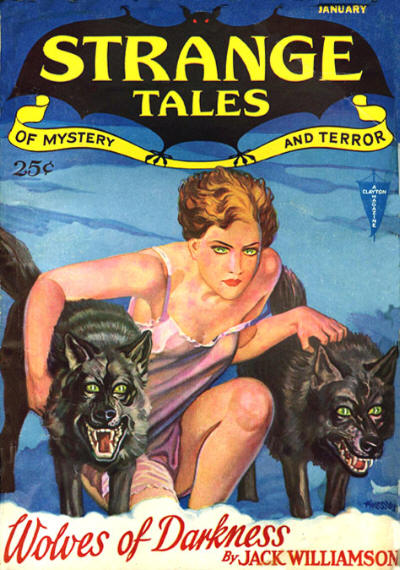


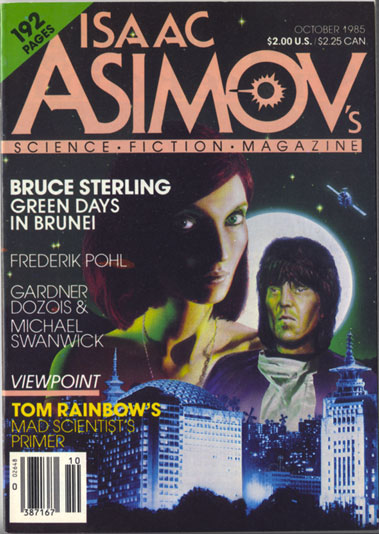


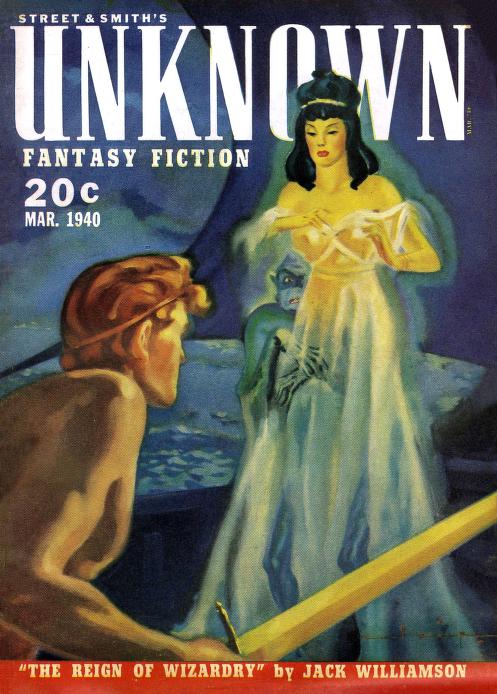


 Science Fiction & Fantasy Remembrance