Who Goes There?
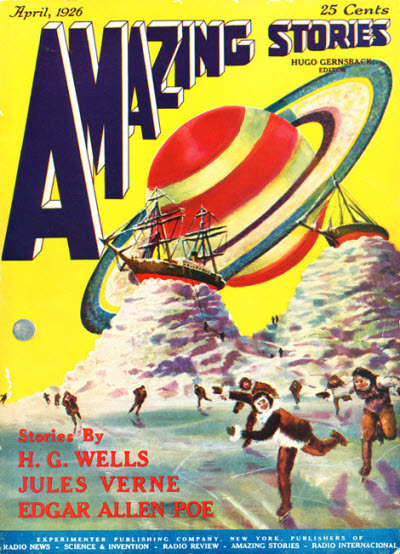
When Hugo Gernsback launched Amazing Stories in 1926, the inaugural issue’s contents would be very important. It was, after all, a newfangled magazine with a novel premise, that being the exclusive focus on science fiction, a term that hadn’t even been coined yet. In his editorial for this issue, Gernsback mentions H. G. Wells, Jules Verne, and Edgar Allan Poe as the leading forerunners of what he calls “scientifiction.” These were and still are important names in the history of the field, so Gernsback had made a wise choice by not only mentioning them, but printing fiction by all three in the first issue. A name he doesn’t bring up alongside those three, but who does appear here, is George Allan England. Contrary to what his last name would make you think, England was an American. He had a pretty active life, being a prolific writer, adventurer, and failed politician, having unsuccessfully ran for governor of Maine as a socialist. Incidentally he was close contemporaries with fellow adventurer, pulpster, and socialist Jack London. But whereas London because rich and famous from his writing, England never reached that level of mainstream success, and nowadays you’d be hard-pressed to find someone who has heard of him.
While England was more a novelist than a short-story writer, he did write a few shorts which have been reprinted more than once, “The Thing from—’Outside’” (sometimes reprinted without the em dash and inverted commas) being maybe the most popular. It was first published in 1923, when England was already in the third act of his career, in Science and Invention, of whom one of the editors was (you guessed it) Gernsback. Apparently he thought it was so nice he printed it twice. It counts as science fiction, I guess, but it’s much more a work of cosmic horror, so that honestly it could’ve just as well have appeared in Weird Tales.
Placing Coordinates
First published in Science and Invention in 1923, then in the April 1926 issue of Amazing Stories. It has since been reprinted in Strange Ports of Call (ed. August Derleth), the January 1965 issue of Magazine of Horror, Friendly Aliens: Thirteen Stories of the Fantastic Set in Canada by Foreign Authors (ed. John Robert Colombo), Sense of Wonder: A Century of Science Fiction (ed. Leigh Ronald Grossman), More Voices from the Radium Age (ed. Joshua Glenn), and a few others. Because it’s been in the public domain for a minute, you can find it on Wikisource of all things.
Enhancing Image
Five Americans have gone canoeing in the Canadian wilderness, a trip which has already gone south by the time the story starts, on account of their indigenous guides having abandoned them. Apparently something had spooked them. This is a racist trope I notice pop up in old pulp adventure writing: the native guide leaving the (white) explorers to their fate or dying unexpectedly. As for the Americans, we have Professor Thorburn and his wife; Vivian, Mrs. Thorburn’s younger sister; Jandron, a geologist; and Marr, a journalist. (Bit of a digression here, but how much younger is Vivian supposed to be than her sister? Professor Thorburn is said to be deep in his fifties, and presumably his wife isn’t too much younger than that, but Vivian’s young enough [and attractive enough] to be called a “girl” more than once.) It’s easy to think at first that the professor is the protagonist, but actually it’s Jandron—an observation easy enough to make with hindsight. Not everyone will make it out alive, and nobody (except for Jandron) knows what they’re doing. Things are already looking rough, even without a cosmic entity taking, since they’re already miles away from civilization and this was in the days before cell phones. This is all before the coming of the ice—and while this is Canada, winter isn’t due yet.
We know about burns, from intense heat, but we also know similar damage can be done with intense cold, hence things like frostbite. Jandron, being a very smart person, finds a ring of ice burned into a rock, which (he tells the others) will be there forever. He’s seen something like this before, and for better or worse, he’s also into Charles Fort. For some context, Charles Fort was a journalist who, late in his life, gained unexpected prominence with a few books that are comprised of unusual and dubious “data.” In other words, useless but curious information, a lot (if not all) of it not based in fact. In other words, he spread misinformation for the fun of it, and also to make a point. He didn’t actually believe, for instance, that mankind is secretly the property is an unimaginably advanced lifeform. He inspired a couple generations of SF writers and readers. One of his books, Lo!, was even serialized in Astounding. It’s unclear how much these people took Fort’s throwaway ideas seriously, or if England believed any of it himself, but Jandron seems to be a true believer.
As Jandron explains later in the story:
“[Fort] claims this earth was once a No-Man’s land where all kinds of Things explored and colonized and fought for possession. And he says that now everybody’s warned off, except the Owners. I happen to remember a few sentences of his: ‘In the past, inhabitants of a host of worlds have dropped here, hopped here, wafted here, sailed, flown, motored, walked here; have come singly, have come in enormous numbers; have visited for hunting, trading, mining. They have been unable to stay here, have made colonies here, have been lost here.’”
Bro would be a crazy person in the real world, but luckily for him (or maybe not) his hypothesis that the Thing stalking him and his friends is an invisible being that exists Outside (with a capital O) the universe is correct. Or at the very least it’s never proven incorrect. “The Thing from—’Outside’” is one of the earliest (it might be the very first) works of fiction to deal with Charles Fort’s writing, even mentioning it directly. In a way it reads like a contemporary of H. P. Lovecraft’s work, albeit pulpier, although I’m not sure if England was aware of Lovecraft at this time. He was most certainly aware of Algernon Blackwood at least, and indeed England’s story reads less like Lovecraft and more like a scientific counterpart to Blackwood’s “The Willows,” which itself has a similar premise but takes a mystical approach. “The Willows” is one of the most reprinted and respected weird horror tales of all time, despite the fact that it’s about fifty pages long and not much actually happens in it. “The Thing from—’Outside’” is more eventful; indeed it’s indicative of England’s trade as someone who wrote for the non-genre pulp magazines. There’s action, but also a lack of elegance.
(Modern readers should also take note that while England was a leftist, he was also a white man born in 1877, so his views on women and non-white folks can chafe, even in this story. Of course, being bigoted and also a socialist is something that can be applied to quite a few white leftists in both the 1920s and the 2020s.)
This is not to say “The Thing from—’Outside’” isn’t worth reading; on the contrary, it’s a good deal of fine. There are moments of genuine creepiness sprinkled into what is really a great-outdoors adventure story with some rather high stakes. The wilderness becomes colder and more inhospitable with every passing hour, so that one night the bonfire they’ve set up goes out suddenly, even with the plenty of wood to spare, as if a giant pair of wetted fingers had pinched out the flame. They also notice that less wildlife has been showing up, even down to the bugs, so that the forest becomes lifeless except for the trees, which themselves are losing their leaves. This change in climate is both unnatural and concerning. Even the river Our Heroes™ have been canoeing along has grown ice at the bottom. “It” is like an invisible cat and the humans are a bunch of field mice, although they make the comparison of being like ants more often. There’s a sense of both patience and sadism to the invisible horror, giving it the semblence of a personality despite being totally unseen and unheard. Some spooky shit is definitely going on, and one by one the party of five dwindles.
There Be Spoilers Here
By the time we get to the climax, the professor and his wife have both died. This is unfortunate. Even more unfortunate is that Jandron now has to deal with a stir-crazy Marr, and Vivian, who isn’t in much better shape. What happens to Marr, thanks to “It,” is maybe the creepiest part of the whole story. While he had blocked himself off from the others the Thing from Outside the universe had contorted and deformed his body and mind, so that he became “something like a man,” a “queer, broken, bent over thing; a thing crippled, shrunken and flabby, that whined.” Ultimately he dies before Jandron and Vivian are rescued, which is maybe a good thing for him. The others narrowly survive, and for Vivian the whole episode has been blacked out of her mind. Eventually they get married (right, there’s a romance angle here that I don’t care for), but Vivian “could never understand in the least why, her husband, not very long after marriage, asked her not to wear a wedding-ring or any ring whatever.” Granted, Lovecraft protagonists tend to get off with worse, so this is bittersweet instead of a downer. But while Vivian remains mercifully ignorant of those days in the wilderness, we’re told Jandron will always be so haunted.
A Step Farther Out
It’s not as good as “The Willows,” but then what is? England wasn’t typically a horror writer, but rather an adventure writer who just so happened to write a decent amount of SF—again, a term that did not exist in the 1910s and for much of the ’20s. He also, for reasons I’m unsure about, took a detour into cosmic horror, and did a fine job at it. England would appear in SF magazines from this point on, mostly after his death, and entirely (unless I’m missing something) through reprints. I’ve not read a whole lot of pre-Campbell magazine SF, but I’ve read enough to know you can do worse (so much worse) than “The Thing from—’Outside.’” You can also do much worse if you’re interested in some classic cosmic horror that’s contemporaneous with Lovecraft, but quite different in style.
See you next time.







 Science Fiction & Fantasy Remembrance