Been a while, hasn’t it? By that I mean, little over a week. For some bloggers this is not unusual, to go a week or even a couple weeks without posting; but for me it’s different, as I like to think one of the things that makes this blog different is its regularity. I would post something every three or four days, or even sometimes twice in as many days, and in hindsight I’m not sure how I did that for two years while only occasionally slipping by, say, posting something a day later than I had intended. The idea was that like a magazine having a monthly or bimonthly release schedule, my posts would come out at regular intervals. As you know, I’ve spent this year covering a lot of stories from The Magazine of Fantasy and Science Fiction, which is celebrating its 75th anniversary. Unfortunately there’s been a bitter irony to my decision to go on a mini-hiatus, as F&SF has also been falling behind with its scheduling. Years ago they went from monthly to bimonthly, and this year those at the top announced the magazine would now be quarterly, with the big 75th anniversary issue presumably hitting newsstands in December. This is bad news no matter how you look at it. F&SF seems to be run by maybe five people plus a small army of hamsters on wheels, and they’ve fallen so far behind on publishing and even accepting stories that authors have had to retract their stories months after submitting and with no feedback. This has been a bittersweet year for F&SF.
It’s also been bittersweet for me, although more recently leaning toward the sweet. I’ve been through a few turbulent relationships this year, but I also started going to therapy, got a prescription for antidepressants and a hormone blocker, plus I recently got to spend time with one of my partners. I got my annual raise at my job, although it wasn’t worth much. I moved into my first apartment, living partly off of savings. It’s funny, I probably have more time (and certainly space) to myself than I ever had since college, yet I’ve found it harder to write for this damn thing. Call it a soft case of writer’s block. I talked with my therapist about this last week and she suggested that maybe it’s because I wrote for SFF Remembrance partly to get away from living under the same roof as my parents—mentally if not physically. That’s not to say my home life was objectively miserable before, but one can only be so happy living in a cage, even if it’s well-ornamented. I’m now freer than I’ve ever been—which means I also don’t have as much motivation to write now. It doesn’t come as naturally to me as it did before. There was some kind of tradeoff I was not told about in advance. I could be happier and be less productive, or more miserable but more productive—or at least that’s how I interpret it. And then there’s the fucking election. On a macro scale things are looking bad for a lot of us, on the horizon, but for me personally life has been kind to me as of late.
But, sooner or later, the show must continue.
I said months ago that for the “normal” months I’d be covering two stories from F&SF, a novella and short story, or two of either; but I neglected to mention full novels. In fairness, this is a truly exceptional scenario, as Algis Budrys’s Hard Landing might be the only instance of a novel being printed wholesale in a single issue of F&SF. I could be wrong. I’m making a bit of an exception by covering it, plus two short stories from that magazine. Why not? This is the last chance I’ve given myself to do such a thing, at least for a while. This will also be the last time I’m not covering serials, as I’ll be bringing that department back in January, with a bang. The world may go to shit, but we’ll have fun. And before you ask, the three stories I neglected to cover last month will get their due—eventually.
For the novellas:
- “Code Three” by Rick Raphael. From the February 1963 issue of Analog Science Fiction. Raphael would write a small number of short stories and novellas over the next decade, but despite living to a reasonably old age (he died just short of his 75th birthday), he wrote very little fiction overall. His work is in such disarray that some of it has fallen out of copyright, including “Code Three,” which would make up the first part of the fix-up novel of the same name. So of course he “won” the Cordwainer Smith Rediscovery Award.
- “Recovering Apollo 8” by Kristine Kathryn Rusch. From the February 2007 issue of Asimov’s Science Fiction. Winner of the Sidewise Award for Best Short Form Alternate History and placed first in the Asimov’s readers’ poll for Best Novella. For this final month of paying tribute to F&SF I figured I should cover another author who was at one point one of its editors. Rusch took over in 1991 and for the next six years gave F&SF a darker, one might say more gothic bent, and it helps that she was also the magazine’s first female editor.
For the short stories:
- “The Phantom ‘Rickshaw” by Rudyard Kipling. From the July 1968 issue of Magazine of Horror. First published in 1885. The first and possibly only time we’ll be covering a Nobel winner on this site, Kipling wrote a good deal of SF, fantasy, and horror, on top of more realistic fiction and poetry. He wrote “The Phantom ‘Rickshaw” when he was 19, but he was already showing signs of greatness.
- “The Christmas Witch” by M. Rickert. From the December 2006 issue of The Magazine of Fantasy and Science Fiction. Mary Rickert is a Wisconsin native who made her debut in 1999, in F&SF, and from then on it would remain her most frequent outlet. She doesn’t seem to have written much if any SF, preferring fantasy and horror. I needed at least one Christmas-themed story, so…
- “It Takes a Thief” by Walter M. Miller, Jr. From the May 1952 issue of If. Before the phenomenon that is A Canticle for Leibowitz, Miller wrote prolifically at short lengths, with 1952 being an especially productive year for him. I find myself gradually becoming a Miller fan, helped by his writing candidly about religion, existential crises, and mental illness—things he experienced first-hand.
- “A Runaway World” by Clare Winger Harris. From the July 1926 issue of Weird Tales. Harris was supposedly the first woman to write genre SF under her own name, and by the time she entered the field she had written her first and only novel, Persephone of Eleusis. Like too many old-timey female SFF writers she wrote a streak of short stories over the course of a decade, then stopped.
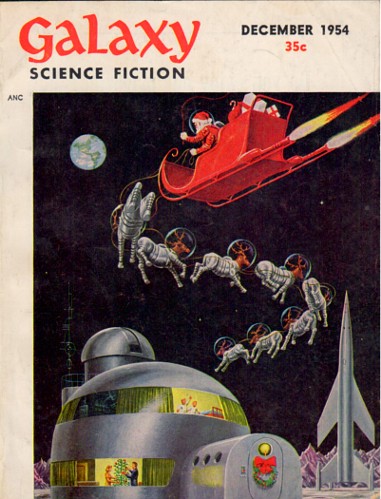
- “Skulking Permit” by Robert Sheckley. From the December 1954 issue of Galaxy Science Fiction. Like Algis Budrys, and indeed Walter M. Miller, Sheckley debuted in the early ’50s and probably could not have found enough markets for his kind of fiction (often urbane satire) any earlier than that. But he contributed prolifically to Galaxy, and the two were practically made for each other.
- “Strata” by Edward Bryant. From the August 1980 issue of The Magazine of Fantasy and Science Fiction. Bryant was one of the curious new talents of the post-New Wave era, having debuted in 1970, and wrote almost entirely short fiction. “Strata” is one of several stories inspired by Bryant’s childhood in Wyoming, and I have to admit I also picked it for the reason that it involves dinosaurs.
For the complete novel:
- Hard Landing by Algis Budrys. From the October-November 1992 issue of The Magazine of Fantasy and Science Fiction. While Kristine Kathryn Rusch was at one point F&SF‘s editor, Budrys was a regular columnist for the magazine for about 15 years, until he stepped down from that position, incidentally around the same time Isaac Asimov stopped writing F&SF‘s science articles (on account of dying). But Budrys, who had made his debut in the early ’50s, was very much alive still, and while he no longer did book reviews for F&SF, the early ’90s were a busy time for him, as he hosted the annual (and controversial, because of the Scientology connection) Writers of the Future contest, began editing the semi-pro magazine Tomorrow Speculative Fiction, and wrote Hard Landing, which would be his final novel.
Once more into the breach before the year ends, eh?


3 responses to “Things Beyond: December 2024”
I enjoyed “Code Three” as a working-class slice-of-life window into another world. But… but… it’s not great. I reviewed the entire fix-up novel.
I also started writing my site to escape the tensions of life. I get that the therapist might come to that conclusion. It might take a minute for you to reorient yourself. And, I hope, to see the benefit continuing on even if life is treating you better! 🙂
LikeLike
About halfway through “Code Three” and I see what you mean by it not being greeeeeat. The dialogue especially is at times cringe-worthy. But, it’s pretty interesting, and also one of the main characters is a biracial woman who, aside from being a little overly emotional, is shown as perfectly capable. I can see how readers at the time would’ve been impressed.
LikeLike
I’m not sure why I didn’t catch that the was half Native American back in 2016 (I see my review wrote her full name so it should have been obvious). That said, I did point out that while she does not entirely escape 60s heroine stereotypes, she does play a vital part in the story.
LikeLike