Who Goes There?
Happy Christmas Eve, you fucking losers.
Robert Sheckley debuted in 1952, the same year as Philip K. Dick and Algis Budrys, and quickly established himself as one of genre SF’s court jesters, especially in the recently launched Galaxy, which would print a good portion of Sheckley’s work throughout the ’50s. It was practically a match made in heaven: Galaxy was rather liberal and socially conscious, with a lot of fiction about average middle-class working people, and Sheckley was (or at least got pigeonholed as being) quite the urbanite. Galaxy leaned towards social commentary and Sheckley was only too happy to provide some social commentary of his own. He’s also an easy writer to dig into, in that one need not think too hard when writing about a Sheckley story. Once you’ve read a few Sheckley stories you can figure out a pattern of his that he was prone to, at least in his early years. Sheckley’s work at its best is major enough that he’s actually one of the few genre SF writers to have gotten a volume in NYRB Classics. Because he wrote a lot, he sometimes wrote bland or just plain bad stuff, for the sake of a paycheck, although “Skulking Permit” shows Sheckley at perhaps his most fun-loving.
Placing Coordinates
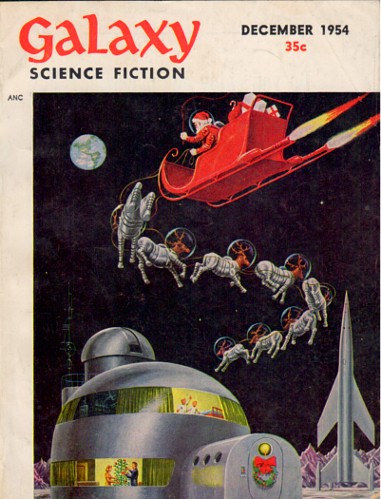
First published in the December 1954 issue of Galaxy Science Fiction. It was reprinted the following year in the Sheckley collection Citizen in Space, and would seemingly be included in every Sheckley collection going forward except for The Store of the Worlds: The Stories of Robert Sheckley. It would also be anthologized in Overruled! (ed. Hank Davis and Christopher Ruocchio). It also has an X Minus One adaptation.
Enhancing Image
The planetary colony of New Delaware has been doing pretty well for itself, except for the fact that contact with Earth has been cut for several decades—indeed, the people of New Delaware have had to fend for themselves for the past 200 years. But then one day, miraculously, contact is regained between the settlers and the government of Earth. This is not necessarily great news. Tom Fisher is a perfectly average fisherman and law-abiding citizen (but then there are no laws to break), who suddenly has found himself with a new job to do. See, the problem is that the apparently sole superpower on Earth has, after a couple centuries, become a totalitarian shithole, being overtly against free speech, democracy, and “aliens.” The people of New Delaware don’t even know what an alien is, although the planet does seem to have indigenous (albeit non-sentient) life of its own. Earth is gonna send an inspector, or rather the Inspector, with some armed men, to see that the people of the colony have conformed to Earth standards of living. The problem, then, is that there is no problem: New Delaware, while a small village and rather agrarian, is also something of a socialist utopia. There’s a mayor, simply called the Mayor, so presumably there’s a local government, but there’s no prison, nor are there pigs cops; and there’s no prison and no police because there’s no crime. There’s not been a murder (or at least a recorded one, for all we know) on New Delaware in 200 years. This is indeed the problem, because one of the ways the colony is supposed to conform to Earth standards is that there must be police, which means there must also be crime. But the village doesn’t have a criminal class.
The Mayor designates Tom as the village’s legalized, bona fide criminal, complete with a skulking permit—an authorization from the Mayor, in writing, to commit crimes. Yes, that includes murder. What could possibly go wrong? In the early years, there are basically two types of Sheckley story: humanity encountering a problem and only making the problem worse by trying to solve it, and humanity encountering a paradox in social norms and trying (in vain) to untangle this paradox. “Skulking Permit” very much fits in the latter category, but it’s a lot of fun. Sheckley pokes fun at the idea of a human civilization that is bereft of crime, and much more pointedly he pokes fun at the increasing militarization and paranoia in the US following the end of World War II. The Earth authority of the far future has gone down the rabbit hole of McCarthy-era anti-socialism (in other words, the rabbit hole we still find ourselves facing), to the point where the government of Earth has become actively genocidal and is looking to exterminate any intelligent alien life it can find. “Conformity” is the word of the day. The people of New Delaware must conform if they wish to regain partnership with the Earth authority, but conformity means actively making life in the village worse. In order to help the village meet standards for the Inspector, Tom must steal, cheat, skulk in places “of ill repute,” and yes, even kill (although thankfully sexual assault is not part of the deal), which are all things he has never done before. How do you introduce something as heinous as murder to a place that has never even known the word, among people who have never killed anything intelligent? Sheckley was one of the most persistent social critics among genre SF writers in the ’50s, although, probably intentionally, he never seemed to suggest an alternative to what he clearly saw as a slippery slope of totalitarianism in the US. New Delaware is not a valid alternative because, in true utopian fashion, it is by its nature impossible. The colonists, for some reason, have taught themselves over the course of generations of be as about as harmful to each other as baby birds. It’s more like Eden than a real place.
The convenient thing about Sheckley from a reader’s perspective, but not so from a reviewer’s, is that Sheckley was not what you would call a deep writer. His stories can be read almost like one can eat very good potato chips: they taste nice and provide some nice sodium, depending on your blood sugar, but they’re not terribly complicated. “Skulking Permit” has a loose plot and a cast of basically one-note characters, but this is fine—for one because it’s a comedy, but also the characters, while one step above cardboard, would be pretty colorful cardboard. Tom being an everyman works in service of the plot, since he is a totally unassuming guy who has to do some unsavory things for the sake of his village. Also, I’m not sure why he did this, but Sheckley gave characters last names that are professions; sure, you might think nothing of it at first, with Tom Fisher, but then you see Billy Painter, Ed Weaver, the Carpenter brothers, and so on. It’s a fucking cartoon, but for a quick read (or about as quick as you can be at 25 pages), I have to admit I chuckled quite a few times. The point of a Sheckley story is often to be funny, first and foremost, which I thought this was. It helps that, continuing with the cartoon comparison, some absurd things happen, such as the local tavern becoming more popular once it becomes known as a “place of ill repute,” or that the villagers aren’t even sure what a prison is supposed to look like, or that a group of villagers cheer like they’re at a baseball game when Tom finally steals something, or the fact that Tom “must” kill one of his fellow villagers but lacks a real motive to do so, being too friendly with everyone. It’s morbid, at least on paper, but in practice it’s perfectly upbeat, in typical Sheckley fashion.
There Be Spoilers Here
Of course, Tom can’t do it. He tries killing the Mayor, and actually comes pretty close, but the Mayor has recently gotten kicked upstairs to the position of General (a rank he doesn’t understand as the village doesn’t have a military) and tells Tom that since he’s a military figure now, to kill him would count as mutiny and not murder per se. Sure, whatever you say. Tom can’t even bring himself to kill the Inspector, someone he has never met and who’s basically an ambassador for a fascist hellscape; but even then, he simply doesn’t have that killer instinct—indeed none of the villagers have it. Seeing that the villagers are unable to kill and thus useless as would-be soldiers in an interplanetary war, the Inspector and his goons decide to just leave the planet and its “uncivilized” people in peace. This is an unusually happy ending for Sheckley, although in a bit of irony, since he was unable to prove himself as a killer, Tom sleeps “very badly” that night. New Delaware fails at becoming a “proper” society, but may have succeeded at retaining its innocence. There’s a lot you could unpack with what Sheckley is implying, but I’m sure he wanted us to enjoy it for what it is: a comedy.
A Step Farther Out
It’s a good fun read, that’s all I can really say.
See you next time.


One response to “Short Story Review: “Skulking Permit” by Robert Sheckley”
thank you, Brian. First time I heard X-Minus One on the old radio shows, Skulking Permit was a favorite. Thank you, Galaxy.
LikeLike