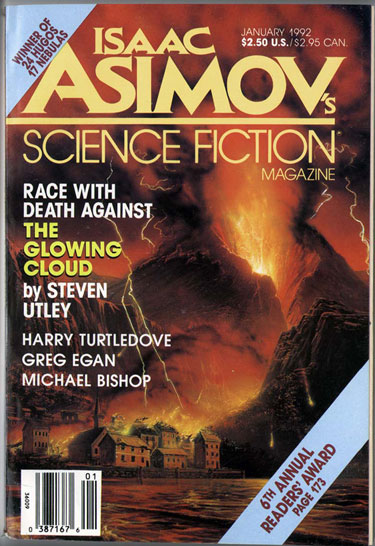
Who Goes There?
Steven Utley would probably be more known today had he taken to writing novels, but he was one of those exceedingly rare writers who never got into novels, preferring to stick purely to short fiction and poetry. Utley was born in Kentucky, at Fort Knox (he was a military brat), and understandably his family moved around when he was young before he settled in Texas (Austin) as an adult, then later Tennessee. He’s partly responsible for the discovery of fellow Austin weirdo Bruce Sterling. He was one of those authors who came about during the post-New Wave period, in the early ’70s, and he wrote prolifically during that decade before falling pretty much silent during the ’80s; then, for reasons I’ve not been able to look into, he came back to writing SF in the early ’90s and basically didn’t stop until his death in 2013. I must have read a few Utley stories before, just because he was a frequent presence in Asimov’s in the ’90s, but I’m struggling to think of their titles off the top of my head. I shouldn’t have such an issue with “The Glowing Cloud,” which, while a little bloated, is a harrowing time-travel story about one of the most horrifying natural disasters of the 20th century: the eruption of Mount Pelée and the destruction of St. Pierre.
Placing Coordinates
First published in the January 1992 issue of Asimov’s Science Fiction, almost on the 90th anniversary of the disaster. It’s only been reprinted twice, in The Year’s Best Science Fiction: Tenth Annual Collection (ed. Gardner Dozois) and the Utley collection Where or When.
Enhancing Image
Everyone knows about Pompeii; to this day it remains the most famous case of a whole town getting buried by volcanic eruption. In 79 CE Mount Vesuvius erupted and killed everyone who was in Pompeii on that day, and the city remained undisturbed and seemingly unnoticed for some 1,500 years until archeologists rediscovered it. Up to 20,000 people died from Mount Vesuvius eruption, but the case of the Mount Pelée eruption of 1902 is in some ways even more remarkable, for it being a relatively modern and well-documented tragedy, for having an even higher body count (nearly 30,000 people), and for the fact that such a disaster could have been easily minimized, yet it was not. St. Pierre (or Saint-Pierre as it’s also called) was a French settlement on the island of Martinique, densely populated and apparently brimming with night life, nicknamed the “Little Paris” of the West Indies. However, a minor character, one Father Hayot, in Utley’s story also calls it “Little Sodom,” which both indicates what the priest sees as a moral vacuum in the city, but also alludes to its imminent destruction—at the hands of Nature, if not a vengeful God. In his introductory blurb, Gardner Dozois says this story “was directly inspired by Gordon Thomas and Max Morgan Witt’s book The Day the World Ended,” and one does get the impression Utley did a good bit of research on the topic before he really began work on “The Glowing Cloud.” This is a story that’s effective at a couple things, not least sparking interest in its subject.
The actual plot is more of a standard cat-and-mouse time-travel thriller, although this is not necessarily a bad thing. Medlin is a time-traveling agent who’s been sent back to St. Pierre, not quite on the eve of its destruction but a little too close for comfort, in search of Garrick, a fellow agent who has gone rogue and apparently has been hiding out in St. Pierre. Another agent, Ranke, was supposed to accompany Medlin to this point, but so far is nowhere to be seen; not that this troubles Medlin too much, given that he has a rather strong dislike for Ranke and indeed it’s the latter’s arrival that the reader is supposed to dread. This manhunt has a couple complications, one being that Garrick is an older woman, a veteran of the profession, and also that she’s the one who had mentored Medlin in the first place. Medlin knows he’ll have to capture or kill Garrick, neither of which he really wants to do. So, there’s the internal conflict, but there’s also an invisible timer to make things more tense, because Medlin has about a week to bring back Garrick (dead or alive) before Mount Pelée engulfs the city, that final explosion and the “glowing cloud” of the story’s title. At this point the volcano has been belching and its environs have already gotten a taste of volcanic ash. The sky has mostly been blotted out. The townspeople are aware that the volcano will erupt, but also that St. Pierre is at a safe distance from what would be lava flow; unfortunately, what Medlin knows about the the townspeople don’t is pyroclastic flow. In case you forgot, pyroclastic flow is the worst that can happen in the event of a volcanic eruption, in which volcanic matter can hurtle downhill at hundreds of miles an hour. It would be impossible to escape on short notice.
Medlin already knows that everyone in town (there are only three people on record who had witnessed Mount Pelée’s eruption and lived to tell the tale) will die soon, which doesn’t help matters any. Conditions have become semi-apocalyptic, even as the government and businesses try to act like everything will turn out fine. Consider this:
It quickly became obvious to [Medlin] that the situation was not only as bad as Father Hayot had said, but becoming steadily worse. Groups of people stood about who seemed to have no place to go, no idea of what to do. These, too, had that unmistakable look of refugees; the authorities must have stopped confining them, but had not decided as yet what else to do with them. Livestock wandered loose. They seemed to be dropping dead faster than the soldiers could haul away the carcasses. Asphyxiated birds lay everywhere. The fountains were fouled with black mud.
“The Glowing Cloud” is indeed about a mini-apocalypse, which at least on a metaphorical level feels… timely. This is made more so because both Utley and Dozois make it clear that the disaster was itself inevitable, thousands of lives could have been spared had the local government evacuated the city—only they decided not to. Local news outlets (which in those days basically meant only print media), being in cahoots with the government, have been indulging in misinformation so as to disincentivize people from leaving St. Pierre. There’s an election going on, and also there seem to be genuine misunderstandings about the severity of the volcanic activity. The most infuriating instance, for both Medlin and the reader, happens much later in the story, when the mayor of St. Pierre has a speech plastered on public bulletin boards. Consider the following:
The occurrence of the eruption of Mount Pelée has thrown the whole island into consternation. But aided by the exalted intervention of the Governor and of superior authority, the Municipal Administration has provided, in so far as it has been able, for distribution of essential foods and supplies. The calmness and wisdom of which you have proved yourselves capable in these recent anguished days allows us to hope that you will not remain deaf to our appeals. In accordance with the Governor, whose devotion is ever in command of circumstances, we believe ourselves able to assure you that, in view of the immense valleys which separate us from the crater, we have no immediate danger to fear. The lava will not reach as far as the town. Any further manifestion [sic] will be restricted to those places already affected. Do not, therefore, allow yourselves to fall victims to groundless panic. Please allow us to advise you to return to your normal occupation, setting the necessary example of courage and strength during this time of public calamity.
Does this remind you of anything?
St. Pierre itself is an interesting locale, even if we get to know only a few of the locals. It’s a French settlement, founded way back in 1635, during the first age of European colonialism, and given its placement in the Caribbean Medlin notes that many if not most of the population is actually non-white, being black or biracial. There’s Madame Boislaville and her young daughter Elizabeth, who give Medlin shelter during the days spends searching for Garrick. (I assume Madame and her daughter are characters of Utley’s invention.) That’s about it, at least without getting into spoilers. Given that it’s a decently sized novella, the plot of “The Glowing Cloud” is rather straightforward and its cast rather small. Its length comes in no small part from it being such a chatty novella, with a few choice characters waxing philosophical about the nature of time travel and whether it’s ethical to try saving the lives of thousands, or even a few individuals, when history dictates these people are supposed to die. History will of course not be defied here, at least in broad strokes. Garrick herself is not trying to alter history, but rather went AWOL by stealing a special drug that would make time-traveling easier and less painful for the traveler, the result being that she can really leave whenever she feels like it. This is a bit of an anticlimax for such a long story, and unlike the other anticlimax it doesn’t feel deliberate on Utley’s part. It could be that while he at some point imagined Garrick as the villain, he simply could not fit her in that role, even thought she does come off as callous. I like Garrick less as a character and more how she compares with Medlin and Ranke, with Medlin being at a crossroads between agents who are more sociopathic than him, to varying degrees. This is ultimately a story about the capacity for human empathy.
There Be Spoilers Here
By the time Ranke shows up, it’s the day before St. Pierre’s appointment with annihilation, so he’s a bit late to the party. Right away he’s shown to be a bit of a hothead, never mind a threat to both of his fellow agents. Utley has been building up Ranke’s arrival for most of the story, so when he finally gets here, appearing as the closest “The Glowing Cloud” has to a human villain, he doesn’t disappoint—for all of the five or six pages he’s here. The most violent and surprising scene in the whole novella is when Ranke, apparently having bitten off more than he could chew with the locals, gets quite literally cut down by an angry mob “as if he were merely some obstinate jungle growth,” mere hours after landing in St. Pierre. By far the most “macho” character of the lot gets his just desserts rather promptly, and even Garrick points out that Ranke’s tough-guy act wouldn’t work.
So there’s that.
Just as curiously is that when it seems everything’s going to hell, Medlin gets rescued at the last minute by a group of fellow time-travelers, although evidently they’re not from the same organization; rather they’re a team of volcanologists from the future (even ahead of Medlin and Garrick’s future), here to observe the eruption of Mount Pelée from a safe distance. This is certainly what we call a happy coincidence, although it also makes sense for time travelers to go back and study a natural disaster like this first-hand, in a time when volcanology wasn’t a discipline yet. Medlin convinces Garrick to take Madame and Elizabeth, so that he might rescue just a couple people from the impending disaster, although the very end of the story is ambiguous if Our Heroes™ actually succeed in evading the glowing cloud. Utley opts (I suppose wisely) for a cautiously optimistic final note, which still feels like a happy ending given how grim this story is.
A Step Farther Out
I’ve seen people react to the current situation in the US like things can’t get much worse. Oh, they can get worse, it’s just a question of how much. Was totally not thinking about that while reading “The Glowing Cloud.” I wonder how many anthologies there are about SF involving natural disasters? I’m a bit surprised this story hasn’t been included in any.
See you next time.
 Science Fiction & Fantasy Remembrance
2 responses to “Novella Review: “The Glowing Cloud” by Steven Utley”
So am I right in thinking that this avoids the comedic register? I’ve only read two Utley stories and their titles give away a lot: “Hung Like an Elephant” (1974) and “Womb, with a View” (1974).
LikeLike
I read your reviews of those stories and I’ll say “The Glowing Cloud” is very different, and you can tell Utley was older and at a different point in his career when he wrote it.
LikeLike