Who Goes There?
Did not think this post would get delayed by almost a week, but I got hit with the double whammy of being sick (some repiratory deal, like a chest cold), which I’m still dealing with, and more importantly being without internet at my apartment for four fucking days. This all happened over Easter weekend, so it felt like just bad luck. Apologies.
Fans of classic crime fiction will know John D. MacDonald for his prolific and popular Travis McGee series of novels, starring the titular detective, with some 21 novels published over a span of about as many years. MacDonald apparently wrote the first handful of Travis McGee novels in rapid succession, slowing down a bit after but still writing at an impressive speed. He’s also famous for his standalone crime novel The Executioners, which you would know better as Cape Fear. He earned the Grand Master Award for lifetime achievement from the Mystery Writers of America in 1972—by no means a small feat, especially given that he had only been writing crime fiction for not quite twenty years at that point. But before all this, before even Cape Fear, MacDonald cut his teeth by writing for various magazines from the late ’40s through much of the ’50s. He wasn’t very picky about what genres he would dabble in, although much of the fiction he wrote in these early years was sports stories, non-genre adventure stuff, and of course science fiction. The magazine market for SF was going through a renaissance at the time, which MacDonald capitalized on. “Half-Past Eternity” is one of MacDonald’s longer SF stories, being about 20,000 words, and in a way fitting for MacDonald it has a mix of SF, crime, and sports fiction. Like sure, why not combine all three?
Placing Coordinates
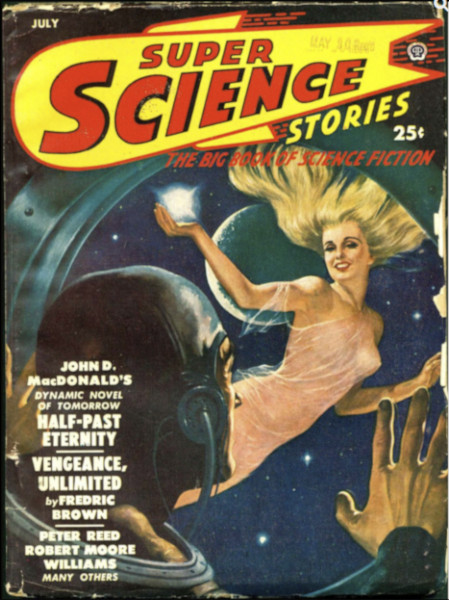
First published in the July 1950 issue of Super Science Stories. It’s only been reprinted twice, in The Human Equation (ed. William F. Nolan) and the MacDonald collection Other Times, Other Worlds.
Enhancing Image
Dr. Garfield Tomlinson goes to make a bet on a boxer, “the kid,” who in fact is in his early thirties and a loser with a soft swing. Tomlinson bets the kid will knock out his opponent in the first round, with an amount of money that surely would’ve been considered suicidal circa 1950. The bookie, Nat February, accepts the bet, but is really puzzled—both by how much money Tomlinson has put on the table and how confident the old doctor is that he’ll win. Which he does. The kid’s swings are unnaturally fast and swing, to the point of breaking his opponent’s jaw, on top of the first-round knockout. Despite the story starting with their perspectives, neither Tomlinson nor Nat is the protagonist (we never even see Nat again after this opening stretch), but instead Sam Banth, an ambitious and amoral con-man who makes it his mission to track down the doctor. He’s street smart, but he’s also smart enough to do some digging at the local library and find Tomlinson’s name, and even where he lives. The doctor had studied longevity in geriatrics, but his most recent research has to do with speeding up time for the young rather than slowing it down for the old. The short of it is that time is partly subjective, in that how each person understands the passing of time involves metabolism, reflexes, etc. For a swift boxer, time seems to move slowly, even if that’s not the case in reality. If you’re an athlete in the heat of the moment, time seems to stretch out like a rubber band, while conversely your reflexes are tuned as if every second counted.
More importantly, Sam realizes that athletes with such an enhancement could make him a fortune. But first, he has to get through to the doctor, along with Linda, Tomlinson’s daughter. Sam is quite a bastard; he would fit right in as the protagonist of a crime story of the sort that focuses on the criminal. He all but coerces Tomlinson into forming two companies with him: Research Laboratories, Inc and Champions, Inc.The idea is basically to “train” athletes who normally would have few prospects with the help of the old doctor’s method of time distortion, thus heightening reflexes and making these losers into stars. Of course, the angle for Sam is to scrape the profits off these athletes, along with having big shares in the company. You might say using such research to make superhuman athletes would be cheating and even rendering these demanding sports monotonous, and you’d be right! Not that Sam is all that concerned about what’s right or wrong. Meanwhile he’s getting smitten with Linda, who by her own admission wants enough money to “smother” herself with. Despite their initial hostility toward each other, since Linda’s well aware Sam wants to take advantage of her father, the two end up having a fair bit in common. While Sam already owns a large stage in the company, the ownership being split three ways, he gets the idea that maybe if something unfortunate were to happen to the old doctor, and also if Sam were to marry Linda, well…
The scheme at the center of “Half-Past Eternity” is a good deal of fun to read, even if we can guess that the whole thing will come crumbling down at some point and in some way. We don’t expect Sam to come out on top, nor do we want him to; but it’s the getting-to-that-point that’s fun. I’m reminded of one of the all-time quintessential noirs, Double Indemnity, that classic premise of a coniving woman and her lover plotting to get rich off her husband’s life insurance. This is all well and good, although the story does suffer a bit from MacDonald’s need to either pad out the word count or give us more of a perspective on the athletes being “trained.” There’s a B-plot involving Wally Christopher, a young man who has a passion for baseball but no future in it at the pro level, on account of not being very good at it. He starts having an affair with the much older Barbara Anson, a respected former tennis player who had quit the game on account of a leg injury. This plot thread ultimately doesn’t go anywhere much and sort of just fizzles out before the climax of the story proper, but we do at least get some insight on what it’s like to live day to day with these heightened reflexes. People who’ve gone through this treatment become so quick, in fact, that they become jittery, and have to train themselves to take things slow—for the sake of appearing normal to the outside world. The catch, like I said, is that the body is actually aging faster than it normally would, so that for someone like Wally time really go by quicker for them and slower for everyone else. I’m sure this will not factor into the story’s climax at all.
I don’t know how far back performance-enhancing drugs were treated as an issue in professional sports, but “Half-Past Eternity” deals with this subject in an SFnal manner, wherein instead of real-world drugs we’re given a vaguely explained time-distorting treatment. Of course, cheating has been a thing in sports for all recorded human history, or for as long as there have been sports with rules. I mentioned that MacDonald, very early in his career, wrote quite a few sports stories, although I’m not sure if you can find them in print anywhere. MacDonald’s short fiction is generally obscure compared to his novels. “Half-Past Eternity” is at an awkward spot where it’s too long to fit neatly in a short-story collection and too short to be honestly called a novel—despite what the front cover of Super Science Stories says. Certainly he could’ve shaved the word count down so that it fit more neatly as a novelette, namely by doing away with the aforementioned subplot. Even with the fat on it, though, this is a fast-moving yarn.
There Be Spoilers Here
Up this point the story has been nominally SFnal, but things are about to take a very Philip K. Dick direction, to the point where I wonder if by chance a young Dick had picked up this issue of Super Science Stories. Sam and Linda plot to kill the latter’s dad, and plan goes off without a hitch. If anything the plan succeeds a little too well. Sam, who himself has sociopathic tendencies, is disturbed by the ease with which Linda is able to get over having a part in her own father’s murder. Maybe it would be best to kill her as well, and take her stake in the company for himself. This plan both succeeds and fails. By the time of his death, Dr. Tomlinson had constructed an “iron maiden,” a portable chamber that would subject the lucky (or unlucky) person inside it to time distortion. If someone were to be trapped in this chamber, though, time for them would speed up such that they would die from a combination of thirst and old age—in just a matter of minutes. They had already seen this effect on animals, through testing, but a human being had never been put in the chamber and killed like this. Yet. Sam succeeds in killing Linda via the iron maiden, but is himself thrown inside and only narrowly avoids dying by breaking out. Having stripped himself of his clothes to escape, Sam is now alone, naked, and most strangely now, in a world where time has all but stopped for him. This is where “Half-Past Eternity” gets really fun. The final stretch of the novella sees Sam moving so fast that subjectively he’s stumbled into a world where everyone and everywhere has almost frozen solid. Even water has effectively turned into a solid, and MacDonald is happy to tell us the convoluted means by which Sam has to eat and drink anything. By this point the sports and crime tropes have fallen to the wayside, with the SF knob being turned all the way up.
In his introduction for this story in Other Times, Other Worlds, Martin H. Greenberg singles out the final chapter of “Half-Past Eternity” as impressive in its handling of “difficult material.” I thought this meant in the sense of graphic or “serious” stuff, but actually he meant something very different. Sam gets away with his crimes, in a sense, and he even lives to old age—all in the span of one day. By the end of his life, at which point mere hours have passed in the objective world, he’s become like Robinson Crusoe, a raggedy old man with long hair. This is a very strange punishment, but at the same time it’s not all bad for Sam, as he effectively becomes ruler of the world, being able to do whatever he wants—or at least anything that doesn’t get him killed. He even kills a man, by accident, early on and gets away with it. Even if the novella wasn’t exactly great up to now, I do think the final chapter is worth the price of admission.
A Step Farther Out
John D. MacDonald is the kind of author you’d think wouldn’t appear on a sci-fi/fantasy review blog more than once, but he wrote quite a bit of SF in just a handful of years, and I do like to cover SF by authors from outside the field sometimes. The last time I wrote about MacDonald was the magazine version of his novel Wine of the Dreamers, which I thought was middling. “Half-Past Eternity” is a marked improvement, in part because it plays more to MacDonald’s strengths. It’s hardboiled and no-nonsense, and the climax, while outlandish and maybe hard to believe if you think about it too long, is a lot of fun. It all goes by quickly, despite being a novella. Given that it’s not been reprinted ever in my lifetime, it’s safe to call this one a bit of a hidden gem. Just don’t take it too seriously.
See you next time.
 Science Fiction & Fantasy Remembrance