Who Goes There?
Leigh Brackett was born in 1915, in LA, the city where she seemed to feel at home for the rest of her life and whose ethos she captured far better than pretty much any SF writer of her generation. She made her genre debut in 1940, in Astounding, but soon moved to other magazines despite them paying less by the word; evidently there was conflict between the kind of SF John W. Campbell wanted for his magazine and the kind Brackett was really interested in writing. Much of Brackett’s short SF could be considered science-fantasy in the Edgar Rice Burroughs tradition, although I think it’s fair to say Brackett soon came to be a finer and more compelling writer than her main inspiration. I say “main” inspiration, because it becomes apparent that Brackett had also taken a sharp interest in the crime fiction Raymond Chandler early on, which may have influenced her to write her first non-SF novel, No Good from a Corpse, published in 1944. Brackett’s interest in crime fiction, as well as her skill with writing it, goes to explain how she landed a job as co-writer of the screenplay for The Big Sleep, Howard Hawks’s film adaptation of Chandler’s famous novel. (Incidentally, a fellow writer on the script was William Faulkner—yes, that William Faulkner.) Writing for film and TV in Hollywood probably paid better than selling to pulpy magazines, but still, Brackett wrote SF consistently through the ’40s and most of the ’50s, until the market virtually imploded.
Placing Coordinates
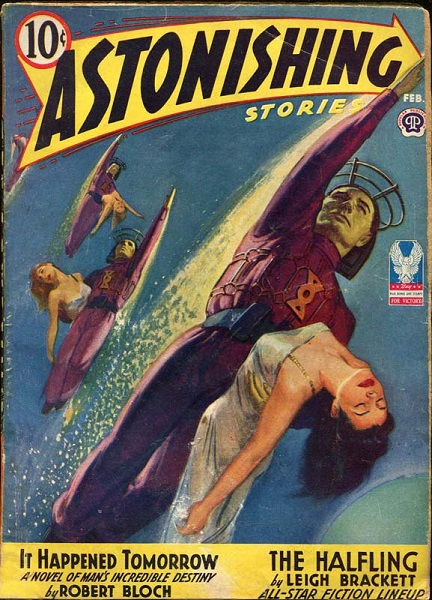
First published in the February 1943 issue of Astonishing Stories. It has since been reprinted in Shot in the Dark (ed. Judith Merril), The Great Science Fiction Stories Volume 5, 1943 (ed. Isaac Asimov and Martin H. Greenberg), and the Brackett collections The Halfling and Other Stories and Martian Quest: The Early Brackett.
Enhancing Image
Jade Greene is the middle-aged owner of a carnival, specializing in performers from other worlds—not humans, but real aliens. We’re on Earth, specifically in California (Brackett’s homeland), but evidently we’re far enough into the future that not only have we made first contact with alien life, but the aliens have even decided to bring their parties to us. Of course, this being Brackett, our solar system seems to be densely populated with alien life, from Mars and Venus and even the moons of other planets. They all live on Earth just fine, despite the differences in gravity and air content. “The Halfling” leans more SFnal than the planetary romances Brackett would become known for, but it plays things a bit loose even by the standards of ’40s SF. Then again, instead of playing into the fantasy half that tends to comprise the planetary romance, Brackett’s decided to take cues from the burgeoning world of American crime fiction, in the mode of Raymond Chandler and Dashiell Hammett. Specifically this is a story told in the first person, and it’s hard to ignore Brackett’s implementation of a certain voice when writing Jade’s viewpoint.
Take this early passage where Jade meets Laura Darrow (she’s actually just called “the girl” for a while) for example:
It’s hard to describe a girl like that. You can say she’s five-three and beautiful, but you can’t pass on the odd little tilt of her eyes and the way her mouth looks, or the something that just comes out of her like light out of a lamp, and hooks into you so you know you’ll never be rid of it, not if you live to be a thousand.
Said passage actually does a fair bit of work, since we can infer right away that a) Jade is smitten with this girl, and b) there’s something different about her, although Jade can’t put his finger on it in the moment. (I say “in the moment,” but Jade is telling all this in the past tense, so presumably he knows how his own story ends, yet he acts ignorant of future events.) We can also infer, by way of a sixth sense known as being the reader of a story, that this Laura will somehow be involved in a conflict which looms on the horizon. Things are about to go wrong.
There are a few other notable members of the carnival, including Sindi, a Martian woman who has been Jade’s exotic dancer of choice, and who Laura wants to replace; and then there’s Laska, a “cat-man” from Callisto who’s another one of Jade’s most prized performers. Important thing about Laska and other members of his race are that they should not be given caffeine under any circumstances, since it’s like a hard drug to them and a cup of strong coffee can drive one into a berserk rage. (We’re told about this early on, conveniently, so that it can come into play later.) As for Sindi, it’s a simple case of jealousy: Laura has a certain knack for dancing that Sindi doesn’t, so that soon the two become rivals. There is also the implication that Sindi might have feelings for Jade, but if so, Jade doesn’t reciprocate them, with him instead being intensely smitten with Laura, despite the fact that, by his own admission, he’s old enough to be her dad. I’ve read enough Brackett at this point that I have to raise an eyebrow at how often she writes romances between young girls and considerably older men. It’s worth mentioning that Brackett married Edmond Hamilton, who was 11 years her senior, although Brackett was about thirty at the time.
It could, of course, be that the censorship typical of genre magazines of the era mandated restraint when it came to matters of sex, but it seems to me that Jade’s infatuation with Laura come less from love and more from lust, what with the many ways he describes her and with Laura herself being sort of a femme fatale figure. We figure that her story about being born between two planets and thus having a sticky situation with immigration law can’t be entirely true, or at least that there’s a crucial component she’s omitting. This is all fine, but predictable. Just as predictable is when one night there’s a murder at the carnival, and Sindi is the victim, just barely alive still when Jade finds her—her throat slashed, as if with giant cat claws. It’s so obvious that Laura is in some way responsible for this that I’m not even counting her playing the femme fatale role as a spoiler. Arguably the real twist comes later anyway, although that is also not too surprising. While I wasn’t terribly invested in Jade and Laura’s relationship and the growing mystery, I did find myself impressed by Brackett’s ability to evoke that hazy LA cityscape narration that would come to define the classic film noir. You can see what Howard Hawks saw when he read Brackett’s first crime novel, and indeed, more so than with other stories of hers that I’ve read, that lingo bleeds into “The Halfling” while feeling natural.
There Be Spoilers Here
Everything goes to hell so quickly that it becomes almost parodic, but it’s still gruesome enough that you sort of have to admire it. There’s a brutality here that will come to figure in a lot of Brackett’s work, a penchant for the hardboiled. The big twist, which you can anticipate if you have more than two brain cells to rub together, is that while Laura appears human, this is all a disguise. The girl Jade has fallen head over heels over is quite literally an illegal alien (bad joke, I know), and also she has an appetite for killing. Indeed she says she’s open to killing everyone in the carnival—everyone except for Jade, whom she’s taken a genuine liking to, although God knows why. This all ends about as well as you’d expect.
Isn’t Jade kind of an odd name for a dude? At most it’s androgynous, which might be a bit of a joke on Brackett’s part, since Leigh is also an androgynous name and there’s a decidedly masculine bent to Brackett’s style, never mind that her protagonists tend to be men.
A Step Farther Out
Despite the Retro Hugo nomination, “The Halfling” has not been as reprinted as some of Brackett’s other early short stories, I suspect in large part because it’s set on Earth and there’s not much in the way of swashbuckling action. It’s a bit of a mixed bag, in that Brackett doesn’t do a very good job of setting up her mystery (or mysteries), but it does at least point the way towards two distinct modes Brackett would become quite good in, namely the detective story and the “mature” SF she would be writing about a decade hence. This is a story I would recommend for those looking to take a deep dive into ’40s SF that goes way outside the rather strict boundaries set by Astounding.
See you next time.

