Who Goes There?
Raymond F. Jones was born in 1915 and spent much of his life in Utah. He seemed to be the first practicing Mormon (Zenna Henderson grew up Mormon but later strayed from the Church) to have written genre SF, so in that sense he was patient zero for what has since become a somewhat common trend in the field. (Indeed there has spawned a whole industry of young Mormon genre writers who learn their craft at BYU and other Christmonger factories.) Jones made his debut in 1941 and from the beginning had a pretty steady relationship with Astounding, although at his most prolific he appeared in other magazines as well. His debut novel, Renaissance, is one of the longer and larger-in-scale novels to emerge from SF magazines in the ’40s, but it’s his 1952 novel This Island Earth which might ring a bell for some people—if only because of the film adaptation being associated with Mystery Science Theater 3000. His 1945 novelette “Correspondence Course” eventually earned a Retro Hugo nomination, deservedly as it’s one of the finer stories to be printed in Astounding during its prime and still reads fairly well.
“Stay Off the Moon!” is an outlier for Jones in a few ways, not the least being that it arrives late in his career. Jones died in 1994, but he only wrote sporadically after the ’50s. Secondly, it was published in Amazing Stories, which was not one of Jones’s regular haunts. Finally, and most strikingly, this is very much an SF-horror hybrid that could’ve reasonably appeared in Weird Tales, had that magazine not closed its doors a decade earlier. Its odd blend of speculative fiction and cosmic horror might explain why it’s basically never been reprinted, despite being considered major enough at the time to be made the cover story. I think it works rather well myself, in spite of the outlandish premise, so that it reads better in execution than it sounds on paper, if that makes any sense. (It’s worth mentioning here that Jones took an interest in Dianetics in the ’50s, something that happened depressingly often with SF writers at the time.)
Placing Coordinates
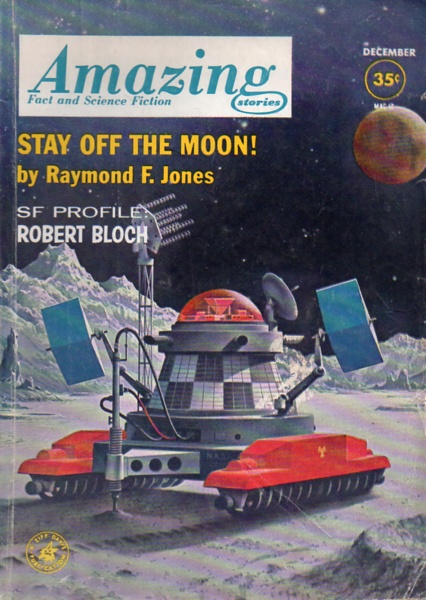
First published in the December 1962 issue of Amazing Stories. It has never been collected or anthologized, and is neglected enough that Jones let it fall out of copyright. As such you can read it on Project Gutenberg. I can think of worse stories that have been reprinted.
Enhancing Image
It’s difficult to talk about this story without bringing up The Big Twist™, but I’m gonna try for as long as I can.
At some unspecified point in the near future, the space program has gone far enough the NASA is now sending a remote-controlled “mobile laboratory,” called the Prospector, to the moon via Saturn rocket. The Prospector’s job is to collect samples on the moon’s surface, and the controller and by extention Mission Control are able to see in fine detail what’s going on out there. This is all in preparation for a manned mission to the moon. Jim Cochran is a technician whose interest in the moon borders on mania, although he also had some skin in the game since Allan, his brother-in-law, is one of those astronauts set to make the voyage and those legendary first steps. Even as the moon floats within mankind’s grasp, however, there’s still a tangable sense of mystery about it that Jim is unable to shake off, maybe because for centuries the moon has been almost more an object of mythology and folklore than a real celestial body that exists in the universe. There’s something romantic about the moon, but also something a bit eerie. In the 19th and early 20th centuries there was much SF and even earnest speculation written about the possibility of life on the moon.
Both the best and worst thing that could happen is if there is absolutely nothing on the moon—just rocks and dust. A profound and insatiable emptiness. This doesn’t sit well with Jim—the likely possibility that the Prospector will find nothing of interest.
The baying of dogs on a wintery, moonlit night.
The madness called lunacy.
Seeds must be planted just so, in relation to the moon, or the crop will fail.
Men had always felt strange things about the moon. Would a Saturn missile and a mechanical monster in its nose be able to destroy all that?
There’s a gear shift that happens midway through the story, but Jones foreshadows the shift well in advance. He invokes werewolves, lunacy, and even calls the Prospector “a mechanical monster.” The vibes are sort of bad from the outset, but it’s hard to articulate why they’re bad, which in my book makes for effective horror. Things get considerably creepier once Jim starts analyzing material collected by the Prospector and finds that there’s something peculiar about the moondust, down to even the atomic level. Now, we know that the moon is an offshoot of Earth, having been formed at the time of Earth’s creation and becoming caught in Earth’s orbit. The moon is made of the same basic ingredients as Earth—or at least this should be the case. But Jim finds, to his horror, that is it not. Not only did the moon not come from Earth’s leftovers, but the moon seems to have originated from somewhere outside the known universe. It is a foreign body that has attached itself to Earth, having come a long way from outside out solar system. The short-term problem is that the very moondust that covers the surface might be lethal to humans, even through spacesuits, but there’s a deeper problem that only gradually rears its head.
There’s something off about the moon, but there’s also a far less esoteric kind of horror here: bureaucracy. What began as Cochran’s Theory soon became a paper which Jim sent to a respected astronomy publication, and thereafter all hell broke loose. NASA and the ghouls in DC are less concerned about the safety of the astronauts and more at the prospect of all this money and manpower having gone to waste. There’s the sunk-cost fallacy to consider: the Americans are too deep into investing in landing men on the moon to back out at this point. Too much has already gone into the space program. It’s too late to back out now, although Jim does have some allies, including Allan and his friend Sam. But it’s not enough.
Scientific judgement was being held in abeyance until actual moon samples were available on earth. For the present, at least one of Jim’s predictions had come true. The hypothesis was becoming known as Cochran’s Theory. That it was also called Cochran’s Idiocy by a few didn’t matter.
We haven’t even gotten to the big reveal yet, but this is still on its own a compelling depiction of how the space race in the ’60s could’ve gone very differently, and indeed much worse, than it did in real life. A lot of classic horror is essnetially conservative in temperament, if not necessarily in politics (although a disproportionate number of the great horror authors over the past couple centuries have been some flavor of right-wing), and “Stay Off the Moon!” continues this streak by saying that maybe it’d be best for all of us if we stopped being obseesed with going to space and landing on the damn moon. As someone who has become increasingly ambivalent about space travel over the years (but for woke reasons), I have to say I get behind this sentiment. It is, to take the title from one of M. R. James’s most beloved stories, a warning to the curious.
There Be Spoilers Here
The Prospector continues its probing and digs deeper, until one day it doesn’t, on account of having been swallowed up by a fissure in the ground that wasn’t there before. Not only have they lost the Prospector, “a billion-dollar experiment” gone up in smoke, and not only does Jim loses his job, but he has made a discovery that will change everything: the moon is alive. There are live hydrocarbons beneath the surface, and something has been lurking inside the moon for God knows how long. Now, in the decades since this story it’s become not uncommon to find horror related to possible life on the moon, or even the moon itself being a living (and also nefarious) thing as seen here, to the point where the premise has sort of become creepypasta material. Jones handles said material with delicacy, though, so that while the actual science is pretty dubious, the reveal of the moon’s true nature is done in very good taste. It helps that while we’re told that whatever cosmic entity lurking in the moon is evil, it’s also more or less unseen. There’s also the added layer of dread from the fact that Jim’s report on the moon terror gets suppressed and he winds up out of a job. There is literally nothing he can do to help people—not even his brother-in-law. Allan loses his life during the Appollo mission, although (and I think this is a pretty wise choice on Jones’s part), we’re not told how he dies.
There would be astronaut deaths with the Apollo missions, namely the Apollo 1 disaster that happened some five years after “Stay Off the Moon!” was published, so there’s an added sense of eeriness here that Jones obviously could not have intended. The tragedy with the moon landing here does nothing to halt the space program, as also happened in real life. We will set foot on the moon—whether it wants us to or not. The ending is bleak as shit, which goes to explain why maybe this did not appear in Analog despite that being Jones’s most frequent outlet.
A Step Farther Out
This is a weird one, and I don’t just mean in the sense that it borders on counting as weird fiction. Rarely do I see a short story shift gears as dramatically as “Stay Off the Moon!” does, which alone would make it at least a curiosity; but at the same time it expresses an ambivalence towards NASA and the space race that was rare at the time, and which would only gradually pick up steam as it became more appearent that something really “useful” would come out of it. That the twist is a hard one to stomach, and of course one which does not align with our scientific understanding of Earth’s moon at all, is something that some readers will be unable to get past. I thought it was more effective than it had any right to be, though, to the point where I found the ending genuinely unnerving.
This story is a bit of a hidden gem.
See you next time.


2 responses to “Short Story Review: “Stay Off the Moon!” by Raymond F. Jones”
The only Jones story I’ve covered — “The Memory of Mars” (1961) — also through me for a loop. It felt like his attempt to channel a bit of PKD. I also described it as a bit of a hidden gem.
LikeLike
It’s definitely a weird one, and its blending of grounded science and cosmic horror will not sit right with some people. But I dig it.
LikeLike