Who Goes There?
Arthur Conan Doyle was born in 1859 in Edinburgh, Scotland, where he also studied to practice medicine. Ultimately Doyle didn’t pursue a career as a doctor, but his medical knowledge would come to be very useful for his actual career as a writer. He started quite young, which his earliest short fiction being published when he was just barely out of his teens; but it was with his 1887 novel, A Study in Scarlet, that Doyle created the two characters who would secure his legacy, to the point where he at times resented their popularity. Taken on its own, A Study in Scarlet is not very impressive, being a detective novel where nearly half the wordage is spent on a flashback sequence that does not involve the two main characters at all. It’s unevenly paced, and there’s the sense that while Doyle may have done good work at short lengths, he was (at least for now) uncomfortable as a novelist. The two main characters in question are Sherlock Holmes and Dr. John Watson, as you probably already know. This marked the beginning of one of the most famous literary franchises in history, although Doyle didn’t start sending Holmes and Watson on adventures in earnest until 1890’s The Sign of the Four. Over the next few years we saw 24 Sherlock short stories, before Doyle “killed off” the world-famous detective, having grown tired of him. However, there came a point where rent was due, or in any case Doyle’s creative batteries had time to recharge.
Of course, Doyle wrote much more than Sherlock, although the titanic success of his prized character overshadows his other work. He was not the first writer of detective fiction (he credited that to Edgar Allan Poe), but he did more to popularize the genre than any other author, setting a standard that would be bent and stretched but not tossed away for decades after. Agatha Christie has sold more books, but then Christie was primarily a novelist, whereas Doyle tended to show his best self when it came to short stories. On top of detective fiction, he also wrote a good deal of historical fiction, as well as horror and SF (even if even “science fiction” had not been coined yet when Doyle was in his prime). His most famous SF story is the 1912 novel The Lost World, but most of his SF was relegated to short lengths, including today’s story. “The Horror of the Heights” reads as predictable now, but it was surely one of the first notable stories to be written about the airplane, following its invention.
Placing Coordinates
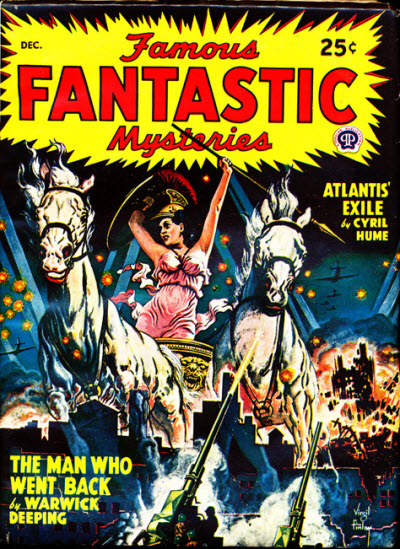
First published in the November 1913 issue of The Strand Magazine. It later appeared in the December 1947 issue of Famous Fantastic Mysteries. There’s no shortage of reprints, including The Seventh Fontana Book of Great Horror Stories (ed. Mary Danby), The Best of British SF 1 (ed. Mike Ashley), Strange Tales from the Strand (ed. William Patrick), The British Way (ed. James E. Gunn), and frankly too many Doyle collections to count, including Danger! and Other Stories, Tales of Terror and Mystery, and Gothic Tales. It’s also in the public domain, so there’s that.
Enhancing Image
The bulk of the story is the “Joyce-Armstrong Fragment,” a mostly intact notebook recovered after the disappearance of Joyce-Armstrong, a renowned pilot who was looking to break the height record. Unfortunately the last page of the notebook seems to have been torn out, but otherwise we have an in-depth account of the last flight the pilot ever took. Now, truth be told my favorite part of “The Horror of the Heights” is the introductory section, in which the narrator (presumably a fictionalized Doyle) recounts the discovery of the notebook and the context for Joyce-Armstrong’s flight. This account seems to be written in what was then the near-future, maybe the 1920s, since there’s a reference to airplanes having been around for “more than twenty years,” but obviously this would not have been true in 1913 (it would’ve been more like ten). However, aviation had come along enough since the Wright brothers’ experiments that the Royal Aero Club had been founded in the UK a few years prior to this story’s publication, and the narrator also references a flight school on Salisbury Plain that was founded around the same time. It’s clear that Doyle wrote this story as sort of an ode to the first generation of aviators, some of whom would see their skills come to very good use in World War I soon enough. If this is an ode to a group of brave men and women, however, it’s also meant to be taken as a cautionary tale, of the sort that borders on cosmic horror.
A day laborer had found the notebook just outside Withyham, which incidentally is where Joyce-Armstrong lives (or lived). There have been too many odd deaths and disappearances with pilots as of late, and one of these hotspots for strange shit also just so happens to be the upper atmosphere above Withyham and its environs—areas of sky that seem to be home to “jungles of the upper air,” as Joyce-Armstrong calls them. Well, he’s decided to take his fewfangled monoplane and see if he can climb to above 30,000 feet, maybe even 40,000 feet, to see what he can find. Despite flying solo, he’s come more than reasonably prepared, taking a shotgun as a sidearm and with a handy notebook to record the prelude to the flight. As he says, in a bit of a funny moment (Doyle is good at these), “If I don’t [survive] this note-book may explain what I am trying to do, and how I lost my life in doing it. But no drivel about accidents or mysteries, if you please.” Much of the story is not even so much about the flight itself as Joyce-Armstrong’s preparation for it, as well Doyle describing the mechanics of climbing in a propeller plane up a higher and higher altitude. This must’ve been thrilling to read at the time, before commercial flying had become a thing and indeed when a very small number of people were qualified to even board a plane, let alone fly one. I don’t wanna say “The Horror of the Heights” has aged poorly, because that would be misleading, but it has simply lost the capacity to thrill the modern-day reader like it would have a century ago, through no fault of Doyle’s own. Sure, some people will always have a phobia of flying, but this story would not be classified as SF if published today; instead it would most likely appear in an outlet for weird fiction.
When giving background on Joyce-Armstrong, the narrator describes the esteemed pilot as something of a poet and a dreamer; that second part is true enough, but I wouldn’t call Joyce-Armstrong a poet. Neither is Doyle, for that matter. Doyle’s gift is for storytelling, humor, and crafting some pretty memorable characters. Joyce-Armstrong is a no-nonsense adventurer type of the sort that can be found in both genre and non-genre pulp fiction from early in the 20th century. Doyle is more literate and self-aware than, say, Edgar Rice Burroughs, but no doubt he was getting paid by the word. If anything about “The Horror of the Heights” should try the reader’s patience, it’s the sheer length, relatively little of which can be attributed to action or plot revelations. In my copy of Gothic Tales, it comes to fourteen rather dense pages with small type, but it could easily have been a few pages shorter. This less has to do with Doyle’s flaws as a writer necessarily (although he does have those) and more to do with (as I said) the fact that what would’ve fascinated readers in 1913 might now read as obvious. You could say the story is a victim of its own success, because it does a very good job of giving a plausible and detailed account of one man’s journey into an “air-jungle,” a place that does not actually exist; and yet Doyle handles his material with a kind of journalistic integrity. It works well, if not entirely, because Doyle takes his own story quite seriously.
There Be Spoilers Here
This is a hard one to spoil, since the ending is all but given flatly away at the beginning, so I won’t go into it.
A Step Farther Out
Did Doyle believe there are creatures lurking in the mists of our upper atmosphere? Probably not. He did come to believe in some screwy shit after the end of WWI, most infamously an obvious hoax about fairies. Doyle’s turn to supersition can be explained by the trauma of losing his son Kingsley in the war, but it should also be noted that Doyle (along with damn near every British public figure at the time) steadfastly supported the UK entering said war. Family tragedy can sometimes renew one’s artistic energy, as happened with Doyle’s close contemporary Rudyard Kipling, who wrote some of his finest and most deeply felt short stories and poetry following his own son’s death in the same war. “The Horror of the Heights” was one of Doyle’s last stories he wrote before the war period, and as such it was one of the last to come out before what is often regarded as Doyle’s artistic decline, even putting aside the fairy stuff. The story itself works best as a snapshot of aviation in its early years, when you had your first flight schools and masters of flying but before these incredible machines were to be used as weapons of death in WWI. It’s hard to believe Doyle would have written the same story even a couple years later.
Anyway…
I’ll see you in about a month, aside from a couple editorial posts. That’s right, I’m taking a “vacation” from this blog. Not the first time I’ve done this. I’m a slow reader and a temperamental writer. Even so, I’ve averaged about 200,000 words a year for this blog for the past four years, because unfortunately, like Doyle, I tend to not be very concise. I do, however, wanna write two or maybe even three Observatory posts during my “vacation,” so you can expect to see one of those every week to ten days. When I come back swinging in October, we’ll be doing a marathon of horror stories, with one coming from the pages of Amazing Stories. Amazing is not a horror-centric magazine, and at the same time I always get into the mood for spooky stuff when October comes around.
I’ll see you then.

