(I’ll be discussing some minor spoilers for The End of Oak Street, but rest assured I will not be going into the film’s controversial ending or anything in detail about the third act.)
There’s a pretty well-known J. G. Ballard quote, taken from his final novel, Kingdom Come, and it goes like this: “The suburbs dream of violence. Asleep in their drowsy villas, sheltered by benevolent shopping malls, they wait patiently for the nightmares that will wake them into a more passionate world.” This is a sentiment that can be found in a lot of Ballard’s work, and it’s this same sentiment that David Robert Mitchell, writer and director of The End of Oak Street, has latched onto with his latest movie. That much is obvious. The whole thing is “obvious,” really, if you’ve seen any of the trailers for it. A little slice of Reagan’s America getting jettisoned into the past and overrun by prehistoric creatures is such a blunt metaphor that I’m surprised it has never been done before, at least in film. It seems like an idea that Mitchell has had tumbling around in his mind since he was in his teens, and I do mean that as a point of praise. Maybe he saw Jurassic Park in theaters 33 years ago and thought of something, or rather seeing Jurassic Park sparked something in him, as it still does with a lot of people. Despite having people running away from dinosaurs as a commonality, though, Mitchell’s latest is quite a different ordeal. The result is a movie that reads in places like Jurassic Park, but also those ’80s movies Steven Spielberg produced but didn’t direct, like Gremlins and The Goonies.
The End of Oak Street is Mitchell’s first movie in eight years, since he directed the career-killing spectacle that was Under the Silver Lake in 2018. Mitchell had originally gained a good deal of traction with It Follows in 2014, a sort of ’80s throwback (complete with Richard Vreeland’s synth-driven score) which stood out as one of the most acclaimed horror movies of its year. But Under the Silver Lake, which is not a horror movie, although it does come off as like a hallucinatory voyage gone sour, got mixed reception at Cannes, with A24 basically dumping it in the woods like some horrifically deformed infant in medieval times when it came time for a theatrical release. It made no sense and made no money, as the saying goes. Now, nearly a decade later and thanks in part to J. J. Abrams as a producer, Mitchell has made his one-for-them theatrical comeback with The End of Oak Street. Reviews have been pretty positive, actually, but the box office numbers have been so-so. It has made back its $85 million production budget, but is unlikely to make up for the marketing costs (rule of thumb is that a theatrical film’s marketing budget is about the same amount as its production budget). What we have here is probably a cult classic in the making, in that it may find its “real” audience a decade or two down the line.
Mitchell’s past three movie’s show a love-hate relationship with America’s past, namely in regards to American pop culture and the ways in which the younger generation have been screwed over by those in power. It Follows puts a twist on the sexually reactionary and anti-feminist/homophobic bent of a lot of ’80s horror movies, especially those of the slasher variety, while Under the Silver Lake is about Hollywood’s (both the film industry and greater Los Angeles) ouroboros-like cannibalizing of its own past. The End of Oak Street returns to the same ’80s well It Follows had gotten water from, but it goes about things in a very different way. For one, we’re now literally thrown back to the ’80s (It Follows intentionally muddies the waters as to when it takes place), more specifically a Michigan suburb in 1982. Also different is the music: gone is Richard Vreeland, which is a bit of a shame. One of my gripes with this movie is that while Michael Giacchino replacing Vreeland makes sense for the film’s ’80s Spielberg vibes, this is not one of Giacchino’s more memorable scores. There’s also the rating, as this is Mitchell’s first movie to not be rated R; but don’t let that fool you, as The End of Oak Street is the most violent PG-13 movie you’re likely to see in theaters all year. Hell, I’m pretty sure it has more on-screen blood than The Odyssey, which was rated R mostly for the (not very bloody) violence.
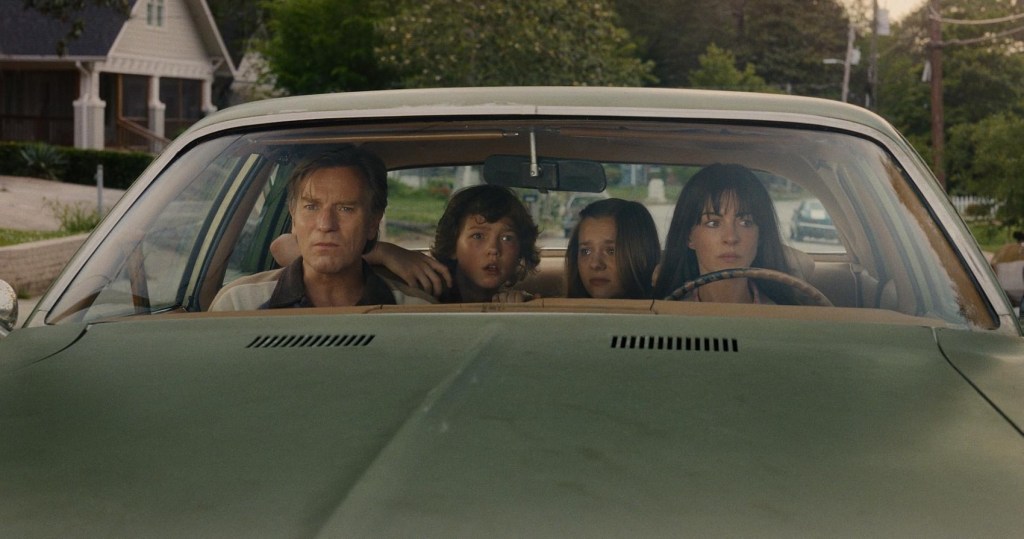
So, what is the idea here? It’s a premise so simple and juvenile that (and again, I do mean this affectionately) it seems to have emerged from a teenage boy’s imagination, albeit filtered through a mature person’s point of view. The Platts are ostensibly a happy white middle-class family. Denis and Greg have two kids, a fenced-in backyard, and even a dog named Starbuck. The son, Brian (Christian Convery [I have to stop in my tracks for a split second every time, being as we have the same name]), has a bow (complete with a quiver of arrows), a group of friends he hangs out with, and oh yes, the neighborhood bully who’s looking to make mince meat out of his ass over some grievance. There’s the daughter, Audrey (Maisy Stella), who’s sort of tomboyish and, in a way unusually subtle for this movie, is implied to be a burgeoning lesbian. Both are in their teens, although Audrey is a bit older and a good deal more capable in tough situations than Brian. Speaking of characters who are implied to be some flavor of queer, there’s Denise (Anne Hathaway), the mom, who’s been secretly working on a semi-autobiographical novel, as a way to vent about her disappointment with her domestic life. Greg (Ewan McGregor), Denise’s husband, has been recently been laid off from his well-paying job, although his hasn’t told Denise about this, instead secretly (except Brian knows about it) working as a pizza delivery driver so as to scrounge some money together.
Now you may think this all sounds implausible, cliched, and kinda dumb—and you’d be right. There’s also the issue of the fact that The End of Oak Street is at least half a decade late to the party, that being the rampant fetishization of ’80s pop culture we saw in the 2010s (think Stranger Things, Ready Player One, etc.) whose sloppy seconds we’re still dealing with in the 2020s. For better or worse, much like an HPV-induced lip sore, ’80s nostalgia has a weird way of going away, only to pop up again periodically. It’s the gift that keeps on giving. Mitchell had indulged in said nostalgia a decade ago and now he’s back at it again; and yet somehow, against all odds, The End of Oak Street finds new ways of tackling well-worn material. On paper I should not give a single fuck about Denise’s put-upon-housewife routine, and yet her dilemma is elevated by Anne Hathaway giving a career-best performance—even better, dare I say, than her likely-to-be-Oscar-nominated performance in The Odyssey. Hathaway gives Denise a depth that’s not necessarily in the script almost sheerly through her physicality. Rarely do I see an actor use her whole body, especially her face, to convey emotions in a mainstream movie like this. There are some moments in this movie that would be difficult to pull off seriously, but Hathaway somehow does it. There’s a palpable sense of loneliness and alienation with her character, in how she really does feel disconnected from the rest of her family, that makes Denise one of the best movie heroines I’ve seen recently.
I could talk more about the human performances, but I know why you’re here, and I’m sure you know why I went to see The End of Oak Street in the first place, aside from being one of those cultish defenders of Under the Silver Lake who waited patiently for what Mitchell might cook up next. We’re here for the dinosaurs, and also some other prehistoric reptiles who decided to join in on the fun. Most heavily marketed of the bunch might be the somewhat fluffy (all the dinosaurs have at least some fur on them) allosaurus, which I’ve seen some folks erroniously call a T. rex despite the very wrong head shape and the fact that it has more than two claws on each hand. A couple (by no means all, since I’d rather not give away everything) other hightlights include a spinosaurus with what might be the ugliest mug of any big-budget movie dinosaur (I have to think the spinosaurus looking so scuffed has to be a joke about how it’s the mascot for what used to be the most widely derided Jurassic movie), as well as some kind of sauropod, two of which treat us to what might be the (at least intentionally) funniest sex scene of 2026. Yet strangely, the most memorable animal of them all is not a dinosaur, nor even a pterosaur (although we do get those as well), but a giant fucking snake that’s first seen emerging out of someone’s backyard swimming pool early in the film. Unlike every other prehistoric beast, even of the most carnivorous of which are simply doing as Nature commanded them, there’s something oddly malicious about this phallic-looking thing with teeth the size of bone saws, as if it had come less out of the past and more out of someone’s nightmares.
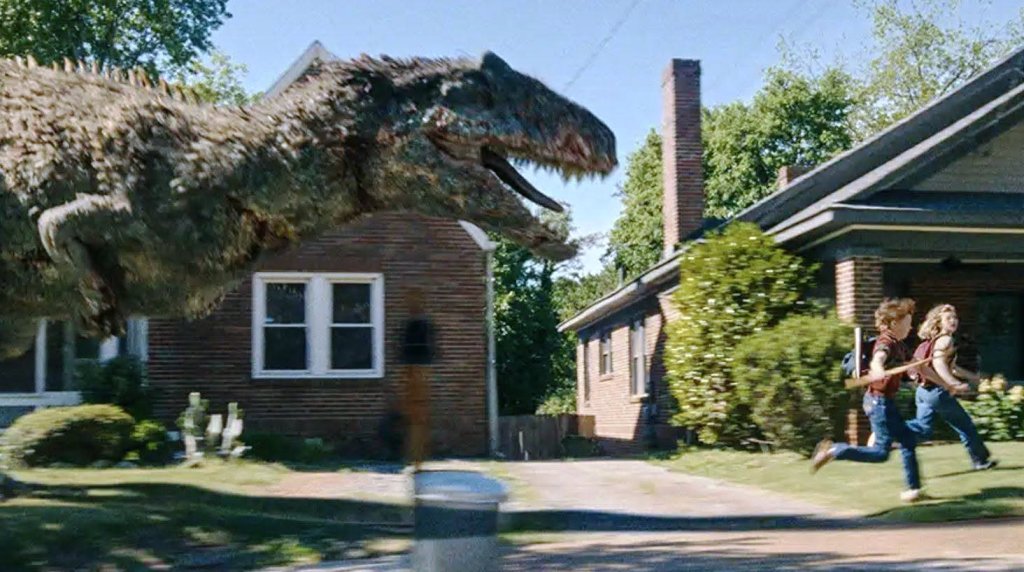
As you can guess, the animals (and I insist on calling them animals as opposed to monsters) are made possible with the use of CGI, the fidelity of which is good but not exactly exceptional, except for the fact that the production budget was less than half that of the latest Jurassic World movie. The special effects, despite the sheer number of them, are surprisingly not the film’s biggest selling point; at no time did I stop mentally during my watch to consider the mechanics of a certain action sequence, or the detail of a certain dinosaur’s computerized skin (or, well, scale) texture. Even when watching Jurassic Park, which I may add is my favorite movie of all time and which I must’ve watched nearly a hundred times over the course of my thirty years, I can’t help but think about the incredible work that went into blending practical on-set effects with CGI. Unfortunately, we now live in a cinematic landscape where so much of that cloud of unknowing behind the process (and the process, as I had read somewhere, is ultimately part of the end product) has been demystified. We know too much now. The power of CGI has gone to answer questions that should’ve remained open. It’s a good thing, then, that much of the visual splender of The End of Oak Street comes not from the effects themselves, but from Mitchell’s direction and Mike Gioulakis’s cinematography (Gioulakis had worked as DP on It Follows and Under the Silver Lake as well). I’ve seen people complain about the use of split diopter shots here, especially one scene in particular that’s almost nothing but split diopter shots, but those people are too weak to survive the coming winter. But that’s just my opinion.
More so than the visuals themselves, what makes the creatures in this big ol’ creature feature captivating, if also a little too unorthodox to take for some viewers, is how they act. Not since the original Jurassic Park has a dinosaur movie committed this hard to depicting said dinosaurs as animals first, monsters second. The End of Oak Street is on the short side by modern blockbuster standards, at only an hour and forty minutes, but in that time we see a wide variety of behavior from different prehistoric species. We see big and small carnivores go after the Platt family, sure, but these same carnivores are quick to give up on the hunt if the humans prove to be too much of a hassle; that most of the humans we come across prove easy prey is beside the point. We see dinosaurs eating, grazing, messing around with human stuff like trash cans, sleeping, shitting, and of course, mating. Aside from the aforementioned sex scene with the sauropods (this got by far the most laughs out of the [admittedly small] audience I saw the movie with), it’s telling that before we’ve even seen our first dinosaur in the flesh, the first sign that something big and prehistoric has started lurking abaout is a giant pile of shit (it’s basically a recreation of that one scene from Jurassic Park, you know the one) in the next-door neighbor’s backyard. Mel Jacobs (P. J. Byrne), the neighbor in question, immediately blames the Platts, as he has a vendetta against them because of Starbuck leaving little accidents on his lawn—but of course, we know better.
The behavior of the dinosaurs and their cousins strikes a balance between what was the common scientific and cultural assumption about dinosaurs for decades, that being that dinosaurs were dumb brutes who could barely find their way to a watering hole, and the more recent tendency in fiction to depict dinosaurs as (equally implausibly, I might add) freakishly intelligent and determined serial killers in lizard form. There’s a well-done action sequence set at night in which the spinosaurus is chasing a couple of the Platt members, but once it’s become clear these pesky humans are more trouble than they’re worth, Big Spino gives up and opts to find some water to drink for the time being. This scene works as a cute nod to the fact that Big Spino was an aquatic predator who would’ve preferred large fish and reptiles over some scrawny mammals, but it also works to demystify dinosaurs, in a media landscape where too often dinosaurs are shown to be more like movie monsters than animals that really lived on this planet millions of years ago. What makes the dinosaurs in The End of Oak Street scary, if anything, is the reality that humans are small, slow, and squishy, with little in the way of natural defenses. We have not had any natural predators since at least the last ice age because of our ingenuity and our use of tools; and even then, a cowboy-style lever action rifle doesn’t do much against the thick scaley coat of an allosaurus. Even Mel, who apparently has a six-shooter on standby, isn’t able to do much against a flock of hungry pterosaurs. There’s a lot of death and carnage in this PG-13 movie.
An unspoken rule with dinosaur movies, especially the Jurassic movies (even the original film [but not the novel] abides this), is that certain types of people are not to be eaten by dinosaurs. Children, of course, are off-limits, as are the very old, and of course nobody who is too sympathetic is to be taken as a snack. The original Jurassic Park, to its credit, does mess with this formula a bit by sacrificing Robert Muldoon, one of its coolest characters; but otherwise when you watch a Jurassic movie you can rest assured that certain characters will be wearing plot armor. This is not so much the case with The End of Oak Street. Our first on-screen death is a nice old lady who seemed to be one of Denise’s few friends in the neighborhood, and we even see that she’s had some of her throat torn out by some small carnivore (again, this movie clings to its PG-13 rating for dear life). We see dead bodies of nearly all ages on the streets and in houses, and in at least one case it looks as if some poor woman had opted to commit suicide in her car, following the dinosaur outbreak. It’s even implied that small children, that most heavily armored of demographics when it comes to these movies, are not safe from the jaws of hungry carnivores. Perhaps most alarmingly, and a point which doesn’t exactly get spelled out, is the fact that the neighborhood never comes together at any point; it really is a case of every man for himself, as people shut themselves up in their houses and families try to escape the suburbs—only to find that there is no escape. Without electricity or even running water, this little pocket of human civilization is trapped in the past forever, and there’s really nothing to be done.
The End of Oak Street is by no means a perfect movie—if anything you could argue it’s a technically sound movie that purposefully tries to be “bad.” We have a schlocky B-movie premise, possibly inspired by The Twilight Zone or The Outer Limits, with a cliche-ridden family drama at the center. Aside from Hathaway, who really should (but will not) get an Oscar nomination for her turn here, the performances range from good to sort of stilted, as if Mitchell was making some of the actors think they were performing in a different kind of movie altogether. The ending has already proven divisive, even among people like myself who generally go to back for this movie, although I personally think it throws a few wrinkles into what could’ve been all too straightforward. But what makes The End of Oak Street special, and indeed worthy of what will probably be cult classic status some ways down the line, is that it manages to be fun as all heck while being just strange and sinister enough that you wouldn’t confuse it with other ’80s throwback projects, which we’ve gotten too many of over the past decade or so. Instead of being coy about its indebtedness to Jurassic Park and other Spielberg movies, it makes its homages quite deliberate while throwing in a twist of its own. This was supposed to mark Mitchell’s return to mainstream filmmaking, but its true audience is of the sort that’s more receptive to cult classics like Carnival of Souls and Roger Corman movies.

