Who Goes There?
Lisa Tuttle was born in 1952, in Texas, although she’s spent most of her adult life at this point in the UK. She wrote her first professional story, “Stranger in the House,” when she was all of 19, and to this day is one of the youngest to win what is now called the Astounding Award for Best New Writer (for some reason not counted as a Hugo, even though it’s given out at Worldcon each year and there’s a list of runners-up). Tuttle’s first love, and indeed the genre she writes most prolifically in, was horror, although her first story of at least novella-length was the SFnal and not very scary “The Storms of Windhaven,” in collaboration with George R. R. Martin. Eventually this collaboration resulted in what could be considered Tuttle’s debut novel, Windhaven, although it’s not indicative of the kind of fiction Tuttle normally writes. For a more telling sample of Tuttle’s style I’d have to recommend the short stories collected in A Nest of Nightmares. “In the Arcade” is not in said collection, maybe because Tuttle considered it too slight (and in fairness, it is slight), but also it’s less straight horror and more SF with a strong horror tinge. It’s a curious little cyberpunk-adjacent piece that unfortunately is too brief and underwritten for me to give full marks.
Placing Coordinates
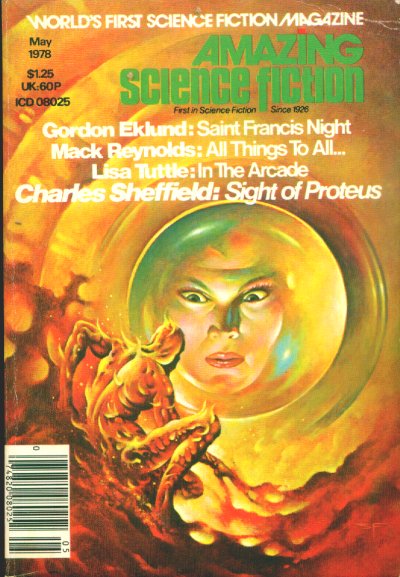
First published in the May 1978 issue of Amazing Stories. It’s been reprinted only a few times, in The Year’s Best Horror Stories: Series VII (ed. Gerald W. Page), Horrorstory: Volume Three (ed. Gerald W. Page and Karl Edward Wagner), and the Tuttle collection Stranger in the House: The Collected Short Supernatural Fiction, Volume One.
Enhancing Image
Before I go into the story proper, I think it’s important to mention that “In the Arcade” features a heavy use of racial slurs, and sadly I can’t go into plot details without repeating some of these slurs. The story itself is not racist at all, but rather racism as a theme figures majorly into it. We’re all adults here, but I thought a disclaimer would be useful.
Anyway, like with a lot of stories, “In the Arcade” starts with someone waking up. Eula Mae wakes up in the middle of the night, suddenly and covered in sweat. Everyone else is still asleep, and more disconcertingly, nobody else seems capable of awaking. Her husband lies next to her, as if dead, although it’d be more accurate to say like an inanimate doll. And there’s something else: outside her bedroom window, Eula sees what should be the familiar moon and night sky, but this is not the case either. “The moon had always been there, she’d looked at it almost every night of her life. And now she looked up and saw not the familiar moon at all but a simulacrum, a falsehood, a stage moon: a light.” Ditto for the clouds, which are described as being like drapes. It’s like the outside of the apartment is a studio lot. After failing to wake the neighbors, Eula decides it’s time to head outside into the street in the dead of light. There’s really nothing left here for her to do. Hell, whatever’s wrong seems to be affecting everyone except for her, she who had been (un)lucky enough to wake.
Obviously we have ourselves an artificial world, or at least an artificial environment. This was not a new idea, even in 1978; and although it’s tempting to think of the premise reminiscent of Philip K. Dick (which, to be fair, it very much is), Dick was not the only author playing with these ideas before Tuttle came along. Unlike Dick, who had a misogynistic streak, Tuttle sought fit to give us a heroine, and one who’s at least middle-aged at that. Also, whereas Dick had an economy of words but no delicate ear for the language, Tuttle’s prose is somehow equally spare but more subtle. I didn’t even catch a tiny passage about a “familiar imprint of the six-pointed star” on Eula’s forehead the first time around. The foreshadows the ending in a sense, but it also tells us something about Eula’s character, namely that she’s supposed to be Jewish, what with the star of David literally marked on her forehead; the fact that it’s imprinted, rather than tatooed, is another telling detail. Another neat little bit of foreshadowing is how Eula is able to break down the door to her sister’s apartment by herself, “although she did
not think of herself as physically strong.” On its own it’s unlikely but still possible for a woman of Eula’s age and shape to do such a thing, but by this point we know something is up.
From here on the details get rather fuzzy. To use some video game terminology, Eula goes out of bounds, clipping through a wall and entering a large, clean, well-lit hall, completely unlike anything she’d seen before. Looking backwards, she finds the city she was living in was called Niggertown (yeah), and we know this because not only is there is a sign for it, but there’s even an accompanying booth, of the sort one would find at a local fair. It’s here that the vibes go from bad to worse, and I do mean that as a compliment. You can practically feel the utter lack of sunlight reading this story, which is just the kind of sensation Tuttle was looking to evoke. The builders of this place were not progressive-minded optimists, but rather of a very different sort. The description of the Niggertown booth itself is kind of a harrowing read, but I don’t think it’s necessary to quote the whole thing here. We get a sensationalist advertisement for an imaginary past, in which seemingly every negative stereotype about black Americans is depicted with reckless abandon. But of course, the people who line up for such an attraction are not to be offended by such brazen racism anyway; clearly there’s a supply and demand here.
There Be Spoilers Here
The implication (and indeed is implied but not shown with “In the Arcade”) that this all takes place in a future where Nazi Germany won World War II. There’ve been so many “Hitler wins” stories over the decades that it takes a little finessing to make such a scenario interesting again, but Tuttle does a fine job here. The two men Eula meets by accident are described as “fine, blond, strong, Aryan types,” which is maybe a bit on-the-nose. Otherwise, however, how these men act could pin them as American just as easily as from Nazi Germany, and maybe that’s the point. One of the men is even wearing a Nazi uniform, yet he doesn’t “sound” German. Hitler himself may or may not be alive still, as we merely get mentions of “the Old Man,” who insists on there being real people in these attractions, even with the increasing use of androids. I like to think it’s some other Nazi higher-up, since I can’t imagine Hitler having lived nearly long enough to see the artificial cities created here, even if the Nazis had won the war. Just a nitpick on my part. Oh, and if you were expecting some great conclusion to this story, you’re shit out of luck, because it sort of just ends. The two men catch Eula unconscious and presumably send her back to Niggertown, and that’s the end of it. I have to think Tuttle had something bigger in mind with this premise than what we got, but I’m not sure. There’s a discerning observation Tuttle makes here about nostalgia having a fascist quality to it (there are few things right-wingers love to do than idolize the past, especially a past that didn’t actually happen), but as it stands “In the Arcade” is less a short story and more like a recounted dream.
A Step Farther Out
Published in 1978, the same year as Joan D. Vinge’s “Fireship,” “In the Arcade” anticipates some tropes that would become well-worn in cyberpunk, which mind you would not even have a name for several more years. Sure, we don’t have computers with this story unless you count the androids, but the sunless past-obsessed setting would become a familiar hunting ground for the likes of William Gibson and Pat Cadigan down the road. Now, since Tuttle is not an SF writer by nature, her rendering of the “arcade” reads less like speculation and more like a bad dream. It’s also such a short story that there’s not much time to become attached to Eula or her situation. One more revision might’ve unlocked its full potential, but I still recommend it for those interested in cyberpunk.
See you all next time.

