Who Goes There?
Happy Halloween, everyone.
How would we remember George R. R. Martin if, God forbid, an anvil had fallen on his head in 1983? Those in SF fandom would know him as one of the most distinguished post-New Wave voices, having made his break in the early ’70s with some very moody and atmospheric science fiction, with the occasional fantasy story thrown in there. He was a runner-up for the inaugural John W. Campbell Award (now the Astounding Award) for Best New Writer. He was, at least up to that point, the youngest ever to win a Hugo in any of the fiction categories, for his 1974 novella “A Song for Lya.” Said novella is just one entry in what came to be a rather loose future history known as the Thousand Worlds, which also includes The Dying of the Light, Martin’s debut novel. His second novel, if you wanna count it, was Windhaven, which he co-wrote with Lisa Tuttle over a number of years, although it’s almost more of a story cycle than a novel. Martin’s single most famous story, and one set in the Thousand Worlds, would have to be “Sandkings,” a Hugo-winning SF-horror (with some dark comedy) tale that’s been reprinted many times by now.
Of course, one thing Martin would not have been was a fundamental game-changer in the world of fantasy, both in literature and TV. A lot of people are unaware that Martin had already been a published (and acclaimed, though not exactly famous) author for 25 years when A Game of Thrones was published in 1996. In fairness, A Game of Thrones arguably marked the point when Martin broke through as a novelist, since up until then his novels were sporadic in quantity and frankly not quite on par with his short fiction in quality. His 1982 horror novel, Fevre Dream, is evocative and thrilling at times but suffers from a case of bloat, being over 400 pages and having at least three different places where it could’ve ended. Martin’s said, I think in both interviews and print, that he considers himself instinctively a horror writer, and indeed his horror short stories (he never could return to horror at novel length after Fevre Dream) are some of his best. “Remembering Melody” is not exactly major Martin, but it’s still thrilling, eerie, and very well-paced, so I consider it a good read.
Placing Coordinates
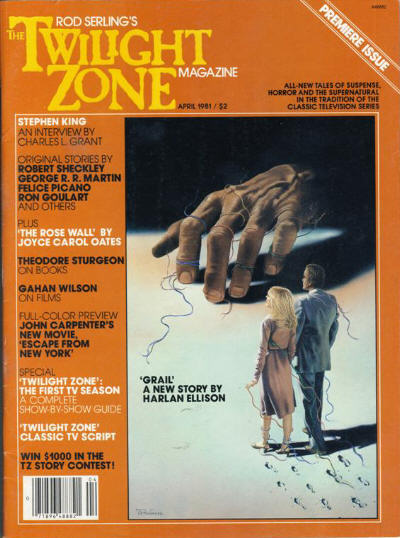
First published in the April 1981 issue of Twilight Zone Magazine. It’s since been reprinted in Great Stories from Rod Serling’s The Twilight Zone Magazine (ed. T. E. D. Klein), Fears (ed. Charles L. Grant), A Century of Fantasy 1980-1989: The Greatest Stories of the Decade (ed. Robert Silverberg), and the Martin collections Songs the Dead Men Sing and the first volume of Dreamsongs. (There’s also GRRM: A RRetrospective, but this was split into the two-volume collection Dreamsongs.)
Enhancing Image
“Remembering Melody” is notable for a couple reasons: it’s the first GRRM story to have gotten a movie/TV adaptation (if you don’t remember the anthology series The Hitchhiker, don’t worry, I had no clue about it prior to yesterday), and also it was Martin’s first attempt at writing a horror story set in what was then the present day. While working on what eventually became Windhaven in 1979, Martin was apparently inspired by Tuttle’s success with writing “realistic” horror stories. Martin had written some horror by this point, most famously “Sandkings,” but these were all horror mixed with SF or fantasy, whereas “Remembering Melody” is pretty grounded for about 80% of the word count. Some months ago I reviewed “The Pear-Shaped Man,” a later story that more thoroughly explores the horrors that can lie waiting amidst everyday life, but how successful is tonight’s story by comparison? Well, it’s shorter, so there’s that.
Now with the plot, we have Ted, a thirty-something lawyer who’s made a good life for himself, if also a somewhat lonely one. The story starts with Ted getting a surprise knock at his door while in the midst of shaving, cutting himself, which is maybe a bad omen. Melody has arrived unexpectedly, and you could say she’s an old friend, although she and Ted haven’t spoken in a few years. When a friend (or former friend) you haven’t talked with or seen in a hot minute suddenly shows up at your door one day, you know implicitly that said friend will ask you for something; nobody wants to reconnect after years of no contact just because they miss the other person that much. It doesn’t help either that Melody looks like shit, and this is barely an exaggeration. Martin is not the most subtle of writers (especially when it comes to dialogue, must be said), but he’s able to tell us a character’s whole backstory just from how he describes them. The first time we see Melody is disconcerting. Get a load of this:
The last time Ted had seen [Melody], three years before, she’d looked terrible. Now she looked worse. Her clothes—shorts and a tie-dyed T-shirt—were wrinkled and dirty, and emphasized how gaunt she’d become. Her ribs showed through plainly; her legs were pipestems. Her long stringy blond hair hadn’t been washed recently, and her face was red and puffy, as if she’d been crying.
She seems like someone half-dead already, but also she seems like she had come out of a time warp. Keep in mind that “Remembering Melody” takes place circa 1980, and this is an important marker because we find out Ted, Melody, and a couple of their mutual friends used to be hippies in college, back in 1970, so a decade earlier. As Ted tells Jill, a friend of his at the law firm, “Everything was weird. […] They were good times, too. Special times. Sometimes I’m sorry they had to end.” The four friends shared a house in their early twenties and had the kind of friendship that lay awkwardly between friends-with-benefits and what we would now call a polycule. (It’s a shame the term “polyamory” would not be coined for another couple decades.) We’re not told specifically why the friend group drifted apart and that era of optimism ended, but if you were reading this issue of TZM in 1981 then you already knew, and even today it’s no secret how the hippie dream eroded. Of course, it’s a bit of a complicated story as to how everything turned sour, but at least in the case of Ted and his friends the drifting-apart was amicable. Everyone went on to have bright futures with good jobs—except for Melody.
Of the four, Melody was the most idealistic, even majoring in art—a move that was probably considered laughably naive at the time, but would be considered even more so (to the point of stupidity) today. Naturally she’s also the one who took “the real world” by far the hardest, although from what we can tell about Melody we maybe shouldn’t feel too bad for her. Much of the horror (at least for me) of “Remembering Melody” doesn’t come from anything supernatural but rather from the very real (to the point where it’s probably happened to you at least once already) scenario of being friends with someone who just takes and takes and rarely if ever gives back. It’s a sort of abusive relationship, made worse here because apparently Melody has gone down the drug-addiction pipeline. So she’s unhealthily skinny, into cocaine, a divorcee (we’re told she married this one guy literally a week after meeting him, I guess out of desperation), and she also seems to be homeless. In other words, it’s hard to imagine her living situation as becoming worse. What’s Ted to do about this?
According to his introduction in Dreamsongs, Martin tried selling “Remembering Melody” to some “slick” publications before submitting it to Twilight Zone Magazine, and it definitely reads as a horror story that’s supposed to have a certain “literary” value, such that it might appear in an outlet that doesn’t primarily print horror fiction. You’d be forgiven for getting through most of the story and thinking there might not be a supernatural element at play after all, even if hindsight tells us it would be reprinted in a few fantasy-themed anthologies. Martin holds his cards close to his chest on this one, so that for better or worse you spend much of the time wondering when the other shoe will drop. Something to keep in mind here is that there are only a few characters in “Remembering Melody” to begin with, but Melody doesn’t interact with anyone aside from Ted, and indeed this is the first time Jill even hears about such a person existing; just something to put a pin in for when we get to the ending.
There Be Spoilers Here
Are you ready? We get two twists for the price of one: the first is that Melody has killed herself, after threatening to do so during an argument with Ted, and the second (bigger) twist is that Melody’s been dead this whole time. Unbeknownst to him, Ted got visited by a ghost at the beginning of the story, and unfortunately said ghost is out for a bit of revenge—not just on
Ted but on their mutual friends. Now, taken literally, I’m not sure how to feel about this reveal, since you can’t really blame Ted for being frustrated with someone who is both a hot mess and a layabout, and his fate as someone who will end up either committing suicide or in a mental institution seems disproportionate. Taken symbolically, though, it does make some sense, if we’re to take Melody as something akin to the vengeful spirit of the failed hippie movement. Melody retained her idealism, but at the expense of real-world concerns like… food, and shelter. She died destitute, a suicide, having been abandoned by her college friends, who themselves had abandoned said idealism and become (ugh) capitalists; so it’s easy to imagine a vengeful ghost coming in for some payback.
A Step Farther Out
I’ve been out of sorts this months, getting back into writing while also having weirdly little time to watch spooky movies as befitting the season. Halloween is by leaps and bounds my favorite holiday, so I wanted to make it count, and yet for some reason I couldn’t. I even had a small case of writer’s block when reviewing the GRRM story, despite it feeling like an easy job and having more or less gathered my thoughts on it right after finishing it. I simply struggled to put the words on the screen. I do recommend “Remembering Melody,” by the way, especially as an introduction to Martin’s horror writing if by chance you haven’t read “Sandkings” before. “Sandkings” and “The Pear-Shaped Man” are more thrilling and entertaining, and in the case of the latter a bit deeper, but for one’s first attempt at a “contemporary” ghost story this is a pretty good one. I think that George R. R. Martin fellow just might have a bright future ahead of him.
See you next time.

