My return to writing reviews here was a bit rocky; of the eight stories I had set out to review for October, I only ended up writing about five of them. This has to be the worst average for me so far, but then I do call these monthly posts forecasts, and forecasts can be off the mark sometimes. As such, partly because of lagging behind and partly because this is still very much the season for spooky shit, we still have a couple horror stories to look forward to before the year is out. In practicve this is primarily an SF review blog, since historically that’s been the genre most represented in American and British genre magazines since the 1920s, but if SF is my “favorite genre” then horror is a pretty close second; it’s just that aside from Weird Tales in its prime (and of course its rivals like Strange Tales and Unknown, short-lived as they were), there’s never been that much of a magazine market for short horror fiction. Same goes for fantasy, to a lesser extent, for reasons that are frankly hard to make sense of neatly.
Something else had been bugging me for a long time, which was the question of when and how I would finally write about Isaac Asimov’s fiction. See, Asimov is a tough nut to crack these days, in part because of how divisive he is as a person (his famously massive ego and his now-infamous penchant for sexually harassing women at conventions), but also his legacy as a writer is up for debate. This might not be the case anymore, but there have been a few generations of SF fan who got into reading science fiction in earnest because of Asimov’s work, and this was also the case with myself. I had read several Asimov novels in high school and college, and even afterward I sometimes plundered the depths of his short fiction. He’s certainly the most famous member of the Futurians, to the point where I often don’t even see the fact that he was a Futurian mentioned when discussing his life story. The profound importance of Foundation and his robot series alone would guarantee Asimov’s place in the SF pantheon, but such importance also has its price. Obviously I’m not gonna excuse the man’s at-times awful behavior, but unlike, say, Robert Heinlein’s, whose novels (especially the later ones) have aged very poorly in places, I think a young reader can still easily get into Asimov’s work and find it enjoyable.
When I thought about what Asimov to tackle at long last, I came to the conclusion that it had to be a) something I’ve read before, albeit many moons ago at this point, and b) one of my absolute favorites of his. The answer, of course, was The Caves of Steel, which might be my single favorite Asimov novel (the Foundation trilogy works best as a whole, rather than as three separate novels, and I also don’t count I, Robot as a novel), but which I have not read since I was all of 18 or 19. Asimov had set out to write an SF-detective novel that would be both compelling and convincing as a detective story in an SFnal setting. This was a novelty at the time, you understand, when, going off of editors’ and authors’ opinions, there seemed to be the common sentiment that SF and detective/mystery fiction were like oil and water. Asimov set out to prove said sentiment wrong, and he was so good at it that he managed to pull it off at least twice (I’ll eventually cover The Naked Sun, The Caves of Steel‘s loosely connected sequel). This will be a trip down memory lane for me, but also a good read.
Now…
We have one story from the 1920s, one from the 1950s, one from the 1970s, one from the 1980s, and one from the 1990s. The oldest of these turned literally a century old this year.
Now, for the serial:
- The Caves of Steel by Isaac Asimov. Serialized in Galaxy Science Fiction, October to December 1953. Asimov is one of the most important figures in 20th century SF, if also one of the more divisive, for the quality and sheer quantity of his work but also his public persona. Certainly Asimov’s famously beige style of prose is a love-or-hate-it deal, and Asimov himself has justifiably come under scrutiny in recent years for his—let’s say dubious relations with women, both fans and fellow authors. I don’t read much Asimov these days myself, but he was a formative writer for me in high school and college, and heck, it’s been about a decade since I had read The Caves of Steel. This is the first of two novels to feature the adventures of human detective Elijah Baley and his robot partner R. Daneel Olivaw.
For the novellas:
- “Sanctuary” by Alan Dean Foster. From the November 1988 issue of Amazing Stories. Originally published under the pseudonym of James Lawson. People who have the misfortune of being Star Wars fans should know that Foster actually wrote A New Hope‘s novelization, albeit with George Lucas credited instead. He’s also made good money on writing many other tie-in novels, almost too many to count. On top of being mostly known as an author of tie-ins, however, Foster has written a good deal of original work over the years.
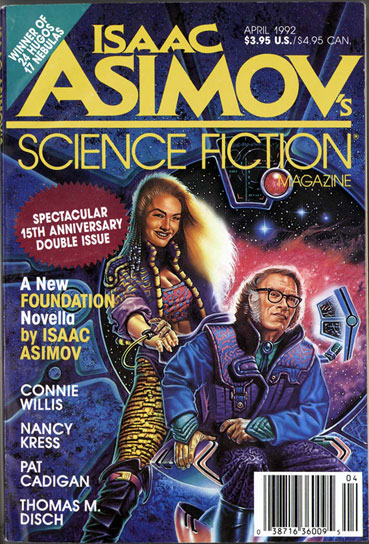
- “Protection” by Maureen F. McHugh. From the April 1992 issue of Asimov’s Science Fiction. McHugh’s level of acclaim is inversely proportional to how much she’s actually written. She’s written only four novels, the most recent of which, Nekropolis, was published way back in 2001, and which is an expansion of an earlier short story. Yet her debut novel, China Mountain Zhang, is regarded by critics as one of the best debut SF novels of the ’90s. “Protection” itself, published the same year, was nominated for multiple awards.
For the short stories:
- “The Night Wire” by H. F. Arnold. From the September 1926 issue of Weird Tales. This is a case of a story utterly dwarfing its creator, as “The Night Wire” has been reprinted many times over the past century, yet Arnold himself remains a totally obscure figure. We know his name was Henry Ferris Arnold and that he was born in 1902, and we can also infer he worked in news coverage.
- “The Barrow Troll” by David Drake. From the December 1975 issue of Whispers. Drake died a few years ago, leaving behind a long and surprisingly diverse body of work. He became most known as a pioneer of military SF, first with the story cycle Hammer’s Slammers and its sequels, but he also wrote more than his fair share of horror and dark fantasy, of which this is an example.
Come along and read with me.

