Who Goes There?
Alan Dean Foster made his writing debut 55 years ago, and has basically never stopped. If you know him at all, it’s as a prolific writer of film novelizations, that niche but apparently lucrative book market wherein the novelist writes a novel based on and expanding upon a film’s screenplay, to be publihed shortly after said film’s theatrical run. Foster has written some pretty famous novelizations, or rather novelizations of pretty famous movies, over the decades, including but not limited to Star Wars (initially credited to George Lucas alone), Alien, Aliens, The Thing (itself based on a novella, in what has to be an ouroboros-like situation), Star Trek (as in the 2009 movie), and many others. This is not even including Foster’s original novels, and even then we’re still not including novels Foster has written set in the Star Wars and Star Trek universes but which are not film/TV novelizations. Following his novelization of The Force Awakens, Foster sued Disney on the basis of the mouse corporation not paying Foster and other authors royalties for e-book sales, which he actually won. So, it’s safe to say Foster’s been making a decent living as a capable journeyman writer.
All this setup makes today’s story come off just a bit more uncharacteristic. Reading Foster’s introduction for Montezuma Strip, one sees him explain (albeit somewhat indirectly) the rationale for coming up with such a setting, and also why Foster would’ve written cyberpunk as someone who was very much not part of that clique in the ’80s. The Montezuma Strip is, as Foster tells us, an attempt to extrapulate what he calls “The Border” might be like in the future, both culturally and economically. As he says in the introduction, “I’ve tried to imagine what [The Border], stretching from the Pacific to the Gulf of Mexico, might be like in a hundred years, more or less.” One thing he does not explain in this introduction is why he had “Sanctuary” and other stories set in the Strip initially published under the pseudonym of James Lawson. It could be that Foster saw this small series as different enough from his usual shtick that he thought it pertinent to assign them a fake author. “Sanctuary” is a rough gem among classic cyberpunk, being at once a product of its time and rather forward-thinking.
Placing Coordinates
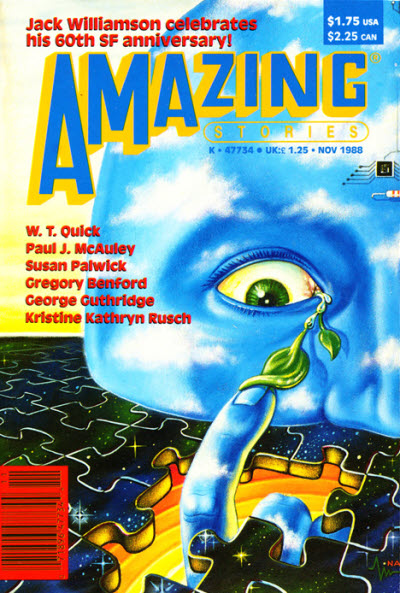
First published in the November 1988 issue of Amazing Stories. It was then reprinted in The Year’s Best Science Fiction: Sixth Annual Collection (ed. Gardner Dozois), as by Lawson. The only other time it’s been reprinted, and indeed the only time it’s been credited to Foster, is the collection Montezuma Strip. This is a bit strange, because I can easily think of worse stories that have been reprinted more frequently.
Enhancing Image
A couple things to take note of before going into the story proper: When picking what to review for this month, I was thinking of Asimov’s The Caves of Steel as the obligatory Noirvember pick, so “Sanctuary” also being an SF-detective story ended up being serendipitous. Also, more entertainingly, the “biographical info” we get about “James Lawson” in the introductory blurb is so obviously a load of shit, stating Lawson is a “government consultant,” “has done technical research for a well-known SF writer,” and that “he and his wife have dedicated themselves to raising six orphans of multiple ancestry.” Foster didn’t even try to come up with a plausible background for his pseudonym, and I think that’s pretty funny.
As for “Sanctuary,” we have a mystery that needs solving and just the right man for such a job. Angel Cardenas is a “Tex-Mex” police detective and a veteran of the force—so up there in years, actually, that he’s on the brink of retirement, whether he wants to be put out to pasture or not. Not only is he in his early fifties, which I guess in the world of “Sanctuary” means he’s a withered old geezer (truth be told, given his position and physicality I assumed he was about a decade older than he is), but he also got nearly killed in an arrest of a “ninloco” gone wrong some years ago, practically turning his face to jelly and forcing him to rely on Charliebo, his seeing-eye dog, for six years. (An uncanny detail about Cardenas is that for being Latino he has baby-blue eyes, which were taken from the otherwise totaled body of a teen girl.) Eventually through surgery and the aforementioned eye transplant, Cardenas regained his sight, but Charliebo stayed; what’s more, in the interum he had trained his other senses to near-supernatural acuity, eventually being what’s called an Intuit. An Intuit is basically someone who is unusually skilled in picking up vocal inflections and telling whether someone is lying. A disproportunate number of judges are Intuits. It’s also a very useful skill for a detective, although from what I recall the story doesn’t make that much use of Cardenas’s special ability—at least not in the way you would expect from a detective story.
For better or worse, Cardenas has at least one big case left in him, and it’s a strange one indeed. We have two murders that may or may not be related, both men being high-ranking designers (basically programmers) for rival companies. Wallace Crescent worked for GenDyne while Vladimir Noschek worked for Parabas SA. Two weeks ago, both men were “vacuumed” at virtually the same time, their bodies being rendered utterly braindead. The strange part is that their abodes didn’t appear to have been ransacked at all, and both bodies are in pristine condition, without any sign of outside interference. Crescent’s family has him on life support, but there’s really no point since his brain had been totally wiped; eventually they’ll have to admit defeat and bury or burn the body. Now, vacuuming, wiping someone’s brain, always leaves some trace of intrusion, but not here. The crime scenes are clean, so to speak. The only way to figure this all out would be to dig into the men’s files at their respective workplaces. On top of his trusty doggo buddy, Cardenas gets the help of Hypatia Spango, herself a senior designer at GenDyne: moody, single, in her early forties. Spango will serve as both Cardenas’s love interest (I don’t feel like I’m spoiling things when I say that) and the local Ms. Exposition.
“Sanctuary” has the unenviable task of both establishing the world of the Montezuma Strip and providing a compelling mystery, and it manages to do a surprisingly respectable job in both areas. Even with all stories combined, Montezuma Strip doesn’t quite clock in at just 250 pages, so this is a setting Foster didn’t see a need to return to very much. This is a bit of a shame, because the setting is pretty novel, being a depiction of life along the US-Mexico border in a future where technology is pretty advanced and yet wages are still pretty low. The borderline slave labor that fuels the Strip is, unfortunately, closer to real life than anything found in a William Gibson novel. There’s of course an ambivalence toward capitalism that comes less from Foster’s own worldview and more simply as a byproduct of the setting. I don’t wanna give the idea that “Sanctuary” is unusually “woke” or anything, because this is still a novella that paints policing in a rather positive light, but it pays more mind to the material conditions behind its characters’ lives than a lot of cyberpunk manages. There’s also the big twist regarding Crescent and Noschek that I can’t discuss in this section, but I’ll say now that despite not mentioning HIV/AIDS at all, “Sanctuary” gives the impression of having been written by someone who is sympathetic to AIDS victims and their horrific condition, if not someone who is himself queer. With this in mind, it’s a story that’s aged fairly well.
“Sanctuary” comes in at about 19,000 words, although despite this length not much actually happens in it and there aren’t many characters to consider. Of the heroic trio, one of them is a dog. Foster spends much of his wordage on worldbuilding as well as delving into the minutia of the weird way cyber-security works in his made-up future. Cardenas and Spango spend a lot of time talking to each other, to figure out what the now-dead designers could’ve been up to and also to form what eventually becomes a romantic relationship. Despite his age, the fact that he nearly got his face blown off, and also the fact that he has not been in a relationship in many years, Cardenas draws Spango to him like a lantern draws moths. The degree to which Spango all but instantly takes a liking to Cardenas does strain one’s suspension of disbelief a bit, but considering the story’s vintage and how such romance subplots tend to be written, it could be worse. Spango’s also shown to be competent and quite intelligent, hence her function as a guide for the not-very-tech-savvy Cardenas.
There Be Spoilers Here
Crescent and Noschek are dead, to begin with—only not entirely. For one, there wasn’t a double murder, but rather a double suicide, or at least it looks like suicide from the outside. Through means that are frankly too convoluted to recount here, Cardenas is able, after many hours, to gather that the designers were having a sort of covert long-distance relationship, which presented them a couple problems, not the least of these being that Noschek was married. Cardenas calls Noschek a “latent homosexual,” which is a term you don’t see often used nowadays, and which does date the story a bit; there’s also no mention of the possibility of Noschek having been bisexual, although in this specific case you could argue such a label would make a distinction without a difference. There’s also the problem of the big tech companies these guys worked for being prone to some institutional homophobia, which on the one hand sounds a bit far-fetched when viewed from [the current year]; but then given how techno-fascists are hogging the world’s capital (and, ya know, the water) whilst allowing the social media platforms they own to get flooded with hate speech, maybe it’s not that far-fetched. Now, brain-uploading has been a cyberpunk chestnut since even before the beginning, if you can believe it, what with pre-’80s cyberpunk-adjacent stuff like John Varley’s Eight Worlds series having it as a crucial part of the setting. I’ve seen it done many times before, but not quite in the way Foster pulls it off here, in which two lovers sacrifice their earthly bodies for a digital existence—not to cheat death, but rather to cheat life. The revelation here is bittersweet, but there’s more to it that I’d rather not go so far into, as I’d prefer you read it for yourself.
A Step Farther Out
A little over seventy years ago, Theodore Sturgeon wrote a story called “The World Well Lost.” It became one of his most famous and controversial stories, despite the fact that it first appeared in the second-rate magazine Universe. To spoil that story, the first twist is that the two aliens seeking refuge are in fact homosexual lovers, and the second (arguably harder-hitting) twist is that the human protagonist is himself a closeted gay man. It was really ahead of its time for 1953, even if it has that layer of ’50s genre pulp. Similarly, “Sanctuary” can be considered both in line with ’80s cyberpunk tropes whilst also depicting a star-crossed queer romance in a surprisingly sympathetic light. That we never get a single line of dialogue from either of the queer men at the story’s center, who after all are supposed to be “dead,” does little to diminish its profundity. Foster seemed to have gone out of his comfort zone with this one, enough to have it published under a pseudonym, but he really ought not to be ashamed of his work here at all. “Sanctuary” is an overlooked entry in the history of queer SF.
See you next time.

