-
Things Beyond: April 2026
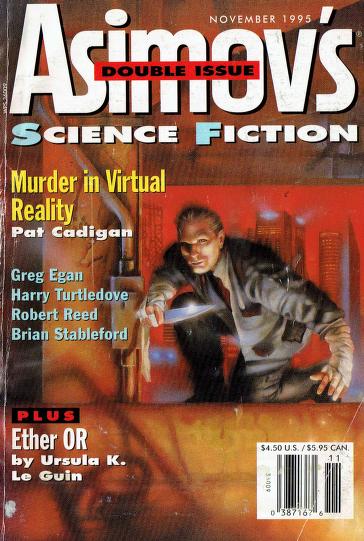
(Cover by Bruce Jensen. Asimov’s, November 1995.) March was a bit of a marathon here at SFF Remembrance, but truth be told I had more fun writing about that very old and dusty science fiction than in the past few months. I had been suffering from fatigue, along with some real-life stuff that was getting to me and making it hard to sleep at night. Now I feel somewhat rejuvinated. I feel good enough about reviewing stuff here again, in fact, that I’m bringing back the two-short-stories two-novellas deal, although I’m still keeping it to one serial for the month. The serial in question is a three-parter, being the first appearance of one of the most important SF novels ever written—and yet one that has been totally lost to the sands of time. You might find references to The Skylark of Space if you’re a Star Wars fan, as a point of trivia, since it was this novel that in part invented the space opera subgenre. Edmond Hamilton was writing space opera at shorter lengths around the same time Smith made his debut, but there was nothing on the scale of Smith’s novel before it. Smith “revised” it for its eventual book publication, removing co-author Le Hawkins Garby’s contributions, but we’ll be reading it as it appeared in Amazing Stories. This was a long time coming for me.
For the dates of stories, we’re looking at one from the 1920s, two from the 1950s, one from the 1960s, and one from the 1990s. Both of the stories from the ’50s are from the first half of that decade, which was an incredibly productive period for magazine SF.
For the serial:
- The Skylark of Space by E. E. Smith and Lee Hawkins Garby. Serialized in Amazing Stories, August to October 1928. When Smith studied chemistry at the University of Iowa, he didn’t think he would later become one of the pioneering authors of space opera. He didn’t even think he would write fiction, until he talked science fiction with Lee Hawkins Garby and her husband, who were friends from college. This was in 1915, before “science fiction” had even been coined as a label. The Skylark of Space took some years to gestate, but when it appeared in 1928 it made Smith a sensation among the then-niche SF readership. Garby’s contributions were later removed when the novel appeared belatedly in book form.
For the novellas:
- “Half-Past Eternity” by John D. MacDonald. From the July 1950 issue of Super Science Stories. Fans of classic crime fiction will be familiar with MacDonald, at least by reputation. His Travis McGee series is one of the most prolific and widely read detective series ever. In 1972 he was given the Grand Master Award by the Mystery Writers of America. He also wrote a good deal of SF from the late ’40s through the early ’50s, along with nearly every other genre.
- “Death in the Promised Land” by Pat Cadigan. From the November 1995 issue of Asimov’s Science Fiction. It was first published in the March 1995 issue of Omni, but that magazine had gone purely online by that point and the Asimov’s printing marked its first physical appearance. Cadigan is arguably the queen of cyberpunk, going back to the ’80s. She’s not as famous as William Gibson or Bruce Sterling, but she really should be more read than she is.
For the short stories:
- “Dumb Martian” by John Wyndham. From the July 1952 issue of Galaxy Science Fiction. It’s surprising to think that Wyndham had made his SF debut in the early ’30s. His career peak came later than it does with most authors, since he was deep in his forties when The Day of the Triffids was published. The ’50s were a great time to be John Wyndham, between his novels and short stories.
- “Timberline” by Brian W. Aldiss. From the September 1961 issue of The Magazine of Fantasy and Science Fiction. This is the fourth installment in Aldiss’s Hothouse series, which was then published as a novel. The series of stories, rather than the novel version, won Aldiss a Hugo, which was certainly a confusing move. It’s been almost a year since I reviewed the last Hothouse story, so here we go.
Hopefully you’ll be reading along with me.
-
Short Story Review: “Shifting Seas” by Stanley G. Weinbaum
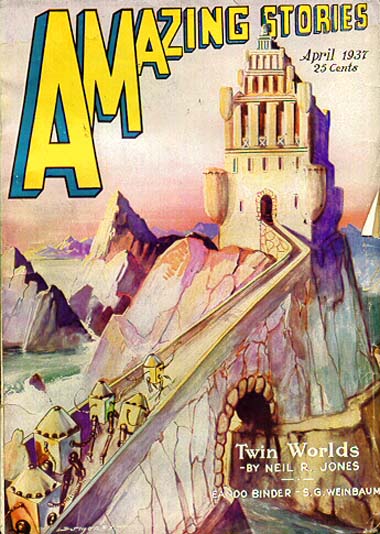
(Cover by Leo Morey. Amazing Stories, April 1937.) Who Goes There?
When Stanley G. Weinbaum died from cancer in December 1935, at the age of just 33, he was maybe the most beloved author in the field at the time, only rivaled by E. E. Smith and maybe John W. Campbell under his Don E. Stuart pseudonym. Certainly his rise to prominence was speedy and brilliant as could only have been challenged by Smith’s debut. Weinbaum made his own SF debut (he had written some non-genre work before this) with “A Martian Odyssey,” in the July 1934 issue of Wonder Stories, this one story basically rewriting the book on alien life in SF. With this story and its sequel, “Valley of Dreams,” Weinbaum became like a god to the niche world of magazine SF practically overnight. He wrote prolifically for the magazines, especially Astounding, over the next year or so, so that despite having been active in the field for a shockingly brief amount of time he had written a thick volume’s worth of short fiction. Reading Weinbaum now, he comes off as “quaint and quirky,” as Alexei Panshin put it in his review of The Best of Stanley G. Weinbaum; but there’s a childlike appeal to Weinbaum that serves as an alternative to the super-serious and downbeat SF that has saturated the market in the decades since his death.
Funnily enough, Weinbaum never appeared in Amazing Stories during his lifetime, presumably because even by 1935 it thoroughly played second fiddle to Astounding. I’m not sure when T. O’Conor Sloane got his hands on “Shifting Seas,” as while it took Sloane an infamously long time between him receiving a story and doing anything with it, I doubt Weinbaum himself had sent this story to this particular magazine. Several of Weinbaum’s stories, including a couple novels, were published after his death, but I’m not sure how his estate would’ve handled his work. The thing with Weinbaum is that his magazine stories can be more or less put into one of two categories, as either a contemporary “gadget” story or a space adventure having to do with exotic aliens. “Shifting Seas” is an outlier in that it doesn’t fit into either of these categories, but is instead a climate catastrophe story with a good dose of political intrigue. It’s interesting and a bit odd, but it’s certainly not what I would suggest for one’s first Weinbaum.
Placing Coordinates
First published in the April 1937 issue of Amazing Stories. It was first reprinted in the Weinbaum collection The Red Peri, and has since also appeared in the collections The Best of Stanley G. Weinbaum and A Martian Odyssey and Other Science Fiction Tales.
Enhancing Image
Ted Welling happens to be at the right place and at the right time, in the sense that he’s in the air, in a “Colquist gyro,” taking aerial photos when disaster his the isthmus connecting North and South America. Had he been on the ground when that lethal combo of earthquakes and volcanic activity hit, he would’ve died along with the million and a half people who ended up perishing. This incident, which is quite literally earth-shaking and would go down as one of the worst natural disasters of the 20th century, will have geological and even political implications in the long run. Even with his flying contraption, Ted barely makes it out of the whirlwind of smoke and ash, landing in Honduras (still a British colony at the time) and realizing that the strip of land, the isthmus, had sunk into the sea. The short-term consequences of this are apparent enough, but it’s only once the world’s attention has turned to this catastrophe and scientists have studied this literal sea change that an even bigger problem emerges. The sinking of the isthmus has changed the trajectory of the Gulf Stream, which, to make a long story short, spells very bad news for the British isles and mainland Europe. While North America will come out of this mostly unaffected, Europe is looking at a sort of ice age, to the extent that millions will die if they don’t evacuate. But to where? That is the main conflict.
There are actually two conflicts in “Shifting Seas,” but before I get to the second one, I wanna talk about the unusual politics and racism of this story. Something I think worth mentioning is that Weinbaum was white, but he was also Jewish, at a time when Jews in America (and Europe, it should go without saying) faced persecution on a systemic level. I think it was Sam Moskowitz who said Weinbaum was the first Jewish magazine SF writer to get published under his own name—a little factoid that’s pretty easy to take for granted now. There’s some racism in “Shifting Seas,” but I’m unsure how much of it is really just Weinbaum depicting the average WASP’s way of thinking or if it reflected his own racism. The deaths of over a million Hispanics at the story’s outset is treated by the white cast as bad, but not that bad, while, in the midst of discussing countries capable of housing European refugees, India’s dismissed as “hopelessly overcrowded.” The stereotype of India being a hive of unwashed masses and too many babies to feed goes back a long way. On the other hand, these countries of the third world are also counted as “civilized” by the third-person narrator, and for reasons that have since been totally lost to time, Japan is put on about the same level as the European empires. I assume this story is set in the 1930s, but that does raise some questions, like, How come no mention is made of the Nazis? Or Italy having turned fascist? Obviously Weinbaum would’ve been aware, which makes their absence all the more conspicious. Maybe this all takes place in a similar but alternate timeline.
Now, as for the love story, because there is one. The large-scale problem is with half of Europe freezing to death, but the small-scale problem is between Ted and Kay, his British wife-to-be. By the standards of ’30s SF, Kay is actually a well-drawn female character, if only because she isn’t helpless, nor is she hopelessly obsessed with her fiancé. She’s a fairly independent woman who unfortunately has been handed the worst of scenarios, seeing as how her home country and family there are facing extinction levels of crisis. She can marry Ted and stay in America, but that would be like a band-aid or splash of disinfectant on a gunshot wound. The crisis of immigration and moving some 200 million people, with countries’ allegiances changing in all this, understandably strains their relationship. Sure, Kay is highly emotional and says some rather strange things, especially as we reach the story’s climax, but it’s hard to blame her, given the circumstances. As for Ted, he—well, he exists. He’s a pretty vanilla pulp hero, although he’s by no means an action star. Hell, there’s not really any action in the conventional sense; instead it’s people talking in a bunch of rooms, plus passages about the worsening climate as if ripped from newspaper clippings. Of course, we’re not here for the characters, and even the romance drama between Ted and Kay is merely there to give us a more on-the-ground perspective of the larger conflict. Weinbaum is not very good at writing human characters: he’s better at describing places or aliens. We don’t get aliens here, but we do get a radically different version of life on Earth.
There Be Spoilers Here
Part of me was hoping there would be no easy solution, but Weinbaum, for better or worse, has a knack for meeting his strange SFnal problems with equally strange SFnal solutions. The ice age ravaging much of Europe ends up being short-lived, at least in the grand scheme of things. Indeed the issues of immigration and xenophobia that Weinbaum raises are way more intriguing than his playing with tectonic plates, ocean currents, and all that. “Shifting Seas” is a fine story, but it would’ve been even better had its author paid more attention to the real-world political issues he raises. Like how does Russia being communist (well, “communist”) relate to its treatment of refugees, or its hostile relationship with imperial Japan? The latter only gets mentioned in passing, and honestly you could read this story that was written circa 1935 and have no idea the USSR was a thing. Or Nazi Germany. The lack of a Nazi Germany or any mention of Hitler still strikes me as strange and inexplicable. I would’ve loved to get Weinbaum’s reasoning for these decisions, but not only has he been dead for almost a century, he was already dead when “Shifting Seas” was published. We don’t even have any interviews with Weinbaum; the only thing of real substance we have by him about himself is an autobiographical sketch.
Reading said sketch, which is included in A Martian Odyssey and Other Science Fiction Tales, Weinbaum comes off as well-read, shrewd, somewhat cynical, and quite intelligent. A passage that stuck out to me is the following, where Weinbaum talks about magazine SF:
[Science fiction] can criticize social, moral, technical, political, or intellectual conditions—or any others. It’s a weapon for intelligent writers, of which there are several, but they won’t practice its use.
Oh, a few have tried it. Dr. [David H.] Keller does it well occasionally, and Miles J. Breuer did it magnificently once or twice. Dr. Bell (John Taine) touches on it at times, but won’t descend to practical suggestions. And by far the most of this sort of writing, when couched in the usual form of satire, is heavy, obvious, and directed at unimportant targets. No one has attempted it on the scale of [Edward] Bellamy, who actually did criticize world social conditions in the form of a science fiction story, and presented a sort of solution.
“Shifting Seas” seems to criticize Europe’s xenophobic streak, and how said xenophobia (its collective persecution of Jews especially would’ve struck Weinbaum as no doubt concerning) might contribute to another war on that continent (something Weinbaum would be sort of right about, although he died years before World War II), but unfortunately it stays at the level of implication without much in the way of exploration. Even more unfortunate is the fact that while Weinbaum was prolific, he also died young, through no fault of his own, before he could hone his craft much. He wrote SF professionally for only a couple years, so that if anything “Shifting Seas” reads like a rough draft of a more ambitious and mature work we never got to see. The solution here is too clean, given how messy the problem is, which indicates a talent that’s promising but still in need of failures and trials. We never got to see that with Weinbaum.
A Step Farther Out
If “Shifting Seas” commits a huge sin at all, it’s that it doesn’t show Weinbaum quite in his natural habitat. What made Weinbaum so unique among his peers was that he wrote aliens who could think and act as well as humans, but who were decidedly not human in any recognizable sense. Or in his less serious stories, those set on Earth, he introduces a nifty gadget or puts a new spin on an idea that went back to H. G. Wells. Jack Williamson or Edmond Hamilton could probably not have written “A Martian Odyssey” or “The Lotus Eaters,” but a Williamson or Hamilton could have feasibly written “Shifting Seas.” As such, this is an outlier both in its subject matter and where it was first published. Maybe the next time I write about Weinbaum I’ll do something more in-character for him.
See you next time.
-
Short Story Review: “Devolution” by Edmond Hamilton
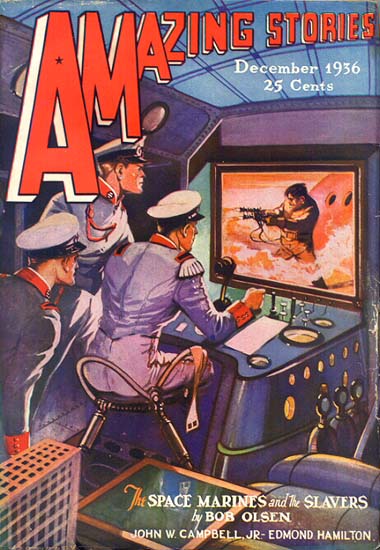
(Cover by Leo Morey. Amazing Stories, December 1936.) Who Goes There?
I have to admit, I fucked up. I was supposed to write about Leslie F. Stone’s “The Human Pets of Mars” for today, except I realized that it was too long to cover as a short story. It’s actually a short novella, and for some reason I had assumed it was shorter. A replacement would have to do. Fret not, I’ll be writing about Leslie F. Stone in the not-too-distant future. I figured that instead I should go for something “safe,” maybe something I’ve read before but haven’t in a while. I was then reminded of Edmond Hamilton’s “Devolution,” which I know for a fact I’ve read before, because it’s in the Orson Scott Card anthology Masterpieces: The Best Science Fiction of the Century. Incidentally this is a story with a similar premise to George Allan England’s “The Thing from—’Outside’,” but with a different tone and quite a different ending. Of course, it makes sense to cover Edmond Hamilton in a marathon of pre-Campbell magazine SF, since he was one of that era’s major architects, made even more sensible as he stayed clear of Astounding and found Campbell too picky an editor.
Hamilton was in 1904, in Ohio, although he later moved to Pennsylvania and then finally California. He made his debut young, in the August 1926 issue of Weird Tales, when he was just 21. He stayed committed to Weird Tales even into the post-war years, when that magazine’s popularity was waning, and he was probably its most consistent contributor of SF. Some of Hamilton’s SF was tinged with horror, whether it appeared in Weird Tales or not, in those pre-war years. Some of his early work also codified the space oprea subgenre, alongside the work of E. E. Smith. But while Smith took his space action to greater heights and longer lengths, Hamilton was easily the more capable writer. By 1950, Hamilton had matured into a thoughtful and pretty reliable writer, while Smith was respected as a relic of a bygone age. “Devolution” is pulpier than Hamilton’s later work, for sure, but it also shows a darkness and pessimism regarding the human condition that would appear much later in a more refined style.
Placing Coordinates
First published in the December 1936 issue of Amazing Stories. I actually have two reprints of this story in my library somewhere, Before the Golden Age (ed. Isaac Asimov) and Masterpieces: The Best Science Fiction of the Century (ed. Orson Scott Card). “Devolution” also has the honor of being reprinted in Amazing Stories as a “classic” more than once, in the April 1961 issue and then in the May 1979 issue.
Enhancimg Image
Ross, an aviator who claims to have seen some very strange creatures in the French-Canadian wilderness, had brought along Gray and Woodin, a couple biologists, with him for this expedition. But it’s been four days of camping and canoeing and so far nothing on these jellyfish-like creatures Ross says he saw from the air one day. Contrary to how the story starts and whose POV we get at first, Ross is not the protagonist here; indeed, him being framed as such is kind of a red herring. Instead the protagonist is Woodin, the older and more even-tempered of the biologists. Not that these three men are all that different from each other in their personalities, but the subversion of the pilot-adventurer not ultimately being the “hero” of the story is the first of a few ways in which Hamilton goes against what would’ve been pulp reader expectations. The setting, a forest in Quebec, also seems ripe for adventure, but ultimately this is not an adventure narrative, as there won’t be much in the way of action. The England story I mentioned involves a similar setting, along with an encounter with an all-powerful alien force, but Hamilton goes in a different direction. When the aliens here do show themselves one night, Woodin’s in for quite a surprise.
“Devolution” plays with a couple super-science ideas that were making the rounds in the ’30s, and which in fact Hamilton had played with before. The first is the notion that evolution of life on Earth got kickstarted because of radiation, which we know now is very much not true. Hamilton had used this evolution-via-radiation idea in an earlier story, “The Man Who Evolved.” This was all in the pre-war years, when atomic weapons were purely theoretical and SF writers took it upon themselves to devise some strange and implausible uses for radioactive elements. (You may recall that Jack Williamson’s take on radiation’s effect on the human body, in “The Metal Man,” was even more outlandish.) Another super-science idea that would end up having a longer shelf life is the notion of “ancestral memory,” in which the human brain can be plundered for locked-away memories, not just of past human lives but those of organisms predating mankind. The aliens in “Devolution” just so happen to have an easy way of diving into Woodin’s ancestral memories, but more on that in a minute. It’s easier for a modern reader to understand at least the narrative appeal of the latter concept, if not the “science” behind it. “Devolution” deliberately goes against the narrative of Darwinian evolution—yet the alternative it presents is a far cry from what we call Intelligent Design.
Woodin is awakened to find Ross and Gray dead—killed by a group of blobular aliens. These aliens, who call themselves Arctarians, are a salvage team who have come to Earth in search of the fate of some colonists who had come here billions of years ago. The Arktarians are flabby and physically unimposing, but they’re exceedingly intelligent, with enough brain power that they can kill a man (as they just did) with a mere thought. Ross and Gray tried using their guns against the aliens, in a moment of blind fear, but it was no use. The aliens had merely acted in self-defense, for they belief aggression is beneath them. In a way the Arktarians are like Vulcans, but blobular instead of humanoid, with reason and mindfulness having top priority in their culture; at the same time they’re like so many energy beings we find in Star Trek, who have the powers of demi-gods. They can even communicate with Woodin telepathically with ease, which is how we get a massive exposition dump on where the Arktarians came from and why they’re here. There’s also the so-far unanswered question of what had become of those Arktarian colonists, which can only be answered by unlocking Woodin’s ancestral memories. The Arktarians find that Woodin, despite being a scientist and a reasonable man, is stupid and small-brained enough that they can crack his mind open easily.
As you can tell, the outlook of this story is decidedly grim. In fact it wouldn’t be out of place for an H. P. Lovecraft story, and that’s before we even get to the big twist, which itself is rather Lovecraftian. While the Arktarians talk and act in such a way that they may well be super-smart humanoids (think again of Vulcans), they certainly don’t look human at all. They also take Woodin’s wellbeing into account only insofar as his ancestral memories would prove useful to them, for they think very little of having killed his colleagues. Indeed, they think of humans like how we think of mice and other animals in a testing lab. Such an intelligent and competent alien race would surely have a hard time appearing in the pages of Campbell’s Astounding some years later, at least without facing the wrath of an even more competent and ingenious human race. Yet it was not that unusual to find alien races in pre-Campbell magazine SF that were so much more advanced than mankind that we’d struggle to comprehend them. This is all well and good, but the twist Hamilton goes for, while maybe appearing obvious to the reader by now, pushes things over the edge, thus making “Devolution” a memorable story.
There Be Spoilers Here
Digging into Woodin’s mind, we discover that billions of years ago, when Earth was just another rock in the midst of black space, a group of Arktarian colonists had come to our planet, after their homeworld had become degraded. Unfortunately, radioactive materials in Earth’s makeup had a slow-burning degenerative effect on the colonists’ biology. The impact wasn’t immediately, but over the case of many generations and millennia, the super-intelligent and bodily weak aliens’ descendants became dumber and less mentally capable, while at the same time becoming physically adaptive to our planet’s unforgiving climate. Unicellular organisms became multicellular, then these invertebrates formed skeletons and even started crawling onto dry land. Amphibians, then reptiles, then mammals. Evolution, but not as we know it. By the time homo sapiens came around, the brain power the Arktarians possessed had been practically extinguished, giving way to a violent and savage race of primates. Yes, mankind is a distant descendant of these boneless and limbless aliens. The realization disgusts the team of alien explorers, compelling them to abandon both Woodin and Earth as a whole. Our planet, as far as they’re concerned, is uninhabitable. The knowledge that not only is he related to these aliens but is considered a genetic failure by them drives Woodin to suicide.
A shared assumption of both many religious people and those who idolize the hard sciences, albeit for different reasons, is that mankind is the logical end point of a long game regarding life on Earth. For better or worse, homo sapiens is capable of “special” things—things even our closest relatives and ancestors could scarcely begin to fathom. Hamilton, in “Devolution,” posits that mankind might represent an end point after all—just such in a way that means bad news for us. The twist rejects both the implied divinity given to mankind in Intelligent Design and the evolutionary exceptionalism put out by champions of Darwinian evolution. Rather, this is a misanthropic story whose darkness is only cushioned by the awkwardness and weigthy exposition of Hamilton’s style. If James Tiptree, Jr. taken the same premise, plot, whole thing, but recreated it in her image, it would surely be one of the bleakest stories in all of SF. The big reveal even echoes that of Lovecraft’s more famous “The Rats in the Walls.”
A Step Farther Out
In his afterword to Hamilton’s story in Before the Golden Age, Isaac Asimov writes about how teenage him had been impressed by “Devolution,” especially its ending. He writes:
On the whole, I am an optimistic writer, and my heroes generally win out in the end and the world is saved. Yet, for years I had noticed that stories with sad endings, or ironical ones, or paradoxical ones struck me harder than those with conventionally happy ones, and stayed with me longer.
And, every once in a while, it seemed to me that the downbeat was better and was even necessary in my own usually upbeat stories. It was remembering stories like “Devolution” that gave me the courage to try such endings.
Hamilton took a cosmic horror premise, gave it a super-science rationale, and then proceeded to put a little twist on it. Why it stayed out of print for 25 years before appearing in Amazing Stories once again, I’m not sure. It could be that while “Devolution” might’ve gone well with readers had it appeared in Weird Tales, where downer endings are not uncommon, more would’ve appreciated it initially; but in Amazing Stories, the more scientific and optimistic magazine, readers would espect solutions to problems. While Hamilton was no stranger to resorting to formula (he was, after all, the chief creative force behind Captain Future), he was more versatile and had a darker view of the world than most of his peers.
See you next time.
-
Short Story Review: “The Lost Language” by David H. Keller
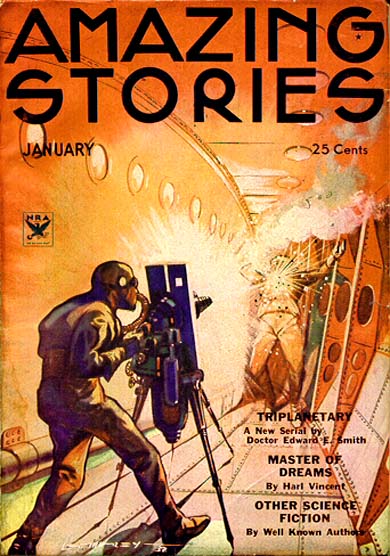
(Cover by Leo Morey. Amazing Stories, January 1934.) Who Goes There?
David H. Keller was one of the oldest authors to have started writing in the field at the time Hugo Gernsback launched Amazing Stories. He was born in 1880, in Philadelphia, and long before he started writing genre fiction he was already a trained physician with an MD, having studied at U Penn. The most formative of Keller’s experiences as a doctor seemed to have been serving in the Army Medical Corps in World War I (like his contemporary and fellow doctor-writer Miles J. Breuer), where he treated that generation of American soldiers suffering from what was called shell shock. He later rejoined the Army Medical Corps for WWII. First-hand experience with the horrible aftermath of a new kind of warfare had a profound effect on Keller’s view of the world, which by several accounts became very pessimistic and reactionary. When he got to writing fiction, as a thing to do on the side, he contributed prolifically to both Amazing Stories and Weird Tales, his SF often having a dark side to it, or in many cases he simply wrote horror. While Keller remained somewhat active when John W. Campbell took over Astounding and reshaped the field in his image to an extent, he remains an artifact of the pre-Campbell years.
Strangely enough, “The Lost Language” does not have the roughness or scare factor of a typical Keller story; on the contrary, it’s quite humane by his standards. Keller’s work as a doctor (especially as a psychiatrist) informs the premise of a boy who grows up forming his own unique language. The story’s sympathetic depiction of a neurodivergent child, while rooted in an SFnal premise, will resonate with modern readers a lot more than so many other SF stories about similar cases, even some written decades after Keller’s. It’s sort of a hidden gem, and has aged pretty well.
Placing Coordinates
First published in the January 1934 issue of Amazing Stories. It wasn’t reprinted at all until the July 1971 issue of Amazing Stories, 37 years later. It also appeared in Science Fiction of the Thirties (ed. Damon Knight) and Young Mutants (ed. Isaac Asimov, Martin H. Greenberg, and Charles G. Waugh). Not that Keller’s stories have been reprinted all that often generally, but “The Lost Language” might’ve been especially neglected on account of lacking Keller’s trademark tinge of horror.
Enhancing Image
David Phillips III is the first boy of David Phillips, Jr. and his wife, after having had three daughters. This was a joyoud occasion, but gradually things soured for the family, since by four years old little David would say a single word. Not even a grunt or whine of displeasure. “Even when he was four they would not admit that he could not,—because all of his relatives, even some of the physicians they consulted, were sure that he could talk if he wanted to.” He was not “mentally deficient,” in fact he otherwise grows up as a bright and healthy boy, able even to take care of himself and be more self-sufficient than a lot of kids his age—except he will not talk. By age five it’s clear to the adults that this is a problem, and a rather unique one. Now, for those of us who are autistic or more generally neurodivergent, it’s not so strange to have grown up not learning or for some reason not choosing to talk until you were of kindergarten age. Maybe your parents took you to a speech therapist, like mine did. Think of all the ways autistic people continue to be discriminated against, in everyday conversation and even on a systemic level, and think about how Keller wrote his story nearly a century ago. Consider how much worse the mental health profession and how less empathetic it would’ve been in those days. The good news is that David’s parents are both patient and wealthy; had David grown up in a working-class family there’s a good chance he would’ve been locked in a cage.
“The Lost Language” is as much about the life of an autistic child as it is about language—how language forms and how the first speakers of a language might feel alienated from their fellows. The only way Daniel communicates with others is through a language of his own invention, this being an entirely written language with no oral component. Soon because something of an international attraction and language specialists from around the world drive or fly thousands of miles to see the boy at work, in a vain effort to understand him. As one specialist says, Daniel’s way of forming language is backwards from how it has historically been done, in that he has developed a language without any sound involved.
To quote said specialist:
“For centuries the human race has communicated with each other, first by sounds, and later by writing. Writing is simply a mode of sound. I admit that people learn to read silently, but even then they transpose the typed symbols into sounds subconsciously and thus obtain the meaning of the printed line and page. The dot and dash of the Morse code simply replaces letters which, in proper combination, have definite sounds, and those sounds for centuries have had definite meaning. This boy forms his own symbols. There is no doubt they mean definite things to him. You have shown me that, and my experiments with him have convinced me that you are right. But his refusal to adopt the symbols of the herd, to learn the alphabet, to follow the lines of communication used by his ancestors and his associates, stamps him at once as abnormal.”
David’s mother rushes to explain that the boy is strange, but he’s certainly not “feebleminded.” This is true enough, but for “the herd” that is society “abnormal” and “feebleminded” amount to the same thing. When David grows up he will be a curiosity for others at best. Because he doesn’t share a common language with the rest of mankind, and refuses to learn, he’ll always be an outcast. And yet, the language he does have turns out to be internally consistent. He has words (or rather symbols) for specific things. He can write “I want an egg,” which granted is a simple sentence, in his language. With time and effort, someone can learn to understand this language. But still, it has no oral equivalent. David and his father end up traveling to London to meet with an inventor, who had already created the “vibrowriter,” a speech-to-text machine. (This is, of course, something your smartphone can do with ease.) The idea is that if human speech can be translated to text, then maybe the reverse is also possible. If David were to have a special typewriter built for his set of symbols, then…
This is all conveyed in a style that strikes me as a mix of documentary-like and akin to a fable. Most of the characters are given names, but their names are mostly incidental; what really matters is the roles they play, in relation to David as either professionals or family members. The style writers often used in pulp SF at the time was of the sensationalist kind, with exclamation points and lots of active voice. The emphasis tends to be on action. Yet there is no action or adventure in “The Lost Language.” There’s not even much of a sense of wonder for Keller to invoke. It reads, in a way, like a much more modern SF story, being focused on an innocuous scientific anomaly—one which at least sounds plausible. There are no world-ending stakes, or even stakes other than on the emotional level for a single family. The years pass, and one of David’s sisters even trains to become a psychologist, “because she loved her little brother.” Ultimately it’s a story about the adults in David’s life wanting to understand him, despite the instinctive urge to cast him out as an “abnormal.” This is incredibly refreshing coming from a story that’s now over ninety years old, more so because Keller doesn’t seem like the kind of person to write something so empathetic.
There Be Spoilers Here
One of the scientists studying David’s language claims it might have something in common with an old and niche Welsh dialect, that Granny Lanarch, an old lady in Wales, would know. Unfortunately when David and his father arrive in Wales, they learn Granny Lanarch is dead—has been dead for a couple years, in fact. The one key to finding an shared lineage for David’s language is gone. There is no surprise victory. “The good guys” do not win in this instance, although Keller assures us this is not much of a loss ultimately, since the aforementioned sister wants to dedicate her work to understanding her brother’s language. For no other reason than that she loves him and doesn’t want to see him totally on his own in the world. The ending is anti-climactic, seemingly by design, but I don’t mind it at all. For once there is no miraculous solution to the characters’ problems, with science treating but not curing the malady.
A Step Farther Out
Truth be told, I may have read this one before, in Damon Knight’s book Science Fiction of the Thirties. I do have that on my shelf, and I certainly remember seeing “The Lost Language” in its pages, complete with Leo Morey’s interior that came with its original appearance. I don’t remember if I had read start-to-finish before, but I’ll certainly remember this reading of it. “The Lost Language” is an example of how pre-Campbell magazine SF wasn’t all spaceships and rayguns, even if a lot of it was that. There’s some 1930s super-science stuff here, but it’s grounded in a world that’s otherwise pretty similar to ours. This was one of Keller’s last notable stories before he stepped away from writing SF for the most part, which is a shame. I’ll be reviewing more of his work at some point.
See you next time.
-
Short Story Review: “Omega” by Amelia Reynolds Long

(Cover by Leo Morey. Amazing Stories, July 1932.) Who Goes There?
Both Wikipedia and the SF Encyclopedia have little to say about Amelia Reynolds Long. She apparently lived a long but quiet life, born and died in Pennsylvania. She lived her whole adult life in Harrisburg, specifically. She got both her BA and MA from U Penn, and incidentally she earned her MA the same year “Omega” was published. Long was part of that first generation of women to write for the genre magazines, and along with Clare Winger Harris she had her work published under her full name. She wrote short SF somewhat prolifically from the late 1920s through much of the ’30s, but by the ’40s she turned away from SF to focus on writing mystery fiction. ISFDB is very useful for tracking authors’ writings, for the most part, but the folks in charge tend to neglect listing non-genre works, even with there being a non-genre section. Long stopped writing mystery fiction in the early ’50s to focus on writing poetry and editing textbooks. “Omega” is a pulpy but somewhat prescient SF-horror tale, seemingly written in homage to Edgar Allan Poe but with that touch of 1930s super-science that dominated the field until the tail end of the decade. Long challenged herself by telling a story of the last days of mankind without using time travel.
Placing Coordinates
First published in the July 1932 issue of Amazing Stories. It’s been reprinted in Avon Fantasy Reader No. 10 (ed. Donald Wollheim), Amazing Science Fiction Anthology: The Wonder Years 1926-1935 (ed. Martin H. Greenberg), and Beyond Time: Classic Tales of Time Unwound (ed. Mike Ashley). Sorry, it doesn’t seem to be public domain yet.
Enhancing Image
Professor Michael Claybridge is giving us a testimony of a pretty unusual event, that being an experiment in which a man, under hypnotic suggestion, took on the persona of the last man to live on Earth—tens of thousands of years in the future. This was an experiment conducted by a friend and colleague of Claybridge’s, Professor Mortimer, and the subject was a man named Williams. From hereon I’ll be summarizing the plot in the present tense, but we can gather from Claybridge’s tone and choice of words in the beginning that this experiment was successful—maybe too successful. The session is a way to test what Mortimer calls “mental time,” his theory that there are two ways in which we understand time: materially and mentally. More importantly, he argues that the latter is just as legitimate and has as much bearing on human perception as material time. Mortimer had already tested this on a willing subject who claimed to have experienced life in the time of Napoleon, but Claybridge is understandably skeptical about this. It’s one thing to claim to have lived, for a moment in your mind’s eye, in a different country a century ago, but what about the future? What about the end of the world as we know it?
People who know their classic horror should immediately think of Poe’s “The Facts in the Case of M. Valdemar,” which on top of being horror is also arguably an example of proto-SF. Hugo Gernsback certainly thought so, even printing it in the inaugural issue of Amazing Stories. Both “The Facts in the Case of M. Valdemar” and “Omega” are examples of SF having to do with hypnotism, or mesmerism as it’s also called, a topic that doesn’t come up so much nowadays but which can be considered a soft science. Hypnotism tends to be written off these days as pseudo-science rather than soft science, not helped because its most prominent influence on the real world in living memory is its connection with Dianetics and the Church of Scientology. Indeed, what Mortimer’s been testing with “mental time” sounds like a more inoccuous precursor to what L. Ron Hubbard and his followers would be doing just a few decades later. Going back to Poe’s story, that one has to do with the titular Valdemar, an old man, who is put under hypnosis while on his deathbed, with the results being disconcerting, to say the least. Williams, a man who is on the run from the law on account of murder, but who is unable to kill himself despite a guilty conscience since his religion “forbids suicide,” signs up for Mortimer’s experiment.
Mortimer (rightly) suspects the experiment, like in Poe’s story, will go sideways somehow, so he has Williams sign a waver and with a hefty cash reward of $5,000. Where Mortimer got the money from, I’m not sure, especially this supposed to be in 1926 (when the story is set) dollars. You may also be wondering how Claybridge contributes to this experiment: he doesn’t really. Well, on a metatextual level Claybridge is there so that we have a “grounded” and journalistic viewpoint on what sounds like a bunch of quackery. In-story the justification is that despite his better instincts he’s become morbidly curious about what Williams might say while under hypnosis. The scene of the action is a room that’s been cleared out for this purpose, described as follows:
It was windowless, with only a skylight in the ceiling to admit light and air. Aside from the chair in which Williams sat, there was no furniture save an instrument resembling an immense telephone transmitter that a crane arm held about two inches from the hypnotized man’s mouth, and a set of ear phones, such as a telephone operator wears, which were attached to his ears. But strangest of all, the walls, floors, and ceiling of the room were lined with a whitish metal.
Basically we have a white metallic cube with only a skylight for air and light, said skylight figuring into the story’s ending. While under hypnosis Williams is made to recount the last six days (in “Biblical time,” as in Genesis) of life on Earth, from the perspective of man—not any specific man, but sort of the inverse of ancestral memory. In a voice that isn’t his own, Williams gives us the story of the last days of mankind, and a planet that has gone very hot and very wet, before finally the seas dry up and the last lifeforms on Earth wither. For the record, as someone who’s read Genesis a couple days, I’m not really sure what Mortimer means by this way of keeping time. There’s material time and mental time, but then there’s Biblical time. If you’ve read even a few books from the Old Testaments, the unknown authors of these books had some pretty funny ideas about how time works. Anyway, we’re given a tour of life, more than 40,000 years into the future. It’s here that Claybridge as both narrator and character evaporates, to say nothing of Mortimer and Williams, as the story turns away from plot and even character to focus on what I have to think is honest speculation.
There was some dying earth SF prior to “Omega,” albeit not a lot of it. Pretty memorably the hero of H. G. Wells’s The Time Machine travels millions of years into the future in the climax of that novella, to find an Earth that’s become all but inhospitable. There was also William Hope Hodgson’s The Night Land, from 1912, which itself would prove quite influential on science fiction and fantasy about Earth in its twilight years, not least of them being Jack Vance’s own The Dying Earth. Long’s way of getting around having to send her characters forward in time in order to give us a glimpse of Earth in such a state also anticipates John W. Campbell’s “Twilight,” which has been reprinted far more often and is in some ways the less dated story. Campbell’s technique is more fluid and “mature” than Long’s, although it must be said Long’s story doesn’t have the unfortunate bits of anti-black racism that crop up in “Twilight.” This is a nice way of saying “Omega” now reads as stilted and rather basic, although it would not been taken as such in 1932. The dialogue especially can be hard to stomach now, but that part mostly goes out the window once Williams tells his story.
There Be Spoilers Here
Not only does Williams feel psychological agony from the hell of Earth’s distant future, but Mortimer isn’t even able to pull him fully out of his hypnotic state. Much like how poor Valdemar is able to keep talking even after death (sorry for spoilering a story that came out 180 years ago), Williams is unable to break out of this “last man” persona. Things go from bad to worse when on “the sixth day” something totally unexplainable happens: as Williams’s persona dies, the man himself seems to get atomized, with only his charred clothes remaining. The skylight from above killed Williams like how sunlight typically kills a vampire. Well, at least those $5,000 would presumably go to his sister.
A Step Farther Out
By the time “Omega” was published, Amazing Stories was no longer the top dog in the small world of magazine SF. Hell, Astounding was a couple years away still from holding that title. Keeping in mind that we’re reading a story from a magazine that had gone from being a pioneer to second-rate in just a handful of years, “Omega” ain’t half bad. It’s simple, and ultimately isn’t trying to say anything all that meaningful about the future of mankind, but its simplicity and egalitarian attitude are to its credit. I said before that Campbell’s “Twilight” takes a similar premise and executes it perhaps more memorably (readers certainly thought that was the case), but “Omega” doesn’t have that certain awkwardness of Campbell’s story which makes it hard to recommend these days.
See you next time.
-
Short Story Review: “The Gostak and the Doshes” by Miles J. Breuer
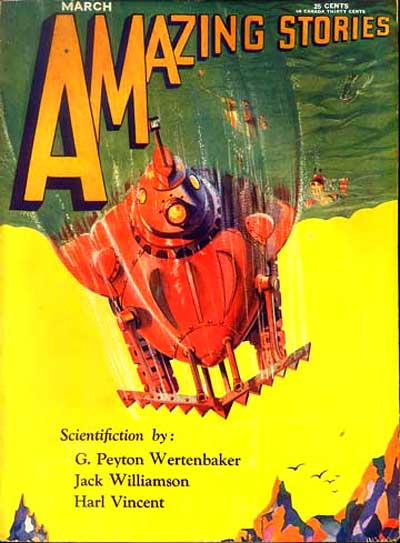
(Cover by Leo Morey. Amazing Stories, March 1930.) Who Goes There?
Miles J. Breuer was born in Chicago in 1889, to Czech immigrants. It’s worth noting that quite a few people involved in the early days of Amazing Stories were either immigrants (Hugo Gernsback was from Luxemburg, Frank R. Paul from what was then the Austro-Hungarian empire) or the children of immigrants. Breuer even wrote for Czech-language publications in the US. But first and foremost he worked to become a medical doctor, earning his MD (a degree that got stapled to his name in bylines) and running an office alongside his father. During the not quite two years America was involved in World War I, Breuer went to France as part of the Army Medical Corpse, where presumably he would’ve encountered in soldiers what soon became known as shell shock. Once the war ended he returned home and once again became a regular physician. Breuer didn’t start writing science fiction until nearly a decade after the war’s end, and even then he didn’t write much SF: only one solo novel, plus a couple dozen or so short stories. It’s clear that writing SF was just a side gig for him, as he had a demanding but well-paying day job. He wrote most of these stories in the late ’20s and early ’30s, before dying at just 56 in 1945.
“The Gostak and the Doshes” might be Breuer’s most reprinted story, and with good reason. This is a bit of a rough gem. It’s the finest story I’ve reviewed this month so far. It’s pretty clearly inspired by H. G. Wells, who after all appeared regularly in Amazing Stories and whose work served as a template for the kind of SF Gernsback wanted to print. This is a story about language, being one of the very first American SF stories to tackle linguistics, but it’s also about the frequent meaninglessness of war, having been written in the wake of America’s pointless involvement in WWI. The point Breuer makes is unfortunately still relevant.
Placing Coordinates
First published in the March 1930 issue of Amazing Stories. It’s since been reprinted in Avon Fantasy Reader No. 10 (ed. Donald Wollheim), Science Fiction Adventures in Dimension (ed. Groff Conklin), Great Science Fiction by Scientists (ed. Groff Conklin), The Arbor House Treasury of Science Fiction Masterpieces (ed. Martin H. Greenberg and Robert Silverberg), Amazing Stories: 60 Years of the Best Science Fiction (ed. Isaac Asimov and Martin H. Greenberg), and A Sense of Wonder: A Century of Science Fiction (ed. Leigh Ronald Grossman). Since it’s in the public domain you can also find it on Project Gutenberg and Wikisource.
Enhancing Image
“The Gostak and the Doshes” is a parallel-universe story rooted in subjectivity and language, in which one is able to traverse between universes along a fourth axis. A recurring phrase that will become very relevant here is the nonsensical sentence “The gostak distims the doshes.” You may be thinking, “What’s a gostak? What the hell is a dosh? What does it mean to ‘distim’ something?” The narrator of Breuer’s story wonders the same thing. I was surprised to find this is not a sentence of Breuer’s invention, and that the book he cites at the beginning was a real book on linguistics: The Meaning of Meaning, by Charles Kay Ogden and Ivor Armstrong Richards, published in 1923. The quote actually comes from Andrew Ingraham, who’s uncredited in the story, and the saying goes like this:
Let the reader suppose that somebody states: “The gostak distims the doshes.” You do not know what this means, nor do I. But if we assume that it is English, we know that the doshes are distimmed by the gostak. We know that one distimmer of the doshes is a gostak. If, moreover, doshes are galloons, we know that some galloons are distimmed by the gostak. And so we may go on, and so we often do go on.
The idea is that while we can infer the syntax of a sentence, the subject, object, etc., this does not bring us any closer to the inherent meanings of the words included. You can say “The gastok distims the doshes” or “The doshes are distimmed by the gastok,” but you still won’t know what the hell it means. Indeed, these are made-up words. Words lacking a definition we can attribute to them, or a picture we can point to, sounds like a bit of a stretch, but remember that the flavor-of-the-month “6 7” joke does not seem to have an origin or inherent meaning either. It sort of just is. This is something the narrator finds out the hard way.
Anyway, the narrator (I don’t recall us getting his name) is a college professor who’s chatting with Woleshensky, an eccentric colleague. Woleshensky has a hypothesis that has to do with being able to travel across universe, or rather to make it so that our universe appears fundamentally different to us, by toying with what he calls the x, y, z and t axes. The t axis in particular will prove useful for this purpose, replacing the z axis with it. The trick is not to change the universe around us, but our perception of it. It boils down to a way of thinking. The introductory scene in which Woleshensky lectures his friend on his hypothesis is a bit long-winded, but it’s necessary to set this all up so that we can get to the good stuff.
Our hapless protagonist decides to put Woleshensky’s idea to the test, which it turns out isn’t even that hard to do. This dimension-hopping would be called an example of psi powers, had “The Gostak and the Doshes” been published a decade later. In the blink of an eye the narrator finds himself in a different college campus, which seems recognizable enough, except that the architecture is said to be of Victorian rather than modern design. (I assume “modern” by 1920s standards.) Everything seems to have gotten more dated, as if the narrator had gone back in time a few decades; but no, this still looks like the present day, just different. Luckily, to the point where it does strain plausibility a bit, it’s easy for him to find someone who speaks perfectly good English, and just as quickly to find a professor on-site who manages to take his problem seriously. Viben is this universe’s equivalent of Woleshensky, and he becomes the narrator’s biggest ally on this side of the dimension shenanigans. The problem is simple: How the hell does the narrator get back to where he belongs?
It takes him several months to even begin answering that question. Life in this alternate universe is too good for him. Not only does he make a few friends, including John, a young man working in life insurance, but he even lands a job on the campus where he had arrived rather easily. He notes that society here is maybe more similar than different from where he had come from, although there’s an “old-fashioned” sensibility about everything. There are automobiles, but horses have not yet gone out of fashion, and even John, a well-paid man, drives “a little squat car with tall wheels, run by a spluttering gasoline motor.” It’s possible this is a version of early 20th century America where Henry Ford hadn’t revolutionized the auto industry. The Model T is never mentioned, and presumably doesn’t exist here. From what we’re told this seems like if the Gilded Age of the 1890s lasted longer than it did in our universe—for both good and ill. For someone with a conservative (in the sense of not liking systemic change) sensibility, like our narrator seems to have, this all sounds well and good.
But that sentence said at the beginning, “The gostak distims the doshes,” comes back, this time in big bold letters. The narrator hears it first on campus, and then when he’s having dinner with John and his family the young man exclaims it like a slogan that’s gotten stuck in his head. A newspaper headline reads, “THE GOSTAK DISTIMS THE DOSHES.” The narrator can gather from contaxt that this sentence is meant to inspire patriotic fervor, something pro-American, or conversely as a declaration of aggression against a perceived enemy. Patriotic pro-war slogans were not a new phenomenon, even at the time Breuer wrote this story. The German military, from the time before Germany became a unified country up until the time of the Nazis, had “Gott mit uns” as a slogan. “God is with us.” Italy had also by this point succumbed to fascism under Mussolini. Even in the supposedly democratic US, support for the war effort in WWI was mandated by the federal government. But whereas “Gott mit uns” has a discernable meaning, “The gostak distims the doshes” does not. Nobody can explain to the narrator what these words mean.
There Be Spoilers Here
War is looking to be on the rise, and then it happens. Perhaps deliberately the details of this war are kept vague, except it has to do with fighting in Europe. Why the US entered this war is never made clear, only that “The gostak distims the doshes” catches like wildfire and becomes a battle cry for patriotic young men like John. Despite his comfy day job, John goes off to the front, where he’s declared MIA—presumably killed in action. (In WWI, so many bodies of the dead were never recovered. Rudyard Kipling came up with a phrase to be used on the gravestones of these unnamed soldiers: “Known unto God.” His own son had been killed in the war.) Eventually the military runs low on enlistments and more people get draft notices, including the narrator, who very much is not the fighting type. It’s less his opposition to war generally and more the fact that he literally cannot gather the reason for why the US has started this war.
As he says:
There seemed to be no adequate cause for a war. The huge and powerful nation had dreamed a silly slogan and flung it in the world’s face. A group of nations across the water had united into an alliance, claiming they had to defend themselves against having forced upon them a principle they did not desire. The whole thing at the bottom had no meaning. It did not seem possible that there would actually be a war; it seemed more like going through a lot of elaborate play-acting.
What follows is an exaggerated version of what really happened to anti-war protesters during WWI. The narrator rejects his draft call, claiming to be a conscientious objector, but the government, while normally reserving jail time for such an “offense,” goes a step farther and subjects the narrator to a kangaroo court. The verdict? Execution. It’s only by repeating what he did to get to this alternate universe in the first place, replacing the z axis with the t axis and forcing a change in perspective, that the narrator’s able to avert this fate, and at the last minute! To think he narrowly avoided dying for a war whose meaning he literally couldn’t grasp. In a bit of humor at the very end, Woleshensky seems nonplussed about his friend’s miraculous near-death experience. Well, it’s a happy ending.
A Step Farther Out
Recently the US started an air war against Iran, in collaboration with Israel, under the pretext of regime change and nation building. This war may or may not escalate into sending boots on the ground, but regardless it’s a war wherein the Iranian government (what’s left of it) sees little reason to surrender and a few good reasons not to. It’s a war that didn’t and indeed does not have popular support among American voters, and it all seems to have started thanks to a rogue executive branch and at the behest of Israel, America’s favorite sugar baby. This is all about as absurd as the war the US starts in “The Gostak and the Doshes.” I’m not really sure what Breuer’s politics were, but the story has such an unmistakable anti-war slant that I have to wonder if Breuer would be shaking his head in disappointment if he lived today and saw far we haven’t come in the past century. Even putting the themes aside, I have to recommend this story as a rare piece of Gernsbackian SF that’s still quite fun to read.
See you next time.
-
Short Story Review: “The Undersea Tube” by L. Taylor Hansen
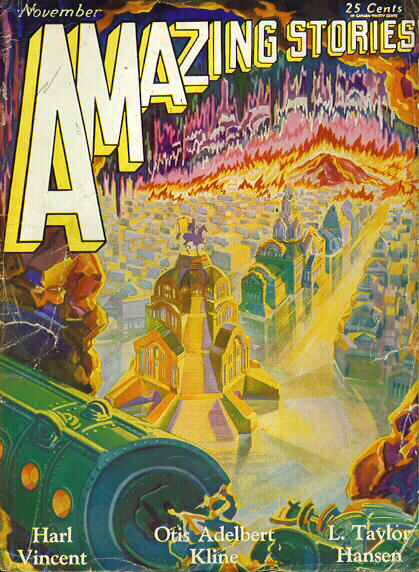
(Cover by H. W. Wesso. Amazing Stories, November 1929.) Who Goes There?
We don’t know that much about Lucile Taylor Hansen. I’m not even sure if we have a photo of her. The funny thing is that when she had a story published in Wonder Stories a sketch of a made-up man was used to conceal her gender, and even the introductory blurb for “The Undersea Tube” seems determined to not refer to gender at all. This might’ve been an idea of the editors, or it could’ve been Hansen’s. It was not unusual in the pulp days for educated women to initialize their first names for publication so as to keep a degree of separation between their writing careers and their day jobs. Hansen herself was well versed in anthropology and geology, doing graduate work at UCLA, and with most of her published work being science articles and books rather than SF. With regards to Amazing Stories she actually contributed far more articles than stories, and over a much longer period of time. But, as so often happens with lady SF writers from this era, she sort of just vanished from the face of the earth one day. Why she insisted on hiding her gender and her first name even into the 1940s, by which time it had become pretty normal to see women use their full names in the genre magazines, nobody can really say.
This is all more intriguing than the story I’m about to write about, which is a robust but underdeveloped bit of 1920s super-science. By this point in the history of Amazing Stories, Hugo Gernsback had relinquished control and indeed took little time in founding a new SF magazine, Science Wonder Stories. T. O’Conor Sloane, formerly the managing editor, then descended to become editor of Amazing Stories. Maybe this was due to old age (Sloane honestly might be the oldest editor of a genre magazine in history, being in his eighties when he finally stepped down in 1937), but Sloane was not as forward-thinking as Gernsback; and while Gernsback had the issue of not paying his authors, Sloane was incredibly slow with accepting/rejecting manuscripts, even losing them on occasion. Unfortunately for both Sloane and the magazine, Amazing Stories was about to get some serious competition in the forms of Astounding Stories and Gernsback’s Wonder Stories. It doesn’t help that some writers and artists, like Frank R. Paul, stayed loyal to Gernsback and jumped ship.
Placing Coordinates
First published in the November 1929 issue of Amazing Stories. It wouldn’t be reprinted until it appeared in Amazing Stories…. again, this time in the May 1961 issue. It has also appeared in The Best of Amazing Stories: The 1929 Anthology (ed. Steve Davidson and Jean Marie Stein). It’s in the public domain, and is on Project Gutenberg.
Enhancing Image
Hansen goes out of her way to explain the logistics behind the Undersea Tube, to the point where the worldbuilding takes up about a third of what is already a short story. This is both a good and bad thing. Bob, the narrator, tells us right away that the Undersea Tube, much like Jurassic Park, ended up a disaster and with a body count. Bob is, in fact, the sole survivor of the disaster. (To get a spoiler out of the way, how he managed to survive the wreck and no one else is never explained.) There are actually a few questions Hansen raises and then deliberately leaves unanswered. What we get is very much speculative fiction, in that there’s earnest speculation about the viability of undersea subways, with a strong mystery element, plus maybe just a hint of fantasy. But we’ll get to that last part in a minute. Bob took the Undersea Tube, namely the tube going between Liverpool and New York City, the most ambitious feat of human engineering in history thus far. There are a few other tubes in operations, namely one going between France and England and another between Canada (Montreal [not fucking Toronto?]) and the US (Chicago), but the Undersea Tube is transatlantic, going across (or rather under) a whole ocean.
Would it be practical to construct a subway that goes across the Atlantic, buried under the ocean floor, as an alternative to commercial airplanes? I’m pretty sure no. Of course, flying across the Atlantic was itself a dangerous prospect in 1929, and some aviators gave their lives to prove this. But Hansen puts in the effort to make the Undersea Tube sound plausible. We even get a few drawings (I assume courtesy of Hansen) showing the tube’s makeup in blueprint form. This is the sort of effort one can easily admire. As for the story, Bob talks with Dutch, a former college roommate (not sure how old they’re supposed to be, but given how long the Undersea Tube must’ve taken to build and a couple jokes the two make, I have to think they’re at least middle-aged) about the Tube. Bob wants to take the Tube from the US to Europe, having some business on the other side and having never taken the Tube before, but Dutch is worried. Ditch is convinced the Tube will succumb to a disaster in the near future—not because of a fault with the Tube itself, but because of the earth around the Tube. To make a long explanation very short, Dutch suspects an earthquake fault is the reason a certain crack, which had formed a while ago, has only gotten wider. There’s a specific spot in the solid rock that’s bound to break open.
This is all told in a matter-of-fact way, as if a journalist were writing a report—appropriate, considering the story we’re reading is a report Bob wrote for “the International Committee for the Investigation of Disasters,” after having survived the incident with the Tube. It’s not sensationalist, at least for the most part, in contrast with a lot of SF of this vintage. Bob and Dutch are one step above total cardboard, but they also aren’t charicatures the likes of which I’ve often found from this era. Dutch was one of the engineers who helped build the Tube in the first place, but since then he’s become disillusioned with his creation. He ultimately decides to ride the Tube on the same voyage as Bob, and as you can guess, he doesn’t make it. His decision to ride to Tube, despite warning Bob, implies he has a death wish, being at least passively suicidal. Melancholy very rarely appears in SF from this era, so that in itself is also a rarity. Finally, the decision to tell us how the story ends right at the beginning while also leaving out an important plot detail, only hinting at it at the outset, is a bit of sophisticated storytelling that makes me think Hansen had a good idea of what she was doing. We’re given a few crumbs of info at the beginning, but not the context until later. I consider “The Undersea Tube” to be lopsided in its pacing and altogether too short, but for its faults it’s by no means half-assed or unoriginal.
There Be Spoilers Here
Early on we’re told about a very strange event that happened in the midst of the Tube’s construction. The diggers had unearthed a cavern, itself seemingly a tomb for a jeweled casket, in which lied a beautiful dead woman. She had been dead for years, maybe centuries, but still appeared young and fresh, as if sleeping—until the casket was opened. The air did not agree with the corpse. But who thise woman could’ve possibly been or where she came from remained forever a mystery. We do get something like an answer when Bob becomes a passenger on the Tube and becomes unexpected bunkmates with an old man who is never identified and whose body is never found among the wreckage afterward. Mund you that the part of the story involving Bob in the Tube is shockingly brief, being little more than a footnote in the wake of what was a ton of lore and super-science. I was really surprised when I came to the end of the story and found that it had, well, ended, as soon as it did. The discovery of an undersea city, perhaps Atlantis, is made ambiguous since Bob is the only one alive to have seen it, and even then he doubts himself. It could be that people who look just like us lived in this decadent and apparently now abandoned city, which if you ask me threatens to venture straight into the realm of fantasy. To think there was a time where people, even educated people, took the idea of Atlantis or Mu seriously. This is a thread Hansen leaves hanging, an unanswered question that could be taken as a positive or a negative.
A Step Farther Out
I’ve been doing a marathon of short stories printed in Amazing Stories in the 1920s and ’30s this month, and so far “The Undersea Tube” might be the one most worth recommending, if not “objectively” the best. It’s genuinely SFnal while also being more than a little different from so many other stories published in the same magazine at around the same time. There’s a tangible sense of mystery and wonder Hansen works to invoke. She was doing something inventive here, so I can understand that even with so few stories under her belt (she wrote less than ten), she still became a subject of interest for fans at the time. At the same time it says something that despite her lack of “literary” prowess she was probably one of the best SF writers to come out of that particular generation.
See you next time.
-
Short Story Review: “The Metal Man” by Jack Williamson
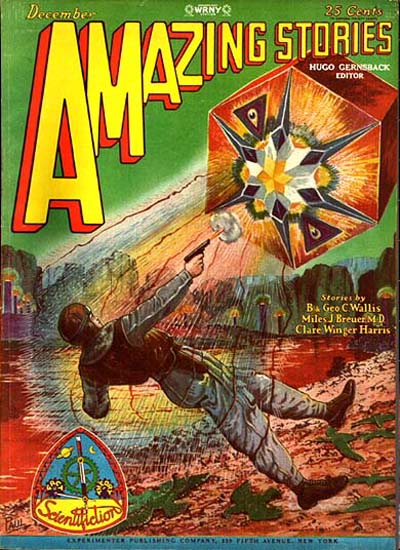
(Cover by Frank R. Paul. Amazing Stories, December 1928.) Who Goes There?
I’ve covered Jack Williamson here a number of times before, in part because he was so prolific and also because his early writing is indicative of the spirit of ’30s and ’40s SF. He made his debut in 1928, with a guest editorial and then a short story, “The Metal Man.” He was only twenty years old at the time, but had taken an interest in writing SF in the mode of A. Merritt as a teenager and was quick to learn the ropes of pulp writing. Williamson would end up having the longest career of any SF writer, at 78 years, having only stopped with his death in 2006. The fact that he appeared in Gernsback’s Amazing Stories and lived through nearly eighty years of the field’s history is really an incredible thing. His Hugo-winning memoir, Wonder’s Child, is a candid record about his childhood, moving from place to place along the southern border of the US (he was actually born in Arizona before it became a state), along with some angst regarding romance and trying to lose his virginity as a young man. He was also candid about his limitations as a writer, namely that no matter how much he worked his craft, he could never develop the refined style needed for more “sophisticated” SF. He simply didn’t have a delicate ear for writing prose.
Said limitations didn’t stop him from staying in the game for decades, pretty much without any kind of hiatus, although his most productive period was in the first dozen or so years of his career. He became the second author to be made an SFWA Grand Master, after Robert Heinlein, and on top of the Hugo he won for Wonder’s Child he won another Hugo as well as a Nebula for his novella “The Ultimate Earth.” Not bad, given he was in his nineties. As for “The Metal Man,” which kicked off this long and acclaimed career, it’s… not very good. Which I guess is understandable, the man was barely out of his teens and this was his first professional sale, in a market that was itself rather new and untested. I can also readily believe Williamson was thinking of Merritt with this, since I’ve read enough Merritt to figure that; but while Merritt impressed a baby-faced Williamson in the 1920s, Merritt now reads as pretty clunky and whimsical.
Placing Coordinates
First published in the December 1928 issue of Amazing Stories. It’s been reprinted more times than should be considered reasonable for a story of middling quality, but I guess it does have some historical significance. “The Metal Man” has appeared in Avon Fantasy Reader #8 (ed. Donald Wollheim), The Best of Amazing (ed. Joseph Ross), The Arbor House Treasury of Science Fiction Masterpieces (ed. Martin H. Greenberg and Robert Silverberg), The Oxford Book of Science Fiction Stories (ed. Tom Shippey), and the Williamson collections The Best of Jack Williamson, The Early Jack Williamson, and The Metal Man and Others.
Enhancing Image
The narrator tells us of a lifelike and life-size statue of a man at the Tyburn College Museum, which despite being in a state of neglect is an object whose very unusual and tragic origin is a sort of open secret. The statue is all that remains of Thomas Kelvin, a widely respected geologist who became obscenely rich off of prospecting for radium, only to have met a slow and yet early demise. He had apparently become sick “of a strange disorder that defied the world’s specialists, and that he was pouring out his millions in the establishment of scholarships and endowments as if he expected to die soon.” Which he did. The man’s body has been encased in metal, and looking at him he seemed to have been in good health, except for a “peculiar mark upon the chest,” a “six-sided blot, of a deep crimson hue, with the surface oddly granular and strange wavering lines radiating from it—lines of a lighter shade of red.” There are disagreements as to how Dr. Kelvin met his fate and became a museum piece, but the narrator claims to have obtained the manuscript of Kelvin’s account of those fatal prospecting days, as his body was shipped in from France. The rest of the story is that manuscript, told straight from the horse’s mouth.
A year prior, Kelvin had hoped to find radium deposits in El Rio de la Sangre, “the River of Blood,” which sure sounds inviting. Now, you may be wondering why the hell a geologist would hope to find radium of all things, since nowadays we know radium to be pretty dangerous and to have only a niche use. You know how in the early 20th century cocaine was used and advertised as a medicinal drug? Similar lines. The effects of radiation on the human body had not yet been studied, a gap in knowledge I suppose Williamson uses to his advantage. Hugo Gernsback’s introductory blurb for “The Metal Man” says the story has “a surprising amount of true science.” No fucking clue what he could possibly mean by this. I guess it’s a surprising amount of true science in that there’s virtually none to be found here. Speaking of things that strain one’s suspension of disbelief, Kelvin is both a wealthy scientist and an aviator, even purchasing a private “monoplane” he pilots himself. He does a scouting run along the river and finds a huge crater, at first appearing to be a lake but actually being a pit of heavy green gas. (Something I couldn’t help but notice is Williamson relying on colors a lot, especially the primary ones, a habit that seems to crop up in his early fiction a fair amount.) Well, in Kelvin goes.
I would like to mention that the pacing of this story is very strange. Kelvin says he only has so much time to write about his adventures, and overall the manuscript is short enough, but it’s also needlessly verbose. This kind of purple (sorry about the color thing) prose is uncharacteristic of Williamson, and it’s no wonder that he would soon abandon it. Merritt wrote in such a style to achieve a certain effect, not unlike Lovecraft (who was, after all, a close contemporary), although it must be said that Merritt was not as deliberate with his word choices. Williamson, having been so young and with not much of a background in literature at this point (he would earn a BA and MA in English much later in his life), didn’t seem to consider both the readability and plausibility of the framed narrative as much as he should’ve. And of course, Kelvin’s need to attribute a color to every goddamn thing is never given any in-story justification.
There Be Spoilers Here
One of the strangest things to happen is Kelvin coming upon an eagle, which had once been living, but having since turned to metal, apparently covered in the same “bluish radiance” as Kelvin and his plane. He then finds other birds, also cast in metal, having fallen victim to the deadly magic of this area by the so-called River of Blood. There’s even a “pterosant,” which is to say an ancient flying reptile. “Its wing spread was fully fifteen feet—it would be a treasure in any museum.” It’s clear that whatever killed these flying creatures will at some point come to collect on Kelvin, but he’s able to delay the inevitable by trying out some awful tasting purple berries. The juice of the berries tastes like ass, but has the helpful ability of counteracting one’s transformation into metal. The solution, unfortunately for Kelvin, is temporary, and the problem is permanent. He’s able to escape this dark little corner of the globe, and to write about it, but he’s a dead man walking.
A Step Farther Out
I’m sort of taken aback by how many times this story has been reprinted and how many editors consider it to be essential Williamson. Is it because it’s his debut? There are major authors with innocuous or even bad debut stories that understandably get thrown in the dust bin of history. Williamson himself thought well enough of it that he went to the trouble of revising it for one of his collections some forty years after the fact. It could be the nominally SF story that’s really an adventure narrative in an exotic location had an appeal for those of Williamson’s generation, and even a generation after that, that’s lost on me now. You can certainly do worse as a twenty-year-old just learning to write sellable pulp, but Gernsback glazing it and history being kind to it is baffling to me.
See you next time.
-
Short Story Review: “The Fate of the Poseidonia” by Clare Winger Harris
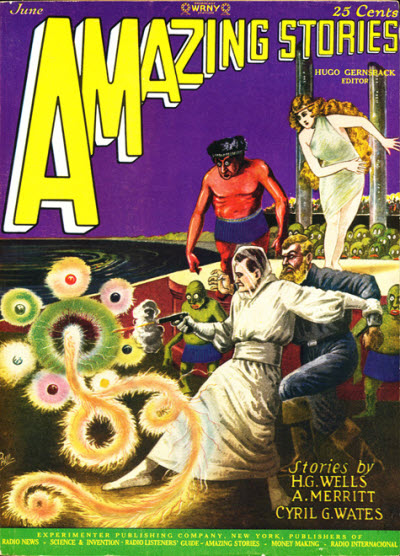
(Cover by Frank R. Paul. Amazing Stories, June 1927.) Who Goes There?
I was supposed to write about a Clare Winger Harris story months ago, in fact her debut, “A Runaway World.” The problem was that not only did I not like the story, I wasn’t even sure what to write about it. Mind you that this was not my first run-in with Harris, having also read “The Miracle of the Lily,” which is considerably better. Harris has a curious life story behind her, so it’s a shame that to this day much of her life remains a mystery to us. She was born in 1891 in Freeport, Illinois. Her father was himself a published author, while her maternal grandfather was the wealthiest man in Freeport. She eventually married Frank Clyde Harris, who was an architect, engineer, and associate professor. So, Harris grew up with some educated and financially well-off people, which was not a given at the tail end of the 19th century. She also seemed to have caught the writing bug from her old man, since by the time she made her SF debut in 1926 she had already written a novel (her only novel, in fact), titled Persephone of Eleusis: A Romance of Ancient Greece, a work of historical fiction. For reasons we’re not sure about, Harris then pivoted to writing SF.
As far as the historians has so far been able to tell, Harris was the first woman to have her work published in the SF magazines under her own name and without her first name initialed to hide her gender. In his introductory blurb for “The Fate of the Poseidonia,” Hugo Gernsback writes that “as a rule, women do not make good scientifiction writers,” (uh oh) “because their education and general tendencies on scientific matters are usually limited.” Not sure what he means by “general tendencies,” but as far as education goes he was unfortunately correct for the time. After all, women in the US were only granted the right to vote in 1920, just seven years earliear, and options for higher education were still pretty limited. Harris was a member of that very first generation of educated women (who would’ve been white and coming from at least middle-class backgrounds) to write for the genre magazines. “The Fate of Poseidonia” is just as good and probably better than a lot of the SF written by men at the time, although I’m still not sure if I would call it a “good” story.
Placing Coordinates
First published in the June 1927 issue of Amazing Stories. It was reprinted only once in Harris’s lifetime, in the collection Away from the Here and Now, and it would stay that way for a few more decades. Since the turn of the millennium, however, it has gotten a new lease on life, being reprinted several times since 2000, in The Prentice Hall Anthology of Science Fiction and Fantasy (ed. Garyn G. Roberts), Daughters of Earth: Feminist Science Fiction in the Twentieth Century (ed. Justine Larbalestier), The Best of Amazing Stories: The 1927 Anthology (ed. Steve Davidson and Jean Marie Stein), The Big Book of Science Fiction (ed. Ann and Jeff VanderMeer), and the Harris collection The Artificial Man and Other Stories.
Enhancing Image
When I wrote my review forecast earlier this month I said “The Fate of the Poseidonia” featured a heroine, which turned out to be incorrect. Either the folks at the SF Encyclopedia stretched things beyond the breaking point, or had confused it with a different Harris story. Our “hero” is very much a man, although George Gregory is not a hero in any meaningful sense. At the outset of the story he’s a young man with a girlfriend, named Margaret, but aside from her and Professor Stearns he doesn’t have any real friends, living in a hotel room and ignoring his neighbors. He also finds his relationship with Margaret has become increasingly strained, or rather distant, which is a sign that a breakup is imminent. What ultimately happens is worse than “just” a breakup, though. Gregory discovers a rival for Margaret’s affection, in the form of Martell, a strange man of about the same age but with a “swarthy, coppery hue” to his skin, “not unlike that of an American Indian.” So, he’s red, and for an amazing reason. Martell is not, as Gregory, Native American, but… let’s be honest and say he is clearly a Martian. The two even meet at a lecture Professors Stearns is giving about canals and potential life on Mars, said lecture proving very relevant.
The twist that Martell is a Martian on Earth is so obvious (at least to a modern reader) that even someone suffering from tunnel vision will catch it early. That Gregory quickly becomes convinced something is off about Martell proves to be a correct hunch, but the lengths Gregory goes to try to get dirt on his romantic rival strain the reader’s sympathy for him. Not only is he an anti-hero, if anything, but he also gets cucked, with Margaret deciding to dump him and go out with Martell instead. To make matters worse, the world’s sea levels have gone down seemingly overnight, leaving unnumerable fish dying on shrunken shores and a fraction’s of the world’s water having mysteriously vanished. The Pegasus, a “transatlantic passenger-plane,” has also gone missing, presumably along with the ocean water. No one knows how this happened, but Gregory has a feeling Martell has something to do with it. (I mean, he’s right.) You may be thinking, where’s the Poseidonia that the story’s title alludes to? We’ll get to that later. Truth be told, the title is sort of a misnomer, since for most of the story the mystery is centered on the fate of the Pegasus. I may have given Martell being a Martian early, but there are plot points that are less obvious.
(By the way, this might just an error typically found in old magazines, and I don’t have any other version of this story on hand, but the chronology of events is confusing. We’re told that the inciting incident happened in the winter of 1894-95, when Gregory and Margaret would be somewhere in their twenties. But the lowering of the ocean levels and the disappearance of the Pegasis are said to happen in 1945, fifty years later. But fifty years have certainly not passed since the story’s beginning. Hell, not even a full year it seems like. Most likely the year we’re given at the beginning is supposed to be 1944-5, but I can’t be sure right now.)
As you can tell from the premise, speculation about life on Mars was a lot more optimistic in 1927 than just a few decades later. First there was speculation about life on Earth’s moon, and then on Mars. There was the frequen that somewhere in our solar system, preferably closer rather than farther away from Earth, there might be intelligent life that can become friends with mankind. We hoped we might not be alone in the known universe. Well, 99 years later and we’re still alone. As for Martell, this might be the first time Martians are written as having skin tone akin to the indigenous peoples of North America. As far as classic alien skin tones go there’s basically little green men and the grays, meanwhile the Martians of H. G. Wells’s The War of the Worlds stay hidden inside their giant metal tripods. But Martians being red-skinned or thereabouts would become the norm for depicting humanoid Martians until at least the ’60s. Of course, by the ’60s we knew there was no such intelligent life on Mars. Harris was forward-thinking in this regard. She also anticipated the proliferation of commercial air flight with a reasonable time frame, although it would take a decade or two longer in real life for airplanes to become commercially the norm than in-story. The 1945 of the story is obviously different from the 1945 we really got, but it’s by no means far-fetched.
Well, except for the Martian business.
Another thing Harris anticipates is a TV set small enough to fit in the comfort of one’s own home. A big plot point is Gregory spying on Martell’s abode and sneaking in when the Martian is out. Aside from this being illegal at the very least, Gregory does discover some decidedly not-human tech, namely a TV-radio combo he dubs the “devil-machine.” Evidently this is how Martell is able to communicate with other Martians. More strangely, Gregory is able to look into far-off places with this machine, convincing him there is some coordinated plot and that Martell and his men are indeed not of Earth. Nah, really? Made even more obvious when Gregory sees one of these Martians with his arms bared, and for some reason they have little sets of feathers. Why would a humanoid need feathers? Never gets explained. Made more inexplicable because aside from the skin tone and texture, and the feathers, these aliens totally pass for human. We unfortunately do not get truly alien aliens in this story.
There Be Spoilers Here
The one thing that really surprised me about “The Fate of the Poseidonia” is that it has a downer ending. The bad guys win. Well, it might be unfair to call the Martians bad, since they have a legitimate reason for taking some of Earth’s water: Mars does have canals, but unfortunately life on the red planet threatens to be snuffed out because of a water crisis. There were some casualties in taking the two planes, but you can’t make an omelet without cracking a few eggs. The ending is absolutely a downer for Gregory, though. He’s been locked up in a mental institution, with no one except Professor Stearns believing him. Margaret has gone off to Mars with Martell, and was in fact the sole survivor of the Poseidonia. She expresses her regret in trusting Martell, in the brief time she has to talk with Gregory, but the signal’s cut and it’s assumed the two will never see each other again. This story does not have a heroine, as the SF Encyclopedia claims, but it does have maybe the most impotent male “hero” of any Gernsback-era SF story. Maybe a male writer would’ve given Gregory some kind of out, but Harris gives her shitty protagonist the worst outcome. This is an admirable and morbid curveball, for a story that’s otherwise predictable.
A Step Farther Out
Did I like “The Fate of the Poseidonia”? Not really. Harris’s style is pretty creaky, and the small type for the magazine version made the physical act of reading rather hard on the eyes. 99 years of science fiction have also rendered the plot, about Martians in disguise plotting to steal resources from Earth, feel all too familiar—for the most part. I will say, Harris making her male lead a petty and insecure cuckold who ultimately isn’t rewarded at all for his actions seems like a deliberate choice. It’s a deeply unflattering depiction of fragile masculinity that would speak to a modern reader far more than the writing on a technical level. With that in mind, it has aged relatively well for a Gernsback-era story.
See you next time.
-
Short Story Review: “The Thing from—’Outside’” by George Allan England
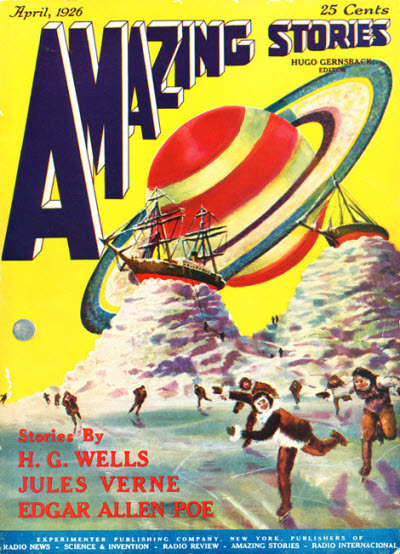
(Cover by Frank R. Paul. Amazing Stories, April 1926.) Who Goes There?
When Hugo Gernsback launched Amazing Stories in 1926, the inaugural issue’s contents would be very important. It was, after all, a newfangled magazine with a novel premise, that being the exclusive focus on science fiction, a term that hadn’t even been coined yet. In his editorial for this issue, Gernsback mentions H. G. Wells, Jules Verne, and Edgar Allan Poe as the leading forerunners of what he calls “scientifiction.” These were and still are important names in the history of the field, so Gernsback had made a wise choice by not only mentioning them, but printing fiction by all three in the first issue. A name he doesn’t bring up alongside those three, but who does appear here, is George Allan England. Contrary to what his last name would make you think, England was an American. He had a pretty active life, being a prolific writer, adventurer, and failed politician, having unsuccessfully ran for governor of Maine as a socialist. Incidentally he was close contemporaries with fellow adventurer, pulpster, and socialist Jack London. But whereas London because rich and famous from his writing, England never reached that level of mainstream success, and nowadays you’d be hard-pressed to find someone who has heard of him.
While England was more a novelist than a short-story writer, he did write a few shorts which have been reprinted more than once, “The Thing from—’Outside’” (sometimes reprinted without the em dash and inverted commas) being maybe the most popular. It was first published in 1923, when England was already in the third act of his career, in Science and Invention, of whom one of the editors was (you guessed it) Gernsback. Apparently he thought it was so nice he printed it twice. It counts as science fiction, I guess, but it’s much more a work of cosmic horror, so that honestly it could’ve just as well have appeared in Weird Tales.
Placing Coordinates
First published in Science and Invention in 1923, then in the April 1926 issue of Amazing Stories. It has since been reprinted in Strange Ports of Call (ed. August Derleth), the January 1965 issue of Magazine of Horror, Friendly Aliens: Thirteen Stories of the Fantastic Set in Canada by Foreign Authors (ed. John Robert Colombo), Sense of Wonder: A Century of Science Fiction (ed. Leigh Ronald Grossman), More Voices from the Radium Age (ed. Joshua Glenn), and a few others. Because it’s been in the public domain for a minute, you can find it on Wikisource of all things.
Enhancing Image
Five Americans have gone canoeing in the Canadian wilderness, a trip which has already gone south by the time the story starts, on account of their indigenous guides having abandoned them. Apparently something had spooked them. This is a racist trope I notice pop up in old pulp adventure writing: the native guide leaving the (white) explorers to their fate or dying unexpectedly. As for the Americans, we have Professor Thorburn and his wife; Vivian, Mrs. Thorburn’s younger sister; Jandron, a geologist; and Marr, a journalist. (Bit of a digression here, but how much younger is Vivian supposed to be than her sister? Professor Thorburn is said to be deep in his fifties, and presumably his wife isn’t too much younger than that, but Vivian’s young enough [and attractive enough] to be called a “girl” more than once.) It’s easy to think at first that the professor is the protagonist, but actually it’s Jandron—an observation easy enough to make with hindsight. Not everyone will make it out alive, and nobody (except for Jandron) knows what they’re doing. Things are already looking rough, even without a cosmic entity taking, since they’re already miles away from civilization and this was in the days before cell phones. This is all before the coming of the ice—and while this is Canada, winter isn’t due yet.
We know about burns, from intense heat, but we also know similar damage can be done with intense cold, hence things like frostbite. Jandron, being a very smart person, finds a ring of ice burned into a rock, which (he tells the others) will be there forever. He’s seen something like this before, and for better or worse, he’s also into Charles Fort. For some context, Charles Fort was a journalist who, late in his life, gained unexpected prominence with a few books that are comprised of unusual and dubious “data.” In other words, useless but curious information, a lot (if not all) of it not based in fact. In other words, he spread misinformation for the fun of it, and also to make a point. He didn’t actually believe, for instance, that mankind is secretly the property is an unimaginably advanced lifeform. He inspired a couple generations of SF writers and readers. One of his books, Lo!, was even serialized in Astounding. It’s unclear how much these people took Fort’s throwaway ideas seriously, or if England believed any of it himself, but Jandron seems to be a true believer.
As Jandron explains later in the story:
“[Fort] claims this earth was once a No-Man’s land where all kinds of Things explored and colonized and fought for possession. And he says that now everybody’s warned off, except the Owners. I happen to remember a few sentences of his: ‘In the past, inhabitants of a host of worlds have dropped here, hopped here, wafted here, sailed, flown, motored, walked here; have come singly, have come in enormous numbers; have visited for hunting, trading, mining. They have been unable to stay here, have made colonies here, have been lost here.’”
Bro would be a crazy person in the real world, but luckily for him (or maybe not) his hypothesis that the Thing stalking him and his friends is an invisible being that exists Outside (with a capital O) the universe is correct. Or at the very least it’s never proven incorrect. “The Thing from—’Outside’” is one of the earliest (it might be the very first) works of fiction to deal with Charles Fort’s writing, even mentioning it directly. In a way it reads like a contemporary of H. P. Lovecraft’s work, albeit pulpier, although I’m not sure if England was aware of Lovecraft at this time. He was most certainly aware of Algernon Blackwood at least, and indeed England’s story reads less like Lovecraft and more like a scientific counterpart to Blackwood’s “The Willows,” which itself has a similar premise but takes a mystical approach. “The Willows” is one of the most reprinted and respected weird horror tales of all time, despite the fact that it’s about fifty pages long and not much actually happens in it. “The Thing from—’Outside’” is more eventful; indeed it’s indicative of England’s trade as someone who wrote for the non-genre pulp magazines. There’s action, but also a lack of elegance.
(Modern readers should also take note that while England was a leftist, he was also a white man born in 1877, so his views on women and non-white folks can chafe, even in this story. Of course, being bigoted and also a socialist is something that can be applied to quite a few white leftists in both the 1920s and the 2020s.)
This is not to say “The Thing from—’Outside’” isn’t worth reading; on the contrary, it’s a good deal of fine. There are moments of genuine creepiness sprinkled into what is really a great-outdoors adventure story with some rather high stakes. The wilderness becomes colder and more inhospitable with every passing hour, so that one night the bonfire they’ve set up goes out suddenly, even with the plenty of wood to spare, as if a giant pair of wetted fingers had pinched out the flame. They also notice that less wildlife has been showing up, even down to the bugs, so that the forest becomes lifeless except for the trees, which themselves are losing their leaves. This change in climate is both unnatural and concerning. Even the river Our Heroes™ have been canoeing along has grown ice at the bottom. “It” is like an invisible cat and the humans are a bunch of field mice, although they make the comparison of being like ants more often. There’s a sense of both patience and sadism to the invisible horror, giving it the semblence of a personality despite being totally unseen and unheard. Some spooky shit is definitely going on, and one by one the party of five dwindles.
There Be Spoilers Here
By the time we get to the climax, the professor and his wife have both died. This is unfortunate. Even more unfortunate is that Jandron now has to deal with a stir-crazy Marr, and Vivian, who isn’t in much better shape. What happens to Marr, thanks to “It,” is maybe the creepiest part of the whole story. While he had blocked himself off from the others the Thing from Outside the universe had contorted and deformed his body and mind, so that he became “something like a man,” a “queer, broken, bent over thing; a thing crippled, shrunken and flabby, that whined.” Ultimately he dies before Jandron and Vivian are rescued, which is maybe a good thing for him. The others narrowly survive, and for Vivian the whole episode has been blacked out of her mind. Eventually they get married (right, there’s a romance angle here that I don’t care for), but Vivian “could never understand in the least why, her husband, not very long after marriage, asked her not to wear a wedding-ring or any ring whatever.” Granted, Lovecraft protagonists tend to get off with worse, so this is bittersweet instead of a downer. But while Vivian remains mercifully ignorant of those days in the wilderness, we’re told Jandron will always be so haunted.
A Step Farther Out
It’s not as good as “The Willows,” but then what is? England wasn’t typically a horror writer, but rather an adventure writer who just so happened to write a decent amount of SF—again, a term that did not exist in the 1910s and for much of the ’20s. He also, for reasons I’m unsure about, took a detour into cosmic horror, and did a fine job at it. England would appear in SF magazines from this point on, mostly after his death, and entirely (unless I’m missing something) through reprints. I’ve not read a whole lot of pre-Campbell magazine SF, but I’ve read enough to know you can do worse (so much worse) than “The Thing from—’Outside.’” You can also do much worse if you’re interested in some classic cosmic horror that’s contemporaneous with Lovecraft, but quite different in style.
See you next time.
-
Subscribe
Subscribed
Already have a WordPress.com account? Log in now.
 Science Fiction & Fantasy Remembrance