What the hell, a whole month went by and nothing crazy happened that wasn’t work-related. Well, the SFF magazines are being choked out by big daddy Bezos and Twitter is now no longer Twitter, but aside from that, everything has been pretty normal!
I’m being sarcastic.
To keep your mind off the fact that the short story within the context of genre publishing is an endangered species and that readers can hardly be bothered to support the lifeblood of the field, let’s read some stories! We have a curious set this month, focusing more on fantasy, which is not normally my thing; indeed the only science fiction stories covered this month are the novellas. Much like pushing myself just a little bit when trying a new food, fantasy is a genre I treat, paradoxically, with both caution and enthusiasm. Enough wasting time, though…
For the serials:
Skull-Face by Robert E. Howard. Serialized in Weird Tales, October to December 1929. Howard wrote for only twelve years, debuting in 1924 and stopping with his suicide in 1936—at age thirty. Most writers barely get their feet off the ground by the time they’re thirty, but not only was Howard a natural-born storyteller, he wrote at a blistering pace such that he still accumulated a vast body of work. Skull-Face is a standalone fantasy, predating Conan by a few years.
The Reign of Wizardry by Jack Williamson. Serialized in Unknown, March to May 1940. Retro Hugo nominee for Best Novel. This was not published in book form until 1964, a 24-year gap that normally would imply the author had died in the interim—only Williamson was not only alive but had another 42 years left in him. Was not Williamson’s first go at fantasy, but it marked his first appearance in Unknown, a new fantasy magazine with more exacting standards.
For the novellas:
“Immigrant” by Clifford D. Simak. From the March 1954 issue of Astounding Science Fiction. The review for this will be posted on Simak’s 119th birthday, which is the least we can do for the man. With the wave of “empathetic” and pastoral SF in recent years, especially the works of Becky Chambers, some have looked back to Simak (rightfully) as a direct ancestor. “Immigrant” hopefully will see Golden Age SF’s most compassionate writer in good form.
“Singleton” by Greg Egan. From the February 2002 issue of Interzone. I was gonna tackle “Oceanic” originally, but that seemed too obvious and maybe not characteristic of Egan’s work. I’ve been quasi-binging Egan’s short fiction as of late, because he interests me. Egan’s one of the major voices in transhumanist science fiction, as well as one of the first Aussie writers to leave a mark on the field. He’s also notoriously aloof; there are no pictures of him on the internet.
For the short stories:
“The Dreaming City” by Michael Moorcock. From the June 1961 issue of Science Fantasy. I’ve read a couple Moorcock stories before, but truth be told he’s one of those authors I’ve been slow to get around to because of a bad first impression. Let’s just say I’m not a fan of his essay “Starship Stormtroopers.” But still Moorcock has been an earnest chronicler of fantasy for the past six decades, and to celebrate we’re going back 62 years to the start of his Elric saga.
“Travels with My Cats” by Mike Resnick. From the February 2004 issue of Asimov’s Science Fiction. Hugo winner for Best Short Story. Resnick was one of the most popular and frequent contributors to Asimov’s in the ’90s and 2000s, winning three of his five Hugos there, with his Kirinyaga series being one of the most decorated in genre fiction. I intentionally picked a standalone story because the Kirinyaga stories kinda bug me, and also I like cats. 🙂
For the complete novel:
The Dwellers in the Mirage by A. Merritt. From the April 1941 issue of Fantastic Novels. During his life and in the years immediately following his death, Merritt was one of the most beloved American fantasists, at least among pulp readers; he even got a magazine named after him with A. Merritt’s Fantasy Magazine. Nowadays Merritt is obscure enough to have “won” the Cordwainer Smith Rediscovery Award. The Dwellers in the Mirage was first published in 1932, but its printing in Fantastic Novels was the first time Merritt’s preferred ending was incorporated, making it the preferred version.
One last thing I wanna mention is that I’ll be revamping my method for reviewing serials. I’ll be writing about the first installment in the same way as usual, but I’ve come to realize that for subsequent installments there are a couple sections of my review formula that are really unnecessary; for example we don’t need an introductory section where I give context to the author if we’re already in the middle of a work by said author. As such you can expect a more streamlined reading experience when we get to the second installment of Howard’s Skull-Face. Things will look a bit different, but this is less a radical change and more like tweaking. Other than that, my review schedule should be back to normal.
(Cover by Richard Powers. Beyond Fantasy Fiction, September 1953.)
Who Goes There?
I’ve read a handful of short stories by Margaret St. Clair at this point, which I understand is not much, but every one of these has something memorable about it. St. Clair got started in the late ’40s and for little over a decade was one of the most prolific female writers in the field—until, so it seems, market forces changed. Although she lived a long life, St. Clair wrote little fiction after 1960, focusing more on novels (and not being a prolific novelist at that) while the intervals between short stories stretched into years. It’s a shame, because her formal talent with the short form is almost unmatched among ’50s SFF writers. “The Goddess on the Street Corner” caught my attention just from its title, but its inclusion in Beyond Fantasy Fiction (H. L. Gold’s short-lived fantasy sister magazine to Galaxy) gave me even more hope. Also, as is typical with St. Clair, this is indeed short and… bitter, actually. I struggled to come up with a review for a bit.
Placing Coordinates
First published in the September 1953 issue of Beyond Fantasy Fiction, which is on the Archive. “The Goddess on the Street Corner” has only been reprinted in English twice, in the St. Clair collection Change the Sky and Other Stories, and in the chunky anthology Masterpieces of Fantasy and Enchantment (ed. David G. Hartwell and Kathryn Cramer). Both are very much out of print.
Enhancing Image
We start with an opening paragraph that I swear has a couple words missing due to a printing error (oh yes, the Gold magazines having shitty copy-editing, home sweet home), but once we get past that we’re introduced to Paul, a street bum, and a mysterious woman who clearly has a supernatural aura about her. It takes Paul a surprisingly short time to come to grips with the fact that the woman is the titular goddess—and that she’s a goddess who’s practically on her deathbed. Even so, a dying goddess has an unworldly beauty, and Paul, like any reasonable hetero man, offers to be her servant. If written today this would be the beginning of a beautiful BDSM relationship, but this is the ’50s so no dice. You think I’m joking, but their relationship quickly takes on a master/pet dynamic.
It’s not clearly immediately that Paul is a bum, but we soon discover the extent of his poverty, in that, being jobless, he get his blood drawn (apparently too often for the local nurse’s liking) for a quick buck. Not only is he single, but he doesn’t rwally have any friends aside from presumably his fellow street bums. The goddess does something unusual in that she asks Paul about his day, about his latest romantic outings, as if such information helps her—although the implication is that it does. The two do not form a romantic bond exactly, but it’s sort of like romance by proxy—except something even weirder happens. To satisfy his goddess’s wants, Paul walks around outside doing nothing in particular, only thinking up stories to tell that would satisfy her. At first I thought this was selfish on Paul’s part, but something to keep in mind that the dude is dead broke; he does not have the money to be asking girls out and eating at restaurants, although the goddess doesn’t seem to understand this.
With what I just said you may be expecting a “liar revealed” plot twist to occur, or for the goddess to call out Paul’s dishonesty; but no, she accepts every word he says without question… maybe because she can’t afford to take them for what they are. It’s depressing, and yet Paul is basically framed as doing right by indulging the goddess’s wants in her last days. If you’ve had elderly members of your family go into hospice or retirement homes, and they might not be all there mentally anymore, you or an older family member might make some shit up when talking to their elders so as to make them feel better, and the elders don’t question it. I remember when my paternal grandma was in retirement care and up to the end we acted like my other grandma (my mom’s mom) was still alive, though she had died a couple years prior. The two were friends, of course. What the old lady didn’t know couldn’t hurt her. Shit, that does sound bad.
I was expecting some commentary on how the Abrahamic religions have driven the old pagan faiths into exile, like in American Gods, and because the goddess is clearly of pre-Christian vintage, but it ended up being a steady downward spiral about a stranger trying to help a fellow stranger whose condition is terminal. The fantasy element reads as allegorical here, as the goddess comes of as an old but still beautiful woman whom Paul loves but is unable to satisfy directly, both becaue of a physical gap and because Paul lives in such abject poverty that he has to steal when he can. This is like if a character in John Steinbeck’s Cannery Row were to, without even thinking twice about it, fall into an urban fantasy tale, although unlike Steinbeck St. Clair doesn’t seem interested in commenting on poverty so much as using a character’s class for the sake of the allegory.
There Be Spoilers Here
The ending is inevitable, and the “twist” is not much less inevitable. Personally I wouldn’t have saved the revelation that the goddess is Aphrodite until the end, because a) it reads as predictable, b) it’s given to us via the omniscient third-person narrator and not either of the characters, and c) the fact that this is the Greek goddess of love doesn’t matter as much as you would think. Sure, it relates to how the goddess wants to hear about Paul’s fabricated love life, but having the deity who’s dying for lack of followers be a love god strikes me as a bit on-the-nose. Does that make it any less depressing when Aphrodite finally goes and leaves Paul alone, destitute, and now an alcoholic? I have to say no.
A Step Farther Out
I feel a little bad about this one. I had read the story (very easily in one sitting) a couple days ago and then proceeded to not put any words to paper about it until the last minute. A minor case of writer’s block. It’s not that this is a bad story; quite the contrary, I was thinking about the implications of the ending long after reading it. Just that with St. Clair’s writing I feel like the quality of it speaks for itself, in a way that’s unencumbered with fancy language. “The Goddess on the Street Corner” is not even the most downbeat St. Clair story I’ve read, but it has an atmosphere that could easily give one the blues. It’s only ten pages long, but it’s not what I would recommend as a casual read. St. Clair can be merciless.
(The Demolished Man. Cover by Martin Herbstan. Shasta, 1953.)
Given the amount of fuckshit that’s been going on with this year’s Hugos, a lot of which I can’t even explain properly, and given that it’s the 70th anniversary of the inaugural Hugos, it’s probably apt to do a retrospective editorial on that now-alien time in SFF history. Before I do that, I ought to give a brief explanation of what the Hugos are, what Worldcon is, and how these have been integral to the organization of SFF fandom. I’m not saying this as an expert, but as an enthusiastic young fan who hopes to travel to some corner of the world with a Worldcon membership in the future. (Let’s face it, it’ll probably be Canada.) I may not have all my facts straight, so bear with me. I’d like to thank Unofficial Hugo Book Club Blogfor their rundown of what might’ve been nominated at the 1953 Hugos (be sure to put a pin in that “might’ve been”) and Jo Walton for her unabashedly subjective series on the Hugos up to the turn of the millennium.
The World Science Fiction Convention, or Worldcon, is, as you may guess, the world’s leading science fiction (and, more recently, fantasy) convention, held almost every year and in theory an international gathering of writers, artists, filmmakers, and fans, complete with all the usual convention hijinks (except for, as far as I’m aware, the selling of not-safe-for-work body pillows at exuberant prices). Worldcon has increasingly lived up to its premise, but it started out as thoroughly American, with the first five Worldcons being held in the US and the first Worldcon held outside an English-majority country not coming until 1970, in Heidelberg, in what was then West Germany. Indeed there would not be a Worldcon held in a non-white majority country until the one in Yokohama, Japan in 2007. Does SFF, historically, have a whiteness problem? The short answer is yes, but that’s an editorial for another day. Things have gotten better, so there’s that.
The Hugo awards have been consistently a part of the Worldcon experience since 1953, and in the world of SFF they’re often thought of as the field’s equivalent of the Oscars (although if we’re going by voting process it’d be more accurate to call the Nebulas the SFF Oscars). A novel could certainly catch more eyes on bookstore shelves if it had a sticker saying “HUGO AWARD WINNER” on the cover. The Hugo is named after Hugo Gernsback: author, editor, failed businessman, and founder of the first science fiction magazine in the English-speaking world. Gernsback brought Amazing Stories into the world in 1926 and explicitly made it out to be a magazine that would publish science fact and fiction pieces, as opposed to just a magazine that would sometimes happen to publish science fiction. Gernsback held control of Amazing Stories for only a few years before moving on to other projects, but he got the ball rolling and by this point it’s a snowball akin to Godzilla—or more appropriately, King Ghidorah, with its multiple heads and tails. Point being, you may not know who Gernsback is, but if you’re an avid SFF reader then you probably know about the Hugos.
As of now there are 17 Hugo categories, with these encompassing damn near everything from prose fiction to graphic novels to TV show episodes (although curiously the attempt to give video games their own category has not panned out as of yet), and that’s not even getting into fan projects. (Totally not relevant here, but Science Fiction & Fantasy Remembrance is itself eligible for Best Fanzine!) But in 1953 there were only seven categories, and only one of them is still in service. The 1953 Hugos were held at Philcon II, in Philadelphia, and while we can see the primordial slime that would evolve into the awards ceremony we now recognize, a few of the categories now read as utterly disconnected from what modern fans care about or would even be aware of. My thesis is that the Hugos were initially concocted to celebrate science fiction as published in the magazines… and sadly too few people read genre magazines these days.
To list the categories for 1953:
Best Novel
Best Professional Magazine
Best Cover Artist
Best Interior Illustrator
Excellence in Fact Articles
Best New SF Author or Artist
#1 Fan Personality
The Best Novel category stands out as not only being the only prose category this year, but the only category to still be around (although, like the dinosaurs and the birds, a couple other categories would leave behind close relatives for the modern age). And why not? There will always be demand for novels; frankly it’s impossible to imagine an SFF readership without a continual list of bestselling novels. The winner was Alfred Bester’s The Demolished Man, which incidentally (actually it was quite deliberate) was the first novel I reviewed in serial form for this site. A lot of people would say The Demolished Man is a fine winner, but it’s also a bit of an odd one for a couple reasons. The first is that Bester is not what we’d call a novelist at heart; he had been active as a short story writer for more than a decade prior to this, and aside from his first two novels (the second being the even more revered The Stars My Destination) his best work is arguably his short fiction. The second is that, according to the time for eligibility for this year’s Hugos (basically August 1952 to August 1953), The Demolished Man should not have qualified since it was first published in the January to March 1952 issues of Galaxy Science Fiction. Still, it’s a flawed but intriguing novel that set a standard for both ’50s SF and futue Hugo winners.
What could’ve beat out The Demolished Man for Best Novel? We’re not sure since there was no shortlist put together for this year, but we can make a few educated guesses. The biggest rival would’ve almost certainly been Clifford D. Simak’s masterful “novel” City, which won the International Fantasy Award that year (the only other SFF award of any significance at the time, and rather prestigious in its own right), and which in my opinion would’ve been an even worthier winner than Bester’s novel. Another big contender would’ve been Frederik Pohl and C. M. Kornbluth’s caustic corporate espionage caper The Space Merchants, which was serialized in Galaxy only a few months after The Demolished Man. Other notable novels from 1952 include Isaac Asimov’s Foundation and Empire and The Currents of Space, Robert Heinlein’s The Rolling Stones, and Wilson Tucker’s The Long Loud Silence. While we were seeing more SF novels get hardcover releases, the magazine serial was still a high-profile affair.
Speaking of which, no doubt the success of Bester’s novel contributed to Galaxy tying with Astounding Science Fiction for Best Professional Magazine, which is a little fucked up considering this would be H. L. Gold’s only Hugo win. Of the “dead” categories, Best Professional Magazine lasted the longest, only being replaced by Best Professional Editor in 1973—a good twenty years later. This was done apparently to acknowledge the rising prominence of book editors, with people such as Damon Knight and Judy-Lynn del Rey giving major credence to original anthologies and paperback releases; a bit of a sad joke, because there would not be a non-magazine Best Professional Editor winner until Terry Carr in 1985. Still, it’s hard to argue with what won in 1953, with the two sides of American magazine SF at the time being equally represented—the hardboiled adventure SF of Astounding with the more cerebral and socially aware SF of Galaxy. Of course, there were so many magazines active, and so many of them publishing good material, that it must’ve been hard to not have a tie.
The next three categories I’ll go over in rapid succession, as I don’t have much to say about them, but they’re also anomalies in the history of the Hugos for how much they illustrate the prominence of magazine publishing at the time. Best Cover Artist was a tie between Hannes Bok and Ed Emshwiller, who were at very different stages in their careers. Emshwiller was a hot new artist who would go on to dominate SFF illustrating for the next decade while Bok was, sadly, a burnout who barely did genre illustrations at that point, let alone covers; the latter is certainly meant as career recognition. Best Interior Illustrator went to Virgil Finlay, and this is a hard one to argue with; we’re talking about one of the top three best interior illustrators in SFF history. Then there’s Excellence in Fact Articles, which went to Willy Ley for his science column in Galaxy. Best Interior Illustrator especially strikes me as a dinosaur here, as interiors have become functionally extinct in the field; even Analog and Asimov’s, which did interiors for decades, rarely do them anymore. Most genre magazines now straight-up don’t have interiors, but they were a big deal in 1953.
(Cover by Ed Emshwiller. Galaxy, June 1952.)
The last two categories are interesting in that they have obvious descendants in the modern Hugos. Best New SF Author or Artist went to Philip José Farmer, who made his genre debut with “The Lovers” in the August 1952 issue of Startling Stories, and by the time he got his Hugo he had put out a few more stories that certainly helped his exploding reputation. What are the parameters for a “new” author here? I’m not sure. For the Astounding Award (which for some reason is not a Hugo, despite being given at the same ceremony, but which otherwise very much takes after the Best New SF Author or Artist Hugo) we know that authors have two years of eligibility within publication of their debut story. For this category I probably would’ve voted for Philip K. Dick, as he would not only become an 800-pound gorilla of the field, but even by the summer of 1953 he had amassed an impressive body of short fiction. Farmer had already published at least one story well before “The Lovers,” but it was, as far as I can tell, not science fiction or fantasy, and ISFDB doesn’t even mention it. Overall, I understand why Farmer caused enough buzz to win.
The last category is #1 Fan Personality, which went to Forrest J. Ackerman. What the fuck is this? #1 FanPersonality. There’s a lot to unpack here. This is not about the “best” fan, and it’s not even about who is the best fan writer necessarily. My assumption is that someone could have a certain reputation at conventions and fandom meetings and be eligible for this award. Keep in mind that members of what we call First Fandom, those who might’ve attended the first Worldcon in 1939, were extremely clique-y, and I mean to like a toxic degree. Of course, Ackerman was and would continue to be an important chronicler of SFF fandom for decades, so if anyone should get it it’s probably him. Still, this is primitive at best compared to what we now have, which is not one but four fan categories: Best Fan Writer, Best Fan Artist, Best Fanzine, and Best Fancast. Fandom has grown a profound amount in the past seventy years, but it’s also become way more scattered; it’s pretty common now to find earnest SFF readers who do not engage with fandom in any meaningful way.
The fan categories have consistently seen some of the lowest voter turnouts at recent Worldcons, despite Worldcon itself only existing because of fans from around the globe agreeing to make this thing happen. There are many fans who don’t read fanzines or listen to fan podcasts. There are many fans who read little to no short fiction and thus do not engage with magazines at all. There were no Hugos for short fiction in 1953, and even now the short fiction categories very much play second fiddle to Best Novel, which is the one that gets people riled up. It’s also safe to say Hugo voters by and large no longer care about science articles and interior illustrations, and there’s a reason why the Best Professional Magazine category turned to dust half a century ago. Fandom priorities have changed greatly; what they’re changing into I cannot say as of yet.
A favorite returns. I reviewed a bunch of Fritz Leiber works last December in time for his birthday, which was a decision I both do and do not regret. It’s demanding to binge an author’s stuff like I did, but the good thing about Leiber is that he’s versatile enough that you can hop around his career and find him in different modes: Fritz Leiber the science-fictionist, Fritz Leiber the adventure fantasist, Fritz Leiber the master of urban horror, etc. He made his genre debut in 1939 and for the next half-century would prove to be one of the most reliable writers of his generation, rivaled (in my opinion) only by Theodore Sturgeon and Clifford D. Simak; and of the three, Leiber is the one I enjoy most for the sheer beauty of his prose. Sturgeon can be overwrought, but Leiber has a hard time writing a bad sentence just ignore The Wanderer, all while showing humor and social awareness. Nowadays Leiber does not get as much credit as he deserves, with his fantasy series starring Fafhrd and the Gray Mouser (incidentally the stars of his debut story) being almost as integral to the formation of American fantasy as Conan—yet so few people bring up these two lovable rogues now.
The early ’50s were an amazing time for science fiction, but not so much for fantasy. There were several attempts to start up hot new fantasy magazines and none of them worked out, folding within a couple years at the most. It’s telling that The Magazine of Fantasy and Science Fiction started out as just The Magazine of Fantasy, but then changed its title after one issue. “The Seven Black Priests” would be the last Fafhrd and Gray Mouser story for four years, and most curiously it saw print in Other Worlds, which was very much an SF magazine. Leiber struggled to get the series published for much of its existence, given that it was a) adventure fantasy, b) rather low fantasy (in that magic doesn’t play much of a part in the world), and c) heavily reliant on short fiction, what with fantasy readers having an irrational fondness for novels that are bloated and meandering.
Placing Coordinates
First published in the May 1953 issue of Other Worlds. “The Seven Black Priests” has never really been anthologized, but it has been collected a couple times and because it’s a Fafhrd and Gray Mouser story it’s been available more or less consistently for the past half-century. The Fafhrd and Gray Mouser volume it’s included in, Swords Against Death, is still in print and is available in ebook and paperback from Open Road Media (if you hate yourself and don’t wanna buy an older edition).
Enhancing Image
We start with Our Heroes™ licking their wounds from having lost the loot of a previous adventure; because I haven’t read every Fafhrd and Gray Mouser story I can’t tell if said adventure is from another story or if it’s just something Leiber made up. Anyway, Leiber assumes, given the episodic nature of the series, that we might not’ve run into the best buddies from Lankhmar before, so we’re reintroduced to Fafhrd and the Mouser, the Mouser “clad all in close garments of gray, even to the hood which shadowed his swart features but could not conceal their pug-nosed impudence,” and Fafhrd, “a huge man with wrists thick as a hero’s ankles, yet lithe withal.” Fafhrd is a barbarian, a red-headed giant from a perpetually cold climate, while the Mouser is the short but quick thief. While they fit into RPG character classes, these are individuals who are difficult to confuse with other fantasy characters, especially from that period.
Speaking of cold, the two rogues are now in the Cold Waste, a wintery landscape that’s about as far from Lankhmar and civilization generally as one can get—only, despite appearances, Our Heroes™ are not alone. Within a couple pages we’ve gotten our first action scene, which indeed gets an interior illustration (courtesy of Michael Becker), as the Mouser faces off with a scrawny but feisty man, who goes toe to toe with the well-armed Mouser with just a knife and loincloth. The man is charcoal-black, although the boys suspect at first he might’ve gotten that complexion from the intense coldness of the area. Our Heroes™ send this knive-wielding lunatic tumbling to his death, but there’s an odd glow at the bottom of that dark pit that makes them uneasy; the man might not be dead after all. The boys continue on their way, not wanting to pay the incident too much mind, but “at least one other eye had seen the pulsing glow—an eye as large as a squid’s and bright as the Dog Star.” We may have to worry about more than just the black priests of the story’s title!
The Cold Waste is mostly snow and frozen vegetation, but there’s also a volcano that provides a bit of heat, along with a green hill by the volcano that houses what the black priests are obsessed over. The boys find, on that green hill, a strange idol with words in an ancient and mostly unknown language, along with (most relevant to our treasure hunters) an eye-like gem that is sometimes described as a diamond but which can’t really be one; it would, however, go for a fair price on the market. This whole thing gives off Indiana Jones vibes and personally I would not touch the damn thing, but given that Our Heroes™ are dead broke, the gem will have to do—even minding the priests who are eager to retrieve it. A couple things to note: there’s a long and not-talked-about-enough marriage between colonialism and treasure-hunting, which if you’re a buzzkill who can’t enjoy well-made entertainment would make characters like Indiana Jones and Nathan Drake less sympathatic. Fafhrd and the Mouser steal something which is not theirs, and it doesn’t help that the priests are from Klesh, a jungle-filled country that’s implied to be African-equivalent.
Leiber narrowly avoids turning the adventure into something that might be deemed too problematic, but I’ll say for now that at least the priests are not described in demeaning language that would normally be reserved for stereotyped black characters; they are, however, the butt of a couple jokes about clerics, which is more understandable. I’m not sure if Leiber was an atheist (he probably was), but there’s some playful ribbing of organized religion here that serves as both entertainment and which illustrates Our Heroes™ as anti-establishment. One of my favorite recurring elements of the Fafhrd and Gray Mouser stories (and this applies to Conan as well) is that hierarchical figures are always viewed as, at best, aloof and untrustworthy. Fafhrd and the Mouser are always looking out for themselves and each other, and maybe their girlfriends if they happen to have those, but they don’t serve any particular authority figure.
For shits and giggles, here’s my favorite exchange:
“The seven black priests— ” Fafhrd muttered.
“The six,” the Mouser corrected. “We killed one of them last night.”
“Well, the six then,” Fafhrd conceded. “They seem angry with us.”
“As why shouldn’t they be?” the Mouser demanded. “We stole their idol’s only eye. Such an act annoys priests tremendously.”
It’s a funny.
“The Seven Black Priests” is the shortest Fafhrd and Gray Mouser story I’ve covered for this site thus far, and it’s both the simplest and most abstract. There aren’t any named characters aside from the boys, and indeed the only actors are the boys and the priests—plus a third party I’ve alluded to but whom I will not get deep into until the next section. The Cold Waste is a bit of a unique location because of the juxtaposition of the snowy landscape with the volcano, but the closest we get to shelter are caves. The plot is also pretty simple, with it being a protracted fight over a gem which itself may or may not have plans of its own. Normally I have a hard time following action in writing, but of the Fafhrd and Gray Mouser stories I’ve covered I actually think this one is the easiest to get invested in if you’re not familiar with the series already; it’s a novelette, so it’s not exactly short, but it’s straightforward and because it has a small cast it shows Our Heroes™ doing what they do best without need for prior knowledge.
There Be Spoilers Here
Fafhrd was the one to take the gem, and since then he’s been acting a little weird at night; as if possessed he talks in a way that’s totally out of character for him, which should send the Mouser warning signs but because this story has to go on a bit longer the Mouser decides to not do anything about it for the time being. Given the known presence of supernatural objects in the world of the series I would’ve just assumed the gem that’s supposed to represent some ancient and evil god is haunted as shit, but that’s just me. One by one the priests get killed off, yet that doesn’t remove the problem of what to do with the gem, which as the story progresses compels Fafhrd to do things that strike the Mouser as unusual. It’s implied from the hieroglyphs on the idol that the priests have journeyed to the Cold Waste to pay respects to their god and prevent it from causing unspeakable mayhem, which if you put it that way makes the boys sound like the real villains, although a) the priests attacked first, and b) the boys could not have known initially what powers the gem had. Sometimes treasure is just treasure.
By the climax of the story it’s become clear that the gem plans to use Fafhrd as its puppet and kill the Mouser to complete its ritual, for “it needs the blood of heroes before it can shape itself into the form of man.” The Mouser is ultimately left with a choice: kill Fafhrd and take the gem for himself, or spare Fafhrd but destroy the gem. It’s a pretty easy choice on paper, actually. What makes Fafhrd and the Mouser heroic is not the fact that they do sometimes save people’s skins, but it’s that their love for each other always pulls them through in the end. Aside from its anti-authority stance, I find myself going back to the Fafhrd and Gray Mouser stories because they present a harsh low fantasy world where friendship redeems. You could even say that, for Our Heroes™, friendship is magic. Leiber rejects the toxic notion that men, in order to prove their “manliness,” must be ruthless and self-serving, instead giving us two undoubtedly masculine men who nevertheless unabashedly love each other. The Mouser destroys the gem and thus kills the mad god who had haunted the Cold Waste for centuries, but more importantly he does it for the sake of his best friend. Unlike most fantasy, male friendship is shown to be a magical power, even for two rogues who are no more wizardly than you and me.
A Step Farther Out
It’s a fun time! Yeah, I don’t have too much to add. This is the shortest and simplest Fafhrd and Gray Mouser story covered thus far and it certainly feels like that. “The Seven Black Priests” must’ve seemed like an odd choice for Other Worlds readers, but it must’ve also been like a puddle in a desert for those who liked heroic fantasy and, in the early ’50s, were getting precious little of it. While it’s not as ambitious as some of the other Fafhrd and Gray Mouser stories I’ve read, or even reviewed, Leiber rarely disappoints with this series and he’s a wordsmith the likes of which we rarely see in old-school genre fiction. It’s guys being dudes in an exotic locale and there’s nothing wrong with that.
At the beginning of Moby Dick you may recall that Ishmael looks for seafaring jobs whenever he gets hit with one of his depressive episodes. “Whenever I find myself growing grim about the mouth; whenever it is a damp, drizzly November in my soul…” All that. I normally rotate through short stories, novellas, and serials for my reviews, but there are times when the latter two categories weary me deeply, and I wish to take a break from those more demanding tasks. Back in March I restricted myself to just short stories, and from the pages of Weird Tales more specifically. The timing felt right. I’ve come to realize that to alleviate myself of my review schedule I would do short stories only in March, July, and October of each year. Rest assured that I’ll be reviewing spooky stories for October, just like I did last year and will certainly do next year. But what about July? This is a question that’s been dogging me, because while my review roster for this past March had a theme to it, July proved more challenging.
Some months back I wrote an editorial on the state of SF in 1953, seventy years ago, and how it served as a high-water mark for the field, embodying the very height of the magazine boom—a level of fruitfulness that would not be matched until the 2010s. In the US alone there were over twenty SFF magazines running in 1953, versus less than half that a decade later. You could say the first half of the ’50s was one of the field’s summer periods, when there was this sense that life would never be this large again, nor would the market be this inclusive. It’s an argument I think is worth making, but now I think I’ll argue again—only this time by way of demonstration. We thus have nine short stories, all with 1953 dates, and all from different magazines. I couldn’t even include something from Astounding, which anyway was the least interesting of the Big Three™ at the time. I’m gonna be covering a nice mix of science fiction and fantasy, including a couple authors I’ve not read anything by before—plus a few old favorites.
The short stories are as follows:
“Watchbird” by Robert Sheckley. From the February 1953 issue of Galaxy Science Fiction. 1953 was a boom year for Sheckley, who had debuted in 1952 but who would amass a reputation and a large body of short fiction (something like thirty short stories) in his first full year as an author. Sheckley submitted to every outlet under the sun but he was particularly fond of Galaxy, to the point where he seemed to show up in every other issue of that magazine in the ’50s.
“Night Court” by Mary Elizabeth Counselman. From the March 1953 issue of Weird Tales. Yes, Weird Tales was still around at this point, even if it was no longer the leading magazine for short fantasy (then again, who was in the lead?). Counselman had debuted in Weird Tales a couple decades earlier and she was one of those authors who stayed loyal to it to the bitter end. I was ssupposed to read my first Counselman story back in March, but plans change. Now we start in earnest.
“Mother” by Philip José Farmer. From the April 1953 issue of Thrilling Wonder Stories. Farmer came to the field late, already deep in his thirties, but his first story, “The Lovers” (the novella version), made an immediate splash and helped earn Farmer a special Hugo for most promising new writer. “The Lovers” was transgressive as far as ’50s pulp SF goes, and it’s not surprising that Farmer would later fit in with the New Wave writers, what with the sexual weirdness…
“The Seven Black Priests” by Fritz Leiber. From the May 1953 issue of Other Worlds. Leiber’s one of my favorites, and also one of the most consistent SFF writers of the ’50s and ’60s just ignore The Wanderer, having debuted in 1939 but staying strong almost to the end of his life. “The Seven Black Priests” is a Fafhrd and Gray Mouser story, a sword-and-sorcery tale that oddly enough saw print in the SF-oriented Other Worlds. The early ’50s were not great for fantasy.
“Paycheck” by Philip K. Dick. From the June 1953 issue of Imagination. I know I covered him only a couple months ago, but what can I say, I’m a Dickhead. Like with Sheckley, Dick had debuted the previous year but really showed what he was made of in ’53, with about thirty short stories published that year and with some of them going on to be classics. As with a good deal of Dick’s work, “Paycheck” would serve as the basis for a (not very good from what I’ve heard) movie.
“Captive Audience” by Ann Warren Griffith. From the August 1953 issue of The Magazine of Fantasy and Science Fiction. A certain aquaintance (cough cough) had pointed me toward this one. Griffith apparently wrote her fair share of mainstream fiction, but she only wrote two SFF stories, both in the early ’50s and both in the pages of F&SF. Curious how you’d see authors from outside the genre magazine bubble feel comfy with submitting to F&SF.
“The Goddess on the Street Corner” by Margaret St. Clair. From the September 1953 issue of Beyond Fantasy Fiction. St. Clair is a fairly recent discovery for me, and one who’s quickly becoming a favorite. In the ’50s she was one of the more gifted SFF short story writers—though sadly her sstories are often too short to spend a couple thousand words on. (It gets weird if the review’s length comes close to that of the story it’s covering.) This one does not look so slight.
“Wolf Pack” by Walter M. Miller, Jr. From the September-October 1953 issue of Fantastic. I could theoretically review all of Miller’s short fiction for this site, though that would take about twenty years at the rate I’m going. Miller is known now for A Canticle for Leibowitz, but he also left behind a fruitful body of short fiction (given this all happened in less than a decade). “Wolf Pack” is one of the more obscure stories in an already overlooked oeuvre; it looked appetizing.
“Little Girl Lost” by Richard Matheson. From the Octover-November 1953 issue of Amazing Stories. Matheson is a favorite of mine—and unlike most genre authors of his generation he would make it big as a screenwriter in Hollywood, working in the ’50s onward on a variety of projects from Roger Corman movies to Star Trek. “Little Girl Lost” was one of several Matheson stories adapted (by Matheson himself, in this case) into a classic Twilight Zone episode.
It’s not vacation, because I’ll still be reading and writing as usual, but I’ll be taking time off from novellas and serials. For those who are still in school, summer represents a time for hanging out with friends and going to the beach and whatnot; in other words, doing what you love most with the time you have. The art of the short story is a passion of mine and I wanna take the time to cover more that may be of interest.
Oh, and I changed the site’s name partially. The verbosity of the previous name was getting to me and I hungered for something more straightforward; that and this new one better matches the URL. Anyway…
(Cover by Margaret Brundage. Weird Tales, December 1934.)
Who Goes There?
Given that her career as an a genre writer was cut short, on account of the premature death of her first husband Heny Kuttner, C. L. Moore’s time in the field was wide-spanning and much lauded. Nowadays (unless you’re a Weird Tales fan) she’s most recognized for her collaborations with Kuttner and the occasional solo story written during their marriage, but Moore gained cred as one of Weird Tales‘s most gifted writers within a year of her professional debut. Her planetary vampire story “Shambleau” was an instant hit and editor Farnsworth Wright cheerleaded her as a force to be reckoned with; within a year she established the two series that would define the first stage of her career, contributing to the planetary romance with Northwest Smith and the fast-growing sword-and-sorcery tradition with Jirel of Joiry. I recommend reading my review of the first Jirel story, “The Black God’s Kiss,” before continuing with this review, since today’s story very much assumes you’ve read what came before it.
Placing Coordinates
First published in the December 1934 issue of Weird Tales, which is on the Archive. Because this is a direct sequel to “The Black God’s Kiss” and thus does not stand on its own, it’s be reprinted considerably fewer times than its predecessor. The good news is that you can still find it readily in Jirel of Joiry and Black God’s Kiss, collections which as far as I can tell are mostly identical and which collect the whole (rather short) series. If you’re British and/or you suck eggs then there’s the SF Gateway omnibus collecting Jirel of Joiry, Northwest Smith, and the short novel Judgment Night.
Enhancing Image
It hasn’t been long since the end of “The Black God’s Kiss,” and yet despite having had her vengeance on the rogue invader Guillaume, Jirel has been tormented by guilt. She had ventured into the dark underworld beneath the castle of Joiry and received the most cursed of weapons: a kiss from a black Buddha-like statue in a temple. Not only did the kiss kill Guillaume but it seemed to send his soul to the underworld, which is the part that’s been troubling Jirel so much. You may recall the ending of “The Black God’s Kiss” was a bit odd, maybe problematic, due to Jirel realizing—too late—that her immense hatred for Guillaume was actually lust (or “love,” but let’s be real with ourselves, what Jirel feels is not love) in disguise.
The first story was almost a subversion on the sword-and-sorcery formula with how it de-emphasized action in favor of describing, in a great detail, an environment totally alien to human experience; call it a Lovecraftian heroic fantasy. Jirel herself is heroic in that she’s quite brave, true, but she’s really an anti-heroine, having no problem with chopping dudes’ heads off if they come into her castle without her consent (this both does and does not feel like a euphemism), and it’s not like she has any virtuous plans for the world in mind. She’s also not a virginal waif who has never seen a man’s drill before, as it’s made clear to us that she’s taken on several lovers before. I’m just gonna say it: she’s a top. The sexual undertones of “The Black God’s Kiss” are more or less absent in “Black God’s Shadow,” though, as Jirel is less concerned now with satisfaction than she is with finding inner peace.
The opening scene focuses on Jirel trying and failing to sleep at night, her castle restored but her faith in herself wrecked. She considers the possibility of Guillaume, in some spirit form, wandering the underworld beneath the castle, calling her out for her act of strange cruelty.
By the power of that infernal kiss which she had braved the strange dark place underground to get as a weapon against him—by the utter strangeness of it, and the unhuman death he died, it must be that now his naked soul wandered, lost and lonely, through that nameless hell lit by strange stars, where ghosts moved in curious forms through the dark. And he asked her mercy—Guillaume, who in life had asked mercy of no living creature.
Jirel knows what she must do: return to the underworld and find some way to put Guillaume’s soul to rest. Pretty simple goal, right? And it is! This is even more straightforward on a plot level than the first story, to the point where it actually becomes a bit hard to talk about. It’s a bit shorter than “The Black God’s Kiss” but feels about the same length because of the density of Moore’s descriptions, compounded by the fact that there’s virtually no dialogue this time around. We have three characters, but without being too specific for fear of spoiling only one of them is both human and alive; therefore don’t expect to read conversations here.
Another thing to take into account is that there’s even less action here than in “The Black God’s Kiss,” with Jirel fighting off strange creatures so much here as battling the strangeness of the underworld and her own psyche, which has taken a hit since the end of the first story. The most we get prior to the (rather prolonged) climax is an encounter with an unseen venomous creature that goes after Jirel’s legs during the underworld’s starlit nighttime—a bit of horrific ambiguity that shows once again that Moore could’ve become a horror maestro on par with Lovecraft and Howard had she kept going down this path. Indeed it’s here in her early fiction that Moore is the most poetic, being preoccupied with capturing places and emotions to an extent that may read to some people as trying too hard but which nevertheless gives the Jirel of Joiry stories a unique weird-adventure atmosphere.
With that said, some of the things I found memorable from “The Black God’s Kiss,” such as Jirel’s encounter with her evil mirror image and the herd of blind white horses, are gone here, replaced with things which do not strike me as eerie or memorable. The temple where the black god dwelled in the first story is no longer on an issland connected to the rest of the underworld by an invisible bridge but is instead at the head of a river. Stuff has changed around without explanation, which I suppose makes sense given the unhuman and eldritch nature of the underworld, but there are still certain rules it abides; for example, Jirel still has to ditch her crucifix in order to see the vast underground realm for what it is.
As far as Jirel’s wandering the landscape goes there’s a bit of “second verse, same as the first” at work, but what makes this one distinct is how it refuses to turn into an action fantasy. Actually I’d go so far as to say “Black God’s Shadow” is considerably more obscure than its predecessor because it almost doesn’t work as a short story—nay, it reads almost more like a prose poem, written by someone who may or may not have survivor’s guilt. I don’t know enough about Moore’s life to speculate, but I do have to wonder what could’ve prompted her to zero in on trauma and overcoming said trauma like she does in the first two Jirel of Joiry stories. There’s a darkness lurking at the core of these stories that makes them hard to grapple with, even from a modern reader’s perspective—a meditation on guilt and the dark side of lust that rings somehow as more personal than is to be expected from a 1930s fantasy series starring a bad bitch with red hair.
I don’t like “Black God’s Shadow” as much as what came before it, but when taking the two stories as two halves of one whole I do think they work better together than each on its own. “Black God’s Shadow” is gloomier and more contemplative than its predecessor, but as I’ll explain it’s also the more uplifting of the two at the end of it.
There Be Spoilers Here
The climax is basically a standoff between Jirel and the black god, the living and demonic statue she made a deal with before, now her adversary. Guillaume’s soul is kept prisoner by the black god and Jirel has to free it while also not being taken prisoner herself. A lot happens… and yet not a whole lot if you think about it. This is a spiritual battle, but it’s more so a psychological one. Jirel has to forgive both Guillaume and herself; in other words, she has two souls to save. While Jirel is unable to resurrect the man she had killed (thankfully Moore does not pull such a deus ex machina), she is ultimately able to free his soul from the black god’s clutches. While Jirel is unsure as to where Guillaume’s soul went, his voice no longer haunts her in her mind and dreams, which means we’ve gotten about as happy an ending as we can expect. Jirel’s victory is hard-won, but she has learned to love herself again, and thus this chapter in her life has now ended.
(I have to wonder how the next story, “Jirel Meets Magic,” follows up on the sheer darkness here, but my assumption is that it won’t, which is fair. A direct acknowledgment of Jirel’s suffering henceforth is unneeded.)
A Step Farther Out
I pulled up the letters column in the February 1935 issue of Weird Tales, which has responses to the December 1934 issue, and was dismayed by how unconstructive responses to “Black God’s Shadow” were. There’s the usual “I really like this and all hail C. L. Moore” stuff, but nothing I could find about how radically different “Black God’s Shadow” is from its predecessor, despite the two very much forming a duology—even more so when we consider that Moore very likely wrote the two back-to-back and had already sold “Black God’s Shadow” to Wright before “The Black God’s Kiss” saw print. The two were printed as separate stories and not part of a serial because, I reckon, there’s a clear divide between them such that they sort of mirror each other, and would not cohere as part of a single narrative. Still, with Jirel having resolved the internal conflict that plagued her since the end of “The Black God’s Kiss,” she was free to go on other adventures, and Moore was free to not return to Jirel of Joiry for several months.
(Cover by Allen Anderson. Planet Stories, Fall 1949.)
Who Goes There?
Planet Stories is a pretty interesting magazine whose contents I ought to give the deep-dive treatment one of these days, since a) it was one of the few SFF magazines in the ’40s to have a distinct personality of its own, and b) it encapsulates pulp science fiction at its most charming. It is a charming publication, with garish action-packed covers (perfecting the brass bra, I wanna add), probably the liveliest letters column in the field at the time, and, despite its juvenile exterior, being home to some excellent writers. Poul Anderson started his Dominic Flandry series here. Ray Bradbury contributed a few entries in what would later form The Martian Chronicles. Philip K. Dick’s first published story appeared here. But the author to define the magazine’s image was undoubtedly Leigh Brackett, whose planetary romances often made the cover, though she was generally keen on publishing in the adventure-leaning magazines like Startling Stories.
Brackett made her first couple sales to Campbell at Astounding Science Fiction, but she quickly looked elsewhere for her fiction, even if these magazines paid less. Nowadays Brackett is most known for the pretty good but uncharacteristic novel The Long Tomorrow, as well as her fairly successful career as a Hollywood screenwriter—for collaborating with Howard Hawks and, at the end of her life, writing the first draft of The Empire Strikes Back. Because Brackett got final screenwriting credit, she won a Hugo when the film won for Best Dramatic Presentation; she had been dead for three years when this happened. But for much of her time in our field, she acted as the heir apparent to Edgar Rice Burroughs, albeit being easily more downbeat and sophisticated than Burroughs. The star of today’s story, Eric John Stark, an Earthman raised on Mercury, owes a good deal to John Carter and Tarzan, with a strong hint of Conan the Barbarian.
Placing Coordinates
First published in the Fall 1949 issue of Planet Stories, which is on the Archive. More importantly, because “Enchantress of Venus” fell out of copyright and someone took note of this, it’s free and perfectly legal, being available on Project Gutenberg in a variety of formats, link here. For print we have more options still, this being one of Brackett’s more reprinted works of short fiction. The most relevant to me would have to be The Best of Leigh Brackett, part of the Ballantine slash Del Rey Best Of series—edited and with an introduction by her husband, Edmond Hamilton. Brackett did the same for Hamilton’s Best Of collection. Aww.
Enhancing Image
A bit of exposition before we get to the story proper, since the mechanics of Venus as depicted in the story are a little odd, especially for modern readers. In contrast with the red desert world of Mars, as in the preceding and proceeding Stark stories, the Venus in “Enchantress of Venus” is about as swampy as you can imagine—with gas so thick that it can actually buoy ships. Specifically the area where the action is set, so called the Red Sea, is what we might now call a dead sea in that it’s not filled with water; it is, however, filled to the brim with red gases. “It was not water. It was gaseous, dense enough to float the buoyant hulls of the metal ships, and it burned perpetually with its deep inner fires.” It is indeed possible to breathe at the bottom of the Red Sea, which will be important to keep in mind for later. I say all this now because I was quite confused at first myself.
Stark has come to Venus in search of a friend, but it doesn’t take long for him to acquire yet one more problem in the form of the captain of the ship he’s taken to Shuruun, the pirate-infested port town. The captain, Malthor, is perhaps one of these pirates in disguise, hoping to knock Stark unconscious or worse—a hint Stark picks up in time to fight back, scarring Malthor, before jumping ship. In Shuruun he again narrowly escapes getting his shit kicked in, partly because he’s musclebound enough to be played by a young Arnold Schwarzenegger and partly because, under strenuous circumstances, his upbringing by native Mercurians kicks in and he’s able to go beast mode. Something we find out quickly enough in this series is that Stark rather strongly takes after Tarzan, being half-man and half-beast, born to Earth people but raised in a savage culture. Stark is a barbarian in the sense that he is halfway between a civilized man and an animal.
While in Shuruun, Stark meets up with Larrabee, a fellow Earthman in exile, one who has been gone so long that people of Earth have since thought him dead. “He had never met Larrabee, but he remembered the pictures of him that had flashed across space on police bands.” The two get along as fellow expats, but Larrabee is about to leave the narrative for a long so it’ll be easy to forget about him. More of immediate importance is that we also run into Malthor’s daughter, Zareth, who going by descriptions of her also has to be of high school age. (I’m somewhat baffled by Brackett’s decision to have the third-person narrator linger on Zareth’s barely pubescent physique. I would expect such a decision from Marion Zimmer Bradley, but not Brackett.) Zareth admits upfront to being an agent of Malthor, who will beat her if she doesn’t do her job of luring Stark into a trap, but even so she refuses to go through with it, instead urging Stark to get out of Shuruun.
There are two female characters of importance here (I guess there’s a third, but she doesn’t do much), with Zareth as the first. Something I’ve noticed about Brackett’s writing is that it would be easy, if we were to apply whiteout to author bylines, to assume that the Stark stories were written by a pretty masculine if also gloomy man, given the role women play here. Not to say Brackett indulges in some internal misogyny, but it’s more how the women exist in relation to the male lead. Zareth is an innocent, almost angelic figure whose beauty (problematically described though it is) is to be taken in an ultimately platonic context; we can infer that while Stark respects Zareth, he is not enough of a pedophile too virtuous, despite his savagery, to see her as anything more than a good friend.
We’re told, however, of a series of islands in the Red Sea, about the “Lost Ones,” people who are spirited away and never to be seen again—about a castle where a band of slave-drivers called the Lhari lives. So naturally Stark goes there! What could possibly go wrong? It’s here that we’re finally introduced to our villains, the Lhari: a family of incestuous thieves and warlords who have taken people as slaves for the purpose of finding something at the bottom of the Red Sea. There are several members, but the big players are Varra, the titular enchantress (also a falconer); Egil, a mad warrior and Varra’s cousin, who also happens to be madly in lust with said cousin (wooo); Treon, a disabled man who is treated by his family as a moron but who is clearly not that, on top of being clairvoyant (ya know, the token good member of the family); and Arel, the matriarch of the family, a demented old woman who is basically a witch.
(Some femme fatales would put on an outward appearance of benevolence, but Varra is surprisingly upfront about being a bad bitch who only wants Stark for his muscles; he is apparently quite… breedable. I’m sorry, I don’t know how else to put that. In fairness to Varra, her choices are some other slave or to give Egil a pity fuck, which she’s not inclined to do. Needless to say Stark is not looking forward to being Varra’s sex slave. If I recall correctly the titular villainess of “Queen of the Martian Catacombs” also treats Stark as a sperm bank with arms and legs, which makes me wonder if there’s some femme-dom fetish-pandering at work here.)
In better news, in being held captive by the Lhari, Stark does finally meet Helvi, the friend he came to Venus looking for in the first place. Helvi has survived as a slave so far, but his brother, who “had broken tabu and looked for refuge in Shuruun,” was not so lucky. “A man cannot live too long under the sea,” Helvi says. They have to get out of here, but ideally before that they ought to figure out what the Lhari are excavating the bottom of the sea for and put a stop to them while they’re at it. You may notice we’re knee-deep in the novella and there’s been shockingly little action up to this point; we’ll get to that, but this is a story heavy on both atmosphere and dialogue, and the Lhari are quite chatty for being so inbred that their family tree looks more akin to a stump. (I’m sorry, I couldn’t resist.)
There Be Spoilers Here
Varra offers Stark to kill Egil and the other members of the family, barring Treon (whom Varra dumbly sees as no threat) and Arel (who’s pretty old and decrepit already), in exchange for Stark’s freedom and being able to raw-dog Varra every other night as co-ruler of Shuruun. This all sounds like a good deal, if not for the fact that Varra is clearly untrustworthy and is as likely to stick a knife in Stark’s back. Stark ultimately refuses, in a reasonable move which indicates he’s at least of average intelligence; some others of his ilk are more easily bamboozled. Unfortunately Stark has made multiple enemies at this point, with even Malthor rearing his head again so that Stark and him can have a rematch. Apparently Zareth, having been beaten (again) for not betraying Stark, has led Malthor to the bottom of the sea. No matter. Malthor goes down easily enough.
Egil, who had been eyeing Stark this whole time, nearly gets him with a crossbow, only for Zareth to do that ’90s action movie trope of jumping in front of the bolt to save Stark, sacrificing herself in the process. I was expecting some deus ex machina to kick in so that Zareth could be saved, but no, she dies the real death. In fairness, Egil’s death is worse, with Treon even looking on casually, “as though he had seen it all before and was not surprised.” Stark and Treon agree to have Zareth buried in her proper place, and the snowball of vengeance has now thoroughly been set in motion. The back end of “Enchantress of Venus” is a bit of bloodbath. A war between the slaves and slave-drivers breaks out with the slaves narrowly winning, “Nearly half the slaves were dead, and the rest wounded.” The Lhari are worse off. Treon kills Varra (a death so sudden that it’s actually easy to miss), but not before she mortally wounds him, while the rest die in battle. Treon, being the token good member of the family, is the only one to get a proper farewell from Stark; Our Hero™ seems just glad to be rid of Varra.
The Lhari have been wiped out, but more importantly the dark secret they’ve been trying to uncover (I won’t go into details, but I will say it reminded me of Indiana Jones and the Kingdom of the Crystal Skull) has been rendered such that nobody can make use of it anymore. It’s not hard to take an allegorical reading from all this, with the dark secret that ought not to be used by anyone standing in for (perhaps) the invention of the atomic bomb. There was a good deal of science fiction written about atomic power and the possibility of nuclear weapons in the year’s leading up to World War II, but following that war SF writers became deeply wary about the tangible reality of living in a world that could be torn asunder by said nuclear weapons—previously hypothetical but now known. “Enchantress of Venus,” like some of Brackett’s other later fiction, is filled with such wariness. Stark rescues Helvi and frees the slaves, but at a steep cost. Despite its action and generous doses of testosterone, this is not an adventure yarn that would make the reader feel like a jolly good badass vicariously.
A Step Farther Out
I was originally gonna tackle the first Eric John Stark story for this site, “Queen of the Martian Catacombs,” but I found that a) I was not yet accustomed enough to Brackett’s swashbuckling style to make total sense of it, and b) “Queen of the Martian Catacombs” was such a straightforward adventure narrative that I struggled to think of things to say about it. Not as much of an issue with “Enchantress of Venus,” in part because it’s so much slower than its predecessor, but it’s also a good deal bleaker. Given the episodic nature of the series it’s expected that Stark will end up pretty much where he started, but in this case it means a whole lot of death, including a few characters we’ve actually come to care about. When the action finally ramps up towards the end it comes almost as a relief, given the oppressive foggy atmosphere and wholly unlikable villains. Brackett’s science-fantasy outlook still reads as partly foreign to me (if you care about scientific plausibility then you will not survive), but look, I’m willing to forgive something if the tone is the right amount of melancholy.
(Cover by Allen Anderson. Planet Stories, Fall 1949.)
This will turn out to be a busy month for me. I’m gonna be a guest on one or two podcasts/streams with some people I very much respect, and I’ll also be flying out of my Jersey/Pennsylvania bubble to visit some friends I rarely ever get to hang out with in person. On the one hand this is all more eventful than what I usually deal with, but also I’ll have a bit less time to manage this site—which won’t stop me from putting in as much effort as I usually do. It’s draining sometimes, but that is how passion works.
My personal life is gonna be busy, but also my review lineup is FILLED for May: we’ve got two serials, two novellas, two short stories, and finally a complete novel—our first one in six months. I know, the gap between novel reviews looks to be wide, but mind you that there aren’t too many of these “complete” novels in the magazines.
One more thing: I mentioned in a past editorial that I think very highly of 1953 as a year when SFF flourished, in general and especially in magazine publishing, which was experiencing a bubble we would not see again until… now, basically. Strangely, I haven’t before covered ANYTHING from that year, so to compensate we’ve got two stories from 1953 in the lineup. 1953 was such a banger that I could probably get five years out of just reviewing everything that was published then.
Enough wasting time, though, let’s see what we have.
For the serials:
All Judgment Fled by James White. Serialized in Worlds of If, December 1967 to February 1968. White is an author I’ve not read a single word of (or at least I think) up to this point, and given his philosophy with storytelling this feels a little criminal to me. When planning this post I flip-flopped between All Judgment Fled, Second Ending, and The Dream Millennium for my first White, since all three sound appealing, and ultimately went with this because I’ve also been meaning to tackle something—anything—that was published in If.
Sos the Rope by Piers Anthony. Serialized in The Magazine of Fantasy and Science Fiction, July to September 1968. Yes, that Piers Anthony. He actually appeared regularly in the genre magazines early in his career, when he was a promising young writer and people did not yet know the horrors he was about to unleash on the world. My only prior Anthony experience was the short story “In the Barn,” and let me tell you… that’s the kind of thing that puts you off an author for years. But maybe Sos the Rope, his second novel, will be good!
For the novellas:
“The Rose” by Charles L. Harness. From the March 1953 issue of Authentic Science Fiction. Retro Hugo nominee for Best Novella. Harness is one of those recent discoveries of mine that I’ve been meaning to explore further—made easier because Harness was not that prolific a writer; when he wrote he was fairly productive, but then he would vanish for several years. Harness apparently struggled to find a publisher for “The Rose” in the US, having to jump across the Atlantic and submit it to a filthy British magazine.
“Enchantress of Venus” by Leigh Brackett. From the Fall 1949 issue of Planet Stories. Brackett is now most known for her part in the messy scripting process for The Empire Strikes Back, for her collaborations with director Howard Hawks, and for the rather unchararcteristic novel The Long Tomorrow. Much of Brackett’s fiction, however, is planetary romance a la Edgar Rice Burroughs, complete with swashbuckling antics. “Enchantress of Venus” is one of several stories starring Eric John Stark, the barbarian hero for the space age.
For the short stories:
“Second Variety” by Philip K. Dick. From the May 1953 issue of Space Science Fiction. Retro Hugo nominee for Best Novelette. Not that I try to hide my biases anyway, but Philip K. Dick is one of my top five favorite authors—and he ain’t #5 on that list. But before he broke new ground as a novelist, Dick was one of the most talented and prolific SFF writers of the ’50s, with about thirty of his short stories being published in 1953 alone. “Second Variety” is one of Dick’s most famous short stories, and yet somehow I’ve not read it before.
“Black God’s Shadow” by C. L. Moore. From the December 1934 issue of Weird Tales. It’s been two months since I reviewed Moore’s “The Black God’s Kiss,” which was a reread, and true enough there was a two-month gap in publication between “The Black God’s Kiss” and its direct sequel. Only a year into her career and Moore had skyrocketed to being one of Weird Tales‘s most popular authors, with the adventures of Northwest Smith and Jirel of Joiry getting started during this period. Moore is a favorite of mine, naturally.
For the complete novel:
Big Planet by Jack Vance. From the September 1952 issue of Startling Stories. Believe it or not, this is a reread—actually one of the first stories I remember reading via magazine scan. As is often the case with me, though, there are surely many things about this novel that I didn’t pick up on a first reading. Vance is not an author I’m strongly attached to, but he does fill a certain niche, being a planet builder par excellence and a crafter of gnarly planetary adventures when he feels like it. Big Planet represents planetary romance shifting away from the Burroughs-Brackett model (which is really science-fantasy), and injecting the subgenre with some semblance of scientific plausibility. But how does this novel hold up on a reread? Let’s find out.
We have a nice mix of science fiction and fantasy, all of it vintage. We’ll get back to some more recent publications next month… maybe. You have to understand that I only cover so much in a given month and that there’s so much history behind the genre magazines. The roster, you may notice, leans toward adventure this month, between the Brackett, Moore, Vance, and probably the Anthony pieces; it just sort of turned out that way. Maybe given that I’ll be traveling soon I thought it appropriate to focus more on tales of high adventure for my site. Regardless, it won’t be a boring lot.
The idea that George R. R. Martin, perhaps the most famous living fantasy writer (or the most famous to not be a raging transphobe) right now, used to be mostly a science fiction writer would strike a lot of people as odd, but that’s the truth. I recommend picking up both volumes of Dreamsongs, the retrospective collection that covers Martin’s essential short fiction up to the turn of the century. The stories themselves are worth it, but Martin also wrote lengthy autobiographical introductions for each section (the stories are divided into thematically appropriate sections), and keep in mind that this was back in 2003… two whole decades ago. In his intro for the section containing “The Lonely Songs of Laren Dorr” and a few other early fantasies, Martin gets weirdly defensive about what must’ve been a recurring criticism of him in fandom at the time: that he was a science fiction writer who “sold out” and started writing fantasy once market forces shifted.
There’s no question that Martin’s priorities with genres changed radically by the time he started working on A Song of Ice and Fire, but the reality is that Martin was always more of a fantasist than a science-fictionist at heart. In the ’70s, when Martin started writing professionally, you had basically two options for getting short fantasy published: The Magazine of Fantasy and Science Fiction, which tended toward fantasy of the whimsical Lewis Carroll sort, and Fantastic, which welcomed adventure fantasy but sadly also paid considerably less than F&SF. Despite the pay gap, though, it was Fantastic and not F&SF where Martin cut his teeth on short fantasy, with him calling “The Lonely Songs of Laren Dorr” his first “pure fantasy” as a pro. Of course, by 1976 Martin was not just a pro but a Hugo winner.
Placing Coordinates
First published in the May 1976 issue of Fantastic, which is on the Archive. It was first collected in Songs of Stars and Shadows, but now you can easily find in the first volume of Dreamsongs. You can also read “The Lonely Songs of Laren Dorr” totally free and legit online as a reprint in Fantasy Magazine, which can be found here. Really you have no excuse.
Enhancing Image
Martin’s third-person narrator, not quite omniscient, gives us the immediate impression that this will play out like a fairy tale—or at leaat part of a fairy tale. Like your typical fairy tale we’re given a broad outline of the plot in advance, along with something like a message we’re supposed to take from it. The narration borders on childlike, but this is ultimately still a fantasy for adults, though I’ll say right now that certain Martin hallmarks like gore and sexual assault are nowhere to be found; you can rest easy on that. Anyway, the narrator tells us that this story is incomplete, like so:
We have only the middle, or rather a piece of that middle, the smallest part of the legend, a mere fragment of the quest. A small tale within the greater, of one world where Sharra paused, and of the lonely singer Laren Dorr and how they briefly touched.
I have to admit that I assumed going in that Laren Dorr would be a woman, even though thinking about it, Laren is not exactly a feminine name. Unconscious bias maybe? Doesn’t matter, because while he’s not strictly the protagonist Laren is very much the character of interest here; he is, after all, the one who changes. Hell, there are only only two onscreen characters, plus one who is mentioned but never seen, plus a group of villains who are also unseen but who still very much lurk just outside the confines of the page. The real protagonist is Sharra, “the girl who goes between the worlds,” a warrior lady whom sadly we find out very little about. We start with Sharra, who is in pretty rough shape, having just escaped a violent encounter into Laren’s world, with a dark crown on her head that apparently lets her use gates between worlds—an ability that the Seven do not approve.
Who are the Seven? We find out basically nothing about them, aside from the fact that they are supposed to be a pretty powerful bunch—perhaps a league of sorcerers—who can see across worlds. We know they’re evil and that also they wanna get their hands on Sharra, having already separated her from her lover (whose name I can’t remember).
I’ve struggled to write about this story, despite its length, because a) the plot is very abstract, and b) very little actually happens. Sharra is a refugee in Laren’s world, and Laren, being the sole keeper of his castle, takes her in as a guest. Laren doesn’t want Sharra to leave but Sharra has to find the gate to the next world at some point. Laren is not necessarily a sorcerer but he’s certainly a powerful being on this world where he’s the only human: he has magical healing powers, for one, and is also seemingly immortal. He’s also in contact with the Seven, and may be in cahoots with them. We get this lengthy explanation for how Laren knew Sharra before she came to his world and how her arrival did not strike him as a surprise, despite him having been by himself for—let’s say a stupidly long amoutn of time.
“You are Sharra, who moves between the worlds. Centuries ago, when the hills had a different shape and the violet sun burned scarlet at the very beginning of its cycle, they came to me and told me you would come. I hate them, all Seven, and I will always hate them, but that night I welcomed the vision they gave me. They told me only your name, and that you would come here, to my world. And one thing more, but that was enough. It was a promise. A promise of an ending or a start, of a change. And any change is welcome on this world.”
Somehow this does not concern Sharra too much—certainly not enough for her to go scrambling for a gate. A few other things I feel like noting, because to his credit Martin does try to generate intrigue with the setting while failing to do so with the characters. Like I said Laren’s world is barren as far as civilization goes, with his castle being stuck in the middle of endless forest; the castle itself also seems to be alive, acting of its own accord by, for example, turning its windows into stone at night as a security measure. During the daytime, though, Sharra and Laren are free to wander and hunt outside the castle as they please—so long as Sharra does not find the gate that is surely hidden around here.
Something I’ve noticed about early Martin is that he was preoccupied with capturing mood over plot and character, sometimes to his detriment. I don’t know what was going on in his personal life at the time that made him write several stories about isolation and feeling disconnected from other people, but then again, anyone who grows up in New Jersey seems to go through a social maladjustment phase. (I wanna point out that John W. Campbell, fellow New Jerseyan and someone Martin’s been open about admiring, had kind of a shitty childhood that no doubt impacted his capacity to get along with others in adulthood.) It could also be that it was simply an artistic thing of his—one that he’s never entirely gotten over. Consider how music is great at capturing emotions but not action (hence most rock operas are kinda lame from a narrative standpoint), and how some of Martin’s fiction is clearly meant to evoke music: “A Song for Lya,” “The Lonely Songs of Laren Dorr,” “Remembering Melody,” and of course A Song of Ice and Fire.
(I mean given that it’s a series of really long novels it should be called An Album of Ice and Fire, but I can see I’m getting distracted.)
Another Martin story I’m reminded of here is “Bitterblooms,” which has a somewhat similar premise, what with someone (a girl, again) being rescued by someone who might be a sorcerer/sorceress (only it’s a woman this time!), and there’s this wiff of Stockholm Syndrome you get from the pages. The difference is that there’s a tangible sense of danger in “Bitterblooms,” an actual conflict between characters that reveals their unsavory sides and puts them to the test. Sure, you could say there’s conflict in the story I’m reviewing here: Sharra wants to leave and Laren wants her to stay. The problem is that Sharra doesn’t wanna leave that badly; she’s not desperate to rescue her lover, nor does she ever come up with a scheme to get rid of Laren. Sharra thinks strongly about leaving for about a minute and then is easily convinced to stay for God knows how long; she may even think Laren worthy of a pity fuck or five. In other words, there’s no imminent threat and no reason to worry, with even the Seven apparently taking a nap through all this.
Much of the story’s 7,000+ words is speant on Laren monologuing about how lonely he is and how much he had been hoping for the day when he and Sharra would meet and he’d be, momentarily, relieved of his loneliness; this is the fantasy equivalent of writing about the tragic tale of a man who has not gotten his dick sucked since the days before 9/11.
There Be Spoilers Here
Zzzzzzzzzzzzzzz…
A Step Farther Out
It took me only a lunch break to read this, but much longer to come up with something to say about it. “The Lonely Songs of Laren Dorr” is almost as pure a mood piece as you can get—at the expense of plot and even basic conflict. When I reviewed Martin’s earlier story “With Morning Comes Mistfall” (review here), I was impressed at how much he was able to do in the span of a dozen pages; sure, it too was a mood piece, but it was rich in characters, themes, and even prose style. It could just be that I much prefer Martin when he’s writing SF over fantasy, as for some reason I rarely find the latter convincing. I’m reminded of when I read “Blood of the Dragon,” which was Daenerys’s chapters from A Game of Thrones edited into a novella, and I thought much of the dialogue was cringe-inducing. “The Lonely Songs of Laren Dorr” did not make me cringe, but it did bore me more than a little. I think Martin went too far in one direction in an effort to capture a specific mood, which strikes me more as play-acting than genuine feeling, which is actually a problem some of his other early fiction has.
(Cover by Margaret Brundage. Weird Tales, January 1938.)
Who Goes There?
Some authors are vindicated posthumously while others see their high reputations in life dwindle in death: Seabury Quinn is one of those latter authors. In the ’20s and ’30s he was almost certainly the most popular author to appear in the pages of Weird Tales; he was so popular that, as far as the disreputable realm of pulp fiction went, he was basically a celebrity. (I’m thinking of an anecdote wherein prostitutes in a New Orleans brothel recognized Quinn as that most prolific and starred contributor to Weird Tales, offering him a “round” free of charge.) His Jules de Grandin series, starring the eponymous occult detective, would alone have made him a household name, but as fate would have it both Quinn and de Grandin are overlooked nowadays—names to be checked off for people like myself who get a kick out of genre factoids. Yet Quinn was surely not bereft of talent, as he was deemed both good and overlooked enough to have “won” the Cordwainer Smith Rediscovery Award.
No doubt a good portion of Quinn’s output was hackwork; this was not unusual among authors of the era, who had to crank out story after story to make a quick buck. All this, however, brings us to today’s story, which Quinn had apparently written out of passion and which, ironically, did not become the cover story for that month’s issue of Weird Tales. “Roads” is a Christmas story, one of such high caliber that Sam Moskowitz (who mind you was not religiously inclined to hold Christmas in special reverence) considered it the best Christmas story ever written by an American, putting it in the same league as Charles Dickens’s A Christmas Carol. This is my first time with Quinn and something tells me I’ll be tracking more of his stuff down, because “Roads” fucking rules.
Placing Coordinates
First published in the January 1938 issue of Weird Tales, which is on the Archive. ISFDB says there was also a highly limited chapbook release that same year, but it does not give a month of publication, which means the chapbook was probably released some months after the story’s magazine appearance. Of much more interest is the chapbook from Arkham House that released in 1948, which a) is riddled with lovely illustrations by Virgil Finlay, and b) may trick you into thinking this is a novella—a trick that even fooled the folks at Wikipedia. No, “Roads” is not a novella; the type in the Arkham House chapbook is almost laughably big, never mind the Finlay illustrations. There are two facsimile reproductions of that chapbook: one in hardcover and the other in paperback, with the former by Red Jacket Press and the latter by Shadowridge Press. The facsimiles are pretty affordable, and if you don’t mind your wallet crying that original Arkham House chapbook is still circulating in the second-hand market.
Enhancing Image
The thing about “Roads” is that I reckon it’s no longer than H. P. Lovecraft’s “The Dreams in the Witch-House” (review here), but whereas Lovecraft’s story is a novelette that just goes on and on, “Roads” is essentially three short stories for the price of one; it’s split into three distinct sections, each covering a different period in will turn out to be a very long life for the protagonist. Just how long are we talking? Wait and see…
We start in Biblical times, indeed not long after Jesus’s birth, the star over Bethlehem and all that. As should be expected, though, life in ancient Roman-occupied Jerusalem is brutish and often short, encapsulated with the opening scene, wherein some marauders try to kill and rob Our Hero™, who is very much not a man of Biblical times: he is Klaus, later (Quinn all but tells us in advance) to become Santa Claus, and he’s a decorated gladiator for Herod—and a Viking. Some of you may be raising an eyebrow at this, since the Vikings would not become a thing for several more centuries. It’s not like this was a silly little detail Quinn snuck into the narrative; no, much is made of Klaus being Nordic, and, in contrast to pretty much everyone else in the story, built like a brick shithouse. On top of being dressed for battle, Klaus carries “a double-bladed ax” and “a long two-handed sword with a wide, well-temptered blade, pointed and double-edged,” which makes me wonder how the fuck these bandits hoped to rob him.
The affair goes about as well for the bandits as you’d expect. Actually a bit better, because Klaus breaks a guy’s wrist rather than smash his head against a stone. Later opponents will not be nearly as lucky.
Klaus, being a stranger in a strange land, is not terribly picky about whom he serves; the idea seems to be that he’ll fight for you so long as you treat him with decency, and so long as you don’t order troops to go around killing infants. Right, about that. Klaus gets along surprisingly well with the Roman occupiers, who treat him basically like a good dog and who even give him a sort of pet name. “Though he had been among the Romans since before his beard was sprouted, their rendering of his simple Nordic name of Klaus to Claudius had never failed to rouse his laughter.” Trouble brews, though, when local king Herod, having been told a prophecy that another will take his place, orders men to go out and slaughter any Jewish boy under the age of two. If you’ve read the novel (or at least the Wikipedia synopsis for the novel) that “Roads” is loosely based on then this sounds like a faithful adaptation so far, insofar as the Jesus narrative is concerned.
Klaus, a natural warrior who is used to fighting with honor, is naturally repulsed when he discovers that legionaries have been marching through the streets and snatching babies from their mothers’ breasts. Although he is not aware of it at the time, Klaus does in fact save an infant Jesus from a small group of soldiers, as the kids parents (though not his real dad) try to get the hell out of Dodge. The fight between Klaus and the soldiers is one of the more shockingly violent scenes I’ve read in recent times, but it’s justified partly because of Klaus’s swordsmanship and partly because of his righteous fury that so-called honorable soldiers would carry out such an order. He fucking cuts a dude in half diagonally. A lesson a lot of people should but do not learn throughout the story is that you don’t want an angry Northman who looks and acts like he belongs in a Robert E. Howard adventure on the rampage. Anyway, Joseph and Mary thank Klaus and inform him of the massacre, and meanwhile there’s something a bit odd about their own, which naturally spooks Klaus at first.
(So Joseph says, “Only last night the Angel of the Lord forewarned me in a dream to take the young child and its mother and flee from Nazareth to Egypt, lest the soldiers of King Herod come upon us unawares.” People took dreams very seriously in Biblical times, but also Joseph taking his family out of Nazareth without warning anyone else in advance is, if you ask me, more than a little morally dubious. Indeed if you want to see the actual moral quandry that would spawn from such an action I recommend checking out José Saramago’s The Gospel According to Jesus Christ. Good novel, that one. I’m getting a little sidetracked here. Quinn is writing a compelling Christmas story, but he’s also deliberately toying with very old and revered material that some people take very seriously.)
The infant Jesus, unbeknownst to Mary and Joseph, communicates with Klaus with what I can only call telepathy. Of course we know that Jesus, being both entirely God and man, is conversing with Klaus in the former form while his baby self just stares at him and makes blup-blup sounds. It’s here that Jesus tells Klaus about the broad strokes of the rest of the plot and how he will eventually give up his warrior ways to become a friend to all children—and not only that, but that Klaus will be made immortal, something that only a couple figures in the entirety of the Bible are granted. (No one is sure what happened to Enoch; maybe he went out to get some milk.) The baby Jesus with his Jedi mind powers has this to say:
When the name of Odin is forgot, and in all the world there is no man to do him reverence at his altars, thy name and fame shall live; and laughing, happy children shall praise thy goodness and thy loving-kindness. Thou shalt live immortally in every childish heart so long as men shall celebrate my birthday.
It’s here that the first section of “Roads” ends, with Klaus and the infant Jesus parting ways, Jesus to return to the land of his birth eventually and Klaus to stay with the Romans. Between the first and second sections there’s a thirty-year time skip: Klaus, a man who should at least be pushing sixty, has not aged a day while Jesus, the man destined to rise from the dead, sees himself at the other end of his mortal life. By the time the two meet again Klaus has become the right-hand man of Pontius Pilate, who, as he is depicted in “Roads,” is a little bitchy and a little antisemitic, but who ultimately has little interest in executing or even punishing Jesus. I know I’m biased, and I’m thinking of a certain movie while reading this tale, but I keep imagining David Bowie in the role of Pontius Pilate; it must be the bitchiness and coded gayness, what with how he calls Klaus “my Claudius.” Well, you can take the Roman out of Rome but you can’t take Rome out of the Roman, or something like that…
This review may seem frontloaded with summarizing the first section, but I wanna give you some time to adjust to the nature of the story’s world before we get into spoilers, which after all are hard to define since, like I said, the broad strokes of the plot are laid out for us in advance. We know that Klaus will eventually become Santa Claus and that his role as a friend to children and the downtrodden is inextricably tied to Christianity (ironic, given that Klaus is, at least for much of the story, a devout pagan). An old platitude goes that it’s not the destination that matters so much as the journey, though, and what follows makes good on the promise made in that first section—that being that this will be one of the weirdest and most capitvating Christmas stories I’ve read in a long time.
There Be Spoilers Here
This section is basically gonna be a series of random notes for me, because while I would looooove to give a beat-by-beat rundown of this story, I’m pressed for time and also, as I said, this one is hard to spoil. As such I’m more interested in the ways Quinn messes with the Jesus narrative and other things more than the beats of the plot. Some may say the liberties Quinn took border on blasphemy, but as far as I’m concerned he’s simply taking a story that is already at least partly fabricated and moving some pieces of the jigsaw puzzle around, occasionally also adding in pieces from a totally different puzzle. In fact let’s make this a list, shall we?
Despite Pontius Pilate sending Jesus, a man Klaus had served before, to his death, Klaus remains loyal to both Pilate and Jesus, even staying by the former’s side while he’s on his death bed. At first it may seem odd that Klaus bears Pilate no ill will, but Jesus makes it clear that he is supposed to be crucified, and that while Klaus and the others are not in on the details of Jesus’s plan, Jesus tells Our Hero™ to not be too worried about it.
Speaking of the crucifixion, one of the most striking little things Quinn does, as far liberty-taking goes, is he puts Klaus in the shoes of the soldier who spears Jesus’s body between the ribs to make sure he’s dead, rather than leave him to the elements. “’Tis long since I have done that favor to a helpless man,” says Klaus, and Jesus in his spirit form thanks him for this act of mercy, however morbid it may be.
I was worried for a bit during the middle section that Quinn was pulling a Mel Gibson and overemphasizing the role Jewish religious leaders played in Jesus’s execution, and I’m still not totally convinced there isn’t some antisemitism at play here. However, while nobody likes or respects the Jewish priests, this turns out to be a running theme in the story, not just with Jewish religious leaders but Christian ones later one. Be sure to put a pin in this note.
Klaus later rescuse a girl from a collapsed building following an earthquake—a girl who will turn out to be Mrs. Claus. Oh boy, a few things to unpack here. First, Erinna is a prostitute who came from Lebanon, a fact that revolts Klaus until Jesus tells him to stop being an asshole and not slut-shame her. (Reminder that Jesus’s “cast the first stone” speech might be the oldest call against slut-shaming in the history of human literature, just so puritanical Christians in the audience are aware.) Klaus, being in need of companionship and aware that Erinna fucks like a champ (that’s right, Mrs. Claus is a SLUT), takes her as his wife, with her being made immortal as well.
With Erinna taking on the married name of Unna, as is apparently a custom for Klaus and his people, the two start traveling the world and working for a number of governments, first over a span of decades and then centuries. Quite remarkably (by that I mean implausibly), Klaus and Unna being both famous and apparently ageless does not become a problem for them until Christianity has become the majority religion in mainland Europe—so like, a few hundred years at least. What I find interesting, though, is that the immortality thing doesn’t really become a problem for them until the crusades start.
Ultimately this is still a “Christian” Christmas story, but something tells me Quinn did not get along with religious authorities, because regardless of their religion, they’re consistently depicted here as at best obnoxious and, later on, as actively murderous. When some Christian do-gooders capture Unna with the intention of executing her as a witch, Klaus shows them no mercy in rescuing his wife. Klaus is also repulsed when crusaders sack Muslim cities and murder what he considers to be innocent people in their homes. I wonder how alt-right shitheads are supposed to take all this.
While it’s implied, via crosses Klaus and Unna wear in later years, that the former eventually abandons his pagan beliefs, we never actually get a conversion scene for Klaus. This is not a preachy work wherein the heathen “sees the light” and is swayed to become a Christian; rather Klaus spreads the best potential of Christianity because he wants to follow the words of a man he respects and whom he knew personally. Giving up his sword and ax at the end to become Santa Claus (with elves and reindeer and all that) at the end is merely the conclusion to an arc that had been in mottion since the beginning.
I could keep going, by the way. The fact that Klaus, who longed to return to his homeland at the beginning, goes back north at the end to evade persecution, only to meet up with the elves (who really are akin to Tolkien’s dwarves in that they’re short and born craftsmen), a fellow persecuted race; the fact that the first time he helps a child in an impoverished town he happens to be dressed in red; the fact that his Roman name of Claudius sets up his changing his name again, this time permamently. A lot happens, and not all of it “makes sense,” but this only really matters if you’re someone asking for strict rationalization in a story that, even without Quinn’s inserts, does not and cannot entirely make sense. The result is an adaptation that’s only slightly more fantastical than the source material, and no less quirky, only it’s not preached as being gospel.
A Step Farther Out
I wouldn’t call “Roads” perfect, but I’m also not sure if I’ve read anything else quite like it. Charlatans, or just people who don’t like to have fun, would knock this story for its “flaws,” but I’d argue those flaws are what give it character—for anything bereft of flaws cannot possibly be considered human, and “Roads” is very much a human story. We have here a retelling of the Jesus narrative with Santa Claus inserted as a Viking out of both time and place, a warrior with sword and ax who becomes a friend to all children. If you ever wanted to see a totally jacked Santa Claus cut down legionaries and crusaders like they’re trees, for some godforesaken reason, then boy do I have just the thing for you. This has to be the most violent Christmas story I’ve ever read/seen that wasn’t made to be edgy on purpose, and yet I can’t say Quinn is being disingenuous; on the contrary, the violence being juxtaposed with Klaus finding his calling as the role we know he’ll ultimately play makes the latter more profound. This is a Christmas story for those true believers who also happen to be fans of Conan the Barbarian.
So Finally we’ve reached the end of my month dedicated to stories from Weird Tales. I revisited a few familiar faces and came across some others whom I had never read before. It was also nice to take a break from covering serials and novellas, much as I love them. There was a lot of hackwork in Weird Tales, and some experiments that didn’t work out, but I was reminded that at the height of its popularity, Weird Takes was easily more daring than most of the pulp magazines on the market, even being a good deal edgier than the relatively puritanical Unknown which all but succeeded it. During this month we covered space opera, vampires, mad scientists, sword and sorcery, good old-fashioned ghost stories, and everything in between. You have to admit that’s a lot of variety for one magazine!
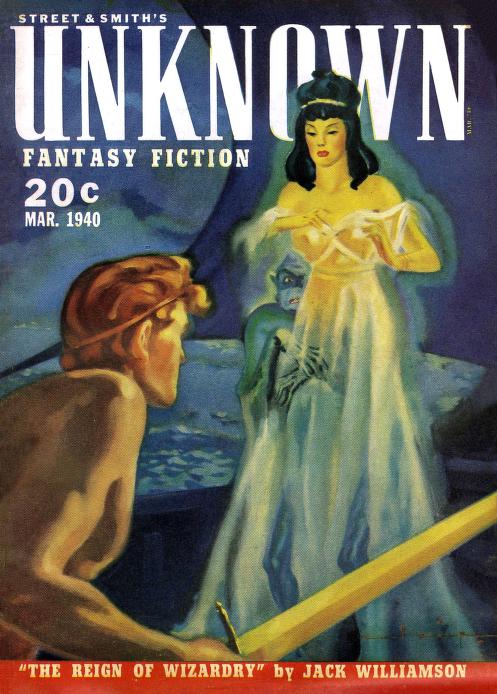





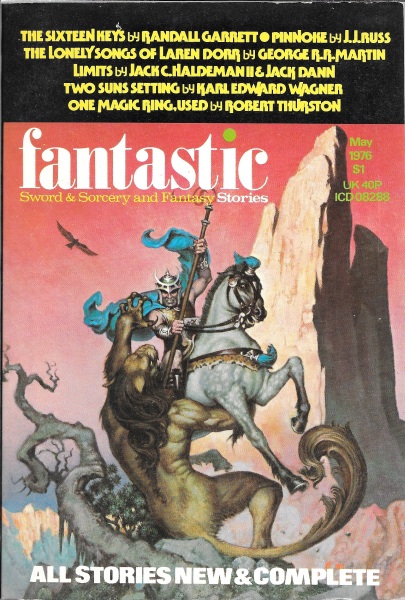

 Science Fiction & Fantasy Remembrance