Nothing unusual for this month, although we do have a couple authors who are not normally associated with SFF, let alone magazine SFF. One of the reasons I decided to make this year more focused on The Magazine of Fantasy and Science Fiction for its 75th anniversary is that, easily more than any of its contemporaries (and F&SF has outlived most of its competitors), is that it has managed to snag authors who otherwise would probably never appear in SFF magazines. It’s quite possible Jonathan Lethem would’ve tried his hand in the magazines regardless of whether F&SF ever existed, but the same can’t be said for Joyce Carol Oates.
I’ve recently been going through another mental health struggle (my bipolar episodes thankfully last hours at a time instead of days or weeks), but that’s not something to be elaborated on—at least not for this post. I may have something in mind having to do with mental illness in certain SF writers that you may or may not see later in the month.
Let’s see what we do have.
For the novellas:
“Oceanic” by Greg Egan. From the August 1998 issue of Asimov’s Science Fiction. Hugo winner for Best Novella. Egan is one of the leading voices of post-cyberpunk, and while mixing SF with detective fiction was a thing pretty much since cyberpunk became a codified subgenre, Egan has gone farther than most in mixing hard science with film noir tropes. Last time we met Egan it was with his mind-bending novella about quantum physics, “Singleton,” but “Oceanic” seems to catch Egan in a very different mode.
“Autubon in Atlantis” by Harry Turtledove. From the December 2005 issue of Analog Science Fiction. Prolific tweeter Harry Turtledove is known as a possibly even more prolific novelist, and while by no means did he invent the alternate history novel he has undoubtedly worked to define that subgenre more than anyone in recent years, especially regarding the American Civil War. “Autubon” is not a misspelling of “autobahn” but refers to the real-life naturalist John James Autubon, who stars in this alternate history story.
For the short stories:
“Friend” by James Patrick Kelly and John Kessel. From the January 1984 issue of The Magazine of Fantasy and Science Fiction. Long-time friends and collaborators, brilliant both solo and together, Kelly and Kessel got their starts around the same time and happened to get involved in the cyberpunk movement, although it would be inaccurate to call either of them cyberpunk writers.
“Drunkboat” by Cordwainer Smith. From the October 1963 issue of Amazing Stories. One of the most unique voices of his day, Smith, as you probably know, is the pseudonym of Paul Linebarger, a respected writer on psychological warfare and consultant on Asian geopolitics. He spent some of his childhood in China. Most of his stories, including this one here, are set in the same future history.
“Mood Bender” by Jonathan Lethem. From the Spring 1994 issue of Crank!. A “literary” author who has never forgotten his roots, Lethem started out in the late ’80s as a genre writer, and indeed his first four novels were all SF before he gained mainstream attention with Motherless Brooklyn in 1999. As with Greg Egan, Lethem has a knack for combining SF with film noir elements.
“Pictures Don’t Lie” by Katherine MacLean. From the August 1951 issue of Galaxy Science Fiction. MacLean debuted just in time for the magazine boom of the ’50s and the first great era for female SF writers. She lived an extraordinarily long time and her career is a distinguished one. “Pictures Don’t Lie” is one of MacLean’s most reprinted stories, and has even been adapted multiple times.
“In Shock” by Joyce Carol Oates. From the June 2000 issue of The Magazine of Fantasy and Science Fiction. Noted tweetsmith Joyce Carol Oates also happens to be one of the most acclaimed living American authors, having won the National Book Award, the Bram Stoker Award, among others. Most of her work is “literary,” but she’s also a somewhat prolific (and quite skilled) writer of horror.
“The Secret Life of Bots” by Suzanne Palmer. From the September 2017 issue of Clarkesworld. Hugo winner for Best Novelette. Palmer was born in 1968 but didn’t make her genre debut until 2012; despite this she has quickly built a reputation as one of the leading authors in the field. She’s been a prolific contributor to Asimov’s especially, but this story marked her first appearance in Clarkesworld.
As you can see this nearly all SF, except for the Oates which is horror, but it’ll also be the last “normal” forecast until September. In July we’re doing all F&SF stories, this time from the ’60s (I covered the ’50s in March), and for August I have a special author tribute in mind.
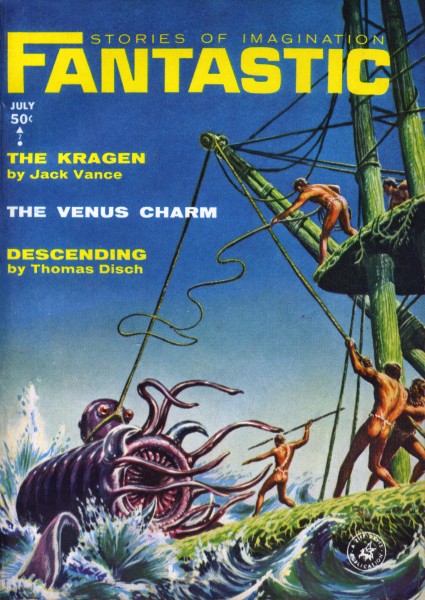
Thomas M. Disch would go down as one of the leading writers of the New Wave era, appearing regularly in New Worlds, and you may even recall I covered the serialization of his 1967 novel Camp Concentration in that magazine’s pages last year. What tends to go ignored, however, is that despite his association with New Worlds it was really Fantastic and Amazing Stories under Cele Goldsmith-Lalli’s editorship that Disch first made his name. He had made his debut in Fantastic in 1962, only 22 years old, and his early work shows a frightening intellect that would see Disch as—along with Samuel R. Delany—an enfant terrible in the ’60s. By his thirtieth birthday he had already written a few novels and enough short stories to fill multiple volumes. Today’s story, “Descending,” possibly shows early Disch at his best; I’d even argue it’s a near-perfect story—except for one thing, which we’ll get to. While ostensibly classified as SF, “Descending” is less conventional science fiction and more existential horror crossed with one of Rudyard Kipling’s machine fables. It’s a real gem of a story.
Placing Coordinates
First published in the July 1964 issue of Fantastic, which is on the Archive. It was reprinted in the October 1992 issue of Amazing Stories, found here. Ironically “Descending” was reprinted online, but you can only access it via the Wayback Machine: it appeared in 2000 on Sci Fiction as a “classic” reprint. For For anthology reprints we have quite a few: 10th Annual Edition: The Year’s Best SF (ed. Judith Merril), Modern Science Fiction (ed. Norman Spinrad), Decade: The 1960s (ed. Brian W. Aldiss and Harry Harrison), and A Treasury of Modern Fantasy (ed. Terry Carr and Martin H. Greenberg). Unfortunately it looks like “Descending” has not been reprinted this century thus far. Can we fix this maybe?
Enhancing Image
Something that occurred to me only now is that we don’t get a name for the protagonist here. Indeed the only named character is the man’s landlady, Mrs. Beale, who appears briefly at the beginning. The man (what else do you call him?) is unemployed, behind on rent, and only able to buy stuff on credit; this was back when credit cards were a relatively new thing. Even his credit score is bad. Immediately we’re introduced to a kind of capitalist nightmare, with the protagonist being seemingly on the precipice of financial collapse, knowing he’d have to land a job soon or else hit the streets. “He had been a grasshopper for years. The ants were on to his tricks.” He’s been avoiding ruin for a minute now, but Disch sets up at the beginning that Our Anti-Hero™ is about to have a very bad day—possibly even a reckoning. It’s an ominous, paranoid start to the story, and things only get more unnerving from there. At a little under 5,000 words this story does not waste out time, but its briskness also feeds into its allegorical nature. It helps that Disch, even at this early stage (he would’ve been only 22 or 23 when he wrote “Descending”), was a fine-tuned prose stylist.
The man takes the subway to get to Underwood’s Department Store, to get some food and a couple books while he’s at it. (“What’s a department store?” is a question zoomers would be asking, and rightfully so, while also asking, “What are malls?”) He gets some groceries, including a pheasant (raw or pre-cooked he doesn’t know), plus copies of Vanity Fair and Middlemarch, of which the former he starts reading on his escalator ride from the top floor of the department store. Worth mentioning that Vanity Fair‘s subtitle is A Novel Without a Hero, and similarly “Descending” could be considered a short story without a hero, or even without characters in the traditional sense. The man is a schmuck, sure, but past that we get to know very little about him; he’s less a flesh-and-blood person and more a stand-in for man’s anxieties in an industrialized capitalist society. It’s also while reading Vanity Fair on the escalator that he realizes that he has been on this thing for, at the very least, half an hour at this point. Probably much longer. Indeed, he calculates he’d been going from escalator to escalator, ever downward, for over an hour, going from the top floor down to the basement—and then past it. He runs the numbers and it doesn’t look good. “He was in the one-hundred-fifty-second sub-basement. That was impossible.” Indeed it would be impossible, unless you’re in a nightmare.
“Descending” is obviously horror, but past that it’s hard to categorize. I tepidly count as it as SF because the role technology plays in the narrative, although it’s worth noting that we never get an SFnal rationale for why the department store escalators go down seemingly forever. This sort of thing just happens. Like I said earlier, it would be more accurate to call this story a machine fable rather than SF—one with a very dark hue. We also never encounter anyone on the escalators, such that the protagonist is unable to seek out an explanation from some third party, nor even to verbalize his anxiety to another human; it’s just him and the surreal depth of the escalators, which seem to only go down, not up. There are stairs, but at this point it would take hours to go back up to the surface that way. Aside from a water fountain every other floor the man only has his groceries to feed on; he even eventually eats the pheasant, without cooking it or anything. Gradually the man is reduced to a kind of savage. The hours turn into days. A small comfort is that with the total lack of life in the sub-basements he can relieve himself without shame. He’s torn between using the stairs, maybe in vain, to get to the surface, and wanting to see how far down the escalators go. It occurs to him that he’ll probably die here.
“Descending” is clearly an allegory, but this also raises a problem: an allegory for what? When we talk about fables and allegories we talk about something that was written to express a certain meaning, often textual if not thinly buried in subtext. This type of work is not as common now as it would’ve been in the 19th century and earlier, having emerged from actual fables (precursors to the modern short story) and epic poetry, but still there are modern examples. Steinbeck’s The Pearl is an allegory about the inherent violence of greed. Watership Down is basically a retelling of Exodus. Animal Farm is about how the Bolsheviks had murdered the Revolution in its crib. “Descending” is not as obvious about the substance of its allegorical intent, and this is where Disch starts to taunt the reader, hanging the story’s meaning like a carrot on a stick. The protagonist compares himself at different points to works of literature, including The Divine Comedy (very likely an inspiration for this story) and Robinson Crusoe, and it’s like Disch is baiting us into making a connection that ends up being hard to articulate. It’s a story about machinery, the vanity of a down-on-his-luck man, and capitalist automation, but it’s hard to parse what Dish is saying about these things. What makes it work is that even if we are to give up on untangling the substance of the fable, the primordial fear that Disch invokes is effective such that the struggle to make sense of it stops being a concern, much like how the protagonist stops trying to make sense of it. “Because he was hungry and because he was tired and because the futility of mounting endless flights of descending escalators was, as he now considered it, a labor of Sisyphus, he returned, descended, gave in.”
There Be Spoilers Here
I do have one gripe, which is the very end. The ending is not ambiguous so much as it’s worded ambiguously. The protagonist gives up and lies down on the escalator steps, and the last sentence raises a question as to what becomes of him. “That was the last thing he remembered.” Does he die, or lose his sanity? Does someone find him eventually? The wording implies he doesn’t die, but then why “remembered”? I wish writers would be more to-the-point when writing a character’s death. The thing here is that Disch had an amazing premise and knew what to do with it for 95% of the story, but then I’m pretty sure he didn’t know quite how to end it. Given the references to Sisyphus and Dante I feel like Disch could’ve ended on a note that’s at one point less ambiguous and at the same time a lot more audacious. The man wonders if he’ll reach the center of the earth if he keeps going down, but we never see the bottom of the machinery; maybe there is no bottom, like how in Mulholland Drive there may not be a mystery, once you try getting under the surrealism and free association. “Descending” doesn’t so much end as it comes to a stop, once the protagonist finds he can no longer go on and perhaps also when Disch finds he has run out of juice. It’s a little blemish on otherwise excellent writing, probably not enough to not make me give if five stars (if I gave ratings here).
A Step Farther Out
I suspect “Descending” was published in Fantastic because it’s one of those genre-bending stories that’s hard to tame. It’s been reprinted in SF and fantasy anthologies. It also had the misfortune of being published one year prior to the first Nebulas, as I think it would’ve been a shoe-in for a nomination there. (Seemingly every third short story printed in 1965 got a Nebula nomination, but “Descending” would’ve actually been deserving of it.) Disch was on a roll at this early period, and while he doesn’t quite stick the landing here, it’s such a good performance overall that I have to give it a hearty recommendation. Sometimes I struggle to write a review for something because I unfortunately felt I was not given much to talk about, but with “Descending” I had the opposite (and much better) problem: this story was almost too dense for me to write about it. Rest assured we’ll be returning to Disch before too long.
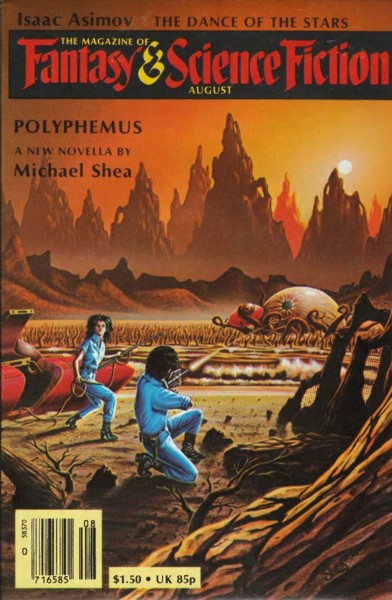
Michael Shea had a pretty interesting career, being one of those authors who started out writing novels before branching out to short fiction; his first novel, A Quest for Simbilis, preceded his first short story by a few years. The result is that by the time of his first short stories he was already a seasoned writer, although I’m still surprised that his most famous story, “The Autopsy,” was only his third published. Today’s story is his fourth. I have to admit I feel bad, because I don’t have a great deal to say about “Polyphemus.” Not to say it’s a bad story—it’s a curious throwback that tries to combine Golden Age planetary adventure with scientific plausibility, plus a generis dose of symbolism and literary references. It can be thought of as almost a companion piece to “The Autopsy,” being concerned with alien biology and, to some extent, an SF-horror hybrid, although “Polyphemus” leans much more on the Sf side of the equation.
Placing Coordinates
First published in the August 1981 issue of The Magazine of Fantasy and Science Fiction, which is on the Archive. It’s been reprinted only a few times, in The 1982 Annual World’s Best SF (ed. Arthur W. Saha and Donald A. Wollheim), and the Shea collections Polyphemus and The Autopsy and Other Stories. The former has gotten a very recent reprint from Valancourt Books—so recent ISFDB hasn’t consistently listed yet.
Enhancing Image
Humans have begun colonizing the planet Firebairn, which is technically hospitable but not exactly welcoming, what with the volcanic activity and the sea life. We have a “sand-hog,” a ship with a few smaller scout boats attached, along with a crew of people hunting “delphs,” which are the native food of choice for the colonists. It’s here we run into our first problem with the story, which is that within the first few pages we’re introduced to over half a dozen characters, a few of whom have no personality to speak of. We have Captain Helion, technically the leader of the expedition although he ends up not being the protagonist. We have Nemo Jones, who does end up being the closest this story has to a protagonist, along with his love interest Sarissa Wayne. We have Japhet Sparks, the ship’s cartographer. We have Orson Waverly, a biologist who will come to be the story’s leading expert on that language we avid readers know: Expositionese. And there are several other named characters I don’t care to dwell on.
Mind you that this is a short novella, and we’re expected to become familiar with at least a few of these characters. Obviously the same can’t be said for some others, since early on we lose a couple redshirts to the monster Waverly comes to call Polyphemus—after the cyclops. It’s fitting, considering the giant tentacled alien the colonists face off with also has one eye, and turns out to be not a very intelligent creature, instead basing its power on size and a complex sensory network. Polyphemus is a carnivore and a competitor for the delph food supply, on top of seeing the humans as potential prey. Thus we have a basic conflict of those who want to kill the alien juxtaposed with Waverly, who wants to study Polyphemus more than kill it. Of course, trying to understand how the monster works on the inside may be the key to killing it, which is how we get into lengthy passages of scientific jargon, most of which (it shames me to say) flew over my head. It would be inaccurate to call this story “hard” SF, but it takes a modern (for the time) approach to what would’ve been an old-fashioned premise even in the early ’80s. Funny thing is that is “Polyphemus” is an update of an Campbellian space adventure published in 1941, there’s now more of a time gap between “Polyphemus” and now than “Polyphemus” and that hypothetical story. The “modernized” update now seems to be old-fashioned itself.
Let’s talk references. Polyphemus itself is named after a cyclops in Greek mythology; and speaking of Greek mythology, we have a piece of equipment called a medusa, which contributes to the climax. Nemo Jones is presumably named after Captain Nemo of 20,000 Leagues Under the Sea, although he has very little in common with his namesake. And of course any story of this nature is gonna invoke comparisons with Moby-Dick and, more recently (indeed it would’ve been recent when Shea wrote the story), Jaws. Here’s the problem: the actual whale-hunting in Moby-Dick takes up maybe a third of the novel. If you were to cut Moby-Dick down to “the essentials” you would be left with a brisk 250-page adventure on the high seas—and also a far less interesting novel. There’s so much character and world depth (never mind the beauty of Melville’s language) you would be missing out on that you may as well be reading a different novel. And at the same time “Polyphemus” is too long for having such a simple plot and such thinly drawn characters, which I understand sounds like a contradiction to what I had just said. Take for instance the romance subplot between Nemo and Sarissa: we know basically nothing about either of these characters, the result being that we aren’t allowed to care much if they live to reunite at the end. This could be fixed by either removing the subplot, if we were to shorten “Polyphemus” by several thousand words, or we could flesh it out if we expanded the story into a full novel—only that would raise more problems.
My point is that Shea was ambitious with this one, and yet somehow he also didn’t go far enough. It lacks the perfect self-containment (never mind the layers) of “The Autopsy,” but it’s also possible I’m just saying that now and might feel different later. It’s possible I’m underestimating this story and as such am not putting the necessary work into it.
There Be Spoilers Here
I wish I had more to say…
A Step Farther Out
A criticism I often throw at modern SF novels is that they could’ve been shorter; we don’t necessarily need something to be 500 pages. This also sometimes applies to novellas, such as “Polyphemus,” which is about 20,000 to 22,000 words but could’ve been finessed with to have been turned into a novelette, or about the same length as “The Autopsy.” There are a few too many characters and ultimately there’s not enough of a plot to chew on. Shea’s attempt at making the movie monster at the heart of the story seem scientifically plausible is worth commending, but ultimately Prometheus is still that—a movie monster. Similarly the characters are a case of spreading too little peanut butter over too wide a slice of bread, so that the humans at times also seem like their B-movie counterparts. It’s possible I’ll come away feeling different on an eventual future reread, but my first impression left me sort of at a loss. Sorry to say.
Not much to say with regards to updates here, other than I’m looking into a tutoring gig and I seem to be starting a polycule, the latter of which I’ve heard is kinda like starting a rock band. If anyone wants to join, please let me know. There are no gimmicks for this month’s review forecast, except that we have a complete novel on our hands for the first time in what feels like forever, and we’ve got a few familiar faces returning to the site. I may have also intentionally picked Lucius Shepard and Aliette de Bodard stories with similar titles. One thing I’ve been thinking about that I’ve decided to act on is reviewing more reprints of classic stories; one every couple months seems like a good deal. The reason for this is at least twofold: I have a soft spot for the classics, but I also wanna cover authors from the pre-pulp years who contributed to genre fiction. This month I’ll be reviewing an SF story by Jack London, who is not known primarily for his SF but who indeed wrote a lot of it. Once again Jack Vance will be providing the novel, which is unsurprising since quite a few of his novels first appeared in magazines, either as serials or all in one piece like this month’s novel.
Don’t wanna keep you long; just letting you know we have another month packed with fiction that looks to be at least interesting, although it’s mostly SF with a couple fantasy stories thrown in.
For the novellas:
“Birthright” by April Smith. From the August 1955 issue of If. Smith sadly is one of many women who wrote SF in the pre-New Wave days whom we know basically nothing about. We don’t know when she was born or when she died. She’s a ghost. She has one solo story, “Birthright,” to her credit, plus one collaboration. ISFDB classifies this story as a novelette, but running the Project Gutenberg text through a word processor shows it’s just over 17,500 words.
“Polyphemus” by Michael Shea. From the August 1981 issue of The Magazine of Fantasy and Science Fiction. Shea had a varied career, lasting from the ’70s until his death in 2014. His work ran the gamut from SF to high fantasy to the Cthulhu Mythos. He won the World Fantasy Award multiple times for his fantasy and horror. His most famous story, “The Autopsy,” is an SF-horror hybrid, and “Polyphemus” looks to be a similar blend of the two genres.
For the short stories:
“The Shadow and the Flash” by Jack London. From the June 1948 issue of Famous Fantastic Mysteries. First published in 1903. London was one of the most popular and prolific authors of the early 20th century, despite dying young. He’s best known for his adventure stories set in the Klondike, such as The Call of the Wild and White Fang, but he also wrote a surprising amount of science fiction.
“The Witch of Orion Waste and the Boy Knight” by E. Lily Yu. From the September-October 2016 issue of Uncanny Magazine. Yu burst onto the scene with her story “The Cartographer Wasps and the Anarchist Bees,” which nabbed her several award nominations. She won the Astounding Award for Best New Writer the same year she graduated from Princeton, which is no small feat.
“The Jaguar Hunter” by Lucius Shepard. From the May 1985 issue of The Magazine of Fantasy and Science Fiction. Speaking of late bloomers, Shepard didn’t start writing fiction as an adult until he was deep in his thirties, but he quickly emerged as one of the defining SFF writers of the ’80s. If you’ve read enough Shepard then you know he has a “type,” and this story looks to be typical Shepard.
“Descending” by Thomas M. Disch. From the July 1964 issue of Fantastic. Feels like it’s been a long time since I covered Disch, with his novel Camp Concentration. Disch was one of the daring young writers to kick off the New Wave in the ’60s, although despite being a regular at Michael Moorcock’s New Worlds he actually first appeared in Fantastic, under Cele Goldsmith-Lalli’s editorship.
“The Defenders” by Philip K. Dick. From the January 1953 issue of Galaxy Science Fiction. It’s been ten months since I last talked about Dick on here, which in my book is too long a wait. The thing about Dick is that he’s become frankly over-discussed in “serious” SF discussions, or at least his most famous novels. Thankfully this is not the case with many of his short stories, such as this one.
“The Jaguar House, in Shadow” by Aliette de Bodard. From the July 2010 issue of Asimov’s Science Fiction. Of Vietnamese heritage, living in France, and writing predominantly in English, de Bodard has a curious cultural background, so it makes sense she would concoct one of the most curious future histories in modern SF. Spacefaring humanity here is decidedly non-white and non-American.
For the complete novel:
Planet of the Damned by Jack Vance. From the December 1952 issue of Space Stories. The early ’50s were a formative period for Vance, who was showing himself to be one of the most imaginative talents at the time—albeit one whose efforts were mostly relegated to second-rate magazines. I’ve previously coveredBig Planet, which was a breakthrough title for Vance, and now we’re on Vance’s follow-up novel, published just a few months later. Planet of the Damned has a rather convoluted publication history: as with Big Planet, the magazine version and not the first book version served as the basis for future “definitive” reprints. It’s also been printed as Slaves of the Klau and Gold and Iron.
(Contains spoilers for “The Ash-Tree,” “A Warning to the Curious,” and “‘Oh, Whistle, and I’ll Come to You, My Lad.’”)
Montague Rhodes James was born in 1862 and died in 1936, incidentally the same year as Rudyard Kipling; and with that, English literature lost two of its finest writers of the supernatural. It wasn’t the only thing they had in common: they were both conservatives of a breed that seemed to die out following the erosion of the British empire, both given to a distrust of women (Kipling more explicitly), both seeming to be relics of a prior age—a status which makes them a bit of a challenge for modern readers. More endearingly, both were consummate and compulsive storytellers. Kipling read stories to his children while James often wrote his stories with the intention of reading them aloud to his friends, which he would then do at Christmastime gatherings. They can’t help it; it’s like a second language for them. But whereas Kipling wrote almost every kind of story then conceivable (adventure, fantasy, science fiction, horror, you name it), James wrote only one kind of story: the ghost story. As he admits in “Stories I Have Tried to Write,” a brief but telling essay, “I never cared to try any other kind.” It’s a good thing he was perfect for such a niche job.
I’ve been reading some M. R. James as of late, or in a few cases rereading. I’ve said before that I’m a bit of a slow reader, and even then I struggle to retain information; but there’s also a pleasure in rereading something juicy, and James’s writing often demands closer examination. It’s occurred to me that James really was one of the best horror writers of his time, and he did this despite (by his own admission) being adept at only one specific kind of story. If you read five M. R. James stories in one day (which I wouldn’t recommend, because each requires at least some time to digest) then you will at some point feel like you’re reading five variations on the same story—the primordial M. R. James story which may not exist. “‘Oh, Whistle, and I’ll Come to You, My Lad’” and “A Warning to the Curious” were written more than a decade apart, but read like the offspring of the same mother—or, to evoke the things lurking in the ash tree at the climax of that story, siblings in the same brood, belonging to the same monstrous spider-queen. To make a more film-nerd comparison, James’s fiction is sort of like the movies of Yasujirō Ozu, in that both artists seemed preoccupied with toying with the same set of ideas, creating works that are similar enough to each other, with subtle and at times profound differences.
In James’s case there is a tangible obsession with the distant past—in many cases the positively ancient past. This wasn’t just a hobby for the man, mind you. James was one of those writers who wrote relatively little fiction (his complete set of ghost stories has been printed in volumes under 500 pages) because he had a day job that both covered his ass financially and was respectable. He spent pretty much his whole adult life in academia, at a few different colleges, from undergrad all the way to senior positions. He was a professional medievalist, and he did not fuck around when it came to uncovering artifacts and works of architecture. If he were alive today he might be one of those “lost media” YouTubers, but ya know, more cultured. Something to keep in mind about James is that, being a Briton and living in the UK most of his life (he did like to travel), he had a first-hand conception of the ancient that filthy Americans like myself simply don’t have. For Americans the “ancient” past goes back to about the 1600s, but for someone who’s traveled through the UK and continental Europe this conception of the past goes back several more centuries. In this sense his story “The Ash-Tree” might be one of his most well-known, at least for American readers, because of its dealings with Puritans and the persecution of alleged witches—things Americans are likely to know about. Fans of Nathaniel Hawthorne will be sure to seek out this one especially.
But more often than not the terrors that haunt James’s protagonists are unspeakably old and ethereal, perhaps more monster than man. Not only are the living characters unable to communicate with these apparitions, but they’re barely even able to understand their existence in the physical world. You may be thinking there are only so many ways one can write about ghosts, or even imagine ghosts; but even comparing James to Kipling, or Montague Rhodes to Henry (that other great ghost story writer), shows that there’s more than one way to skin a cat. Indeed, unlike the popular conception of ghosts up to the Edwardian period, James’s (I’m talking about M. R. now) ghosts are decidedly meaner, crueler, more unreasonable, and more impenetrable. Or, to quote H. P. Lovecraft in “Supernatural Horror in Literature,” in which he articulates James’s virtues better than I could:
In inventing a new type of ghost, [James] has departed considerably from the conventional Gothic tradition; for where the older stock ghosts were pale and stately, and apprehended chiefly through the sense of sight, the average James ghost is lean, dwarfish, and hairy—a sluggish, hellish night-abomination midway betwixt beast and man—and usually touched before it is seen. Sometimes the spectre is of still more eccentric composition; a roll of flannel with spidery eyes, or an invisible entity which moulds itself in bedding and shews a face of crumpled linen.
That latter description, by the way, applies to the ghost at the center of what is arguably James’s masterpiece, “‘Oh, Whistle, and I’ll Come to You, My Lad.’” This story, one of the finest ghost stories of all time, also happens to be a perfect encapsulation of James’s wants, fears, virtues, and limitations; it is a microcosm of everything relevant to and about M. R. James. We follow an academic, Professor Parkins, journeys to the coastal town of Burnstow (based on the real town of Felixstowe) for vacation, where he ends up golfing with a fellow at the same inn who mostly goes simply by “the Colonel.” Parkins gets word that there’s an attraction within walking distance of the inn that may be of interest to him: the site of a Templar preceptory, now mostly buried. The site would be at least 600 years old, and yet, England itself being such an old country, there might be something worth digging for. One day Parkins goes to the site as part of his beach walk, and digs out a whistle that, despite being caked in and clogged with dirt, remains miraculously intact. There’s writing on the whistle, in Latin, which Parkins can only partly make out, but which he translates as, “Who is this who is coming?” Having cleaned the whistle, and out of curiosity, he decides to use it. This is a mistake. The whistle’s owner has been dead for centuries, and yet upon Parkins’s discovering the whistle has been brought back into this world—first as a vague human-shaped specter that stalks Parkins on the beach and later taking possession of the aforementioned “crumpled linen.” This might be the only time in history the stereotypical bedsheet ghost is made threatening.
Everything is neatly laid out for us. We have an intellectual but sort of hapless protagonist, a pastoral locale that seems inviting but which houses an ancient evil (locations in James stories always seem either to be wide open spaces or storied buildings like cathedrals and old colleges, no in-between), a spirit of the distant past which is catapulted into the present by some cursed object, and ultimately an anti-intellectual message. For James, the past seems to always be just one bad move away from resurfacing, on a collision course with the present unbeknownst to the latter. The central character of “A Warning to the Curious” takes what is supposedly the last buried crown on England’s coasts, made to stave off foreign enemies, and draws the unwanted attention of something—and, even after returning the ancient crown to its rightful place, he pays for his transgression. Similarly the latest in a line of Puritan landowners falls prey to a witch’s curse that his ancestor had brought upon the family in “The Ash-Tree,” with the witch continuing to wreak vengeance long after her execution. According to James, the past is never dead—merely dormant. In cosmic horror a rule of thumb is to never alert the eldritch horror to your presence, but while James’s ghost stories are not cosmic, they do have a similar rule: do not wake that which is sleeping. All things considered, Parkins gets off lightly.
It’s funny to think that James would revolutionize the ghost story, since he was about as far removed from the revolutionary as is possible. He was a reactionary, a staunch anti-Modernist, a misogynist, and if contemporary accounts are to be believed, a bit of a man-child. He had no sense of worker solidarity, wasn’t remotely interested in making the world a better place, and seemed to be a walking goldmine of useless trivia (again, think “lost media” YouTuber); and yet it could be argued that this sheltered lifestyle, this state of being perpetually knee-deep in the past, had nurtured James’s writing rather than hindered it. Sure, you (possibly left-leaning reader—or maybe not) and I find the politics of, say, H. G. Wells, a lot more agreeable, but I don’t think Wells (at least young Wells) could’ve written such a menacing work of horror as “‘Oh, Whistle’” or “Count Magnus” or “Casting the Runes.” I’ve been having this thought, or rather question, tumbling around in my head lately: Is horror a conservative genre? Very loaded question, probably worthy of its own editorial at a later date. Historically some of the great horror writers were conservative, and certainly the best writers of ghost stories in particular have tended to be right-wing. It could be because conservatives go through life already being stalked by phantoms—by the specters of queerness, feminism, socialism, and what have you. M. R. James is a rare case where his artistry was often fabulous because of his backwards politics, and more specifically because of his crippling fear of the present.
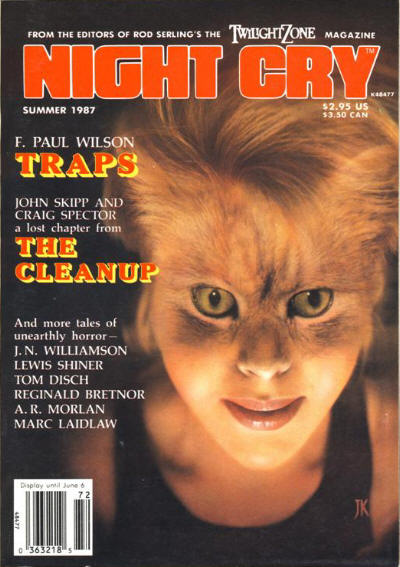
A doctor by day and a bestselling author by night, F. Paul Wilson has had a long and pretty acclaimed career since he debuted in the early ’70s, being one of John W. Campbell’s last discoveries. His fiction can be basically divided into SF and horror, although the two are not mutually exclusive. He has the unique honor of earning both the Bram Stoker and Prometheus Award for Lifetime Achievement, for his horror and libertarian-themed SF respectively. His 1981 novel The Keep was adapted into an ill-fated Michael Mann film. “Traps” itself was apparently adapted into a short film, but I can’t find anything on it. This story is Wilson in pure horror mode, almost written in the allegorical mode but seemingly lacking a moral at its center. It’s an effective little short, and unsurprisingly it got a Stoker nomination. It could’ve worked as an episode of Tales from the Darkside, which is probably not a reference you were expecting.
Placing Coordinates
First published in the Summer 1987 issue of Night Cry, which was a reprint-oriented sister mag to Twilight Zone Magazine. It’s not on Internet Archive, but it is on Luminist. It then appeared in the Wilson collections Soft and Others and Ad Statum Perspicuum. For anthology appearances we have 100 Fiendish Little Frightmares (ed. Stefan Dziemianowicz, Martin H. Greenberg, and Robert Weinberg) and Piercing the Darkness: A Charity Anthology for the Children’s Literacy Initiative (ed. Craig Cook).
Enhancing Image
This story is not quite ten pages, so let’s get right into it. Hank is a do-gooding husband with twin daughters, and the family has recently moved into a rural-ish Jersey suburb where their house is one of maybe two on the street. (Incidentally the first house I lived in was similarly one of the first in a new development, and also in Jersey.) The scenery is nice, but the problem is with all the critters, which Hank is loathe to deal with. “He didn’t like killing anything. Even ants. Live and let live was fine with him, but he drew the line at the threshold of his house.” There’s especially been a mice problem, in the attic, with one of those hatches that unfurls a set of steps. Let’s face it, no one likes to go into the attic for whatever reason, although I would say the older the house the creepier the attic becomes. More history that way. In Hank’s case he’s had to take pains to set up mousetraps in the attic, and he has to do all this in secret so as to not traumatize his young daughters, who are big Mickey Mouse fans and who are set to go to Disney World very soon. “Kids had Disney World on the East Coast and Disneyland on the West. Katie and Kim would start out on their first pilgrimage Thanksgiving morning.” And yet there was still the mice problem.
The business is already morbid enough, but things get weird when Hank finds the traps are working—and also only the heads of the mice remain. The bodies are missing, or more accurately something must’ve taken the bodies. “Something had eaten the dead mice. Something bigger than a mouse.” And there’s an awful smell slowly growing from the attic that can’t just be rodent corpses. What’s neat about “Traps” is how economical it is: there’s barely any dialogue; there are only four characters to speak of, only one of whom really matters; we’re given a gruesome if technically mundane situation, only for there to be a twist in the routine; and we’re given a reason for why Hank would be going about this by himself. This all happens in the span of a few pages. Let’s talk about what David G. Hartwell, in his seminal anthology The Dark Descent, considered the three basic classes of horror: allegorical, psychological, and supernatural. Obviously, as Hartwell admits, the three are not mutually exclusive, and indeed with a lot of stories you’ll find some balance of two of these classes. “Traps” reads almost like an allegory, with some kind of moral message the reader is supposed to take away from it—only there doesn’t seem to be one. It does, however, work similarly to a fable you might read aloud to your children. Not that I’d recommend showing “Traps” to kids unless you wanna make sure they get no sleep for a few days; but then it could feasibly be understood by a younger readership, since Wilson’s style is straightforward, concise yet gripping, and while there’s violence it’s not too graphic.
Then there’s the psychological aspect. We can infer that whatever lurks in the attic is probably not a racoon or badger, but another part of the sense of looming doom is Hank listening for the mousetraps as they go off with a snap, often in the dead of night, and having to check the results the next morning. to make things worse, something has been sneaking into the attic through a vent, which Hank has to nail shut in the hopes this does the trick. At this point I would’ve forked over the money to hire an exterminator, but a) this is on short notice, since the family’s leaving for Disney World in a few days, and b) with hindsight it’s safe to say an exterminator wouldn’t have been able to help much with the thing in the attic. Our normal everyman Hank is thus faced with a dilemma: he could call someone take care of the issue, to the inconvenience and possible trauma of his family, or he could try taking care of the problem himself. Ultimately he goes with the latter, which turns out to be a very bad idea—which if you’re familiar with horror tropes you would’ve guessed already. “Traps” is the kind of setup-payoff horror story that’s determined to end on a bad note for the protagonist, but it’s the execution that matters most here.
There Be Spoilers Here
I said earlier that “Traps” fits primarily into the allegorical and psychological classes of horror, but this isn’t quite true as we do get a quick dose of that third class at the very end. Hank, seeing that something had come through the vent, is understandably worried about this. Unfortunately for Hank and even more unfortunately for his family, as he had left the hatch to the attic open, a monster, “big as a rottweiler, brown scruffy fur, a face that was all mouth with huge countless teeth, four clawed arms extended toward him as it held onto the beams above with still two more limbs,” killing him all but instantly. In the last seconds of his life realizes two things: that he’s being killed by some unspeakable horror he could not have possibly anticipated, and that he has unwittingly and probably doomed his family to being eaten by the same creature. This all happens in literally the last paragraph of the story, and I have to admit in the couple days since I read “Traps” this ending has stuck with me, for its suddenness and inexplicableness. There’s no reason (at least none I could pick up) for why there should be a six-limbed carnivore the size of a large dog and with about as many teeth as a shark should exist and be living in this family’s house specifically. It’s a complete break from reality that the story alludes to heavily and yet does not try to rationalize. The result is an ending that I find disturbing, for its implications but also for the sheer nightmarish quality of it.
A Step Farther Out
Wilson has been prolific for the past half-century and change, although sadly he has written relatively little short fiction. It’s a shame because the standalone horror stories I’ve read of Wilson’s have all been pretty strong. “Traps” is short, almost a vignette, but it has a finely laid out setup-and-payoff structure that makes the ending so disturbing, even if it’s also predictable. You can write horror that the reader can anticipate and get away with it so long as you effectively discomfort the reader as they await the inevitable. It’s stuck with me the more I’ve thought about it.
Frank Belknap Long had an exceedingly long life and career, born in 1901 and writing from about 1920 to well into the ’80s. He was close friends with H. P. Lovecraft, and was the first author to contribute to the Cthulhu Mythos, although it wasn’t called that in Lovecraft’s lifetime. “The Hounds of Tindalos” was Long’s third Mythos story, despite Wikipedia calling it the first to not be written by Lovecraft. This one story would have a rather large influence on Mythos fiction to come, with the hounds themselves even appearing later in Lovecraft’s “The Whisperer in Darkness,” in one of several instances of Lovecraft inspiring and in turn being inspired by others in the so-called Circle. There’s even an anthology of Mythos stories by different writers featuring the hounds. By the ’40s Long would move away from cosmic horror and focus more on science fiction, and indeed “The Hounds of Tindalos” is an early example of Long marrying the weird with the scientific, creating a structurally flawed but pretty memorable SF-horror narrative with an iconic monster at the center. It’s one of the more influential cosmic horror stories, and that’s because Long effectively utilizes one of the scariest things known to man: basic geometry.
Placing Coordinates
First published in the March 1929 issue of Weird Tales. It was then reprinted as a “classic” in the July 1937 issue. It first appeared in book form in the Long collection of the same title, with a pretty gnarly Hannes Bok cover for the first edition. We also have Avon Fantasy Reader #16. For anthology appearances there’s Tales of the Cthulhu Mythos: Volume 1 (ed. August Derleth), The Spawn of Cthulhu (ed. Lin Carter), and The Science Fiction Century (ed. David G. Hartwell).
Enhancing Image
Frank is an average guy who happens to be buddies with a real eccentric in the form of Chalmers, a sort of scientist-mystic who has contrarian views regarding objective reality. His library is filled with books on alchemy and theology, and “pamphlets about medieval sorcery and witchcraft and black magic, and all of the valiant glamorous things that the modern world has repudiated.” Or as Charles Fort would’ve put it, the excluded. Chalmers rejects what would’ve been conventional scientific narratives in 1928, although to Frank’s mild relief he does see Einstein as a kindred spirit, “a profound mystic and explorer of the great suspected.” Chalmers has a hypothesis that time, the fourth dimension, is actually an illusion, there merely because without it the human mind would wither at being able to see everything happening simultaneously. To test this he has concocted a drug which, if successful, should have the effect of breaking down that barrier. He wants Frank to be there as witness, and to act if something goes wrong. This is like your friend trying LSD for the first time and having you stay in the room with them for hours on end as a sober spectator, although LSD had not yet been invented when Long wrote this story.
Drugs play a surprisingly large role in the history of cosmic horror writing, although in the ’20s and ’30s these things were treated with utmost skepticism, if not contempt. In the context of a cosmic horror narrative the ambivalence makes sense. Sure, Aldous Huxley would later argue for the positive potential of hallucinogens, but for fiction with an overall thesis of “There are things man is better off not knowing,” it makes sense to go on an anti-drug screed. I’m not sure what experience Long would be basing his writing of this fictional drug on, although it seems he had been reading the Tao Te Ching and found it inspirational—but not for religious reasons. Chalmers takes the drug, which takes effect “with extraordinary rapidity,” and to say he has a trip would be understating it. What Chalmers expected happens, in that he not so much hops across bodies through time but experiences all these different perspectives at the same time; it’s that he can only convey this information to Frank in a linear fashion. But there’s something much more concerning that rears its head in the midst of this trip, which only Chalmers can see (not so much see as comprehend) and which forces Frank to break him out of the trance.
Let’s talk about the hounds, since they’re the star of the show, which is saying a lot since they never technically appear. We never see the hounds because they don’t exist in three-dimensional space. As Chalmers says, “There are […] things that I can not distinguish. They move slowly through angles. They have no bodies, and they move slowly through outrageous angles.” They’re only called hounds because Chalmers really isn’t sure what else he can call them; they’re certainly not like any dog in the real world, and they might only be distantly related to something mythical like Cerberus. In line with Lovecraft’s own conception of morality, the hounds are evil, but only as understood by humans. They act simply according to their nature, which apparently is an unspeakably horrific one. Or, as Chalmers says:
“They are beyond good and evil as we know it. They are that which in the beginning fell away from cleanliness. Through the deed they became bodies of death, receptacles of all foulness. But they are not evil in our sense because in the spheres through which they move there is no thought, no morals, no right or wrong as we understand it.”
Because Chalmers broke through the barrier of time he also stepped into the hounds’ domain, which if you know your cosmic horror is always a fatal mistake. The worst thing you can do in this kind of story is to alert the eldritch horror to your presence. So, there are basically two kind of geometry: curves and angles—cleanliness and foulness. Which sounds a bit silly as I’m saying it, but I respect Long for trying to apply a scientific rigor to something which refuses to be understood in human terms, even if math is supposedly the language of the natural world. This melding of the weird and scientific might’ve helped inspire Lovecraft in his own later, more SFnal Mythos stories, such as At the Mountains of Madness and “The Shadow Out of Time.” I can’t say for sure because I’m a layman and not a scholar. If you’re a Lovecraft scholar then feel free to call me a dumbass. Anyway, what makes the hounds memorable, despite never being seen in-story (though this hasn’t stopped people from trying, such as the aforementioned Bok illustration), is that they’re threatening while also not being god-like figures like Cthulhu or Shub-Niggurath; these are animals basically, as their name indicates, but they’re not puppers you’d wanna pet.
Unlike some other contemporary attempts at writing cosmic horror, Long’s language is fairly unadorned; even Chalmers, who is given to monologuing, is not as verbose as the average Lovecraft narrator. Frank (who might be a stand-in for Long) is less a typical cosmic horror narrator and more riding shotgun to the poor sap who normally would be narrating. Long might’ve done this one-degree-of-separation tactic because Chalmers is such an eccentric and so detached from normal human behavior that the reader (the God-fearing Christian reader who might dabble in the occult as a tourist) might not have anything to latch on to. This decision seems like a good idea, but as we’re about to see, it does have a serious drawback, which in my opinion stops “The Hounds of Tindalos” from entering masterpiece territory and instead relegates it to the realm of “pretty good.” I mean, there are far worse things you can be than pretty good.
There Be Spoilers Here
The story is split into five chapters, of which the first is by far the longest; this first chapter puts us in Frank’s shoes and the result is one long scene that happens in one location. So far so good. The second chapter, much shorter, sees Frank and Chalmers plastering up the angels in the latter’s room, since the hounds have been alerted and, as said before, enter through angles. But then Long makes the odd decision to jettison us from Frank’s flesh prison (Frank himself basically disappears from the narrative), and to switch perspectives to what seems to be a third-person view—and then to switch perspectives yet again. All in the span of just a few pages. Perspective, especially in a short story, is an important thing to keep consistent, and it’s a rule Long violates without (I would think) just cause. Of course things don’t turn out well for Chalmers; when do they ever. I think the last cosmic horror story I read where the protagonist/narrator comes out of the ordeal more or less intact was Robert E. Howard’s “The Black Stone” (review here); and yes I do consider Chalmers the real protagonist of Long’s story. On the plus side, Chalmers’s death manages to be both gory and genuinely creepy: authorities find his body with his head removed and placed on his chest, and yet there’s not a drop of blood at the scene. And to make things weirder there’s protoplasm on the body. Certainly no human could’ve done such a clean job, one that seems physically impossible—unless your existence is deemed physically impossible by known science.
A Step Farther Out
As I’ve been getting more into horror fiction I think I’ve come to appreciate the efforts of the “old masters” more. The irony with Long is that he would outlive Lovecraft and Howard by decades, but he never garnered even close to the amount of respect and impact as them—in death or in life. When he died he was so poor that he was initially buried in a potter’s grave, and it was only because of several big names in the weird fiction scene banding together that allowed him a proper burial about a year later. Clearly there’s some respect there, but if Long gets mentioned nowadays it’s very likely because he was buddies with Lovecraft. I know I haven’t helped with that problem. “The Hounds of Tindalos” points toward a talent who does indeed take after Lovecraft but whose priorities might lie elsewhere. If anything the quality of this story has made me curious in Long’s later, more mature work, albeit I know he drifts away from the cosmic.
(Cover by Frank Kelly Freas. Analog, December 1972.)
As has unfortunately become commonplace, there have been a few deaths in the family. Christopher Priest and Brian Stableford died in February and Vernor Vinge little over a week ago. This last one hit me by far the hardest. Obviously there are some people I’m not mentioning, but unfortunately unless I really wanted to I can’t cover everyone. There’s too much. The past month or so has been rough for me. I had a nasty fall a few weeks ago and I seem to have acquired mild PTSD from it. Half of my face got messed up and I ended up spending some time in the ER. Obviously I’m doing better now. Yet somehow I don’t feel totally “right.”
Hopefully some good (or at least interesting) fiction will help me! We have a nice mix: two SF novellas, plus two SF short stories, two fantasy, and two horror. Or at least these stories seem to fit predominantly into those genres; obviously they’re not mutually exclusive.
For the novellas:
“A Woman’s Liberation” by Ursula K. Le Guin. From the July 1995 issue of Asimov’s Science Fiction. One of the most universally beloved of all SFF writers, Le Guin started relatively late but would enjoy a very long and acclaimed career. She’s one of the few authors to enjoy about equal reverence for both her SF and fantasy. Her Hainish Cycle, especially The Left Hand of Darkness and The Dispossessed, might constitute her best and most important work overall. “A Woman’s Liberation” is set in the same universe as those novels, and is a loose sequel to “Forgiveness Day” and “A Man of the People.”
“Palely Loitering” by Christopher Priest. From the January 1979 issue of The Magazine of Fantasy and Science Fiction. British Science Fiction Award winner for Best Short Fiction. Priest died in February, after a career spanning more than half a century. His 1974 novel Inverted World is something of a cult classic. His 1995 novel The Prestige was turned into a movie by Christopher Nolan. ISFDB classifies “Palely Loitering” as a novelette, but at about forty pages in F&SF I suspect it counts as a novella. It got a Hugo nomination for Best Novelette but placed third in the Locus poll for Best Novella.
For the short stories:
“The Hounds of Tindalos” by Frank Belknap Long. From the March 1929 issue of Weird Tales. Long had a ridiculously long (ha) career, spanning from the 1920s to his death in 1994. He was a close friend of H. P. Lovecraft and the two seemed to take inspiration from each other, with “The Hounds of Tindalos” being one of the first Cthulhu Mythos stories not written by Lovecraft.
“Traps” by F. Paul Wilson. From the Summer 1987 issue of Night Cry. A doctor by day and a bestselling author by night, Wilson is the only person to have earned both the Bram Stoker and Prometheus Award for Lifetime Achievement. He likes to hop between science fiction and horror, with the two not being mutually exclusive. “Traps” itself was a Stoker nominee for Best Short Story.
“The Swordsman Whose Name Was Not Death” by Ellen Kushner. From the September 1991 issue of The Magazine of Fantasy and Science Fiction. Kushner got started in the ’80s writing Choose Your Own Adventure books before turning to proper fantasy literature and even radio. This story is set in the same universe as her novel Swordspoint but, as far as I can tell, is not a sequel.
“Two Suns Setting” by Karl Edward Wagner. From the May 1976 issue of Fantastic. British Fantasy Award winner for Best Short Story. Wagner was a devotee of both horror and sword-and-sorcery fantasy. His Kane series very much follows in Robert E. Howard’s footsteps, but Wagner at his best was a genuine poet as well. “Two Suns Setting” was his first (and I think only) appearance in Fantastic.
“Original Sin” by Vernor Vinge. From the December 1972 issue of Analog Science Fiction. Despite debuting in 1965 and remaining active until about half a decade ago, Vinge’s output is fairly small; but, given the five Hugo wins, he certainly did something right. “Original Sin” is one of Vinge’s more obscure stories, but I went with it on the recommendation of a certain colleague.
“The Growth of the House of Usher” by Brian Stableford. From the Summer 1988 issue of Interzone. Stableford passed away in February after a very long and winding career. (Incidentally Priest, Vinge, and Stableford all debuted within a few years of each other.) He was a prolific translator of French SF and contributed to the SF Encyclopedia, on top of a massive amount of fiction.
Charles Beaumont was one of a generation of SFF writers who may have started out in the pulps, but who quickly adopted a style that allowed them to enter the slicks—possibly even attract mainstream attention. Beaumont debuted in the January 1951 issue of Amazing Stories with “‘The Devil, You Say?’,” which he would much later adapt into one of the more iconic episodes of The Twilight Zone, for which he was a prolific contributor. Like Ray Bradbury and Richard Matheson, Beaumont played fast and loose with genre conventions, but ultimately one could consider him a horror writer. It should come as no surprise that he would write a few scripts for Roger Corman movies, including an adaptation of his own novel (his only solo novel, sadly), The Intruder. In the ’50s and early ’60s he was one of the best short story writers, and his list of classic stories (“Perchance to Dream,” “The Jungle,” “The Howling Man,” etc.) is impressive.
No doubt Beaumont would’ve kept going, maybe even made his big break as a screenwriter, had a horrific illness (likely a combination of Alzheimer’s and Pick’s disease) not eaten away at his brain in the last few years of his life. He apparently looked and acted like a man who was pushing ninety when he died in 1967, at 38 years old. Beaumont’s early death is surely one of the more tragic losses in the field’s history, made worse because he stopped writing right before the New Wave kicked in. But today’s story, “Free Dirt,” shows a young and hungry Beaumont, arguably at the height of his powers as a short story craftsman. Here we’re presented with a ruthless and ironic horror yarn in the allegorical mode.
Placing Coordinates
First published in the May 1955 issue of The Magazine of Fantasy and Science Fiction, which is on the Archive. It has since been reprinted in The Graveyard Reader (ed. Groff Conklin), The Best Horror Stories from the Magazine of Fantasy and Science Fiction (ed. Edward L. Ferman and Anne Jordan), and now can be found pretty easily in the Beaumont collection Perchance to Dream: Selected Stories.
Enhancing Image
Mr. Aorta (what an odd name) is a scoundrel. I don’t mean in the sense that he chases after women or loves gambling, but that Mr. Aorta is a cheapskate to the point where he’ll dupe other people into not making him pay for anything. Beaumont set out to write a thoroughly detestable protagonist, but he had a challenge on his hands: making someone utterly loathsome without also making him a rapist or murderer. Now, Mr. Aorta is a thief, but being a thief doesn’t necessarily make you a bad person; rather it’s his devotion to cheating other people out of their dues that makes him a shithead. He sees thievery as like a craft. Consider how he has gotten not having to pay train fare down to a science: “Get in the middle of the crowd, look bewildered, inconspicuous, search your pockets earnestly, the while edging from the vision of the conductor—then, take a far seat and read a newspaper.” He doesn’t seem to have a job, instead living off all but picking other people’s pockets, even going so far as to impersonate a homeless man and ask for change whilst having his own house. You have to admit, this is rather monstrous behavior, and Beaumont does a great job at setting up his loathsome character for failure.
We know Mr. Aorta is greedy by his actions, but also by how he looks: he is described as grotesquely fat. I’m not even sure if this counts as a negative criticism, but I wanted to acknowledge it, since obesity has been used for centuries as shorthand for a few different meanings, though they are by no means exclusive. It depends on context, of course. More often an obese person is framed as being greedy and/or glutenous, especially with a penchant for overeating; more abstractly it can symbolize the infinite wealth-seeking of capitalist industry (when we talk about “fat cats” we’re talking about fat guys in fancy suits chomping cigars). More optimistically it can symbolize happiness or contentedness: Santa Claus is always depicted as rotund and the Buddha is sometimes depicted as quite massive, despite the historic Buddha certainly not having those proportions. In Beaumont’s story, Mr. Aorta is a miser in the truest sense of the word; he is the gold-hoarding dragon on top of the mountain; he is the penny-pinching capitalist taken to almost an unrealistic extreme. I wanna say this kind of fat-shaming is a product of the story’s age, but sadly you and I know fat-shaming continues to be almost a universal quirk of human behavior; even leftists, who really should know better, are not immune to it.
So how does Mr. Aorta get his just desserts? Because even from Anthony Boucher’s introduction we’re told that this is the story of a man who has, let’s say a deeply flawed worldview (that everything not nailed down belongs to him implicitly), and that this man is about to learn a very hard lesson. In that sense “Free Dirt” is nigh impossible to spoil, because both the author and editor allude to the protagonist’s comeuppance at the start. How does Mr. Aorta come to pick up mounds of free (cemetery) dirt by the truckload and what could possibly compel him? Obviously it’s the word on the sign: free. “What is the meaning, the essence of free? Why, something for nothing. And, as has been pointed out, to get something for nothing was Mr. Aorta’s chiefest pleasure in this mortal life.” Mr. Aorta borrows his neighbor Mr. Santucci’s (he has a first name, but I’m omitting it for the sake of consistency) truck and periodically dumps the free dirt in his backyard, where he intends to grow a garden with it. Think of all that free, furtive soil, never mind that it came from a cemetery, pay no mind to that. If this was a realistic story nothing untoward would happen to Mr. Aorta, but because he has the misfortune of living inside a supernatural allegory, he’s about to find out—too late—that he has made a grievous error.
There Be Spoilers Here
The garden scheme works—until it doesn’t. The free dirt bears Mr. Aorta vegetables until it stops, until the garden starts to degenerate. Desperate, he goes from taking cemetery dirt that was on offer to straight-up grave-digging—not graverobbing, but taking soil from dug but unoccupied graves in that cemetery. Little does he know he’s also digging his own grave. One night, in the backyard, his garden having been obliterated, he sees a solitary reminder of what his scheme was supposed to produce. “A white fronded thing, a plant, perhaps only a flower; but there, certainly, and all that was left.” He reaches for the flower, but soon finds himself at the bottom of a pit, just deep enough (and Mr. Aorta being physically weak enough) that he can’t quite get out of it. The comes the kicker: God has his vengeance. The flower, just out of his reach, now resembles “a hand, a big human hand, waxy and stiff and attached to the earth.” Then the dirt starts being piled on him. It’s a nasty way to go, being buried alive, but it’s about to get weirder.
Enough time has passed without word from Mr. Aorta that Mr. Santucci becomes concerned, despite not being exactly fond of the man. He turns out to not be in his garden where we would expect, but in his dining room—dead. Mr. Santucci and his wife think he had simply eaten until his stomach ruptured, but the autopsy finds that Mr. Aorta’s stomach is filled—several pounds’ worth, maybe—with dirt. How could he have eaten that much dirt, or indeed more than a little of it? The idea of choking on dirt is horrifying enough. But then if he died in the garden like we were led to believe then how did he get back inside his house? These are troubling questions and Beaumont’s not giving us the answers. “He tried to get rid of the idea, but when the doctors found Mr. Aorta’s stomach to contain many pounds of dirt—and nothing else—Mr. Santucci slept badly, for almost a week.” Clearly we’re not supposed to expect a realistic or plausible answer, but simply to accept that the dirt is somehow cursed and that God (or some other power not to be toyed with) has reaked vengeance on Mr. Aorta. It’s an allegory—a fairy tale about a man being undone by his own greed.
A Step Farther Out
It’s been a few days since I had read this story (bit of a long explanation), so the visceral discomfort I felt with the ending has since softened. With that said, its effectiveness is undeniable. The style is indicative of slick fiction of the ’50s, and in that sense it shows its age, but with a bit of finesse it could feasibly be published today. Beaumont seemed preoccupied with the inner darkness of man, whether it be greed or the inability to connect with one’s brethren, and “Free Dirt” is a succinct example of Beaumont as a moralist—not the good-tempered Sunday school teacher but the righteous vengeance of the Old Testament God.
Robert Graves was, like Ernest Hemingway and J. R. R. Tolkien, is a writer whose subject matter of choice is inexptricably linked with having survived the horrors of World War I. His wartime experiences would more or less shape his career as a writer, resulting most tangibly in his first commercial success, his memoir Good-Bye to All That. Also like Hemingway, Graves was a hot mess: his first marriage was a disaster, and he had an intense homosexual relationship (he was a messy bisexual like yours truly) in his youth that did not end well. Then there was the PTSD from his time in the war, which no doubt strained things. He was involved in a sort of love triangle, between his first wife and fellow writer Laura Riding, in the ’20s when he and Riding were still early in their careers. Incidentally (or maybe not), Graves would write “The Shout” during a rather fraught period in his relationsip with Riding. Be sure to put a pin in that one.
Graves considered himself an Artist™, someone who was genuinely interested in the classics, and unlike the vast majority of writers he achieved real commercial success. Good-Bye to All That was popular, but I, Claudius and its sequel Claudius the God became major bestsellers that are still talked about and considered some of the best fiction of the 20th century. Undertandable! These two novels are great, and they are what convinced me to read “The Shout,” which is easily the most famous out of Graves’s relatively small body of short fiction. It even got adapted into a film of the same name, which is decent but which I think loses much of the story’s psychological density; or rather much got lost in translation.
Placing Coordinates
“The Shout” was first published in 1929 as a chapbook. It was reprinted in the April 1952 issue of The Magazine of Fantasy and Science Fiction, which is on the Archive. It has the unusual honor of appearing in F&SF twice, the second time being in the May 1959 issue, which you can find here. Prior to its first F&SF appearance it saw book publication in the Graves collection Occupation: Writer. It’s been anthologized quite a few times over the years, but seems to have gone scarce recently.
Enhancing Image
An unnamed narrator visits an asylum and has a chat with Charles Crossley, who we’re told is highly intelligent but has one or two delusions. Immediately we know something is up because Crossley thinks he was arrested for the murders of three people, and as we find much later on he recounts these happening; but apparently they didn’t. Or did they? The other delusion, “which is more humorous,” is that he thinks his soul has been broken into four pieces. How did this happen? How did he get thrown into a mental hospital? Crossley is all too happy to tell us, and about a certain couple who, not coincidentally, the narrator is friends with. In fact all three partiers know each other. Most of the story is Crossley’s monologuing to the narrator, and this is important to remember because Graves is gonna play some tricks on us. Unreliable narrators get brought up constantly in literature classes, and Crossley is a good example.
Through Crossley’s narration we’re introduced to Richard and Rachel, and right away I was weirded out a bit because Rachel is my therapist’s name. Anyway, they’re pretty comfortable with each other, married in sort of the European sense (they admit having crushes on other people, but never actually commit adultery), to the point where they discuss their dreams with each other regularly. The latest one is a doozy, not least because somehow they both the same dream at the same time. “We not only live together and talk together and sleep together, but it seems we now even dream together,” Richard says wistfully, although the dream will turn out to be foreboding. A man with a black handkerchief wanders the sand dunes on the outskirts of town, and this man turns out to be Crossley in the waking world. Richard and Crossley meet after church one day and, after tormenting some kids, Crossley wedges his way into the couple’s lives. He’s charming, and yet also uncanny. He claims to have spent eighteen years in the Australian outback, hanging out with the indigenous population, and in that time learning a few tricks—the biggest of these being a “terror shout.” One degree of it will drive you mad, another will kill you.
Crossley claims to have used the shout before, but Richard is skeptical. Rachel, not so much. In a sense you’ve seen this plot before: strange outsider reeks havoc on the lives of an unassming middle-upper class family, no doubt the author saying something about class or sexuality or whatever. If you’ve seen Pier Paolo Pasolini’s Theorem, or more recently Saltburn, you can guess the trajectory of the plot—only you would still be wrong to a degree. I think the love triangle aspect, in which Crossley inevitably cucks Richard and keeps Rachel to himself (though she later claims she was just joshing), is the least interesting part of it, it does make sense when you consider Graves’s chaotic love life at the time. He admitted to seeing himself as Richard in the triangle, with Laura Riding presumably being the inspiration for Crossley. Curious that the woman in the real-world equation is replaced with a man. The tension between Richard and Crossley is certainly not what you would think of as between two straight men, although maybe I’m projecting Graves’s queerness here. Richard’s interest in getting a demonstration of Crossley’s shout could be thought of as like a man propositioning another man for a sexual act. Richard surviving the shout (he puts wax in his ears ahead of time, unbeknownst to Crossley) marks the turning point of the story, but it also serves as a point of no return—as if Richard and Crossley have had sex by some strange proxy, and indeed it’s here that the story becomes hard to decipher.
So about the stones. There are stones scattered across the sand dunes, which Richard finds may not just be ordinary stones. Following the shout, he picks up a stone and it’s like his mind is suddenly filled with information he couldn’t possibly have known before. “He began to think about shoemaking, a trade of which he had known nothing, but now every trick was familiar to him.” He tosses the stone out of fright and just like that, his knowledge of shoemaking leaves him. Things get even weirder when he later talks with the town shoemaker and the other man recalls the sensation of having been thrown suddenly by some unseen force. If what Richard suspect is right then every person in town is connected with a stone in the sand dunes, as if each person’s soul were not in their own body but kept away in these inanimate objects. This means Richard and Rachel have their own stones that their souls are linked to, and maybe the same can be said of Crossley. This reads as insane, if taken literally, but remember that Crossley is now telling us this as someone whose stone has been broken into pieces. The stone breaking could be a metaphor for severe mental trauma, which Graves would know a thing or two about. I know a few people whose personalities have fractured from PTSD, and when understood that way Crossley’s case does not seem as outlandish. But still, it’s surreal.
There Be Spoilers Here
Cucking Richard is good a good idea, especially if he finds the stone your soul is connected to. Crossley loses his mind and is promptly arrested for having killed three people in Australia—only we know he wasn’t arrested. At the asylum, Crossley suddenly loses it again and threatens to use the shout when a doctor detains him—and then something very weird happens. A storm kicks up and the narrator narrowly survives what seems to be a burst of lightning that touches down, killing both Crossley and the doctor. It’s unclear if the shout is what killed the doctor or the lightning bolt, since he’s found with his fingers in his ears. Did Crossley somehow conjure lightning or was it a hell of a coincidence? But then we get to the weirdest part. The narrator meets up with Richard and Rachel (the real couple, divorced from Crossley’s perspective), and they react with horror to the doctor dying (they knew him) but barely react to Crossley dying. They claim to have met him only once, casually, as he was putting on a magic show. Unsurprisingly perhaps, Crossley did not have intimate knowledge of the couple like he claimed to have.
Normally this would be where such a story would end, but Graves gives us one last little mindfuck of a line that I’ve been thinking about since then. Rachel says that Richard didn’t like Crossley’s magic show, and Richard (again, the real Richard) says, “‘No, I couldn’t stand the way he looked at you all the time.” Last line of the story and we’re left with a lingering quetion or two. How much was Crossley making up? Did more happen between the three of them than the couple at the end are letting on? Is Richard more prone to jealousy than Crossley made him out to be? Certainly it would be insecure of him to be hung up on how a stage magician looked at his wife. It’s impossible to say because we don’t meet the real Richard and Rachel until the very end and they only have a couple lines; at the same time those lines are telling. Crossley claimed Rachel visited him at the asylum but at the end the two don’t seem to have ever met him past the one time, unless we take Richard’s “all the time” remark to imply it wasn’t just the one time—that they really were intimate with each other. It’s intentionally confusing, and obviously that won’t sit well with all readers, but I’m a sucker for this kind of literary mind game.
A Step Farther Out
On the one hand I’m not sure how effective this story is as horror. The shout itself is not exactly scary (it’s even less scary in the movie, but that might a problem of trying to do it justice visually), and the supernatural element is more confusing than frightening. On the other hand, I’ve thought a lot about this story over the past few days. From a literary perspective, when trying to take in all the ambiguities (not to mention observations on mental illness) Graves packed into such a small space, it’s almost a masterpiece. I think it’s fascinating. It’s a good example of F&SF reprinting material by mainstream authors that fit in with the magazine’s MO.





 Science Fiction & Fantasy Remembrance