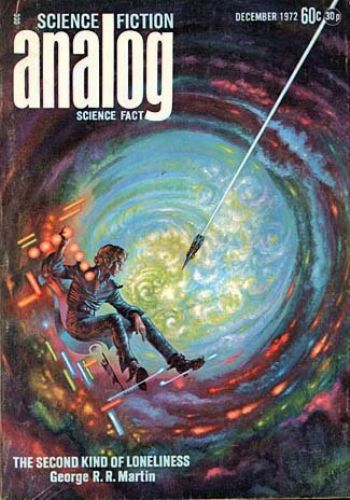
(Cover by Frank Kelly Freas. Analog, December 1972.)
As has unfortunately become commonplace, there have been a few deaths in the family. Christopher Priest and Brian Stableford died in February and Vernor Vinge little over a week ago. This last one hit me by far the hardest. Obviously there are some people I’m not mentioning, but unfortunately unless I really wanted to I can’t cover everyone. There’s too much. The past month or so has been rough for me. I had a nasty fall a few weeks ago and I seem to have acquired mild PTSD from it. Half of my face got messed up and I ended up spending some time in the ER. Obviously I’m doing better now. Yet somehow I don’t feel totally “right.”
Hopefully some good (or at least interesting) fiction will help me! We have a nice mix: two SF novellas, plus two SF short stories, two fantasy, and two horror. Or at least these stories seem to fit predominantly into those genres; obviously they’re not mutually exclusive.
For the novellas:
“A Woman’s Liberation” by Ursula K. Le Guin. From the July 1995 issue of Asimov’s Science Fiction. One of the most universally beloved of all SFF writers, Le Guin started relatively late but would enjoy a very long and acclaimed career. She’s one of the few authors to enjoy about equal reverence for both her SF and fantasy. Her Hainish Cycle, especially The Left Hand of Darkness and The Dispossessed, might constitute her best and most important work overall. “A Woman’s Liberation” is set in the same universe as those novels, and is a loose sequel to “Forgiveness Day” and “A Man of the People.”
“Palely Loitering” by Christopher Priest. From the January 1979 issue of The Magazine of Fantasy and Science Fiction. British Science Fiction Award winner for Best Short Fiction. Priest died in February, after a career spanning more than half a century. His 1974 novel Inverted World is something of a cult classic. His 1995 novel The Prestige was turned into a movie by Christopher Nolan. ISFDB classifies “Palely Loitering” as a novelette, but at about forty pages in F&SF I suspect it counts as a novella. It got a Hugo nomination for Best Novelette but placed third in the Locus poll for Best Novella.
For the short stories:
“The Hounds of Tindalos” by Frank Belknap Long. From the March 1929 issue of Weird Tales. Long had a ridiculously long (ha) career, spanning from the 1920s to his death in 1994. He was a close friend of H. P. Lovecraft and the two seemed to take inspiration from each other, with “The Hounds of Tindalos” being one of the first Cthulhu Mythos stories not written by Lovecraft.
“Traps” by F. Paul Wilson. From the Summer 1987 issue of Night Cry. A doctor by day and a bestselling author by night, Wilson is the only person to have earned both the Bram Stoker and Prometheus Award for Lifetime Achievement. He likes to hop between science fiction and horror, with the two not being mutually exclusive. “Traps” itself was a Stoker nominee for Best Short Story.
“The Swordsman Whose Name Was Not Death” by Ellen Kushner. From the September 1991 issue of The Magazine of Fantasy and Science Fiction. Kushner got started in the ’80s writing Choose Your Own Adventure books before turning to proper fantasy literature and even radio. This story is set in the same universe as her novel Swordspoint but, as far as I can tell, is not a sequel.
“Two Suns Setting” by Karl Edward Wagner. From the May 1976 issue of Fantastic. British Fantasy Award winner for Best Short Story. Wagner was a devotee of both horror and sword-and-sorcery fantasy. His Kane series very much follows in Robert E. Howard’s footsteps, but Wagner at his best was a genuine poet as well. “Two Suns Setting” was his first (and I think only) appearance in Fantastic.
“Original Sin” by Vernor Vinge. From the December 1972 issue of Analog Science Fiction. Despite debuting in 1965 and remaining active until about half a decade ago, Vinge’s output is fairly small; but, given the five Hugo wins, he certainly did something right. “Original Sin” is one of Vinge’s more obscure stories, but I went with it on the recommendation of a certain colleague.
“The Growth of the House of Usher” by Brian Stableford. From the Summer 1988 issue of Interzone. Stableford passed away in February after a very long and winding career. (Incidentally Priest, Vinge, and Stableford all debuted within a few years of each other.) He was a prolific translator of French SF and contributed to the SF Encyclopedia, on top of a massive amount of fiction.
Carol Emshwiller came a bit late to the whole writing-fiction thing, not even writing her first novels until she was in her sixties, but she would have one of the longest and most acclaimed careers of any modern SF writer. She started in the mid-’50s and remained more or less active until her death in 2019; the crazy part is that she would remain a high-quality writer over that sixty-year span. She steppd away from writing for much of the ’60s but returns just in time to contribute to Dangerous Visions, with one of its better stories, “Sex and/or Mr. Morrison.” Despite having started in the ’50s, Emshwiller changed her colors like a chameleon and fit right in with the New Wave crowd—and then changed again for the post-New Wave years. This is a degree of versatility most writers couldn’t manage.
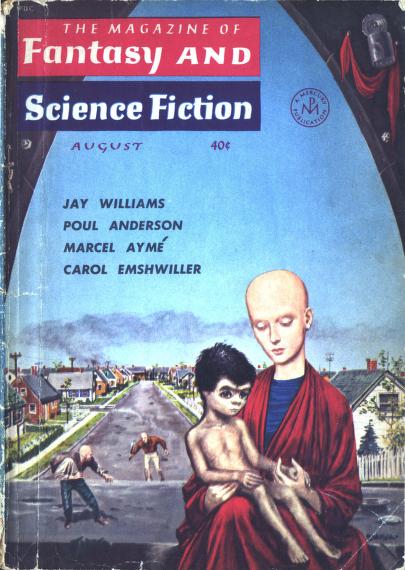
I should probably mention at this point that Carol was the wife of legendary illustrator (later experimental filmmaker) Ed Emshwiller. Yeah. In one of the cuter instances of both halves of a couple being successful creative types, Ed sometimes illustrated Carol’s stories, including the cover depicting “Day at the Beach” that you see above. (It would have to be the cover because F&SF made it a policy to not have interior illustrations for stories.) “Day at the Beach,” while short and simple in a way, has enough evocative imagery that such a cover might’ve been earned; you could do a lot worse than this one. It’s a post-nuclear fable that reminds me of Cormac McCarthy’s The Road, in its grimness but also its central message.
Placing Coordinates
First published in the August 1959 issue of The Magazine of Fantasy and Science Fiction, which is on the Archive. It was reprinted in The Year’s Best S-F: 5th Annual Edition (ed. Judith Merril), An ABC of Science Fiction (ed. Tom Boardman, Jr.), Future Love: A Science Fiction Anthology (ed. Victoria Williams), Beyond Armageddon: Twenty-One Sermons to the Dead (ed. Martin H. Greenberg and Walter M. Miller, Jr. [?!]), and the Emshwiller collection The Collected Stories of Carol Emshwiller Vol. 1. Unfortunately, if what I’ve heard is true, the proofreading for that last one is really bad.
Enhancing Image
We meet Myra, a housewife who has “neither eyebrows nor lashes nor even a faint, transparent down along her cheeks.” She is in fact totally hairless, and so is her husband Ben. Their son, named Littleboy, is however a different story, being “the opposite of his big, pink and hairless parents, with thick and fine black hair growing low over his forehead and extending down the back of his neck.” Littleboy is three-and-a-half years old and we’re told that things were normal not long before then, when nuclear war broke out; it’s implied Littleboy was in utero when Myra and Ben got a generous dose of radiation. Emshwiller is light on the details: we’re never told who fired the first shot, which countries went to war (although we can guess(), or how much of civilization is left after the fallout. Presumably not much. I say “post-nuclear” but it’s fair to call “Day at the Beach” a post-apocalyptic tale. And then Myra gets the idea to take her family to the beach. It’s a nice sunny Saturday—or at least she thinks it’s a Saturday; she’s unsure.
We aren’t told a lot about what life in such a future is like. We know oil is apparently a precious and fought-over commodity, like in Mad Max, and that the family is used to having to defend itself through violent means, as we’ll see later. What do they do for food? It’s not dwelled on. “Day at the Beach” is about ten pages long, and if anything it could be longer, which is the best kind of negative criticism. It’s a slice-of-life narrative in the allegorical mode, which as I said before reminds me of The Road, albeit with a lot less cannibalism. (There isn’t any on-screen cannibalism, don’t worry.) It’s a story about making way for the next generation, of “carrying the fire” as McCarthy liked to put it, in spite of horrendous circumstances. Myra and Ben are disfigured from the radiation and Littleboy is undoubtedly a mutant, but they don’t love him any less for it. Even Littleboy’s unconventional name alludes to the story’s allegorical nature, with the child being a stand-in for the next generation. As Anthony Boucher says in the introduction, it’s about “the endurance and adaptability of the human spirit.”
The family has a simple goal in mind, which is to hang out at the beach—alone. They don’t seem to have any mutuals, no oomfies or pookies to call on for such an occasion; but then maybe solitude in the midst of nature is what Myra and Ben want. It’s a tranquel scene, although I have to say I’m not sure if letting Littleboy go swimming in the buff was the norm for really young children in the ’50s or if it’s a casualness brought on by the end of civilization and public decency laws. Probably the latter. It does feed into the sense of tranquility, and of a kind of purity. They may not be a sight for sore eyes (although I must admit that going by her depiction in Ed’s cover, Myra rocks the bald look), but that doesn’t make them any less kind to each other. In the years during and following World War II there was much speculation on what life might be like in the wake of nuclear fallout, from Judith Merril’s “That Only a Mother” to Walter M. Miller’s A Canticle for Leibowitz. The idea of humanity becoming mutated, with negative or possibly even positive effects, from the bombs was a popular one. Actually the “human mutants” stock is still high, if the continuing popularity of the Fallout series (now with its own TV show) is anything to go by.
Emshwiller seems to suggest that while life is rough, and some harsh decisions must be made, and although our descendants may look different from us, they (probably) won’t be any less human. Governments may fall and capitalism might (hopefully) end at some point (as Lovecraft says, “even death may die”), but the average person, with even a little bit of luck, will persist. Like the Okies in The Grapes of Wrath (indeed the migrant workers who now suffer on the receiving end of border violence), the survivors of nuclear catastrophe will not go quietly into the night. In a way it can be thought of as a response (although Emshwiller probably didn’t intend this, and anyway I have no way of proving it) to Merril’s most famous story—a ray of hope to the stark terror of “That Only a Mother.”
There Be Spoilers Here
I’m tired.
A Step Farther Out
So that’s it. End of the month. I didn’t end on the strongest note, but the Emshwiller is a good example of F&SF‘s range of fiction and willingness to take on more poetic material. In 1959 (incidentally this was the only story Emshwiller saw published in 1959) there were really only a couple options for “Day at the Beach.” Maybe Galaxy would’ve taken it. The genre SF market had shrunk massively; certainly it was no longer the market of near-endless possibilities that it would’ve been at the start of the decade. F&SF was arguably the only American SFF magazine that was doing really well at this point. The late ’50s and early ’60s were a low period for short fiction writers, and this was especially true the women. A lot of female writers would leave the field around 1960 in search of greener pastures, no doubt in part due to the market shrinking massively, and Emshwiller would be one of those women who stepped away from the scene.
The ’50s—especially the first half—were a goldmine for satirical writing in genre SF, with writers like Robert Sheckley, William Tenn, and Philip K. Dick acting as court jesters for the scene; and then there was possibly the most talented of the satirists (or at least he could’ve been, had he lived longer), which was C. M. Kornbluth. Despite having died at the horribly young age of 34, of a weak heart, Kornbluth was prolific and at the time of his death he had been writing fiction for nearly twenty years. He debuted in 1939, about 15 years old, and wrote at a mile a minute (often under pseudonyms) until 1942, when he got pulled into the war effort. He would eventually return to writing circa 1949, just in time for the magazine boom that was about to take place, and he never looked back. He wrote quite a few novels, alone and in collaboration with Frederik Pohl, but his best stuff was short-form, which only got more ambitious as he aged.
“MS. Found in a Chinese Fortune Cookie” is arguably not even science fiction, but it is very much about science fiction, and about science fiction writers. It’s a self-reflexive dual narrative that, in only about ten pages, shows Kornbluth hunting intellectual big game. At first I wasn’t quite sure what to make of it, since it really is a weird fucking story; but, having sat on it for a few days now, I feel more qualified to talk about it. This is the kind of story that rewards the reader for already being familiar with the author’s work, but while it is fannish, it’s not exactly a flattering depiction of being into genre SF at a time when the genre got no respect.
Placing Coordinates
First published in the July 1957 issue of The Magazine of Fantasy and Science Fiction, which is on the Archive. It was then reprinted in The Best from Fantasy and Science Fiction, Seventh Series (ed. Anthony Boucher), the only book publication of this story Kornbluth lived to see. It appeared in the Kornbluth collections The Marching Morons and Other Science Fiction Stories, Thirteen O’Clock and Other Zero Hours, and His Share of Glory: The Complete Short Science Fiction of C. M. Kornbluth.
Enhancing Image
There are two threads, which I’ll call the primary and secondary narrative. The primary is a series of messages hidden inside fortune cookies (hence the title), written by one Cecil Corwin, science fiction writer; and the secondary is asides written by C. M. Kornbluth, whom you may have heard of. Corwin has apparently gone insane and vanished off the face of the earth, with only these secret messages detailing what happened to him, in his own words, while Kornbluth, being a long-time friend and Corwin’s literary executor, gives us some much-needed context. Thus we have the “Corwin Papers”—notes you’d find in place of those platitudes that are normally found inside delicious fortune cookies. It’d be accurate to title the story “MS. Found in Chinese Fortune Cookies,” but I understand that doesn’t quite as good. Still, we have two protagonists: Corwin and Kornbluth.
This is all a bit strange, not least because “Cecil Corwin” is one of the aforementioned pseudonyms Kornbluth used back when he started writing. I’m not sure how many readers in 1957 would’ve known this, but Anthony Boucher almost certainly knew, as did some other folks who knew Kornbluth personally. The implication is that Corwin and Kornbluth are meant to be taken as the same person, or maybe as two sides of the same persona, or maybe as two personalities inhabiting the same body a la A Scanner Darkly. Immediately we’re thrown into the deep end of metafictional hijinks, in a maneuver that probably would’ve made Jorge Luis Borges proud (although Kornbluth had almost no way of knowing about Borges in his lifetime). There are some other characters mentioned, very likely based on real people, whose names have been changed undoubtedly for legal reasons and because Kornbluth doesn’t wanna make too many enemies.
Corwin is a writer who thinks he has found what he calls The Answer—the one secret to life, the universe, and everything, which would end human suffering and initiate the kingdom of Heaven on Earth. Despite being on the brink of monumental success, Corwin suspects he might also be on the precipice of insanity. “Of course The Answer looked logical and unassailable, but so no doubt did poor Charlie McGandress’ project to unite mankind through science fiction fandom, at least to him.” I get the impression Kornbluth (the author) was trying desperately not to bring up L. Ron Hubbard or Scientology by name, but you’d have to be blind as a bat to not notice the allusions to what were then fandom hijinks. And in fairness to Corwin, he’s not wrong when he suspects that trying to write out The Answer will get him into serious trouble. Indeed the conspiracy surrounding The Answer is the closest the story gets to SF territory, which reminds me of the centuries-long feud at the heart of The Crying of Lot 49. I wonder if Thomas Pynchon has read Kornbluth?
I wouldn’t recommend “MS. Found in a Chinese Fortune Cookie” to people unfamiliar with Kornbluth for a few reasons: it assumes you know who Kornbluth is, that you have at least a cursory knowledge of SF fandom politics in the ’50s; and also, structurally, this is a tangled mess of a story. We’re given two unreliable narrators for the price of one. Immediately we’re signaled to doubt Corwin because he says, “They say I am mad, but I am not mad”—only to chide himself for opening on such a cliched line. Then there’s Kornbluth (the character), who cuts out parts of Corwin’s writing for a few given reasons, but the result is that the notes are left even more fractured than they would’ve been originally. Kornbluth (the character) will also sometimes cut in to voice his disagreement with something Corwin says, either because he genuinely believes what he’s saying or because he wants to make sure not to get caught in the conspiracy that would drive Corwin to write these messages. Needless to say the plot is hard to spoil, because of its layers but also the fact that the story is inextricably linked with Kornbluth’s career within the history of genre SF.
There is a key to this story, in a way, although it wouldn’t be published until after Kornbluth’s death. For people like myself who are actively interested in “old” science fiction there’s a little volume called The Science Fiction Novel: Imagination and Social Criticism (ed. Earl Kemp), published in 1959, which collects four lectures given by as many SFF writers, those being Robert Heinlein, C. M. Kornbluth, Alfred Bester, and Robert Bloch. These lectures were originally given a couple years earlier, which Kornbluth giving his in January 1957 at the University of Chicago. The name of the lecture is damning: “The Failure of the Science Fiction Novel as Social Criticism.” The idea, basically, is that while there have been works of SF that work as social criticism, there are too few such examples in a sea of pure entertainment; and, maybe more damningly, said examples fail to leave a tangible impression on the public consciousness. Aside from some excessive psychoanalyzing of George Orwell, it’s a good read.
At one point Kornbluth talks about Wilson Tucker’s 1952 novel The Long Loud Silence, a novel which he feels is effective as social criticism, but an abject failure in sparking any societal change. Unlike Harriet Beecher Stowe’s Uncle Tom’s Cabin and Upton Sinclair’s The Jungle, which (Kornbluth says) really did change how some people thought and acted (in the case of The Jungle it directly inspired government policy), The Long Loud Silence made no such impression; not only that, but it didn’t become a bestseller and is indeed now an obscure novel—forgotten. In trying to explain how this happened, Kornbluth goes further to explain what it was like being a “science fiction writer” in the ’50s, at a time when the market was more vibrant than ever before but which the mainstream dared not touch:
[The Long Loud Silence] was ignored because publishers think of their books in rigid categories. Tucker’s book fell into the category “science fiction.” Books in the category “science fiction” get no promotion or advertising to speak of, they get misleading jacket blurbs, and a sale of five thousand copies is considered a realistic target. The idea is to sell it to the science fiction readers, clear expenses, make a little money on the paperback reprint, pat the author on the back and tell him to write another book, boy, we love your stuff.
Even 1984, which was a bestseller and which Kornbluth praises immensely, had failed to spark any societal change. One of the most famous novels in the English language, often quoted (and misunderstood), and yet despite its immense popularity 1984 remains a novel of ideas that have never materialized. There has not been (to my knowledge) a libertarian socialist society that exists now past the extreme local level, let alone one that takes direct inspiration from Orwell’s warning. (The point of the novel, of course, was the scare readers away from capitalism and socialistic fascism [or fascistic socialism] and encourage a socialist change wherein people of all skin colors and class backgrounds would be allowed to flourish.) If even the most famous SF novel on the planet cannot do what mainstream literature has done, then why are we here? What is the purpose of writing science fiction other than for the lulz and the funzies? Is SF hopes to stand on the same level as mainstream literature then (Kornbluth says) there has to be a work on part with Uncle Tom’s Cabin in terms of societal impact. (That Uncle Tom’s Cabin is now often held as an “important” but poorly aged protest novel that one doesn’t read for pleasure is beside the point.)
The increasing existential dread for the SF writer is one both Corwin and Kornbluth sense, although unlike Kornbluth (the author), Corwin thinks he has found the answer—even The Answer. In a sense you could say this story is autobiographical, because I do think Corwin’s anxiety about the seeming unimportance of the SF writer mirrors Kornbluth’s own. It’s like what he says about the relationship between the reader and the SF writer (although you could argue this goes for any writer of fiction): “There’s a touch of intellectual sadism in us. We like to dominate the reader as a matador dominates the bull; we like to tease and mystify and at last show what great souls we are by generously flipping up the shade and letting the sunshine in.” Science fiction—the reading and writing of it—is like a game. But Corwin and Kornbluth argue this must not or at least should not be so—that science fiction should serve more purpose than as entertainment.
There Be Spoilers Here
[REDACTED]
A Step Farther Out
When Kornbluth died in March 1958 he was on his way to succeeding Anthony Boucher as editor of F&SF, and one can’t help but wonder where the magazine might’ve gone under his direction. Certainly he was becoming increasingly concerned with the bottom-tier position science fiction occupied in the zeitgeist, having at that point been relegated mostly to monster movies and speculation on new technology. The complexity and seriousness (despite its absurd premise) of “MS. Found in a Chinese Fortune Cookie” point toward Kornbluth trying to open a door—a door that would prematurely slam shut. I’m reminded of the SF Encyclopedia’s entry on Edgar Allan Poe, who like Kornbluth died young, before he could reach his full potential: “If his career had lasted longer, he might have awoken us more inescapably to his vision; as it stands, we must awaken ourselves to him.” The same can be said of Kornbluth.
While never quite breaking into the mainstream like Ray Bradbury, Richard Matheson clearly copped a few notes from the Bradbury notebook and, over time, became one of the more accomplished authors in the field. He debuted in 1950 with “Born of Man and Woman,” which despite being written when he was 22 or 23 remains one of his most famous stories. He quickly amassed an impressive body of short fiction, but it was his 1954 novel I Am Legend that remains his most famous work, being one of the few truly influential depictions of vampires to come out of the 20th century. His other major novels include The Shrinking Man, Hell House, and Somewhere in Time, but it’s his efforts as a short story writer and screenwriter that hold my attention the most. He wrote the short story and screenplay (I’m not sure which came first) for Duel, Steven Spielberg’s first movie. He was the second most prolific writer for The Twilight Zone—only behind Rod Serling, of course. Unlike close contemporary and fellow Twilight Zone writer Charles Beaumont, he lived to see much recognition in his lifetime.
“Steel” was itself turned into a Twilight Zone episode, adapted by Matheson, with Lee Marvin as the lead; it’s one of the better episodes in the original series, I would say. If you’ve seen the episode (as I have) then you’ve already seen the story told in the source material, albeit compressed. Unsurprisingly Matheson did not stray much from his own story. Unlike “Little Girl Lost,” which I reviewed before and which Matheson also turned into a Twilight Zone episode, I’d consider “Steel” to be major Matheson. I’m not sure why it has been reprinted relatively few times.
Placing Coordinates
First published in the May 1956 issue of The Magazine of Fantasy and Science Fiction, which is on the Archive. It later appeared in The Twilight Zone: The Original Stories (ed. Martin H. Greenberg, Richard Matheson, and Charles G. Waugh) and the collections Duel: Terror Stories by Richard Matheson and Steel and Other Stories. That last one seems to be a tie-in for the movie Real Steel, which is a much looser adaptation than the Twilight Zone episode. Yeah, “Steel” has been adapted more than once.
Enhancing Image
The premise is simple. It’s the year 1980, and human boxers have been replaced by human-like robots for several years now. We follow Kelly, his mechanic friend Pole, and their fighting robot Maxor. Unfortunately Maxor is a B-two, out of date for a few years now what with B-nines set to release, and he’s barely holding together at the seams.
“The trigger spring in his left arm’s been rewired so many damn times it’s almost shot. He’s got no protection on that side. The left side of his face’s all beat in, the eye lens is cracked. The leg cables is \vorn, they’re pulled slack, the tension’s gone to hell. Christ, even his gyro’s off.”
The three have traveled far for a match, and while they’re set to get an amount of money for even one round in the ring, Maxor might fall apart before he can land a single punch. Kelly himself used to be a boxer, before the robots came in, but he’s middle-aged now, balding, and reminiscing on his glory days. “Called me ‘Steel’ cause I never got knocked down once. Not once. I was even number nine in the ranks once,” he says. When they finally get to the prep room and Maxor has a major malfunction, Kelly’s left with seemingly no options: if his robot doesn’t work then he and Pole don’t get paid at all and they return home with their tails between their legs. Doesn’t help the two have been pretty tight on money. However, Kelly reasons, the robots already look uncannily similar to real humans, and because these are pre-internet days and because Maxor’s been out of the limelight for a minute, nobody in the crowd is likely to recognize him. Kelly comes up with a crazy idea, but with some finesse it just might work.
Let’s talk about sports a bit. I’m supremely indifferent sports, even e-sports despite being a Gamer™ and despite having been a wrestler for nearly a decade. I was that strangest of amalgamations in middle school through most of high school: the nerd-jock. I was an athlete but also a late bloomer when it came to reading, and I had to make due with a rare eye condition, scoliosis, and (very likely) autism. It takes some fine storytelling for me to get into a sports narrative, and yet I have to say of all the sports subjects, boxing might have the easiest time with this, being closest kin to wrestling, a deeply intimate and individualistic sport. It probably helps that boxing has been blessed with some of the best fictional depictions in film and literature, from Rocky and Raging Bull to Leonard Gardner’s Fat City. The trend continues with “Steel,” both the story and the Twilight Zone episode. I’m not sure if Matheson is a fan of boxing (he’s almost certainly not an expert), but that doesn’t matter because this is a story about one man who, whether he knows it or not consciously, desperately wants to relive his glory days—to feel like the toughest man in the world again.
At the same time it’s about the need for the human element in sports, and how replacing the human spirit with robotics is no adequate substitute. For decades, indeed since the 19th century, there’s been a fear, especially among the working class, that automation will replace human labor and that humans may even be forced to train the machines that will leave them out of a job. I was scrolling through copy-editing positions the other day (I’m looking for a second job at the moment) and I saw a couple that were for some AI company, wherein the position called for competent human writers to spend hours tinkering with chatbots so that these machines can write coherent sentences. They want people to come in and train simulacra to do their own jobs for them. Obviously this will not do, for a number of reasons. Even in the world of “Steel,” while boxing between robots is popular, there are limitations: the models up to now are unable to even get back on their feet if they’re knocked down. “A felled B-fighter stayed down. The new B-nine, it was claimed by the Mawling publicity staff, would be able to get up, which would make for livelier and longer bouts.” The people want robots, but what they truly want is the real deal.
(As a random note, I find it slightly funny that Matheson, for no discernable reason, moved the year down from 1980 to 1974 when writing the Twilight Zone script, despite the episode airing in 1963—just over a decade before it’s set to take place. Obviously Matheson could not have possibly expected lifelike robots to not only be invented but replace human participants in sports by then. It’s a good thing science fiction is meant to comment on the perpetual present moment rather than predict the future, contrary to what a lot of people seem to think.)
Matheson gets a lot of work done in about twenty pages: he introduces a future America that’s different but not too different, a friendship between two guys that goes back years, a whole history of one of the guys as a former athlete, and a tense do-or-die sports narrative. You don’t have to be into boxing to find enjoyment or meaning in it, which I’d argue goes the same for any sports writing: it should be able to engross someone who previously had next to no interest or knowledge in the sport. We know a fight’s coming, and admittedly the fight in the story’s climax is the least engrossing for me personally, but a) that’s not the point, and b) it’s a personal thing of mine when it comes to action writing, so I’m not holding it against the story too much. I knew where things were going in advance, and while I wasn’t surprised at any point, that’s not a fair criticism to make from someone who had already seen a faithful adaptation. My point is that Matheson is often good, and when he’s good he’s great.
There Be Spoilers Here
The ending is bittersweet, although how bitter or sweet you think it is depends on how much you believe Kelly’s optimism. He poses as Maxor and predictably gets his ass beaten—almost killed, actually. It’s amazing he survived, going up against a robot made to fight other robots, and even more amazing the ruse worked. Kelly and Pole only get half the money they were owed since Kelly went down in the first round, but again, Kelly got away with the bamboozle, he got some money out of it, and, if only for a minute (possibly the longest minute of his life), he got to feel like a boxer again. Obviously Kelly is too injured to try such a stunt again, and they only got enough money for bus fare and to repair the outdated Maxor; but who knows, people have come back from worse than this. I personally see it as a triumphant ending, despite Kelly’s initial dismay at the low payment, because it’s a spiritual victory for Kelly, even if it’s not quite what he wanted. The former boxer has, for a brief moment, snatched his passion from the jaws of automation; and this can only be a victory.
A Step Farther Out
There’s a reason “Steel” has been adapted multiple times now, and that’s because it is fundamentally a well-done—one might even say well-oiled machine of a short story. It’s structurally sound, has a beginning, middle, and end, has a small cast of characters we can readily identify with; and perhaps most importantly, at least according to what Theodore Sturgeon thought constituted a great SF story, it poses a question about the human condition that would not be possible without an SFnal element in the equation. It’s about nostalgia, in a way, but it’s also about alienation, in both the general and Marxist senses of the word—about the need to feel connected with one’s own labor. Even ignoring all of this, paying no attention to its possible meanings, it’s just a fun read ultimately.
(I wrote a lengthy Letterboxd review of Dune: Part Two when I first saw it, and since I figured I would make many of the same points here as there I could reuse that review—with some revisions. Needless to say I’ll be spoiling both parts of Denis Villeneuve’s Dune, as well as Frank Herbert’s Dune and Dune Messiah.)
You can’t seriously discuss Dune without spoiling it, but then Dune is kinda hard to spoil. If you’ve read the book or seen the ill-fated David Lynch adaptation then you already know the plot beats—up to a point. Even if you weren’t already familiar with the source material, the broad strokes of the plot aren’t hard to predict. Dune has been a sacred cow among genre fans for over half a century, and I’m pretty sure its success lies less in the story it tells (although I’m informed the series gets increasingly unhinged) and more in the manner of the telling. I’d argue Frank Herbert was not a great line-for-line writer, but he had a knack for worldbuilding, such that any adaptation of Dune has the unenviable task of making all this lore digestible. Dune: Part One (I’m calling it that now) was reasonably faithful to the book, albeit with some streamlining; but while, broadly speaking, Part Two does the same, there are some major deviations that have a ripple effect, resulting in an ending that feels profoundly different from the book’s, not to mention leads much more smoothly into Dune Messiah. Of course, there are changes that necessitate the inevitable Dune Messiah movie being quite different from its source material right out the gate.
Denis Villeneuve and his co-writer Jon Spaihts turn what was, on a casual reading, a very happy ending in Herbert’s book into something much more sinister. Paul Atreides transforms into a villain the likes of which even Baron Harkonnen could only dream of being. This has always been true, really, because the jihad Paul inspires kills billions through war and famine, and this has always been the case. The implications are very different, though. In the books the jihad grows into something far beyond Paul’s control, picking up an inertia that he’s blind to until it’s too late. Dune Messiah is Paul realizing he has inadvertently become Space Hitler™. (Have we mentioned this is basically a retelling of Oedipus Rex, minus the mother-fucking?) In Villeneuve’s Dune, Paul not only becomes Space Hitler™ by the point at which the first book ends (in the book he retains his heroism), but becomes Space Hitler™ knowing in advance that his actions will lead to mass death on an interplanetary scale. And he doesn’t seem to care anymore. He has given in completely to the “prophecy” which he and his mother Jessica actively played into, has given up Chani, and willingly becomes ruler of the known universe because, at the end, he is a bastard.
Dune: Part Two might be the most fatalistic blockbuster ever made. With Hollywood filmmaking there’s always a sense of the outcome being preordained, of the good guys winning and whatnot, but this movie turns such an expectation on its head by making it clear to the audience partway through that Paul, the hero of the story, will turn evil. Paul learning the ways of the Fremen takes about five years in the book; enough time passes that he and Chani have a son. But in the movie the timespan is crunched from five years to maybe five months. This time crunch is controversial among fans of the book, and I can see the argument, but ultimately I think it works in favor of the film’s sense of fatalism. The results of the time crunch are profound: Paul and Chani never have Leto (the first time), Paul’s sister Alia isn’t even born by the movie’s end, and the Fremen becoming violently militant becomes less something that happens without Paul even noticing at first and more a train coming right towards him at full speed. The jihad becomes a rocket that has not quite reached its target but is getting there, second by second, guaranteed to hit its mark.
This is not a perfect movie, but it is very interesting, especially for someone who has read the first two Dune books. I know Villeneuve wants to adapt Messiah but then stop there, and I suspect how he’s gonna wrap things up neatly there so as to make a trilogy out of this adaptation. It’s funny because by making Chani a denier of the prophecy, by not having her be all but married to Paul, indeed by having them break up at the end (she looks so dejected; it really is one of the most vivid depictions of heartbreak I’ve seen in a major Hollywood production), she seems to be set up as the real hero of Messiah. Which hey, might be good for her in the long run! If you’ve read Messiah then you know things do not turn out well for Chani, so her getting cucked here might be for the best. I will say, having Chani only show up at the end of Part One and having their relationship start from there means the romance in Part Two is a bit rushed. It’s a quibble, but I understand if people get bent out of shape over it.
Speaking of which, it boggles my mind that this is only about ten minutes longer than Part One, since way more happens. If people thought Part One was slow (I didn’t) then Part Two should be understood as course correction. This is a packed 166 minutes. This is still like 25 minutes shorter than Avatar: The Way of Water but feels about the same length (because nothing happens in that movie, for all its length). Incidentally, this is an anti-Avatar, thematically. You could like both movies, but understand that Avatar and its sequel play the white savior narrative completely straight while Dune very much subverts said narrative. Paul is the foreigner who will save the Fremen, fulfill their prophecy, and help them take back their home planet. Oh, he’ll save them alright—at the expense of much of life in the known universe. I know people have memed about it, but this is the most sinister character arc in a Hollywood Blockbuster since the Star Wars prequels; but ya know, with writing that doesn’t suck and without the audience already knowing the hero-turning-villain will ultimately redeem himself. I’m honestly unsure if Paul will reckon with the damage he’s done in the Dune Messiah movie.
What’s funny is that looking back on both parts, the most decent members of House Atreides are Duke Leto and Duncan Idaho, both of whom die in Part One (although I assume the latter will return in Dune Messiah). Leto dies about halfway through Part One, having been ambushed by the Harkonnens in the middle of the night. What’s interesting about Leto is that despite his position of authority he does seem like a genuinely good man: he loves Jessica as if she were his legal wife, he cares for his son deeply despite Paul technically being a bastard, he doesn’t seem to have any beef with the Fremen, and he really does wanna make the best of a bad situation by setting up a colony on Arrakis. He wants to colonize the planet “the right way,” and dies for it, his efforts getting wiped out literally overnight. The films posit there is no “right way” to colonize; if you fail then so much the worse for you, but if you succeed then mass death is virtually guaranteed. Westerners have been trying to colonize parts of the world since the 16th century, resulting in the eradication of indigenous peoples (we see one such example in progress with the Palestinian genocide), yet despite centuries of evidence to the contrary we still think there’s a “right” way.
Do I like Part Two more than Part One? Hmmmm. I still think my favorite stretch out of all of Villeneuve’s Dune is the first hour of Part One. Ya know, the stretch of that movie that has no fucking action to speak of and which people complain is too slow. I know, weird, but the best moments in these movies show Villeneuve as someone who keenly understands visual storytelling, worldbuilding, and also just science fiction as an ethos. He’s a genuine fan of the genre and you can feel it in each of his SF movies. I still think Arrival is his best (it’s arguably the best SF movie of the 2010s), but I’m also curious how he will try to make Rendezvous with Rama compelling for modern movie audiences. (I like the novel a lot, but modernizing it and giving it a sense of actual stakes will be a challenge.) He will get at least a Best Director nomination at the Oscars next year and I will eat a fucking shoe Werner Herzog-style if he doesn’t.
For readers of a certain generation, Robert Heinlein’s juveniles got them into science fiction at an early age; for others (and indeed the two are by no means mutually exclusive), it was Andre Norton. Born Alice Mary Norton, she had her name changed legally to Andre Alice Norton when she started to write in the ’30s, although she didn’t make her SFF debut until 1947. She also sometimes wrote under the pseudonym “Andrew North.” With a career that spans more than half a century, Norton was incredibly prolific, with her Witch World series alone probably taking up a whole shelf or two. Along with the likes of Fritz Leiber and Poul Anderson she made an impression writing both science fiction and fantasy.
I’ll be the first to admit I have not yet read any of Norton’s novels, and have only read a few of her short stories. Funnily enough, for how much she wrote overall, Norton wrote comparitively little short fiction, and even less of it appeared in the magazines. “Mousetrap” is a very short Martian odyssey from Norton, so fittingly I won’t be keeping you long with this review. It’s one of those vignettes that carries a nasty little sting in its tail. It’s also the kind of soft SF that easily found a home in F&SF‘s pages in the ’50s—not fantasy, but not something to think seriously about.
Placing Coordinates
First published in the June 1954 issue of The Magazine of Fantasy and Science Fiction, which is on the Archive. Some of Norton’s work has fallen into the public domain, but “Mousetrap” has not. You can find it in The Many Worlds of Andre Norton, The Book of Andre Norton (same collection, different title), Wizards’ Worlds, and The Prentice Hall Anthology of Science Fiction and Fantasy (ed. Garyn G. Roberts). Oh, and it was included in The SFWA Grand Masters, Volume Two (ed. Frederik Pohl).
Enhancing Image
Mars has become like a wonderland for explorers, for several reasons, but a big one is we know we’re not alone in the universe. People haven’t found talking aliens exactly, but they’ve found the petrified bodies of alien creatures, “sand monsters,” that stand in the desert, encased with some details of their anatomy hidden. Only problem is taking one of these monsters to some research center. The monsters, “which can withstand the dust storms, the extremes of desert cold and heat, crumble away if so much as a human finger tip is poked into their ribs.” The bright side is being able to hold one of these monsters together means big money. (Bit of an aside, but I would have to go digging for an earlier usage of “Space Marines.” I’m sure this is not the first time, but mind you this was before “military SF” was even a concept.) Enter our three main characters: the narrator, Sam Levatts, and Len Collins. Sam is a local drunk, but he’s courageous, and he knows more about these monsters than the average person. Thus Operation Mousetrap, an effort to nab one of these monsters, is underway.
Some days ago by and the expedition Sam and Len go on doesn’t turn out well. Sam shows the narrator a picture he had taken of one particular sand monster: what appears to be a humanoid woman, with wings. Is she is a human mutant or some humanoid alien we don’t know about? Impossible to tell, but the narrator admits she’s lovely; unfortunately she’s also dust now. Len, in an effort to secure the winged woman, had destroyed her. This is important to remember, since does set up a certain action Sam takes at the story’s end. It also raises a question: Where do these monsters come from? They seem to be of different species, possibly not native to Mars, yet you can barely find anything in the desert, let along a secret civilization of humanoid aliens. Norton implies a lot while saying little. As the narrator says, “the desert dry lands haven’t been one quarter explored,” and similarly “Mousetrap” is a very short (I would say 3,000 words or less) story leaves much territory unexplored. This is not necessarily a bad thing: while the narrative of the narrator and the explorers is self-contained, with a neat twist ending, the setting is vast. There’s not much worldbuilding you can cram into such a small space, but Norton manages.
Something else that stuck out to me was Norton’s style, which struck me as overtly masculine—with a little twist or two in there. Boucher and McComas are upfront in their introduction in calling Norton a woman, which is important because this was still early in her career and people were still prone to thinking “Andre” was a man. I forget if it was a review the came out the same year as “Mousetrap” or a year later, but P. Schuyler Miller, in writing about one of Norton’s anthologies, apologizes for having misgendered her previously. What a nice guy. Still, this is a deeply masculine narrative: there aren’t any female characters with lines, and as the narrator points out, the few women who have come to Mars tend to not be much to look at. Yet the female monster Sam is obsessed with is practically deified, and perhaps more tellingly, her femininity is deified, her body sporting “the distinctly graceful curves we have come to associate with the stronger half of the race.” In old literautre I’m so used to women being called the “fairer” or “weaker” sex that I had to reread this passage to make sure I got the narrator’s remark right. For the narrator it’s perhaps a moment of self-deprication, but Norton it feels like an ironic stattement.
And as we find out in the short span of this story, men do seem to be (at least in some ways) the weaker sex in Norton’s world. Sam is a drunkard, Len is a manipulator, and the narrator is maybe a little too content to stay in his bar (the Flame Bird), away from the adventure of the desert. The winged woman, a symbol (at least for Sam) of feminine perfection, is undone by a man’s touch, and so much be avenged. The title takes on a double meaning as the petrified monsters aren’t the only things being trapped. It’s not exactly a funny story (ultimately it’s a dramatic tale of revenge), but it’s written with a biting irony Boucher and McComas would’ve liked; of anything it reminds me of a minor Henry Kuttner story.
There Be Spoilers Here
I mentioned earlier there is certainly alien life on Mars, although it doesn’t have to be humanoid or even something with limbs. Sometimes it’s just a little green lump—a blob—that looks harmless to the uninitiated. Sam knows these parts better than Len and decides to use this to his advantage. Appatently, aliens of all shapes and sizes have gone through the desert and come across these green blobs, maybe even touched them out of curiosity. The blob turns Len into “a featureless anthropoidic figure of reddish stuff,” like the winged woman in the picture, and Sam uses Len’s own gooing equipment to stabilize the petrified Len. Sam is so cold in basically killing a man that the narrator is too stupified to object—and anyway, he might get a bit of the profit. The natives of Mars, though looking harmless, have a very strange defense mechanism. I had to reread the last page or so to understand fully what happened here (it is maybe too brief for its own good), but I’d be lying if I said Norton’s “solution” to the problem of the sand monsters wasn’t inventive. The introduction’s comparison to Stanley G. Weinbaum’s “A Martian Odyssey” makes sense, if only because the conclusion feels like something Weinbaum would’ve imagined.
A Step Farther Out
Not much to say about this one, other than I admire Norton’s ability to imply a future world while also showing very little of it. The Mars of “Mousetrap” feels fleshed-out despite the fact that this is a one-off story that’s only half a dozen pages long. We’ll never return to this setting again, yet it seems like part of a much larger universe. It’s almost like Norton had a talent for such things, hence why she mostly wrote series.
Anthony Boucher and J. Francis McComas wanted to start a fantasy magazine in the mid-’40s, but couldn’t get it greenlit until the decade was about to end. They both were perfectly qualified for such an endeavor, at a time when the SFF magazine boom was still a year or two off: Boucher was an accomplished author and book reviewer while McComas had just co-edited what was, at the time, the definitive SF anthology with Adventures in Time and Space. According to Lawrence E. Spivak’s (F&SF‘s initial publisher) introduction in the inaugural issue, The Magazine of Fantasy would try to encompass the whole breadth of fantasy, “from the thrilling to the chilling, from the comic to the cosmic,” providing a safe haven for what must’ve at the time seemed like the endangered species that was short fantasy fiction. Unlike Weird Tales, which leaned towards horror, and Unknown, which leaned towards the comedic, The Magazine of Fantasy would take a jack-of-all-trades approach with what material was accepted.
Of course, It would only stay “just” a fantasy magazine for the first issue. From the Winter-Spring 1950 issue onward it would be the magazine we now know and love, incorporating SF and fantasy of almost every flavor. But just because the editors caved and hopped on the SF bandwagon doesn’t mean F&SF was any less unique than before; on the contrary, it remained the only SFF magazine of its kind in the ’50s, and even today it stands out as arguably the most progressive outlet in the field thanks to the efforts of current editor Sheree Renée Thomas. Indeed for most of its life F&SF has had a left-leaning mindset, with Boucher and McComas making it clear from day one that they would go out of their way to encourage women who were trying to make it in what was up to that point a thoroughly male-dominated market. When it came time for picking what stories by which authors I should cover this month, it would’ve been easy to have an entirely all-women lineup, given contributors to F&SF in the Boucher/McComas years: Zenna Henderson, Rosel George Brown, Miriam Allen deFord, Mildred Clingerman, Judith Merril, and the list keeps going.
F&SF turns 75 this year; it is the second oldest SFF magazine still active, only behind Analog Science Fiction. Whereas Analog intentionally appeals to an older and more hard-nosed sect of genre readership, however, F&SF is remarkable for its ability to change its colors chameleon-like with the times, and even being ahead of its time on occasion. It would be a fool’s errand to cover fiction from the whole span of F&SF‘s existence, so I decided to devote March, July, and October to the ’50s, ’60s, and ’70s respectively. As such, for this month, we’re looking at a small sample of what was published during the Boucher/McComas years, then during Boucher’s solo tenure, and finally the beginning of a short but very fruitful period with Robert P. Mills’s editorship. Something that really made F&SF stand above its contemporaries was its sense of dignity, being a digest with artsy and at times abstract covers that managed to snag authors from outside the genre SFF market. You have Shirley Jackson, who was definitely a genre author but who very rarely went outside the “slick” markets; and you have Robert Graves, who was totally outside the field but who would appear (with reprints) a few times in F&SF. I think I’ve said enough now; let’s get to it.
For the short stories:
“The Listening Child” by Margaret St. Clair. From the December 1950 issue. I covered St. Clair not long ago, although if I’m being honest I was in the midst of a horrible time in my life (long story), and thus I think she deserves another go now that I’m (for the moment) in a healthier state of mind. “The Listening Child” was the first published under St. Clair’s “Idris Seabright” pseudonym.
“The Shout” by Robert Graves. From the April 1952 issue. First published in 1929. The early years of F&SF were defined in part by its reprints, so I felt obligated to pick one. It helps that I had read I, Claudius and Claudius the God recently and loved them. “The Shout” sees Graves going for supernatural horror, published the same year as his star-making memoir Good-Bye to All That.
“The Silken-Swift” by Theodore Sturgeon. From the November 1953 issue. Sturgeon is one of my favorite writers; in terms of the short story I think he rivals Hemingway and Cheever. Nobody in the field at the time had a bigger heart, and impressively he hopped between SF, fantasy, and horror. “The Silken-Swift” is from Sturgeon during his peak era, and is also said to be one of his own favorites.
“Mousetrap” by Andre Norton. From the June 1954 issue. Readers of a certain age will tell you they got into SF by reading Heinlein’s juveniles, Norton’s, or both. Norton is one of the most prolific writers in the field’s history, with her Witch World series alone taking up a whole shelf or two. Strange thing is she wrote relatively little short fiction, and even less of it appeared in the magazines.
“Free Dirt” by Charles Beaumont. From the May 1955 issue. Beaumont was one of the best horror and fantasy writers of the ’50s and early ’60s, and would’ve kept at it had he not died of a horrific brain disease at 38. He was the third most prolific writer on The Twilight Zone, behind Richard Matheson and, of course, Rod Serling. He also had a movie review column in F&SF around this time.
“Steel” by Richard Matheson. From the May 1956 issue. Speaking of which, Matheson is a personal favorite of mine, and unlike Beaumont he did live (indeed a very long time) to see some degree of mainstream recognition. He’ll always be most famous for I Am Legend, but I’ll always think of him first as a short story writer and screenwriter. “Steel” was itself turned into a Twilight Zone episode.
“MS. Found in a Chinese Fortune Cookie” by C. M. Kornbluth. From the July 1957 issue. Like Beaumont, Kornbluth died way too young, but he also got a lot of work done in the short time he had. He’s most known for The Space Merchants, written with Frederik Pohl, but for my money he was a better short story writer than novelist. This was one of the last stories of his published in his lifetime.
“The Omen” by Shirley Jackson. From the March 1958 issue. Jackson is one of those authors who needs no introduction. She’s one of the most famous American horror writers, and one of the few prior to the ’70s to find success with horror novels more specifically. Sadly she didn’t live to take advantage of the ’70s horror boom. “The Omen” is pretty obscure for Jackson, likely because it’s not horror.
“Day at the Beach” by Carol Emshwiller. From the August 1959 issue. Wife of artist and filmmaker Ed Emshwiller, Carol is just as talented as her husband, proving early on she had a knack for the short story. She started in the ’50s and kept writing until her death in 2019. In a case of creatives in a relationship supporting each other, Ed sometimes did art for Carol’s stories, as is the case here.
I think I struck enough of a balance between SF and fantasy with this roster. It’s very tempting to focus only on the SF part of F&SF, but fantasy of various flavors (except sword-and-sorcery, which Boucher and McComas were weirdly deaf to) has always played a part in the magazine, especially in those early years. Short stories, as opposed to novellas and serials, defined F&SF at the outset, so it also happens to make sense we’re reading nothing but short stories this month.
Unfortunately I don’t have a lot to say about Tom Purdom. “Reduction in Arms” is actually my first Purdom story, despite the fact that I’ve been meaning to get around to reading at least a couple of his short stories before this. In this unique case, I decided to consult a certain colleague, Gideon Marcus over at Galactic Journey (which I’m now writing for), since he had known Purdom personally for some years, and he came back with an obituary segment he wrote for the SFWA.
This is not the whole piece, but you get the idea:
Tom was a titan. His career spanned eight decades, putting him among the Top 5 active SF authors in terms of longevity. Moreover, he was ahead of his time, featuring persons of color, positively portrayed queer couples, and polyamory in his SF works… in the early sixties. But most of all, Tom was a mensch of the first order, doing good without tooting his horn. And he was a good friend.
I couldn’t have said it better.
Placing Coordinates
First published in the August 1967 issue of The Magazine of Fantasy and Science Fiction, which is on the Archive. It’s been reprinted only once in English, in the anthology International Relations Through Science Fiction (ed. Martin H. Greenberg and Joseph D. Olander). Purdom apparently turned “Reduction in Arms” into a novel in 1971, but that’s only been printed the one time. From what I can tell he had envisioned the short story first and then decided to expand on it.
Enhancing Image
It’s the near future, and the Cold War has simmered down a bit in the wake of the Treaty of Beijing Peking, in which the US and USSR have agreed to keep tabs on each other for the sake of preventing nuclear annihilation. Of course, weapons of mass destruction don’t necessarily have to be nuclear, as the unnamed (to my recollection) narrator tells us that the US government has been tipped off to a possible secret lab in a Russian mental hospital. Lesechko, a scientist and a patient at said mental hospital, is rumored to be experimenting with a “ninety-five plus” virus—a bio-weapon with such a rapid spread that it would kill off 95% of a country’s population before a vaccine could be produced. The few who happen to be immune to such a virus would inherit a land of ruins, and needless to say the Cold War would turn very hot very fast. The narrator works a desk job and as such is in no immediate danger, but his colleagues, namely Weinberg and Prieto, are sent to inspect the mental hostpial.
The aim is to see, by way of inspection and interrogation, if the rumors are true, and if so to stop the experiments. The problem is that the team’s second aim is to preserve the Treaty of Peking, since it’s paramount for arms reduction and there are people on both sides who want the treaty thrown in the garbage—to make the Cold War heat up again. As you can guess, this almost has more in common with John le Carré spy novels than with genre SF conventions, although it does remind me of Algis Budrys’s Who?, which also had an explicit Cold War theme and dealt with the thorny nature of US and USSR relations. Like in Who?, there’s a dilemma at work. The narrator puts the core issue succinctly enough:
We assumed the Russians would deny us access, and we would have to negotiate with them. Before the negotiations began, we had to let them know we would withdraw from the treaty if they destroyed the lab while we were negotiating and tricked us into inspecting real patients. If they wanted to keep the treaty, they could either prove no lab had ever been hidden in the hospital—let their technical staff and ours figure out how—or they could show us the lab and give us all the information Lesechko had obtained.
The setup is very good. There are a couple things holding this story back from being more engaging, though. Let’s talk narrators. We have a first-person passive narrator here, in the sense that he doesn’t really do anything and is only reporting the events of the story after the fact. Now, a first-person passive narrator could work, depending on what type of story you’re telling. One of my favorite narrators in all of literature is in William Maxwell’s So Long, See You Tomorrow, and that guy spends most of the novel telling someone else’s story; but then the thing with Maxwell’s novel is that it’s about the tragedy of not treating someone with empathy at a time when they could really use a helping hand. A passive narrator can work in a story that’s light on action, but the problem is that “Reduction in Arms” is, at its core, an espionage thriller. Such a story requires a sense of urgency and a level of apparent danger that demands the reader’s involvement, and this is all deflated when the narrator is a) not in any danger, and b) writing about these events like he’s writing a not-terribly-interesting memoir. I was not on the edge of my scene when I should’ve been.
Another problem is length, although it’s not the problem I usually have with story length. Purdom had apparently written “Reduction in Arms” as a novelette, then shortened it and submitted, got rejected, then expanded it back to novelette-length. Given the weight of the subject matter, I actually think this story is too short, which you could say is the best negative criticism you can give of something. At 23 magazine pages I think it could’ve easily been double that length and made into a novella. We are introduced to a few interesting characters, Prieto especially with his background in the Cuban Revolution, but there’s little dialogue and we’re not given much time with these characters before everything goes to hell. I can see why Purdom would return to this material and make a novel out of it, because it’s rich as a what-if scenario and a pseudo-historical document. There were a lot of SF stories written during the Cold War that were about the Cold War, especially during its hotter moments (the Bay of Pigs “fiasco” is referenced here), but Purdom’s story feels more plausible than most. Just as importantly, this is not a story that mindlessly demonizes the Soviets.
There Be Spoilers Here
The lab turns out to be real, which would be bad enough, but Prieto also goes rogue and starts on a rampage against security and lab assistants. In a way this is convenient, despite the lives lost, because if the secret lab had just been discovered then the US would have reason enough to back out of the treaty; but with Prieto going against orders and threatening to take off with lab documents, the Soviets have very good reason to cooperate with US agents. The only solution that would satisfy both parties is for Weinberg to get the documents out of Prieto’s hands—by any means necessary. Weinberg is a trained agent, but he’d never actually had to kill anyone before; now he had to kill one of his own countrymen. It’s objectively the right thing to do, but Weinberg has to work himself up to it, and it doesn’t help that Prieto is very skilled gunman. “Whenever people talk about the good of humanity, Tolstoy had said, they are always getting ready to commit a crime.” The resulting shootout ends in Prieto dying and Weinberg narrowly surviving, more importantly with the documents intact. It’s a thrilling climax that could’ve been made better by a change in perspective and more development of the characters who are in the thick of it.
The very end implies that this skirmish over the bio-weapon lab will not be the last such incident, although I couldn’t help but be distracted by the story seemingly ending mid-sentence. I think the ellipses are supposed to be foreboding, but I was more thinking that the story had been cut off before it reached a proper conclusion.
A Step Farther Out
I wanna recommend “Reduction in Arms” more than I do. It’s a great idea for a story that ultimately still feels like a rough draft. In 1967 it might’ve been more impressive, hence it making the cover of the F&SF issue it appeared in. It could also be that I had recently read le Carré’s The Spy Who Came in from the Cold, because I simultaneously felt like I knew where Purdom was coming from and that this Cold War spy fiction deal had been done better. I do wanna give Purdom another chance in the future.
Howard Waldrop debuted in 1972, apparently one of the last authors to be discovered by John W. Campbell, but he would quickly head off in a very different direction from the house of Analog. Waldrop’s fiction can be russtic and nostalgic, sometimes positing what-if scenarios, most famously in his World Fantasy-winning story “The Ugly Chickens,” an alternate history in which the dodo had not gone extinct in the 17th century. His short fiction is what has secured his legacy, since Waldrop had only put out one solo novel, Them Bones in 1984. In the introductory blurb for today’s story, Gardner Dozois says Waldrop was working on a novel titled I, John Mandeville, but this book never materialized. In an age where authors hopped on novel-writing for that bigger paycheck, or even started out as novelists before moving “down” to short fiction for funzies, Waldrop is one of the few notable SFF authors of his generation who was almost a pure short fiction writer. He death last month has left a hole in the field.
Both readers and writers must’ve really liked “Do Ya, Do Ya, Wanna Dance?” since it was nominated for the Hugo, Nebula, and Theodore Sturgeon Memorial Award, and placed third in that year’s Locus poll for Best Novelette. I also really liked it! I’m surprised I haven’t read more Waldrop since the few stories of his I’ve read have been certified bangers; but then he also wasn’t that prolific a writer, so I ought to savor it. There’s definitely a hint of autobiography with this one, as the narrator is a about a few years younger than Waldrop and is an Austin denizen.
Placing Coordinates
First published in the August 1988 issue of Asimov’s Science Fiction, which is on the Archive. Its quality was immediately noted, as Gardner Dozois would reprint it in The Year’s Best Science Fiction: Sixth Annual Collection. It then appeared in the Waldrop collections Night of the Cooters and Things Will Never Be the Same: A Howard Waldrop Reader.
Enhancing Image
The plot is simple. “The Class of ’69 was having its twentieth high school reunion.” The story takes place in what would’ve been a very near but decidedly alternate future—a 1989 that’s different from what the year ended up being but otherwise is close enough to reality to be plausible. It’s this near-future element that qualifies the story as SF—that and the ending, although I’ll try not get ahead of myself here. The narrator, Frank Bledsoe, is pushing forty and makes his living as a handyman. “I help people move a lot. In Austin, if you have a pickup, you have friends for life.” Austin. Feels like a Richard Linklater movie. This story is much more about characters and speculation than plot, so pardon me if my reviews sounds a little disjointed. This is a very hard story to spoil. It’s totally possible Frank is a stand-in for Waldrop, but I don’t know enough about Waldrop to make that assessment. There’s less a plot and more a series of reminiscences connecting to a single event—in this case the reunion.
Frank is a passive protagonist: he doesn’t really do anything, which would be a problem if this was an action narrative. Instead it almost reads like autobiography, with a strong dose of self-reflection. I mean why not, it’s been twenty years since he graduated high school. It’s been ten years since I graduated high school, and I’ll be honest, I barely remember anything from that time in my life. I was on the wrestling team, until a leg injury junior year convinced me to quit. I didn’t have my first serious relationsip until about a month before graduating, and that whole thing (three years!) was a mistake (I was immature and I wish I had treated her a lot better than I did). I don’t talk to any of the friends I had in high school. People, Frank included, are able to recall their teen years with crystal clarity, but I just can’t. I was an outcast who was very likely autistic and, as it turns out, someone with bipolar disorder who would go undiagnosed for ten years. Things were very different in 2014. We had a Democrat president who had backed a mass murder campaign in the Middle East, and Taylor Swift was seemingly everywhere in the press and on the radio. Okay, maybe it wasn’t that different. People much older than me have a better sense of time passing.
Part of me wonders if Waldrop had not envisioned “Do Ya, Do Ya, Wanna Dance?” as a non-SF story, maybe something he would’ve sold to The New Yorker or somewhere else that probably pays better than Asimov’s. Most of the story barely even registers as speculative, which I can see as a problem for some people. Of course, the reality is that the market for non-genre short fiction is rather small, or at least pales in comparison to the wealth of potential buyers in genre fiction. It’s also totally possible Waldrop started writing with the ending in mind, in which case it’s intentionally designed as a non-SF story that suddenly explodes into something else in the climax. Waldrop has an uncanny ability to evoke the ordinary, slightly altered by an ingredient of his own making. “The Ugly Chickens” could be a literary short story that teachers would make students read in high school, except for the whole dodo thing. “Flying Saucer Rock and Roll” could be a literary coming-of-age narrative, like Stephen King’s The Body, if not for the whole aliens-causing-a-blackout bit. This story could be just a middle-aged dude reflecting on years past, but have you heard of this band called Distressed Flag Sale and a gnarly show they wanna put on…?
But then the story is less about Frank and more about the time of his youth, the state the US was in, the future that failed to happen. By his own admission he’s not a very interesting person. “I care a lot. I’m fairly intelligent, and I have a sense of humor. You know, the doormat personality,” he tells us. Thing is, Frank is not unique. Indeed much of the story is him finding that his former comrades have largely moved away from their radical youths and slipped into unassuming lives. This is a story about people who would’ve graduated high school in the late ’60s, about those who would’ve been old enough get drafted into the Vietnam War; in other words, this is a story about boomers. Waldrop seems to be in search of an anwer to a question that pertains to people of his generation: Why are boomers like that? Why does the average boomer seem so tired and reactionary? In a less charitable way of putting it, why is the average boomer a coward? Didn’t these people attend Woodstock? Didn’t they make a ruckus at the 1968 Democratic National Convention? What happened to these people? Why had their fighting spirit gone the way of the dodo? Can’t just be old age. Waldrop implicitly gives us a few answers to this question, by way of illustrating how times changes for the boomers between 1969 and 1989.
For one, not everyone boomer was a hippie—pretty far from it. Pop culture tends to do some funny shit, not the least of it being a tendency to co-opt radical movements of the past. Remember when ultra-capitalist Beyoncé appropriated Black Panther attire? Remember when milquetoast liberal Aaron Sorkin turned the leftist Chicago Seven into a pack of like-minded liberals? People, in “remembering” the hippies of the late ’60s and early ’70s, tend to paint these people as a) not as politically subversive as reality dictates, and b) more popular at the time than was the case. Truth is there were a lot of bootlickers among the youth at that time. One of the more memorable characters in Waldrop’s story is Hoyt Lawton, a classmate who was about as straight-laced as they came and who would go on to be a yuppie. “He won a bunch of money from something like the DAR for a speech he made at a Young Republicans convention on how all hippies needed was a good stiff tour of duty in Vietnam that would show them what America was all about.” There were a lot of Hoyts in the US (there still are, actually), and these people went on to vote for Reagan and “master” the stock market. Donald Trump is one such boomer we all know.
The Democratic National Convention. The moon landing. The Manson murders. Altamont. Kent State. This all happened in a period of two years and basically destroyed hippies’ reputation as a genuinely subversive group working towards the betterment of mankind. The so-called New Left came into conflict with itself. Leftist groups like the Black Panthers were being systematically targeted by the government. War protesters were being arrested. It was a bad time to be an American who was not a bootlicker. Maybe the real eccentrics—those, say, in Austin, who really believed in the cause—were being worn out. The guys in Distressed Flag Sale (now renamed Lizard Level) got arrested on bogus drug charges in 1970 and that forced the band to split up. 1969, the year of the Stonewall riots. The burgeoning queer community was then torn to shreds by AIDS, by the government deliberate ignoring of the virus. AIDS does get brought up in the story, sort of in passing; a shame none of the characters are explicitly queer, feel like that was a missed opportunity. We would not have Pride parades without riots. Queer liberation is inherently distrutful of government. God, imagine the work we could’ve accomplished with the hippies. This is a future that failed to happen, or rather wasn’t allowed to happen.
There Be Spoilers Here
So, that reunion. Distressed Flag Signal play some ’60s classics, but then their frontman drunkenly comes out, saying they’re gonna play a song that nobody would’ve heard—a song that existed only by way of reputation, like a myth. It’s called “Life Is Like That” and was due to be on their upcoming album (which never materialized due to the breakup), called either New Music for the AfterPeople or A Song to Change the World. “It was a great song, man, a great song. […] It was going to change the world we thought. […] We were gonna play it that night, and the world was gonna change, but instead they got us, they got us, man, and we were the ones that got changed, not them.” And then something very strange happens. The song has a hypnotic effect on the crowd, and I don’t mean just in the way good music will make people bump in the club, but it seems to draw the whole building into a frenzy. First a few hundred people, but then it builds—goes beyond the building. A few hundred people dancing turns into a few thousand, people dancing in the streets, people forming conga lines, people feeling a kind of insane euphoria that comes through either great sex, drugs, or a bipolar manic episode. The song does what the band hoped it would: it changes people. A literal infection of music that spreads throiughout the land.
One must imagine them happy, even as they dance until their legs give out. It’s sort of ambiguous as to whether the ending is supposed to be fully good or bittersweet, but still, these people are happy; for some of them it might be sheer happiness for the first time in two decades. It’s an ending that leaps straight into the fantastic, and its inexplicableness and potential meaning boost this story for me.
A Step Farther Out
How much you enjoy this story might depend on how much you’re willing to connect with people of a certain generation—people who, at this point, are starting to die from old age. One reason this could’ve been reprinted only once in the past thirty years is that it’s a story written in the ’80s about the ’80s, and more specifically about people who were old enough in the ’80s to be raising families of their own. And, let’s face it, boomers don’t exactly have a good reputation among millennials and younger people like myself. My simple counterargument is twofold, a) that Waldrop is pretty good at what he does, and b) if we make no attempt to understand previous generations then what hope do we have of not repeating their mistakes? I take an amateur’s interest in the historical context of really any fiction, although it helps if said fiction is good—which this is.
(Cover by Edward Valigursky. Amazing Stories, May 1959.)
Who Goes There?
From the ’50s until Arkady’s death in 1991, the Strugatsky brothers were almost certainly—along with Stanislaw Lem—the most internationally acclaimed SF writers to come out of the Soviet Union. There are a few reasons for this. No doubt during the Cold War there was a push to translate Soviet fiction that badmouthed practices in that coalition, and usually could get away with it since the censors apparently didn’t pay as much attention to genre fiction as “serious” literature. Even so, the Strugatsky brothers sometimes ran afoul of censors, with their novel The Doomed City being written in 1972 but not published until 1989 as censorship was loosening. Their 1972 novel Roadside Picnic is one of the most famous non-English SF novels of all time, helped by an extremely loose but equally fascinating film adaptation in Andrei Tarkovsky’s Stalker.
In the introductory blurb, Norman Lobsenz (I think it’s Lobsenz) says “Initiative” is the first Soviet SF story ever to see publication in the SF magazines. This might be true, although I’m not ready to tumble down that particular rabbit hole. I’m not sure whose decision it was, Lobsenz’s, Goldsmith’s, or Rutley’s, but despite giving us a direct translation of the title (“Spontaneous Reflex”) in said blurb, the story itself is named “Initiative.” In fairness “Initiative” does sound better in English than “Spontaneous Reflex,” and basically conveys the same meaning in fewer syllables. “Initiative” was first published in the Russian in 1958, and was one of the Strugatsky brothers’ first published stories.
Placing Coordinates
From the May 1959 issue of Amazing Stories, which is on the Archive. Finding reprints for stories in translation can be a bit tricky. For example, “Initiative” was never reprinted in book form—at least under that title. As “Spontaneous Reflex” it was reprinted in what seems to be the same anthology under two different titles, A Visitor from Outer Space and Soviet Science Fiction (editor not credited). As “The Spontaneous Reflex” it appeared in Red Star Tales: A Century of Russian and Soviet Science Fiction (ed. Yvonne Howell). See what I mean?
Enhancing Image
Urm (“Universally Reacting Mechanism”) is a robot—a metal giant that does not wanna harm anyone, the only problem being that it’s bored. “The Master” has gone away and apparently nobody has been left on-site to watch over Urm and make sure he doesn’t get into any funny business. Suppose you’re a machine with arms and legs, and some capacity to make decisions on your own? You might wanna get a hobby or two. You might even become curious. Urm takes it upon himself to explore what seems to be a nuclear power plant (we’re not given many details), scaring an assistant or two and accidentally getting himself irradiated—which is fine, because Urm is virtually indestructible. He leaves the site “a contaminated and a wiser robot,” news of which the underlings at the plant are quick to bring to Urm’s makers, namely Nikolai Petrovich and Piskunov. (I don’t think we ever get Piskunov’s first name, although the authors felt it necessary to give us Petrovich’s first and last name almost every time.) To make matters worse, this is in Siberia, and there’s a snowstorm going on.
I would be intereted to discuss this story with someone who actually has a background in robotics, since it posits a few questions about artificial intelligence, albeit not very seriously. The Strugatsky brothers are known for having a cynical sense of humor, and at least in this early story their humor reads like a similar-looking branch to Robert Sheckley’s—but not belonging to the same tree. Two comedic voices in genre SF that formed around the same time but totally parallel to each other. But whereas early Sheckley can often be summed up as the man’s folly when inventing or confronted with a scientific revelation (the situation will always get worse, and often it ends very grimly), the Strugatsky brothers are a bit more forgiving. “Initiative” is a comedy of errors, but it’d be more accurate to say it’s a comedy of one error, even if it’s a big one. Piskunov and his team had designed Urm for a specific purpose (we’ll get to that in spoilers), but failed to consider the cognitive limitations of a being that a) practically a newborn, and b) only semi-sentient. It’s less that Urm doesn’t act according to his programming and more that his programming is flawed in ways not predicted.
The human characters don’t really matter here other than as physical stand-ins for man’s hubris; they’re little more than cardboard, and that’s fine because the story compensates in other ways. Urm is pretty interesting as a plausible depiction of a self-aware robot, since unlike Asimov’s robots he’s never overcome with delusions of religious zeal or godhood, nor does he particularly dislike humans. He also, we’re told, doesn’t have a sense of self-preservation, such that a man on the street firing a gun at him in terror doesn’t phase him at all—never mind that it would probably take a literal tank to destroy him. Of course what makes him so special, and why Piskunov is determined to capture him rather than destroy, is his brain, “an extremely complicated and delicate network of germanium and platinum membranes and ferrite.” There’s some debate as to how much Urm’s actions are of his own initiative (ha) and how much it’s him simply reacting to stimulation; after all, “reacting” is part of his name. Like a toddler his absorbs information without actually trying to understand it.
Here we see a somewhat juvenile prototype of what would become a recurring theme for the brothers, that being human cognition and its relationship with ethics. Because Urm had been programmed to take interest in tangible things but not ethics and morals, and because it has no real sense of self past a need for stimulation, it’s not fully sentient. It’s not immoral (it doesn’t even cause that much trouble, ultimately) so much as amoral. The Strugatsky brothers seem to be arguing that it’s not possible to be truly self-aware while also being totally divorced from morality. This is a basic premise, and anyone who ascribes to religious faith, or indeed anyone who leans somewhere on the left politically already knows this; whether they choose to do anything good or constructive with the fact that their capacity to think is linked inextricably with the capacity for moral understanding is a different question. Like any self-proclaimed leftist who indulges in racism, classism, misogyny, or transphobia, Urm runs into a problem because there’s a connection not being made in his thinking—although in fairness to Urm this is because the connection can’t be made.
There Be Spoilers Here
With the help of some construction equipment the crew are able to trap Urm and have him turned off, and nobody even had to die to make this happen! It’s also here that we’re finally told why such a robot would be invented in the first place. “Initiative” takes place not far in the future (everything is recognizably “modern”), but enough in the future that it’s clear the Space Race is in full swing. Makes sense: this story was published in Russia about a year after Sputnik. Unlike way too many American SF stories of the time (and until about the ’70s, it turns out), the scientists here got the bright idea to send robots to probe planets in the solar system instead of humans. Urm was made of very tough stuff because he’s supposed to set foot on Venus at some point; this was before it became known to everyone that Venus is too inhospitable a place, even for specially armored robots like Urm. You could date this story, from it being obviously written in the early days of the Space Race, but ultimately the Strugatsky brothers are more interested in thought experiments immerging from the tech than the tech itself—as tends to be the case with good science fiction.
A Step Farther Out
I liked it, and unlike early Sheckley there’s a good deal to chew on here despite the comedic tone. (I like Sheckley, but if we’re being totally honest, once you’ve read a few early Sheckley storie you can predict where they’re going.) This is still much smaller in scale than the intellectual big game the brothers would be hunting a decade or so down the road, but it marks the beginning of what would be a very fruitful creative friendship. That the brothers almost always worked together, what with Boris only writing two novels after Arkady died despite outliving him by two decades, shows a fluidity of style and work ethic. If you were an American genre reader and had picked up the May 1959 issue of Amazing Stories, the prospect of reading a Soviet SF story in translation would’ve been novel, but it also would’ve presented a story that was a bit more cerebral than what American genre readers at the time would’ve expected.