Not much to say with regards to updates here, other than I’m looking into a tutoring gig and I seem to be starting a polycule, the latter of which I’ve heard is kinda like starting a rock band. If anyone wants to join, please let me know. There are no gimmicks for this month’s review forecast, except that we have a complete novel on our hands for the first time in what feels like forever, and we’ve got a few familiar faces returning to the site. I may have also intentionally picked Lucius Shepard and Aliette de Bodard stories with similar titles. One thing I’ve been thinking about that I’ve decided to act on is reviewing more reprints of classic stories; one every couple months seems like a good deal. The reason for this is at least twofold: I have a soft spot for the classics, but I also wanna cover authors from the pre-pulp years who contributed to genre fiction. This month I’ll be reviewing an SF story by Jack London, who is not known primarily for his SF but who indeed wrote a lot of it. Once again Jack Vance will be providing the novel, which is unsurprising since quite a few of his novels first appeared in magazines, either as serials or all in one piece like this month’s novel.
Don’t wanna keep you long; just letting you know we have another month packed with fiction that looks to be at least interesting, although it’s mostly SF with a couple fantasy stories thrown in.
For the novellas:
- “Birthright” by April Smith. From the August 1955 issue of If. Smith sadly is one of many women who wrote SF in the pre-New Wave days whom we know basically nothing about. We don’t know when she was born or when she died. She’s a ghost. She has one solo story, “Birthright,” to her credit, plus one collaboration. ISFDB classifies this story as a novelette, but running the Project Gutenberg text through a word processor shows it’s just over 17,500 words.
- “Polyphemus” by Michael Shea. From the August 1981 issue of The Magazine of Fantasy and Science Fiction. Shea had a varied career, lasting from the ’70s until his death in 2014. His work ran the gamut from SF to high fantasy to the Cthulhu Mythos. He won the World Fantasy Award multiple times for his fantasy and horror. His most famous story, “The Autopsy,” is an SF-horror hybrid, and “Polyphemus” looks to be a similar blend of the two genres.
For the short stories:
- “The Shadow and the Flash” by Jack London. From the June 1948 issue of Famous Fantastic Mysteries. First published in 1903. London was one of the most popular and prolific authors of the early 20th century, despite dying young. He’s best known for his adventure stories set in the Klondike, such as The Call of the Wild and White Fang, but he also wrote a surprising amount of science fiction.
- “The Witch of Orion Waste and the Boy Knight” by E. Lily Yu. From the September-October 2016 issue of Uncanny Magazine. Yu burst onto the scene with her story “The Cartographer Wasps and the Anarchist Bees,” which nabbed her several award nominations. She won the Astounding Award for Best New Writer the same year she graduated from Princeton, which is no small feat.
- “The Jaguar Hunter” by Lucius Shepard. From the May 1985 issue of The Magazine of Fantasy and Science Fiction. Speaking of late bloomers, Shepard didn’t start writing fiction as an adult until he was deep in his thirties, but he quickly emerged as one of the defining SFF writers of the ’80s. If you’ve read enough Shepard then you know he has a “type,” and this story looks to be typical Shepard.
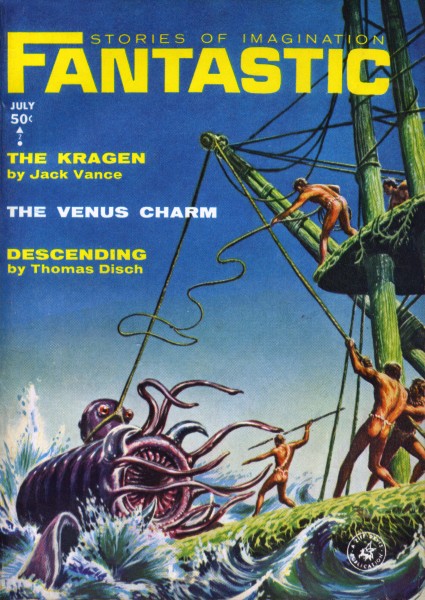
- “Descending” by Thomas M. Disch. From the July 1964 issue of Fantastic. Feels like it’s been a long time since I covered Disch, with his novel Camp Concentration. Disch was one of the daring young writers to kick off the New Wave in the ’60s, although despite being a regular at Michael Moorcock’s New Worlds he actually first appeared in Fantastic, under Cele Goldsmith-Lalli’s editorship.
- “The Defenders” by Philip K. Dick. From the January 1953 issue of Galaxy Science Fiction. It’s been ten months since I last talked about Dick on here, which in my book is too long a wait. The thing about Dick is that he’s become frankly over-discussed in “serious” SF discussions, or at least his most famous novels. Thankfully this is not the case with many of his short stories, such as this one.
- “The Jaguar House, in Shadow” by Aliette de Bodard. From the July 2010 issue of Asimov’s Science Fiction. Of Vietnamese heritage, living in France, and writing predominantly in English, de Bodard has a curious cultural background, so it makes sense she would concoct one of the most curious future histories in modern SF. Spacefaring humanity here is decidedly non-white and non-American.
For the complete novel:
- Planet of the Damned by Jack Vance. From the December 1952 issue of Space Stories. The early ’50s were a formative period for Vance, who was showing himself to be one of the most imaginative talents at the time—albeit one whose efforts were mostly relegated to second-rate magazines. I’ve previously covered Big Planet, which was a breakthrough title for Vance, and now we’re on Vance’s follow-up novel, published just a few months later. Planet of the Damned has a rather convoluted publication history: as with Big Planet, the magazine version and not the first book version served as the basis for future “definitive” reprints. It’s also been printed as Slaves of the Klau and Gold and Iron.
Won’t you read with me?
 Science Fiction & Fantasy Remembrance
One response to “Things Beyond: May 2024”
I look forward to the Michael Shea review. He’s an author I’ve heard of but not read.
LikeLike