Who Goes There?
During his lifetime, Poul Anderson was one of the most prolific and respected genre SF writers, winning seven Hugos for short fiction (a number I think only met by Harlan Ellison’s wins) and three Nebulas. He was a made a Worldcon Guest of Honor at a rather young age, although by that point he had already been active for little over a decade. Anderson was born in 1926 to Danish immigrants, and he and his family even lived in Denmark for a short time when he was very young—his Danish heritage being something that comes up rather often in his fiction. Vikings and generally people roaming the seas pop here and there, such as in the Hugo-winning story “The Longest Voyage,” and even in “Witch of the Demon Seas,” which is much earlier and less refined, there’s this sense that Anderson saw the sailor’s life as something to admire. The ship as a microcosm for human society would be used more famously in his novel Tau Zero, with the depths of space as a stand-in for the ocean. This is one of several recurring themes with Anderson, who over the course of half a century wrote too many novels and short stories to count across several series, not to mention all the standalone titles. He studied physics at the University of Minnesota, but took up writing full-time as soon as he graduated.
I was supposed to review a different Anderson novella, “A Tragedy of Errors,” months ago, but I never got around to it, and indeed I still haven’t read that story. I should, at some point. The thing with Anderson is that he wrote so much, the vast majority of which was published in the genre magazines, that he’s a good go-to author for when I’m feeling low on inspiration with review material. Anderson wrote so much, in fact, that a lot of his work has not been reprinted that frequently, if at all. In the case of today’s story its obscurity can be explained by its length, the fact that it was originally published under a pseudonym (there’s an Anderson story under his own name in this same issue, the more often reprinted “Tiger by the Tail”), and also it being on the weak side by Anderson standards.
Placing Coordinates
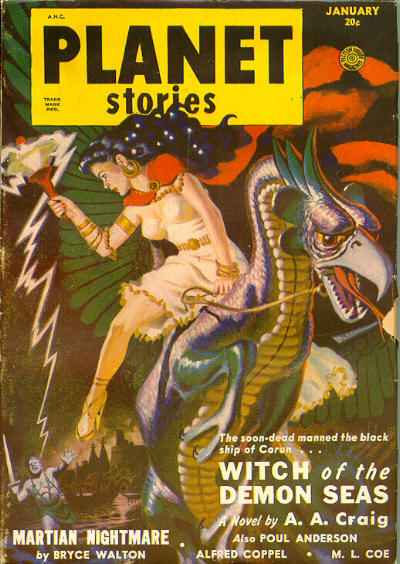
First published in the January 1951 issue of Planet Stories. It has since been reprinted in Swords Against Tomorrow (ed. Robert Hoskins) and the Anderson collection Swordsmen from the Stars. It has fallen out of copyright, so you can read it on Project Gutenberg.
Enhancing Image
There’s a procession going on in Achaera, showing off the captured pirate king Corun and his band of men. Corun of Conahur used to be a legitimate warrior, and a widely respected man, who turned pirate and roamed the seas. As the sorcerer Shorzon puts it, the man may be executed, but he deserves to be put “in a decent tomb.” Shorzon’s granddaughter, the young witch Chryseis, seems to agree with the old man, and even appears to be taken with Corun upon simply seeing him. The whole public affair is theatre, of course: Corun is to be locked away in a cell, apart from his men, and executed in due time. Of course, this is before Shorzon has anything to say on the matter, in which case the sorcerer has an offer to make with Corun. The idea is simple, that Corun is to accompany Shorzon and Chryseis with a small army to the Demon Sea, an infamous territory home to the Xanthi, an intelligent race of reptile-like humanoids who take to water like swans, and who are infamous for their capacity to overwhelm the forces of men. Corun was called upon not just because he’s supposed to be one of the finest warriors in the land, but because he’s one of the few people to have actually voyaged to the Demon Sea and lived to tell the tale.
So Corun has two options, either certain death at the hands of the law, or probable death at the hands of the Xanthi. The correct choice is obvious. “In any case—to live! To die, if he must, under the sky!” It also helps that he has immediately fallen for Chryseis’s beauty and elusive charm, which I’m sure will not come back to bite him.
Now you may be thinking, “Witches? Sorcery? I thought this was science fiction.” Well, it’s nominally science fiction. “Witch of the Demon Seas” is a planetary romance with a rather heavy emphasis on the fantasy half of the science-fantasy equation; there’s an SFnal twist late in the story, but for the most part the only thing that would identify it as SF is the fact that the action is set on a planet that is decidedly not Earth, and at the same time is not one of those secondary worlds a lot of fantasy works use. This is an alien planet, home to a wide breadth of alien life, including Chryseis’s pet “erinye,” a stranged winged beast. First and foremost it’s a maritime adventure set on the high seas, with the final destination being a black castle on an otherwise desolate island. In a way it’s all more reminiscent of The 7th Voyage of Sinbad than even Leigh Brackett’s planetary adventures, from which Anderson clearly took some inspiration. Brackett and Planet Stories had almost become synonymous with each other through the ’40s and ’50s, but while Brackett was prolific, she could not be there to provide a novella or novelette for every issue; hence there were other wirters, including Anderson very early in his career, who wrote what you might call Brackett Lite. Anderson is competent at providing such material for the magazine, but this is clearly not what he would ultimately excel at.
On the voyage, aboard the Briseia, we meet Captain Imazu, maybe the most sympathetic figure in the whole story, and certainly the one who seems most aware of what kind of story he’s in. He can see right through Shorzon’s scheme and knows intuitively that Chryseis figures into it somehow, but Corun is too horny star-struck to listen to reason. (By the way, you may notice that Corun has a similar name and even backstory to a certain Celtic warrior we all know.) The sequence when we’re on the Briseia, which includes a thrilling action scene when some of the Xanthi try boarding the ship by force, is also my favorite. What can I say, it takes advantage of my weakness for maritime stuff. (Also, as a final aside, I couldn’t help but notice Anderson using “larboard” to refer to “port,” as in the port side of the ship, using what was even in 1950 a very outdated nautical term. He obviously would’ve been aware that port had long since replaced larboard in the seaman’s lexicon, so I wonder why he did this.) There’s also the burgeoning romance between Corun and Chryseis, which is about as arbitrary as it is fast-moving (they’re implied to have sex after about maybe a few days of knowing each other), so I’m not too thrilled about that part. Mind you that we eventually get a plot-relevant explanation for why Corun falls head over heels for this girl he just met, but that doesn’t mean I like it.
There Be Spoilers Here
Sorcery is, psi powers?? No way.
A Step Farther Out
Was sort of dragging my heels to write about this one, although real-life circumstances also contributed to the delay. Anderson is a curious writer in that for how much he wrote over the decades, rarely does one catch an Anderson story that’s outright bad. Weak Anderson is still often better than what a lot of his contemporaries were doing, even those who arguably had higher highs in their output. “Witch of the Demon Seas” sees Anderson near the end of his apprentice phase, a period that undeniably came to end by the time he was writing the magazine version of Three Hearts and Three Lions and the serial version of Brain Wave a few years later. But aside from the fixation on piracy (a profession Anderson seemed to have some sympathy for even later in his career, see The Star Fox) and the nomadic anti-hero, this is a story one can skip when studying Anderson.
See you next time.

