Who Goes There?
Philip K. Dick was born in 1928, one half of a pair of twin siblings, but his sister died in infancy while Dick survived—a loss that would crop up here and there in his work throughout his life. Dick wrote some juvenelia when he was a teenager, but he landed his first professional sale in 1951, although it would take another year for said story to appear in print. Having flunked out of college (actually he got kicked out of UC Berkeley for failing what at the time was mandatory ROTC) and no longer wanting to work at a record store, Dick decided to try writing full-time. It was grouling work, and while he wrote at a mile a minute (with the help of amphetamines), poverty would plague him for much of his adult life. He tried breaking into the mainstream with a few non-genre novels, but only one of them, the pretty solid Confessions of a Crap Artist, even saw publication in his lifetime. In spite of all this, along with the fact that he died at the age of just 53, he came to have one of the most distinctive and important ouevres of any genre SF author. For years after his death he acted as sort of a go-to example for “intellectual” stimulation in SF, with themes and such. Dick has been such a favorite with academic types for so many years that it seems like recently we’re finally able to take a step back and better appreciate his work.
Even with his faults, of which there are several (his penchant for misogyny, his at-times sloppy phrasing, that like every prolific writer he fell back on a set of themes and character types), taken into account, Dick is arguably the best American SF writer of the ’50s and ’60s. Keep in mind also that a lot of Dick’s best work lies in his short stories, which he didn’t write as frequently after the ’50s; indeed he transitioned from being one of the best short-story writers of the ’50s to one of the best novelists of the following decade. “A Game of Unchance” came out during an especially busy year for Dick, which saw the publications of The Penultimate Truth, Clans of the Alphane Moon, The Simulacra, and the book version of Martian Time-Slip. This SF-horror yarn reads like a companion piece to a much earlier Dick story, “Colony,” although the situation here is different.
Placing Coordinates
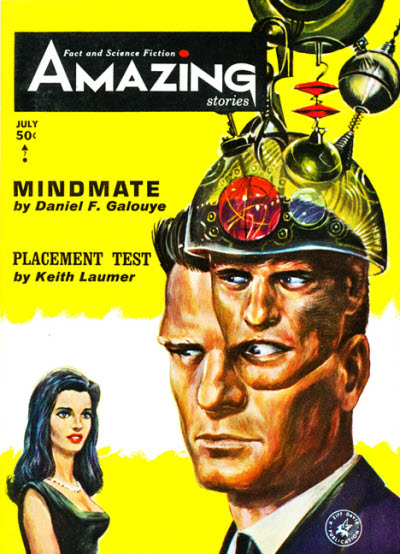
First published in the July 1964 issue of Amazing Stories. Took a surprisingly long time for “A Game of Unchance” to appear in book form, being reprinted in the 1980 Dick collection The Golden Man. Other Dick collections with this story include We Can Remember It for You Wholesale and Selected Stories of Philip K. Dick.
Enhancing Image
At some point in the future, Mars has been colonized, or at least is in the process of being colonized. The habitable but not exactly friendly planet (the depiction of Mars here, as with Martian Time-Slip the same year, would’ve been anachronistic even for 1964) is the new home for a bunch of human settlers, whose rough-and-tumble lifestyle echoes that of the sharecroppers from earlier in the 20th century. One day an alien carnival ship lands outside of town, promising games, magic shows, freaks, and “WOMEN,” that last part practically in all caps. Falling Star Entertainment Enterprises. Bob Turk remembers what happened when a similar ship landed round the same time the previous year: the results were not good. “Last time a carnival had come to their area they had been robbed of most of their crops—accepted by the pitchmen in barter—and had wound up with nothing more than an armload of useless plaster figurines.” Well, not gonna happen this time. Fred Costner, Tony’s son, is “sort of half-witted” but who also possesses genuine psi powers, so he can act as a spy for the settlers and help them win the big prizes at the carnival. What they win, however, ends up being far more troublesome than it could’ve possibly been worth.
The most valuable prizes at the carnival seem to be a bunch of plastic figurines, like toy soldiers but bigger and more complicated-looking. The carnies are protecting these and reserving them for only the biggest winners, although why is a mystery to Fred. “He could not for the life of him fathom the carny’s reasons for protecting these; surely they were worthless.” Still, the logic goes that the tougher the challenge, the sweeter the prize. Of course, Bob and company are cheating here, what with Fred’s help, although the carnies apparently have a psi person of their own trying to rig games. The whole thing is rigged, is the point. The prize in question, a bunch of “microrobs,” are not actually micro in size at all, but they could be confused for toys. Only thing is they’re very much not toys. One of them damn near blinds Hoagland Rae, a village leader, and another one later fatally wounds a Martian gopher. These little bastards, who don’t seem to be sentient but who at the same time quickly prove to be unruly, come upon the townsfolk almost like a plague of locusts. Bob and the others, being unprepared for such a thing, have to call in military guys from the UN. (The most unrealistic part about this story, aside from Mars itself, is the notion that the UN is good for anything.) Even then, the carnies show no interest in helping with the infestation; on the contrary they’re all too happy to leave the settlers with the mess they’d made for themselves.
Given that the themes that recur in Dick’s fiction have been picked apart by people more well-read than me, one pet theme of Dick’s that flies somewhat under the radar is his ambivalence toward capitalism. Dick was not a leftist himself, although he was open about having quite a few leftist friends; but since very early in his career his writing expressed a disdain for both corporate shenanigans and government authoritarianism. There’s a memorable scene early in Ubik where Joe Chip, the protagonist, has to haggle with his robotic apartment door. There’s some not-too-subtle commentary on class hierarchy in Do Androids Dream of Electric Sheep? “A Game of Unchance” takes a critical if also sympathetic view of the settlers by calling out their foolishness for giving up their livelihoods for some carnival games, but also pointing out that life in the colony is horribly dreary. The colonists do not see themselves as a people with values or even “culture” so much as they see themselves as a bunch of individuals trying to fight off boredom and poverty. The ship makes bank off the colonists, takes advantage of their need for entertainment, and at the same time leaves them with some killer robots. One of the UN men theorizes that they were in fact not supposed to win those microrobs, but this is never confirmed, and anyway the ending casts doubt on this theory.
There Be Spoilers Here
The central tragedy, indeed the horror, of “A Game of Unchance” is that the villagers are doomed to make the same mistakes, despite their best efforts. As such the story has a cyclical structure, with the opening and ending scenes being similar. This is rendered literally when another carnival ship arrives, although evidently not the same people as from earlier in the story. Of course there were freaks and scantily clad women, and “the games of chance had been placed—conveniently—ahead of even the girly shows and the freaks.” Maybe things will be different this time. We’re introduced to another valuable prize in the form of “homeostatic traps,” which are like automated robots made to combat pests like the microrobs—indeed they seem to have been made with the microrobs in mind. The villagers, desperate for a solution to their immediate problem, give up all they can to win these traps. Once again the carnies have a psi person on their team, but once again Fred is able to cheat into winning the most valued prize. “It was almost as if they had worked it that way on purpose.” We’re all but told in plain words that the cycle of those who con and those who get conned will continue, as surely as the sun will rise tomorrow.
A Step Farther Out
“A Game of Unchance” lies on the border between major and minor Dick, as it’s a bit too long and winding for what it is, and there’s this sense that we’ve seen this premise done before—maybe even by Dick himself. For the most part, though, the execution is quite good. It’s the kind of story where thinking about it after the fact is maybe as rewarding as the experience of reading it. There’s a creeping pessimism that hangs over most of Dick’s work, but it’s especially pronounced here, with the ending line being a haunting moment. The anti-capitalist commentary here unfortunately has not aged in the 62 years since its publication. While it’s not as outright horrifying or bleak as “Colony” (without spoiling anything about that story, I seriously recommend it), it posits the sentiment that we will keep falling into the same traps in the hopes of getting out.
See you next time.

