-
Novella Review: “Memorare” by Gene Wolfe

(Cover by Mondolithic Studios. F&SF, April 2007.) Who Goes There?
People generally fall into three camps when it comes to Gene Wolfe: they haven’t heard of him, they respect him but they find it hard to get into his work, or they really go to bat for whom they believe to be one of the best writers ever. I fall into that second camp. Wolfe was no doubt brilliant, being more literary and sophisticated than most of his New Wave contemporaries. He sold his first story in 1951 but did not start writing again with any regularity until 1966, from then on becoming more or less affiliated with the original anthologies like Orbit and Universe that were cropping up at that time. Nowadays Wolfe is most known for The Book of the New Sun, a series of four (or five, depending on how we count Urth of the New Sun) novels that are meant to be taken as one whole. Even though I struggle to get through The Book of the New Sun personally, it’s hard to deny its mixing of far-future science fiction and low fantasy has a unique appeal.
Today’s story, “Memorare,” is not a case of Wolfe playing with genre boundaries, though, being spacefaring sciennce fiction from start to finish. The Magazine of Fantasy and Science Fiction has, over the decades, done several special author issues, typically involving a cover depicting the author, a tribue essay, and a short story or novella by said author which was specially commissioned for the issue. “Memorare” is a standalone novella that was nominated for the Hugo, Nebula, and Theodore Sturgeon Memorial Award, and for newcomers to Wolfe it may serve as a good introduction to his strengths—if also one or two of his weaknesses.
Placing Coordinates
First published in the April 2007 issue of F&SF, which is on the Archive. As far as reprints go, you have two options. “Memorare” got a chapbook release in 2008 from Wyrm Publishing, looking quite fetching due to the cover, which looks like a poster for a ’50s B-movie. That same year we got our second and final reprint, as part of Year’s Best SF 13 (ed. David G. Hartwell and Kathryn Cramer), marking its only anthology appearance. In other words, this thing has not been brought into print since 2008, which is a bit odd considering it was clearly an acclaimed work. Could we get a collection that focuses on Wolfe’s more recent short fiction maybe?
Enhancing Image
Gordon Van Gelder’s opening blurb for this story references Survivor (boy, what a dated reference that is), which is relevant because what follows is basically a survival adventure narrative. March Wildspring is a documentary filmmaker who at the moment is a bit down on his luck, trying to cobble together footage for a show on the asteroid memorials that are sprinkled around Jupiter and Saturn. He travels around in his ship, in a world where for some reason spaceships are called “hoppers,” with a “digicorder” which is basically a camera; I don’t know why Wolfe has a tendency to not call things as they simply are. This all sounds simple enough, even boring enough, since at first you might think that taking footage of mausoleums in space would be straightforward—but this is a Gene Wolfe story.
In the future, certains persons of the filthy rich and famous (and perhaps insane) variety have opted to enshrine themselves in space, specifically in the asteroid belt where they could say, “I wanna build a tomb inside that,” and they might actually get their wish. The logistics to build one of these things must be a fucking nightmare, but Wolfe and the characters don’t dwell on that part so much aside from noting that, at least as far as the materials needed, it could be done. But should it…? To make things worse, these memorials sometimes have traps set in place for those who wanna do some graverobbing, which on the one hand makes sense if you’re someone who has some really valuable loot placed in your tomb, but also, this all sounds a little bit insane. I don’t know what it says about March that he’s also crazy enough to be doing this shit (the tomb-raiding) regularly enough that he wants to make a whole documentary about his experiences.
Something that didn’t occur to me until just now is that world of “Memorare” is not that dissimilar from John Varley’s Eight Worlds series, in that the solar system has been more or less colonized entirely and people, more often than not, hop across moons and planets for the sake of tourism—of fighting off boredom. There are some differences. For one Earth has not been taken over by aliens in “Memorare” (indeed aliens are absent here, so cross that off the list), and also the solar system is a bit more dangerous in Wolfe’s story. In the Eight Worlds stories people are rarely in danger to the extent that their lives could end permanently; it’s actually quite hard to die for real in the Eight Worlds series, so conflicts not involving permadeath are preferred. But in “Memorare” people die permanently, and often violently. “Every year, five, or ten, or twenty don’t make it back,” says March when referring to fellow travelers among the planets.
Right, one more thing. Certain tomb owners can cheat death (but not really) by reproducing their likenesses with a hologram or even an android; this is not the same as cloning and memory backups in the Eight Worlds, but it’s the closest people can get to life after death. The uncanny result of all this is that March can (and indeed does) interview what are effectively the ghosts of the owners of these tombs, as hologram projections or droids.
The first half of “Memorare” is pretty episodic, with March hopping around before meeting up with his business partner and love interest, Kit, whom he desperately wants to marry but can’t—at least partly, according to Kit, because of their careers. I don’t wanna dwell on Kit too much because I’m not really a fan of her character—or the other leading lady of the story, for that matter. I’ll explain why in a minute, but let’s say Wolfe is setting up a love square that detracts from the narrative more than it adds. Few authors, even the good ones, do romance well, and Wolfe has yet to convince me he’s one of those few who can make it work. We’re soon introduced to Robin, Kit’s friend and, as it turns out, March’s ex. We had heard before that March is a divorcee, but apparently he’d been divorced twice, one of those times with Robin. Indeed Robin used to go by the name of Sue, but she had it legally changed.
March and Robin’s relationship was not a happy one.
Robin whispered, “He’s my ex. Kit.”
“Jim?” Kit goggled at her. “I saw Jim. It was Wednesday night.”
“Not Jim. Oh, God! I hate this!”
March said, “It’s been years since the final decree, Kit, and the proceedings dragged on for a couple of years before that. I had abused her—verbally. I had said things that injured her delicate feelings. Things that were quoted in court, mostly inaccurately and always out of context. I had persecuted her—”
“Don’t! Just don’t! Don’t say those things.”
“Why not?” March was grim. “You said them to a judge.”
“I had to!”
Jim, by the way, is Robin’s current partner, a gaping asshole who for some reason talks like a 1930s gangster; we’ll get to him in a minute. The thing about Wolfe that tends to keep me at arm’s length with him is that he is basically never direct with the reader, opting instead to hide behind characters who are rarely honest with anything, even themselves, plus his thing for shrouding plot details in ambiguity. As far as the plot goes “Memorare” is actually straightforward for Wolfe, there’s surprisingly little in the way of narrative trickery, but that part about unreliable characters is still there—for what purpose I cannot say. The relationship between March and Robin is arguably the dramatic focal point of the story, yet it’s also the murkiest: for one we’re never sure how trustworthy either’s side of the story is, but Robin’s frazzled demeanor implies that her side of things is to be taken with a grain of salt. I have issues with this situation.
Another problem I have with Wolfe, which I really do think is a shortcoming of his and not just a matter of personal taste, is his blind spot for writing female characters who are both sympathetic and three-dimensional; or rather he has a hard time doing either when it comes to women. I know, it’s not a unique criticism, especially for a man of Wolfe’s age, but what separates Wolfe from, say, Harlan Ellison, is that it’s not hard to figure out why Ellison has a misogynistic streak: he’s an angry short guy who went through one messy divorce too many. With Wolfe, however, the man’s writing is so controlled and so meticulous that I have to assume his light but conspicuous misogyny is there for a reason—only I can’t fathom what that reason is. Of the four main characters March is the only one who is allowed to never sound like a cartoon, but he’s also the only one who’s never framed as all that untrustworthy. Protagonist bias? Then again he’s very much not a perfect person; he makes mistakes and it’s his own personal hell, namely his relationship problems and more implicitly his crisis of faith (of course he’s Catholic, if only lapsed), that drives the plot.
Wolfe is known for several things, among them his devout if also pessimistic Catholicism which crops up in his fiction, often only subliminally. Secular readers have less of an issue with Wolfe than, say, Flannery O’Connor, because unlike O’Connor Wolfe is never trying to convert the reader. For the record I do like O’Connor, despite not being Catholic or even Christian, because she’s so damn good at what she does (“A Good Man Is Hard to Find” is a Catholic horror story, and one of the greatest horror stories ever written), but Wolfe’s worldview is despondent enough that he’s much more on the side of Graham Greene than O’Connor; or to put it more in the context of genre fiction, think of Walter M. Miller, Jr., although Miller was despondent enough to despair in the end. “Memorare” is certainly dark, though, with its constant imagery and talk of death, never mind the muddy relationships between the four main characters, with love and life itself on the line. About half the “characters” we read about are people who are already dead, their specters merely lingering in the dark rocky vaults of space.
There Be Spoilers Here
The latter half of “Memorare” is concerned with what is supposed to be one of the most dangerous tombs in the solar system: Number Nineteen. This is a strange, even surrealistic place, host to a crowd of people and founded by someone whose name is somehow unknown, though he must have been unspeakably wealthy to have such an elaborate tomb constructed. Number Nineteen is basically a world unto itself, despite being only an asteroid; this naturally means that footage of the interior would go for a lot of money—if March and company can make it out in one piece. By this point Jim has caught up with the rest of the party and joined in the festivities. I really hate Jim. That’s okay, because Jim is the only character we’re unequivocally supposed to dislike. Everything that comes out of this dude’s mouth is bullshit, be it what he’s saying or how he’s saying it—never mind that, regardless of Robin’s testimony, it’s clear that Jim is an abuser and almost proud of it; his offscreen death at the end is a little satisfying.
What’s far less satisfying, even horrifying, is Kit’s abrupt and violent death just as she and March are about to escape. It’s one of the most effective and disturbing little pieces of writing I’ve seen in a while, regardless of how I had felt about Kit’s character up to that point, made only more shocking because March does not react to it immediately. Robin chooses to stay behind so that March can escape, and sacrifice affects him deeply. The only good thing here is that the footage March got is, at least according to his boss, incredible, with his company buying it pretty much on the spot. Sure, his personal life may be ruined, but at least he’ll be all set financially. That’s gotta mean something, right? Obviously there’s some cynicism on Wolfe’s part about the exploitative nature of reality TV, which after all is documentary filmmaking taken to a more sensationalist level—ya know, like those shitty and problematic “true crime” documentaries that get popular on Netflix.
But then we get to the very end.
We get a list of credits for the documentary March wanted to make, with dedications to Kit and Jim. We also find out with these credits, however, that not only did March go back to Number Nineteen and rescue Robin (okay) but that they also… remarried in the time between the rescue and the documentary’s release? They’re both listed as editors with Robin taking March’s last name (again). Now, documentaries are mostly made in post-production; it could take a year or a damn near a decade to cobble together a documentary in the editing room. Regardless, there’s a whole story here with March and Robin getting back together that’s hinted at but which goes untold. The real issue I have is that everything we’ve seen up to this point indicated that no matter how much they might forgive each other and reconcile, getting back together would be a bad idea for both parties. Like obviously these two are a toxic couple—whether that toxicity is mutual or one-sided doesn’t matter ultimately. I suppose this is meant to give of us a ray of hope at the end, but as far as bittersweet endings go I find the sweet half far less convincing than the bitter.
A Step Farther Out
I’m a bit mixed on this one. The good news is that I went in worried that “Memorare” would be Wolfe in typical cryptic mode, and it actually ended up being more accessible than I expected. Despite being a pretty late work of his, “Memorare” is something you can recommend to someone who has not read Wolfe before and they probably won’t bounce off of it. Wolfe’s Catholicism is a bit more overt here than in much of his fiction (that I’ve read, anyway), but like any good storyteller he uses his worldview to enrich his work thematically and emotionally, which is very much the case here. The downside is that Wolfe’s blind spot when it comes to writing women rears its head with a vengeance in “Memorare,” the misogyny being turned up a notch or two for reasons I can’t fathom. I’m also not sure what Wolfe’s deal is with the anachronistic dialogue; given the chapbook’s cover there’s this running theme of “retro” science fiction, a sort of throwback, but I don’t understand what the purpose of that connection is. Despite my gripes, though, I don’t think it’s unreasonable to wanna see this, and some of Wolfe’s more recent short fiction, preserved in a new retrospective collection.
See you next time.
-
The Observatory: Science Fiction’s Love-Hate Relationship with the Oscars

(From Everything Everywhere All at Once, 2022.) So the Academy Awards happened last month, whose proceedings were impressive for both good and bad reasons. I don’t mention it often, but I’m a film buff. I majored in film studies and for a couple years I tried (and failed) to find a position in that industry. Still, while film is my wife (on paper), science fiction is very much the mistress I love at least as much if not more—like with those lovey-dovey letters Albert Camus wrote to his mistress. As such I have a history of getting excited and subsequently let down whenever it looked like an SF film might gain that most coveted of film awards: the Oscar for Best Picture. Hell, in the 2000s we had two Hugo winners (for Best Dramatic Presentation) that were also quite eligible for taking that Oscar, those being Gravity and Arrival. Gravity is all style and no substance when you get down to it, but while Arrival had no realistic chance of taking on La La Land and Moonlight, it would’ve been a very deserving winner.
Thing is, up until 2023 there was not a single SF movie that won Best Picture—an award that’s actually gone to a few fantasy films (including another Hugo winner with The Return of the King) and even a horror film with The Silence of the Lambs. But no science fiction. Indeed most of the classics in the genre, which nowadays are held up as high art and placed alongside such films as Citizen Kane and The Godfather, were not even considered for Best Picture. To think that 2001: A Space Odyssey, the most revolutionary film of its kind for a good decade, was not up for Best Picture, its biggest nomination being for Best Director (which it should’ve won handily). Blade Runner, even in its somewhat botched theatrical cut, would’ve been a fine contender, but not only was it not nominated for Best Picture, the legendary and absolutely BANGER score by the late Vangelis was not up for an Oscar either. The Empire Strikes Back, the best and most sophisticated of all the Star Wars films, was also snubbed, although, for what it’s worth, A New Hope was a major contender for Best Picture.
Most recently, prior to this year’s Best Picture winner, there was Dune, Denis Villeneuve’s fresh adaptation of Frank Herbert’s novel. Villeneuve already won a Hugo for Arrival and he’d win another for Dune, but both movies, on top of being superb science fiction, were also Best Picture nominees. Dune swept the technical categories (visual effects, sound, etc.), but to everyone’s dismay and confusion, Villeneuve was not up for Best Director. HUH? How did this happen? Oh yes, this movie which conveys a sense of scale and awesomeness very rarely seen in any medium was apparently helmed by someone who did not deserve recognition for heading that visual strength and cohesion. (He got nominated for Best Picture and Adapted Screenplay, but you know what I mean.) Dune is not unique in this fuckery, though, because the decades-long relationship between science fiction and the Oscars can be boiled down to SF films doing well in technical categories but eating shit everywhere else. Amy Adams gave one of her best and most acclaimed performances in Arrival, but she got snubbed, I guess because great acting can be discounted if aliens are involved.
Some truly bewildering snubs, especially for movies that in hindsight have aged better than their competitors… but recently this all changed, or at least a major exception was made. Yeah, you know I’m gonna talk about Everything Everywhere All at Once, albeit not in too much depth.
I saw EEAAO in theaters twice, and that was about a year ago. I had been following Daniel Scheinert and Daniel Kwan since their first feature together, Swiss Army Man, one of the most lol random but also charming indie films of the 2010s. A lot of people didn’t like Swiss Army Man, but upon seeing it some years ago I knew that we were dealing with giants in the making, which is why EEAAO‘s excellence did not strike me as a surprise. It’s a visual wonder of a film, especially impressive considering its small budget, and while thematically it’s not as deep or layered as it could’ve been, it does a lot with so little. The direction and editing were the highlights for me, along with costume design that, again, went pretty hard given the limited resources. The performances, despite the occasional silliness, were also all around excellent, with special mention going to Ke Huy Quan, who deservedly won awards at pretty much every ceremony.
What surprised me a good deal more was how EEAAO not only instantly became one of the most acclaimed films of 2022, but how it built up an inertia for awards attention that it never lost. After a while I started to think, “Could this be the one…?” There were a couple things going against it, namely that it was released theatrically way back in March, and also that it was produced by A24, who for several years had a bad reputation for not bothering to campaign their movies properly during awards season. The biggest obstacle, from my perspective, was that EEAAO is unabashedly and unambiguously SCIENCE FICTION; it’s goofy and unhinged, but the basis for its universe-hopping hijinks is very much science-fictional. There’s an internal consistency and set of rules for how one is supposed to tap into the lives and “powers” of one’s alternate selves. The film’s logic is actually not dissimilar from a short novel I reviewed some time ago: Fritz Leiber’s Destiny Times Three. The line between a Campbellian Golden Age romp and a movie with a mostly Asian cast that came out last year is straighter than you’d think, but the point is that this movie was not Oscar material.
Until it damn near swept on the big night, anyway.
It won Best Picture, but it also became the first film in Oscar history to win Best Picture and also three acting Oscars. Only two films had done that before, those being A Streetcar Named Desire and Network. It was the first Best Picture winner to win more than five Oscars since Slumdog Millionaire. It was the second ever Hugo winner to also win Best Picture. It was, as I said before, the first SF movie to win Best Picture. It was both a critical and financial success, and already the Daniels have a blank check to do whatever the hell they want with their next film—this time with Universal writing the check. The Daniels are clearly intelligent, if quirky, filmmakers, but of their two films together only one has been science fiction, so I’m not sure yet if they’re students of the field or if they rather simply used science fiction as a diving board for a plot germ that couldn’t have happened without SF trappings. Villeneuve clearly loves science fiction for its own sake, for its capacity to explore all avenues of human thought and emotion in ways other genres don’t allow, but it could be that people in the film industry were charmed by the Daniels and their film because neither seemed all too loyal to any genre, never mind science fiction.
The question I have at the end of all this is: Does this mean we’ve finally broken the glass ceiling with SF being respected by the Academy? Personally I don’t think so—not yet. EEAAO went up against big odds and won out, but it might also turn out to be the exception that proves the rule. True, it’s the second Best Picture winner in five years to feature a predominately Asian cast, and it did manage to get away with some insane gags and an overall lack of predictability; and yet EEAAO‘s runaway success tells us surprisingly little about the collective attitudes of industry folks who partake in these award circuses. We’ve been burned before. Remember Parasite winning only a year after Green Book? 12 Years a Slave the year after Argo? (I like Argo, but it’s a very by-the-book kind of movie.) Then we had Nomadland, a protracted Amazon commercial, and CODA, a movie nobody has actually seen. The Academy getting it right with EEAAO feels inexplicable, and that’s because it might have been. Maybe none of this means anything.
We’ll see…
-
Serial Review: Camp Concentration by Thomas M. Disch (Part 2/4)

(Cover by Eduardo Paolozzi. New Worlds, August 1967.) Who Goes There?
There’s debate as to when the New Wave of science fiction started, since certain works, such as Alfred Bester’s The Stars My Destination, anticipated the transgressions made during that movement. Authors who would be often affiliated with the movement, such as Kate Wilhelm, R. A. Lafferty, and Harlan Ellison, also usually got their start in the field well before the mid- to late-’60s height of the New Wave. Another author who came around just in time was Thomas M. Disch, who in the ’60s saw pbulication on both sides of the Atlantic, in both the US (ohh) and the UK (eww), and aside from having the handicap of being a filthy British magazine, New Worlds proved to be the ground where Disch could be his saltiest and most transgressive. Camp Concentration saw serialization in New Worlds in 1967, just before that magazine was to run into some real legal (on top of the already financial) problems, and thus, regardless of its flaws (I do have some quibbles), it can be seen as emblematic of New Worlds during its peak, despite being written by an American author. Disch’s novel would see book publication in the UK the following year, although weirdly American readers would have to wait until 1969 for an American edition.
Placing Coordinates
Part 2 was published in the August 1969 issue of New Worlds, which is on the Archive; and just to keep my bases covered I think this will be the first time I’ve linked to Luminist. Just be aware that PDFs on Luminist tend to be BIG, including this one, but at least its collection of New Worlds is more complete than the Pulp Magazine Archive’s. As for book versions there aren’t a lot of options, but it looks like the Vintage paperback is still in print and readily available, so yeah, probably go for that.
Enhancing Image
Before we get to the plot, which there isn’t a whole lot of for this installment, let’s talk about interiors and how they can relate to the stories they’re supposed to be illustrating. Sometimes an interior, depending on where it’s placed, can be illustrating something that has already happened in the text, or it can serve as a kind of foreshadowing, alluding to something that will happen later in the text but which, upon seeing the interior, we will not have read for ourselves yet. Part 2 of Camp Concentration opens with an interior by Zoline, depicting a rabbit on its hind legs kissing a cherub, which sounds transgressive but also like a non sequitur—for now. Believe it or not this is a pretty good use of illustrative foreshadowing, as it sets up the meat of what is to come in Part 2, though we’re not able to connect those dots yet. I guess it’s NSFW, given the cherub’s dingus is hanging out, but that’s also not an uncommon sight in religious paintings and sculptures.
Observe:
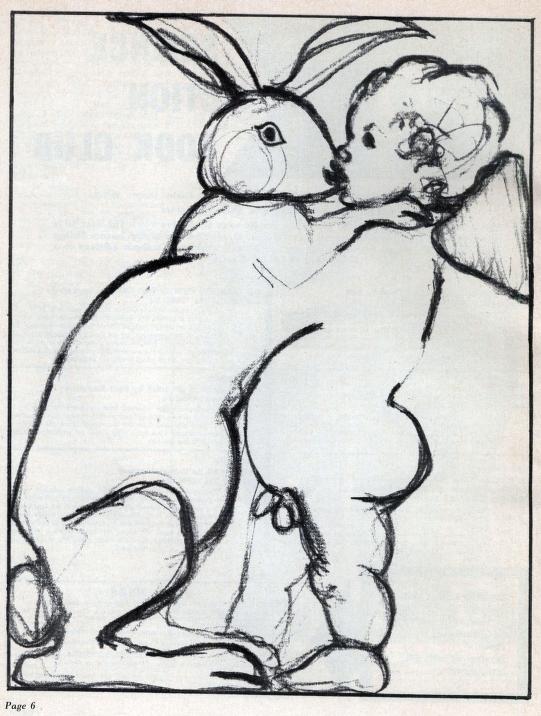
Last time we ended with a performance of Christopher Marlowe’s Doctor Faustus that went wrong, with the magic pixie dream boy George having fallen violently ill with what turns out to be a condition all the prisoners at Camp Archimedes have—a condition that gives them only months to live. George soon dies and there’s a funeral held for him; we didn’t get to know him very well, but he clearly serves as the sacrificial lamb for both Camp Archimedes and the novel, Disch seemingly telling us that even the most innocent of the lot are not safe. Louis, who was already an unhappy camper (lol) before this, threatens to have a breakdown.
The prisoners do things to preoccupy themselves, partly because the drug they’ve been given has heightened their intelligence and thus their need to satiate cognitive activity, and partly to keep their minds off the fact that they will all die rather soon. Louis starts writing a three-act play of his own, titled Auschwitz: A Comedy, which perhaps for the best we learn very little about. This is one of those little things about the novel that can be taken as either simply edginess for the sake of itself or a bit of very dark comedy; I’m inclined to think it’s the latter. I’m reminded of a line in the film Crimes and Misdemeanors wherein a character insists that comedy is simply “tragedy plus time,” a philosophy Disch might agree with—that is to say, once enough distance in time is made from a terrible event, that terrible event can be warped and recontextualized to become funny.
Louis has another conversation with the camp doctor and local Ms. Exposition (not to mention the novel’s only female character), Dr. Busk, where we’re finally told what exactly the prisoners have been injected with, because it’s not just any drug. To make a long story short, the prisoners of Camp Archimedes have been infected with a highly advanced form of syphilis, that most horrible of vinereal diseases in a pre-AIDS world which sees the victim succumb to insanity, then death. Some famous people thoughout history were known, or at least suspected, to have contracted advanced syphilis, the most famous example probably being Friedrich Nietzsche. Yet, as Dr. Busk points out, these people who were ultimately ruined by the disease also seemed to have flashed of brilliance amidst the madness that could have been a direct result of the disease, and though he is loathe to admit it, Louis has to agree somewhat.
But it has been suggested—and by some very reputable people (though they were not usually in the medical line)—that neuro-syphilis is as often beneficent as it is at other times malign, that the geniuses I’ve mentioned (and many others that I might add) were as much its beneficiaries as its victims.
Meanwhile there’s an apparent rivalry between Haast and Busk with regards to certain activities the prisoners take up to preoccupy themselves, with Haast being on the side of the mystic and Busk being on the side of the materialist—a rivalry that involves Louis and Mordecai. Mordecai, last time we saw him, had taken a keen interest in alchemy, which by now has blossomed into an autistic fixation. It’s here that we get the most memorable scene in the installment, and the point of inspiration for that opening interior illustration. Mordecai, who by this point become perhaps a little unscrewed mentally, introduces Louis to his three “familiars,” those being rabbits who have also been infected with the disease and who subsequently only have a short time to live—though for them it’s a matter of weeks rather than months. The rabbits seem to all be male, for they also have incredibly swollen testicles because of the disease.
That’s one half of the equation for the illustration, but we’ve not quite reached the other half involving the cherub yet…
There’s an obvious parallel between the prisoners and the rabbits, with the two being treated more or less the same. Testing on animals, and rabbits especially, has historically been pretty common, to the point where the imagery of rabbits in cages in some laboratory has been shorthand for experimental (and unethical) testing. I do have to wonder if Disch was thinking of Flowers for Algernon when writing Camp Concentration, since the two have similar premises and play with the same notion of accelerated human intelligence. Of course, the premise of Flowers for Algernon is actually a bit more implausible because scientists, no matter how unethical, would not test their hypothesis on a single rodent and then greatly upscale that experiment for a human. Disch also uses his premise to comment on the US government’s gross treatment of protestors during the Vietnam war; it’s not hard to think the government at this time would see infecting a bunch of naysayers with a terminal disease in the name of “science” as a convenience, even killing two birds with one stone.
I know I mentioned this in the previous installment, but the Tuskegee experiment, wherein dozens of African-American men were unknowingly infected with syphilis, was still in progress, unbeknownst to Disch and the rest of the American public. The lesson here is to never underestimate the potential evils of government—then or now. This is all made extra eerie since Mordecai is easily the most prominent black character among the ensemble, and it’s clear that he’s also been taking his condition not too well. We’re never sure how sincere Mordecai is being about his turn towards mysticism, but what’s not so ambiguous is that he’s dying, and he’s a man in the midst of an existential crisis. “The whole goddamned universe is a fucking concentration camp,” he says at one point, and for him that might indeed be true; for a terminally ill man, where freedom is impossible, life itself has become a prison where “escape” means death.
There Be Spoilers Here
Mordecai, with Haast’s approval, performs a religious ritual on Midsummer’s Eve, one which pushes Dr. Busk’s buttons, but while the not-so-good doctor is triggered in the short term (of course the one female character is a total stick in the mud), she feels morbidly vindicated when the “elixir” Mordecai has been working on seemingly has no effect; not only that, but Mordecai dies, pretty abruptly, before completing the ritual. Haast, who really did believe in Mordecai’s promise as an alchemist, feels betrayed by both his death and the lack of effectiveness of his studies, and he has quite the episode. Mysticism has failed, and materialism does not provide a cure for the specter of death which plagues them all.
What’s strange about the series of revelations in this installment is that Louis treats his own terminal condition like it’s supposed to be a surprise; like sure it sucks that you’ll die from syphilis in a few months, but given what we’ve known up till now I would’ve just assumed that was the case. Of course it makes sense symbolically, in a deal-with-the-devil fashion: Louis and the other prisoners were trapped in more conventional prisons, ones which had shitty living conditions but which at least showed the posibility of release, and they made a deal with Haast where they got to live in an underground facility that was more like a hotel than a prison—only, unbeknownst to them, they had all been given death sentences. Still, I can’t always make sense of Louis’s reactions to plot developments, like how I also can’t tell if he’s merely a lapsed Catholic or an apostate; he certainly sounds concerned with the theological minutia of the Church scriptures.
Speaking of which, the actual ending of Part 2 is a protracted dream sequence, which Louis is somehow able to recall in detail (writers beware that dreams, and the recollection of dreams, basically never work this way), wherein he has a rather odd conversation with a monstrously fat Thomas Aquinas, with cherubs as minions. Louis, eyeing one of the cherubs, notices something worrying about it, “the distressing inflammations that had swollen its tiny scrotum and caused the poor thing to walk with a strange, straddling gait.” Does this sound familiar? Now it all adds up… sort of. I’m still not quite sure what Disch means with the swollen testicles bit, but he’s clearly drawing a line between rabbits and people, with cherubs standing in for the latter. There’s also a subliminal homosexuality about all this, since both the rabbits and cherubs, given their genitals, are supposed to be male. (I know what you’re thinking: that sounds bioessentialist. I’m talking specifically in the context of the novel, which is so lacking in women anyway that male homosexuality is all but inevitable, even without Disch’s teasing.) What could it all mean, though? I’m not sure yet.
On a final note, we’re one again reminded of the Faustian theme of man’s hunger for knowledge at any price, with Aquinas’s obesity being symbolic of his insatiable hunger for knowledge. Obesity is typically used in fiction as shorthand for a character’s greed (a gross demonizing of obesity that even left-leaning people are guilty of using at times), but at least here I can sort of look the other way since Disch is using it less to illustrate Aquinas (who after all is just a figment of Louis’s imagination here, and thus a projection of his own insecurity) and more to illustrate Louis’s character, not to mention how it ties into the novel’s general thesis. How problematic this all could be considered is a topic for another time, perhaps.
A Step Farther Out
Sorry for the relative brevity of this one, but given how short these installments are and how pressed for time I am I don’t see why not. There’s also not a whole lot to say with this one, since it has middle-of-the-trilogy syndrome written all over it—just replace “trilogy” with “quartet.” Something I’ve come to realize about this novel is that, structurally, it has peaks and valleys: there’s a long conversation or three followed by a Very Important Event™ that changes the course of the plot. We have scenes where characters are just talking, which in some way set up what’s about to transpire, followed by a crescendo wherein Louis’s world is rocked.
Strange thing about Part 2 in particular is that we get basically two climaxes: the first one with Mordecai, and then at the end we have the dream sequence with Aquinas which, admittedly, bordered a little too much on padding for my liking. I think I get where Disch is going with the latter, symbolically, but given how short this novel already is I have to wonder if he drew out the dream sequence as long as he did because he realized oh shit, one of the novel’s major characters is dead and we’re only about halfway through. Still, it says something about the evocativeness of that symbolism that I’m still thinking about it a couple days after having read it.
See you next time.
-
Short Story Review: “The Big Night” by Henry Kuttner
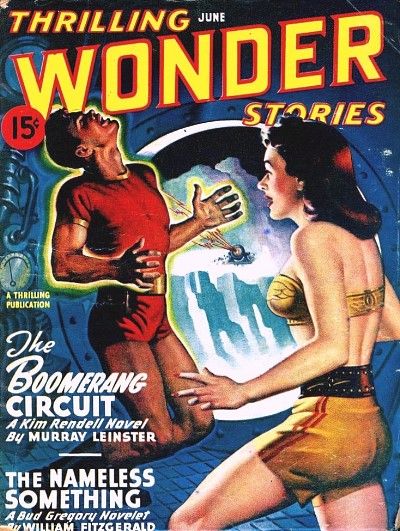
(Cover by Earle Bergey. Thrilling Wonder Stories, June 1947.) Who Goes There?
Last month I reviewed C. L. Moore’s “The Black God’s Kiss” (review here), which was a reread and a reminder that sometimes rereads are important. As I delve deeper into the works of Moore and her first husband, Henry Kuttner, the more I think that there ought to be a major resurgance in interest with regards to these two. In the ’40s Kuttner and Moore were the writing duo in science fiction, being so seamless in their collaborations that they struggled to tell who wrote what—a layer of ambiguity that has plagued genre historians ever since. With some stories it’s safe enough to say who did what, but sometimes it comes down to “educated” guesses: a rule of thumb is that if a story post-1940 is credited to Moore alone then it probably is just her, but Kuttner sadly does not receive the same treatment for stuff published under his byline without Moore. The two as a pair contributed frequently to Astounding Science Fiction, but each would also submit to other outlets solo, and Kuttner especially appeared without Moore’s next to his quite often in Startling Stories and Thrilling Wonder Stories. It might be that because Kuttner did not have as high a reputation as Moore that he was more inclined to appear in second-rate magazines.
It’s true that Kuttner was a less refined writer than his wife; his technique was more steeped in the tradition of pulp craftsmanship, being more adept at producing “raw” story over memorable lines of prose. As such, Kuttner is harder to judge on a line-by-line basis, but rather should be judged by the total effect his work has, which at its best certainly rivals Moore’s. Kuttner was also one of the great humorists of classic SFF, being one of John W. Campbell’s court jesters in the peak days of Astounding and Unknown, but the downside is that his knack for comedy can cast a veil over his talent for social commentary and, yes, a bit of philosophy. Today’s story, “The Big Night,” is relatively serious for Kuttner (though it’s still knee-deep in pulp prose), which might be why he had it initially published under the pseudonym Hudson Hastings.
Placing Coordinates
First published in the June 1947 issue of Thrilling Wonder Stories, which is on the Archive. The good news is that if you want a more readable digital copy you’re in luck, because for some reason this story fell out of copyright and it’s available, perfectly legally, on Project Gutenberg. As for paper reprints you only have a few options, but the ones I recommend are pretty good. First, and as will usually be a source for Kuttner/Moore reviews, there’s Two-Handed Engine, a massive tome that collects “essential” stories from Kuttner and Moore, both solo and in collaboration, and you can get a used copy for a reasonable price. There’s also the Ballantine paperback volume The Best of Henry Kuttner, which admittedly relies too much on stories that were most likely written in collaboration with Moore (Moore does not get the same treatment for her Ballantine Best Of volume). Suprisingly “The Big Night” has not been anthologized anywhere, not even for like a stray collection of pulp-era space opera stories. Oh well.
Enhancing Image
Normally when we’re introducing to spaceships, especially in pulp-era SF, there’s an attempt on the author’s part to capture a sense of wonder with the ship’s bulk and speed, but Kuttner doesn’t do that; instead we’re introduced to La Cucaracha (yes, that’s its name) with language that would be considered unflattering, her “fat body” scarred with a molten streak across her middle and with spot-welds standing in for liver spots. La Cucaracha is an old ship and she’s on her last leg, and to make matters worse her skipper, Sam Danvers, is drunk again. Danvers mostly plays second fiddle to the story’s real protagonist, Logger Hilton, the first mate.
(An aside before we continue is that I wouldn’t go into this expecting female representation at all, as there’s not a single named female character and La Cucaracha‘s crew is all-male.)
Hilton is called to talk with Danvers, or rather to talk him out of his stupor, as Danvers is indeed quite drunk and, like his ship, is very old. “He was a big man, or rather he had been once, but now the flesh had shrunk and he was beginning to stoop a little.” We aren’t told ages, but judging from some comparisons I’d say Hilton is in his forties while Danvers is in his seventies, so you know we’re not dealing with spring chickens. When we meet Danvers he’s “making a speech to an imaginary Interplanetary Trade Commission.” The ITC, as I’ll call it from now on, had recently done a routine inspection of the ship and found she’s “unsafe,” which isn’t surprising given she’s riddled with scars and she may break apart any moment. On the one hand Danvers is fundamentally a sympathetic character, and from his perspective the ITC (i.e., government regulation) is the villain, but both Danvers and Hilton know that La Cucaracha is not long for this world.
You see, La Cucaracha is a hyper-ship, which is to stay a ship that can cross hyperspace and easily venture into what’s called the Big Night—the space beyond our solar system. To get around the speed-of-light barrier in space travel authors will opt for some kind of shortcut, and jumping into hyperspace—a dimension totally removed from ours—is this story’s shortcut of choice. Interstellar travel was, up till recently, done with hyper-ships, but something has been threatening to make these great ships obsolete: long-distance teleportation. More useful for transporting cargo than people, but still teleportation presents a cheap and relatively safe alternative to hyper-ships. The implication, which Kutter might agree with, is that the introduction of “matter-transmitting” will be a net positive for interstellar relations and commerce (important because, as we’ll see, there are a few intelligent alien species to contend with), but still hyper-ships being outmoded will put thousands of men out of work.
So about those aliens. We’re introduced to several characters on the ship, not all of whome are human. There’s Hilton and Danvers; there’s Wiggins, the second mate; there’s Saxon, a fresh “recruit” who is not exactly there of his own volition; but most intriguingly for me there’s Ts’ss, a Selenite, Kuttner’s most original creation here. The Selenites are a tentacled raxce akin to octopi, and in disposition they’re rather stoic, a very old and wise race, even bearing a resemblance to Vulcans. Ts’ss is the Spock equivalent, which… look, I’ve held off on this long enough: I can’t help but make comparisons to Star Trek with this one, they’re too obvious. Even hyperspace reminds me of a ship warping, although the blinking-in-and-out-of-existence part is more stark here; you can’t see SHIT in hyperspace, you have to calculate where you’ll end up. “You had to work blind here, with instruments. And if you got on the wrong level, it was just too bad—for you!” Anyway, in a story where characters each have a single defining trait (we can’t afford more than one), Ts’ss is the closest we get to someone multi-layered, though ultimately he is still merely a support player.
At a little over 10,000 words this is a novelette, but “The Big Night” has perhaps one too many characters/subplots. There’s a subplot with the ship meeting up with a trader on a distant planet, which naturally doesn’t work out because the trading post there is set to have teleporters installed; there’s a subplot with Saxon, the new recruit, which doesn’t do much aside from provide a sort of deus ex machina for the climax; there’s a weird little detour involving another alien race that I’ll get into deeper in the spoilers section that could’ve been cut. Generally this story suffers from being overstuffed considering the simplicity (albeit effective simplicity) of its tone and thesis. Kuttner also does the thing where alien races are boiled down to traits that basically all members of that race share, but for a short story this is more forgivable than if it was a whole novel.
Kuttner was always the pessimist, but that sense of doom was usually counterbalanced by a healthy dose of humor; not so with “The Big Night.” While I just shat on this story for its pacing, I’m impressed that something from the late ’40s can be this fatalistic about the future of space travel. By most metrics the crew of La Cucaracha would probably be tried in court for smuggling and kidnapping; a fraction of the crew, including Saxon, the new guy, were shanghaied, a fact that Hilton and Danvers find bitter but ultimately a necessary evil to keep the ship going. There just aren’t enough people signing up for hyper-ships these days, and even Hilton plans to put his engineering degree to good use once this last trip is finished. The end of an age coming and nobody can stop it.
There Be Spoilers Here
The second alien race we come across are the Canopians, who are considered to be morons as far as sentient races go, albeit with one attribute that makes them indespensible space-farers: they have a real knack for navigation. While at the trading outpost Hilton gets roofied by Danvers, in a way, Hilton is well aware, not dissimilar from how the ship shanghais people, but this time it’s to get Hilton back on the ship without him putting up a fight—over the fact that Danvers recruited a Canopian. Hilton just wants to go home and be done with this whole business, but Danvers isn’t done yet. The Canopian’s skill with navigating and Saxon’s background as a teleporter engineer (a little fact that Hilton is hesitant to tell Danvers) rescue La Cucaracha from almost certain destruction during its return trip. The back end of “The Big Night” is a little too convoluted for me, and if I didn’t run it through Google Docs (Is there a more efficient way to get a word count for something?) I would’ve assumed it was a longer novelette.
By the end we’ve reached the point where the ship has some more time bought for itself, but how long is the question. Now doubt some of the crew will jump ship on the next step; there may even be threats of mutiny, which anyway is always a concern with ships. It’s here that we get my favorite bit of dialogue, which naturally comes from Ts’ss, and it really sums up Kuttner’s point in a way that borders on poetic:
“The reason I keep shipping on La Cucaracha is because I can be busy and efficient aboard, and planets aren’t for Selenites any more. We’ve lost our own world. It died long ago. But I still remember the old traditions of our Empire. If a tradition ever becomes great, it’s because of the men who dedicate themselves to it. That’s why anything ever became great. And it’s why hyper-ships came to mean something, Mr. Hilton. There were men who lived and breathed hyper-ships. Men who worshipped hyper-ships, as a man worships a god. Gods fall, but a few men will still worship at the old altars. They can’t change. If they were capable of changing, they wouldn’t have been the type of men to make their gods great.”
Ts’ss supposes that yes, teleportation is replacing the hyper-ships, but then eventually something else will come along and replace teleportation. No doubt the riders of horse carriages felt a similar sense of doom when the automobile started becoming commercially viable, or when silent movie actors had to face spoken dialogue. Some do not make the transition, and that’s a perfectly natural byproduct of change, if unfortunate. Danvers would rather die than give up his ship, and given his age that’s likely to happen whether anyone would want that or not. Some people will never give up the old ways. Kuttner doesn’t seem to be rooting for tradition here (he hardly strikes me as a conservative), but he may be saying that there’s virtue in stubbornness, if that stubbornness serves something great.
A Step Farther Out
I said at the beginning that Kuttner’s writing ought to be taken in totality, and that very much applies to “The Big Night,” a story that could’ve been a thousand words shorter but which remains, at its core, a bittersweet passing the torch in the distant future. Usually in SF we see spaceships and teleportation working in tandem, and realistically, if the two were to ever happen, they probably would not conflict so much—but still Kuttner considers, more than some other authors, the possible repurcussions of teleportation. I’m reminded specifically of the early section of Star Trek II: The Wrath of Khan, and also Star Trek VI: The Undiscovered Country, where there’s a palpable sense of an era coming to an end, and also Kirk and Danvers not being that dissimilar: both love their ships too much to pack it in just yet. Most of Kuttner’s work that I’ve read up till now has been set on Earth and in the near future or even the “present” day, but “The Big Night” makes me wonder what other space-faring SF he wrote…
See you next time.
-
Serial Review: Camp Concentration by Thomas M. Disch (Part 1/4)

(Cover by M. C. Escher. New Worlds, July 1967.) Who Goes There?
Thomas M. Disch started out not too dissimilar from close contemporaries Samuel R. Delany and Roger Zelazny, being at least adjacent to what we’d call the New Wave period of science fiction. Like Delany and Zelazny, Disch was literate, uncompromising, at times crass, but also quite funny; he had a sense of humor, even when working with premises that produced the bleakest outcomes. His debut novel, The Genocides, is apparently one of the bleakest works in the genre’s whole history, and he was just getting started with that one. Disch wrote a ton in the ’60s (about half his novels were published that decade, so by the time he turned thirty) for a variety of outlets, but his presence at New Worlds, under Michael Moorcock’s editorship, had to be the most unconstrained, the most vulgar. New Worlds was the only SFF magazine on either side of the Atlantic at the time where you could see dirty words like “fuck,” “shit,” “piss,” “pussy,” “cock,” “cunt,” “twat,” and “Englishman.” As such it shouldn’t be surprising that the first installment of today’s novel, which appeared in New Worlds at the height of its powers, has some of those words along with ones I did not mention.
I’ve been curious about Camp Concentration for a while, and since starting this site of mine I’ve gotten a good reason to read it carefully. It’s also the longest serial I’ve done so far if we’re going strictly by number of parts, but in its book form Camp Concentration clocks in at only about 180 pages. Each part is only 10 to 25 pages, but keep in mind that the type is microscopic, on top of being two-columned, and in A4 format—some made-up British thing, I think. Not a long book, this one, but it looks to pack a punch.
Placing Coordinates
Part 1 was published in the July 1967 issue of New Worlds, which is on the Archive. Just a heads up, we’ll be moving to Luminist at some point for this serial, because the Pulp Magazine Archive’s coverage of New Worlds is a bit spotty right now. This is a very nice cover by M. C. Escher too, which is a nice change; a lot of the covers for New Worlds from this period are just kind of ugly. Anyway, this is not a novel that has been reprinted very often; it wasn’t even printed in the US until 1969, hence American reviewers were slow to cover it. I do believe the most recent paperback release from Vintage is still in print, so try looking for that one. It’s at least much easier to find than the chapbook release of Disch’s “The Brave Little Toaster,” which has been out of print since the ’80s and which goes for prices that’ll make your wallet weep.
Enhancing Image
Louis Sacchetti is a poet, and at the outset he’s also a political prisoner, with a history of dissent. A few things immediately struck me about Louis, all of them seemingly contradictory. Despite his history of protest he does not act like one of those “flower children” that would’ve been making the rounds on college campuses and at rock concerts in the ’60s, but rather someone of the older generation who was sympathetic to the cause. He’s also a believing Catholic—a “WASC,” he calls himself at one point, although aside from confessionals he hasn’t done much that could be considered Catholic-y as of late. He’s also, really by his own admission, an egocentrist: he gets a kick whenever someone mentions that they’ve read his poetry, which he hasn’t been able to read in book form himself on account of being held prisoner. “For ten years I could lay claim to no book but my wretched Doctor’s thesis on Winstanley; now my poems are in print—and it may be another five years before I’m allowed to see them.” We start off in a normal everyday prison, without any science-fictional trappings aside from what’s happening outside the prison, but we won’t be here for long.
Right, so I don’t think we’re given an exact year, but Camp Concentration takes place in the near future—like the very near future. The US president is McNamara, as in presumably Robert McNamara, which seems to imply that he would succeed Lyndon B. Johnson; keep in mind now that Johnson and McNamara were partly responsible for the war effort in Vietnam (which hadn’t even gotten so bad yet when Disch was writing this novel, probably in late 1966) escalating like it did. Pretty much immediately we’re placed in what now reads as an alternate past wherein the US’s efforts to “defend” South Vietnam grew more drastic than anticipated—or maybe just as drastic as reality would have it. Something you have to understand about Camp Concentration is that it’s a bit of a time capsule; Disch makes no secret of what current events he was taking inspiration from when writing it. In that way the novel feels very much “of its time,” but there were also few SF novels at the time that placed such a high bet on capturing that specific time frame, to the point where metaphor is all but expelled.
The novel is written in the form of Louis’s diary, which he keeps at the prison he starts at and will keep when he’s moved, unexpectedly, to somewhere else without his knowledge or consent. We’re given a month and day but not a year. In this initial sequence we’re introduced to a few characters who will probably never be seen again once we get to that other place, namely a couple “faggots” (look, I’m bisexual and Disch was gay, I think we can use that word with impunity) who share Louis’s (what I have to think is a large) cell with a “Mafia” guy. These first several diary entries establishes Louis’s character somewhat, and get us in touch with the unabashed crassness of the novel’s world, but we’re given very little insight as to what’s happening or what any of this might signify. Not gonna lie, I was worried the salty language was just gonna be there because this is New Worlds and we gotta have some shock value at first, and I was also worried that this would be one of those SF novels where the SF element is so subtle that it might fly over my head, but thankfully this will not be the case.
There’s a brief pause where Louis is unable to write in his diary before he’s given it back at the new place: Camp Archimedes, which is not a prison in the conventional sense but something else—call it a testing facility. There’s a bit of eerie prescience set up here, because I’m not sure how aware Disch could’ve been of several gross human rights violations that the US government was committing against its own citizens at the time; the Tuskegee syphilis experiment, for one, would not be made public until five years after this novel’s publication. Anyway, Louis is introduced to the head of Camp Archimedes, Humphrey Haast, or as he likes other people call him, H. H., a former big-time military man who now in his old age looks after this little testing facility of ours. Haast pretends to wanna be on friendly terms with Louis, but seems aware that kidnapping a man is not a surefire way for him to become buddies with you—even if you compliment his poetry and he’s always up for such a compliment.
Louis is horrified to be here at first, but soon becomes relatively accustomed to the quirks and mysteries of Camp Archimedes, which after all proves a much different and possibly less dreary existence than back when Louis was in Springfield Penitentiary. “Shall I confess that there is a kind of pleasure to be had in the situation, that a strange castle is rather more interesting than the same old dungeon all the time?” Why yes it is, maybe. It’s here, once we’ve gotten introduced to a few of the main characters, namely Haast, local Ms. Exposition Dr. A. (stands for Aimée) Busk, George the happy idiot, and Mordecai, the unofficial leader among the “students” of this establishment. Or you know, if you’d rather think of them as guinea pigs, which really they are. A lot of the men here are exmilitary, brought in on insubordination, aggrivated assult, those sorts of things, being given the choice between prison and Camp Archimedes and picking the latter; it must’ve at least sounded more exciting for them. Everyone here plays a role, with Louis as the equivalent of the town poet, as well as a sort of middle man between the fellow prisoners and the leaders of the place.
A few things to note here before we get to the climax of Part 1, since there both is and is not a lot of ground to cover. With a couple exceptions we don’t get any meaningful descriptions of places and objects; this is the sort of thing you’d expect from someone writing in a diary. One of the chief advantages of having a first-person narrator write a diary or memoir, especially for a new writer, is that you need not worry much about giving places and things flowery descriptions, because realistically, if you were the one writing in a journal or whatever, you’d focus on what matters to you specifically, which would probably be people’s personalities and your conversations with them. There’s also some possibility (I’d argue almost inevitability) of Louis being an unreliable narrator, since he recites quite a few conversations (indeed these convos take up the bulk of the “action”) that probably didn’t go down exactly as how he recalls them, but chances are we’re supposed to take his writings at face value. If you’re looking for adventures with spaceships and rayguns then you might have to wait—or that stuff might not come at all; what we have is a series of dialogues that border on Socratic.
There Be Spoilers Here
By the back end of Part 1 we’ve come to know that there is very little that’s off the table for Camp Concentration, with homosexuality and harsh language being not implied but overtly parts of the text. There’s another thing that would usually be considered taboo that gets referred to almost with glee here: drug here. Unfortunately for Louis and the others, the prisoners are not taking drugs of the fun kind, but rather something wholly experimental that is supposed to raise one’s intelligence. Now, we’ve seen many stories in the field before this that played with the notion of accelerating human intelligence, and drugs may have even played a part in some of them, but probably not as depicted in Disch’s novel. The prisoners are given a drug that might work, or it might not—or hell, it might work but have some serious side effects. People are only now, in the year 2023, coming to the realization that the truly dangerous drugs are not cocaine and heroin, but prescription drugs that you can buy perfectly legally. The legality of Camp Archimedes is pretty murky, of course, but given that the military is involved to some extent and that the site is backed by “a private foundation,” the US government probably doesn’t mind.
George, the friendliest if not brightest man among the lot, has been ill as of late for reasons none of the other prisoners can explain, but that doesn’t stop our boys from performing Christopher Marlowe’s Doctor Faustus (with a shoutout to Goethe’s version, of course) in Part 1’s climax. Keep in mind that up to this point both Louis and Disch have toyed with intertextuality in a way that’s kind of frivolous but which also bring some light to what’s going on within the novel, especially Dante’s The Divine Comedy. The connection with the Faust/Faustus myth being made explicit is only the cherry on top, what with humanity’s quest for knowledge and the repercussions of that quest, and I have to wonder if Disch is teasing us here. Disch, like Delany and Zelazny, loves to play with mythology and juxtapose myths from ye olden times with “modern” lingo and anxieties.
I find all this amusing, but I have to admit I’m a little concerned that the pyrotechnics of Part 1’s climax might be something that Disch cannot top, or at least elaborate upon. the point being that its here that George illness enters dire territory, and it’s here that the prisoners are all suddenly made aware that George’s declining health is not unique to him—that it is, in fact, something that will afflict them all within a matter of months. The fruit of knowledge reveals the worm inside…
A Step Farther Out
At first it was rough going a bit, just because we spend time in a location that we never come back to, and at first we’re not even sure what the plot is. Once we enter Camp Archimedes, though, it’s off to the races. On the one hand I’m tempted to call Disch’s use of profanity edgy, and yeah, it’s a bit edgy, but don’t we tend to use saltier language when we’re chatting with close friends? Despite the darkness of the atmosphere, and the mass death implied at the end, it’s far from a dour novel—at least so far. Louis is a conversational and pretty coloquial narrator, and while he is egocentric and pretentious, he readily admits to that. Indeed the point, so far, seems partly to challenge Louis’s vanity and bring him down to the level of the rest of the prisoners. This is in essence a prison novel, complete with references to homosexuality, but it’s also playful riff on multiple myths: Disch knows that we know that he knows, so he has fun using intertextuality like a carrot on the end of a stick. I very much await what he has in store for us…
See you next time.
-
Novella Review: “Forgiveness Day” by Ursula K. Le Guin

(Cover by Wojtek Siudmak. Asimov’s, November 1994.) Who Goes There?
Ursula K. Le Guin is one of the decorated and universally beloved authors in all of genre fiction, and indeed is one of the few authors I know whose impact can be felt in both science fiction and fantasy almost equally. She started late, already in her thirties when she sold her first SFF story, but by the time she turned forty she had become one of the major voices in the field, and the ’70s only cemented her dominance. With novels like The Left Hand of Darkness, The Lathe of Heaven, and The Dispossessed all published only a few years apart it’s not hard to see how Le Guin earned her stripes. It was also during this period that she established the two series that would occupy much of her output for the rest of her life: the Earthsea series and the Hainish series. For my money it’s the latter series that makes Le Guin one of the greats for me, with every Hainish story I’ve read being at the very least interesting, and often being very much food for thought. Unfortunately, Le Guin would abandon Hain and the many worlds of that series for about a decade and a half to persue other avenues.
But then she came back! The ’90s saw a major resurgance for the Hainish series, with Le Guin also starting to contribute regularly to genre magazines while she was at it. Today’s story, “Forgiveness Day,” was first published in Asimov’s Science Fiction but later was collected in the book Four Ways to Forgiveness—not a novel but a collection of stories linked by setting and themes. Among the many worlds of the Hainish series the stories in Four Ways to Forgiveness all have to do with the sister planets Werel and Yeowe, and a massive slave rebellion on one that impacts the other. The second, third, and fourth of these stories were first published in Asimov’s, with “Forgiveness Day” being the first.
Placing Coordinates
First published in the November 1994 of Asimov’s, which is on the Archive. Like I said it’s part of Four Ways to Forgiveness, or Five Ways to Forgiveness if you’re reading the Library of America edition, as that includes the later story “Old Music and the Slave Women.” The collection is not hard to find, regardless of the version, but “Forgiveness Day” has also been anthologized elsewhere, namely The Year’s Best Science Fiction: Twelfth Annual Collection and The Best of the Best Volume 2, both edited by Gardner Dozois; the latter collects some of the best novellas to have been included in Dozois’s The Year’s Best Science Fiction series up to that point. There’s also The Found and the Lost: The Collected Novellas of Ursula K. Le Guin, which includes most of the stories in Five Ways to Forgiveness plus several novellas and novelettes from throughout her career.
Enhancing Image
Within the first page we’re told a good deal about our first protagonist (I say that because there’s a second one we’ll get to in a bit), Solly, who is young but has been “around,” as it were. With hundreds of lightyears under her belt and having been on a dozen planets, Solly is perfectly qualified to act as Envoy despite her age. Her latest assignment as an agent of the Ekumen (basically the Hainish equivalent of Star Trek’s Federation) is to venture to the kingdom of Gatay, on the planet Werel, to observe and partake in one of that kingdoms holidays—indeed the titular holiday, the Day of Forgiveness. With Solly are two men, a guide and a bodyguard: the former is not so important but the latter will become our second protagonist, so let’s go through each of them in an orderly fashion, yeah?
First there’s San, the guide, who is somewhat smarmy but still useful, acting as Mr. Exposition for both Solly and the audience, letting us in on some cultural nuances of Gatay, “showing [Solly] with a bare hint what was expected or what would be a gaffe.” And we’ll need that guidance too, because Gatay, being part of Werel, is not at all what we’d call progressive or a libertarian paradise; there are rules to be followed. The first thing Solly learns is that being a woman in Gatay sucks some major dick: your capacity to speak with others is limited and you’re not allowed to partake in male activities—which, in Gatay, is most things. There are exeptions, of course. For one, it’s okay to talk with another woman if the rules of society deem her to not be a “woman” in the full sense of the word, because as it turns out, slaves aren’t really to be considered people here.
Right, so slavery is in vogue on Werel, as it was on Yeowe before the slaves revolted en masse on that planet. “On Werel, members of the dominant caste are called owners; members of the serving class are called assets. Only owners are referred to as men and women; assets are called bondsmen, bondswomen.” So you have people who are, depite being fully-fledged adults, someone else’s property. Some of the conflict that arises throughout the story is Solly’s reluctance to respect other people’s cultures, and indeed her crassness may be her chief character flaw, but in her defense slavery is not a cultural practice worth respecting. (It occurred to me early on that Le Guin probably modeled the slave culture of Werel on the Antebellum South, what with its lack of democracy and its highly decadent upper crust.) As such Solly’s interactions with other characters depends on if they’re “assets” or “owners,” or agents of the Ekumen like herself.
(Another aside: The natives of Werel and Yeowe are noted to be dark-skinned, and I’m sure Le Guin got a small kick, thought she would never say so, out of the irony of creating a culture of dark-skinned slave-owners.)
Speaking of which, we have Teyeo, the bodyguard. Teyeo seems to be a shadowy figure at first, but soon we’ll find he’s about as important and certainly no less heroic than Solly, despite a dark past which continues to haunt him. Teyeo is one of those people who seems mentally predisposed to always be a soldier or involved in military affairs to some extent; in that way he’s rather old-fashioned himself. The third-person all-seeing narrator gives us a rundown of Teyeo’s character, or at least how he is at the outset, with this (and more) to say:
“His reality was the old reality of the veot class, whose men held themselves apart from all men not soldiers and in brotherhood with all soldiers, whether owners, assets, or enemies. As for women, Teyeo considered his rights over them absolute, binding him absolutely to responsible chivalry to women of his own class and protective, merciful treatment of bondswomen. He believed all foreigners to be basically hostile, untrustworthy heathens.”
Mind you that Le Guin basically turns back the clock to give us a recap of events partway into the story, but from Teyeo’s perspective. It’s here that we find out that Teyeo took part in the fight against the slave uprising on Yeowe, which he did less out of wanting to make sure assets were denied their freedom and more as a government man; even so, having one of your heroes (and he is supposed to be heroic) aim his gun against slaves is a bit of a tough pill to swallow. As is made clear, though, these are different cultures which value different things. For example, cross-dressing is perfectly fine on Werel (hmmm), both for actors since, like in the days of Shakespeare, male actors would also play female roles, and for women like Solly who want to sneak into male-oriented gatherings. Indeed Batikam, who is rather famous locally and who catches Solly’s attention, is one of these so-called “transvestite” actors, though he’s not as important to the plot as he would seem at first. In one of the more implausible moments in the story, Bakiman, a stage actor, is shown to not be strictly homosexual, as Solly makes no secret of being horny for him and so they get it on at one point.
(Bakiman, on top of being a crossdresser, both on- and off-stage, is also technically an asset: he and his fellow actors are owned by a company rather than an individual person, which does give them a bit more leeway. Le Guin also has some fun with the reversal of pairing Solly, a woman who dresses like a man so she can see Bakiman perform, with a man who dresses like a woman, seemingly because he likes the aesthetics of women’s clothing. It should come as no surprise that “Forgiveness Day” was up for the
James Tiptree, Jr.Otherwise Award, which funnily enough Le Guin won that year for a different story.)Le Guin is an impressive writer because she wears a multitude of hats, depending on what you’re reading: she could be wearing her anthropology hat, her feminism hat, her humanism hat, her anarchism hat, her Taoism hat, among a few others. “Forgiveness Day” sees Le Guin in full anthropology mode with a dash of feminism; it’s clear that we’re supposed to connect the systemic and inflexible misogyny of Werel with that planet’s normalization of slavery—that the two seek to control what people can and cannot do, to turn people essentially into product, hence “asset” as a euphemism. A gripe I have with this sort of worldbuilding is that for some reason Le Guin thinks it’s fine for whole planets to represent cultures, as opposed to real life where you’ll be in for a rude awakening if you travel from California to Texas (or even from Austin to Houston) expecting the exact same values and customs. If you can get past that, it’s pretty interesting.
There Be Spoilers Here
There both is and is not a lot to say about “Forgiveness Day.” You may notice that I’ve delved into the characters and backstory a fair bit but less so the plot, and that’s because while the backstory is multi-faceted and at times ambiguous, the plot itself is straightforward. I think it’s straightforward. You could theretocially cut out flashbacks and worldbuilding to make this a novelette rather than a novella, but a) it’d be rendered incomprehensible, and b) it’d be way less engrossing. The backstory is the story, you see. The situation Solly and Teyeo end up in is the result of their personal flaws combined with the systemic problems of their environment, as opposed to a Rube Goldberg machine of plot beats.
Here’s the plot in a nutshell:
A woman is sent with a guide and a bodyguard to a kingdom where the woman is play what should be a simple part in a ceremony for one of the kingdom’s big religious holidays. The woman has to contend with this society’s backwards customs regarding the treatment of women, along with slavery being part of everyday life, but ultimately she keeps going with the mission she is to accomplish. One night the woman and her bodyguard are kidnapped by people who at first seem to either want to kill her or hold her for ransom, but they’re shown to be well-intentioned—if incompetent. As it turns out the woman was spared an assassination attempt at the ceremony by some religious fanatics. Eventually, after sitting things out and doing some rather intimate bonding, the woman and her bodyguard are rescued with a non-violent solution and they all live happily ever after.
Correct me if I’m wrong about that, I’ll be sure to edit this part and act like I didn’t make that mistake to begin with. Point being, the back end of the novella is concerned with Solly and Teyeo being stuck in a room together and talking for the most part. There’s a good deal of paranoia, including the possibility that the Ekumen conspired to have Solly killed and blame it on those who support the slave revolt on Yeowe. Loyalties are not always clear, “slaves and masters caught in the same trap of radical distrust and self-protection,” with the paranoia being implicitly a byproduct of a culture that treats a fraction of its people as property. The disease of slavery permeates all social interactions and the happy ending for Solly and Teyeo implies both Werel and Yeowe being rid of this practice.
The story’s explicit anti-slavery stance and far less explicit anti-capitalist stance makes me wonder how neo-Confederates (i.e., slavery apologists) reacted to it and the book it became a part of at the time. This is an older and more mature Le Guin (I’m not sure if the Le Guin who wrote The Word for World Is Forest would’ve made Teyeo so sympathetic), but still this is Le Guin with a clear purpose. Contemporary reviewers seemed to laud “Forgiveness Day” and Four Ways to Forgiveness as Le Guin’s strongest science-fictional statement in quite a few years, and I have to agree that even this lone novella lacks the low energy and frivolous writing that one would expect from an author was then in the fourth decade of her career.
A Step Farther Out
I don’t entirely understand this one, but that has less to do with Le Guin’s writing, which is often lucid if also given to chunky expository paragraphs, and more to do with the density of the worldbuilding. While it is functionally a standalone narrative, “Forgiveness Day” alludes to a much larger conflict that can’t be summed up in a single novella, so it’s no wonder that we’re given a few other stories to explore the setting further. Le Guin always had an anthropologist’s mentality with storytelling, but it seems like that side of her only became more prominent as she aged, with the Hainish story “Mountain Ways” (review here) also being ultimately more concerned with the background of the characters than the characters themselves; unlike that story, though, “Forgiveness Day” has an actual ending, and a pretty good one to boot. Five months after publication we got another novella centered round Werel and Yeowe in Asimov’s, with “A Man of the People.” Given how these stories were published close together and how they relate to each other, that certainly gives me an idea for a future review…
See you next time.
-
Things Beyond: April 2023

(Cover by Steve Hickman. Fantastic, May 1976.) It’s the first day of April… and I don’t have a prank in mind.
I’m just gonna do what I do with every one of these forecast blogs, which is to give you a quick update on things and then list off what I’ll be reviewing in the coming weeks. Hope you did your taxes well in advance and aren’t scrambling now! If you’re a filthy American, that is.
Anyway, the biggest thing to happen to this blog recently has been the opportunity to get interviewed by German warrior queen and Hugo winner Cora Buhlert (link here), which naturally gave me the warm fuzzies. This is a relatively young blog, but already I feel I’ve made major progress with it, and it’s been a reliable excuse for discovering new (to me) authors and returning to old favorites. My goal with this site has been to indulge my own quirky and admittedly retro-leaning love of genre fiction, with a literary if also highly colloquial bent, and on that front it’s been a success. Honestly there are too few active fanzines in the field right now, with a good number of them being one-man shows like myself, and goddamnit we deserve to get more notice among industry regulars.
Now, where was I?
Right. It’s been what, four months since I covered a so-called complete novel? And uhh, we still haven’t gotten there yet: April is thirty days, not 31. Sad. Just one more month, I promise. In the meantime we have a serial, two novellas, and two short stories. Admittedly we have more familiar faces in the lineup than I would normally prefer, but given my schedule as of late I’ve made an exception for myself. Let’s see what we have.
For the serial:
- Camp Concentration by Thomas M. Disch. Published in New Worlds, July to October 1967. Disch is one of those American authors who appeared regularly in New Worlds during the height of the New Wave era, alongside Samuel R. Delany and Roger Zelazny. This is a four-part serial, but don’t be fooled! From what I can tell each installment is pretty short, which adds up because the novel in book form is like 180 pages. Short, but potent—or so I’ve heard. I’ve read a few short works from Disch before but this will be my first novel of his.
For the novellas:
- “Forgiveness Day” by Ursula K. Le Guin. From the November 1994 issue of Asimov’s Science Fiction. Hugo and Nebula nominee for Best Novella, and winner of the Theodore Sturgeon Memorial Award. I hate to say this as someone who likes Le Guin a lot, but I’ve yet to read the linked collection Four Ways to Forgiveness—thought apparently now it’s titled Five Ways to Forgiveness (they found another one). Three of the stories in this collection were published in Asimov’s in fairly close succession, with “Forgiveness Day” being the first.
- “Memorare” by Gene Wolfe. From the April 2007 issue of The Magazine of Fantasy and Science Fiction. This is one of those F&SF special author issues. Hugo and Nebula nominee for Best Novella. Wolfe made his first SFF sale in 1951, but he didn’t start writing regularly until the mid-’60s, where from then on he became one of the field’s most distinguished authors. He’s most famous for The Book of the New Sun and the fix-up novel The Fifth Head of Cerberus, but Wolfe did not shy away from short fiction, with “Memorare” as but one example.
For the short stories:
- “The Big Night” by Henry Kuttner. From the June 1947 issue of Thrilling Wonder Stories. I covered C. L. Moore again last month, so I figure I ought to do Kuttner the same. The two are often treated as a package deal, forming like Voltron under their own names as well as a variety of pseudonyms, especially for the high-paying Astounding Science Fiction. Kuttner also appeared in several magazines apart from Moore. Take “The Big Night,” for example, which Kuttner had published under the pseudonym Hudson Hastings.
- “The Lonely Songs of Laren Dorr” by George R. R. Martin. From the May 1976 issue of Fantastic. Martin has spent the past few decades so entrenched as a fantasist that it’s easy to forget there was a time when he mostly wrote science fiction instead, and that it was fantasy which was reserved for once in a blue moon. In 1976 you had two fantasy magazines: F&SF and Fantastic, and the latter paid worse. But Martin was good buddies with Ted White, Fantastic‘s editor, and this saw the publication of Martin’s first “pure” fantasy.
That’s it, that’s all I have. I take way too long to come up with these forecasts. I actually wrote this about a week ago; you’re only reading it now. Funny how time works. And as for those adventures in time and space…
Won’t you read with me?
-
Short Story Review: “Roads” by Seabury Quinn

(Cover by Margaret Brundage. Weird Tales, January 1938.) Who Goes There?
Some authors are vindicated posthumously while others see their high reputations in life dwindle in death: Seabury Quinn is one of those latter authors. In the ’20s and ’30s he was almost certainly the most popular author to appear in the pages of Weird Tales; he was so popular that, as far as the disreputable realm of pulp fiction went, he was basically a celebrity. (I’m thinking of an anecdote wherein prostitutes in a New Orleans brothel recognized Quinn as that most prolific and starred contributor to Weird Tales, offering him a “round” free of charge.) His Jules de Grandin series, starring the eponymous occult detective, would alone have made him a household name, but as fate would have it both Quinn and de Grandin are overlooked nowadays—names to be checked off for people like myself who get a kick out of genre factoids. Yet Quinn was surely not bereft of talent, as he was deemed both good and overlooked enough to have “won” the Cordwainer Smith Rediscovery Award.
No doubt a good portion of Quinn’s output was hackwork; this was not unusual among authors of the era, who had to crank out story after story to make a quick buck. All this, however, brings us to today’s story, which Quinn had apparently written out of passion and which, ironically, did not become the cover story for that month’s issue of Weird Tales. “Roads” is a Christmas story, one of such high caliber that Sam Moskowitz (who mind you was not religiously inclined to hold Christmas in special reverence) considered it the best Christmas story ever written by an American, putting it in the same league as Charles Dickens’s A Christmas Carol. This is my first time with Quinn and something tells me I’ll be tracking more of his stuff down, because “Roads” fucking rules.
Placing Coordinates
First published in the January 1938 issue of Weird Tales, which is on the Archive. ISFDB says there was also a highly limited chapbook release that same year, but it does not give a month of publication, which means the chapbook was probably released some months after the story’s magazine appearance. Of much more interest is the chapbook from Arkham House that released in 1948, which a) is riddled with lovely illustrations by Virgil Finlay, and b) may trick you into thinking this is a novella—a trick that even fooled the folks at Wikipedia. No, “Roads” is not a novella; the type in the Arkham House chapbook is almost laughably big, never mind the Finlay illustrations. There are two facsimile reproductions of that chapbook: one in hardcover and the other in paperback, with the former by Red Jacket Press and the latter by Shadowridge Press. The facsimiles are pretty affordable, and if you don’t mind your wallet crying that original Arkham House chapbook is still circulating in the second-hand market.
Enhancing Image
The thing about “Roads” is that I reckon it’s no longer than H. P. Lovecraft’s “The Dreams in the Witch-House” (review here), but whereas Lovecraft’s story is a novelette that just goes on and on, “Roads” is essentially three short stories for the price of one; it’s split into three distinct sections, each covering a different period in will turn out to be a very long life for the protagonist. Just how long are we talking? Wait and see…
We start in Biblical times, indeed not long after Jesus’s birth, the star over Bethlehem and all that. As should be expected, though, life in ancient Roman-occupied Jerusalem is brutish and often short, encapsulated with the opening scene, wherein some marauders try to kill and rob Our Hero™, who is very much not a man of Biblical times: he is Klaus, later (Quinn all but tells us in advance) to become Santa Claus, and he’s a decorated gladiator for Herod—and a Viking. Some of you may be raising an eyebrow at this, since the Vikings would not become a thing for several more centuries. It’s not like this was a silly little detail Quinn snuck into the narrative; no, much is made of Klaus being Nordic, and, in contrast to pretty much everyone else in the story, built like a brick shithouse. On top of being dressed for battle, Klaus carries “a double-bladed ax” and “a long two-handed sword with a wide, well-temptered blade, pointed and double-edged,” which makes me wonder how the fuck these bandits hoped to rob him.
The affair goes about as well for the bandits as you’d expect. Actually a bit better, because Klaus breaks a guy’s wrist rather than smash his head against a stone. Later opponents will not be nearly as lucky.
Klaus, being a stranger in a strange land, is not terribly picky about whom he serves; the idea seems to be that he’ll fight for you so long as you treat him with decency, and so long as you don’t order troops to go around killing infants. Right, about that. Klaus gets along surprisingly well with the Roman occupiers, who treat him basically like a good dog and who even give him a sort of pet name. “Though he had been among the Romans since before his beard was sprouted, their rendering of his simple Nordic name of Klaus to Claudius had never failed to rouse his laughter.” Trouble brews, though, when local king Herod, having been told a prophecy that another will take his place, orders men to go out and slaughter any Jewish boy under the age of two. If you’ve read the novel (or at least the Wikipedia synopsis for the novel) that “Roads” is loosely based on then this sounds like a faithful adaptation so far, insofar as the Jesus narrative is concerned.
Klaus, a natural warrior who is used to fighting with honor, is naturally repulsed when he discovers that legionaries have been marching through the streets and snatching babies from their mothers’ breasts. Although he is not aware of it at the time, Klaus does in fact save an infant Jesus from a small group of soldiers, as the kids parents (though not his real dad) try to get the hell out of Dodge. The fight between Klaus and the soldiers is one of the more shockingly violent scenes I’ve read in recent times, but it’s justified partly because of Klaus’s swordsmanship and partly because of his righteous fury that so-called honorable soldiers would carry out such an order. He fucking cuts a dude in half diagonally. A lesson a lot of people should but do not learn throughout the story is that you don’t want an angry Northman who looks and acts like he belongs in a Robert E. Howard adventure on the rampage. Anyway, Joseph and Mary thank Klaus and inform him of the massacre, and meanwhile there’s something a bit odd about their own, which naturally spooks Klaus at first.
(So Joseph says, “Only last night the Angel of the Lord forewarned me in a dream to take the young child and its mother and flee from Nazareth to Egypt, lest the soldiers of King Herod come upon us unawares.” People took dreams very seriously in Biblical times, but also Joseph taking his family out of Nazareth without warning anyone else in advance is, if you ask me, more than a little morally dubious. Indeed if you want to see the actual moral quandry that would spawn from such an action I recommend checking out José Saramago’s The Gospel According to Jesus Christ. Good novel, that one. I’m getting a little sidetracked here. Quinn is writing a compelling Christmas story, but he’s also deliberately toying with very old and revered material that some people take very seriously.)
The infant Jesus, unbeknownst to Mary and Joseph, communicates with Klaus with what I can only call telepathy. Of course we know that Jesus, being both entirely God and man, is conversing with Klaus in the former form while his baby self just stares at him and makes blup-blup sounds. It’s here that Jesus tells Klaus about the broad strokes of the rest of the plot and how he will eventually give up his warrior ways to become a friend to all children—and not only that, but that Klaus will be made immortal, something that only a couple figures in the entirety of the Bible are granted. (No one is sure what happened to Enoch; maybe he went out to get some milk.) The baby Jesus with his Jedi mind powers has this to say:
When the name of Odin is forgot, and in all the world there is no man to do him reverence at his altars, thy name and fame shall live; and laughing, happy children shall praise thy goodness and thy loving-kindness. Thou shalt live immortally in every childish heart so long as men shall celebrate my birthday.
It’s here that the first section of “Roads” ends, with Klaus and the infant Jesus parting ways, Jesus to return to the land of his birth eventually and Klaus to stay with the Romans. Between the first and second sections there’s a thirty-year time skip: Klaus, a man who should at least be pushing sixty, has not aged a day while Jesus, the man destined to rise from the dead, sees himself at the other end of his mortal life. By the time the two meet again Klaus has become the right-hand man of Pontius Pilate, who, as he is depicted in “Roads,” is a little bitchy and a little antisemitic, but who ultimately has little interest in executing or even punishing Jesus. I know I’m biased, and I’m thinking of a certain movie while reading this tale, but I keep imagining David Bowie in the role of Pontius Pilate; it must be the bitchiness and coded gayness, what with how he calls Klaus “my Claudius.” Well, you can take the Roman out of Rome but you can’t take Rome out of the Roman, or something like that…
This review may seem frontloaded with summarizing the first section, but I wanna give you some time to adjust to the nature of the story’s world before we get into spoilers, which after all are hard to define since, like I said, the broad strokes of the plot are laid out for us in advance. We know that Klaus will eventually become Santa Claus and that his role as a friend to children and the downtrodden is inextricably tied to Christianity (ironic, given that Klaus is, at least for much of the story, a devout pagan). An old platitude goes that it’s not the destination that matters so much as the journey, though, and what follows makes good on the promise made in that first section—that being that this will be one of the weirdest and most capitvating Christmas stories I’ve read in a long time.
There Be Spoilers Here
This section is basically gonna be a series of random notes for me, because while I would looooove to give a beat-by-beat rundown of this story, I’m pressed for time and also, as I said, this one is hard to spoil. As such I’m more interested in the ways Quinn messes with the Jesus narrative and other things more than the beats of the plot. Some may say the liberties Quinn took border on blasphemy, but as far as I’m concerned he’s simply taking a story that is already at least partly fabricated and moving some pieces of the jigsaw puzzle around, occasionally also adding in pieces from a totally different puzzle. In fact let’s make this a list, shall we?
- Despite Pontius Pilate sending Jesus, a man Klaus had served before, to his death, Klaus remains loyal to both Pilate and Jesus, even staying by the former’s side while he’s on his death bed. At first it may seem odd that Klaus bears Pilate no ill will, but Jesus makes it clear that he is supposed to be crucified, and that while Klaus and the others are not in on the details of Jesus’s plan, Jesus tells Our Hero™ to not be too worried about it.
- Speaking of the crucifixion, one of the most striking little things Quinn does, as far liberty-taking goes, is he puts Klaus in the shoes of the soldier who spears Jesus’s body between the ribs to make sure he’s dead, rather than leave him to the elements. “’Tis long since I have done that favor to a helpless man,” says Klaus, and Jesus in his spirit form thanks him for this act of mercy, however morbid it may be.
- I was worried for a bit during the middle section that Quinn was pulling a Mel Gibson and overemphasizing the role Jewish religious leaders played in Jesus’s execution, and I’m still not totally convinced there isn’t some antisemitism at play here. However, while nobody likes or respects the Jewish priests, this turns out to be a running theme in the story, not just with Jewish religious leaders but Christian ones later one. Be sure to put a pin in this note.
- Klaus later rescuse a girl from a collapsed building following an earthquake—a girl who will turn out to be Mrs. Claus. Oh boy, a few things to unpack here. First, Erinna is a prostitute who came from Lebanon, a fact that revolts Klaus until Jesus tells him to stop being an asshole and not slut-shame her. (Reminder that Jesus’s “cast the first stone” speech might be the oldest call against slut-shaming in the history of human literature, just so puritanical Christians in the audience are aware.) Klaus, being in need of companionship and aware that Erinna fucks like a champ (that’s right, Mrs. Claus is a SLUT), takes her as his wife, with her being made immortal as well.
- With Erinna taking on the married name of Unna, as is apparently a custom for Klaus and his people, the two start traveling the world and working for a number of governments, first over a span of decades and then centuries. Quite remarkably (by that I mean implausibly), Klaus and Unna being both famous and apparently ageless does not become a problem for them until Christianity has become the majority religion in mainland Europe—so like, a few hundred years at least. What I find interesting, though, is that the immortality thing doesn’t really become a problem for them until the crusades start.
- Ultimately this is still a “Christian” Christmas story, but something tells me Quinn did not get along with religious authorities, because regardless of their religion, they’re consistently depicted here as at best obnoxious and, later on, as actively murderous. When some Christian do-gooders capture Unna with the intention of executing her as a witch, Klaus shows them no mercy in rescuing his wife. Klaus is also repulsed when crusaders sack Muslim cities and murder what he considers to be innocent people in their homes. I wonder how alt-right shitheads are supposed to take all this.
- While it’s implied, via crosses Klaus and Unna wear in later years, that the former eventually abandons his pagan beliefs, we never actually get a conversion scene for Klaus. This is not a preachy work wherein the heathen “sees the light” and is swayed to become a Christian; rather Klaus spreads the best potential of Christianity because he wants to follow the words of a man he respects and whom he knew personally. Giving up his sword and ax at the end to become Santa Claus (with elves and reindeer and all that) at the end is merely the conclusion to an arc that had been in mottion since the beginning.
I could keep going, by the way. The fact that Klaus, who longed to return to his homeland at the beginning, goes back north at the end to evade persecution, only to meet up with the elves (who really are akin to Tolkien’s dwarves in that they’re short and born craftsmen), a fellow persecuted race; the fact that the first time he helps a child in an impoverished town he happens to be dressed in red; the fact that his Roman name of Claudius sets up his changing his name again, this time permamently. A lot happens, and not all of it “makes sense,” but this only really matters if you’re someone asking for strict rationalization in a story that, even without Quinn’s inserts, does not and cannot entirely make sense. The result is an adaptation that’s only slightly more fantastical than the source material, and no less quirky, only it’s not preached as being gospel.
A Step Farther Out
I wouldn’t call “Roads” perfect, but I’m also not sure if I’ve read anything else quite like it. Charlatans, or just people who don’t like to have fun, would knock this story for its “flaws,” but I’d argue those flaws are what give it character—for anything bereft of flaws cannot possibly be considered human, and “Roads” is very much a human story. We have here a retelling of the Jesus narrative with Santa Claus inserted as a Viking out of both time and place, a warrior with sword and ax who becomes a friend to all children. If you ever wanted to see a totally jacked Santa Claus cut down legionaries and crusaders like they’re trees, for some godforesaken reason, then boy do I have just the thing for you. This has to be the most violent Christmas story I’ve ever read/seen that wasn’t made to be edgy on purpose, and yet I can’t say Quinn is being disingenuous; on the contrary, the violence being juxtaposed with Klaus finding his calling as the role we know he’ll ultimately play makes the latter more profound. This is a Christmas story for those true believers who also happen to be fans of Conan the Barbarian.
So Finally we’ve reached the end of my month dedicated to stories from Weird Tales. I revisited a few familiar faces and came across some others whom I had never read before. It was also nice to take a break from covering serials and novellas, much as I love them. There was a lot of hackwork in Weird Tales, and some experiments that didn’t work out, but I was reminded that at the height of its popularity, Weird Takes was easily more daring than most of the pulp magazines on the market, even being a good deal edgier than the relatively puritanical Unknown which all but succeeded it. During this month we covered space opera, vampires, mad scientists, sword and sorcery, good old-fashioned ghost stories, and everything in between. You have to admit that’s a lot of variety for one magazine!
See you next time.
-
Short Story Review: “Strange Orchids” by Dorothy Quick

(Cover by Margaret Brundage. Weird Tales, March 1937.) Who Goes There?
Dorothy Quick is a name I recognize but prior to today’s story have not read anything by; specifically I know her as a contributor to Unknown, wherein her most prominent work would be a series of short stories called the Patchwork Quilt series, which sadly only has three entries and which Quick apparently abandoned by the time Unknown died. We don’t know a lot about Quick: we know she started writing SFF in the early days of genre pulp and that she basically stopped once the first incarnation of Weird Tales went under. She seems to be one of those authors whose genre output positively correlates with the state of magazine fantasy, in that once Unknown closed that was a market gone for her, and Weird Tales later closing must’ve been the last straw. She did, however, continue to write fiction in mainstream outlets. Anyway, I feel bad because I don’t have much to say about today’s story and I can’t say reading it filled me with confidence about covering Quick in the future, though I do wanna get to those Patchwork Quilt stories.
Placing Coordinates
First published in the March 1937 issue of Weird Tales, which is on the Archive. Judging Margaret Brundage covers, on a scale from 1 to 10 with 1 being chaste and 10 being “Is this pornographic?,” I would give this one a 2 or a 3; it’s pretty tame. I didn’t even notice the naked girl with the orchid on her body at first. Anyway, sad reality with most pulp-era lady authors is that their stuff doesn’t get reprinted often, and “Strange Orchids” is no exception. As far as I can tell there’s only one reprint, that being Sisters of Tomorrow: The First Women of Science Fiction (ed. Patrick B. Sharp and Lisa Yaszek), which thankfully looks to be in print in hardcover and paperback. But yep, looks like those are all your options.
Enhancing Image
We start with Louise, the narrator/protagonist, telling us that everything basically turned out fine in the end: oh sure, her hair is white now from getting spooked so hard, but she came out of whatever ordeal it was fine and she even ended up with this guy she really likes. This might be the fastest way possible to defuse tension, and I don’t know why Quick informs us of the bittersweet ending so far in advance. Within just a few sentences we get one of my biggest issues with this story, which is that Louise is not in any real danger; at most she has a tough time for a bit, we already know she gets better, and thus this is a hard story to spoil.
Whilst at a friend’s party, Louise meets the other two corners of what amounts to a love triangle: Rex, who is obviously a Good Guy™ and the aforementioned handsome fella Louise gets together with; and Angus, who is so obviously the villain that it’s actually not funny. (Never trust a guy named Angus.) Just how obvious is Angus’s villainy? Well, there have been several girls who’ve gone missing as of late, under similar circumstances, and Angus over here is acting incredibly suspicious—to the point where, if not for the plot that unfolds, Angus would probably be the first white man in history to get arrested simply for acting like someone who ought to be arrested. That Angus acts creepy towards Louise, simultaneously insulting her and trying to seduce her, should already make him a suspect.
Hmmmmmm.
To make things slightly more complicated, Rex is a G-man who’s part of a task force looking for these missing girls; already this story strains my suspension of disbelief by depicting a federal agent as a good guy who will not do anything morally dubious. I’m getting ahead of myself, as you may guess, but there’s really not much of intrigue here. I will, however, list off a couple things—really little more than references themselves—that I found at least memorable, if not very substantive.
The first is that there are several references to homosexuality sprinkled in the text that ultimately don’t amount to anything, but which are still work mentioning considering this is the ’30s and it was uncouth to mention homosexuality in pulp fiction. Right away, during the party in the opening stretch, we have a reference to “female impersonators,” whom we’re to take as transvestites (probably the word that would’ve been used at the time, or something even less flattering). Any queer man who’s lived in the past century will be at least a little familiar with the term “female impersonator,” which seems to cover anyone from drag queens or just gay men who dress in feminine-leaning attire. Again, not flattering, but Quick even mentioning this at all is above what we’d normally expect from ’30s pulp fiction.
The other thing is the coded homosexuality of Angus, who despite seeking to own Louise (as a wife but also maybe as something else), comes off as a bitchy and effeminate gay man, even being called “Oscar Wildish” at one point. He dresses well and Louise can’t help but notice the soft whiteness of his hands, “the hands of an artist or a dreamer,” which indicate that a) he’s not used to doing menial labor, and b) he pays more attention to grooming himself more than the average man. He’s also obsessed with flowers, especially orchids (I wonder why), with flowers typically being taken as symbolically feminine. There’s another reason why Angus’s heterosexuality is rather hard to take at face value, but I’ll get to that (briefly) in the spoilers section; it’s not like I can talk about much else.
Finally, we get a reference to contemporary cinema here, which does not happen often in genre fiction from any era, let alone one where sound film was still a recent phenomenon. There’s a movie starring Lionel Barrymore (yes, related to Drew Barrymore) wherein a mad scientist “reduced people to dolls” and made them do his bidding. I’m pretty sure this is supposed to be The Devil-Doll, but it goes unnamed in the story—point being it’s almost certainly a real movie. Now isn’t that fun?
Easy to forget I’m a movie buff, but whatever.
There Be Spoilers Here
Zzzzzzzzzzzzzzzzzz…
Okay, I do wanna talk about the ending a bit, if only because it kinda pisses me off; not because the ending on its own is bad, but because it wastes the last chance this story had to become really interesting.
Louise and Rex hatch a plan to nab Angus, since Rex already suspects Angus (as would anyone with more than two brain cells) but lacks hard evidence with which to book him. The plan goes amiss since for some reason Angus is telepathic and can read Louise’s intentions, thus kidnapping her and having a rather protracted James Bond villain moment wherein he explains (at length) what he plans to do: namely he wants to turn Louise into another slave, hypnotized via a special kind of orchid Angus has been breeding, to go along with the other girls he has kidnapped.
But all is well! Well Rex and the other feds are unable to save the other girls, who by this point have become humanoid abominations with orchids sprouting out of their chests, they’re able to save Louise in the nick of time. They uhh, gas Angus’s mansion? I wonder how that would read to a post-World War II audience. Anyway, my main problem here is that Louise is never in real danger, in that she does basically nothing in order to save the day since Rex is at her beck and call and the feds managed to break in without her input. Despite being the narrator, and you’d think the protagonist, Louise is ultimately little more than a damsel in need of rescuing, and I have to say I expected better.
How disappointing.
A Step Farther Out
In covering exclusively Weird Tales stories this month I’ve run the spectrum of genres that saw print in that magazine, but also a spectrum of how I feel about these stories, from the sublime (“The Black God’s Kiss”) to the putrid (“The Dreams in the Witch-House”) and everything in between, and “Strange Orchids” is certainly in that nebulous “in between” spot. This is about as middle of the road as you can get for me, in that I don’t dislike it exactly but I also don’t have anything strongly positive to say about it. If this story has committed a crime it’s the crime of being totally predictable, to the point where I was anticipating some kind of twist or catch to what seemed to me like a strictly formula affair, only to find out that no, this is not really a creative story but something that would’ve struck readers even at the time as nothing to write home about. I almost prefer something memorably bad like “The Dreams in the Witch-House” over a story so forgettable.
See you next time.
-
Short Story Review: “Vulthoom” by Clark Ashton Smith

(Cover by Margaret Brundage. Weird Tales, September 1935.) Who Goes There?
Clark Ashton Smith was the third of the big three contributors to Weird Tales during the height of that magazine’s first incarnation—at least with hindsight; Lovecraft or Smith would be replaced with Seabury Quinn if we’re judging by initial popularity. Smith, Lovecraft, and Robert E. Howard were part of a circle who frequently exchanged letters, and there’s little doubt that this association allowed Smith any sort of exposure after he mostly stopped writing fiction; that he outlived Lovecraft and Howard by a couple decades and was able to provide commentary on this period in pulp history certainly helped. A strange thing about Smith is that he has to be one of the best writers, at least of the pulp era, who wrote fiction largely for the sake of profit: he found, early in life, that he loathed menial labor too much while also struggling to envision himself hunched over in an office—thus he turned to fiction. Smith’s initial artistic love was poetry, and by the end of his life he had turned to sculpting, but it’s his short fiction (he never wrote a novel in adulthood) that maintains his legacy.
Over a period of about five years (1930 to 1935) Smith wrote the vast majority of his 100+ short stories, amassing a body of work that’s quite big (despite the lack of anything approaching even novella length) and surprisingly varied, ranging from sword and sorcery to science fiction of the ’30s super-science variety; and it’s this latter category that today’s story very much falls into. I like Smith quite a bit, but sadly I’m gonna have to rag on him at points during this review because “Vulthoom” is… not very good. It’s not terrible, it certainly has points of interest which I’ll discuss, but Smith fails to capitalize on his talents with this outing, namely his knack as a highly lyrical prose stylist. Some people give Smith shit because his prose is highly baroque, but when Smith is on the ball there’s a distinct rhythm to his style that, aside from Lord Dunsany and maybe a couple others, is very hard to find elsewhere. In other words, the style is the substance.
Placing Coordinates
First published in the September 1935 issue of Weird Tales, which is on the Archive. This is one of the more overtly lurid Brundage covers; there’s even a nipple outline! I don’t know how one would feel buying a copy of Weird Tales with a Brundage cover at a newsstand. “Vulthoom” first saw book publication in Genius Loci and Other Tales, from Arkham House, and later saw print as part of Ballantine’s Adult Fantasy series, in the Clark collection Xiccarph. You’d think the Smith collections from Ballantine would go for a reasonable price, but these little mass market paperbacks now go for at least $30 used. As for in-print options we have The Maze of the Enchanter: Volume Four of the Collected Fantasies of Clark Ashton Smith, part of a series that collects all of Smith’s short fiction.
Enhancing Image
We start right off with what will sound like an assbackwards criticism, but hear me out: the first stretch of “Vulthoom” is too fast. Right away we’re introduced to Our Heroes™, two guys who are down on their luck and whose misfortunes have made them become friends. Haines got kicked off his former ship and is now struggling to find a new crew, while Chanler is “a professional writer of interplanetary fiction” whose money has run low. Rather than give us a scene or two where Smith shows these characters interact and grant us insight into their daily troubles, Smith instead opts to tell us outright what their problems are, which is unusually direct and unpoetic for him. We learn everything we need to about Our Heroes™ in not even half a page, but the problem is that we proceed to learn nothing more about them; they remain basically the same at the end as they do the beginning, despite the mind-bending second act.
We do at least learn some about this version of Mars, which sadly is not very imaginative either: it’s a dying planet with a somewhat feudal system of governance, and the Martians themselves are humanoid. And of course there are canals, because this is old-timey SF and Mars has to have canals. Smith’s version of the red planet is undoubtedly informed by Edgar Rice Burroughs and the pulp writers who immediately followed in his wake; what makes its saminess less excusable is that “Vulthoom” came out more than a year after Stanley G. Weinbaum’s “A Martian Odyssey,” which revolutionized SF depictions of Mars by introducing aliens that are truly alien and not just humans with differences in height and skin tone. Smith was fairly inventive with his fantasy, but less so with his SF is what I’m saying.
Anyway, Haines and Chanler come across one of these Martians one night, an unusually tall guy who, apropos of nothing, informs Our Heroes™ that his master (the tall Martian is a servant) is aware of their plight and wants to make a deal with them. The men, who really should say no to strangers but who have indeed fallen on hard times, reluctantly agree to the proposition—a reluctance that will only grow once they enter a secret underground cavern. The cavern is populated by Martians who are unusually tall like the servant (so we’re told, since we never get to meet a “normal” Martian), with these Martians working for someone called Vulthoom. (This is all in the first five pages, by the way.) Vulthoom is apparently the ancient Martian equivalent of Satan, but the men theorize that the underground Martians work for an anti-government revolutionary who simply has taken on the name of Vulthoom as an alias, which is a curious theory but whose political questions come to nothing since the conflict becomes something totally different.
Even so there’s a sense of wonder to be had during this discovery of the vast cavern, with Smith allowing himself to put the plot on hold for a second to describe this new world, telling us “the improbable was verified, the fabulous had become the factual.” It’s just frustrating to me that Smith fails to play to his strengths here. As someone who often likes Smith’s fiction, I’ve gotten enough experience with him that I can point out his Achilles’ heel, namely his lack of inventiveness as a plotter. Consider his relatively grounded ghost story “Genius Loci” (review here), which is memorable not for its plot, which is pretty simple, but for its psychological intensity, atmosphere, and the rhythmic if also dense structuring of Smith’s prose. At the risk of making myself sound like a moron, “Vulthoom,” in comparison with Smith’s best like “Genius Loci” and “The Dark Eidolon,” is too readable. Characters and plot beats are laid out plainly with little to no poetic digressions, with only the setting and a certain something later on getting the full Clark Ashton Smith treatment, which ultimately makes it read like Smith is imitating a less talented and more conventional writer.
Things do spice up, though, when we meet Vulthoom—or at least hear the voice of Vulthoom, since we never actually see him. Haines and Chanler are taken to what I can only call a giant flower, which seems at first to be Vulthoom’s form but is in fact merely a tool for Vulthoom, who is… somewhere else. It’s hard to separate spoilers from non-spoilers with this one, what with how future developments are easily telegraphed, but I think it’s safe to say here that Vulthoom is a Lovecraftian creation in that it’s impossible for the human characters to comprehend him fully. What we do understand early on is that Vulthoom is leading these Martians to one day leave the red planet and eventually head for Earth, having planned all this for centuries and even putting himself and his minions through thousand-year-long periods of hybernation. I have serious questions about the chronology of the hybernation periods and Smith’s understanding of time, but I think I’ll just head to the spoilers section.
There Be Spoilers Here
Vulthoom wants Our Heroes™ to act as human ambassadors for when they make the trip for Earth, which turns out to be not as innocuous a mission as it sounds… rather predictably, I might add. The flowers release a perfume with a strong hallucinogenic effect, not to mention the capacity to control minds, and for a bit the story becomes something of an anti-drug screed. Look, I love doing some drugs myself, so I’m predisposed to roll my eyes at Smith’s finger-wagging, but I also have to admit that the scene where Haines and Chanler trip some massive balls because of the perfume is pretty entertaining, even if Smith wants to have his cake and eat it too. Oh sure, say drugs are bad while also pulling out all the stops for what equates to an acid trip sequence, whatever you say. Even when it comes to what is undoubtedly the high point of the story, my feelings are mixed.
Something about Vulthoom that I found interesting but which went underdeveloped (like basically everything else) is his androgyny. One of the men sees what he deems an attractive figure inside one of the flowers, but Smith is vague about attributing a gender to said figure, though Vulthoom himself goes by male pronouns. There’s a feminine quality to Vulthoom as both a seducer and how he’s associated with flowers and perfume, but I don’t know what Smith is trying to say here and honestly I’m not convinced he’s actually trying to say anything. It’s a shame because there’s a subtle eroticism and ambiguity with the hallucinated figure in the flower, described as “elfin” and of “symmetrical” beauty, yet Smith refrains from attributing a gender or even a sex to this figure. Vulthoom is effectively the evil temptress often found in pulp fiction of the era, only he’s said to be male…
Rather than continue to dwell on this I’ll just bring up the solution to the problem Our Heroes™ face, or rather how they hope to stall it since they can’t escape and can’t even get word back to the surface that there’s an underground plot to invade Earth. Early on we’re introduced to giant glass bottles that store a vapor which apparently causes everything to go into the aforementioned hybernation for a thousand years, which struck me as obvious, like yes of course we’ll get back to these bottles for the climax. And so we do. The victory however is arguably pyrrhic, as Vulthoom points out, since not only are the humans sacrificing themselves, but Vulthoom and his minions are merely entering a period of deep sleep prematurely; eventually they’ll be back to their usual business.
Of course, while a thousand years will pass by like the blink of an eye for Vulthoom subjectively, it’s still a long time for anything not in hybernation. A lot can change in the span of a thousand years, but perhaps wisely Smith leaves this final question unanswered.
A Step Farther Out
Smith has written well on the topics of obsession and cultish behavior, but this is not really one of those good examples. I’m more disappointed than anything. Vulthoom himself (itself?) is a fine creation, but it’s wasted on human characters who are dull as dishwater, such that Smith gives us their backstories upfront and then refuses to elaborate. One is a writer who occasionally says a stereotypical writer thing and the other doesn’t have any distinguishing features to speak of. The setting is also sadly underdeveloped; we start on the Martian surface and we’re there for about two pages before going underground. See, the thing is that Smith’s science fiction is mostly glossed over because he wasn’t a very good science-fictionist: he was a poet first, then a fantasist, and then whatever came after that. “Vulthoom” seems to be Smith deliberately writing in what was the standard super-science mode, and I have to wonder if he considered submitting it to Astounding Science Fiction before going to his regular outlet, Weird Tales. Regardless, this is far from what I consider essential Smith.
See you next time.
-
Subscribe
Subscribed
Already have a WordPress.com account? Log in now.
 Science Fiction & Fantasy Remembrance