-
Serial Review: Rime Isle by Fritz Leiber (Part 2/2)

(Cover by Vincent Di Fate. Cosmos, July 1977.) Who Goes There?
But the time Rime Isle was serialized in the newfangled (and very short-lived) Cosmos Science Fiction and Fantasy, both Fritz Leiber and his Fafhrd and Gray Mouser series had been in the game for almost forty years. Despite that length of time, there had been only one Fafhrd and Gray Mouser novel, with the series being mostly relegated to short stories and novellas. Rime Isle is one of the longest entries in the series, and in 1977 it had a few options for publication. It could’ve gone to F&SF, but Leiber’s The Pale Brown Thing (an abridged version of Our Lady of Darkness) was being serialized that same year, and anyway, F&SF doesn’t run serials often. There was also Fantastic, which under Ted White was by far the biggest outlet for sword and sorcery among the magazines, but Fantastic also didn’t pay very well. Then there was Cosmos, one of the new kids on the block, edited by David G. Hartwell and appearing in a fancy letter-size format, like if F&SF had way bigger pages (and less legible type) and actually had interior illustrations.
1977 saw not one but TWO serials from Leiber, and in hindsight I picked the wrong one to review. Sure, Rime Isle is a fine choice for a second Fafhrd and Gray Mouser story to cover (at least it’s not the first or else it’d be incomprehensible), but I ran into a couple issues, one of which doesn’t have to do with the writing. The first problem is that Cosmos reads terribly as a PDF and I suspect it’d still read badly if I had a physical copy in my hands. I’m amazed that Omni lasted as long as it did and had such a large readership because this triple- (or in the case of Omni quadruple-) column formatting is barely fucking readable; the type is microscopic, there are too many typos and weird typographical choices, and as a PDF it’s nothing but a pain to scroll through. So yeah, painful to read, which partly why I wasn’t able to get a lot out of it (or Part 1, for that matter), but as for the other issue? Well…
Placing Coordinates
Part 2 was published in the July 1977 issue of Cosmos, which is on the Archive. Did you know that there are multiple SFF magazines named Cosmos? Actually makes it a bit of a pain to look up; at the same time it’s not surprising because it’s just the kind of name you’d see for one of the seemingly infinite magazines put out in the ’50s, which did indeed see an incarnation of Cosmos—just not this one. While it is a late entry in the series and in my opinion not one of the better ones, Rime Isle is still a Fafhrd and Gray Mouser story and therefore it’s very much been collected. You can find a fresh copy of the collection Swords and Ice Magic in paperback, as well as ebook, but beware that both are from Open Road Media, which may well be the Darth Vader (or at least the Darth Maul) of SFF ebook publication. Oh the authors I like whose recent paperback editions have been mediocre outings from this one company! But moving on!
Enhancing Image
With the people of Rime Isle mostly being of no help, Fafhrd and the Mouser have to deal not only with the machinations of Khahkhk and his Mingols, but two refugee gods with Odin and Loki. Yes, those guys, in case you forgot. Afreyt and Cif, two members of the island’s council, take in these gods from another world, and by the end of Part 1 a warrant has been made for their (the ladies’) arrest. Now our favorite barbarian-thief duo have to command their ships, keep their ladies safe, and figure out how to beat the Mingols without also succumbing to the tricks of Odin and Loki, especially the latter (not surprising to us but definitely a shock to the characters). We get swashbuckling thrills, some hallucinogenic erotic (though nothing too raunchy) episodes, and a couple of lecherous old gods!
I honestly do recommend reading all this in book form, because it has to be an upgrade from its magazine publication. Sure the interiors (courtesy of Freff and Jack Gaughan) are nice enough, they’re not worth the tiny text or how many typos litter said text, inclusing some printing quirks like some letters consistently getting replaced with other letters; it’d bn likn if I rnplacnd nvnry e with an n for a whole paragraph, it’d get annoying. But that’s only half of it, because while I always enjoy reading reading tales of Fafhrd and the Gray Mouser, I’m more here for the quippy dialogue and humor than the action, and not only is Rime Isle heavy with action, it’s not all too clearly written. Since Fafhrd and the Mouser are separated for most of it and there are two action sets working in tandem, the perspective keeps flipping between Our Anti-Heroes™ and it can be sometimes hard to tell who is who. There is an also an unusually high number of side characters, many of whom only serve to give the action a sense of scale and to remind us that Fafhrd and the Mouser each commands a ship of scoundrels.
What I’m saying is that if I was ever to reread Rime Isle, it’d be as part of Swords and Ice Magic, where at least it’d be more readable; but I also think of the series that I’ve read so far it’s the most cluttered and impenetrable entry. Heavens forbid this be your first tango with the series, because there are continuity references that I did not expect and which will almost certainly confuse people who are not already familiar with said continuity. If you’ve never read “Stardock,” for instance, you’ll be wondering what the big deal with a certain subplot and a certain character is, and if you’ve never read “Ill Met in Lankhmar” then you’d probably think Fafhrd and the Mouser are just haughty misogynists who don’t like getting “attached” to women because they’re too manly for that sort of thing. The truth is that Fafhrd and the Mouser are reluctant to commit because of a tragic thing which happened to them in “Ill Met in Lankhmar,” the story where they first met (although it’s one of the later entries in the series to be written), and without at least that and “Stardock” this serial would be nigh-incomprehensible.
Hell, even if you’ve read the aforementioned stories, not to mention The Swords of Lankhmar, you might find Rime Isle‘s reliance on callbacks to be too demanding and to take too much away from what this serial does well, namely the maturity of the non-action scenes and how active the female characters are in the plot. The Fafhrd and Gray Mouser stories tend to feel like a treehouse club just for boys, but Rime Isle is at its best when it’s at its most egalitarian, which is not that unusual for Leiber but is certainly a bit so for the series.
Placing Coordinates
Yes the day is saved, but it’s not quite that simple. For one, Fafhrd loses his LEFT HAND. Like that shit is gone, and it’s bloody too, possibly the most violent moment in the whole serial, made more so because of how sudden it is. In typical Fafhrd and Gray Mouser fashion the ending is not entirely happy, with Afreyt and Cif still being on uneasy terms with the rest of Rime Isle’s government. There is, however, room for hope. Unusually for an entry in this series, Fafhrd and the Mouser don’t fuck off and head out for another potential adventure at the end. I’m not sure exactly when the series continuity “ends,” or what would be the end point in the series chronology, but I have to think Rime Isle comes pretty close. Sure, the main villain eats shit, Odin and Loki get disposed of (being just as much curses as assets), and it seems like Fafhrd and the Mouser get their girls of the week, but there’s no catch as far as I can tell. What adventures can these two have from here on out? Especially given their new positions of leadership and the fact that they’re not two lone wolves working together anymore; it’s like the boys have been dragged kicking and screaming into real maturity.
I know, not much of a review this time, sorry. Merry fucking Christmas (two days late).
A Step Farther Out
Am I done yet? I’m almost done with my Leiber tribute month, and honestly I’ve started to feel burnt out. Maybe this wasn’t the best idea, although I still very much like the sentiment of it, not to mention that Leiber has a lot of certified hits and even more hidden or forgotten gems under his belt. When you write for half a century you’ll probably start coasting after the twenty-year mark, but Leiber didn’t do that, and in fairness to Rime Isle it feels like the work of someone who, while he’s deep enough into his career to become a legacy figure, has enough talent and consciousness to reflect on said legacy and even respond to it. The playful misogyny of some earlier Fafhrd and Gray Mouser stories gets skewered here, with victory being out of reach if not for the ingenuity of the leading ladies. Fafhrd and the Mouser are also a bit more mature at this point, and there’s the implication that our boys (who are about middle-aged at this point) will settle down and not get as caught up in their need for masculine heroism. It might be one of my least favorite entries in the series based on execution, but Rime Isle shows that Leiber, even at this point, would not go gently into the night.
See you next time.
-
Short Story Review: “The Moon Is Green” by Fritz Leiber

(Cover by Richard Powers. Galaxy, April 1952.) Who Goes There?
Nowadays we’re used to genre authors hopping across the border, so to speak, or even just mixing several genres together in a stew; you have “SF” authors writing fantasy with ease and vice versa. But 70 years ago there was not much cross-pollination, mostly due to there not being much of a market for fantasy then. Fritz Leiber started as one of the best fantasists of his generation, contributing regularly to Weird Tales and Unknown in the late ’30s and ’40s, but the SF magazine market started bubbling and by 1950 it became prudent to turn to writing SF. Some authors did not make the transition, but Leiber was one of those who became a good science-fictionist due to market forces; he had written some SF prior to 1950, but his material from this second phase of his career was decidedly stronger than what came before. It seemed only natural that he would be made Guest of Honor at the 1951 Worldcon, given his almost rebirth as one of the best SF short story writers of the period, and this rebirth was in no small part due to the premiere of what was, at least for a time, the best SF magazine on the market.
Galaxy Science Fiction, for at least most of the ’50s, was the gold standard for magazine SF—not just short SF, but even novels which ran as serials. While not always appealing to the hard SF crowd which continued to devour Astounding and while not as strictly “literary” as F&SF, Galaxy presented a new breed of SF which was socially conscious, which commented on what were then current conditions for real people, and which was more willing to discuss topics like gender roles, the growing suburban populace, and a wave of new technology which overwhelmed people’s minds in the years following World War II. Leiber, who was always a little more cosmopolitan than his fellows, spent 1950 to 1953 delivering a string of classic short stories in the pages of Galaxy, of which “The Moon Is Green” is one.
Placing Coordinates
First published in the April 1952 issue of Galaxy, which is on the Archive. Oddly it has not been reprinted that often, but there are options. There’s The Best Science Fiction Stories: 1953, edited by Everett F. Bleller and T. E. Dikty, which has a couple alternate titles, such as The Best Science Fiction Stories: Fourth Series. We also have The Great SF Stories #14, covering fiction published in 1952, edited by Isaac Asimov and Martin H. Greenberg. If you’re looking for more of a collector’s item then there’s The Leiber chronicles: Fifty Years of Fritz Leiber from Dark Harvest, although I’m not sure how pricey it would be to get online.
Most curiously this is the first story I’ve covered for my blog which got adapted for the legendary radio program X Minus One, which in the ’50s was probably the best introduction to short SF of the period. That episode is available on both the Archive and YouTube, although I recommend only listening to it after reading the story, since… well, it doesn’t entirely do justice to Leiber’s writing. It’s a bit less poetic and a bit more overblown is what I’m saying, along with the performances being uneven.
Enhancing Image
Effie and her husband Hank live in an apartment, which is normal; what’s not so normal is that this apartment is one of the few constructed on the surface. Most of what is left of humanity lives underground, but Effie and Hank live a privileged existence by virtue of Hank’s connections with the Central Committee—what is left of the government—while Effie is supposed to be fertile, although she and Hank have been unable to have a child all these years. The obvious implication is that Hank is impotent, but it must also be said that the world had gone to SHIT a good deal prior to the story’s beginning. The years following the bombings of Hiroshima and Nagasaki saw a nigh-endless wave of SF about the dangers of nuclear weapons, and “The Moon Is Green” is not even Leiber’s first go at the subject.
What makes “The Moon Is Green” different from a lot of other nuclear catastrophe stories of the period, especially ones prior to the coming of Galaxy, is that it’s more a domestic drama than an outright nuclear catastrophe story. Another thing that was unusual (for the time, anyway) is that we get a heroine in Effie, and unlike most female characters from this period in SF she’s not fickle or overly reliant on the men in her life, but someone with thoughts and dreams of her own. I know, totally radical. Mind you that by 1952 we had started to see an influx of women in the field, and for the first time it could be said that SF had a place for women among its many voices—though the ratio of men to women was still very much lopsided. Still, authors like Leiber dabbling earnestly in writing female protagonists was a sign of some profound changes.
Anyway, despite the fact that objectively life is pretty good for her (or at least it could be a whole lot worse), Effie is not satisfied with her life as essentially a first-generation Morlock. “A mole’s existence, without beauty or tenderness, but with fear and guilt as constant companions. Never to see the Sun, to walk among the trees—or even know if there were still trees.” She pines for pastoralism, for the simple pleasures of taking a stroll through the forest and gazing up at a full brightly lit moon during a clear night. Both Effie and the narration specifically describe her hunger as a hunger for beauty, which takes on almost a religious zeal; that she hopes to transcend her semi-buried existence will lead to tragedy. The problem is that she can’t go outside because the outside world is shrouded in radioactive dust, which will kill most things and what it doesn’t kill it would presumably make stranger.
So what to do? She’s unhappy but she can’t go anywhere, and at this point she doesn’t even like staying with her husband, whom she clearly sees as having become overly controlling and bureaucratic. Hank is not exactly a villain, but he’s pretty far from what we would call a model husband; he almost cares more about his relationship with the Central Committee than with his wife, and while his fears about death by radiation are not unjustified (what stops him from being a villain), he has become one of those no-fun-allowed people who has to do everything by the book. What separates the two, and what allows the real drama of the story to happen, is that Hank demands that Effie go with him to a Committe meeting, where he hopes to get his foot in the door as a small-time bureaucrat, but Effie refuses on the grounds that
she has Covidshe’s too sick to go. Relauctantly Hank leaves her behind, on the condition that she not do any funny business like touching the lead shutters of their apartment, which can carry radiation.I wonder how long she’ll behave herself?
A more important question that will become more pronounced when we get to spoilers is: What is more important to life, its longevity or its quality? Because the two are not always the same. The main conceit of Joanna Russ’s We Who Are About To…, maybe the thorniest of all ’70s SF novels, is that life can only mean so much when there’s minimal pleasure to be taken from it. What’s the point of continuing to live after the bombs have gone off if you’re to become a burrower for the rest of your years? If the best you can hope for is that your children’s children will be able to enjoy what you could not (assuming there’s anything left) once there’s been enough radiation decay. You might have a long-term plan, but what do you do in the short term? Even the act of love-making might lose its luster.
In post-nuclear stories there’s a variety of possible obstacles for the characters, and you’d know this regardless of whether you’re a connoisseur of the subgenre or if you just play a lot of Fallout. In A Canticle for Leibowitz the biggest threat is the death of human knowledge; in The Road the biggest threat is the total loss of human empathy, never mind that the race is ultimately fucked in that novel and there’s no going back; in “The Moon Is Green” the biggest threat is the fact that regardless of who’s left, life underground or just barely above ground is quite shitty. There’s government, there’s a semblance of order, and some human culture remains, but at least in Effie’s mind there is no beauty left—only the machinery of human endeavor. Which is what makes what happens next tragic and yet vaguely hopeful.
There Be Spoilers Here
While Hank is out, Effie gets a visitor—from outside. How? Surely everyone who didn’t go underground died or turned rabid; but Patrick is not like most people. (He also sounds like a damn leprechaun in the X Minus One adaptation for some reason.) Somehow he and his cat have been able to survive in the outdoors this whole time, with Patrick himself seemingly bereft of mutations. Tempted by the prospect of life outside of her burrow, and the fact that Patrick is a charming enough fellow, Effie not only touches the shutters but opens her apartment window to meet Patrick face to face, exposing herself to the radioactive dust of the outside world. Why would she do this? Consider that it seems to be standard practice for the underground people to have Geiger Counters on them, to test for radiation easily, so paranoid are they about what’s left of civilization succumbing to its own failings. Yet Patrick claims that actually the radiation has decayed much faster than expected, and that actually it’s all fucking sunshine and rainbows outside civilization’s metal coffin.
Now, a few question. Why do these buildings on the surface have windows? Why are they comprised of materials which could transmit radiation? How come Effie and Hank didn’t divorce after failing to produce a child after several years? The last question is sort of answered by Hank eventually coming back and accusing of Effie having an affair with a colleague of his (Effie claims at one point to be pregnant, but from how I read it I took her as lying about it). I’m also not sure what Patrick would’ve lived off of all this time, given how much animal and even plant life would’ve died off in the interim, although given what he reveals later some radioactive sunflower seeds would probably not hurt him. Doesn’t quite explain the cat, but in typical ’50s post-nuclear fashion we just take mutated animals for granted. You’d think with how well-documented the bombings of Hiroshima and Nagasaki were that there would be more stories from this period about the actual effects of radiation on organic matter.
When Hank returned unexpectedly, however, the truth about Patrick comes out via a waving of the Geiger Counter. Contrary to what Patrick had said, the outside world was still smothered in radioactive dust that would be fatal to most living things, and in fact Patrick HIMSELF makes the Geiger Counter go off the damn charts. Appartently Patrick puts on an act in order to get some action with women who have locked themselves off from the outside, which is… actually even more horrifying than it sounds at first. Like how many times has he done this? How many people have died because of his need for companionship? Not that he makes a secret of being a harbinger of death once he’s outed, being “Rappacini’s [sic] child, brought up to date,” in reference to the famous Nathaniel Hawthorne short story. Hawthorne’s “Rappaccini’s Daughter” is one of the great 19th century SF stories (worthy of a future blog entry, I’d say), about a mad scientist’s daughter who, in being experimented on and living alongside poisonous plants, has become immune to the poison at the cost of now being poisonous herself.
The twist here is that while Patrick thinks himself a modern incarnation of that tragic woman, it is really Effie who takes after Rappaccini’s daughter, being the victim of her own circumstances, torn and ultinately brought down by the two most important men in her life. Leiber takes what was already potentially a feminist narrative (Hawthorne’s sympathies for the women of his time being prescient, all things considered) and alters the perspective to make that feminist angle more explicit. Leiber would explore the “woman’s angle” in later works such as The Big Time, albeit much quirkier in that case, but “The Moon Is Green” is a quite serious and quite effective early attempt at writing a woman’s perspective in a science-fictional context.
Having lost hope in the man who’s been with her and having been betrayed by the man who had teased her with a new way of living, Effie runs off on her own into the wasteland, for good or ill. In a lot of love triangles you would get rid of the hypotenuse by way of, say, death, or having the third wheel find someone else, but what makes “The Moon Is Green” subversive for its time is that Effie turns her back on both of the men in her life. Patrick leaves, knowing he won’t be able to bring Effie back, while Hank locks himself up again and tests himself with his Geiger Counter, his own immediate future hanging in the balance. Whether Effie dies or adapts to the wasteland is unknown, but even if she doesn’t adapt to the radiation she might think it best to die on her feet and with her lungs taking in the unclean air. All for just a slice of beauty, and a taste of freedom.
A Step Farther Out
Leiber’s short fiction from this period tends to be pretty damn solid, and “The Moon Is Green” is no exception. It could be that I’ve been reading a good number of his works in quick succession, but I’ve been noticing how many of Leiber’s stories read like plays. “The Moon Is Green” could very easily work as a one-act play: you’ve got one location, a total of three on-screen characters (four if you count the cat), and it’s not like you need fancy effects work to realize the setting or what happens in the climax. It’s very simple like that, but it also works. When I picked this one for review I knew basically nothing about it, not even it being a post-nuclear fable not entirely dissimilar to “Coming Attraction”; but whereas you could argue that that more famous story is tinged with misogyny, “The Moon Is Green” is one of Leiber’s more actively feminist efforts.
Effie is an active chaeacter with a sense of interiority, and she doesn’t want anything stereotypical like wanting to have a ton of kids or to be a good wife, but to escape from the cage of her daily life for something more freer and more beautiful. Her fate is left open, but Leiber supposes that, regardless of whether she lives or dies in the wasteland, it might be best for Effie to leave the men in her life and chase after her dream. Best of luck to her.
See you next time.
-
Serial Review: Rime Isle by Fritz Leiber (Part 1/2)
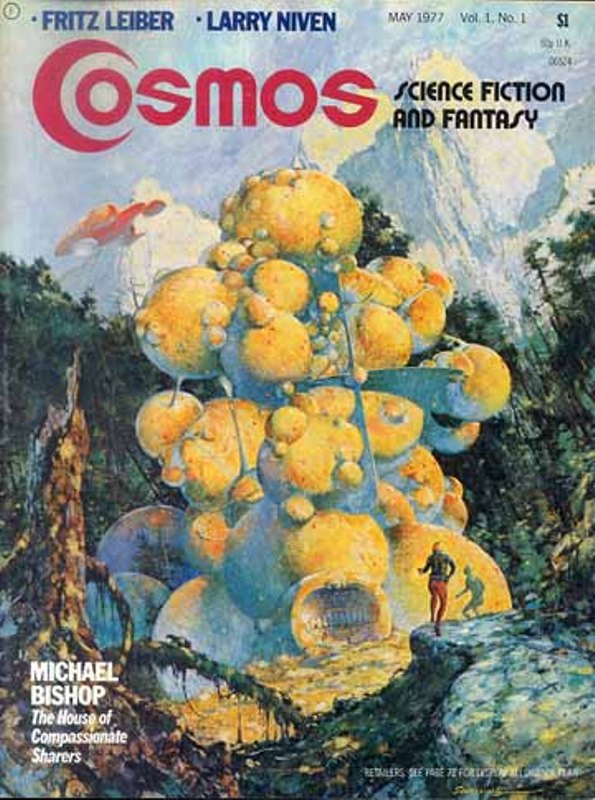
(Cover by George Schelling. Cosmos, May 1977.) Who Goes There?
The year was 1977. It was the year, depending on how you look at it, when science fiction either broke through into the mainstream or became forever relegated to a dancing bear, especially in cinema. (I’m talking about Star Wars here.) But it was a pretty good time to be Fritz Leiber! He had just won another Hugo and Nebula, this time for his alternate timeline short story “Catch That Zeppelin!,” which while not the most ambitious tale ever, showed Leiber to retain his humor and his tenderness well into his sixties. A lot of Leiber’s contemporaries can’t say the same for themselves. It was also during this year that Leiber’s final novel, Our Lady of Darkness, saw publication, and it was even serialized in a rather altered state in The Magazine of Fantasy and Science Fiction as The Pale Brown Thing. We also got one of the longest Fafhrd and Gray Mouser stories with Rime Isle, the subject of today’s review, and unfortunately this would mark one of Leiber’s final appearances in the magazines, though he would continue to published in original anthologies and collections.
Placing Coordinates
Part 1 was published in the inaugural issue of Cosmos Science Fiction and Fantasy, which is on the Archive. Cosmos is just the sort of anomaly I would tackle for my blog, because it was short-lived (only four issues), nobody remembers it, and yet a few of us probably should. Edited by a young David G. Hartwell and sporting a fancy letter-size format with massive detailed interior illustrations, Cosmos was unfortunately another casualty of the ’70s wave of new SFF magazines, only some of which survived past infancy (Asimov’s and Omni being the big success stories, of course), and on top of that it was another argument for why a letter-size SFF magazine is unsustainable. Personally I don’t see it as a big loss. I was actually dreading reading Rime Isle, not because of the story itself but because the letter-size format is not as accessible as digest or even pulp; the type is not only three-columned but is fucking TINY. Not only do my eyes strain but having to lean in constantly makes my scoliosis act up. I suppose it might be better if I were to read a print copy and not a PDF, but I can’t imagine it’s much of an improvement.
Rime Isle is not one of the more famous Fafhrd and Gray Mouser stories, but it’s still part of that series, and as I’ll later explain it feels like a focal point in the series continuity, which means it’s been reprinted a fair number of times. It hasn’t ever been anthologized really as far as I can tell, but it’s been collected a couple times, namely in Swords and Ice Magic and the omnibus collection The Second Book of Lankhmar; the former is available in paperback and ebook (from Open Road Media, AAAAAAAGH) while the latter is an affordable hardcover from Gollancz / Orion.
Enhancing Image
This is a late Fafhrd and Gray Mouser story, both in publication order and in internal chronology; the boys have been at it for a long time now. At the beginning we find Our Anti-Heroes™ leaders of their own ships, landing in Rime Isle after an off-screen battle with Sea-Mingols and ready to collect what’s owed them. The problem is that none of the people who greet Fafhrd and the Mouser seem aware that the two had pushed back a pirate invasion, or that they had even been hired by the island’s government. Things get even weirder when Afreyt and Cif, two members of said government and the ones who had contacted Fafhrd and the Mouser in the first place, deny their involvement in front of everyone. So no payment and no acknowledgment of the job which has been performed.
Like with “Scylla’s Daughter” (review here), we’re outside the confines of Lankhmar, but with Rime Isle we’re at least on land for most of it. Rime Isle itself is a curious setting, being an isolated survival-of-the-fittest society in which the people are generally hard workers, tenacious, and perhaps most unusually, atheistic. Like vocally atheists. Like Richard Dawkins would be proud of these people if not for their seeming lack of interest in high culture. Keep in mind also that in the world of Nehwon there are, like, a lot of supernatural beings about? Ghouls and monsters and even demigods, not to mention beings from quite literally other universes. I’m saying that being an atheist in the world of Fafhrd and the Gray Mouser would be like being an atheist in Star Trek, given how many aliens in the franchise are basically akin to gods; you probably wouldn’t belive in the Abrahamic God, but you’d probably bet your life on something awesome like that.
The conflict thus comes not entirely from the villain of the week (although there is a villain of the week, we’ll get to him in a second), but from the people Our Anti-Heroes™ are supposed to be helping. You have Rime Isle, which unbeknownst to the people in it is currently a sparkle in the eye of a demon, Khahkht, who plots to use the people’s skepticism against them. The problem also is that nobody fucking believes that Fafhrd and the Mouser, along with their ships full of berserkers and thieves respectively, are here to do good, and Afreyt and Cif aren’t helping—at least not in public. As it turns out the council that governs the island wasn’t even aware of Fafhrd and the Mouser being involved; it was a call made only by the two ladies. As such, things are a little awkward right now, and it would be a real shame if perhaps a horde of Sea-Mingols were to invade…
In “Scylla’s Daughter” we got a pretty memorable girlboss, but with Rime Isle we get two girlbosses for the price of one, only this time they seem to be actually benevolent. The Fafhrd and Gray Mouser series has seen a lot of women come through over the years, often in the form of love interests, and I don’t think it’s a spoiler to say Afreyt and Cif are being set up as the new love interests of the week; their being paired repeatedly with Fafhrd and the Mouser repeatedly indicates this. However, what makes them different from some previous love interests is that they’re shown to be equals with their partners. Afreyt and Cif are capable councilwomen and good leaders, although they got themselves into a bit of a predicament prior to the story’s beginning. As far as old-timey SFF authors go I would say Leiber is better than most with regards to the misogyny issue, easily surpassing Heinlein and Asimov but maybe being a step below H. Beam Piper in the writing women department. At least so far Rime Isle sees Leiber on good behavior with how he writes his female leads.
Khahkht is less enticing. Not that the Fafhrd and Gray Mouser stories are known for their villains, but I almost wish Khahkht wasn’t here, not that that would make much of a difference to the rest of the cast, since they don’t interact in Part 1 and as far as the Rime Islers (Rime islanders?) are aware he doesn’t exist. Khahkht exists so that Fafhrd and the Mouser can be split up partway through the story and sent on separate quests; it’s like Leiber knows that Our Anti-Heroes™ are at their best when together so he conspires to keep them apart half the time. It could also explain why “Stardock” remains my favorite entry in the series, where it’s about comradery and brotherhood from start to finish, invisible mountainwomen aside.
Speaking of which…
There Be Spoilers Here
The climactic action is not the big spoiler here, but something else that gives Rime Isle its own eccentricity, which is the intorduction of gods from other worlds—specifically a version of our world where the Nordic gods were real. In “Scylla’s Daughter” (and later The Swords of Lankhmar, the “canon” novel-length expansion) we met Karl Treuherz, an explorer atop a two-headed serpent who has been hopping across different universes; if that sounds like a lot, it is. Karl even gets namedropped here, and this is to set a precedent for how the fuck it is that Odin and Loki (yes, those two) have found their way into Nehwon, albeit in pretty bad shape. Afreyt takes care of Odin while Cif takes care of Loki, and these gods right now are transparent and practically bedriiden, on the brink of nonexistence. The explanation we’re given is that gods cease to exist once nobody believes in them anymore, and this even applies to gods within Nehwon.
It takes several volumes to compile the Fafhrd and Gray Mouser stories, but this series is not a singular epic like The Lord of the Rings—rather it’s greater than the sum of its parts. When Fafhrd and the Mouser aren’t slumming in Lankhmar they’re adventuring abroad, which gives Our Anti-Heroes™ a lot of chances to meet with foreign cultures and peoples, and Leiber usually has fun concocting these new lands. Rime Isle is an island full of hard-knuckled people who used to worship gods but have not apparently lost their faith, and the only thing keeping Odin and Loki alive is the single worshipper each of them has—that Afreyt and Cif are the only ones keeping them from oblivion, and they’ll need that worship too because having a couple gods (even weak ones) on your side can be pretty useful. My main issues with the first installment of Rime Isle are that a) we get barely a word out of Odin and Loki, which is disappointing, and b) the action is underwhelming, not helped by Cosmos having such borderline illegible type.
A Step Farther Out
This is very much not what I would recommend as one’s first Fafhrd and Gray Mouser story; your mileage will vary depending on how familiar you already are with the series. Most of the stories I’ve read so far have no hinged on continuity so much, but Rime Isle, while it’s still compehensible even without any prior knowledge, rewards you if you know about some of the weirder stuff to happen to our barbarian-thief duo, especially “Scylla’s Daughter” or The Swords of Lankhmar. Similarly to that earlier entry it also takes advantage of what had by the ’70s become pretty lax censorship in the magazines, although nothing too raunchy happens (so far, anyway). A criticism that can sometimes be tossed at Leiber’s writing is that he can dip his toes in misogyny, and while the lechery of the elder gods may be uncomfortable to some, the leading ladies of Rime Isle (the setting, but also the serial) are definitely Women Who Do Stuff™. Afreyt and Cif are intelligent women who are clearly written as Fafhrd and the Mouser’s equals, and who for much of Part 1 are in more control of the situation than Our Anti-Heroes™. Love interests of the week? Maybe, but also possibly something more than that.
Much of Part 1 is setup, admittedly. Khahkht is mostly talk, and ultimately the collective skepticism of Rime Isle’s people may prove just as much a threat to the island as Khahkht’s horde. Not that the premise of old gods “dying” if they lose faith was new, even at the time, but I wonder if Neil Gaiman had read some Fafhrd and Gray Mouser before writing American Gods? Wouldn’t be too surprising.
See you next time.
-
Novella Review: “Ship of Shadows” by Fritz Leiber
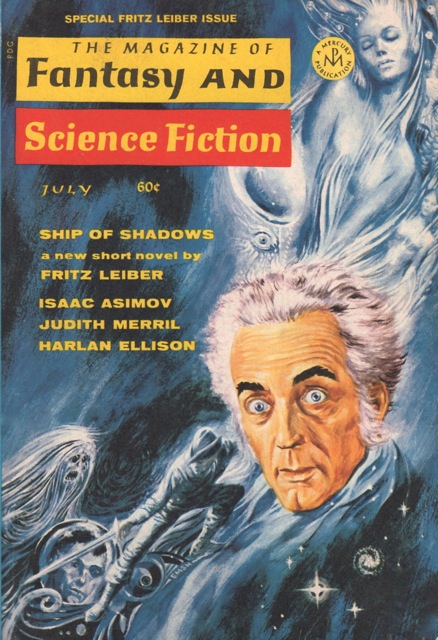
(Cover by Ed Emshwiller. F&SF, July 1969.) Who Goes There?
By 1969, Fritz Leiber had been in the game for thirty years (a long time, mind you), and yet unlike most of his contemporaries he had not started to rest on his laurels, or, even worse, embarrass himself in front of his peers. Isaac Asimov became known as a pop scientist, releasing the occasional short story but mostly spending his time on articles and science books. Robert Heinlein went silent after The Moon Is a Harsh Mistress, and when he returned he seemed to have lost his magic touch (imagine waiting four years for a new Heinlein novel and you get I Will Fear No Evil). Theodore Sturgeon was mostly not writing at this point, although he was gaining himself some major Trek cred and he would soon return to the magazines with fresh material. Clifford Simak was pumping out about one novel a year, but the late ’60s were not exactly peak years for him. Yet Leiber not only remained productive but played nicely with the New Wave kids, fitting in with authors a generation younger than him; even at this relatively late stage of his career he remained restless.
“Ship of Shadows” was written specially for Leiber’s F&SF tribute issue, and as should probably be expected of a special author tribute story it goes just a bit farther than the average Leiber yarn. Whereas Leiber tends to jump between SF, fantasy, and horror with his fiction, “Ship of Shadows” dabbles in all three genres, though it can ultimately be considered science fiction for reasons I’ll get to much later. On the one hand this is a perfect recipe for disaster, or at least a muddled story, but the hodgepodge of genres paid off, as it won the Hugo for Best Novella. It’s also a reread for me, but it’s been a couple years, and as it turns out I remembered even less of “Ship of Shadows” than I thought I did—which is not necessarily a mark against it!
Placing Coordinates
First published in the July 1969 issue of The Magazine of Fantasy and Science Fiction, which is on the Archive. Incidentally this is one of those old F&SF issues I actually have a physical copy of, which is cool. Being a Hugo winner, “Ship of Shadows” has been reprinted quite a few times over the years, first in World’s Best Science Fiction: 1970 (confusingly covering fiction from 1969), edited by Terry Carr and Donald Wollheim. Naturally it would also appear in The Hugo Winners, Volume Three; it was supposed to appear in the previous volume, but Isaac Asimov, by his own admission, had somehow forgotten to include it. We also have the Leiber collection Ship of Shadows, very creatively named no doubt. If you’re an avid collector then there’s Masters of Science Fiction: Fritz Leiber from Centipede Press, although I do wanna warn you that a copy of this pristine hardcover will run you in the hundreds of dollars. Sadly it looks like there aren’t any reprints in paperback or hardcover that are currently available new, but on the bright side you have a lot of second-hand options.
Enhancing Image
Spar is an elderly (or at the very least decrepit) member of Windrush, some kind of ship that may or may not be the world entire. It’s amazing that Spar is able to accomplish anything given that a) he’s half-blind, and b) he’s a raging alcoholic. Indeed we start with Spar nursing himself through a hangover, which compounds his already poor eyesight, but quickly things “improve” when he comes across a talking cat—yeah, a talking cat, and it’s not a hallucination. The cat, to be named Kim, is clearly intelligent, and while there are “witches” on the ship who have cats as their familiars, Kim seems to be acting on his own. The two bond and start a sort of business relationship, with Spar providing Kim with a home and Kim providing him a service as rat catcher. Meanwhile Spar works at the Bat Rack (I sense a Halloween theme going on here) as a bartender’s assistant; said bartender is Keeper (get it? like barkeep? but also his brother’s keeper…?), who gives Spar something to do while also trying to not have him waste away on booze.
Know how you shouldn’t get high on your own supply? Same goes for drink, and it doesn’t take a rocket scientist to figure Spar is an addict.
A few things to note about the Bat Rack and the people who frequent it. Much of the novella’s action happens in or around this bar, which gives the story a vaguely theatrical tingue, what with there being only a few locations of note. The characters also have tangled personal and professional relationships, and it might be easiest to understand them as if in the context of a film noir, and why not, the setting and the character archetypes fit the bill well enough. Spar is our nominal hero who, much like the typical film noir protagonist, is knee-deep in his vices, with Keeper as the straight man. Suzy is a barfly who has a bit of a maybe-maybe-not going on with Spar, being much less the femme fatale than the film noir protagonist single obligatory lady friend, if he even has one. There’s Kim, the humorous and callous sidekick who arguably functions as the id to Spar’s ego. Then there’s the Big Bad™ of the story (not a spoiler, trust me), Crown, who is all but said to be the local pimp, as well as a big deal at the Bat Rack.
Oh, and then there’s Doc—the sage.
Regardless of where we actually are, we’re almost certainly not on Earth; for one thing, the method of timekeeping in Windrush is different. “Workday, Loafday, Playday, Sleepday. Ten days make a terranth, twelve terranths make a sunth, twelve sunths make a starth, and so on, to the end of time,” so says Spar. There’s a four-day cycle, ten days in the equivalent of a week, and so on, although this doesn’t help with understanding the setting so much as it helps give the impression that the setting itself is not totally understandable. Not much is explained in at least the first half of “Ship of Shadows,” partly because Spar, being our POV character, doesn’t know a whole lot himself, but also partly because his ability to comprehend his surroundings is hampered by his blindness. While everything being described as a “blur” got repretitive for me, I get that there are only so many words you can use to convey the fuzziness and lack of depth of poor eyesight.
Windrush is a curious setting for what swerves between fantasy, horror, and SF, as the descriptions of the ship’s interior very much imply that the story, on the whole, falls into that last genre. What complicates matters is that aside from the “normal” people aboard Windrush, there are also apparently witches, vampires, and even zombies, although tellingly these creatures of the night are not confronted directly (unless I’m missing something); for example we hear a good deal about witches, but we never see a witch or see witchcraft performed. The closest we get to witchcraft is actually medical science, plain and simple, and nobody aside from Doc understands how modern (or I guess it’d be considered futuristic) medicine works. Doc, whom Spar comes to with hopes of restoring his eyesight and even giving him a new pair of teeth, is the real hero of the story if anything, but since he’s a supporting character we’re not always sure what he’s up to.
Doc, who is maybe not the oldest (although he would be up there) but certainly the wisest of the cast, is also seemingly the only one aware that there was life prior to the current dynamic in Windrush. More than anything he represents the standards of our civilization, and I don’t think it’s a coincidence either that Doc, being the only truly civilized man on a ship full of barbarians, has a little black bag that amounts to the story’s MacGuffin. Little black bag? A doctor’s bag that can do anything? Does this sound a little but like the equally sought-after MacGuffin of C. M. Kornbluth’s “The Little Black Bag”? Similarly there’s a tinge of pessimism about humanity’s future, and how Doc’s equipment is the ony thing keeping what’s left of humanity from teetering off a cliff. Take Doc’s response to Spar’s request for new eyes and teeth, which is as bitter as it is solemn:
After what seemed a long while, Doc said in a dreamy, sorrowful voice, “In the Old Days, that would have been easy. They’d perfected eye transplants. They could regenerate cranial nerves, and sometimes restore scanning power to an injured cerebrum. While transplanting tooth buds from a stillborn was intern’s play. But now… Oh, I might be able to do what you ask in an uncomfortable, antique, inorganic fashion, but…” He broke off on a note that spoke of the misery of life and the uselessness of all effort.
Leiber was not only aware of Kornbluth but was close contemporaries with him, although the two have starkly different worldviews. Doc’s little black bag, and generally the narrative of how it will take a select few “smart” people to prevent humanity from blowing itself up, are definitely in keeping with Kornbluth’s writing, but let’s not kid ourselves; this is merely paying homage to a fellow great writer, rather than pastiche. For the most part “Ship of Shadows” reads like Leiber—not exactly classic Leiber, as it is grimier and bloodier than his early ’50s standouts, but it has the theatrics, the inventiveness, and the sense of wit one can expect from him. Had Kornbluth not already been dead for a whole decade he may have written a New Wave piece not too dissimilar from “Ship of Shadows.” Just beware that this is Leiber in an unusually dark vein (though not without a snarky sense of humor) by his standards.
F&SF used to (I guess they still do it, but we’ve only gotten one of these since 2002) dedicate special issues to authors deemed important in the field, especially authors who have contributed immensely to F&SF, with Leiber of course being one of the authors to receive this treatment. The tribute story, written specially for the issue, tends to be a novella, though not always, and typically you can expect the author indulge in as many of their fetishes (in the non-sexual meaning of the word) as possible while also, ideally, delivering a fine read. Eventually I’ll review Poul Anderson’s “The Queen of Air and Darkness,” which also won a Hugo, and that novella is, for good or ill depending on your biases, very Anderson-y; similarly “Ship of Shadows” is up there with the most Leiber-y of works, and as a result of that it’s a bit muddled but also highly entertaining. It also has the advantage of being, like much of Leiber’s best work, pretty compact all things considered; it’s a novella, sure, but only maybe 20,000 words in length, and Leiber gets a lot of mileage by the gallon with this one.
There Be Spoilers Here
The big twist of “Ship of Shadows” is that it’s a generation ship story. Now, that may sound rather niche, but the generation ship story was, at least for a time, a pretty crowded subgenre (if it can even be called a subgenre) of SF. If you’ve read, say, Heinlein’s “Universe” or Brian Aldiss’s Non-Stop then you know there are certain tropes to expect here. The thing about generation ships is that they sound cool on paper but realistically would run into a number of problems that are likely to jeopardize the whole operation, of which I would say the big three are: 1. the passengers or the crew commit mutiny and overthrow the ones in charge, 2. enough time passes that, depending on the sophistication of the ship’s design, the passengers might even forget that they’re on a spaceship, and 3. some illness or virus breaks out that, once it spreads, nobody on the ship is able to stop it, so we’d be looking at death or something not quite as bad. “Ship of Shadows” manages to tick all three boxes, because Leiber is going one step beyond with this one.
Whatever crew seems to be left on Windrush is clearly in charge of shit anymore, I suspect because they’ve tried to isolate themselves from the mostly ill passengers. Speaking of which, the passengers have almost entirely succumbed to the Lethean rickettsia, known colloquially as Styx ricks, with Doc the only person onboard who has the equipment and the know-how to treat symptoms; why then Doc and Keeper, who are demonstrably more rational, should give the reigns to Spar at the end is beyond me, but apparently it’s due to Spar’s position as the closest the drama has to an innocent soul. Awkward and unearned sex scene (well, implied sex scene) with Suzy aside, of course.
The novella’s climax is pretty over the top, almost reaching the levels of Titus Andronicus with how gruesome it is, although it must be said it lacks the camp factor of that infamous play. Not only are Crown and Ensign Drake disposed of in bloody fashion, but Suzy, who up to this point has been the only sympathetic female character of any substance, gets it maybe the bloodiest of all; there’s being fridged, and then there’s being fed unceremoniously into a meat grinder. Given Leiber’s history of quasi-pacifism, and how violence is often treated in his fiction (i.e., as something to be avoided), the brutality of “Ship of Shadows” further reinforces this notion that Leiber is pulling out all the stops—for both good and bad. Mostly good, but I was reminded rather uncomfortably that “Ship of Shadows” is one of those Leiber stories where he unintentionally comes off as much more of a woman hater than he really was.
Qualms aside, the ending is still one of those classic eureka moments, typical yes but often satisfying in a generation ship story where the characters realize that the universe is unfathomably bigger than their metal coffin. No wonder then that the twist is what I remembered more than anything (aside from Kim and the generally ghoulish atmosphere) from my first reading. Leiber loves his Halloween shit and he knows how to do the monster mash. That the ghoulish apperitions seemingly haunting Windrush are human drug addicts is maybe a little anticlimactic, but as another entry in Leiber’s continuing interest in the nature of addiction (especially alcoholism, which the man himself was prone to) it makes sense allegorically.
A Step Farther Out
I have to admit I’m a sucker for stories set on ships. Not a fan of actually being on ships, but stories about ships? Aw hell yeah. No wonder I like Melville and Conrad. A ship is the perfect setting to invoke paranoia, loneliness, nightmarish visions, a sense of isolation, all this negative shit that would be bad for the characters but good for us as readers. “Ship of Shadows” starts out as murky, intentionally so what with Spar’s eyesight, almost masquerading as fantasy before revealing itself to be SF in the second half, unfortunately sort of petering out at the very end. What makes “Ship of Shadows” so memorable is that while it would not be surprising if someone in their thirties wrote it, it’s a good deal more surprising that Leiber was pushing sixty at the time. There’s a bit of New Wave, a bit of satirical fantasy in the Unknown tradition, and a bit of that trademark Leiber quirkiness; the only thing it’s seriously missing is his thing for chess. It’s also a contender for Leiber’s most violent story, although your mileage may vary with regards to his treatment of his female characters (admittedly more brutal than the norm for him). In 1969, thirty years into his career (almost to the month), he was still searching for new avenues.
See you next time.
-
The Observatory: Fritz Leiber, the Man Who Was Married to Space and Time

(Fritz Leiber, circa 1969.) Our favorite authors don’t always come to us at such a young age; it happens a lot, but not all the time. No doubt I still would’ve fallen head over heels for Philip K. Dick and Kurt Vonnegut had I discovered them in college instead of high school. But some discoveries take longer than one would think. Given how they are such kindred spirits, it’s startling to know that H. P. Lovecraft did not start reading William Hope Hodgson until fairly late in life. Despite his connection (for both better and worse) with Robert E. Howard, L. Sprague de Camp did not start reading the tales of Conan until long after he had started writing fantasy of his own. And similarly, I had not read so much as a word of Fritz Leiber until I was in my early twenties; mind you I had only turned 27 this month. All this despite Leiber, regardless of the genre he tackles, quickly becoming one of my favorites.
It’s hard for me to remember now what my first Leiber story was: it had to be either “Gonna Roll the Bones,” by virtue of its appearance in Dangerous Visions (ed. Harlan Ellison), or it was his 1950 story “Coming Attraction,” which appeared in The Science Fiction Hall of Fame Volume One (ed. Robert Silverberg). The former is a somewhat nightmarish fantasy, an allegory for addiction which explicitly tackles gambling but more implicitly alcoholism (there’s a good deal of overlap between gambling and heavy drinking) while the latter is a grimy post-nuclear fable that would become emblematic of material published in Galaxy Science Fiction. Indeed “Coming Attraction” saw print in one of the very first issues of Galaxy, and for the next few years Leiber and that newfangled magazine would have quite the fruitful relationship—see his equally classic post-apocalypse story “A Pail of Air.” It was during that productive period of 1950 to 1953 that Leiber really showed himself to be a top-tier science-fictionist, although labeling him as just that would be doing him a disservice.
Fritz Leiber was born on Christmas Eve, 1910, in Chicago, which for decades was his home turf, though he would adopt San Fransisco in the third act of his life. In the first years of his career as a writer he often went by the byline of Fritz Leiber, Jr., to differentiate himself from his old man, who was then known as a Shakespearean actor. Fritz, the son, started out as an actor like his father, both on the stage and even nabbing some small roles on the big screen, but he realized that acting was not in his future, despite his physical stature and his voice which carried enough weight for two men. Listen to his speech, “Monsters and Monster Lovers” (which was also printed in Fantastic), delivered at Pacificon II, and you can easily detect an alternate timeline where Leiber starred in Universal horror movies, like an American Boris Karloff. His background as a thespian would even inspire some of his fiction; his Hugo-winning novel The Big Time reads like it was meant for the stage.
Leiber would not debut officially in the field until 1939, at the age of 28, but he was already prepping his pen for a few years at that point. His first genre story, “Two Sought Adventure,” published in the August 1939 issue of Unknown, introduced not only Leiber to the SFF magazine world but also his most lasting creation, Fafhrd and the Gray Mouser. It’s worth noting, though, that while “Two Sought Adventure” was the first story published to feature everyone’s favorite barbarian-thief duo, it was not the first written. Leiber had apparently written “Adept’s Gambit” in 1936 (as far as I can tell the novella was more or less in its final form here), but it would not be published until the collection Night’s Black Agents came out in 1947—a whole decade later. Leiber’s struggle to get his work (more specifically his fantasy) published was a speed bump that would appear several times throughout his career, less aimed at Leiber in particular and more indicative of fantasy’s precarious place in the mid-20th century.

(Night’s Black Agents. Cover by Ronald Clyne. Arkham House, 1947.) One of the few sympathetic voices to fantasy in the ’40s and ’50s was Arkham House, founded by August Derleth and Donald Wandrei with the mission statement of preserving the works of Lovecraft via book publication, though certain contemporary authors were also picked up. It’s no coincidence that Leiber got his early horror and fantasy collected alongside the likes of Lovecraft, Clark Ashton Smith, and Ray Bradbury; not only was he was a practitioner of weird fiction, but he was even correspondents with Lovecraft toward the end of the latter’s life. No doubt Lovecraft had a profound impact on Leiber, but what’s curious is that you probably wouldn’t guess this from reading the fiction collected in Night’s Black Agents. Early horror outings like “The Automatic Pistol,” “Smoke Ghost,” and “The Hound” (the last of which I reviewed recently) don’t have a cosmic flavor so much as an urban one. These stories are not about bookish introverts who stumble upon eldritch terrors, but average city slickers who confront classic supernatural forces as transplanted to 20th century cityscapes.
In “The Automatic Pistol” we have a weapon which on the surface looks like any other gun (say, a Colt 1911), but which turns out to maybe have a mind of its own; in “Smoke Ghost” we have a classic ghost narrative, but the specter itself seems to represent something which can only be possible in a world shaken by the industrial revolution; in “The Hound” we have one of the most classic of monsters—the werewolf—but as a stand-in for the oppressiveness of skyscrapers and apartment complexes. This trend would continue with Leiber’s debut novel, Conjure Wife, published as a complete novel in Unknown in 1943, this time taking witchcraft and applying a few twists to it, first by replacing the typical Puritan settlement with a 20th century college campus and second by giving witches a different kind of role in society. The result is darkly comedic, if also problematic given our current understanding of gender roles (mind you that it would be a fatal error to take Conjure Wife too seriously or too literally). Being a landmark in fantasy literature, not to mention being a pretty enjoyable read to this day, Conjure Wife justifiably won Leiber a Retro Hugo for Best Novel, beating out his second novel and his first science fiction novel.
Leiber’s second and third novels, Gather, Darkness! and Destiny Times Three, are SF, with the latter capping off the first phase of his career. From the outset, Leiber wasn’t really a science-fictionist, but far more convincingly a fantasist; his best work from that first phase is mostly not his science fiction, which he didn’t write a lot of anyway. Whereas Leiber’s fantasy and horror felt basically fully formed (although obviously it would mature) from the beginning, the same cannot be said of his SF. Destiny Times Three, for instance, reads very much like A. E. van Vogt pastiche; it lacks the trademarks (namely his sense of humor) that so often define Leiber’s fantasy, especially his Fafhrd and Gray Mouser stories. Leiber would do a much better job at writing convincing (not to mention compelling) SF when he started contributing to the magazines frequently again in 1950—a level of crafstmanship he would retain, albeit somewhat sporadically (he would either write prolifically or nothing at all), for the rest of his career.
It could be during the aforementioned period of 1950 to 1953 that Leiber became a master of SF more out of necessity than anything; he had a strong incentive to take on the role of science-fictionist, as while the SF magazine market was booming during these years, things were not looking so good for fantasy and horror. Unknown went under in ’43, Weird Tales (or rather its first incarnation) was on its last legs, and there wasn’t much new blood to go around for magazine fantasy or horror. Fafhrd and the Gray Mouser themselves were basically put on ice, not appearing at all between “The Seven Black Priests” in 1953 and “Lean Times in Lankhmar” in 1959. On the bright side, it was during this period that we got some of Leiber’s most famous and most anthologized short SF, including “Coming Attraction,” “A Pail of Air,” “The Moon Is Green,” and “A Bad Day for Sales.” Leiber becoming Guest of Honor at the 1951 Worldcon (it was Nolacon I) was very much earned, and his formidable level of quality in the early ’50s must’ve almost made him seem like a new man to the SFF readership.
When Leiber returned, after a short hiatus, in the late ’50s, he not only revived Fafhrd and the Gray Mouser but devised a new SF series: the Change War cycle of stories. It’s this point, from 1957 to about 1970, that could be considered Leiber’s finest era. Aside from winning a slew of awards, perhaps the most passionate (certainly the most unique) acknowledgement of Leiber’s talent and importance would have to be the November 1959 issue of Fantastic, which not only printed “Lean Times in Lankhmar” but had all of its fiction pieces be by Leiber himself, as a tribute to the man. Fantastic had debuted in 1952, but it was only under the new editorship of Cele Goldsmith in 1958 that it became arguably the best fantasy-leaning magazine on the market; more importantly in Leiber’s case, it became a safe haven for fiction of his which he could not have reasonably submitted elsewhere. At least one Fafhrd and Gray Mouser story a year would see print in Fantastic, until Goldsmith stepped down in the 1965, whereafter the series would be put on another (albeit briefer) hiatus.

(Cover by Morris Scott Dollens. Fantastic, November 1959.) The ’60s were a pretty good time to be Fritz Leiber; after all, he had, seemingly for the first time in his career, options. If he wanted to write a Fafhrd and Gray Mouser story or some miscellaneous adventure fantasy then he could send it to Fantastic; if he wanted to write more “high-brow” fantasy, something more urban or literary, then he could send it to The Magazine of Fantasy and Science Fiction; if he wanted to write SF there were several magazines waiting in the wings, including Galaxy, Worlds of If, and Amazing Stories. “How come Analog didn’t get brought up?” I’m not exactly sure when this happened, but it looks like Leiber abandoned what was then Astounding Science Fiction after 1950, presumably because he found editor John W. Campbell’s pushing of Dianetics, along with his increasing conservatism, alienating. Minus that, the field was open! It was also the most prolific Leiber was as a novelist since the ’40s, with five novels published in the ’60s, though it must be said that Leiber was never much of a novelist; he was more impressive as a practitioner of the short story.
With “Ship of Shadows” (written specially for an F&SF tribute issue) and “Ill Met in Lankhmar” in 1969 and 1970 respectively, Leiber became the first author to win the Hugo for Best Novella twice in a row.
You may have noticed that Leiber has been in the game for a long time at this point. 1939 saw the debuts of Leiber, Robert Heinlein, Isaac Asimov, Theodore Sturgeon, and A. E. van Vogt, and by 1970 Leiber was (with the possible exception of Sturgeon) the only writer from that class to still be producing work strong enough that the word “legacy” need not be applied to him. While the New Wave was rocking the scene and plenty of writers in their twenties and thirties were pushing the field forward, Leiber continued to play impeccably with writers a generation younger than him. He won two more Hugos in the ’70s, as well as winning the newfangled World Fantasy Award three times that decade—all for stories which, while maybe not the very best he ever wrote, demonstrated a persistence of vision. Whereas Asimov and Heinlein, two of the most important voices in the history of American SFF, were resting on their laurels at this point, Leiber took the ’70s as an opportunity to return to and refine what he had started out with: urban fantasy and horror.
His final novel, Our Lady of Darkness, was published in 1977, and it was his first major venture into urban fantasy since his 1950 novel You’re All Alone (review forthcoming) while also acting as a sort of bookend to Conjure Wife. Leiber did not retire at this point, as he continued to write short fiction, albeit not as prolifically, for several more years; but it did represent the last hurrah for what had been a remarkably consistent and yet adventurous career, despite the setbacks. He was given the Gandalf Grand Master Award in 1975 (the second person to receive it—Tolkien was the first, naturally) and the following year he was given the World Fantasy Award for Life Achievement, both acknowledging his enormous contributions as a fantasist. In 1981 he was made an SFWA Grand Master. Even with all this recognition, however, Leiber continued to elude mainstream notice, not becoming a pop scientist like Asimov or getting mainstream book deals like Heinlein; he was a star in SFF fandom, but outside of it he remained obscure.
It could be that Leiber never gained mainstream popularity because he didn’t seem to have a “brand” about him. The closest to a constant Leiber had throughout the half-century of his career would be Fafhrd and the Gray Mouser, but they never picked up traction like Howard’s Conan did; of course, Conan is now more treated as an icon than a character, and thus he is often misunderstood, never mind that Howard didn’t live to reap the benefits. Whereas Howard and Lovecraft are treated as “types,” as writers who are bound by their obsessions, Leiber is not so easy to categorize, his restlessness and spontaneity being used against him. It could be that Leiber’s lack of drive as a novelist (as novels sell more than short story collections) relegated him to being “merely” an exceptional writer at short lengths. Many writers who excel at the short form tried and often failed to jump to novel-writing when it became clear what the market favored, and while Leiber never sold himself out in this manner, he also, as a result, became (and remains so) hard to find outside of used bookstores.
Given that he was a better writer, line for line, than most if not all of his contemporaries (he and Sturgeon might be the only “Golden Age” authors whose works remain a joy to read simply as literature), and given that he possessed a vision which only aged, rather than withered or shattered, with the years, Fritz Leiber’s continued lack of appreciation among genre readers (especially younger readers) is nothing short of scandalous. His prime lasted not a few years, but a few decades.
-
Serial Review: Destiny Times Three by Fritz Leiber (Part 2/2)

(Cover by William Timmins. Astounding, April 1945.) Who Goes There?
The first phase of Fritz Leiber’s career can said to have lasted from 1939 to 1945, incidentally overlapping with World War II. While Leiber would write the occasional short story from 1946 to 1949, there would be a five-year gap between novels, those being Destiny Times Three and You’re All Alone. It was also during this gap that Leiber more or less vanished from the magazines, with said occasional work getting published first in book form, perhaps most famously his modern vampire story “The Girl with the Hungry Eyes” and the Fafhrd and Gray Mouser novella “Adept’s Gambit.” But the war years saw Leiber as a regular contributor to Weird Tales, Unknown, and even Astounding Science Fiction, despite (at least at this early point in his career) being much more of a fantasist than a science-fictionist. Case in point, Destiny Times Three, which feels almost more like fantasy than SF, with its multiverse madness and dubious science-fictional elements. Even so, Leiber’s third novel (though it is quite short) would get a Retro Hugo nomination.
Placing Coordinates
Part 2 was published in the April 1945 issue of Astounding, which is on the Archive. Because Destiny Times Three is so short, and yet too long to be considered a typical novella, it has not been reprinted often. It was first brought into book form as part of an anthology, Five Science Fiction Novels, in 1952, edited by Martin Greenberg, and it wasn’t published solo until 1957—more than a decade after its serialization. You could also get it cheap enough as part of Binary Star, No. 1, the other half of that being Norman Spinrad’s “Riding the Torch.” As far as I can tell it’s not possible to get a book publication of Destiny Times Three that’s in print currently.
Enhancing Image
We have two psychologists and best buddies, Thorn and Clawly, who live in the Dawn Civilization, not our world but a utopian world in which a benevolent world government (like the UN is it actually did its job) keeps everything in check—except for something peculiar that has been going on lately. People have been reporting more nightmares than usual, and there have been these amnesiac episodes where people don’t recognize themselves or the people in their lives. Turns out these episodes are due to the exchanging of minds, people being swapped with their counterparts from a world that is mostly the same and yet quite different from the Dawn Civilization. Thorn not only unwittingly takes a talisman which is connected with these parallel worlds, but his finds his mind spontaneously swapped with that of his counterpart.
There are three worlds, all of which share a point of divergence about thirty years prior to the events of the present day, and all have to due with the accessibility of an invention known as subtronic power, which is apparently the best thing since sliced bread. In the Dawn Civilziation, subtronic power is open for public use; in World II, which seems to be launching an invasion of the first world, subtronic power is only kept in the hands of what is in that world a totalitarian government; in World III, subtronic power is suppressed entirely. To further complicate things, these parallel worlds exist because of an even greater invention: the Probability Engine. Watched over by eight experimenters, the Probability Engine has the capacity to create and destroy worlds based on points of divergence, and the talisman Thorn took is needed to work the Probability Engine. Oktav, one of the experimenters, tries to warn Clawly of the impending invasion from World II without giving away the Probability Engine’s existence, though this has mixed results.
In World I Thorn is a psychologist, but in World II he’s a rebel, Public Enemy #1 against the totalitarian government, which Thorn finds quickly to be a huge change in circumstances; and whereas Thorn II is still a good guy, the same cannot be said for Clawly II, who is a fascist collaborator. At the end of Part 1 we saw Thorn, now in the body of Thorn II, be taken into custody and presented to the government of World II, who, sensing (correctly) that Thorn had swapped minds with his counterpart, think it better to kill Thorn on the spot, despite him being in Thorn II’s body. It’s at this point that Thorn spontaneously mind-jumps once again, he assumes because of the fight-or-flight response. Part 2 thus starts with Thorn in what he thinks to be his own body again, although we gradually find that this is not the case.
I said in my review of the previous installment that I suspected we would get to World III at some point, since that only made sense, although it was highly unlikely that someone from World III would jump into World I, given the former’s presumed lack of technology. Which turned out to be right. If you thought World II with its Orwellian nightmare was a tough piece of work then World III will utterly dismay you, unless of course you happen to be a Ted Kaczynski type. The world has basically gone to shit—not just from a political standpoint but from a basic physical one; it’s a post-apocalyptic scenario in which the people who are left live like mountain men and animals rule the landscape once more. Leiber being Leiber, his descriptions of this new desolate landscape are excellent; as weary as I am about the post-apocalypse subgenre, it pains me a little that we never got the Fritz Leiber equivalent of A Canticle for Leibowitz or I Am Legend.
A ruined world, from which the last rays of a setting sun, piercing for a moment the smoky ruins, struck dismal yellow highlights.
But recognition could only be held at bay for a few minutes. His guess about the ravine had been correct. That snow-shrouded, milelong mound ahead of him was the grave of the Opal Cross. That dark monolith far to the left was the stump of the Gray H. Those two lopped towers, crazily buckled and leaning toward each other as if for support, were the Gray Twins. That split and jagged mass the other side of the ravine, black against the encroaching ice, upthrust like the hand of a buried man, was the Rusty T.
It could hardly be World I, no matter after what catastrophe or lapse of years. For there was no sign, not even a suggestive hump, of the Blue Lorraine, the Mauve Z, or the Myrtle Y. Nor World II, for the Black Star’s ruins would have bulked monstrously on the immediate left.
So Our Heroes™, Thorn and Clawly, are split up, and Clawly has to contend not only with an invasion but with a “benevolent” world government that refuses to take him seriously. Admittedly I too would struggle to be taken seriously if I concocted a massive hoax about a Martian invasion because the actual invasion would be too crazy to believe. In Part 1 I was unsure about the credentials of the “utopian” society of World I, but thankfully I was convinced in Part 2 that, no, we’re actually not supposed to view this “utopia” as usfficient for human happiness and freedom. Partly what allows the invasion to happen is the complacency of the so-called benevolent world government, not to mention that while there is literally a world of difference between the governments of World I and II, they’re shown to not be all that different when the chips are down.
Part 2 is shorter than the first installment, so I feel I don’t have as much to say here, but I will say that the structure of this novel is a bit odd—sort of like a lopsided hourglass. We start out lost and confused, like we’re a kid who’s too small to be in the ball pit, before the sky clear and the scope of the narrative contracts rather than expands. At the beginning of Part 2 we’re still in the middle of that contraction, and we spend most of this installment torn between two relatively small subplots before, all of a sudden, the scope expands again, resulting almost more in an explosion than an expansion. If you’re expecting an epic threeway battle a la Lord of the Rings then you’ll be disappointed, but I would argue something even more astounding happens in the last few pages of this novel.
My criticisms of Part 1 are mostly still relevant, and at least one criticis has only gotten more severe, that being the lack of female voices among the cast; not only that, but the cast has seemingly only gotten smaller as we approach the climax. Destiny Times Three is a short novel, true, but the best novellas and short novels don’t need expansion to make themselves feel more whole, whereas this novel feels deprived of more characters, more character depth, more worldbuilding, generally more material that isn’t just action. I chock it up to the time in which it was written and where it was published, since (with exceptions, obviously) the SF of the ’40s very much leans more on the plot end of the plot vs. character spectrum. The bright side is that on top of fast-moving plots, the best SF of this period is rich in ideas, and Leiber has a pretty good one to throw at us right at the end.
There Be Spoilers Here
The Probability Engine is maintained by the experimenters, but it wasn’t invented by them—something that Oktav points out in an argument with his colleagues (mind you it was his talisman that Thorn took). The actual people who built the Probability Engine turn out to maybe not be a “people” at all, but something that even Leiber doesn’t have a word for. Easily the cleverest part of Destiny Times Three is that unbeknownst to us, what has been assumed to be a third-person narrative is actually first-person. One could argue that the narrative only becomes first-person once Thorn unlocks his talisman and gets in touch with his two counterparts, thereby getting into contact with the inventors, but I like to think everything we’ve up to this point is from the inventors’ perspective, who are, after all, revealed to be practically all-seeing. Thorn, who is reconciled with his alternate selves, gets the best ending of the characters, whereas the experimenters are rightly punished for their callousness and their treatment of the alternate worlds.
The ending of Destiny Times Three borders on transcendental, although it doesn’t quite get there, though it’s hard for me to articulate why. Transcendence within the boundaries of SF is a tricky thing simply because what makes science-fictional transcendence special is its marrying of the secular and the religious, or oftentimes finding the religion in the secular. The ending of 2001: A Space Odyssey might be the most famous example of transcendence—of conceptual breakthrough—in all of SF, but it’s not religious at all, at least not overtly. Similarly the reveal of the inventors could be compared to a meeting with the divine, but Leiber doesn’t decorate the moment with any religious symbolism; it’s a perfectly secular revelation. And yet despite Leiber’s talent as a wordsmith, its execution leaves me wanting somehow. I suppose Destiny Times Three has the same problem a lot of other early Leiber I’ve read has, in that while it has its high points, it feels half-baked compared to the formal elegance of his work from about 1950 onward, compounded by it being a longer work.
A Step Farther Out
Destiny Times Three feels like just the sort of short novel which could’ve benefited from expansion, though unfortunately it never was. Leiber’s vision is simultaneously grand and claustrophobic, featuring only a few characters who really matter in the drama while also doubling or tripling that factor when you combine those characters’ alternate selves. The action is fast-moving, and there’s a good dose of political intrigue, although we don’t get to know any of the three worlds too deeply, and thinking back on it the action might be there to take our minds off the fact that the characters themselves are not some of Leiber’s finest creations. Mind-blowing on paper, somewhat less so in execution, this is an early work which hints at more ambitious and more finely tuned outings which play with similar concepts, namely the Change War series. Still, on a sentence-by-sentence level it’s hard to fault Leiber, as even this early he shows himself to be more poetric than most (if not all) of his fellow Astounding writers. The biggest criticism I have of Destiny Times Three is that I wish there was more of it.
See you next time.
-
Short Story Review: “The Hound” by Fritz Leiber

(Cover by Richard Bennett. Weird Tales, November 1942.) Who Goes There?
Fritz Leiber has a curious relationship with the pulp horror scene of the ’30s; he started in earnest in 1939, but he was already prepping for his writing career, and he was in contact with some pretty major figures, including none other than H. P. Lovecraft. Leiber’s correspondence with Lovecraft in the last year or so of the latter’s life had a pretty immense impact on the younger author, and actually I remember Leiber quoting Lovecraft a couple times in the first installment of Destiny Times Three. Unlike though, say, Robert Bloch, whose first stories were straight Lovecraft pastiches, Leiber found his own voice (or at least enough) right away with his first professional genre publication. Still, the legacy of Lovecraft stayed with Leiber, especially in his horror, which sometimes approaches the cosmic but which more often stays rooted in known reality. A key innovation of Leiber’s as a horror writer crossbreeding old terrors with what was then a newfangled modernity, no doubt influencing what we’d now call urban fantasy.
“The Hound” was published about a year after what is arguably Leiber’s most importan horror story, if not his best: “Smoke Ghost.” Genre historian Mike Ashley called “Smoke Ghost” “arguably the first seriously modern ghost story,” in that it’s a ghost story which is unique to the post-industrial urban setting; it’s not something that could’ve been written prior to the industrial revolution. What “Smoke Ghost” did for ghosts “The Hound” sets out to do similarly for werewolves, and indeed the two feel like companion pieces—being Leiber’s first real attempts at modernizing these old chestnuts of horror.
Placing Coordinates
First published in the November 1942 issue of Weird Tales, which is on the Archive. It was soon reprinted in the Leiber collection Night’s Black Agents from Argham House, complete with a handsome-ass cover by Ronald Clyne. It’s been anthologized several times over the decades, although I’m not sure how many of them you can get new. While Masters of the Weird: Fritz Leiber looks to be a fetching collector’s item, it’s just that—a collector’s item. And before you ask, unfortunately no, “The Hound” was not included in the Ballantin collection The Best of Fritz Leiber, although given the breadth of his output it’s no surprise if several major short stories did not make the cut. The most viable option, if you don’t wanna prowl through used bookstores, is the collection Horrible Imaginings, although find it at your own risk, as it’s from—you fucking guessed it—Open Road Media. I swear these bastards exist just to give all the authors I like mediocre paperbacks with the intent on further burying their legacies.
Enhancing Image
You won’t be getting much in the way of plot synopsis here, mostly because “The Hound” might be the shortest short story I’ve reviewed thus far, and it’s also not densely told in terms of its plot, although it is dense in its imagery and its ability to invoke eeriness. It’s clear to me that Leiber wanted to capture a certain exquisite vibe more so than he wanted to tell a conventional werewolf story. Good for him!
Our “hero” of the day is David Lashley, although there’s nothing really heroic about him; he’s a put-upon young man with a job he doesn’t seem particularly fond of. At first I thought David was supposed to be younger, since he’s shown at the start to still be living with his parents, but actually it looks like he’s a good thirty years old. David’s parents are elderly now and he has to take care of them, both in physically looking after them and also paying the bills with his job. If this sounds a little like Kafka’s “The Metamorphosis,” that’s because it might be an homage, although I’m not sure if Leiber had read Kafka at this point; he probably did, considering his involvement with the so-called Lovecraft Circle and all that, and also because “The Hound” as a whole has a remarkable Kafkaesque vibe about it. I’m using “Kafkaesque” in the correct sense of the word here, because the short story touches on themes prevalent in Kafka’s work, such as alienation, both from one’s own family and society at large.
And then there’s the city. David has been having nightmares about a red-eyed monster, like a dog but not quite, stalking him for years now, and he’s reached a breaking point; there has to be something to these nightmares of his. Of course what David is really afraid of is not some werewolf which might gnaw on his bones in the middle of the night, but something much bigger than even the biggest dog: the city—urbanity. I said before that “Smoke Ghost,” that revolutionary story from the pages of Unknown, transplanted the ghost to the modern landscape—quite literaally, with the ghost being a personification of the factories, the garbage in the streets, the put-puttering of automobiles, of modernity. The potential threat of the werewolf unnerves David on its own, but what really gets to him is the werewolf as only the beginning—the first bite—of a vastly larger creature. We’re back to Kafka again, with the city as villain.
Take this early passage, which juxtaposes (and Leiber does it quite subtly here) the threat of the werewolf with David’s position as a “modern” man, a man of the city:
David Lashley clenched his hands in his overcoat pockets and asked himself how it was possible for a grown man to be so suddenly overwhelmed by a fear from childhood. Yet in the same instant he knew with terrible certainty that this was no childhood fear, this thing that had pursued him up the years, growing ever more vast and menacing, until, like the demon wolf Fenris at Ragnorak [sic], its gaping jaws scraped heaven and earth, seeking to open wider. This thing that had dogged his footsteps, sometimes so far behind that he forgot its existence, but now so close that he could almost feel its cold sick breath on his neck. Werewolves? He had read up on such things at the library, fingering dusty books in uneasy fascination, but what he had read made them seem innocuous and without significance—dead superstitions—in comparison with this thing that was part and parcel of the great sprawling cities and chaotic peoples of the twentieth century, so much a part that he, David Lashley, winced at the endlessly varying howls and growls of traffic and industry—sound sat once animal and mechanical; shrank back with a start from the sight of headlights at night—those dazzling, unwinking eyes; trembled uncontrollably if he heard the scuffling of rats in an alley or caught sight in the evenings of the shadowy forms of lean mongrel dogs looking for food in vacant lots.
Think about it, “the endlessly varying howls and growls of traffic and industry.” Can I take a moment to gush about how a good a writer, sentence-by-sentence, Leiber is? At his best he becomes genuinely poetic, and (this is a hot take) I’d say he comes much closer to marrying sheer terror with the beauty of the English language than Lovecraft. The two men were only a generation apart, but Leiber still reads as modern (if occasionally pulpy) while Lovecraft reads like he’s from a totally different era—which he was, I suppose. Much of my joy in reading “The Hound,” even when not much was actually happening on the pages (which is a lot of it), came from the way in which Leiber wrote (almost sculpted, like he was carving a swan out of a giant cube of ice) about the dark world surrounding Our Hero™. That David’s paranoia feels rather unprompted is beside the point, although admittedly it does feel like we’ve been thrown into the middle of a larger narrative; there’s a lot about David we don’t get to know.
Well, we know a few things: we know David resents caring for his parents, we know he likes but is unable to settle down with this one woman he’s good with (Kafka again), and we know he wants to get the fuck out of the city but is unable to articulate this desire himself. He also has a friend, Tom Goodsell (which sounds like symbolism but probably isn’t), who has some rather odd things to say about werewolves and the supernatural in general when asked about them. In-story, Tom’s half-joking proposition about the evolution of the supernatural in relation to civilization probably didn’t help David’s paranoia, but on a meta level he summarizes Leiber’s mission statement pretty well. In short, the haunted castle narratives of the pre-Victorian era are no longer compatible with the “modern” conception of the supernatural, because between 1792 and 1942 we got, among other things, Darwinian evolution. The automobile. The airplane. And pretty soon, nuclear weapons.
Even the psychologically adept ghost stories of Henry James would struggle in the face of modernity, and God knows they would struggle even more in the wake of the atomic bomb. If our understanding of the nature changes then our understanding of the supernatural must also change. You might not agree with that statement; God knows there’s always a market for an old-fashioned vampire novel that barely treads beyond the ground mapped out by Dracula. But Leiber is making a grander statement here, not just about how we write about the supernatural has the evolve, but also that horror writing much evolve as well. The dude respected Lovecraft a great deal, and worked to preserve his legacy, but he also acknowledged that we (anyone who wants to become a practitioner of horror) has to, at some point, move beyong Lovecraft—into uncharted waters.
Consider this, from Tom:
I’ll tell you how it works out, Dave. We begin by denying all the old haunts and superstitions. Why shouldn’t we? They belong to the era of cottage and castle. They can’t take root in the new environment. Science goes materialistic, proving that there isn’t anything in the universe except tiny bundles of energy. As if, for that matter, a tiny bundle of energy mightn’t mean—anything.”
In part it reads like an essay on what a modern horror story should be, and there’s definitely a criticism towards “The Hound” that it reads almost more like what Leiber thinks a good horror story ought to read like than a good horror story on its own; in that sense it doesn’t hold up as well as “Smoke Ghost,” which is considerably more gripping as a narrative by comparison. And yet, Leiber probably figured (correctly) that it would be better to discuss what he thinks horror ought to become by way of demonstration rather than to lecture the read about it straight up. Also because presumably more people would read it as a short story than as an essay, but that’s neither here nor there. Another advantage is that with fiction Leiber is allowing himself to go full blast on describing David’s mindset, the setting around him, the way he doesn’t vividly describe the ghostly werewolf that’s stalking him, all that. It’s hard for this man to write a bad sentence.
There Be Spoilers Here
I’m not a fan of the ending. When David finally confronts the hound, I do appreciate that Leiber refrains from describing the creature much, partly because the scene is so darkly lit (a blackout occurs in the climax) and partly because Leiber at least knows that the unseen is much scarier than the seen. Even so, the ending commits the sin of having David saved by way of deus ex machina, albeit a mundane one in a vacuum: it’s just some guy with a flashlight, whose name and even face are unknown. It’s also, I have to admit, a little corny. When David asks if the rescuer had seen the hound himself, he replies with:
“Wolf? Hound?” The voice from behind the flashlight was hideously shaken. “It was nothing like that. God, I never believed in such things. But now—” Then the voice spoke out with awful certainty and conviction. “It was— It was something from the factories of hell.”
The dialogue up to this point had admirably stayed away from the typical oh-ye-gods Weird Tales brand of horror dialogue, and the omnicient narrator even pokes fun at the melodrama of it early on, but I suppose Leiber couldn’t help himself at the very end.
Now is a good time to explain why I like werewolf stories so much. I suppose it’s the inherent duality of the thing; a werewolf, by definition of its name, might not necessarily turn into a person, but it will always transform into something. There’s always the possibility of transformation with werewolves. A vampire will always be a vampire, whether they want to be or not, but a werewolf implies duality. In the case of “The Hound,” the werewolf and the city are all but said to be two sides of the same coin—that duality right there, the beast and the civilized. I don’t think it’s a coincidence that Leiber started the Fafhrd and Gray Mouser series, about two adventurers who would rather travel abroad than settle down in urbanity, around the same time he wrote “Smoke Ghost” and “The Hound.” He was a bit of a cosmopolitan, but I can’t help but find Leiber’s ambivalence toward urbanity palpable.
A Step Farther Out
Earlier I said that “The Hound” is like a companion to Leiber’s earlier horror story, “Smoke Ghost,” and while I think that’s true I also think “The Hound” got published in what was then the lesser magazine because it’s somewhat less refined than its older brother. While his fears are justified, David’s fear of the wolf feels inexplicable at first, almost like it’s more a product of his psyche (which itself is not in the best shape) than a flesh-and-blood creature. Even with a story this short, Leiber strings together only but the bare bones of a plot, with a few characters thrown in who appear once and then never show up again. The ending is oddly unsatisfying, but then at least it wasn’t quite as predictable as I was anticipating. And yet, something must be said of how eerie and prescient Leiber’s vision is, not to mention how poetic his descriptions can get. He doesn’t tell a narrative or give us insight into our lead character so much as he presents a colorful metaphor for what happens when—to cop E. M. Forster’s sentiment—the machine stops.
Leiber would return to urban horror again, perhaps most famously with his debut novel Conjure Wife, but it didn’t take long for him to move to greener pastures. Or hell, for him to dip his toes in every other subgenre of horror and fantasy.
See you next time.
-
Serial Review: Destiny Times Three by Fritz Leiber (Part 1/2)
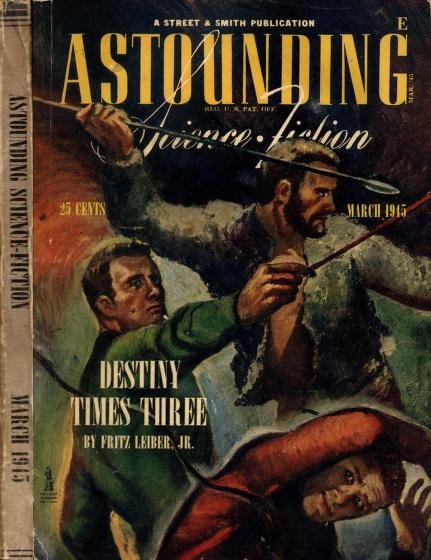
(Cover by William Timmins. Astounding, March 1945.) Who Goes There?
Fritz Leiber spent the first phase of his career, from about 1939 to 1945, mostly published in Weird Tales and Unknown, and more precariously in Astounding Science Fiction. I say “more precariously” because Leiber, at least early in his career, was not too keen on science-fictional writing; he would write some stone-cold SF classics like “Coming Attraction” and “A Pail of Air,” but that was later. Destiny Times Three was Leiber’s third novel, and it basically closed out the first phase of his career, in that while he continued to write in the latter half of the ’40s, his output was more sporadic, and evidently he struggled to find outlets for his material. Serialized in two parts, this is very much a short novel, but as we’ll see it packs quite a punch. It was nominated for a Retro Hugo for Best Novel.
Placing Coordinates
Part 1 was published in the March 1945 issue of Astounding Science Fiction, which is on the Archive. Time has not been very good to this novel in terms of publication. It did not see print in book form until the anthology Five Science Fiction Novels in 1952, from Gnome Press, edited by Martin Greenberg (not to be confused with Martin H. Greenberg, not that I would ever make such a mistake). Five years later and it finally got a solo book release, as part of the Galaxy Science Fiction Novel series. Things went dark for a while and in 1978 it reappeared as one half of Binary Star No. 1, the other half being Norman Spinrad’s “Riding the Torch.” Apparently there are hardcover and paperback editions of the novel by itself from Wildside Press, but I’m not sure where you would find these. Destiny Times Three has the misfortune of being too short a novel (it’s arguably a novella) to easily justify printing on its own, but it’s also too long to be anthologized, especially in the current market. Your best bet might just be the serial version.
Enhancing Image
We start with Thorn, a psychologist, accidentally stealing an object which he struggles to describe and whose possession he finds inexplicable. “It was about two inches in diameter and of a bafflingly gray texture, neither a gem, nor a metal, nor a stone, nor an egg, though faintly suggestive of all four.” If it sounds like I’m just tossing you into the middle of things without explaining who Thorn is, or what it is he stole, or from whom he was taking it, that’s because Leiber does the same thing. Admittedly Destiny Times Three does not start on the best foot; indeed I’d say it starts out pretty confusing and gets gradually more understandable as it goes on, which I suspect was by design, but it also means quite a few readers are gonna bounce off the opening chapters. We’re given no context at the outset what kind of world Thorn lives in, which is important because it’s clearly not our world. As such I’ll have to tackle this synopsis shindig a bit differently from the usual.
The plot centers around Thorn and Clawly, lifelong friends and colleagues who study people’s dreams, as you do. Something they’ve noticed lately is that people seem to be having far more nightmares than to be expected, and what’s far weirder is that these people have amnesiac episodes in which they don’t remember or recognize the people in their lives. The amnesiac episodes are temporary, but still, there are too many of these cases to be ignored. It looks like there be trouble in paradise. Thorn and Clawly live in what could be called a better alternative to our world, being a world apparently free from mass starvation and war, along with top-down tyranny, despite the presence of what is called the World Executive Committee. The World Executive Committee is basically like if the UN actually did its job, and curiously this novel was serialized mere months prior to the UN’s founding.
I would say Leiber’s expectations of a world government were too optimistic, but this was also the same period when Robert Heinlein, during his flaming liberal phase, would have more or less agreed with such optimism.
This utopia is called the Dawn Civilization, but for reasons to be given later I’ll refer to it from now on as World I (mind the Roman numeral). What makes it such a smashing civilization is apparently the wide availability of what Leiber calls subtronic power, which is supposed to be the best thing since sliced bread and whose accessibility has allowed for a technological and political Good Future™. I don’t know what subtronic power is exactly, because Leiber doesn’t really bother to explain it, but it’s obviously supposed to be analogous with atomic power. So-called Golden Age SF can be broken into two groups: pre-Hiroshima and post-Hiroshima. A good deal of pre-Hiroshima SF was about the potential greatness of atomic power, whereas post-Hiroshima SF was concerned about its potential as a weapon, though there are exceptions; you can guess which group Destiny Times Three falls into. I have to wonder if Leiber would’ve made a thinly veiled substitute for atomic power the great tech of the novel had he written it even one year later.
So, Thorn has a mysterious object which naturally unbeknownst to him has more power than he is aware of, and Clawly is driven to desperation after failing to convince the World Executive Commitee that these bizarre psychological episodes have any tangible importance. Clawly goes to see Oktav, an oracle, about what to do about what he suspects to be attempts by some outside force to invade the Dawn Civilziation, though Oktav knows a lot more than what he tells the poor psychologist. You see, Clawly theorizes that when people have these memory lapses that they’re not actually losing their memories, but that their minds are being displaced—put elsewhere and replaced by something. It sounds outlandish and you can see why the higher-ups scoff at him, but if you’ve read the script like Clawly did then you would reach similar conclusions.
So he tells the World Executive Committee:
“It is my contention—I might as well put it in plain words—that alien minds are displacing the minds of our citizens, that they are infiltering Earth, seeking to gain a foothold here. As to what minds they are, where they come from—I can’t answer that, except to remind you that Thorn’s studies of dream landscapes hint at a world strangely like our own, though strangely distorted. But the secrecy of the invaders implies that their purpose is hostile—at best, suspect. And I need not remind you that, in this age of subtronic power, the presence of even a tiny hostile group could become a threat to Earth’s very existence.”
Meanwhile, Thorn experiences what can only be called a waking nightmare—a surreal passage that stands out as one of Part 1’s highlights, and a typically excellent bit of prose for Leiber. Of course it’s not just a nightmare: something is happening to Thorn, though he doesn’t realize it right away. Soon he finds himself in a place he doesn’t recognize, in a body which is still his but which at the same time he feels to be alien somehow, and that’s only the start of his troubles. Could it have something to do with the object he stole without remembering why he did that? Does it have to do with a possible mental invasion that Clawly has been talking about? Yes to both, but how exactly is left up to spoilers.
I’ll say here that I went into Destiny Times Three thinking it would be a time travel narrative, which it isn’t really; it involves multiple timelines but they’re more like alternate realities. That’s right, we’re dealing with a multiverse story, and from 1945! Despite it’s brevity, this baby is dense, not just with action but also with ideas, and while details do clear up as we understand more about the workings of World I, the significance of the object Thorn took (it’s actually called a talisman) and so forth, you might have to reread a few passages to get what’s going on. Leiber would venture into equally if not even more high-concept territory later in his career, such as his Change War series, but Destiny Times Three might be his most ambitious work up to this point, though I have to admit I’ve not read his earlier SF novel Gather, Darkness! Safe to say Leiber is pushing himself into new territory here.
A few criticisms at the end of this section…
If you’re expecting women to play any significant roles in this novel, too bad, at least for Part 1. There’s a very minor female character (I don’t think she even has a name) who shows up once and is never seen again, and all the characters who matter are manly men of action. I’m trying to remember where exactly this was, but I recall Leiber years later saying he regretted not giving women a bigger role in the narrative for this specific novel. If you’re looking for a character-focused work then you’ll also be disappointed, as Destiny Times Three is driven by action and ideas; it’s a wild ride that only gets wilder as it goes on, but it’s not psychologically complicated. I would say, however, that Leiber is chasing after a vision that is quite astounding (haha, I know) given how short the novel is, and if he was pressured to keep it brief for magazine publication then oh well, that’s how life is.
There Be Spoilers Here
Thorn has swapped minds with someone who both is and is not himself. Whereas Thorn is a law-abiding psychologist, Thorn II (the man whose body he now occupies) is a rebel, and he needs to be a rebel because the Bad Future™of World II is run by a tyrannical world government (as opposed to the good world government). Clawly II himself is a member of said big bad government, which complicates things when Thorn crosses paths with this alternate version of his best friend.
How did we get here? Not just the swapping of minds but the fact that there’s more than one reality. Going back to subtronic power, there are apparently three timelines which diverge depending on what the leaders of the world do with this new discovery that could shape the future of mankind. In World I, deemed “the best” timeline, subtronic power was made accessible to the public; in World II, it’s held hostage by what is now a fascist world government; in World III, the discovery of subtronic power is totally suppressed. We don’t meet anyone from World III—at least not yet; but World II is basically the antagonist of the novel, as we find out its government is plotting an invasion of World I. Yet there is an even greater discover than subtronic power, one which makes such an invasion even possible: the Probability Engine. Placed outside space and time, the Probability Engine is maintained by a council of experimenters, of which Oktav is a member, and it was Oktav’s talisman which Thorn had taken.
The Probability Engine was probably invented by a third party (let’s face it, it’s either aliens or far-future humans), and it has the power to create (and, conversely, destroy) alternate timelines; at least that’s how I understand it. For the purposes of the novel there are three timelines, though at least for now only two are important. Rather than jump across timelines via portals or a time machine, one’s mind is swapped with his/her counterpart’s, which kinda… reminds me of a certain movie. To be fair, I’m pretty sure the Daniels have never even heard of Destiny Times Three, but it just goes to show that these “nifty sci-fi ideas” are usually really fucking old and that nothing is original. And also Santa Claus isn’t real.
A gripe I often have with multiverse stories is that when we see someone’s alternate selves they’re too closely related, despite the fact that you’d probably turn out a different person if your parents conceived on this day instead the other day, never mind all these other factors. I even criticized Sarah Pinsker’s otherwise pretty enjoyable novella “And Then There Were (N-One)” for having dozens of different versions of herself (it’s that kind of story) that are not that different. Even Everything Everywhere All At Once, great a movie as it is, does not go far enough with presenting just how radically different multiple versions of yourself would be; we never, for instance, see a male version of Michelle Yeoh’s character, even though that seems highly likely to occur. Leiber dodges this gripe by having the big change occur after Thorn, Clawly, and the other major characters were already born, so they have the same physiologies, names, and even some of the same childhood experiences.
The question is, how do you fight an invasion of minds? How do you fight against an army when it’s an army of body snatchers? How do you protect your mind from being swapped with that of your counterpart’s? You’ll just have to wait a bit.
A Step Farther Out
Part of me feels that Leiber originally conceived Destiny Times Three as a fantasy, since it almost leans closer to that than SF. The council of experimenters are like sorcerers. Subtronic power may as well be magic. Yet given the lack of a viable market for fantasy, especially of this length, in 1945, I wouldn’t be surprised if Leiber tinkered with it enough to make it SF. Not much of a criticism, really. At the risk of sounding immature, Destiny Times Three works because it is so COOL. The notion of an invasion not happening through some portal or gateway or a time machine, but through our minds, is COOL. The notion that all it takes is one invention to change not just society at large but people’s individual personalities is COOL. So far we’ve only seen World I and II, but the possibility of encountering that third world (which does not sound like a picnic) and having all three intersect is COOL. It’s a cool novel, and I hope it only ramps up in Part 2.
I also have to wonder if Leiber had been reading any A. E. van Vogt and what he thought of it, because Destiny Times Three strikes me as conspicuously van Vogt-esque, for both good and ill. This is Leiber at his least lucid (now doesn’t that phrase roll off the tongue), and I certainly wish he could explain himself better here, something he normally does with elegance. But also like van Vogt, the vision is so grand, so close to the transcendent, that it almost feels religious despite being undeniably secular. It’s like a cosmic epic in miniature, and I’m here for it.
See you next time.
-
Novella Review: “Scylla’s Daughter” by Fritz Leiber
(Cover by Vernon Kramer. Fantastic, May 1961.) Who Goes There?
Fritz Leiber, after a hiatus in the ’50s, returned in full force at the end of that decade, in no small part due to new management over at Fantastic and Amazing Stories. Cele Goldsmith doesn’t get brought up much when talking about great magazine editors, but she really should be; she not only made Fantastic a viable outlet for short fantasy, she all but singlehandedly revived Leiber’s Fafhrd and Gray Mouser series. For the November 1959 issue of Fantastic all the fiction pieces were by Leiber, in a special Leiber tribute, and we also got “Lean Times in Lankhmar,” the first Fafhrd and Gray Mouser story in six years. From then on we would get at least one Fafhrd and Gray Mouser story in Fantastic every year until 1965, when Goldsmith stepped down. While Leiber stayed consistently productive with other things after Goldsmith left, it would take him a few years to return to the series that now stands as his most lasting achievement.
For some context: Fafhrd and the Gray Mouser are a barbarian and thief duo who take on odd jobs for fun and profit in the secondary world of Nehwon, and most often the city of Lankhmar. “Scylla’s Daughter,” however, does not take place in Lankhmar, but on the high seas. This is like my eighth or nineth story from the series—I’ve lost count a bit. “Scylla’s Daughter” garnered a Hugo nomination for Best Short Fiction (the Best Novella category did not exist yet), and would serve as the base for The Swords of Lankhmar.
Placing Coordinates
First published in the May 1961 issue of Fantastic, which is on the Archive. Despite the Hugo nomination, “Scylla’s Daughter” has been reprinted a grand total of two times, first in the fantasy anthology Barbarians, edited by Robert Adams, Martin H. Greenberg, and Charles G. Waugh, which seems to have been printed only once; the second is Modern Classics of Fantasy, edited by Gardner Dozois, which is a beefier anthology and which is easy enough to find used. While it does feel weird for this novella to have appeared so rarely, it did get expanded into the sole Fafhrd and Gray Mouser novel, The Swords of Lankhmar, in 1968, which I suppose rendered “Scylla’s Daughter” both obsolete and non-canon. Sometimes you get novellas which, when expanded into novels, stand well apart from their novel counterparts, but this is not one of those times.
Enhancing Image
We start on the Squid, a grain ship that’s moving as part of a fleet from Lankhmar to a neighboring city. If you think we’re gonna get off the Squid and hit land at some point, think again: this story is entirely seafaring. Fafhrd and the Gray Mouser have been recruited basically as mercenaries for the fleet, and the fleet is gonna need some manpower considering a) it’s a trading fleet with quite a bit of booty worth stealing, and b) the previous fleets sent on this trade deal never returned, which is a bit ominous. Admittedly a government, even in Fantasy Land, hiring Fafhrd and the Mouser to guard a grain ship would be like if the Japanese government hired Lupin III and Jigen as bank security. That’s fine, it’s all in good fun. But why are we here? What kind of arrangement is this?
Thankfully the Mouser, being a cunning prick, is fluent in Expositionese, and lets us in on the situation:
“This fleet bears a gift of grain from Overlord Glipkerio to Movarl of the Eight Cities in gratitude for Movarl’s sweeping the Mingol pirates from the Inner Sea and mayhap diverting the steppe-dwelling Mingols from assaulting Lankhmar across the Sinking Land. Movarl needs grain for his hunter-farmers turned cityman-soldiers and especially to supply his army relieving his border city of Klelg Nar, which the Mingols besiege. Fafhrd and I are, you might say, a small but mighty rear-guard for the grain and for certain more delicate items of Glipkerio’s gift.”
The “more delicate items” are supposed at first to be some animals onboard: a dozen white rats that are really big and are allegedly really intelligent. The real gift, however, aside from the grain, might be Hisvet, a demoiselle (a young noblewoman) and fellow passenger on the Squid. Hisvet is quite beautiful, so beautiful that she soon drives Fafhrd and the Mouser to the depths of simpery—which they may or may not regret down the road. Hisvet has a peculiar relationship with rats in general, and she has a special connection with the dozen white rats in particular, which at first sounds innocuous.
There’s a pretty funny scene where the Mouser and Hisvet are tasting plums and tossing them overboard one after another. “A shark following in the wake of the Squid got a stomachache.” In general this is a pretty funny novella, especially in the first half before things get serious, and it demonstrates Leiber’s lively sense of humor that sometimes worked in tandem with his sense of horror. Indeed “Scylla’s Daughter” could almost be considered a horror-comedy, between Fafhrd and the Mouser’s rom-com shenanigans with Hisvet and the somewhat foreboding setting, with these ships at sea in an area that is supposedly haunted by shipwrecks—not accidental shipwrecks even, but plunderings and sabotages.
The word of the day is “rat.” We’re talking literal rats and also rats in the metaphorical sense, between the rats onboard and, for instance, the Mouser’s willingness to screw over Fafhrd if it means getting closer to Hisvet. We know that Our Anti-Heroes™ that are gonna make it to the end in one piece, but what was being bought and at what cost? That I’ll leave for the spoilers section, but I’ll say that if you’re familiar with how the Fafhrd and Gray Mouser series works even a little bit then you’ll figure that the love triangle at the story’s center will have to be broken somehow. Complicating things is Frix, Hisvet’s devoted maid, with whom she has a rather, hmm, odd relationship (put a pin in that one). Also complicating things is that rats have been known to sink ships (gnawing through wood and rope and all that), and nobody on the Squid is keen on having the white rats aboard.
At one point, in what is kind of a surreal episode, the fleet crosses paths with someone who quite literally seems to have come from nowhere, a German adventurer named Karl Treuherz. If you’ve been wondering as to how the cover on this issue of Fantastic relates to “Scylla’s Daughter,” that’s Karl on top of his two-headed sea serpent. We even get talk of Homer’s Odyssey and the original Scylla, a six-headed sea dragon, although this raises the question of how Karl could know about Homer or anything from our well. After all, Nehwon is a secondary world; it does not share history with Earth. Well, Karl isn’t from Nehwon; he can travel between different worlds. This is a bit much to put on the reader in the middle of a seafaring adventure, even if “Scylla’s Daughter” is a relatively late entry in the series. Karl also has some lines in German, but conveniently those all get translated via humorous footnotes.
What does Karl have to do with the plot, though? He talks with Fafhrd for a bit and then fucks off. Well, his two-headed serpent does have an appetite for rats, so just keep that in mind…
Karl also very much acts as a red herring, and a pretty obvious one. On the morning after Fafhrd’s meeting with Karl, one of the fleet’s ships is discovered to have been sunk. Some suspect that Hisvet may have ordered rats to sink the ship, given her kinship with rats and a superstition that there may be a cult of hyper-intelligent rats—an accusation which Fafhrd and the Mouser, of course, try to rebuke. Hisvet claims that Karl and his two-headed serpent had sunk the ship, which is convenient but also not very convincing if you think about it. Up to this point Hisvet has been a somewhat passive character in the whole equation, but the Karl episode prompts her to take a more active (and more foreboding) role. It could be that something else had sunk the ship, or maybe Hisvet now acting so suspicious is a sign that she knows more about rats than she lets on.
One last thing I wanna mention before we get into the meaty spoilers is a walking bit of irony: a black cat that’s also on the Squid. There are sveeral scenes where Fafhrd tries to get along with the cat, only for it to bite/scratch him for his troubles. The cat (as is to be expected) also does not get along with rats at all, and his aversion to Hisvet is some heavy-handed foreshadowing that Hisvet is not all she claims to be. Yet the cat’s violent attitude toward Fafhrd also pushes him more in Hisvet’s direction, making him believe her more whereas otherwise he might be more skeptical. “‘I forswear all cats!’ Fafhrd cried angrily, dabbling at his chin. ‘Henceforth rats are my favorite beasties.’” And boy won’t he eat those words.
There Be Spoilers Here
An important lesson to take from this is that you should never ditch your buddy for a girlboss. Ya know, bros before hoes. Hisvet probably does have a soft spot for Fafhrd and the Mouser, but that doesn’t stop her from drugging them so that they’ll be out of the way while she starts working her magic with the white rats. Something funny about the rats is that we’re told they’re intelligent, but the twist is just how intelligent: they’re able to follow orders and wield tiny swords, with little hats to match! The leader of the white rats, and basically Hisvet’s second in command, is named Skwee, and isn’t that a cute name for a villain. It’s silly, undeniably, like something out of an old animated Disney film, but I’m pretty sure Leiber intended that silliness; I wouldn’t be surprised if he was thinking of Pinocchio or Peter Pan when he wrote “Scylla’s Daughter.” Some Fafhrd and Gray Mouser stories have a creature feature feel about them and this is one such example.
Something that really jumped out at me in this story’s climax is the lesbianism, which is more than implied but less than said. What, lesbianism? In a magazine fantasy story from 1961? It’s more likely than you think! I’ve seen homosexuality get brought up in older magazine SFF, but not this directly or positively. To be more specific, not only are Hisvet and Frix in cahoots (not surprising), but they’re also all but said to be lovers (a little surprising), what with Hisvet not only kissing Frix, who then kisses Fafhrd (Hisvet kissing Fafhrd by proxy), but Hisvet admits later that men and women have fallen for her before and that she knows how devoted Frix is. Curiously, Leiber does not Bury Your Gays™, at least not here; once Karl shows up again and starts wreaking havoc on the rats, Hisvet and Frix hightail it off the Squid. Ya know what, good for them; I wonder what will happen to them in the novel version.
I suppose I have two issues with the ending: the first is that Karl appearing again reeks of deus ex machina, with Fafhrd and the Mouser actually doing very little to fight the rats, and the second is that even if I didn’t know about The Swords of Lankhmar I would’ve guessed we got a sequel to this. Fafhrd and Gray Mouser stories typically read as standalones, but “Scylla’s Daughter” ends on a bit of a sequel hook, what with Hisvet and Frix getting away at the end, and we did sort of get a sequel in the form of expansion, but I prefer my stories in this series to be more tightly knit. This is gonna sound silly, but we could’ve also used more bromance between Fafhrd and the Mouser; these stories tend to be at their best when Our Anti-Heroes™ are working together, and in “Scylla’s Daughter” they’re usually not interacting with each other or they’re falling over each other’s dicks for Hisvet.
A Step Farther Out
It’s not what I would recommend as one’s first Fafhrd and Gray Mouser story, but “Scylla’s Daughter” has all the qualities of what I’d consider a good entry in the series: humor, terror, an engaging love interest, more than a touch of weirdness, and of course good swashbuckling adventure. What always brings me back to the Fafhrd and Gray Mouser series is not just Leiber’s borderline poetic and often lively prose, or even the thrills of the adventures themselves, but the overwhelming friendship between these two guys that keeps them together for decades, but in-story and throughout Leiber’s career. Not enough fiction, in my opinion, does platonic friendship between men well or convincingly (too often it reads as subliminally romantic), and yet Fafhrd and the Mouser stay consistent as the two best bros in Lankhmar. I cannot imagine these guys screwing each other or wanting to screw, although they would certainly go on double dates. I like this series a lot because even though Fafhrd and the Mouser get themselves into some shit, they always get out of it, and they always do that by sticking together.
See you next time.
-
Things Beyond: December 2022

(Cover by Ed Emshwiller. F&SF, July 1969.) It’s that special time of year, and I’m not just saying that because it’s Christmastime. Truth be told, I’m not crazy about Christmas; I certainly don’t go nuts over it like I do with Halloween—which is why my review roster for this month is not Christmas-themed. My birthday is also this month (it’s the 9th, if you’d like to know), but that’s not why I’m here. Some months thing will be totally normal, but then there are times like this. Oh, we still have the usual rotation, albeit with a little twist (in fact it’s a new department), which I’ll get to in a minute. The real twist is that this will be a single-author lineup, and the guest of honor is Fritz Leiber.
Fritz Leiber was born on Christmas Eve, 1910, and when he made his professional genre debut in 1939, he was about to mark a new era in fantasy writing—although people were not aware of this at the time. His most lasting achievement is the grand episodic narrative of Fafhrd and the Gray Mouser, one of fantasy’s most daring duos and a landmark in what is now called Sword and Sorcery (the same subgenre which contains Robert E. Howard’s Conan, among other things). Leiber’s tales of Fafhrd and the Gray Mouser are by no means his only contribution to the genre, and indeed his turf goes far beyond just fantasy. You know, I really like Leiber, but even with most of my favorite authors I would not dedicate a whole month to reviewing works of theirs; what makes Leiber different from most is his ability to dabble in basically everything, from fantasy to horror to science fiction. Across the half-century of his career, Leiber shfited from genre to genre, mood to mood, not being as easy to pin down as most of his contemporaries.
Since this is a bit of an unusual month for reviews, I decided to go an extra step and introduce another new department—albeit an irregular one. There aren’t too many of them, but there are in fact “complete” novels in the magazines, especially in the ’40s and ’50s. Or rather were, because magazines running novels was basically an attempt to keep paperbacks (which were gaining traction) from biting their heels, an attempt which ultimately and inevitably proved a failure. A lot of “complete” novels being run in magazineare also just novellas, but there are exceptions! Leiber’s 1950 novel You’re All Alone is one such exception, and while it is technically an abridged version of The Sinful Ones (long story), at 40,000 words it’s a bit too long to be comfortably called a novella, at least for my blog. I’ll explain how this new thing will work at the end.
So, we get two serials, two novellas, two short stories, and a complete novel in honoring this bastard. Not the last time I’ll be doing this single-author month deal, but obviously it’s something I’ll only do maybe once a year. But enough! It’s time to reveal what we’ll be reading.
The serials:
- Destiny Times Three, first published in the March to April 1945 issues of Astounding Science Fiction. Retro Hugo nominee for Best Novel. Not one of Leiber’s more famous works, if the number of times it’s been reprinted says anything, but then it is quite a short novel—probably too short to sell on its own but also too long to be anthologized easily. One of Leiber’s earliest attempts at depicting alternate timelines, a premise that he would return to fruitfully much later.
- Rime Isle, first published in the May to July 1977 issues of Cosmos Science Fiction and Fantasy. Never heard of Cosmos? Don’t worry, it only lasted four issues. Rime Isle is part of the Fafhrd and Gray Mouser series, being a later entry, as well as one of Leiber’s final appearances in the magazines; thereafter he stuck to original anthologies. Whereas some other Fafhrd and Gray Mouser stories are often cited, this is not one of them. I know basically nothing about it.
The novellas:
- “Scylla’s Daughter,” from the May 1961 issue of Fantastic. The late ’50s saw a major revival for the Fafhrd and Gray Mouser series, which was not coincidental considering Fantastic‘s new editor, Cele Goldsmith, clearly sympathized with Leiber and wanted to buy what he was selling, with Fafhrd and the Gray Mouser getting at least one story a year in that magazine until Goldsmith left. “Scylla’s Daughter” would later be expanded into The Swords of Lankhmar.
- “Ship of Shadows,” from the July 1969 issue of The Magazine of Fantasy and Science Fiction. This is a special issue of F&SF, being one of its author tribute issues, with “Ship of Shadows” as the lead novella. Technically a reread, but it’s been long enough that I could use a refresher, and hell, I remember liking it quite a bit. Leiber stories tend to fall into SF, fantasy, or horror, but “Ship of Shadows” ticks all three boxes, and it won a Hugo while it was at it!
The short stories:
- “The Hound,” from the November 1942 issue of Weird Tales. The first several years of Leiber’s career saw him dwell primarily in Weird Tales and Unknown, the top fantasy-horror magazines of the early ’40s. Not being the most comfortable with SF, Leiber distinguished himself at first as a young master of terror and the supernatural. “The Hound” is one such early horror effort from Leiber, and hey, it’s apparently a werewolf story, and I love me some werewolves.
- “The Moon Is Green,” from the April 1952 issue of Galaxy Science Fiction. After being relatively inative in the late ’40s, Leiber came back strong early the next decade, and his return to the field coincided with those explosive first years of Galaxy, the new SF magazine on the market. Leiber became one of Galaxy‘s leading writers in the early ’50s, and “The Moon Is Green” is one of those Galaxy-Leiber tales to get adapted for the legendary X Minus One.
Now, finally, the complete novel:
- You’re All Alone, from the July 1950 issue of Fantastic Adventures. Apparently the magazine version is an earlier draft that Leiber had tried but failed to get published, since the fantasy market in the latter half of the ’40s was in the dumps, but luckily Fantastic Adventures, previously a second-rate pulp outlet, was under new management. Leiber would then “expand” the novel for book publication under the title The Sinful Ones, but from what I’ve heard the magazine version is better.
About how these complete novel reviews will work. My review schedule is on a rotation basis, switching between short stories, novellas, and serials; depending on how many days there are in a month I would cram in a third novella or short story. The way I have it figured is, if a month has 31 days, and if I’m set to review a novella on the 31st day, I’ll switch that would-be novella out for a complete novel. After all, I wanna save the biggest single review project for last, and I wanna give myself enough time to really digest the extra long material. The resulting review will itself of course be longer than average. Now, how do I separate a complete novel from a novella? How does one tell the difference, especially since magazines, while usually two-columned, have different type sizes and therefore some can pack more wordage into each page? Sometimes magazines give rough word counts, but much of this, admittedly, will come down to my own discretion.
Not making promises, but complete novel reviews will probably be the last department I add to my blog. This is a one-man show, ya know, and I do have a day job to contend with. Still, I wouldn’t be doing this if it wasn’t out of passive, and you also know that I’m a compulsive reader. The more the merrier! Just hope I can do someone as great as Leiber justice with this.
Won’t you read with me?
-
Subscribe
Subscribed
Already have a WordPress.com account? Log in now.
 Science Fiction & Fantasy Remembrance