-
Novella Review: “Cascade Point” by Timothy Zahn

(Cover by Doug Beekman. Analog, December 1983.) Who Goes There?
It feels weird to introduce Timothy Zahn, because he’s a somewhat famous author who’s famous for reasons that have nothing to do with this site. Zahn debuted at the tail end of the ’70s and quickly became a regular contributor to Analog Science Fiction under Stanley Schmidt’s editorship, and not surprisingly he also became a regular at Baen Books. Zahn’s fiction, from what I can tell, skews toward good old-fashioned space opera, but with more attention paid to character work than some of his fellows. What really gained Zahn recognition, though, was his attachment to the old Star Wars expanded universe, being perhaps the most prominent and most acclaimed author to write for that (now defunct) continuity. Thrawn, Zahn’s single most famous creation, is so beloved that he’s actually crawled his way into post-Disney buyout Star Wars properties. Zahn’s Star Wars cred is so prominent, in fact, that a lot of people seem unaware that he’s written things that have nothing to do with that franchise.
Not that I’m one to talk.
“Cascade Point” was the first story of Zahn’s that I’ve read, and so far it’s the only thing by Zahn that I’ve read. Don’t worry, I’ll fix that eventually. It was written during an especially prolific period for Zahn, and even nabbed him a Hugo (despite not getting a Nebula nomination) for Best Novella. Technically a reread, because I know for a fact I read it as part of The New Hugo Winners (see below), but I basically remember nothing about it from that first reading. In hindsight I think I just didn’t give it a lot of attention, which is a shame because I can see why readers at the time would’ve liked it a lot.
Placing Coordinates
The December 1983 issue of Analog is not on the Internet Archive. Not on Luminist, either. Same goes for any Analog issues after 1979. That’s right, if you want it you’ll have to buy a hard copy with dollars, pounds, shekels, and so on, which is what I did. Like I said, I try to read these stories as they had originally appeared unless it’s a reprint. What’s weird is that despite the Hugo, and despite Zahn’s status, “Cascade Point” has not been reprinted often. The New Hugo Winners, edited by Isaac Asimov and an uncredited (for some reason) Martin H. Greenberg, is easy enough to find used. That Doug Beekman cover is so good that they reused it for the first edition of Cascade Point and Other Stories, and I don’t blame them. Most interestingly (to me) it was bundled with Greg Bear’s “Hardfought” as a Tor Double, that series packaging Hugo- and Nebula-winning novellas together. Finally, if you want a reprint published in the 21st century we have The Mammoth Book of Mindblowing SF, edited by Mike Ashley.
Enhancing Image
Pall (seems like a bastardization of “Paul,” but would be funnier and indeed is porbably pronounced like “pal”) Durriken has a fine enough job as the captain of the Aura Dancer, a space liner that’s not what you would call first-class. Durriken is not the most sociable of men, reliying most on Alana Keal, his right-hand (wo)man and the person onboard he gets along with the most. The plot involves a trip to the colony planet of Taimyr with a small number of passengers in tow, but we really get a quality-over-quantity deal here as two of the passengers, Rik Bradley and his psychiatrist Dr. Hammerfield Lanton, are a bit of an odd pair. These two, as it turns out, will cause some issues.
As you know if you’ve read enough science fiction, space travel is highly impractical at best; without faster-than-light travel or some way to cheat around spacetime it would years at bare minimum just to leave one’s solar system. Of course FTL as we understand it is impossible, something I suspect was considered true even in 1983, which of course did not stop authors from going with the “ceating around spacetime” option. Here, we have a series of warp points called cascade points, in which not only can ships basically teleport but also seem to intersect with alternate universe. Yes, this is another multiverse narrative, sort of, but the multiverse is not made as big a deal of as you would think. As far as anyone can tell a ship going through a cascade point is not liable to enter an alternate universe by accident—which is not to say it can’t happen…
Passengers and crew are supposed to take drugs that knock them out cold during a ship’s maneuvering through a cascade point, minding that these points are days apart; in other words, everyone goes unconscious except for the person piloting the ship. First-class ships like luxury liners can afford to have an autopilot installed for cascade point maneuvers, but the Aura Dancer is decidedly not first-class and so Durriken has to stick it out alone, every time, without losing his sanity. Given that it’s set far in the future, robots and computers play a shockingly small role in the literal mechanics of the setting. I’ll elaborate on this a bit later, but I’ll say for now that, looking back on it, this lack of computerization is one of those signs that this novella was not of its time, but actually before its time. It feels like a Star Trek episode, like from the ’60s, the original show—not that that’s necessarily a bad thing.
So, about the cover. In case I didn’t make it clear before, I really like it. Some cover stories get covers that have little to do with the actual story, but this is not one of them. Sometimes with a cover story you can tell which scene exactly inspired the cover art, and in the case of “Cascade Point” it’s the first time we see the effects someone awake would experience when going through one of those cascade points.
Observe:
I will never understand how the first person to test the Colloton Drive ever made it past this point. The images silently surrounding me a bare arm’s length away were life-size, lifelike, and—at first glance, anyway—as solid as the panels and chairs they seemed to have displaced. It took a careful look to realize they were actually slightly transparent, like some kind of colored glass, and a little experimentation at that point would show they had less substance than air. They were nothing but ghosts, specters straight out of childhood’s scariest stories. Which merely added to the discomfort… because all of them were me.
Durriken sees alternate versions of himself when going through a cascade point, or rather the ghosts of different versions of himself since he can’t interact with them and they, conversely, are unaware of his existence. It’s a bit of a psychedelic effect, and it makes for a good illustration, but it’s not the root of the conflict; nay, the root of the conflict is people. See, Dr. Lanton is treating Bradley for neurosis, and Lanton has this brilliant idea to use the cascade points as a possible way to treat Bradley, keeping him awake through the multiverse hijinks. As you can tell, this is a horrible idea. Lanton is the closest the story has to a conventional villain, although he’s less malicious and more laughably incompetent—so ethically dubious that I honestly have to wonder if he’s based on Eugene Landy. Hmm, Lanton, Landy…
Lanton’s ideas about treatment are so obviously bad that even Durriken feels the need to point it out; but then, Lanton is a paying customer and a passenger on Durriken’s ship. The human drama comes from Lanton’s treatment methods but also some equipment he brings aboard that a) he didn’t consult any of the crew about in advance, and b) might contain materials that could interfere with the ship’s delicate maneuvering balance. For instance, if some device Lanton brought aboard just so happened contained a specific and rather rare metal that would throw the ship’s cascade point maneuvering off—well, you can guess what might happen. For now, thought, the big problem is simply dealing with the asshole and also making sure Alana, who has a history of falling in love with her “patients” (it’s a good thing she’s not a nurse), doesn’t get too attached to Bradley.
You have the relationship square of Durriken, Alana, Lanton, and Bradley; there are other characters with names, but you’re not gonna remember them. Would pose a problem if this was a novel, but being a 20,000-word novella leaves only so much room for character, and the characters Zahn does focus on are pretty fun to read about, even if some of their antics can wander beyond the realm of plausibility. I seriously doubt, for one, that Lanton would be a licensed psychiatrist who’s allowed a seemingly endless supply of drugs and gadgets; maybe it would’ve been plausible in 1983, given changing medical practice standards, but certainly not now. Alana, while she’s charismatic, is also a bit of a satellite, with her relationship with Bradley dominating her character for most of the story.
Durriken is a fun protagonist, though, which is good considering he’s also the narrator. Writing a first-person narrator is always a dangerous game, because as a reader you’re basically sitting down and having a one-way conversation with this person for however many minutes or hours. Thign is, the person spewing words at you could be a real annoying prick, but thankfully Durriken has just enough of a sense of humor without detouring into asshole territory. His objections to Lanton’s methods are super-reasonable (a little too understated, if anything) and it’s clear that he cares about his crew and his ship while also wishing he could have a better life for himself. Seeing alternate versions of himself is disorienting just visually, but it’s also unnerving for him to think about all the ways his life could’ve gone better or worse. Not too philosophical, but it’s fine character work.
There Be Spoilers Here
Early in the story we hear, rather passively, that ships have occasionally gone missing mid-voyage; no wreckage or signs of piracy or system failure, but rather ships just straight-up vanishing into thin air. The Aura Dancer is a secured vessel, but the fact that these vanishings remain unexplained doesn’t help Durriken’s conscience. He’s right to be worried, too; turns out Lanton brought aboard a gadget with a certain rare metal inside it that would mess with the ship’s cascade point maneuvering, requiring compensation, but more importantly it sends the ship more off-course than anyone could’ve expected. When we finally get to Taimyr we find… nothing. Nobody waiting for the ship. No buildings. Not even the remains of buildings. It’s as if the world had never been colonized, which gets Durriken thinking…
Basically, the Aura Dancer hopped into an alternate universe where Taimyr remains uninhabited. Thanks a lot, Lanton! Keep in mind that the situation is more complicated than I’m letting on, but that’s the gist of it. “Cascade Point” is arguably hard SF, but it’s such a loaded term that it could apply to anything that has even the most tenuous connection to real science. I’m not a scientist or someone with a background in physics (I majored in film studies) so I’m just the kind of person Zahn would cater to when he goes on about Ming metal and cascade points and other invented nonsense. My general rule is that if a story’s science can’t be easily disproved by a middle schooler then it’s fine enough for me, I usually won’t get hung up on inaccuracies, in which case “Cascade Point” passes easily.
What’s important is that with the heightened stakes, the character drama intensifies. There’s a bit of romantic tension between Durriken and Alana, on top of Alana’s deal with Bradley, but luckily Zahn keeps their relationship platonic; they’re very good friends and it’s clear that they trust each other more than anyone else on the ship. So what’s the solution? To make a long story short, going backwards. There are extra steps, but again, that’s the gist of it. Crazy. How come nobody’s done this before? Well, as far as we know anyway. The potential for ships to hop across universes is pretty vast, a vastness that’s only hinted at here. The ending is rather happy-go-lucky with Durriken saving the day and Alana giving him a figurative pat on the back, albeit Lanton gets away with his idiocy. Disappointing.
The very last scene is pretty good, though. It brings closure to Durriken’s character arc while giving us something genuinely heartwarming. Not necessary from a plot angle, but I’m glad Zahn included it.
A Step Farther Out
I chose this for review partly because it’s one of those stories where I’m pretty sure I didn’t give it the attention it needed the first time around, and partly because I thought it’d be interesting to read/review it in close proximity with “Hardfought,” since the two were reprinted together at one point. It’s curious to read these two so close together, because aside from being spacefaring hard SF by “macho” ’80s authors, they have very little in common, and their goals are also quite different. “Hardfought” is honestly one of the most impressive pieces of science fiction at any length that I’ve read in a long time—a genuine effort on Bear’s part to write from the future as opposed to simply about the future. “Cascade Point” is considerably more straightforward and less ambitious, which means it goes down easier but there’s less to think about. The cliche about the Hugo winner being the crowd-pleaser and the Nebula winner the “literary” choice is more often untrue than not, but it’s pretty accurate here.
Which is not to say “Cascade Point” isn’t an effective crowd-pleaser. It’s old-fashioned, and it arguably would’ve read as that even at the time, but Zahn knows what he’s doing. I’m a sucker for narratives set on ships, bonus points if there’s good crew dynamics, and this is a good one. It’s a classic Analog narrative in that it’s ultimately a “problem” story: there’s a scientific problem, usually an anomaly, and Our Heroes™ have to solve it. The ingenuity of man triumphs. Like I said, this feels like it could’ve been a Star Trek (specifically TOS or TNG) episode, and not a bad one. Just set your expectations for something that’s pleasing but not mindblowing.
See you next time.
-
Serial Review: The Tower of Glass by Robert Silverberg (Part 3/3)

(Cover by Jack Gaughan. Galaxy, June 1970.) Who Goes There?
As author, editor, and fandom personality, Robert Silverberg is indispensable. It’d be very hard to make sense of SF’s transition from the pre-New Wave ’60s to the debauchery of the New Wave without taking Silverberg’s talent and influence into account. His original anthology series New Dimensions published seminal works by the likes of Ursula K. Le Guin and James Tiptree, Jr., and in the late ’60s and early ’70s Silverberg wrote an almost superhuman sequence of novels that would be enough for most authors’ whole careers. He won a Nebula with A Time of Changes (which I’ll no doubt review eventually) and his 1972 novel Dying Inside is easily one of the ten best SF novels of the ’70s; the fact that it didn’t win a Hugo and/or a Nebula is scandalous. The Tower of Glass (minus the definite article in book form) is from this sequence of novels, and how does it hold up with the admittedly stiff competition upon finishing? Let’s see…
Placing Coordinates
Part 3 was published in the June 1970 issue of Galaxy Science Fiction, which is on the Archive. If you want it in book form it’s not hard to fine used online at all. As for the serial, I do wanna warn you that it is unusually long compared to the previous installments; indeed it might take up damn near half the novel, which I made the mistake of trying to get through basically in one sitting. The wonky pacing might’ve skewed my opinion on the third act of this novel is all I’m saying.
Enhancing Image
The drama with Cassandra Nucleus, the android Leon spaulding had mistakingly killed at the end of the previous installment, is resolved without much fanfare: Krug signs a contract to reimburse the company that owned Cassandra, and the civil suit is dropped. Hell, Krug can afford it. For Krug, the biggest thorns in his side have seemingly been taken care of and he can return to focusing on the tower, which at this point he might care more about than his own son. Not that anyone can blame Krug, really; his son Manuel is a bit of a chump.
Something that gradually and undeniably becomes a problem with this last installment is that Silverberg a) gives into his need to be edgy a little too much, and b) feels the need to end the novel on a BANG despite so much of it being a low-key character-focused drama. I was intrigued up to this point despite there being very little in the way of action, but Silverberg is about to ramp things way up—and not necessarily for the better. His side gig as a writer of erotica also rears its ugly head with quite literally any scene involving Lilith Meson, Manuel’s android mistress and SPOILERS! part of a con to make him become a human spokesperson for android equality. Lilith and Thor Watchman have been scheming to make Manuel a player for their team, with Lilith actually having feelings for Watchman and not Manuel. Or maybe she has feelings for neither. It’s hard to figure what her deal is.
There’s a lengthy (it feels longer than it is) sequence where Lilith dresses Manuel up as an alpha android (that’s right, Manuel, presumably a white man, technically parades around in redface) and he gets a taste of what it’s like to live as an android. The experience is more than a little traumatizing. On top of the dozen other things going on in this novel, Silverberg digs deeper into the caste system among androids, between the alphas, betas, and gammas, with gammas being the least intelligent and most expendable. We travel though a gamma ghetto and it’s all rather grotesque—and yet somehow it also feels of little consequence. It’s during this sequence that Silverberg introduces yet more things, including a drug that slows down one’s sense of time and which a lot of gammas are hopelessly addicted to. Don’t think about it too hard, it doesn’t really come up again.
We get multiple sex scenes with Lilith here, which on the one hand must’ve surely struck magazine readers in 1970 as transgressive, but the problem is that they really aren’t necessary, and also, to be a little more blunt, Silverberg’s not very good at the writing porn thing. If I have to read about “breasts” (that specific word) in my SFF ever again for the next week I’m going to [YASS] myself. Silverberg is excellent at writing about the male psyche but far less convincing when trying to capture “the woman’s angle,” which is where things get ugly. Either you accept it or you don’t. Silverberg at his best is able to make you forget about his limitations and instead make you think the same things he’s thinking about, namely stuff involving identity, religion, existentialism, the works. Silverberg in erotica mode is nothing I want, though, although like I said it must’ve been more eye-catching at the time.
Anyway, as for Krug we still have at least three issues: the tower, the prospect of getting granchildren out of Manuel and Clissa, and lastly this weird little subplot that I could’ve sworn was not introduced in previous parts involving a spaceship. On top of building the tower to communicate with the mysterious alien signal coming from that distant star, Krug is also sending what almost amounts to a generation ship full of androids in that direction, although given the nature of space travel and time dilation he would not live to see the passengers arrive at their destination. The move feels like desperation on Krug’s part, but also on Silverberg’s; it’s like Silverberg added this thread at the last minute for the sake of getting the ending he wants. I’m not even sure what the androids onboard are supposed to do when they eventually get to where the signal’s coming from.
It’s not all bad. Even taking the awkward sex talk into account, anything with Thor Watchman is destined to be at least readable. His newfound religious weariness from the end of Part 2 continues to ferment, and on top of that his relationship with Lilith, which up to this point had been professional, takes a much more intimate turn. The result is a love triangle that will naturally end with one of the players getting kicked out at the end, but who and how are questions yet to be answered. You may be wondering: How does Clissa figure into this? She doesn’t, really. Oh, I’ll get to her in spoilers, but I’ll just say for now that what Silverberg does with her—a character who’s been sadly underutilized for most of the novel—is objectionable.
If I sound unusually bitter with this final installment it could be that it’s easily longer than the previous ones, and also is much busier than the others. What was merely bubbling at the surface before is now bursting and making a mess everywhere, and it’s like Silverberg realized he created about five different subplots and has to resolve all of them in a novel that, in its book form, only clocks in at about 200 pages. Something I tend to like about pre-1980 SF novels is their brevity, how even if you don’t like what you’re reading you won’t be reading it for long, but The Tower of Glass is one of those rare good novels from the period that really could’ve been improved by expansion. Even an extra 40 or 50 pages, or in other words if this was a four-part serial instead of three parts, would’ve done it favors. Silverberg fits too many concepts into too small a space, and ultimately his economy of wordage works against him.
We’ve got an almost comically tall glass tower with a tachyon beam, teleportation, ego-swapping, a caste system of androids, a family drama, a love triangle, and a Darwinian nightmare future that’s more hinted at than actually shown. YA GOT ALL THAT? Okay, time to jump to the explosive climax, which I certainly have some thoughts about.
There Be Spoilers Here
He had considered it before, but Krug finally agrees to do a shunting session with Watchman, his top android. What could go wrong? Everything. The ego-swapping reveals not only Watchman’s con with Manuel but, more importantly, Krug’s disdain for being treated as a god. Which you can’t say is unexpected. Up to this point we’ve been unsure as to how “good” a person Krug is, but the climax certainly does not help his case, which makes his fate all the more curious.
Watchman’s faith, which had been on uncertain ground before, is now shattered, and as an alpha—not just an alpha but one heading the building of the glass tower—he has authority when he announces publicly that Krug is a false god. The result is utter disaster. Androids leave their posts, go on strike, and some even kill their human overseers. A worldwide revolt of androids begins, and Krug’s empire collapses in what seems like a matter of hours. Stretching one’s suspension of disbelief a bit here, but okay. Point being, everything goes to hell. Watchman sabotages the tower and overrides its various safety measures, causing it to collapse. Manuel barely escapes an angry android mob with Clissa getting fridged in an unnervingly unceremonious fashion. Right, so about that…
The women in The Tower of Glass really draw the short stick. Lilith loses Watchman at the end, with Manuel a nervous wreck, and Clissa gets apparently raped and butchered by androids offscreen. This is not it, chief. For one, I seriously find it hard to believe that androids would go after a human woman like this, but also, given the parallels Silverberg has drawn between the fight for android equality and the real-world civil rights movement for BIPOC quaulity (which was still very much going on when the novel was being writtne, mind you), this does not look good from an allegorical standpoint. Also, it’s a waste of character. Clissa’s outspoken sympathy for androids comes to naught, something even Manuel himself points out. Why introduce a character with this viewpoint if you’re going to not only barely use her but give her so shitty an exit? Againt this is like Silverberg was running out of time on the novel.
Going back to the spaceship that was only recently introduced, Krug uses it to escape the android rebellion, but also to cut out the middle man and travel to the distant planet himself. Again I’m not sure what he hopes to accomplish when he gets there, but then it might still be preferable to staying on what is quickly becoming a hellworld. We don’t know if the androids really will take over or if the humans will be able to fight back, but it doesn’t look good. In the span of about 20 pages The Tower of Glass goes from being a domestic, if intense, drama to being a tragedy of apocalyptic proportions. On an allegorical level it mostly works (as a religious and Freudian allegory, that is) but in execution it feels weirdly rushed and tactless by Silverberg’s standards. Surely he had considered a better way to tie all these subplots together, but deadlines might’ve forced him to compromise.
A Step Farther Out
Silverberg really let me down on this one, man. With reviewing serials I’ve found that the final installment will either make or break the whole thing, the latter more often being the case, and The Tower of Glass is sadly not an exception. There are sparks of that late ’60s and early ’70s Silverberg brilliance here, but I guess the saying is true: it’s possible to have too much of a good thing. Comparing it to as refined a masterpiece as Dying Inside is almost unfair, one because of that novel’s quality, but its simplicity. Both novels are short, only about 200 pages, but Dying Inside is so much more focused and yet so much more intense, never mind more elegant in its usages of the tools at its disposal. I can see how readers were impressed enough by The Tower of Glass at the time that it got a Hugo nomination, although I probably would’ve voted for Poul Anderson’s Tau Zero that year. If you want a sample of what New Wave SF was like then you could do worse than The Tower of Glass, but it’s not even Silverberg’s best novel (or even probably his third best) attempt at this particular mode of writing.
See you next time.
-
Short Story Review: “Non-Zero Probabilities” by N. K. Jemisin

(Cover by Andreas Rocha. Clarkesworld, September 2009.) Who Goes There?
Assuming you’re “in the know,” you already know about N. K. Jemisin, by reputation if not by having read several of her many novels. With that said, a bit of an introduction is in order, for me if no one else. Jemisin is so far the only author to have won the Hugo for Best Novel three years in a row, along with the only author to win the Hugo for Best Novel for all three entries in a trilogy. (Vernor Vinge won with three consecutive novels, but said novels were all published several years apart.) The Broken Earth trilogy, a fantasy series with a dying Earth setting, did all this, along with the third entry, The Stone Sky, winning a Nebula. While her career is still very much in progress, Jemisin stands as one of the most acclaimed SFF authors of the past decade, and has achieved that certain status that the vast majority of authors crave: to be a critical darling and a regular bestseller. “Non-Zero Probabilities,” an early short story from Jemisin, was also a Hugo and Nebula finalist.
I’m ashamed to say that prior to doing this review I’ve not read a single word of Jemisin’s fiction. Sure, I’ve checked out her blog, and I follow her on a certain social media platform that has a bird for a logo, but the thing with Jemisin (this is not a criticism, please don’t kill me) is that she sure loves her series. On top of the aforementioned Broken Earth trilogy we also have the Inheritance trilogy, which I actually saw an omnibus edition of at a Barnes & Noble the other day; the thing was fucking HUGE. Most recently we have The World We Make, which came out last year from Orbit, as the sequel to The City We Became. Jemisin has yet to write a novel that’s not part of a series or franchise, so either I wait for her to write a standalone novel or I get over my fear of commitment and give one of these a shot.
Placing Coordinates
“Non-Zero Probabilities” was first published in the September 2009 issue of Clarkesworld, and you can read it for free online here. Check out also the magazine’s podcast reading of the story here. Despite the Hugo and Nebula nominations (along with being a damn fine story), “Non-Zero Probabilities” has not been reprinted much, although you can easily find a print version of it in the Jemisin collection How Long ’til Black Future Month? Jemisin has not written a great deal of short fiction over the years, with How Long ’til Black Future Month? collecting the vast majority of it, and she has not published a short story since 2019. The good news is that several of those stories have appeared in various online magazines, which means we’ll be seeing her on this site again… eventually…
Enhancing Image
Adele (no, not that one) is your standard quirky biracial (half black, half Irish) woman, although her situation as of late has not been standard. New York has been caught in a sort of bubble where statistically unlikely things have been happening with frightening regularity—for both good and ill. One of the first things we see is a shuttle train being derailed and killing bare minimum a couple dozen people—a horrifying accident that normally would be unthinkable but which recently has been inexplicably allowed into existence. “The probability of a train derailment was infinitesimal. That meant it was only a matter of time.” Incredibly unlikely yes, but not impossible. This is by no means an isolated incident; miraculous things have been happening constantly, but only in this finite space.
“It’s only New York, that’s the really crazy thing. Yonkers? Fine. Jersey? Ditto. Long Island? Well, that’s still Long Island. But past East New York everything is fine.”
At least my home state has not been affected!
New York has been transformed, sort of cut off from the rest of the world, in a way that’s not seen so much as experienced. I’m reminded very much of Bellona, that isolated wasteland (or wonderland, depending on how you look at it) of Samuel R. Delany’s mammoth novel Dhalgren. If you’re even remotely familiar with that novel and are worried that “Non-Zero Probabilities” might approach that level of opaqueness, fear not, this is basically a comedy. A rather dark comedy, but a comedy nonetheless. The fact that it’s set in New York, one of the world’s biggest punching bags, and not say, fucking Cleveland, makes the hijinks hit much harder. Granted, there’s a bit of an out-of-pocket comment made about Bangkok being “pedophile heaven,” which is a little… culturally insensitive perhaps; there’s also a joke about Chinese knockoffs, which might’ve been a fresh joke then but just feels tired now. But the insensitivity is all in good fun, and boy does this story have fun with the sheer lunacy of its premise.
I’m not sure if I’m supposed to call “Non-Zero Probabilities” fantasy or SF, given that the scientific “explanation” is only mentioned in passing and is not even confirmed to be the cause of the bubble. People who normally would not be superstitious have started taking good luck charms seriously, and conversely doing away with things meant to represent bad luck. It’s a bad time and place to be a black cat. Hundreds of thousands of people are set to gather together in Yankee Stadium and I guess push the bad vibes out of the city—although that would necessitate pushing out the good vibes as well. Sure, you could get absolutely fucked over in a convoluted series of accidents, but you could also win the lottery twice in a week. By the way, if you’re wondering if the mass prayer at Yankee Stadium will serve as the climax, just don’t think about that.
At 3,350 words this is probably the shortest story I’ve covered for the site, and it’s also a contender for the most plotless. Adele goes about her day, she meets up with a couple people she knows and they talk about the bubble that’s overtaken New York, and Adele herself does not get into any life-threatening situations. The stakes, at least from a certain angle, are low. We don’t get a plot so much as a series of happenings, which are both entertaining and logical extensions of a setting wherein the unlikely has become likely and there is no such thing as impossibility.
Question: Who would want to live in New York?
I’m not talking about the New York of the story, I’m just asking generally.
Anyway, this thing is highly readable and very short; it’s just long enough that you get a taste of what Jemisin’s doing but short enough that it doesn’t tire itself out as a comedy. It’s an episodic narrative where we get these short scenes that illustrate Adele’s character, the ways in which the city has changed, or both, often to comedic effect. The conflict does not involve Adele directly so much as a general question of science vs. superstition; on a micro level it has to do with Adele’s nominal Catholicism (ya know, the Irish in her) being challenged on two fronts, by a scientific anomaly on one and a supernatural force which may not be the Abrahamic God on the other; on a macro level it’s a question of whether “objective” reality is merely determined by numbers or if there’s an invisible hand orchestrating events.
It’s a bit of a thinker, but first and foremost it’s a slice-of-life comedy that’s constructed efficiently and written with remarkable confidence.
There Be Spoilers Here
This is a hard one to spoil, first because, like I said, it’s basically a slice-of-life narrative, but also because it doesn’t really have an “ending.” Now, not every story has to go out with a bang; it’s possible, occasionally even preferable, to leave things open, and “Non-Zero Probabilities” is one of those stories where I actually don’t mind the lack of closure. The question of whether the statistical anomalies are driven by science or superstition goes unanswered, but to answer that question, or rather to give us the answer, would probably be unsatisfying. Jemisin makes the wise choice of plopping us straight into this augmented New York for a few thousand words and then taking us out of it just as quickly, with a helpful dose of humor but also an air of mystery about what the city might become. Much like Dhalgren, like the Bellona of that novel, the mystery behind the anomaly is much more interesting than the possibility of finding a solution.
A Step Farther Out
A pretty good introduction to Jemisin’s fiction, although something tells me this is lightweight by Jemisin standards, but that’s not necessarily a bad thing. Sometimes you want your short story of the day to be like comfort food. I also have to admit that as a fan of comedic fantasies in the Unknown tradition I’m predisposed to find the hijinks of “Non-Zero Probabilities” at least a little involving. Not all of the jokes work, but most of them do in my opinion, which is more than can be said of most comedic SFF. A lot of the humor of course has to do with Jemisin’s snappy narrator’s voice and the fact that she doesn’t waste time on flowery descriptions when she knows that’s not the kind of writing we’re here for. I can see why it’d be deemed a bit too minor to be included in best-of-the-year anthologies, but given its modest goals which it achieves with easy success, I liked it quite a bit.
See you next time.
-
The Observatory: Was 1953 the Best Year in SF History?

(Childhood’s End. Cover by Richard Powers. Ballantine Books, 1953.) Are we halfway through the first month of the year already? Aw geez, that means I gotta write something. I always have a few editorial ideas swimming around, but the question is always: When should I write these? A topic can be timeless, or it could benefit from being discussed at just the right moment. The right person in the right place can make all the difference, and the same goes for articles, even ones I’m not getting paid for. It’s January 15, 2023, which means two things: it’s a Sunday, and it’s also Robert Silverberg’s 88th birthday. Hopefully we can get a dozen more out of him.
I don’t consider myself a big Silverberg fan, at least not yet, but I do see his place as a constant in SF history as indispensable. I can’t think of anyone alive now aside from maybe Samuel R. Delany whom I would like to sit down with and interview for an hour more than Silverberg, for the simple reason that Silverberg has a nigh-endless supply of stories to tell—not stories as in fiction, mind you, but life stories, stories within SF fandom, stories about all the times he got rejected by editors and, naturally, the subsequent acceptances. This is a man who traded words with John W. Campbell, Anthony Boucher, H. L. Gold, Frederik Pohl, Ben Bova, etc., and lived to tell the tale. This man has attended every Hugo ceremony since its inception in 1953, since he was just old enough to be able to attend the Hugos, and that alone would make his memory a precious thing to back up on some hypothetical external hard drive for people’s memories, which are essentially their beings anyway.
And speaking of 1953…
I have a lot of anthologies on my shelves. I’m young and amateur, but still I think I have a good number. One of those is Silverberg’s Science Fiction: 101, which is a curious mixture of fiction anthology, writing advice, and memoir. I don’t think it’s in print anymore, sadly, but I do recommend finding a copy, as, regardless of how one may feel about Silverberg as a person, the fiction selected is of quite a high standard—some certified classics with a few deeper cuts thrown into the equation. Something I couldn’t help but notice, though, even if Silverberg didn’t bring it up himself, is that focus on ’50s SF in the anthology, and more specifically on a certain year. Of the thirteen stories included, five are from 1953, which one might think to be a little much, especially given that there are only two stories from the ’40s (C. L. Moore’s “No Woman Born” and Cordwainer Smith’s “Scanners Live in Vain”). Yet 1953 is undoubtedly framed as a Big Year™ for Silverberg, which makes sense; he was just then starting to write SF in earnest, having lurked around long enough as a fan and now readying to make his mark on the field.
Science Fiction: 101 shows off short SF that meant a lot to Silverberg personally, mostly stuff published during a period in his life when he was making the jump from fan to professional. The slant towards 1953, however, only hints at just how prolific and remarkably high in quality that year was for a lot of people active in the field then. On multiple fronts, the field was rolling ahead at full speed, with the growing accessibility of paperbacks meeting halfway with a magazine market which was at the very height of a bubble—a bubble that, mind you, was about to burst, but in the moment it was at a point of critical mass, which meant a diverse market for writers who otherwise might struggle to get published in Astounding or Galaxy. In the US along there were well over a dozen SF magazines active in ’53, including Amazing Stories, Fantastic, Future Science Fiction, Science Fiction Quarterly, Worlds of If, Universe Science Fiction, Startling Stories, Thrilling Wonder Stories, Planet Stories, Space Science Fiction, and frankly almost too many more to count. We would not see this saturated an SF magazine market again until, well, now, but I’ll come back to that at the end.
There was something for everyone. If you wanted “literary” thinking man’s SF then Galaxy and F&SF scratched that itch tremendously; if you’re stubborn and like to read macho SF about psi powers then Astounding has your back; if you’re into planetary romance and generally adventure SF then there are a few options; if you like certain authors but wish you could buy even more of what they’re selling, then good news, those authors have probably sold to more magazines than you existed. And of course, if you’re one of those few sad fantasy readers in that weird point in time that’s post-Chronicles of Narnia but pre-Lord of the Rings then you’ll be pleased to know there’s a new fantasy magazine on the market: Beyond Fantasy Fiction, helmed by Galaxy‘s own H. L. Gold. And if that’s not enough, especially if you’re an avid book reader, the paperback market for SF is opening up big time, and that door will only open wider.
1953 was a great year to be Philip K. Dick, Robert Sheckley, Poul Anderson, Theodore Sturgeon, Arthur C. Clarke, and quite a few others. Dick and Sheckley had debuted the previous year, but 1953 saw these one-man writing factories pull out all the stops; you could probably make a top 10 list of your favorite Robert Sheckley stories from 1953 alone. It was also the year that Arthur C. Clarke, who had appeared from time to time in the American market previously, made his first big splash with American readers here, not just with the publication of Childhood’s End but also a slew of short stories that are still highly regarded, the most famous being “The Nine Billion Names of God.” Poul Anderson, who had been active for some years but had not made much impact, invoked F&SF‘s first serial with Three Hearts and Three Lions, forcing editors Anthony Boucher and J. Francis McComas to backpedal on their “no serials” policy.
When it came time for Hugo voters back in 2004 to partake in the Retro Hugos, all the aforementioned authors got at least one nomination, not to mention others getting in as well. I understand that the Retro Hugos are a controversial topic (Worldcon doesn’t even do them anymore, at least for now), but I find the idea admirable, and at the very least we get some deep cuts that deserve to be rediscovered on top of the usual suspects. The “1954” Retro Hugos, covering the best stuff to come out of 1953, might have, across all its fiction categories, the strongest of any Retro Hugo lineup. You’re probably thinking, “Voters are biased, they always pick either already-famous works or minor works by famous authors,” and that is basically true. For one I’m pretty sure the people who gave Damon Knight’s “To Serve Man” the Retro Hugo for Best Short Story were thinking about the justly famous Twilight Zone adaptation and had not actually read Knight’s story; if they did they would deem it as minor. I’m also pretty sure Ray Bradbury was not the best fan writer of 1938, just call it a hunch.

(Cover by Ed Emshwiller. F&SF, October 1953.) What makes the 1954 Retro Hugos different, however, is that the shortlists (never mind the winners) for fiction, regardless of category, are all but unimpeachable. Let’s take Best Novel as an example, because this really is a golden set of nominees. We have Clarke’s Childhood’s End, Isaac Asimov’s The Caves of Steel, Theodore Sturgeon’s More Than Human, Hal Clement’s Mission of Gravity, and the winner with Ray Bradbury’s Fahrenheit 451. While not my personal favorite, Fahrenheit 451 is one of the most famous novels in all of SF; people continue to read it, it’s still being discussed quite actively, and it’s even taught in schools; it’s a stone-cold classic of the field and its win is deserved. With that said, you could literally pick any of these other novels and you wouldn’t really be wrong to do so. The Caves of Steel is arguably Asimov’s single best novel; Childhood’s End is a career highlight for Clarke, not to mention one of his most influential; More Than Human sees Sturgeon in rare good form as a novelist; and even the most obscure of the bunch, Mission of Gravity (Clement is one of those authors begging to be rediscovered), is a foundational example of hard SF.
All killer, no filler. You can’t say that with the Best Novel shortlist for any other Retro Hugo year, either because of nominees that are justly forgotten or because of nominees that don’t hold up to modern scrutiny. Yet the near-uniform excellence of the nominees here, as the best of 1953, tells me that it was a very good year indeed. A lot of people were active in the field at the time, but just as importantly, a lot of those people were producing damn good work that still holds up. There was filler, and there was retrograde SF that would’ve been considered old-timey in fashion even in 1953, but there was also so much treasure from so many different voices that the sheer level of quantity and quality is hard to ignore. It was even a good time to be a lady author, what with women like C. L. Moore, Leigh Brackett, Margaret St. Clair, Andre Norton, Judith Merril, and others who have been sadly forgotten producing good work; we would not see this many women contributing to SF again until at least the ’70s.
Now, I admit, I have a ’50s bias. When I started reading short SF in earnest some years ago I mostly stuck to the ’40s, ’50s, and ’60s, with that middle decade especially getting attention. I have a real soft spot for SF from the ’50s, but not because it’s idyllic or puritanical or old-fashioned—it’s because the SF of that period is often not any of those things. The first serial I reviewed for my site was Alfred Bester’s The Demolished Man, a sleazy novel about cold-blooded murder, prostitution, incest, and generally the dark side of a world where telepaths are the top 1%. A little more intense than what you’d expect for a novel published in 1952, and yet when the inaugural Hugos were held the following year Bester’s novel was honored with the first Hugo for Best Novel. Clearly writers and readers alike (at least enough of them) were daring enough in 1953 to think that a novel about the aforementioned cold-blooded murder, prostitution, incest, etc., was not only welcomed in SF spaces but could be considered a great work of literature. People seventy years ago were not as naïve as we like to pretend.
But that was, after all, seventy years ago, and of course 1953 is not the best year in SF history; there really cannot be a “best year” for a genre lauded for its capacity to change and adapt over time. The best year for SF hopefully has not happened yet. Yet certainly 1953 is emblematic of a specific point in time for the genre’s history, a time when the magazine market was booming, book publishing was on the rise, and we even get a few major “sci-fi” films that would help determine the genre’s cinematic power for the coming decade; more specifically I’m thinking of The Beast from 20,000 Fathoms and The War of the Worlds, by no means perfect movies but ones which set a standard for the genre on the silver screen. The variety of voices writing SF in 1953 would also not be outdone for many years, and if we’re talking about short SF alone, we would not see such diversity again until the current era, what with several online magazines publishing works by people who would not have been heard even in that wonderland of ’53, whether because of their race, sexual orientation, or political leanings.
The future should always look better, and if it doesn’t then we should try to make sure that it does. There’ve been think pieces and discussions recently about the need for utopian SF, and why not? SF writers aren’t supposed to predict the future, but it’s possible to offer a blueprint for how people might be able to make a world wherein future generations will want to live. First, however, you need SF that’s thriving with quality works by quality people, and you can’t have that if the market has narrowed, where only so many outlets can only take so many voices. I shudder to think of a time when short SF has been basically locked out of discussion by virtue of so few short stories being published, which is why it’s such a good thing that the market is doing very well right now, and why such a level of diversity that we now see is to be treasured. If 1953 for SF represents anything it’s the same thing that 2023 for SF ought to represent: the promise of a good future.
-
Serial Review: The Tower of Glass by Robert Silverberg (Part 2/3)

(Cover by Jack Gaughan. Galaxy, May 1970.) Who Goes There?
Robert Silverberg retired from writing fiction in 2015, but who can blame him? His output is so prolific and far-reaching that he wrote enough for at least three people; few things make the folks at ISFDB sweat more than organizing Silverberg’s bibliography, with his short fiction tracking quite literally in the hundreds, a good portion of it under several pseudonyms. Silverberg won a special Hugo in 1957 as a promising new writer (he began a few years earlier, but the dam only break in ’56) when he was barely out of his teens, and by the time he turned 25 he had a whole career’s worth of fiction under his belt. It was only after a short hiatus in the ’60s, though, that Silverberg started producing the work he is now most acclaimed for, including but not limited to a a rapid-fire series of novels written between 1967 and 1972, although only 1971’s A Time of Changes won a major SFF award. He won three Nebulas for his short fiction, however, including one for the mythical and emotionally stunning novella “Born with the Dead.”
The Tower of Glass (or just Tower of Glass as it’s known in book form) is one of those novels that was written at a time when Silverberg could almost do no wrong, and so far that level of quality has been met. Part 1 introduced quite a few characters and a lot of intrigue, yet it didn’t feel overstuffed; Silverberg forgoes long descriptions of places and people’s bodies in favor of getting to the meat of the matter and making it all very readable. Now, calling something “readable” feel like faint praise, because really most writing in a language you’re fluent in is “readable,” but Silverberg has a vigorousness that’s hard to match and which often makes his writing intoxicating. How well does Part 2 hold up? Stay tuned.
Placing Coordinates
Part 2 was published in the May 1970 issue of Galaxy Science Fiction, which is on the Archive. Galaxy was in a bit of a rough state at this point, after Frederik Pohl stepped down as editor, but it was a pretty good time to be Robert Silverberg in the magazine; he had no less than four of his novels serialized in Galaxy between 1969 and 1972, and generally the serials that ran in the magazine during this period are more impressive than the short fiction. As with honestly too much of Silverberg’s output your best bet, if you want a book copy, is to look in the secondhand market, with the bright side being that used copies of Silverberg books are not hard to find.
Enhancing Image
I actually don’t have that much to say about Part 2, which with egards to any work of fiction can mean one of two things: either it’s really good in a way that is almost self-evident, not requiring a great deal of analysis, or it’s such a piece of shit that I don’t care to discuss it much. Part 2 falls into the former category, which probably wasn’t clear before. My gripes with the first installment has been all but removed, at least for now, on account of Silverberg focusing on certain characters and pushing others to the sidelines, at least for the moment.
For one, the female characters whom I felt before to be somewhat lacking in characterization play little to no part in this installment, which I guess is a fine enough solution. Lilith only appears in the final scene, and I don’t think Clissa even makes an appearance, let alone has a line of dialogue. We do get a new female character in the form of another android, Cassandra Nucleus, but she’s only in one scene, and as I’ll explain soon it seems that Silverberg thought her much more useful than alive. The result is that Part 2 is closer to being a sausage fest, which would be more of an issue if the male main characters weren’t so engrossing.
We still have our three-man band of Simeon Krug, his son Manuel, and Thor Watchman, although Watchman gets a good deal more screentime (pagetime?) than his human co-leads. It’s with Watchman that the novel zeros in on its themes, namely those of religion and racial equality; the religious understones in the first installment have now become overt, and Silverberg borders on sermonizing here, but thankfully he is quite the capable sermonizer. Ironic, I know. The glass tower that serves as the primary background for the novel has taken on a transcendent tinge, not just in its sheer size (its projected height is stupidly high), but its ambition, with astronomer Niccolo Vargas at one point calling it “the first cathedral of the galactic age.” Unbeknownst to Vargas, and even Krug, there’s an actual cathedral hidden away near the construction site—only this one is secret, and made for androids.
I said in my review of the first installment that Watchman is, if anything, overzealous in his loyalty to Krug; he sees him as a godlike figure. It’s only now, though, that we come to understand just how Watchman feels about Krug, the man, the idea of the man, as God made flesh for androids. Religious zeal, and the struggle to protect that faith, is the backbone of the conflict for Part 2, and it looks like it will boil over into the concluding installment. Very interesting. Everyone is being tried here in different ways: Krug, with his dream of making contact with an alien race; Manuel, with his conflict of interests as a very well-to-do human man who is hopelessly in love with an android; and Watchman, an android who is torn between his loyalty to his creator and his loyalty to his race.
An aside, but it took me a while to realize androids’ “last names” are often occupations. Thor Watchman, Siegfried Fileclerk, Lilith Meson (as in the particle), and Cassandra Nucleus. (Most likely androids are named either after occupations or having to do with physics. There’s another android, for instance, whose last name is Quark.) It’s as if androids are names after their capacity to do work—as if that’s the extent of their worth in the eyes of humans.
We also get a new gadget in this installment, whose application is yet to be seen, which is shunting. By some process that Silverberg doesn’t care to explain much (nor should he), shunting is basically ego-swapping, wherein two people can quite literally swap perspectives and walk around in each other’s bodies for a bit. A shunt room, where the action happens, sounds like one of those things that rich people use when they get bored, although there’s a hint it might be used to help the strained relationship between Krug and Manuel. Krug considers shunting with his son for a moment, but rejects it on the grounds that it would feel wrong, and in fairness to him the Freudian implications of such a device would be nigh-endless. Lucky for the both of them (or maybe not), there’s a much bigger problem that will soon arise and give Krug, at best, a major headache.
You see, the aforementioned android cathedral was built in secret, and not even Krug knows that his own androids worship him. The result of android religion being made public could be disastrous; therefore, presumably any measure necessary must be taken to avoid this becoming known to the human public. When Leon Spaulding, Krug’s private secretary and local test tube baby, comes close to finding out about the secret cathedral, the androids mislead him by saying Krug is in danger, which Spaulding naturally reacts to. What happens next is something that neither side could’ve predicted, and which will cause a great deal of pain for both of them.
There Be Spoilers Here
Krug gets confronted by two members of the AEP—the Android Equality Party. We have Siegfried Fileclerk and Cassandra Nucleus, the latter of whom will be dead in just a minute. I do have a question first, though: If androids are property then how do they hold political positions? Obviously their potential for upward movement would be limited, but it seems like if an android is able to be some congressman’s secretary then the likelihood of politicians becoming sympathetic to android rights would be very high. Actually there’s the unspoken question of how slave labor have become normalized once again in Western society, but given the awful things that have happened in recent years maybe it’s not that far-fetched. What’s important is that Krug is not happy to see these people; he even takes some issue with them calling themselves “synthetic persons.”
There’s some debate as to what exactly Krug thinks of androids (it doesn’t look good, mind you), but tragedy strikes before we can get a clear answer on that. Spaulding, under the impression that the androids are assassins, kills Cassandra Nucleus with a “needler” (yes, I’m thinking of the Halo games, although apparently a needler is not an uncommon name for a weapon in old-timey SF) while she’s only a foot or two away from Krug. The action is a real security hazard, but the real cause for drama is that Cassandra and Siegfried are not assassins, not to mention they’re property, which means Cassandra is damaged property. The court case with the company that owns Cassandra will no doubt empty Krug’s wallet a touch. The fallout among the androids proves more painful, though.
The highlight of Part 2 has to be the lengthy political discussion Watchman has with Siegfried after Cassandra’s death. Silverberg wrote this novel in the wake of Martin Luther King’s death and there’s this sense that he’s responding to what was then the unwinding of the civil rights movement, although curiously his characters do not mention said movement; they do bring up the American Civil War, and even the treatment of first-generation Christians in ancient Rome. Watchman is a pseudo-Christian who thinks his faith in Krug, his ability to withstand punishment, will help lead to android equality (how much Watchman actually believes in android equality is left ambiguous) while Siegfried is more proactive. It’s a political debate, but it’s also a religious one, which leaves Watchman with some questions about Krug’s character, along with his own faith.
His faith had not wavered before Fileclerk’s brusque pragmatic arguments but for a few moments, while they were thrusting and parrying beside the body of Cassandra Nucleus, Watchman had felt the touch of despair’s wings brushing his cheeks. Fileclerk had struck at a vulnerable place: Krug’s attitude toward the slaying of the alpha. Krug had seemed so unmoved by it! True, he had looked annoyed—but was it merely the expense, the nuisance of a suit, that bothered him? Watchman had riposted with the proper metaphysical statements, yet he was disturbed. Why had Krug not seemed lessened by the killing? Where was the sense of grace? Where was the hope of redemption? Where was the mercy of the Maker?
The installment ends with Manuel and his buddies getting word that an android had been killed by accident, with Krug involved. How could this escalate? We’ll just have to wait and see.
A Step Farther Out
The plot thickens.
My enjoyment of this novel goes up with each chapter; it gets better as it goes along. I’ve adapted myself to reading novels in serial format, more or less, but even by my standards this was a breeze. I got through about fifty magazine pages (or 75 book pages, to make a guess) in two sittings, and I got through most of it in the second sitting. Silverberg can write. He’s not exactly a poet, but he has the superhuman ability to get you wrapped up in his world when he’s on the ball, and The Tower of Glass (unless it fumbles in the third installment) is definitely Silverberg on the ball. He does the Philip K. Dick thing where he jumps around between different characters’ perspectives and puts us inside their heads so that we empathize if not necessarily sympathize with them, no matter how detestable their actions might be. Could he fuck it up at the end? Maybe. But I don’t think he will.
See you next time.
-
Novella Review: “Hardfought” by Greg Bear

(Cover by Don Brautigam. Asimov’s, February 1983.) Who Goes There?
Greg Bear was an author and illustrator who got started very young, first being published when he was only a teenager, but he wouldn’t start writing in earnest until he was in his twenties, during the post-New Wave burnout period of the ’70s. You can find Bear in the pages of Ben Bova’s Analog and Jim Baen’s Galaxy, but still we have not reached the point of Bear as an “important” author. It’s only in the ’80s that Bear, along with the other so-called Killer B’s (Gregory Benford and David Brin bring the others), dusted off the disco glitter and helped reintroduce unadulterated hard SF to the field at a time when much of the fiction had gone soft. 1985 especially proved a fruitful year for Bear with the publication of not one but two of his most famous novels, those being Eon and Blood Music, the latter a greatly expanded version of what is probably his most famous short story. The former very much takes after Arthur C. Clarke while the latter is one of the earliest forays into nanotechnology.
Bear is one of the few authors to win the Nebula in more than one fiction category in the same year, winning Best Novelette with “Blood Music” and Best Novella with the subject of today’s review, “Hardfought.” Having read “Blood Music” several times before, I thought I knew what to expect with the longer work, but the truth is that “Hardfought” and “Blood Music” almost feel like they were written by different authors—both highly intelligent but also clearly working on different levels of literary sophistication. Whereas “Blood Music” is at heart an old-fashioned problem story in which a scientist goes one step too far in his quest for enlightenment, “Hardfought” is of a different breed, and much harder to describe. These, like the best of his fiction, show Bear as someone who was, despite his appearance as a hard-headed devotee of science, a considerably more morally and philosophically serious artist than his fellows.
Unfortunately, Bear passed away in November 2022 following heart surgery. His death shook the field, and while he was long past producing his best work, it was as if a door had been closed on an era of SF writing. Tackling “Hardfought” is my way of paying tribute to this late giant.
Placing Coordinates
First published in the February 1983 issue of Asimov’s Science Fiction. Since this is a Nebula-winning novella it has been reprinted a fair number of times; it was even included, apparently as a last-minute addition, in Bear’s first short story collection, The Wind from a Burning Woman. It appeared, alongside “Blood Music,” in Gardner Dozois’s first annual The Year’s Best Science Fiction. Another anthology appearance from the ’80s would be The Mammoth Book of Modern Science Fiction: Short Novels of the 1980s, edited by Isaac Asimov, Martin H. Greenberg, and Charles G. Waugh. If you’re looking for more recent collections there’s The Collected Stories of Greg Bear from Orb, and if you hate yourself and wanna waste your money there’s the three-volume Complete Short Fiction of Greg Bear from Open Road Media. Finally, “Hardfought” became one half of a Tor double, the other half being Timothy Zahn’s “Cascade Point,” which won the Hugo for Best Novella the same year “Hardfought” won the Nebula.
Enhancing Image
Normally when reviewing stories, regardless of length, I try to do a point-by-point outline of the plot without going overboard with it. I write these reviews with the intention that some reader might actually pick up a copy of what I’m reviewing and follow along, or might get a good enough of an idea about what the thing is that they might pick it up afterwards, assuming I recommend it. I will not do that with “Hardfought,” because while I’ve gotten to the point where I think I understand what happens in broad strokes, I’m not confident enough to give a point-by-point outline. For better or worse (ultimately I’d say for the better), “Hardfought” seems designed to not be understood entirely—at least not on a first reading; it is almost unreasonably difficult, which was a shock to the system for me. I did not think Bear was capable of writing a 60-page story that is this dense and elusive, with enough material to fill a 400-page novel.
I took six pages of notes for this. Not unusual for a complete novel, but for a novella it’s a bit much, and you’re gonna need those notes.
What’s befuddling is that if taken in broad strokes, the plot is actually not that complicated; it’s an enemies-stuck-together narrative not too unlike Barry B. Longyear’s “Enemy Mine” (also a Nebula winner, coincidence), although past that basic premise the two are literally worlds apart. It’s like if you forced Gene Wolfe to write a space opera. You have a forever war between two spacefaring races: mankind and the Senexi. You might assume that the humans are the more relatable characters, but you might wanna put a pin in that one. The Senexi are an unspeakably ancient race—so old that they live around gas giants due to the minimal chemistry of those planets. Despite their collective age, the Senexi are, at least on the individual level, not as advanced as humans, and indeed one of the key themes of the novella is a new race overtaking the old.
We then have two protagonists whose viewpoints alternate and who occasionally are hard to tell apart: this is deliberate. In one corner we have Aryz, a “branch ind,” which is to say an underling, little more than an extension of the brood mind, which is like but not quite the Senexi equivalent of a queen bee. A brood mind would be big game from the humans’ perspective while the branch inds are expendable, even from the perspective of the branch inds themselves. A branch ind will gladly sacrifice itself to protect its brood mind, and it might even choose suicide over dishonor. In the other corner we have Prufrax, a girl who thinks she has been trained to fight the Senexi, yet who is unaware that she is currently being held prisoner by them.
The ship Aryz is on had captured half a dozen human embryos, plus a mandate, a “memory storage device” that doesn’t function just to back up memories but to store as much past human experience as possible. A brood mind serves a similar function to a mandate in that it stores the memories of past Senexi, not just the past ten years of Senexi experience but entire generations, hence why they’re so valuable. Another theme “Hardfought” plays with is the notion of collective memory, which we see practiced on both sides of the conflict but with different methods. The Senexi have an organic creature which is all mind and no action, supported by others who are supposed to be all action and no mind; meanwhile the humans use machines for seemingly everything, from tracing their history to raising their young. The captured mandate serves partly as a teacher for Prufrax and her fellow prisoners.
Aryz is deemed too individualistic to function as a branch ind; the good news is that rather than dying he’s granted a different and arguably better job by his brood mind, which is to watch over the “human shapes” and try to learn about them. Why would Senexi want to capture some humans and a mandate? Why would human want to capture a brood mind? Why would we want to capture a general or a scientist who’s working for the other side? Information, naturally. Not really to “understand” the other side but to find out their weaknesses, what makes them tick, where they’re doing research, what resources they’re after. The problem for Aryz is that he may be learning too much about the humans under his watch, to the point where he almost understands them better than his fellow brand inds. Quite a feat too, considering Prufrax and her fellow humans are more than a little hard to parse, and honestly at first I wasn’t even sure they were human.
A lot of far-future SF has the problem of a supposedly far-future mankind sounding too much like the mankind that the writer knew in whatever time period they were writing. The people of Heinlein’s Future History sound like affluent white Americans from the ’40s and ’50s. “Hardfought” does not have such a problem, though. The people of the far future (we’re talking several centuries from now) sound really fucking weird, and Bear plays some elaborate word games both to misdirect the reader and to reinforce the sheer alienness of people who are supposedly our ancestors. Aryz is the most relatable character and this is not an accident or a mistake; we actually understand his mindset better than Prufrax’s, despite him being the literal alien in the equation.
He had long since guessed the general outlines of the brood mind’s plans. Communication with the human shapes was for one purpose only, to use them as decoys, insurgents. They were weapons. Knowledge of human activity and behavior was not an end in itself; seeing what was happening to him, Aryz fully understood why the brood mind wanted such study to proceed no further.
He would lose them soon, he thought, and his work would be over. He would be much too human-tainted. He would end, and his replacement would start a new existence, very little different from Aryz’s—but, he reasoned, adjusted. The replacement would not have Aryz’s peculiarity.
“Hardfought” should come with its glossary, but it doesn’t so you’ll just have to learn what certain words mean as you go along. For starters, the word used for the title is not an adjective like hard-won, it’s a noun; from what I can tell a “hardfought” in-story is a battle or a skirmish. “Eyes-open” is awake, “eyes-close” is asleep, “biologic” is short for biological or organic, “the overness of the real” is objective reality, a “fib” is something fictitious rather than factual, and the list keeps going. Far-future humanity has its own vocabulary, and while it would be unthinkable to do something like this for a short story, it is quite possible at the novella length, which Bear takes full advantage of. It’s confusing, but I’m positive that’s by design: if we understood these brainwashed cyborgs of the future right away then the theme of understanding your enemy would be for naught.
Speaking of which, to call “Hardfought” anti-war would be a bit of an understatement. The lack of communication between mankind and the Senexi is what drives the conflict, with neither side wanting to give the other the chance to coexist or even explain itself. The war has apparently been going on for generations with no end in sight, although it’s implied that mankind will eventually drive out the older race. But at what cost? Prufrax and her comrades are born and raised for battle, and it’s unclear as to what would be done with them if they served their sentence and had to live during peacetime. Heinlein, in Starship Troopers, posits that militarism breeds individuality, and that in order to retain its freedom mankind must fight the bugs, who after all they do not share any words with. I like Starship Troopers, but I think it goes without saying that Heinlein’s hypothesis is disagreeable, and even though Bear strikes me as on the conservative side, his disagreement with said hypothesis is evident.
One more thing…
On Prufrax’s side of the plot we read what seem to be flashbacks, which cannot be since Prufrax could not have experienced the things she’s remembering; she has spent her current (important word there) life on the Senexi ship. What we’re actually doing is we’re seeing these “flashbacks” via the mandate, which lets us look into not only Prufrax’s memories but those of others as well, although the exact nature of these memories is saved for the climax. I was confused at first, because I was wondering how we could be reading the memories of someone who who by all accounts has not experienced those memories, but Bear uses these flashbacks, much like the invented vocabulary, to distance us from mankind of the distant future. But still, mankind would presumably be the “good” side in this conflict, as that’s kind of an unspoken rule with military SF, right? Right…?
It’s like Greg Bear took my brain and blasted it with a shotgun. You have to rework your thinking when reading “Hardfought” if you want to understand, which is a very “this won a Nebula” thing to say. Having more in common with the early works of Samuel R. Delany (and, this may sound blasphemous, being more sophisticated than most of early Delany) than the hard SF being pumped out by his peers, Bear’s novella is packed to the gills with invention, big ideas, big moral statements, many of which are hidden behind a veil of language, and perhaps most unexpectedly of all, character. Aryz is one of the best alien characters I’ve read as of late—an alien who looks radically different from mankind (Senexi physiology is quite weird) but who through personality comes off as more human than the actual in-story humans, what with their bloodlust and their cybernetic implants.
Again, a reminder that this is somehow a novella and not a full novel; you could read it in an afternoon, but you really should take your time with it.
There Be Spoilers Here
Get fucked, I’m not spoiling the back end of this thing.
Just saying right now it’s stellar, and made me reconsider what I had been reading. Bear uses these “flashbacks” like he’s about to break the very notion of spacetime in half, AND HE MAKES IT WORK.
A Step Farther Out
If there was ever a novella that deserves a reread, it’s this one. “Hardfought” is undoubtedly the most challenging thing I’ve had to review for this site thus far, which was not something I was expecting. I really should’ve, though, because Shawn McCarthy (I assume McCarthy wrote it) tells us in the opening blurb that this is not your grandpa’s military SF. McCarthy had recently taken over as editor of Asimov’s and I’m pretty sure this is how “Hardfought” got published when it did; it would’ve been too literary for Analog and too hard SF for F&SF, but McCarthy quickly showed herself to be a daring editor and her bet on this one paid off.
Before we tell you about the author, let us first warn you that the story you’re about to read Is like nothing else you’ve ever seen in these pages. It’s a difficult story—not one you can skim before going to bed at night. But it is also, we think, a very rewarding story. Give it your time and attention, and we don’t think you’ll regret it.
Bears plops us in the deep end from the start and by the end we’ve come to understand what he’s doing. If you’re along for the ride then you might be incentivized to reread the whole thing; for myself I ended up rereading whole passages for the sake of this review, because I needed to but also because I had become entranced. Bear is hunting extraordinarily big game here, all in the space of sixty pages, no doubt compressed pages but by no means rushed. The thematic and linguistic weaving prevalent throughout “Hardfought” have given me much to think about these past few days, never mind the thinking it made me do while in the act of reading it. Calling it “military SF” almost doesn’t feel right, despite the cybernetics and space war, because it’s such an intricately constructed work, both in its writing and its morals, which is more than can be said for most of the subgenre.
See you next time.
-
Serial Review: The Tower of Glass by Robert Silverberg (Part 1/3)
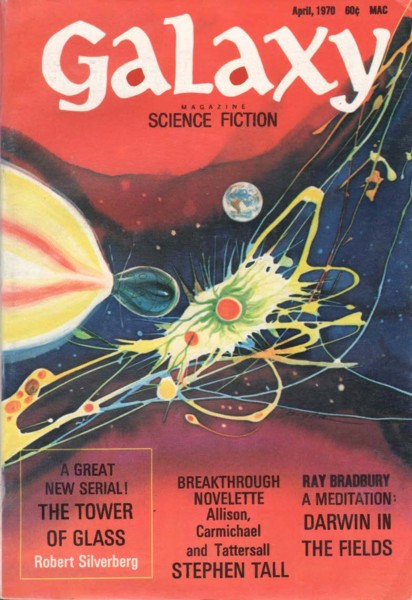
(Cover by Jack Gaughan. Galaxy, April 1970.) Who Goes There?
It’s hard to introduce Robert Silverberg for the simple reason that there’s so much that can be said and we have only so much time. Silverberg has been a staple of SF fandom for the past seven decades; he was writing letters to the magazines when he was a teenager and he has attended every Hugo ceremony since the inaugural one in 1953. While he announced his retirement from writing fiction back in 2015, he continues to be an active in other ways, and indeed his fiction alone would mark him as one of the field’s most prolific voices. Silverberg started as a startlingly productive, if also generally unexceptional, writer in the ’50s before taking a few years off and returning markedly improved. As both an author and editor (his original anthology series New Dimensions was a big deal in the ’70s) he helped usher in the New Wave, championing daring writers like Ursula K. Le Guin and James Tiptree, Jr. Whereas a lot of great writers start resting on their laurels by the time they turn, say, forty, Silverberg continued to produce some great fiction and commentary well into the ’80s, a period which hosts some of my favorite works of his.
The Tower of Glass (I don’t know why they got rid of the definite article for the book publication) came out during a particularly hot time for Silverberg, who was literally getting Nebula nominations (invluding four wins!) every year from 1968 to 1973 across multiple categories. The Tower of Glass itself was a Hugo and Nebula nominee, losing both to Larry Niven’s Ringworld. I’ve read Dying Inside, which is one of my favorite SF novels as of late, and The Man in the Maze, which I liked well enough, so I’m curious if The Tower of Glass will be another certified banger or if it’s “just” good.
Placing Coordinates
Part 1 was published in the April 1970 issue of Galaxy Science Fiction, which is on the Archive. You’d think getting Hugo and Nebula nominations would give The Tower of Glass more time on bookstore shelves, but you’d be mistaken. If you wanna read the book version then you’re probably best off finding a used copy online, since Silverberg paperbacks are cheap and conversely really hard to find in bookstores. Silverberg took a few hiatuses throughout his career, on at least one occasion because his disillusioned with the SF market and the fact that his books kept falling out of print, and it’s not hard to see why he’d feel that way. You could get an ebook version, but it’s from Open Road Media (cursed be their name) so I’d prefert not to; the good news is that we did recently get a paperback edition, this one from ReAnimus Press. But still, finding new editions of Silverberg’s novels is not the best time in the world.
Enhancing Image
Simeon Krug (what a name) is an aging entrepreneur, the patriarch of an empire, and perhaps the single most important human currently living. Krug’s current top-priority project is a glass tower being constructed in the Canadian tundra, considered the closest to an ideal location for what would be the most advanced communication tower on the planet despite the harsh weather. Much like the ancient pyramids, the glass tower is being built by hundreds of workers, living off next to nothing, but whereas the pharaohs would have used slave labor, Krug uses a somewhat different method: androids of his own design.
The world of The Glass Tower is one in which humanoid life is split into three castes: the natural born, i.e., those just like us, then there’s the ectogenes, essentially test tube babies, people who are still biologically human but who were grown outside of the uterus, and then there are the androids, the synthetic humanoids. The androids themselves are split into three groups, those being the alphas, betas, and gammas, with the alphas being the most intelligent, most privileged, and rarest of the lot. An alpha android would serve as Krug’s second in command, and indeed we get that with Thor Watchman (what a name), an alpha who oversees the construction of the glass tower and who, we’ll come to find, may be the enigmatic member of the cast thus far.
The third point of the triangle, as far as the POV characters are concerned, is Manuel Krug, Simeon’s son, a married man who regardless is treated as a playboy and a layabout, but who nonetheless is the heir to the Krug name. We don’t get much from Manuel early on, but in the spoilers section I’ll get to his side of the story. Part 1 is a revolving door of perspectives, broken up into subplots going from Simeon to Watchman to Manuel, a revolving door which does not exactly move the “plot” forward but which does, with each successive point of view, add a great deal to both the character-centered drama slowly developing and especially the world in which these characters live. While we don’t get ray guns and flying cars, we do get some profound differences between our world and the world of the novel, not the least of these being teleportation which has rendered borders all but obsolete, not to mention the creation of a race of humanoids who are physically stronger than humans on average and who will work for super-cheap.
The androids are a whole can of worms, so I’ll wait a bit to get into them and how they see Krug, their creator, because it’s… well, it sure is something.
Silverberg seems to understand that the characters and what they mean to each other are more important than plot beats, since we come to find that at least on the face of it, not much happens in The Tower of Glass. What keeps us guessing, and keeps us reading, is Silverberg’s character work, which is mostly thorough and inventive, and for our convenience we even get what amounts to a roll call of supporting characters, some of whom are not important in Part 1 but who may figure into events later on.
Clissa, the wife of Manuel Krug,
Quenelle, a woman younger than Manuel, who is his father’s current companion.
Leon Spaulding, Krug’s private secretary, an ectogene.
Niccolo Vargas, at whose observatory in Antarctica the first faint signals from an extrasolar civilization were detected.
Justin Maledetlo, the architect of Krug’s tower.
Senator Henry Fearon of Wyoming, a leading Witherer.
Thomas Buckleman of the Chase/Krug banking group.
A Witherer, for your information, is someone in favor of the dissolving of government; I feel like there’s another word we’d use to describe that political view, but hell, let Silverberg have his fictional political parties. It’s not a totally irrational view either, since teleportation (the use of “transmats”) makes it all too easy to travel between countries, and what good are governments if the very borders of these countries are undermined to the point of being ignored?
And yes, the transmat works much the same way as a teleporter in Star Trek: you get ripped apart on one end and then put back together on the other. You die and then are reborn every time. “The transmat field ripped a man’s body into subatomic units so swiftly that no neural system could possibly register the pain and the restoration to life came with equal speed.” I never cease to find this method of teleportation amusing.
The tachyon particle had been “invented” only a couple years prior to the writing of the novel, and you can tell Silverberg (no doubt he was far from the only SF writer who did this) was eager to jump on this newfangled toy, as the glass tower is set to use a tachyon beam which will reach out into space farther and faster than any previous communication device. SF writers are always keeping an eye out for new inventions, discoveries, and trends in the realm of science. Think about all those stories from the ’70s that treat black holes like they’re the latest big-budget video game release. The technology plays a distant second to the religious and personal implications of the glass tower, however, as Krug and his team of astronomers (there is seemingly no one Krug cannot buy) are dead set on making contact with what is apparently a distant planet—a planet which, given its circumstances, is highly unlikely to support life, and yet the team had gotten a signal from that planet which implies a fellow sentient race in the universe.
Simeon Krug is your typical Silverberg protagonist to an extent in that he’s balding, he feels old regardless of his objective age, he’s highly intelligent yet deeply melancholy, something of a male chauvinist, and rather inexplicably he has no issue with picking up the ladies. This is not as much of a criticism as it sounds; if Silverberg’s protagonists are modeled after himself to some degree or other, which happens often enough, then they’re not flattering self-portraits except for the conspicuous gets-with-the-ladies angle (which is certainly worthy of criticism). Authors like to project at least a little bit of themselves into their characters, especially their leads, and if Silverberg gets away with projecting himself repeatedly like this it’s because the projections are so earnest and the emotions ring so true.
While Simeon reaches out for the unreachable in what feels like a religious voyage, however, Thor Watchman and his android fellows are already having their own religious experiences…
There Be Spoilers Here
When we get to Watchman’s subplot it’s easy to think that despite his outward loyalty to Krug, Watchman is secretly conspiring with those who want total equality for androids; actually the opposite turns out to be true, in that he might be a little too loyal to Krug. He’s against emancipation for androids basically on religious grounds, because the androids (not all, but apparently a lot of them) quite literally treat Krug as a godlike figure. In a way this makes sense, considering Krug invented the androids and oversees the factories that make them, which is certainly a science-fictional difference androids have from real-world slaves. The fervor of it is creepy on its own, but the notion that Watchman and likeminded androids are happy as slaves is even creepier, not, I suspect, that Silverberg thinks androids, should they come about in the real world someday, are fit to be manual laborers for life. I will say, however, that had this been written by Isaac Asimov we would probably get a different angle on the Krug worship thing.
The Tower of Glass is set a few hundred years from now, and the world has changed quite a bit—not entirely for the better. Actually it’s kind of a Darwinian nightmare, and even Silverberg’s narration calls it Darwinian at one point, leading me to believe we’re not supposed to see this future world as something to aspire to; this is a good thing, because hoo boy. The introduction of a race of advanced yet obedient workers who can be built and made to work for cheap has resulted in the obliteration of the working class, both in cheap human labor being made obsolete and also the physical population being dwindled. You might be thinking, “Well, maybe working class people reproduce less on account of the need for cheap labor being lowered.” There’s that, but there’s also some top-down eugenics (a form akin to China’s one-child policy) involved, which gives me the heebie jeebies.
The human population has slowed in its growth to such an extent that it has actually gone down worldwide, which I suppose is more believable than the population reaching, say, twenty billion in two centuries. Overpopulation is thus not a concern. We actually do see such population dwindling in certain parts of our world, which Silverberg posits could happen on a worldwide scale should advanced machinery replace human labor; not saying it’s a correct “prediction,” but it’s logical enough. The real point of conflict in-story, then, is whether androids should be considered people with all the human rights involved. Manuel and Clissa are in favor of android emanicpation, although only the latter is outspoken about this and the two for some reason do not bond over this shared sympathy. Of course this could be because Manuel has an ulterior motive for wanting androids to be recognized as on par with humans: he beds one on the side.
The back end of Part 1 focuses on Manuel and his conflicting emotions regarding androids, along with his position as the man who will run his old man’s company someday—a position he doesn’t want. A tour of an android factory, seeing first-hand how the sausage is made so to speak, sends Manuel into an existential crisis, not least because he is quite passionate about Lilith, an adroid who, like Thor Watchman, is an alpha. (Yes I get that she’s called Lilith, how very clever, Mr. Silverberg.) Manuel loves Lilith more than Clissa but after the factory tour cannot get over the fact that Lilith, despite her personality and intelligence, is made of synthetic materials. Ironically Lilith comes off as more “human” than Clissa, despite the latter being perfectly sympathetic, on account of Lilith being characterized more vividly, and I’m actually looking forward to the inevitable drama with this love triangle. We get hints of a showdown but Silverberg is keeping things only fizzling with a sure hand, and I mean that in a good way.
A Step Farther Out
The first installment of The Tower of Glass is a curious one for sure, not least because, unlike a lot of serial installments, it doesn’t end on a cliffhanger or a point of peril for the characters. So far the plot has actually been kind of lax, but what’s interesting is that I very much look forward to what happens in the next installment, despite the relaxed pacing so far. Silverberg weaves a few subplots together here, and fittingly he also crams in a good deal of worldbuilding and thematic juiciness so that there is always something to read into, even when nothing “important” is happening on the page. We have what is ostensibly a religious narrative in which someone likens himself to God, or at least a prophet, and this person is trying to make contact with what might be sentient life from a distant planet. We also get a caste system, racism, loneliness, yearning, and other things typical of Silverberg from his late ’60s to early ’70s period. Silverberg repeats himself a bit with these elements, yes, but The Tower of Glass, like his best work from this period, is all but unmatched in its ambition and intensity.
Of course we do have a caveat or two. If you’re expecting well-drawn female characters then you’ll probably be disappointed. Lilith comes close, and in the rest of the novel we might come to understand her more, but right now none of the (admittedly few) women featured are as psychologically realized as their male counterparts. Not that I should have to remind you that an old-timey SF story from more than half a century ago is not great with female representation, but it’s frustrating with Silverberg especially because he knows better—it’s just that for some reason, at this relatively early point in his career, he chose not to. A small price unless that sort of thing really bothers you, I just wanted to point that out, because otherwise this installment gets high marks from me.
See you next time.
-
Short Story Review: “The Perfect Match” by Ken Liu

(Cover by Luis Lasahido. Lightspeed, December 2012.) Who Goes There?
The 2010s was the decade that Chinese SFF, which had been quite active in its native country for some years, broke into the Anglosphere unequivocally and irreversibly, and while such a phenomenon is complex, necessitating the actions of many talented people, perhaps no individual marked this shift more than Ken Liu. As an author, translator, and editor, Liu has marked the point where Chinese and American SFF meet, in his own fiction and in his efforts to bring Chinese authors (most famously Cixin Liu) to the English reading public. For better or worse, he’s by far the leading ambassador for a whole generation of authors, the result being that the formidable quality of his own fiction can get overshadowed. Liu himself won back-to-back Hugos for his short stories “The Paper Menagerie” and “Mono no Aware,” both about transplanted Asian protagonists (Chinese and Japanese, respectively) who must contend with their heritage. Despite the intensity of some of his fiction, it’s never less than humane, with Liu curiously managing to combine tenderness with a confrontational focus of vision.
On top of being one of the best short story writers of the current era, Liu was, at least up until a few years ago, one of the most prolific. From 2010 to about 2015 (incidentally when his debut novel, The Way of Kings, was published) he wrote what must’ve been at least a dozen short stories and novellas a year, with some of these even getting adapted. His short story “Good Hunting” was adapted into one of the better Love, Death & Robots episodes while a connected series of short stories served as the basis for the animated series Pantheon. His most recent novel, Speaking Bones, the latest in the increasingly epic (and long) Dandelion Dynasty series, came out in 2022 from Saga Press.
Placing Coordinates
“The Perfect Match” was published in the December 2012 issue of Lightspeed, and you can read it online for free here. The bad news is that this story has only been reprinted in English twice; the good news is that they’re both pretty easy to find new copies of. First we have the Liu collection The Paper Menagerie and Other Stories, which I have proudly on my shelf and which I would say is essential for anyone wanting to catch up on one of the masters of “modern” SFF. The second is the anthology Brave New Worlds, edited by John Joseph Adams, although I have to warn you that there are two editions of this book and the first does not include “The Perfect Match,” with Liu’s story apparently being added at the last minute to the second. Given that Brave New Worlds is about dystopian SF, it doesn’t take a rocket scientist to figure out what we’ll be dealing with here…
Enhancing Image
Sai is a pretty average dude who works a job he likes enough and who, while currently single, got out of an amicable relationship and is ready to get back on that horse—all too easy to do, given that his AI helper, Tilly, is able to match him with any woman whose interests most closely match his own. Tilly is like Alexa if Alexa was also a dating app that didn’t suck. Make no mistake, though, Tilly is not a character; she’s only slightly more advanced than the “AIs” we currently have, in that she’s not actually sentient, but rather an extension of a program. Like Alexa, or hell, Joy from Blade Runner 2049, her seeming femininity is meant to be a cushion, because unconsciously we want a motherly figure who cares for us and yet who does not need or want to be intimate with us.
I’m saying all this up front because both the title and the opening section of the story make it sound like it’s about romance, which it really isn’t. A shame too, because once I realized where the plot was heading I became somewhat less interested, if only because on paper you’ve seen this story literally a hundred times before if you’re a genre veteran. Anyway, Tilly recommends Sai this woman, name not important, who sounds like a great match for him, except their date doesn’t go so perfectly—not because of the woman, but because recently Sai has been having some intrusive thoughts. It has to do with Jenny, his paranoid neighbor whom he doesn’t see much and who comes off as a neo-Luddite, yet there’s something alluring about her. What’s her deal? Not that it takes too long for him to find out.
Talking to Jenny was like talking to one of his grandmother’s friends who refused to use Centillion email or get a ShareAll account because they were afraid of having “the computer” know “all their business”—except that as far as he could tell, Jenny was his age. She had grown up a digital native, but somehow had missed the ethos of sharing.
This may sound familiar. You have the male protagonist who starts out a sleeper in a world he thinks to be swell but is actually shit, only to have the sleeper awoken by a rebellious woman; for some reason it’s always this dynamic, with a man being driven to rebellion via awakening, both having his eyes opened metaphorically to the world around him but also often being awakened sexually. If you’ve read George Orwell’s 1984 or Yevgeny Zamyatin’s We then you know how this will play out generally (although for the sake of the rest of us I’ll save the later plot developments for spoilers), and even more so if you’ve read the seemingly endless supply of dystopian fiction inspired by those novels. Sai and Jenny are based on archetypes, and for all his narrative craftsmanship (the story moves along at a brisk but natural pace), Liu does little to subvert those archetypes.
Can we talk about how 1984 totally FUCKED UP the very idea of writing dystopian SF? Not that it was Orwell’s fault, he was simply reacting to what was then a rising approval of Stalinism among the Western left, seeing authoritarian socialism as no better than capitalism and possibly in some ways being even worse. The problem is that the characters, plot beats, and overall message of 1984, when not misunderstood (which they often are, most conspicuously by right-wingers), have become so diluted that the novel doesn’t even read like a novel anymore so much as a blueprint for writing baby’s first dystopian narrative. Every other male lead is an analogue for Winston, every other rebellious female love interest is an analogue for Julia, and O’Brien… well, we’ll get to O’Brien later, because he also sort of gets an analogue in “The Perfect Match.”
When Sai meets Jenny again, post-date, something has changed for Sai and by extension the two of them. As I’ve said Jenny is the rebellious woman, and detecting this change in Sai she invites him inside. How did she figure this change? Because Sai got home off-schedule, for the first time ever; he has a rigid routine and thanks to Tilly he’s constantly reminded to keep to that routine. Yet his dissatisfaction with the date has led him home off-schedule, and so Jenny wonders if maybe she can recruit him for a scheme she has in mind. The thing is that while Sai has begun questioning his life a bit, he’s still of the conviction that the corporate-run future of his world is benevolent, that Tilly has his best interests at heart, that he’s a free individual despite his lack of personality.
Jenny has some words about that.
“Look at you. You’ve agreed to have cameras observe your every move, to have every thought, word, interaction recorded in some distant data center so that algorithms could be run over them, mining them for data that marketers pay for.
“Now you’ve got nothing left that’s private, nothing that’s yours and yours alone. Centillion owns all of you. You don’t even know who you are any more. You buy what Centillion wants you to buy; you read what Centillion suggests you read; you date who Centillion thinks you should date. But are you really happy?”
Prior to the story’s beginning Sai was presumably content, but he was probably never happy and he certainly was never free. I don’t know if this Ken Liu’s actual worldview, but I suspect he’s of the opinion that conflict is necessary for happiness. Sai faced basically no conflict prior to the story and thus he was deprived of happiness, but interestingly, once conflict enters his life, his range of emotions is widened, his horizons expanded. Once he ditches the notion of perfection and living a totally peaceful (i.e., boring) life he starts to feel things, which like anything transformative can be traumatizing but also a positive force ultimately. Sai’s budding relationship with Jenny (see the aforementioned metaphorical and sexual awakening) is just a bonus, and not really a convincing one. Liu has written romance well elsewhere, but in “The Perfect Match” it’s done because other dystopian narratives have done it and also because it moves the plot along.
This may sound vaguely militaristic, but conflict builds character. The conflict doesn’t have to be violent or earth-shattering, mind you, it can be as banal as deciding whether to order an Uber or to call a friend who lives nearby. A character’s capacity to make decisions (and this applies to both fictional characters and real people) is what makes that character, which admittedly is why I feel Jenny is more of a plot device than a real person; she does everything we think she’s going to do and she doesn’t go off her own script, never mind the dystopian SF cliches she tosses at Sai. But Sai, on the other hand, contradicts himself and prevents himself from being totally consistent, which, aside from him being the POV character, makes him feel more flesh-and-blood, never more shown than in the climax.
There Be Spoilers Here
Jenny has this hacking scheme wherein Sai, who’s already a corporate worker, sneaks in a virus that will basically fry Tilly by corrupting her with false data. Not that the world would be saved all of a sudden, but it would be a good start. Sai had turned off his phone when he first met up with Jenny and from then on the two made sure there was no way for Centillion (the company behind Tilly) to spy on them. At first the hacking seems to have worked! Only for, you guessed it, Sai and Tilly to be placed under arrest and shown to Christian Rinn, the big cheese at Centillion himself. I had legitimately forgotten this dude’s name and I didn’t put it down in my notes; his name really is not important.
What’s important is that Rinn is this story’s version of O’Brien, except he had no pretense of being a rebel, just somebody who waited off-screen for Our Heroes™ to make their move. Thinking about it, Rinn first slightly more into the same category as Mustapha Mond from Brave New World (if you remember that guy), who lectures John Savage and friends in that novel’s climax about why the world as they know it works the way it does and why an authoritarian like Mond is totally in the right. Rinn’s justification for Centillion tech monopoly is basically that it was inevitable—not because of how technology is advancing or because people want to feel “safe,” but because technology serves to make people’s lives more convenient. People want as much convenience as possible and companies like Centillion are only too happy to oblige.
In fairness to Rinn, he is objectively correct. How do you undo this? How would you turn back the clock on how technology figures into our lives? It’s not like you can nuke civilization back to the dark ages, that would be comically evil and also wildly impractical. Liu seems to be making the argument that while progress as seen in-story is not exactly “good,” it is progress, and progress will not be defied. There is no feasible way, especially for two people, to take down a whole system like this. This shouldn’t come as a surprise, but how did Centillion even find out about the hack? By tracking Sai’s phone. And they were not even unaware of Jenny’s doings. The hacking was never gonna work, although I just assumed that would be the case anyway. Because we can’t have happy endings with this sort of thing, right?
Well, it’s not all bad. Whereas Winston Smith and John Savage awaken to the hell they live in and get completely fucking destroyed for their troubles, Sai comes out of the deal unharmed—not just physically but also he’s about as psychologically adept as he’s ever been. While Sai and Jenny are all but blackmailed into working for Centillion at the end, the fire of rebellion has clearly not gone out in Sai’s heart, and his traumatic awakening has made him into more of an individual. You might be able to defeat the system, sure, but you as a free-thinking person can resist it…
A Step Farther Out
A little mini-rant for my final thoughts. A common misconception about SF, which has been around for decades and which persists in a lot of modern discourse (more so for people outside of fandom), is that SF works to predict the future. This is very obviously bullshit. Like SF so clearly is not predictive that it’s laughable, and true enough we often poke fun at old-timey SF wherein the “predictions” were dead wrong. No, we did not get fully functioning androids by 2019 a la Blade Runner, although Los Angeles certainly became more of a smog-covered shithole by that point. No, we did not get immense overpopulation and death of the oceans by 2022 like in Soylent Green. Whenever an SF writer puts out a future date it’s basically a placeholder, to let us know that the action is happening in the future and not in our present; it’s not supposed to be the author’s actual prediction of what things will be like by a given year.
Liu wisely refrains from putting a date on “The Perfect Match,” which after all is a future society that basically doesn’t seem all that futuristic. There isn’t anything totally out there in terms of technology being showcased here; everything we read about in-story is feasible, indeed (Liu would argue) it’s likely to be realized. When an SF story is called “prescient” or “ahead of its time,” this is just a little bit insulting to the author, even if it feels true to us. Don’t worry, I’ve done it many times myself. So if someone were to remark about this story, “Wow, Ken Liu was being prescient with this one,” they’re making the incorrect assumption that Liu in 2012 was predicting what have by now become the clear dangers of technocracy, as opposed to extrapolating on what he sensed was a growing trend at the time. “Extrapolation” is maybe the biggest key word to understanding SF.
“The Perfect Match” is somewhat derivative, but it certainly feels modern in its concerns, which sounds lame considering 2012 was not that long ago, but for all of us a great deal has changed since that time. Hell, I was in high school in 2012, a portion of my life that now feels totally alien to me. And while the ending isn’t a happy one, it leaves room for hope on the micro scale, if not the macro one, which for a dystopian narrative is good enough.
See you next time.
-
Things Beyond: January 2023

(Cover by Doug Beekman. Analog, December 1983.) Pop that champagne because IT’S THE NEW YEAR, BABY! WOOOO! 2023 LET’S FUCKING GO! Not that I expect this to be a better year than last (mind you that 2022 was mostly pretty good for me), but there’s always something a little exciting and yet anxiety-inducing about turning over to a new year. It implies change, which is often scary. Last month I spent the whole time reviewing fiction by Fritz Leiber, one of the best to ever do it, and while it was nice to pay such a tribute, it also became exhausting. I missed the sheer variety of discovering new voices and returning to some old favorites. We actually don’t have any such favorites this month, although we do have a couple authors I’ve grown fond of in the past year or two.
Most importantly, this is the time for me to correct some mistake. For example, I’ve never read even a single word of N. K. Jemisin’s fiction, despite her impressively high status. I know, I suck for that. The thing is that Jemisin is one of those authors who likes to focus on series, and I have commitment issues; she also hasn’t appeared in the magazines too often, but I did manage to snag an early story of hers that caught my attention. We also have a short story by Hao Jingfang that I technically must’ve read, due to its inclusion in a certain anthology, but which I literally have no recollection of. Speaking of rereads and stories I don’t remember reading even though I must have, we have what is perhaps Timothy Zahn’s most famous short work—not saying much considering how his contributions to Star Wars have utterly dwarfed the rest of his output.
And of course, any reason to read more Ken Liu is a good reason.
For the serials:
- The Tower of Glass by Robert Silverberg. Published in Galaxy Science Fiction, April to June 1970. Hugo and Nebula nominee for Best Novel. I don’t know why they got rid of the definite article for the book version. With Silverberg you could basically throw a dart as his stuff published between 1967 and 1972 and land on a classic, and I’d be surprised if The Tower of Glass isn’t one of those. Incidentally Silverberg turns 88 this month, and unless he pulls a Betty White we’ll be celebrating his birthday, for a man who’s been in the game seven goddamn decades.
- The People of the Black Circle by Robert E. Howard. Published in Weird Tales, September to November 1934. Howard, unlike Silverberg, sadly did not live so long; in fact he killed himself when he was only a few years older than me. But Howard wrote a truly frightening amount in his short time, and The People of the Black Circle is one of the longest “official” entries in the Conan series. That’s right, we’ll be reading some Conan the Cimmerian! Not the first hero of sword and sorcery, or even the first created by Howard, but Conan is the great codifier.
For the novellas:
- “Hardfought” by Greg Bear. Published in the February 1983 issue of Asimov’s Science Fiction. Yeah, I know, the timing of it. Never mind that Bear sadly passed away back in November, I’d actually been meaning to read his Nebula-winning novella “Hardfought” for a minute. I’ll even be reviewing another Bear story next month, just not on my own; that’ll be his Hugo- and Nebula-winning short story “Blood Music” (from the same year!) as part of Young People Read Old SFF.
- “Cascade Point” by Timothy Zahn. Published in the December 1983 issue of Analog Science Fiction. So this won the Hugo for Best Novella of 1983 while Bear’s “Hardfought” won the Nebula, and the two have even been bundled together as a Tor double. Why not? I’ve also been meaning to return to this one since I admit when I read “Cascade Point” I didn’t retain much from it, which could mean the story is mid or it could mean I didn’t give it the proper amount of attention. We’ll see…
For the short stories:
- “The Perfect Match” by Ken Liu. Published in the December 2012 issue of Lightspeed. Liu’s fiction is so humane, his prose is so elegant, and while he doesn’t write short stories as often as he used to (he went from being insanely prolific to be “only” moderately prolific), he’s now a bestselling and beloved novelist. His short story “Good Hunting” got adapted for one of the best Love, Death & Robots episodes and his fiction has served as the basis for the series Pantheon.
- “Non-Zero Probabilities” by N. K. Jemisin. Published in the September 2009 issue of Clarkesworld. Hugo and Nebula nominee for Best Short Story. Jemisin has the unique honor of being the only author thus far to win the Hugo for Best Novel three years in a row with her Broken Earth trilogy. Her standing has only escalated in the past decade and she rivals Ken Liu as a generation-defining author. I’ve never read any Jemisin past some of her blog. Heresy, I know, but we’re about to fix that!
- “Folding Beijing” by Hao Jingfang. Published in the January-February 2015 issue of Uncanny Magazine. Hugo winner for Best Novelette. I know I must’ve read this before, as part of Invisible Planets (courtsey of Ken Liu), but I literally remember nothing about it. Let’s see if the forgetfulness was warranted. Also has the honor of being the first reprint to be covered on my blog, on account of it first being published in Chinese, but we’ll be looking at its first English publication.
I’m not in favor of quotas, generally speaking; they make me feel bad. I feel like I shouldn’t be obligated to cover this much material by these demographics in a year, but at the same time the name of the game is to discover potential gold, both old and new, from many different walks of life. So I’m not including Liu, Jemisin, and Jingfang for the sake of imaginary brownie points—I’m doing it because I feel I owe it to myself to broaden my horizons and not only explore works by someone I already like (Liu) but to discover a new potential favorite (Jemisin). SFF, being speculative by its nature, should be about venturing out to new territories and sailing through uncharted waters. You can’t hang on to the past forever.
We have a diverse set of authors here, though. We have some sword and sorcery with Howard, some New Wave SF with Silverberg, some classic hard SF with Bear and Zahn, and voices from the current generation with the short stories. I’m looking forward to it.
Won’t you read with me?
-
Complete Novel Review: You’re All Alone by Fritz Leiber

(Cover by Robert Gibson Jones. Fantastic Adventures, July 1950.) Who Goes There?
This is it. The last Fritz Leiber review I’ll be writing for a long while. I’m about tuckered out at this point, but thankfully we’re ending this month on somewhat of a high note. I like Leiber quite a bit, and his range is impressive, but even with that said, this is not the sort of thing I’d normally do with an author. I’m not even sure I’ll do it again, ever, but it’s been a neat experiment! Most importantly, going through so many of his works in such a span of time has made me appreciate Leiber’s versatility more, the things that make him tick, as well as become more aware of his few limitations. That Leiber continued to produce great work for so long, despite some obstacles, is a testament to his skill and especially his creative restlessness. Despite debuting in 1939, alongside Isaac Asimov and Robert Heinlein, Leiber did three decades later what those peers of his could not: remain contemporary. His longevity and his versatility across several genres are remarkable, and much of his material still reads as perfectly modern.
You’re All Alone was part of a big revival for Leiber, having reinvigorated himself around 1950 after half a decade of low productivity and struggling to publish what little he wrote. Despite being published around the same time as SF classics like “Coming Attraction” and “A Pail of Air,” though, You’re All Alone‘s origins go back much farther, with themes and a tone that fall much more in line with Leiber’s horror fiction from the early ’40s. ISFDB provides an unusually lengthy note on the short novel’s gestation, but beware that this is a secondary source and the couple of typos left in tell me it’s not as thoroughly edited an entry as it should be. Basically, Leiber started working on You’re All Alone in 1943, right after finishing Conjure Wife and Gather, Darkness!, with the intention of submitting it to Unknown. Unfortunately, Unknown kicked the bucket midway through the year and Leiber was left without a suitable market for his fantasy-horror tale. It wasn’t until Fantastic Adventures, under the new editorship of Howard Brown (who also took over Amazing Stories), became a more prominent fantasy outlet in 1950 that Leiber’s novel would see publication.
Now, there are two versions of this novel: there’s the shorter magazine version under the title of You’re All Alone, and then there’s the longer book version titled The Sinful Ones (what a trashy, inferior title). The latter was initially published in 1953 with changes were made without Leiber’s consent, and it was “spiced up” considering books had looser censorship standards than the magazines. This strikes me as funny because the magazine version is already lurid enough, for reasons I’ll get into, and that while I haven’t read The Sinful Ones yet I feel like teetering more on the eroticism would simply be too much. Clocking in at 40,000 words (according to the contents page, and I can believe that estimate), You’re All Alone is too long to be considered a typical SFF novella (normally we’d be talking 20,000 to 30,000 words), and thus I’m reviewing it as a “complete novel,” even though it’s technically an abridged text.
Placing Coordinates
First published in the July 1950 issue of Fantastic Adventures, which is on the Archive. Pretty striking cover, huh? It does a good job of letting you in on this being a little horrifying, a little paranoid, but also, judging from the woman’s torn clothing, a little sexually charged as well. Oh, there’s a dog in the novel, and it’s big and ruthless enough to rip out a man’s throat, but it’s not nearly that big. Unusually for a complete novel, You’re All Alone saw magazine publication more than once, appearing again in the November 1966 issue of Fantastic, which you can also find here. It’s been reprinted in both its magazine form and as The Sinful Ones, which can get confusing; there’s a paperback of The Sinful Ones from Wildside Press, and there’s a combo paperback with You’re All Alone and C. G. Gilford’s The Liquid Man, also a Fantastic Adventures complete novel. Your best bet is to just bite the bullet and read it online, since neither version has been published often, and unfortunately even the shorter version is too long to be anthologized.
Enhancing Image
Carr Mackay is just your average thirty-something in a lot of ways. He’s got a nice job at a Chicago employment office, he’s attractive enough but not model material, he has a sexy if also demanding girlfriend, and he doesn’t have any major hangups to speak of. Unfortunately for Carr, whose life prior to the story’s beginning seemed to be simple, he’s about to get a real kick in the pants in the form of a girl (said to be college age, don’t think about it too hard) who will both make and break his world. What follows is a trip into a nightmare world, a novel-length chase sequence, and perhaps most perplexing of all, a bit of a love story.
We meet Jane, who comes in presumably for job opportunities but who, judging from her nervous demeanor, is here for something else. She notices something off about Carr, but she won’t say what it is, at least not in public. Carr himself notices that a tall blonde woman is spying on both of them, or at least that’s what it looks like. Jane tells Carr to act like everything’s normal, but she’s not doing a good job at such an act and all of this is confusing for Carr, who is now finding out that there’s somsrthing “different” with him, something which separates him from everyone else. When Jane leaves, the tall blonde, apropos of nothing, slaps her, but Jane does not react; she doesn’t so much as flinch, just ignoring the slap and walking out. Do the two know each other? How come nobody in the office reacted to this? The opening scene is uncanny, and it’s also from this early point that Leiber injects a bit of social commentary into the equation.
No one said anything, no one did anything, no one even looked up, at least not obviously, though everyone in the office must have heard the slap if they hadn’t seen it. But with the universal middle-class reluctance, Carr thought, to recognize that nasty things happened in the worlds they pretended not to notice.
You’re All Alone is a Chicago narrative through and through, and it’s pretty far from a flattering depiction of the city. Of course, this could be just about any city. For such an urbanite, Leiber consistently made out cityscapes to be nightmarish, oppressive, artless, unappealing, specifically in his horror fiction. While it was published years afterward, You’re All Alone has more in common with his early stories “Smoke Ghost” and “The Hound” (see my review of the latter here) than with other works of his published during that time. There is no science-fictional basis for what happens to Carr; he, the average guy, is plopped by the hand of God from “our” world into something else entirely, as if someone had flipped a switch in the universe. One second his girlfriend Marcia and his coworker Tom act like their usual selves and the next they start acting strange, like they too had been suddenly put into a different universe, only they act unaware of it.
One moment everything’s normal, the next it’s all backwards. That’s what falling in love is like, you know, only here it’s a bit more foreboding. Who can he trust? He supposes it would have to be Jane, but she hesitates to explain herself, only to say that she and Carr ought to trust each other, that the people Carr knows are not entirely who they seem to be, and that the tall blonde is someone to be avoided at all costs. This would be sort of a demented meet cute if not for the fact that Carr is already taken, though he won’t be like that for long. First Tom introduces him to someone who does not exist (possiblly Jane is supposed to be in that place, but Tom is talking to thin air), and later when Carr meets up with Marcia she talks to him, but not quite. Again Marcia is talking to thin air, but it’s like she’s talking to a Carr who is not where she thinks he is, like Carr has gone invisible and there’s another alternate version of him that’s supposed to be in his place.
What the hell’s going on here? Carr has his theories, as to why people he knows are suddenly ignoring him or acting like he’s somewhere he’s not, as to why Jane has singled him out. And surprisingly, in the midst of his theorizing, he more or less figures out what the deal is, although it’s hard to explain, all the more so because there’s no why given. Basically, Tom and Marcia and the others are not the people who are acting weird, but in fact it’s Carr and Jane (along with the tall blonde) who are acting out of order. The tall blonde is named Hackman, and she’s part of a trio of people who, like Carr and Jane, have stepped out of the “normal” world and entered a level of existence where normal people can’t touch them.
The “normal” world of You’re All Alone is predetermined, with everything on a set path, with an unwritten script that everyone is supposed to follow. The people of this world may look alive, but they’re basically robots (not literally but metaphorically) who exist to serve what is predetermined. There are, however, exceptions… people who have broken from the script, who have become truly alive in the sense that they’re able to think and make decisions that go against the greater reality. The weird part is that the robots don’t react to when the “free” people break from the script; they just keep going like nothing has changed, reacting to the ghosts of the people they assume to be following along. The result is that the “free” people are free to do whatever they want, albeit they have to contend with other people who have gone off-script, some of which I’ll get into in the spoilers section.

(Interior illustration by Henry Sharp.) The question is, how do you inject physical conflict into a story where the leads are unable to be hurt by 99.9% of people in the world? Well, suppose you had a secret, and a possibly dangerous one at that; then suppose there was a small group of people that knew this secret of yours, and conversely you would know their secret. You would become secret sharers, which means you could form a bond over your shared knowledge, or…
Carr and Janes are faced with danger from more than one direction. On the one end you have the trio of Hackman, Wilson, and Dris, plus their dog (yes, the dog on the cover and in the interior art, although it’s nowhere near that size) and on the other they face an even more mysterious threat: a gang of four men in black hats, who seem to scare the aforementioned trio just as much as our leads. Then there’s a wild card in the form of Jane’s ally, or at least the closest she has to one, a fellow “free” person whose name we never learn, only described as a small man with glasses. How trustworthy is he? How do we deal with these villains? Stay tuned.
There Be Spoilers Here
This is a novel full of thrills, not just of the horror variety but also incorporating some thrills of the romantic/sexual kind. Not a surprising development, but as Carr and Jane try to evade the fiends which haunt the city streets, they also grow closer together, and the result is kind of a love story. Romance is not something often practice in old-timey SFF, and even more rarely does it work; while I wouldn’t put the romance between Carr and Jane on a Shakespearean pedestal, it’s a more earnest effort than what most authors of the time would’ve given us. The problem with writing romance in the world of old-timey SFF is that presumably there would have to be some chemistry between a male lead and a female lead, and the latter specifically is an issue because most authors were not keen on writing a female lead as more than just a satellite love interest.
Jane is not as thoroughly characterized as some later Leiber leading ladies (try saying that three times fast), but she’s certainly not a trophy with legs existing only as a reward for Carr. Unlike the average leading lady in SFF from this time, Jane also has some real baggage; her home life sucks (she has basically none to speak of, on account of going off-script), she constantly lives in fear, and she has some major trust issues—with Carr as well as the small man with the glasses. Unlike most other examples from this period, Jane is not a perfect do-gooder or a total shrew but a believably flawed person, and ultimately Carr accepts her anyway, which I think is pretty sweet. Really ahead of his time, that Leiber.
Speaking of being out of the norm, there’s this common assumption that American life in the ’50s (You’re All Alone was written in the ’40s, but you’ll get what I mean) was puritanical, basically devoid of depictions and discussions of sex outside of the bedroom. You didn’t read about it, and you didn’t watch it, and you certainly didn’t talk about it. I’m thinking of Pleasantville, which is a good movie, but it’s also often misunderstood to be a parody of ’50s American suburban life when it’s actually parodying ’50s American suburban life as depicted in ’50s American television. The truth is that people seventy years ago were about as horny then as they are now—which is to say they were pretty fucking horny, it’s just that they didn’t have as many outlets for expression. A good deal of pulp fiction illustrations from this period shows scantily clad or tastefully nude women, either in a state of distress or of joy.
Why do you think the book version of this novel is called The Sinful Ones? To make it sound more lurid for the book market, sure, but it’s also not entirely inaccurate. Carr, Jane, the small man with the glasses, and others of their kind are indeed the sinful ones, the ones who have broken from societal norms on account of breaking of the big machine, and well, if you had the ability to get away with, say, being a peeping tom without consequence, you may very well do that. A “free” person in the world of the novel wouldn’t use that ability to rob a bank or get away with murder (although the latter, as we see, is certainly an option), but rather for something even pettier: to get their rocks off. Sexuality defines so many of the motivations and actions among the characters that the novel would cease to function without it; even the “wholesome” romance between Carr and Jane is tinged strongly with sexual tension.
In one of the most memorable scenes in the novel, Carr and Jane are out on one of their “dates” and they stop at a club, except they don’t take part in Chicago’s night life so much as have their fun apart from it. At one point Jane does a strip tease for Carr where everyone can see them, except nobody notices past maybe a split-second of disruption, like a glitch in the Matrix. It’s provocative, but it also captures intimacy between lovers in a public space that I’ve rarely seen in fiction. It’s like you’re both caught in a bubble and suddenly you turn into a couple of exhibitionists. Why should you care if people watch? There really is nobody else.
Jane looked at Carr and let her slip drop. Tears stung Carr’s eyes. Her breasts seemed far more beautiful than flesh should be.
And then there was, not a reaction on the part of the crowd, but the ghost of one. A momentary silence fell on Goldie’s Casablanca. Even the fat man’s glib phrases slackened and faded, like a phonograph record running down. His pudgy hands hung between chords. While the frozen gestures and expressions of the people at the tables all hinted at words halted on the brink of utterance. And it seemed to Carr, as he stared at Jane, that heads and eyes turned toward the platform, but only sluggishly and with difficulty, as if, dead, they felt a faint, fleeting ripple of life.
And although his mind was hazy with liquor, Carr knew that Jane was showing herself to him alone, that the robot audience were like cattle who turn to look toward a sound, experience some brief sluggish glow of consciousness, and go back to their mindless cud-chewing.
The eventual two-way confrontation with Hackman, Wilson, and Dris (and let’s not forget the dog!) and the gang of four (who are implied, going by their names, to be mafia members) is also inevitable; thus I don’t feel the need to dig deep into that. I was expecting thrills and chills with You’re All Alone, a robust and fast-moving plot with Leiber’s reliable level of prose, but what I was not expecting was sheer grime and sleaziness of the setting to not only be as present as it was but also to inform the plot to such an extent. Sex and violence are like border towns in neighboring countries, techically separated but only a stone’s throw apart. Leiber knew all about sex, violence, and alienation, and he respected the audience enough to let them in on this dark knowledge. For “pulp trash” in 1950 to do this? It’s likelier than you think. In hindsight the version of You’re All Alone that we now have would probably not have gotten printed in Unknown, a magazine which for all its virtues was a “classier” and more chaste establishment.
The ending is hopeful, if also too abrupt for my tastes, yet there’s still this sense of danger lurking around every corner, as if the dog that had been stalking Carr and Jane for much the novel was only a taste of future terrors. The total lack of an epilogue (the novel ends at exactly the same time the action ends) hints at a lack of real closure. Our leads can escape normal everyday life, but they can’t escape the shadows of the city, nor can they even hope to return to normality. It’s the story of star-crossed lovers who find, for both better and worse, that they are not alone.
A Step Farther Out
Leiber wasn’t much of a novelist, despite the two Hugo wins (plus a Retro Hugo) in that category, but unlike Destiny Times Three, which was short and felt like it could’ve been longer, You’re All Alone is short and yet feels like it wouldn’t really benefit from expansion. The cast is small, the plot is simple when you get down to it, yet this baby is dripping with atmosphere; the Chicago skyline is oppressive, the alleys and clubs no refuge from the lurking terror of suffocation. I’m not surprised Leiber had started working on it in the early ’40s, since it has more in common with his horror fiction and even the moodier Fafhrd and Gray Mouser stories from that period. Leiber started out as a fantasist, but he was especially a practitioner of horror—a student of Lovecraft who quickly outpaced his teacher. You’re All Alone, published during Leiber’s return as a masterful science-fictionist, feels like the climax of his horror phase, being his last major venture in the genre for at least a decade. It might be the strongest argument for Leiber as the most important innovator in urban fantasy (and horror) in the days before Neil Gaiman, which may sound like a niche compliment, but it really isn’t.
Well, that’s it! I might do something like this again late next year, but this has been exhausting, if somewhat enlightening. Leiber is one of the few old-timey SFF authors who can be read voraciously in a variety of modes, and if there’s anything I’ve learned it’s that such a marathon is unwise for even an author as varied as him. I’ll be posting this on the last day of 2022, and if you’re reading this in the future (which yeah, 99% likelihood you will be) you’ll have at least something of an idea as to how 2023 is going. Is it better? did things somehow get worse? Regardless, I’m looking forward to getting back on a regular schedule with a roundtable of authors, jumping across decades and discovering (and rediscovering) several quite different voices. Much as I like to pay tribute to an author I respect very much, the thrill of discovery is so much greater…
See you next time.
-
Subscribe
Subscribed
Already have a WordPress.com account? Log in now.
 Science Fiction & Fantasy Remembrance