Skip to content

Science Fiction & Fantasy Remembrance

Celebrating the genre magazines, one story at a time…

  • About
  • Serial Reviews
  • Novella Reviews
  • Short Story Reviews
  • Complete Novel Reviews
  • Things Beyond
  • The Observatory
  • The Author Index
  • Novella Review: “Palely Loitering” by Christopher Priest

    April 17th, 2024
    (Cover by Ron Walotsky. F&SF, January 1979.)

    Who Goes There?

    Christopher Priest had a pretty long and dramatic career, and it pains me that (as far as I can remember) this is the first time I’ve read any of his fiction. I tried reading his novel Inverted World a couple months ago but had a false start with it; the timing wasn’t quite right. Inverted World is one of the cult classics of ’70s SF, even getting an NYRB paperback edition. (NYRB is like the Criterion Collection for book snobs, sorry but it’s true.) His novel The Prestige would be adapted for film by Christopher Nolan, which on the one hand must’ve brought some extra attention to Priest’s work but which he also didn’t seem to appreciate much—probably because Nolan told people to not read Priest’s book before watching his movie, which you have to admit is an asshole move. Speaking of assholes, I think the first time I heard of Priest was through the decades-long wait for Harlan Ellison’s The Last Dangerous Visions, the most famous SF book to never be published—until this year. I have thoughts on that. But Priest had spearheaded the controversy over Ellison seemingly refusing to finish his anthology with an essay called “The Last Deadloss Visions,” which got Priest a Hugo nomination. Incidentally, the final version of The Last Dangerous Visions had its publication announced shortly after Priest’s death. What timing, huh? I mean what are the odds J. Michael Straczynski would announce the upcoming release for TLDV one month after the death of its most ardent critic?

    Anyway, “Palely Loitering” is my first Priest story, and while I’m ultimately mixed on it, I do have to admit it’s impressive. It’s a melancholy and mind-boggling time travel coming-of-age narrative that, given Locus classified it as a novella and the Hugos classified it as a novelette, seems to be one of those borderline cases in terms of length. I wish I had an ebook copy so I could run it through a word processor. I’m gonna be a bit liberal and side with Locus; it might come out to 18,000 or 18,500 words. People at the time were certainly impressed with “Palely Loitering,” as it won the British Science Fiction Award for Best Short Fiction.

    Placing Coordinates

    First published in the January 1979 issue of The Magazine of Fantasy and Science Fiction, which is on the Archive. It would reprinted in the Priest collection An Infinite Summer, named after the story Priest had given to Ellison for The Last Dangerous Visions and then retracted. It was anthologized in The Best Science Fiction Novellas of the Year #2 (ed. Terry Carr), The Mammoth Book of Time Travel SF (ed. Mike Ashley), and As Time Goes By (ed. Hank Davis).

    Enhancing Image

    Mykle starts out as a ten-year-old boy, moody even for his age, the sole son in a well-to-do British family who sometimes wants to get away from his sisters. It’s the future, in what is called the “Neuopean” Union (Priest never explains this), and the UK seems to be stuck, or at a crossroads between different eras. “We lived in the age of starflight, but by the time I was born mankind had long lost the desire to travel in space,” Mykle tells us. A big way to pass the time is to go to Flux Channel Park, a park in the Victorian British fashion that started out as a rather quirky invention. The Park was originally a “flux-field,” built for experimental space flight, which the government decided to have converted into a tourist attraction after the last ship to be launched from the flux-field did not return after several years. The Park is basically home to a time distortion field, with the Flux Channel having three bridges, each with different time properties. One bridge acts normally, while another would send you 24 hours into the past, and the third would send you 24 hours into the future. The flux-field, the “channel” itself, is not to be played with.

    So of course Mykle jumps onto the flux-field.

    The stunt lands him not 24 hours into the future but 32 years, wherein he meets an older (although not by that much) man who helps him get back to his own time. I’m not really spoiling anything by saying this older man is a future version of Mykle, which even Mykle admits is an obvious turn of events. “Although the answer seems obvious in retrospect it was some years before I realized it,” he says. The older Mykle is, as the younger one puts it, “pompous and over-bearing,” being preoccupied with a young woman he considers to be the most beautiful in the world—so beautiful that he dares not talk to her. Listen, I think a lot of us went through “simp” phases in our youths. At the same time young Mykle isn’t wrong when he thinks his older self is being self-serious, although the Mykle now narrating (whom we can infer is much older than either past self) is more sympathetic to the young man’s plight. Something to keep in mind when reading this story is that Mykle-as-narrator is telling us about events that would’ve happened many years in the past, and that he ends up referring to multiple past selves across different points.

    “Palely Loitering” is interesting, historically, as a very telling work of ’70s British literature. Mind you that at this point, in the late ’70s, there was basically no market for short SFF to speak of in the UK; the major outlets like New Worlds and Science Fantasy had gone the way of the dodo, and while several notable SFF magazines would be born in the ’70s in the US, the same cannot be said for the UK scene. No doubt “Palely Loitering” would’ve been published in the UK first had there been a viable option, as it is quintessentially a British narrative, being obviously written in the wake of an economic recession, the waning of public interest in space flight (the last people would’ve walked on the moon about five years prior to Priest writing “Palely Loitering”), some of the worst flare-ups of violence in Ireland, and all setting the stage for the Thatcher administration which came about shortly after this story’s publication. There are scars in the British character still very much lingering from World War II three decades later. It’s little wonder then that those with enough money would try to jump into either the past or the future, and also that the fashion and manners of these people would be out of step with what we would expect from people of the future. Mykle’s own style of narrating is rather mannered, even for an Englishman—unless he were emulating the speech of an Englishman of the 1870s and not the 1970s.

    I do have a few questions regarding the logistics of the flux-field and the Park, which Priest does not answer. Mykle breaks away from his family and jumps onto the flux-field itself pretty easily, apparently without any railing or fencing to stop people from landing on it. This seems like an obvious security oversight. If touching the flux-field directly lands you at some point in the distant future, then how would you hope to get back to your time? Mykle gets lucky with help from his future self, but most people wouldn’t be so lucky. How often would this sort of thing happen? For the sake of legal drama surely it must not be a common occurrence, and yet it’s hard to imagine people not constantly going off the beaten path out of curiosity and stepping on the flux-field often, damn the consequences. Wouldn’t it also be easy to run into past and future versions of yourself, given how the bridges work? Of course, this last point plays into the story: it does make sense, to a degree, for Mykle to meet past and future versions of himself, although then one wonders why we don’t see this happen with other people in the story. The Park seems like a Jurassic Park-level disaster waiting to happen, built with what Mark E. Smith would call “the highest British attention to the wrong detail.” But then maybe its dubiousness is also part of the point.

    Of course, any story involving time travel will inevitably become a heady matter, what with how the rules of the story’s interpretation of time travel work. Sometimes meeting a different version of yourself would cause a time paradox and make the universe reset itself, or something like that, but time paradoxes are obviously common in the world of “Palely Loitering”—possibly even encouraged by the builders of the Flux Channel Park. Mykle’s chance meeting with the young-adult version of himself and seeing the woman (named Estyll) the latter is obsessed with plants a seed in his head, which will eventually make him map out the exact spot in the flux-field where he landed the first time so he can go back to that same point in the future. Despite seeing her again, however, as Mykle gets older he becomes more withdrawn, more introverted—in a way more pathetic. “As I grew older, and became more influenced by my favorite poets, it seemed not only more sad and splendid to glorify [Estyll] from a distance, but appropriate that my role in her life should be passive.” Slowly but surely he becomes the young man he had previously written off as a hopeless romantic. He is his father’s son.

    Mykle’s sister drift in different directions as they get older, but more importantly there’s a tragedy in the family as the father dies before his time, and for better or worse Mykle’s father was an important man. Still only a teenager at first, Mykle matures and learns to run his dad’s business, eventually becoming one of the more important men in England—yet still he can’t bring himself to say another word to Estyll, seeing her as some kind of ideal even after he marries a different woman and by all accounts is happy with her. The obsessions never leaves his mind for long; it’s the kind of longing that probably doesn’t happen in real life and certainly doesn’t happen in the modern age, rather being the sort of longing Lord Byron and his ilk would’ve written about a whole century prior. It’s clear that Estyll does not fascinate Mykle strictly as a person, but rather symbolizes something which cannot be found in the present moment—only either in the past or the future, which the Park literally has bridges to. It’s tempting to think Proust helped inspire the story, especially Mykle’s ponderous and at times melodramatic narrative voice, but Priest is dead now and will not be answering anymore.

    There Be Spoilers Here

    Good news, the ship that mysterious vanished all those years ago is now returning! Bad news, it can only land on the flux-field and that means the Park will have to be dismantled! This happens when Mykle is now 42 years old, so 32 years after that fateful day when he jumped onto the flux-field and landed… 32 years into the future. Hmmm. The back end of this story is a bit convoluted, since it involves a middle-aged Mykle realizing that not only can multiple versions of himself exist in the same space but that these different versions don’t necessarily come from the same continuity. Yes, we’re getting into multiverse shenanigans with this one, although it wasn’t called that at the time and was pretty far off from becoming a worn-out concept. Looking at the cover for this issue of F&SF again, I realize it’s technically a spoiler, as the shadowy men in coats and hats are different versions of Mykle; but it’s out of context, so it’s fine. The ending, wherein Mykle basically plays matchmaker and gets an alternate past version of himself to finally go out with Estyll, is honestly moving, even despite the matchmaking antics being confusing to read in the moment. My heartstrings were pulled.

    A Step Farther Out

    Part of me wonders what this story would’ve read like had it been written by an American, but after a couple days of thinking on it that has more to do with my bias against Victorian-style narration than a fault with the story. It does get rather convoluted, but Priest got a lot done with this short novella, implying a whole future world whilst keeping the action more or less restricted to a single stage. It’s moody, just the right amount of bittersweet at the end, and perhaps most importantly for modern readers, it hasn’t aged much because of the deliberately anachronistic setting. After reading “Palely Loitering” I decided to read all of “The Last Deadloss Visions,” and these two tell me I might be a Priest fan in the making. I should get back to Inverted World, and maybe check out The Affirmation…

    See you next time.

  • The Observatory: For M. R. James, the Past Is Never Dead

    April 15th, 2024
    (Illustration by James McBryde, 1904.)

    (Contains spoilers for “The Ash-Tree,” “A Warning to the Curious,” and “‘Oh, Whistle, and I’ll Come to You, My Lad.’”)

    Montague Rhodes James was born in 1862 and died in 1936, incidentally the same year as Rudyard Kipling; and with that, English literature lost two of its finest writers of the supernatural. It wasn’t the only thing they had in common: they were both conservatives of a breed that seemed to die out following the erosion of the British empire, both given to a distrust of women (Kipling more explicitly), both seeming to be relics of a prior age—a status which makes them a bit of a challenge for modern readers. More endearingly, both were consummate and compulsive storytellers. Kipling read stories to his children while James often wrote his stories with the intention of reading them aloud to his friends, which he would then do at Christmastime gatherings. They can’t help it; it’s like a second language for them. But whereas Kipling wrote almost every kind of story then conceivable (adventure, fantasy, science fiction, horror, you name it), James wrote only one kind of story: the ghost story. As he admits in “Stories I Have Tried to Write,” a brief but telling essay, “I never cared to try any other kind.” It’s a good thing he was perfect for such a niche job.

    I’ve been reading some M. R. James as of late, or in a few cases rereading. I’ve said before that I’m a bit of a slow reader, and even then I struggle to retain information; but there’s also a pleasure in rereading something juicy, and James’s writing often demands closer examination. It’s occurred to me that James really was one of the best horror writers of his time, and he did this despite (by his own admission) being adept at only one specific kind of story. If you read five M. R. James stories in one day (which I wouldn’t recommend, because each requires at least some time to digest) then you will at some point feel like you’re reading five variations on the same story—the primordial M. R. James story which may not exist. “‘Oh, Whistle, and I’ll Come to You, My Lad’” and “A Warning to the Curious” were written more than a decade apart, but read like the offspring of the same mother—or, to evoke the things lurking in the ash tree at the climax of that story, siblings in the same brood, belonging to the same monstrous spider-queen. To make a more film-nerd comparison, James’s fiction is sort of like the movies of Yasujirō Ozu, in that both artists seemed preoccupied with toying with the same set of ideas, creating works that are similar enough to each other, with subtle and at times profound differences.

    In James’s case there is a tangible obsession with the distant past—in many cases the positively ancient past. This wasn’t just a hobby for the man, mind you. James was one of those writers who wrote relatively little fiction (his complete set of ghost stories has been printed in volumes under 500 pages) because he had a day job that both covered his ass financially and was respectable. He spent pretty much his whole adult life in academia, at a few different colleges, from undergrad all the way to senior positions. He was a professional medievalist, and he did not fuck around when it came to uncovering artifacts and works of architecture. If he were alive today he might be one of those “lost media” YouTubers, but ya know, more cultured. Something to keep in mind about James is that, being a Briton and living in the UK most of his life (he did like to travel), he had a first-hand conception of the ancient that filthy Americans like myself simply don’t have. For Americans the “ancient” past goes back to about the 1600s, but for someone who’s traveled through the UK and continental Europe this conception of the past goes back several more centuries. In this sense his story “The Ash-Tree” might be one of his most well-known, at least for American readers, because of its dealings with Puritans and the persecution of alleged witches—things Americans are likely to know about. Fans of Nathaniel Hawthorne will be sure to seek out this one especially.

    But more often than not the terrors that haunt James’s protagonists are unspeakably old and ethereal, perhaps more monster than man. Not only are the living characters unable to communicate with these apparitions, but they’re barely even able to understand their existence in the physical world. You may be thinking there are only so many ways one can write about ghosts, or even imagine ghosts; but even comparing James to Kipling, or Montague Rhodes to Henry (that other great ghost story writer), shows that there’s more than one way to skin a cat. Indeed, unlike the popular conception of ghosts up to the Edwardian period, James’s (I’m talking about M. R. now) ghosts are decidedly meaner, crueler, more unreasonable, and more impenetrable. Or, to quote H. P. Lovecraft in “Supernatural Horror in Literature,” in which he articulates James’s virtues better than I could:

    In inventing a new type of ghost, [James] has departed considerably from the conventional Gothic tradition; for where the older stock ghosts were pale and stately, and apprehended chiefly through the sense of sight, the average James ghost is lean, dwarfish, and hairy—a sluggish, hellish night-abomination midway betwixt beast and man—and usually touched before it is seen. Sometimes the spectre is of still more eccentric composition; a roll of flannel with spidery eyes, or an invisible entity which moulds itself in bedding and shews a face of crumpled linen.

    That latter description, by the way, applies to the ghost at the center of what is arguably James’s masterpiece, “‘Oh, Whistle, and I’ll Come to You, My Lad.’” This story, one of the finest ghost stories of all time, also happens to be a perfect encapsulation of James’s wants, fears, virtues, and limitations; it is a microcosm of everything relevant to and about M. R. James. We follow an academic, Professor Parkins, journeys to the coastal town of Burnstow (based on the real town of Felixstowe) for vacation, where he ends up golfing with a fellow at the same inn who mostly goes simply by “the Colonel.” Parkins gets word that there’s an attraction within walking distance of the inn that may be of interest to him: the site of a Templar preceptory, now mostly buried. The site would be at least 600 years old, and yet, England itself being such an old country, there might be something worth digging for. One day Parkins goes to the site as part of his beach walk, and digs out a whistle that, despite being caked in and clogged with dirt, remains miraculously intact. There’s writing on the whistle, in Latin, which Parkins can only partly make out, but which he translates as, “Who is this who is coming?” Having cleaned the whistle, and out of curiosity, he decides to use it. This is a mistake. The whistle’s owner has been dead for centuries, and yet upon Parkins’s discovering the whistle has been brought back into this world—first as a vague human-shaped specter that stalks Parkins on the beach and later taking possession of the aforementioned “crumpled linen.” This might be the only time in history the stereotypical bedsheet ghost is made threatening.

    Everything is neatly laid out for us. We have an intellectual but sort of hapless protagonist, a pastoral locale that seems inviting but which houses an ancient evil (locations in James stories always seem either to be wide open spaces or storied buildings like cathedrals and old colleges, no in-between), a spirit of the distant past which is catapulted into the present by some cursed object, and ultimately an anti-intellectual message. For James, the past seems to always be just one bad move away from resurfacing, on a collision course with the present unbeknownst to the latter. The central character of “A Warning to the Curious” takes what is supposedly the last buried crown on England’s coasts, made to stave off foreign enemies, and draws the unwanted attention of something—and, even after returning the ancient crown to its rightful place, he pays for his transgression. Similarly the latest in a line of Puritan landowners falls prey to a witch’s curse that his ancestor had brought upon the family in “The Ash-Tree,” with the witch continuing to wreak vengeance long after her execution. According to James, the past is never dead—merely dormant. In cosmic horror a rule of thumb is to never alert the eldritch horror to your presence, but while James’s ghost stories are not cosmic, they do have a similar rule: do not wake that which is sleeping. All things considered, Parkins gets off lightly.

    It’s funny to think that James would revolutionize the ghost story, since he was about as far removed from the revolutionary as is possible. He was a reactionary, a staunch anti-Modernist, a misogynist, and if contemporary accounts are to be believed, a bit of a man-child. He had no sense of worker solidarity, wasn’t remotely interested in making the world a better place, and seemed to be a walking goldmine of useless trivia (again, think “lost media” YouTuber); and yet it could be argued that this sheltered lifestyle, this state of being perpetually knee-deep in the past, had nurtured James’s writing rather than hindered it. Sure, you (possibly left-leaning reader—or maybe not) and I find the politics of, say, H. G. Wells, a lot more agreeable, but I don’t think Wells (at least young Wells) could’ve written such a menacing work of horror as “‘Oh, Whistle’” or “Count Magnus” or “Casting the Runes.” I’ve been having this thought, or rather question, tumbling around in my head lately: Is horror a conservative genre? Very loaded question, probably worthy of its own editorial at a later date. Historically some of the great horror writers were conservative, and certainly the best writers of ghost stories in particular have tended to be right-wing. It could be because conservatives go through life already being stalked by phantoms—by the specters of queerness, feminism, socialism, and what have you. M. R. James is a rare case where his artistry was often fabulous because of his backwards politics, and more specifically because of his crippling fear of the present.

  • Short Story Review: “The Swordsman Whose Name Was Not Death” by Ellen Kushner

    April 13th, 2024
    (Cover by Bob Eggleton. F&SF, September 1991.)

    Who Goes There?

    Author, anthologist, and (curiously) radio personality, Ellen Kushner has been active off and on since the early ’80s. As far as I can tell she’s one of those writers who basically works within the confines of a single genre—in this case fantasy. Her 1990 novel Thomas the Rhymer won the World Fantasy Award for Best Novel. Her Riverside universe is comprised of three novels plus a smattering of short fiction, of which today’s story is an example. “The Swordsman Whose Name Was Not Death” is a borderline sword-and-sorcery narrative and is, as Kristine Kathryn Rusch puts it in the introduction, “a coming of age story—with a twist.” Of course I won’t say what the twist is here, but this is one of those stories that’s arguably more pleasurable to think about with the gift of hindsight than it is to read in the moment. This is not necessarily a bad thing. It struck me enough that I’m now curious about picking up a couple of Kushner’s novels.

    (Note: Truth be told, had I known about Kushner’s position on the ongoing genocide in Gaza, as well as her support of certain loathsome personalities, before I had written this review, I probably would not have chosen a story of hers, nor would I have gone through the trouble of buying a couple of her novels like I said I would. It’s relatively easy to put aside an author’s shitty politics when they’ve been dead for years, as is often the case with this site, but not so when one can support the author with shitty politics monetarily. It’s a mistake I hope not to repeat often.)

    Placing Coordinates

    First published in the September 1991 issue of The Magazine of Fantasy and Science Fiction, which is on the Archive. It was then reprinted digitally in Strange Horizons, although you’d have to use the Wayback Machine to find that now. More conveniently it was reprinted digitally in Fantasy Magazine, which you can find here. Sadly Fantasy Magazine closed its doors late last year, so there will probably come a point when the site will shut down and you’ll have to use the Wayback Machine as well. For print appearances we have The Year’s Best Fantasy and Horror: Fifth Annual Collection (ed. Ellen Datlow and Terry Windling), In Lands That Never Were: Tales of Swords and Sorcery from The Magazine of Fantasy & Science Fiction (ed. Gordon Van Gelder), and more recent editions of Swordspoint that include a few short stories set in the Riverside universe.

    Enhancing Image

    This story begins and ends with a wound. Richard St. Vier, master swordsman, has just taught some punk a lesson. This is a coming-of-age story, but not for Richard, who is already a fully-formed person and who for all I know could be the hero of another story set in the Riverside universe. Speaking of which, Riverside itself is sort of a red light district, “beyond reach of the law,” where Richard lives with his scholar friend Alec. The two make an odd couple, a brains-and-brawn pair that would probably strike people as funny in more civilized corners of the city, hence their residing in Riverside. “It would not have been a safe place for a man like Alec, who barely knew one end of a knife from another; but the swordsman St. Vier had made it clear what would happen to anyone who touched his friend.” It’s sort of unclear how platonic the two are, given some exchanges much later on, which would fit in with Kushner’s playing with sex and gender. Maybe they’re just roommates. Anyway, after the opening fight Richard is chilling when he’s confronted with a boy who’s probably barely in his teens, and whom he at first mistakes for a girl. The boy wants to work for the master swordsman as a servant, but Richard’s not interested. It’s clear the boy wants to become an apprentice, but Richard’s not biting.

    In under 5,000 words we’re given a vivid picture of Riverside as a semi-historic low-fantasy setting, where magic doesn’t seem to play a part in the average person’s life, but at the same time this is certainly not the Renaissance of our world. It’s hostile and at the same time cozy, in a weird way. It could be because the stakes of this particular story are low. It’s essentially a slice-of-life narrative that will—without the reader realizing it—turn into something else, albeit without ever turning into an adventure. This is about relationships, about how characters perceive each other, and how the reader perceives these characters. There’s a bit of foreshadowing that I didn’t even catch the first time around with regards to the true identity of one of these characters. Despite being “friends” officially, jokey remarks between Richard and Alec imply maybe a friends-with-benefits relationships. (These two are so gay together it’s insane.) In short, it’s about deception, or at least lying by way of omission. Kushner is playing some tricks on the reader, but in a friendly, unpretentious way, which at first doesn’t seem serious but which provides some real food for thought. It helps that Kushner’s style is so breezy and so affable, such that it doesn’t surprise me this story would be reprinted online twice. When it appeared in the November 2011 issue of Fantasy Magazine it would’ve been two decades old, but it fits in neatly with short fantasy being published for the first time in the 2010s.

    On returning home by himself, “in a cul-de-sac off the main street; part of an old townhouse, a discarded veteran of grander days,” Richard finds the lights are out on the first floor—but there’s someone inside. Not one to take chances, Richard takes out his sword and is about to enter slowly, only for a “small woman” to throw herself on him in desperation, pleading for protection. This is all pretty strange, Richard thinks, but out of sheer politeness he lets the girl into his apartment, albeit with caution. Eventually Alec comes home and assumes Richard really did get a servant, in a misunderstanding, but is pretty chill with the girl sharing the apartment for the night. (And oh my goodness, Richard and Alec are sleeping in the same bed, this is too much.) The next morning, however, and things are not what they had seemed before, for the girl turned out to be the teen boy mentioned earlier in disguise. I have to quote this exchange here since it a) it’s funny, and b) it neatly sums up the story’s gender-bending antics:

    St. Vier eased himself onto his elbows. “Which are you, an heiress disguised as a snotty brat, or a brat disguised as an heiress?”

    “Or,” Alec couldn’t resist adding, “a boy disguised as a girl disguised as a boy?”

    It’s been a few days since I read “The Swordsman Whose Name Was Not Death,” partly because I had to let it simmer and also because I was feeling some mild burnout with writing, but since then I’ve come to appreciate how tightly knit this one is. For a story now over thirty years old it still feels “modern,” between the queerness, Kushner’s very readable style, and what turns out to be a striking thesis hidden in plain sight. (By the way, I suspect the queerness still holds up perfectly because Kushner herself is a queer writer, being bisexual.) Speaking of the thesis, you may be wondering, “If the damsel being a boy in disguise is the twist, then what would count as spoilers?” You see, that’s not the real twist…

    There Be spoilers Here

    Kushner bamboozled us, but goddamn it, she bamboozles us yet again! Alec’s joke earlier is almost correct, except it turns out the genders are reversed: it’s a girl disguised as a boy disguised as a girl. Now isn’t this confusing? The girl-as-boy, who trains with Richard and proves to not be a hopeless case but gets wounded in the process, has her true identity revealed. (You could theorize the girl is actually a trans boy, or at least an egg, but it’d only be a vague implication, and anyway there’s already enough going on that we probably don’t need further complications. At the same time this story was basically tailor-made for genderqueer readings.) Alec pulls a book with a blood stain on it out of the girl’s breast pocket, titled The Swordsman Whose Name Was Not Death (in a bit of a meta move), an erotic chivalric romance that, coincidentally, Alec’s sister also had. “It’s about some Noble girl who comes home from a ball and finds a swordsman waiting in her room for her. He doesn’t kill her; he fucks her instead. She loves it. The End.” In this case the swordsman doesn’t kill the girl, but he doesn’t fuck her either; yet there’s undoubtedly a symbolic deflowering as the girl gets her first taste of swordplay and bleeds for it. The metaphor is pretty blunt, but so effective that it made me reevaluate the story up to this point. Rusch wasn’t lying—it is indeed a coming-of-age narrative, a gender-bending symbolic taking of a girl’s virginity that’s at once traumatic and liberating. This is the kind of juicy material that made me buy two of Kushner’s books.

    A Step Farther Out

    At first I was wondering what Kushner was up to with this one, since at first it seemed like a pretty standard low-ish fantasy yarn with a stoic tough-guy swordsman at the center—only to find out the tough guy is not the point. Kushner plays with gender and symbolism in a way that is somehow both blunt (it’s pretty hard to miss) and yet timeless. It starts as one thing but then becomes a protracted metaphor for a young woman’s first sexual experience. An unexpected turn of events, but this is one of those surprises that caught me in its trap in the best of ways.

    See you next time.

  • Short Story Review: “Traps” by F. Paul Wilson

    April 10th, 2024
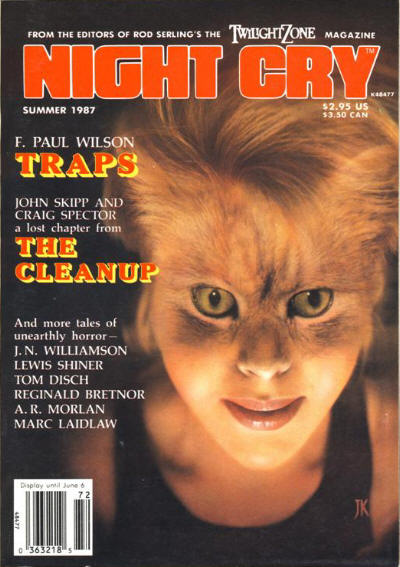
    (Cover by J. K. Potter. Night Cry, Summer 1987.)

    Who Goes There?

    A doctor by day and a bestselling author by night, F. Paul Wilson has had a long and pretty acclaimed career since he debuted in the early ’70s, being one of John W. Campbell’s last discoveries. His fiction can be basically divided into SF and horror, although the two are not mutually exclusive. He has the unique honor of earning both the Bram Stoker and Prometheus Award for Lifetime Achievement, for his horror and libertarian-themed SF respectively. His 1981 novel The Keep was adapted into an ill-fated Michael Mann film. “Traps” itself was apparently adapted into a short film, but I can’t find anything on it. This story is Wilson in pure horror mode, almost written in the allegorical mode but seemingly lacking a moral at its center. It’s an effective little short, and unsurprisingly it got a Stoker nomination. It could’ve worked as an episode of Tales from the Darkside, which is probably not a reference you were expecting.

    Placing Coordinates

    First published in the Summer 1987 issue of Night Cry, which was a reprint-oriented sister mag to Twilight Zone Magazine. It’s not on Internet Archive, but it is on Luminist. It then appeared in the Wilson collections Soft and Others and Ad Statum Perspicuum. For anthology appearances we have 100 Fiendish Little Frightmares (ed. Stefan Dziemianowicz, Martin H. Greenberg, and Robert Weinberg) and Piercing the Darkness: A Charity Anthology for the Children’s Literacy Initiative (ed. Craig Cook).

    Enhancing Image

    This story is not quite ten pages, so let’s get right into it. Hank is a do-gooding husband with twin daughters, and the family has recently moved into a rural-ish Jersey suburb where their house is one of maybe two on the street. (Incidentally the first house I lived in was similarly one of the first in a new development, and also in Jersey.) The scenery is nice, but the problem is with all the critters, which Hank is loathe to deal with. “He didn’t like killing anything. Even ants. Live and let live was fine with him, but he drew the line at the threshold of his house.” There’s especially been a mice problem, in the attic, with one of those hatches that unfurls a set of steps. Let’s face it, no one likes to go into the attic for whatever reason, although I would say the older the house the creepier the attic becomes. More history that way. In Hank’s case he’s had to take pains to set up mousetraps in the attic, and he has to do all this in secret so as to not traumatize his young daughters, who are big Mickey Mouse fans and who are set to go to Disney World very soon. “Kids had Disney World on the East Coast and Disneyland on the West. Katie and Kim would start out on their first pilgrimage Thanksgiving morning.” And yet there was still the mice problem.

    The business is already morbid enough, but things get weird when Hank finds the traps are working—and also only the heads of the mice remain. The bodies are missing, or more accurately something must’ve taken the bodies. “Something had eaten the dead mice. Something bigger than a mouse.” And there’s an awful smell slowly growing from the attic that can’t just be rodent corpses. What’s neat about “Traps” is how economical it is: there’s barely any dialogue; there are only four characters to speak of, only one of whom really matters; we’re given a gruesome if technically mundane situation, only for there to be a twist in the routine; and we’re given a reason for why Hank would be going about this by himself. This all happens in the span of a few pages. Let’s talk about what David G. Hartwell, in his seminal anthology The Dark Descent, considered the three basic classes of horror: allegorical, psychological, and supernatural. Obviously, as Hartwell admits, the three are not mutually exclusive, and indeed with a lot of stories you’ll find some balance of two of these classes. “Traps” reads almost like an allegory, with some kind of moral message the reader is supposed to take away from it—only there doesn’t seem to be one. It does, however, work similarly to a fable you might read aloud to your children. Not that I’d recommend showing “Traps” to kids unless you wanna make sure they get no sleep for a few days; but then it could feasibly be understood by a younger readership, since Wilson’s style is straightforward, concise yet gripping, and while there’s violence it’s not too graphic.

    Then there’s the psychological aspect. We can infer that whatever lurks in the attic is probably not a racoon or badger, but another part of the sense of looming doom is Hank listening for the mousetraps as they go off with a snap, often in the dead of night, and having to check the results the next morning. to make things worse, something has been sneaking into the attic through a vent, which Hank has to nail shut in the hopes this does the trick. At this point I would’ve forked over the money to hire an exterminator, but a) this is on short notice, since the family’s leaving for Disney World in a few days, and b) with hindsight it’s safe to say an exterminator wouldn’t have been able to help much with the thing in the attic. Our normal everyman Hank is thus faced with a dilemma: he could call someone take care of the issue, to the inconvenience and possible trauma of his family, or he could try taking care of the problem himself. Ultimately he goes with the latter, which turns out to be a very bad idea—which if you’re familiar with horror tropes you would’ve guessed already. “Traps” is the kind of setup-payoff horror story that’s determined to end on a bad note for the protagonist, but it’s the execution that matters most here.

    There Be Spoilers Here

    I said earlier that “Traps” fits primarily into the allegorical and psychological classes of horror, but this isn’t quite true as we do get a quick dose of that third class at the very end. Hank, seeing that something had come through the vent, is understandably worried about this. Unfortunately for Hank and even more unfortunately for his family, as he had left the hatch to the attic open, a monster, “big as a rottweiler, brown scruffy fur, a face that was all mouth with huge countless teeth, four clawed arms extended toward him as it held onto the beams above with still two more limbs,” killing him all but instantly. In the last seconds of his life realizes two things: that he’s being killed by some unspeakable horror he could not have possibly anticipated, and that he has unwittingly and probably doomed his family to being eaten by the same creature. This all happens in literally the last paragraph of the story, and I have to admit in the couple days since I read “Traps” this ending has stuck with me, for its suddenness and inexplicableness. There’s no reason (at least none I could pick up) for why there should be a six-limbed carnivore the size of a large dog and with about as many teeth as a shark should exist and be living in this family’s house specifically. It’s a complete break from reality that the story alludes to heavily and yet does not try to rationalize. The result is an ending that I find disturbing, for its implications but also for the sheer nightmarish quality of it.

    A Step Farther Out

    Wilson has been prolific for the past half-century and change, although sadly he has written relatively little short fiction. It’s a shame because the standalone horror stories I’ve read of Wilson’s have all been pretty strong. “Traps” is short, almost a vignette, but it has a finely laid out setup-and-payoff structure that makes the ending so disturbing, even if it’s also predictable. You can write horror that the reader can anticipate and get away with it so long as you effectively discomfort the reader as they await the inevitable. It’s stuck with me the more I’ve thought about it.

    See you next time.

  • Short Story Review: “The Hounds of Tindalos” by Frank Belknap Long

    April 6th, 2024
    (Cover by C. C. Senf. Weird Tales, March 1929.)

    Who Goes There?

    Frank Belknap Long had an exceedingly long life and career, born in 1901 and writing from about 1920 to well into the ’80s. He was close friends with H. P. Lovecraft, and was the first author to contribute to the Cthulhu Mythos, although it wasn’t called that in Lovecraft’s lifetime. “The Hounds of Tindalos” was Long’s third Mythos story, despite Wikipedia calling it the first to not be written by Lovecraft. This one story would have a rather large influence on Mythos fiction to come, with the hounds themselves even appearing later in Lovecraft’s “The Whisperer in Darkness,” in one of several instances of Lovecraft inspiring and in turn being inspired by others in the so-called Circle. There’s even an anthology of Mythos stories by different writers featuring the hounds. By the ’40s Long would move away from cosmic horror and focus more on science fiction, and indeed “The Hounds of Tindalos” is an early example of Long marrying the weird with the scientific, creating a structurally flawed but pretty memorable SF-horror narrative with an iconic monster at the center. It’s one of the more influential cosmic horror stories, and that’s because Long effectively utilizes one of the scariest things known to man: basic geometry.

    Placing Coordinates

    First published in the March 1929 issue of Weird Tales. It was then reprinted as a “classic” in the July 1937 issue. It first appeared in book form in the Long collection of the same title, with a pretty gnarly Hannes Bok cover for the first edition. We also have Avon Fantasy Reader #16. For anthology appearances there’s Tales of the Cthulhu Mythos: Volume 1 (ed. August Derleth), The Spawn of Cthulhu (ed. Lin Carter), and The Science Fiction Century (ed. David G. Hartwell).

    Enhancing Image

    Frank is an average guy who happens to be buddies with a real eccentric in the form of Chalmers, a sort of scientist-mystic who has contrarian views regarding objective reality. His library is filled with books on alchemy and theology, and “pamphlets about medieval sorcery and witchcraft and black magic, and all of the valiant glamorous things that the modern world has repudiated.” Or as Charles Fort would’ve put it, the excluded. Chalmers rejects what would’ve been conventional scientific narratives in 1928, although to Frank’s mild relief he does see Einstein as a kindred spirit, “a profound mystic and explorer of the great suspected.” Chalmers has a hypothesis that time, the fourth dimension, is actually an illusion, there merely because without it the human mind would wither at being able to see everything happening simultaneously. To test this he has concocted a drug which, if successful, should have the effect of breaking down that barrier. He wants Frank to be there as witness, and to act if something goes wrong. This is like your friend trying LSD for the first time and having you stay in the room with them for hours on end as a sober spectator, although LSD had not yet been invented when Long wrote this story.

    Drugs play a surprisingly large role in the history of cosmic horror writing, although in the ’20s and ’30s these things were treated with utmost skepticism, if not contempt. In the context of a cosmic horror narrative the ambivalence makes sense. Sure, Aldous Huxley would later argue for the positive potential of hallucinogens, but for fiction with an overall thesis of “There are things man is better off not knowing,” it makes sense to go on an anti-drug screed. I’m not sure what experience Long would be basing his writing of this fictional drug on, although it seems he had been reading the Tao Te Ching and found it inspirational—but not for religious reasons. Chalmers takes the drug, which takes effect “with extraordinary rapidity,” and to say he has a trip would be understating it. What Chalmers expected happens, in that he not so much hops across bodies through time but experiences all these different perspectives at the same time; it’s that he can only convey this information to Frank in a linear fashion. But there’s something much more concerning that rears its head in the midst of this trip, which only Chalmers can see (not so much see as comprehend) and which forces Frank to break him out of the trance.

    Let’s talk about the hounds, since they’re the star of the show, which is saying a lot since they never technically appear. We never see the hounds because they don’t exist in three-dimensional space. As Chalmers says, “There are […] things that I can not distinguish. They move slowly through angles. They have no bodies, and they move slowly through outrageous angles.” They’re only called hounds because Chalmers really isn’t sure what else he can call them; they’re certainly not like any dog in the real world, and they might only be distantly related to something mythical like Cerberus. In line with Lovecraft’s own conception of morality, the hounds are evil, but only as understood by humans. They act simply according to their nature, which apparently is an unspeakably horrific one. Or, as Chalmers says:

    “They are beyond good and evil as we know it. They are that which in the beginning fell away from cleanliness. Through the deed they became bodies of death, receptacles of all foulness. But they are not evil in our sense because in the spheres through which they move there is no thought, no morals, no right or wrong as we understand it.”

    Because Chalmers broke through the barrier of time he also stepped into the hounds’ domain, which if you know your cosmic horror is always a fatal mistake. The worst thing you can do in this kind of story is to alert the eldritch horror to your presence. So, there are basically two kind of geometry: curves and angles—cleanliness and foulness. Which sounds a bit silly as I’m saying it, but I respect Long for trying to apply a scientific rigor to something which refuses to be understood in human terms, even if math is supposedly the language of the natural world. This melding of the weird and scientific might’ve helped inspire Lovecraft in his own later, more SFnal Mythos stories, such as At the Mountains of Madness and “The Shadow Out of Time.” I can’t say for sure because I’m a layman and not a scholar. If you’re a Lovecraft scholar then feel free to call me a dumbass. Anyway, what makes the hounds memorable, despite never being seen in-story (though this hasn’t stopped people from trying, such as the aforementioned Bok illustration), is that they’re threatening while also not being god-like figures like Cthulhu or Shub-Niggurath; these are animals basically, as their name indicates, but they’re not puppers you’d wanna pet.

    Unlike some other contemporary attempts at writing cosmic horror, Long’s language is fairly unadorned; even Chalmers, who is given to monologuing, is not as verbose as the average Lovecraft narrator. Frank (who might be a stand-in for Long) is less a typical cosmic horror narrator and more riding shotgun to the poor sap who normally would be narrating. Long might’ve done this one-degree-of-separation tactic because Chalmers is such an eccentric and so detached from normal human behavior that the reader (the God-fearing Christian reader who might dabble in the occult as a tourist) might not have anything to latch on to. This decision seems like a good idea, but as we’re about to see, it does have a serious drawback, which in my opinion stops “The Hounds of Tindalos” from entering masterpiece territory and instead relegates it to the realm of “pretty good.” I mean, there are far worse things you can be than pretty good.

    There Be Spoilers Here

    The story is split into five chapters, of which the first is by far the longest; this first chapter puts us in Frank’s shoes and the result is one long scene that happens in one location. So far so good. The second chapter, much shorter, sees Frank and Chalmers plastering up the angels in the latter’s room, since the hounds have been alerted and, as said before, enter through angles. But then Long makes the odd decision to jettison us from Frank’s flesh prison (Frank himself basically disappears from the narrative), and to switch perspectives to what seems to be a third-person view—and then to switch perspectives yet again. All in the span of just a few pages. Perspective, especially in a short story, is an important thing to keep consistent, and it’s a rule Long violates without (I would think) just cause. Of course things don’t turn out well for Chalmers; when do they ever. I think the last cosmic horror story I read where the protagonist/narrator comes out of the ordeal more or less intact was Robert E. Howard’s “The Black Stone” (review here); and yes I do consider Chalmers the real protagonist of Long’s story. On the plus side, Chalmers’s death manages to be both gory and genuinely creepy: authorities find his body with his head removed and placed on his chest, and yet there’s not a drop of blood at the scene. And to make things weirder there’s protoplasm on the body. Certainly no human could’ve done such a clean job, one that seems physically impossible—unless your existence is deemed physically impossible by known science.

    A Step Farther Out

    As I’ve been getting more into horror fiction I think I’ve come to appreciate the efforts of the “old masters” more. The irony with Long is that he would outlive Lovecraft and Howard by decades, but he never garnered even close to the amount of respect and impact as them—in death or in life. When he died he was so poor that he was initially buried in a potter’s grave, and it was only because of several big names in the weird fiction scene banding together that allowed him a proper burial about a year later. Clearly there’s some respect there, but if Long gets mentioned nowadays it’s very likely because he was buddies with Lovecraft. I know I haven’t helped with that problem. “The Hounds of Tindalos” points toward a talent who does indeed take after Lovecraft but whose priorities might lie elsewhere. If anything the quality of this story has made me curious in Long’s later, more mature work, albeit I know he drifts away from the cosmic.

    See you next time.

  • Novella Review: “A Woman’s Liberation” by Ursula K. Le Guin

    April 3rd, 2024
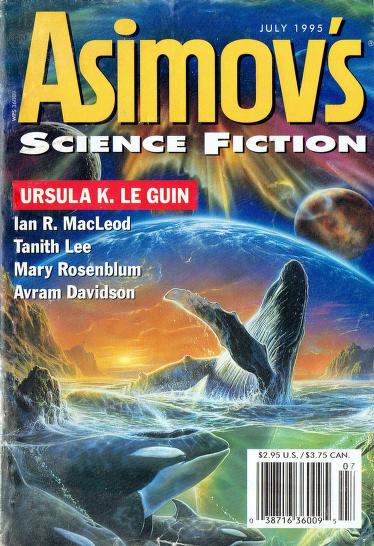
    (Cover by Bob Eggleton. Asimov’s, July 1995.)

    Who Goes There?

    Ursula K. Le Guin: you may have heard of her. She’s one of the most acclaimed authors in all of modern SFF, at times daring and yet somehow free of controversy (for the most part, as I’ll explain). She got started fairly late, only starting to write SFF when she was already in her thirties, but given that she lived to be almost ninety her career would be exceedingly long and varied. She’s also one of those rare authors to leave a major impact on both SF and fantasy, primarily with her Hainish and Earthsea cycles. The former might be her best work, when taken as a whole. My relationship with Le Guin has changed a good deal over time, ever since I first read The Left Hand of Darkness a little over ten years ago. As I’ve drifted closer to her politics over the past few years and become more familiar with her work I’ve come to have more mixed feelings on her as an artist, which I know is almost like a paradox. I think Le Guin is often great, and that of the Great™ SFF writers she’s one of the most versatile; but she’s also an idealist who doesn’t seem given to passions other than said idealism.

    I’m gonna use her Four (later Five) Ways to Forgiveness as an example. Three of these stories were published in Asimov’s, with “A Woman’s Liberation” being the final one. It’s not a direct sequel to the previous stories, “Forgiveness Day” and “A Man of the People,” but it definitely complements those stories and more specifically could be seen as the yang to the latter’s yin. They share a few characters, but more importantly “A Woman’s Liberation” feels like a flipped-perspective retelling of “A Man of the People.” I’m not sure if this would work better as its own thing or if read immediately after the previous story like it would be in the collection. I enjoyed “A Woman’s Liberation,” but somehow feel it’s a weaker installment.

    Placing Coordinates

    First published in the July 1995 issue of Asimov’s Science Fiction, which is on the Archive. It then appeared in Four Ways to Forgiveness and by extension Hainish Novels and Stories, Volume Two. For anthologies we have The Year’s Best Science Fiction, Thirteenth Annual Collection (ed. Gardner Dozois) and A Woman’s Liberation: A Choice of Futures by and About Women (ed. Sheila Williams and Connie Willis).

    Enhancing Image

    The story is the fictionalized memoir of a former slave named Rakam, who having been freed years ago is now writing about her early years. We know at the start that things will turn out well for her in the end, which is good to know because to say Rakam had a rough childhood would be understating it. She was raised on Werel, as a slave, although her pitch-black skin suggests (indeed other characters take note of it) that she might be of noble heritage. Right, so on Yeowe and Werel dark skin is considered more desirable while light-skinned people are considered “dusty,” which seems to be an inversion of the dark-light dynamic among blacks that goes back to the days of chattel slavery. I suppose Le Guin is trying to make a statement about the arbitrary nature of skin complexion and desirability. Anyway, Yeowe has had a successful slave rebellion; its people are now free—or at least the men are. Slavery is still alive and well on Werel.

    Rakam’s first sexual experience is as basically a sex toy for Lady Tazeu, the matriarch of Shomeke. Lady Tazeu is a curious character: she treats Rakam gently, all things considered, but is quite possibly a pedophile and also has a jealous streak. Lord Shomeke and Lady Tazeu also have a son, Erod, who is a young abolitionist and, as it turns out, Rakam’s half-brother. When she reaches a certain age Rakam’s mother tells her that there’s a reason for her dark skin: she is Lord Shomeke’s illegitimate daughter. But if Lady Tazeu ever finds out about this then she never tells Rakam. Lord Shamake falls fatally ill and the manor is placed under quarantine, and Lady Tazeu kills him and then herself; whether she does this so as to put the man out of his misery or out of revenge is left unclear. With both of his parents dead, Erod takes over the manor, and he signs papers that will free the slaves and allot them each a bit of money. This has disastrous consequences, as many of the slaves are killed overnight by neighboring slave-owners who think a rebellion is underway. Rakam is freed of her bondage, only to be forced into more servitude. Despite having her freedom papers, said papers mean basically nothing. “The government would not interfere between owners and those they claimed as their assets.”

    You may notice that similarly to “A Man of the People,” this is less a proper novella and more like a compressed novel, giving us only the essentials for this narrative of one person’s life. We follow Rakam from her birth to not long before she would’ve started writing her memoir. One major difference between this and the other Yeowe-and-Werel stories (the ones I’ve read, anyway) is that “A Woman’s Liberation” is written in the first person. Despite this change in mode, Rakam’s style is actually not that different from the third-person narrators of the other stories, the only real difference being that those other narrators are omniscient, whereas there are little gaps in Rakam’s narrative—information she was never able to obtain. “I did not learn to read or write until I was a grown woman, which is all the excuse I will make for the faults of my narrative.” She still comes off as firmly literate, though, despite being a late bloomer when it came to reading. This is indicative of Le Guin’s long-winded style that she had developed by the ’90s, simultaneously craftine labyrinthine paragraphs that cram more information into overall less space. I’m not sure what inspired the change, but the Le Guin of the ’90s is quite different from how she was in the ’70s.

    Le Guin’s style evolved, but so did her worldview it seems. The Dispossessed remains the quintessential left-libertarian SF novel, but I think it’s fair to say it’s not a feminist novel—or at least women’s liberation is not a chief concern. (The short story “The Day Before the Revolution,” a sort of distant prequel to The Dispossessed, could by contrast be considered an explicitly feminist narrative, although Le Guin doesn’t quite connect the dots with feminism and anarchism.) With the stories that make up Four Ways to Forgiveness Le Guin makes it pretty explicit that the notion of human liberty is incomplete without feminism—indeed freedom under a hypothetical socialism would be freedom only for a fraction of the population if women’s liberation is not a high priority. Erod starts out as a sympathetic character, albeit one who makes an error out of shortsightedness that gets a lot of people killed, but when we meet him again some years later he’s shown to be a low-key misogynist, much to Rakam’s displeasure. (Not sure where to put this, but isn’t it convenient that despite finding Erod attractive in her youth and even being offered to him as a bed-warmer, the half-siblings never get intimate?) Good news I suppose is that Rakam does meet a few decent men in her life, including Ahas, a fellow slave at the manor, and much later we meet a face or two that should strike us as familiar…

    The thing about Le Guin that makes her a favorite of literary types and classroom discussion is that she’s such a pious writer—she’s so virtuous that she seemingly has never done anything wrong in her life. Her politics are very far on the left, which should on paper make her a no-no for those who try to keep literary discussion “apolitical,” but she’s so gentle about said politics. She might’ve become aware of this purer-than-pure status because—and I’m not sure when exactly this happened—she gets super-horny in the later Hainish stories. Oh sure, sexuality is integral to The Left Hand of Darkness, but in a clinical, anthropological sense. Women’s sexuality is also at the heart of “The Day Before the Revolution,” but we have not yet reached maximum levels of horny. Then we get to Rakam’s story, which at its core is about her political and sexual awakening, the two coinciding and indeed feeding off each other. Consider this passage, in which Rakam (and I have to think this is also Le Guin responding to critics) explains why much of her memoir is concerned with sex:

    Now you may say in disgust that my story is all of such things, and there is far more to life, even a slave’s life, than sex. That is very true. I can say only that it may be in our sexuality that we are most easily enslaved, both men and women. It may be there, even as free men and women, that we find freedom hardest to keep. The politics of the flesh are the roots of power.

    Rakam has been freed, but while she is technically a freed woman on Werel, she’s still a slave sexually; up to about the halfway point of the story the only sex she’s known has been through rape. Her orientation is a grey area: she’s probably bisexual, or even more likely pansexual since she doesn’t seem to think along gender lines when it comes to attraction. Le Guin is funny when it comes to sexuality because, given that she was most likely straight (I don’t recall reading about her ever being attracted to anyone who was not a man, and anyway she was very happily monogamous), her interest in queer yearning and relationships often has this sense of detachment—like she empathizes, but maybe she doesn’t know what it’s like to live as a man who sometimes has crushes on other men, who is always anxious about these crushes because coming out to another man could result in something far worse than a rejection. With the exception of the unrequited romance in The Left Hand of Darkness, I don’t usually buy Le Guin’s characters being attracted to each other—which brings me to spoilers.

    There Be Spoilers Here

    I said earlier that that a few characters from “A Man of the People” reappear here, although you don’t have to have read that story to understand what’s happening. The first is Old Music, the Hainish bureaucrat who has appeared in all the previous Yeowe-and-Werel stories in small but pivotal roles; and here he comes again, this time to help Rakam get off Werel, although she doesn’t discover until after the fact that he was Old Music. Once Rakam gets to Yeowe, which as I’d said is a liberated planet, we meet “Mr. Yehedarhed,” who you may recognize as Havzhiva, a Sub-Envoy for the Ekumen and the protagonist of “A Man of the People.” Finally there’s Dr. Yeon, a major character from that story and perhaps Havzhiva’s closest friend. Being an outsider, Rakam only knows so much about these people, but if you’ve read “A Man of the People” then you know a lot has happened. Rakam impresses Havzhiva and convinces him to let her found a publishing house, and in the process the two fall in love—the first time Rakam’s ever fallen in love with someone and had that affection returned.

    The development of Rakam and Havzhiva’s happens over the course of maybe ten magazine pages, and if that sounds rushed, that’s because it is. It could be that, taken on its own, we simply don’t know enough about Havzhiva to trust him; oh sure, we’ve read “A Man of the People” and can carry that information over to this related story, but Rakam doesn’t know all that shit. The big things Rakam gets to know about her love interest is that he’s an abolitionist, a women’s lib sympathizer, and that he took a knife to the gut the fucking day he landed on Yeowe. From Rakam’s perspective, Havzhiva is basically perfect—which makes him boring. Because “perfect” people are boring. Le Guin admitted to dislike writing evil characters, which is why you can count the number of total scumbags in her fiction on one hand; but conversely she has a tendency at times to write characters who are seemingly bereft of human flaws. Goody-goodies, ya know. Rakam has trust issues and anxiety (understandably), but Hazhiva in the context of this story is a bit of a cypher, which hurts the romance.

    A Step Farther Out

    As I was reading “A Woman’s Liberation” I couldn’t help but feel like something was missing—indeed it’s the same reservation I have with the other entries in this “story suite” but even more so here. It’s good fiction but not good science fiction. Of the Yeowe-and-Werel stories I’ve read this one is the least SFnal, in that it could be most easily rewritten as a realistic narrative. Le Guin was clearly inspired by real-world slave narratives when writing it, but I think the lack of original input is to its detriment. I also think that while it does work well in concert with “A Man of the People,” it does feel redundant to some degree. Granted, I might be saying the same thing about that other story had the two been published in reverse order. Ultimately the problem could be that they’re too similar. I’m curious for when I eventually read Four/Five Ways to Forgiveness and see how these stories work together when taken as pieces of a larger narrative.

    See you next time.

  • Things Beyond: April 2024

    April 1st, 2024
    (Cover by Frank Kelly Freas. Analog, December 1972.)

    As has unfortunately become commonplace, there have been a few deaths in the family. Christopher Priest and Brian Stableford died in February and Vernor Vinge little over a week ago. This last one hit me by far the hardest. Obviously there are some people I’m not mentioning, but unfortunately unless I really wanted to I can’t cover everyone. There’s too much. The past month or so has been rough for me. I had a nasty fall a few weeks ago and I seem to have acquired mild PTSD from it. Half of my face got messed up and I ended up spending some time in the ER. Obviously I’m doing better now. Yet somehow I don’t feel totally “right.”

    Hopefully some good (or at least interesting) fiction will help me! We have a nice mix: two SF novellas, plus two SF short stories, two fantasy, and two horror. Or at least these stories seem to fit predominantly into those genres; obviously they’re not mutually exclusive.

    For the novellas:

    1. “A Woman’s Liberation” by Ursula K. Le Guin. From the July 1995 issue of Asimov’s Science Fiction. One of the most universally beloved of all SFF writers, Le Guin started relatively late but would enjoy a very long and acclaimed career. She’s one of the few authors to enjoy about equal reverence for both her SF and fantasy. Her Hainish Cycle, especially The Left Hand of Darkness and The Dispossessed, might constitute her best and most important work overall. “A Woman’s Liberation” is set in the same universe as those novels, and is a loose sequel to “Forgiveness Day” and “A Man of the People.”
    2. “Palely Loitering” by Christopher Priest. From the January 1979 issue of The Magazine of Fantasy and Science Fiction. British Science Fiction Award winner for Best Short Fiction. Priest died in February, after a career spanning more than half a century. His 1974 novel Inverted World is something of a cult classic. His 1995 novel The Prestige was turned into a movie by Christopher Nolan. ISFDB classifies “Palely Loitering” as a novelette, but at about forty pages in F&SF I suspect it counts as a novella. It got a Hugo nomination for Best Novelette but placed third in the Locus poll for Best Novella.

    For the short stories:

    1. “The Hounds of Tindalos” by Frank Belknap Long. From the March 1929 issue of Weird Tales. Long had a ridiculously long (ha) career, spanning from the 1920s to his death in 1994. He was a close friend of H. P. Lovecraft and the two seemed to take inspiration from each other, with “The Hounds of Tindalos” being one of the first Cthulhu Mythos stories not written by Lovecraft.
    2. “Traps” by F. Paul Wilson. From the Summer 1987 issue of Night Cry. A doctor by day and a bestselling author by night, Wilson is the only person to have earned both the Bram Stoker and Prometheus Award for Lifetime Achievement. He likes to hop between science fiction and horror, with the two not being mutually exclusive. “Traps” itself was a Stoker nominee for Best Short Story.
    3. “The Swordsman Whose Name Was Not Death” by Ellen Kushner. From the September 1991 issue of The Magazine of Fantasy and Science Fiction. Kushner got started in the ’80s writing Choose Your Own Adventure books before turning to proper fantasy literature and even radio. This story is set in the same universe as her novel Swordspoint but, as far as I can tell, is not a sequel.
    4. “Two Suns Setting” by Karl Edward Wagner. From the May 1976 issue of Fantastic. British Fantasy Award winner for Best Short Story. Wagner was a devotee of both horror and sword-and-sorcery fantasy. His Kane series very much follows in Robert E. Howard’s footsteps, but Wagner at his best was a genuine poet as well. “Two Suns Setting” was his first (and I think only) appearance in Fantastic.
    5. “Original Sin” by Vernor Vinge. From the December 1972 issue of Analog Science Fiction. Despite debuting in 1965 and remaining active until about half a decade ago, Vinge’s output is fairly small; but, given the five Hugo wins, he certainly did something right. “Original Sin” is one of Vinge’s more obscure stories, but I went with it on the recommendation of a certain colleague.
    6. “The Growth of the House of Usher” by Brian Stableford. From the Summer 1988 issue of Interzone. Stableford passed away in February after a very long and winding career. (Incidentally Priest, Vinge, and Stableford all debuted within a few years of each other.) He was a prolific translator of French SF and contributed to the SF Encyclopedia, on top of a massive amount of fiction.

    Won’t you read with me?

  • Short Story Review: “Day at the Beach” by Carol Emshwiller

    March 31st, 2024
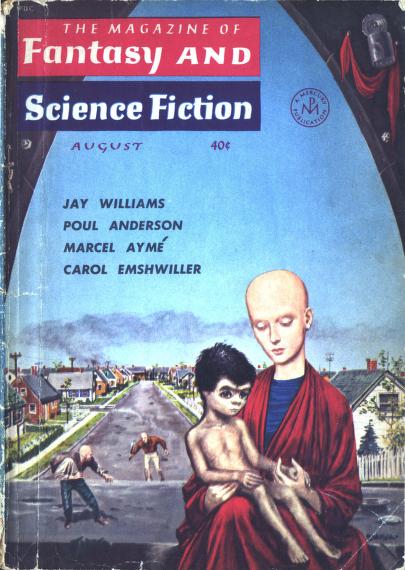
    (Cover by Ed Emshwiller. F&SF, August 1959.)

    Who Goes There?

    Carol Emshwiller came a bit late to the whole writing-fiction thing, not even writing her first novels until she was in her sixties, but she would have one of the longest and most acclaimed careers of any modern SF writer. She started in the mid-’50s and remained more or less active until her death in 2019; the crazy part is that she would remain a high-quality writer over that sixty-year span. She steppd away from writing for much of the ’60s but returns just in time to contribute to Dangerous Visions, with one of its better stories, “Sex and/or Mr. Morrison.” Despite having started in the ’50s, Emshwiller changed her colors like a chameleon and fit right in with the New Wave crowd—and then changed again for the post-New Wave years. This is a degree of versatility most writers couldn’t manage.

    I should probably mention at this point that Carol was the wife of legendary illustrator (later experimental filmmaker) Ed Emshwiller. Yeah. In one of the cuter instances of both halves of a couple being successful creative types, Ed sometimes illustrated Carol’s stories, including the cover depicting “Day at the Beach” that you see above. (It would have to be the cover because F&SF made it a policy to not have interior illustrations for stories.) “Day at the Beach,” while short and simple in a way, has enough evocative imagery that such a cover might’ve been earned; you could do a lot worse than this one. It’s a post-nuclear fable that reminds me of Cormac McCarthy’s The Road, in its grimness but also its central message.

    Placing Coordinates

    First published in the August 1959 issue of The Magazine of Fantasy and Science Fiction, which is on the Archive. It was reprinted in The Year’s Best S-F: 5th Annual Edition (ed. Judith Merril), An ABC of Science Fiction (ed. Tom Boardman, Jr.), Future Love: A Science Fiction Anthology (ed. Victoria Williams), Beyond Armageddon: Twenty-One Sermons to the Dead (ed. Martin H. Greenberg and Walter M. Miller, Jr. [?!]), and the Emshwiller collection The Collected Stories of Carol Emshwiller Vol. 1. Unfortunately, if what I’ve heard is true, the proofreading for that last one is really bad.

    Enhancing Image

    We meet Myra, a housewife who has “neither eyebrows nor lashes nor even a faint, transparent down along her cheeks.” She is in fact totally hairless, and so is her husband Ben. Their son, named Littleboy, is however a different story, being “the opposite of his big, pink and hairless parents, with thick and fine black hair growing low over his forehead and extending down the back of his neck.” Littleboy is three-and-a-half years old and we’re told that things were normal not long before then, when nuclear war broke out; it’s implied Littleboy was in utero when Myra and Ben got a generous dose of radiation. Emshwiller is light on the details: we’re never told who fired the first shot, which countries went to war (although we can guess(), or how much of civilization is left after the fallout. Presumably not much. I say “post-nuclear” but it’s fair to call “Day at the Beach” a post-apocalyptic tale. And then Myra gets the idea to take her family to the beach. It’s a nice sunny Saturday—or at least she thinks it’s a Saturday; she’s unsure.

    We aren’t told a lot about what life in such a future is like. We know oil is apparently a precious and fought-over commodity, like in Mad Max, and that the family is used to having to defend itself through violent means, as we’ll see later. What do they do for food? It’s not dwelled on. “Day at the Beach” is about ten pages long, and if anything it could be longer, which is the best kind of negative criticism. It’s a slice-of-life narrative in the allegorical mode, which as I said before reminds me of The Road, albeit with a lot less cannibalism. (There isn’t any on-screen cannibalism, don’t worry.) It’s a story about making way for the next generation, of “carrying the fire” as McCarthy liked to put it, in spite of horrendous circumstances. Myra and Ben are disfigured from the radiation and Littleboy is undoubtedly a mutant, but they don’t love him any less for it. Even Littleboy’s unconventional name alludes to the story’s allegorical nature, with the child being a stand-in for the next generation. As Anthony Boucher says in the introduction, it’s about “the endurance and adaptability of the human spirit.”

    The family has a simple goal in mind, which is to hang out at the beach—alone. They don’t seem to have any mutuals, no oomfies or pookies to call on for such an occasion; but then maybe solitude in the midst of nature is what Myra and Ben want. It’s a tranquel scene, although I have to say I’m not sure if letting Littleboy go swimming in the buff was the norm for really young children in the ’50s or if it’s a casualness brought on by the end of civilization and public decency laws. Probably the latter. It does feed into the sense of tranquility, and of a kind of purity. They may not be a sight for sore eyes (although I must admit that going by her depiction in Ed’s cover, Myra rocks the bald look), but that doesn’t make them any less kind to each other. In the years during and following World War II there was much speculation on what life might be like in the wake of nuclear fallout, from Judith Merril’s “That Only a Mother” to Walter M. Miller’s A Canticle for Leibowitz. The idea of humanity becoming mutated, with negative or possibly even positive effects, from the bombs was a popular one. Actually the “human mutants” stock is still high, if the continuing popularity of the Fallout series (now with its own TV show) is anything to go by.

    Emshwiller seems to suggest that while life is rough, and some harsh decisions must be made, and although our descendants may look different from us, they (probably) won’t be any less human. Governments may fall and capitalism might (hopefully) end at some point (as Lovecraft says, “even death may die”), but the average person, with even a little bit of luck, will persist. Like the Okies in The Grapes of Wrath (indeed the migrant workers who now suffer on the receiving end of border violence), the survivors of nuclear catastrophe will not go quietly into the night. In a way it can be thought of as a response (although Emshwiller probably didn’t intend this, and anyway I have no way of proving it) to Merril’s most famous story—a ray of hope to the stark terror of “That Only a Mother.”

    There Be Spoilers Here

    I’m tired.

    A Step Farther Out

    So that’s it. End of the month. I didn’t end on the strongest note, but the Emshwiller is a good example of F&SF‘s range of fiction and willingness to take on more poetic material. In 1959 (incidentally this was the only story Emshwiller saw published in 1959) there were really only a couple options for “Day at the Beach.” Maybe Galaxy would’ve taken it. The genre SF market had shrunk massively; certainly it was no longer the market of near-endless possibilities that it would’ve been at the start of the decade. F&SF was arguably the only American SFF magazine that was doing really well at this point. The late ’50s and early ’60s were a low period for short fiction writers, and this was especially true the women. A lot of female writers would leave the field around 1960 in search of greener pastures, no doubt in part due to the market shrinking massively, and Emshwiller would be one of those women who stepped away from the scene.

    But she would return.

    See you next time.

  • Short Story Review: “The Omen” by Shirley Jackson

    March 27th, 2024
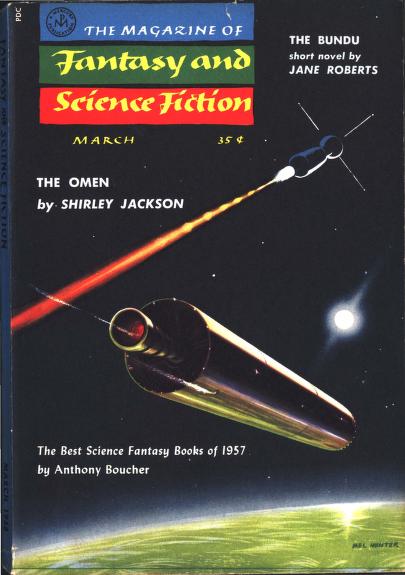
    (Cover by Mel Hunter. F&SF, March 1958.)

    Who Goes There?

    One of the most famous authors in 20th century American literature, Shirley Jackson occupies the same space as Ray Bradbury in the sense that she broke into the mainstream by sticking to slick outlets. In 1948 her short story “The Lottery” was published in The New Yorker and sparked an enormous amount of press and controversy, and “The Lottery” has since been canonized as one of those classic short stories high school English students are subjected to. But Jackson wrote much more than “The Lottery,” even if we’re counting just her short fiction; but she also was the rare successful horror novelist prior to 1970, with classics like The Haunting of Hill House and We Have Always Lived in the Castle. Unfortunately she didn’t live to see the horror renaissance of the ’70s, as she died in 1965, at 48 years old, after years of what should’ve struck people at the time as concerning levels of drug and alcohol abuse. In a way she was a victim of her own success, since being a famous lady writer who made more money than her husband contributed to the strain in her marriage, which was a miserable ordeal.

    It would be fair, I think, to call Jackson a horror writer first and foremost; certainly her horror writing is what made her legacy. She did sometimes not write horror, as is the case with today’s story, “The Omen,” one of Jackson’s few appearances in F&SF—indeed one of maybe a handful of appearances she made in the genre outlets. No doubt F&SF‘s dignified appearance, fast-and-loose philosophy with genre boundaries, plus (I suspect) some charm on Anthony Boucher’s part, had some role in wrangling a thoroughly slick author like Jackson. “The Omen” is pretty obscure, especially for Jackson, and admittedly it’s not a hidden masterpiece by any stretch of the imagination; but it does show another side to Jackson, albeit with some of the venom we come to expect with her.

    Placing Coordinates

    First published in the March 1958 issue of The Magazine of Fantasy and Science Fiction, which is on the Archive. It was then reprinted in The Best from Fantasy and Science Fiction, Eighth Series (ed. Anthony Boucher) and the Jackson collection Just an Ordinary Day, a volume of stories which hitherto had either gone unpublished or uncollected in a previous Jackson collection. It’s possible there’s a reprint that ISFDB doesn’t register, since Jackson is sometimes considered a non-genre author, but I find it believable that “The Omen” has only been reprinted twice.

    Enhancing Image

    Granny is nice old woman in her eighties, who gets along with her daughter, son-in-law, and grandkids—and on the day of the story she also gets hit with an unexpected but very welcome bit of money. She gets an envelope, inside of which is a check for $13.74, “with a covering letter saying that the sender had owed it to Granny’s husband for nearly fifty years, and so was paying it now to his widow, with interest.” Now, in today’s economy $13.74 is piss, but circa 1957 it would’ve been a good deal of money, especially for an old lady. You could do quite a bit with $13.74. She makes a list of things to get her family members, including a perfume brand named Carnation and a stuffed blue cat—only problem being it takes her all of five minutes to lose the list. Anyway, Granny is not the main character, but a much younger woman named Edith, who is in a long-term relationship with some guy named Jerry but who is hesitant to marry him—not because of Jerry, but Edith’s abusive and domineering (redundant) mother.

    The omen of the story’s title is Edith making a mistake and finding Granny’s shopping list instead of taking her own bag. Being destitute and a little supersticious, Edith takes the shopping list to be a sort of guide that’ll help her return home, and even maybe help her make up her mind on the Jerry situation. Let’s talk about genre, and about F&SF‘s policy in the ’50s, especially after J. Francis McComas stepped down. Usually fiction printed in F&SF would be SF, fantasy, or a hybrid, but on occasion Boucher would buy a story that can’t really be called SFF, yet is also maybe too strange to have seen print in the slick outlets. Jackson’s first original story in F&SF, “One Ordinary Day, with Peanuts,” doesn’t have any discernable fantastic elements, and indeed ISFDB classifies it as non-genre; yet it might’ve been too hard to classify (it isn’t horror, and yet there’s something vaguely sinister in its twist) for higher paying markets. “The Omen” arguably is not fantasy at all, depending on how you interpret the list. Is this a case of something like magical realism, or is it a bunch of coincidences? Are the omens good or bad, and does it matter on a cosmic scale?

    I personally am counting “The Omen” as fantasy because I have to I think Jackson’s implying that some cosmic force is pointing Edith in the right direction, even though she can’t be sure of it. She can’t know the context for the “Carnation” on the list, instead taking it to mean finding a literal carnation flower, and so she happens to meet a man on the street with one carnation on his breast who’s on his way to getting married. The soon-to-be-married man is also taking part in a contest involving a certain woman and $100 in groceries, which Edith gets wrapped up in. A comedy of mistaken identity ensues. I think the man with the carnation is a seed planeted in Edith’s mind that will later influence her to be more assertice in her relationship with Jerry, but I might be overthinking it. Jackson could at times be a writer of shocking subtlety, although I don’t think “The Omen” is an example of such; it seems to be Jackson taking herself and her world (New York) less seriously. Edith’s journey is a sort of spoof odyssey wherein Our Heroine™ is someone of modest means and probably average intelligence who maybe tricks herself into thinking she’s stumbled into a fantastical situation. Your mileage may vary.

    Reading this, I couldn’t help but think about Jackson’s life, the circumstances of her writing, and a kind of unexpected but perfectly logical contemporary comparison: Flannery O’Connor. The two were in some ways very different: O’Connor was a diehard Catholic while I struggle to believe the woman who wrote We Have Always Lived in the Castle believed in an all-loving deity. But they were also pessimists with a biting sense of humor and an equally biting sense of justice, and even though Jackson often wrote horror at a time when the genre was pulp-adjacent, I do think she was at least almost as morally serious as O’Connor. (Sadly they also both died young.) This is why I’m not sure what to make of “The Omen,” which depicts a downtrodden woman who is, quite possibly, on the cusp of liberating herself from one abuser to falling into the hands of another. The few times we hear from Jerry are not flattering. It could also be that I’m projecting Jackson’s own deeply unhappy marriage onto a character of hers, but I can’t help but get the impression that Edith, while on the surface being presented with a way out with Jerry, may be stuck between a rock and a hard place.

    There Be Spoilers Here

    Edith soon finds a cafe, Kitty’s Lunch, where the owner herself had, “with odd humor, chosen to adorn the window of Kitty’s Lunch with a large painted blue cat.” The cafe also happens to have a payphone Edith can use, and she just happens to have enough money for a cup of coffee and a phone call. And don’t feel too bad for Granny, who you may recall lost her list and subsequently forgot everything she was supposed to get. But everything works out. I could be wrong, though, but the ending feels phony to me, which I know is an odd way of putting it. I don’t think Jackson believes in her own happy ending. Granny, at the very end, even calls the outcome of events “sentimental,” which is a word that I can’t imagine Jackson would use without puking in her own mouth a tiny bit; Jackson doesn’t do sentimentality. Is this impression of fakeness intentional or just a failure at being sincere? It’s a question Jackson’s not keen on answering.

    A Step Farther Out

    “The Omen” is a lesser known Jackson story, because of its relatively lighthearted tone but also I don’t think it shows Jackson at her best. We know Shirley Jackson could be a really vicious and subversive writer for her time, but “The Omen” reads as the eternal pessimist indulging in sentimentality. You could even argue it’s non-genre and that not only should it have not been printed in F&SF but that I shouldn’t have covered it for this genre blog of mine, but I’ll be generous and work off the assumption that the hints of supernatural intervention should be taken at face value. It’s a curiosity that shows Jackson’s range, but it’s not something I’d recommend unless you’re a Jackson completionist.

    See you next time.

  • Short Story Review: “MS. Found in a Chinese Fortune Cookie” by C. M. Kornbluth

    March 24th, 2024
    (Cover by Mel Hunter. F&SF, July 1957.)

    Who Goes There?

    The ’50s—especially the first half—were a goldmine for satirical writing in genre SF, with writers like Robert Sheckley, William Tenn, and Philip K. Dick acting as court jesters for the scene; and then there was possibly the most talented of the satirists (or at least he could’ve been, had he lived longer), which was C. M. Kornbluth. Despite having died at the horribly young age of 34, of a weak heart, Kornbluth was prolific and at the time of his death he had been writing fiction for nearly twenty years. He debuted in 1939, about 15 years old, and wrote at a mile a minute (often under pseudonyms) until 1942, when he got pulled into the war effort. He would eventually return to writing circa 1949, just in time for the magazine boom that was about to take place, and he never looked back. He wrote quite a few novels, alone and in collaboration with Frederik Pohl, but his best stuff was short-form, which only got more ambitious as he aged.

    “MS. Found in a Chinese Fortune Cookie” is arguably not even science fiction, but it is very much about science fiction, and about science fiction writers. It’s a self-reflexive dual narrative that, in only about ten pages, shows Kornbluth hunting intellectual big game. At first I wasn’t quite sure what to make of it, since it really is a weird fucking story; but, having sat on it for a few days now, I feel more qualified to talk about it. This is the kind of story that rewards the reader for already being familiar with the author’s work, but while it is fannish, it’s not exactly a flattering depiction of being into genre SF at a time when the genre got no respect.

    Placing Coordinates

    First published in the July 1957 issue of The Magazine of Fantasy and Science Fiction, which is on the Archive. It was then reprinted in The Best from Fantasy and Science Fiction, Seventh Series (ed. Anthony Boucher), the only book publication of this story Kornbluth lived to see. It appeared in the Kornbluth collections The Marching Morons and Other Science Fiction Stories, Thirteen O’Clock and Other Zero Hours, and His Share of Glory: The Complete Short Science Fiction of C. M. Kornbluth.

    Enhancing Image

    There are two threads, which I’ll call the primary and secondary narrative. The primary is a series of messages hidden inside fortune cookies (hence the title), written by one Cecil Corwin, science fiction writer; and the secondary is asides written by C. M. Kornbluth, whom you may have heard of. Corwin has apparently gone insane and vanished off the face of the earth, with only these secret messages detailing what happened to him, in his own words, while Kornbluth, being a long-time friend and Corwin’s literary executor, gives us some much-needed context. Thus we have the “Corwin Papers”—notes you’d find in place of those platitudes that are normally found inside delicious fortune cookies. It’d be accurate to title the story “MS. Found in Chinese Fortune Cookies,” but I understand that doesn’t quite as good. Still, we have two protagonists: Corwin and Kornbluth.

    This is all a bit strange, not least because “Cecil Corwin” is one of the aforementioned pseudonyms Kornbluth used back when he started writing. I’m not sure how many readers in 1957 would’ve known this, but Anthony Boucher almost certainly knew, as did some other folks who knew Kornbluth personally. The implication is that Corwin and Kornbluth are meant to be taken as the same person, or maybe as two sides of the same persona, or maybe as two personalities inhabiting the same body a la A Scanner Darkly. Immediately we’re thrown into the deep end of metafictional hijinks, in a maneuver that probably would’ve made Jorge Luis Borges proud (although Kornbluth had almost no way of knowing about Borges in his lifetime). There are some other characters mentioned, very likely based on real people, whose names have been changed undoubtedly for legal reasons and because Kornbluth doesn’t wanna make too many enemies.

    Corwin is a writer who thinks he has found what he calls The Answer—the one secret to life, the universe, and everything, which would end human suffering and initiate the kingdom of Heaven on Earth. Despite being on the brink of monumental success, Corwin suspects he might also be on the precipice of insanity. “Of course The Answer looked logical and unassailable, but so no doubt did poor Charlie McGandress’ project to unite mankind through science fiction fandom, at least to him.” I get the impression Kornbluth (the author) was trying desperately not to bring up L. Ron Hubbard or Scientology by name, but you’d have to be blind as a bat to not notice the allusions to what were then fandom hijinks. And in fairness to Corwin, he’s not wrong when he suspects that trying to write out The Answer will get him into serious trouble. Indeed the conspiracy surrounding The Answer is the closest the story gets to SF territory, which reminds me of the centuries-long feud at the heart of The Crying of Lot 49. I wonder if Thomas Pynchon has read Kornbluth?

    I wouldn’t recommend “MS. Found in a Chinese Fortune Cookie” to people unfamiliar with Kornbluth for a few reasons: it assumes you know who Kornbluth is, that you have at least a cursory knowledge of SF fandom politics in the ’50s; and also, structurally, this is a tangled mess of a story. We’re given two unreliable narrators for the price of one. Immediately we’re signaled to doubt Corwin because he says, “They say I am mad, but I am not mad”—only to chide himself for opening on such a cliched line. Then there’s Kornbluth (the character), who cuts out parts of Corwin’s writing for a few given reasons, but the result is that the notes are left even more fractured than they would’ve been originally. Kornbluth (the character) will also sometimes cut in to voice his disagreement with something Corwin says, either because he genuinely believes what he’s saying or because he wants to make sure not to get caught in the conspiracy that would drive Corwin to write these messages. Needless to say the plot is hard to spoil, because of its layers but also the fact that the story is inextricably linked with Kornbluth’s career within the history of genre SF.

    There is a key to this story, in a way, although it wouldn’t be published until after Kornbluth’s death. For people like myself who are actively interested in “old” science fiction there’s a little volume called The Science Fiction Novel: Imagination and Social Criticism (ed. Earl Kemp), published in 1959, which collects four lectures given by as many SFF writers, those being Robert Heinlein, C. M. Kornbluth, Alfred Bester, and Robert Bloch. These lectures were originally given a couple years earlier, which Kornbluth giving his in January 1957 at the University of Chicago. The name of the lecture is damning: “The Failure of the Science Fiction Novel as Social Criticism.” The idea, basically, is that while there have been works of SF that work as social criticism, there are too few such examples in a sea of pure entertainment; and, maybe more damningly, said examples fail to leave a tangible impression on the public consciousness. Aside from some excessive psychoanalyzing of George Orwell, it’s a good read.

    At one point Kornbluth talks about Wilson Tucker’s 1952 novel The Long Loud Silence, a novel which he feels is effective as social criticism, but an abject failure in sparking any societal change. Unlike Harriet Beecher Stowe’s Uncle Tom’s Cabin and Upton Sinclair’s The Jungle, which (Kornbluth says) really did change how some people thought and acted (in the case of The Jungle it directly inspired government policy), The Long Loud Silence made no such impression; not only that, but it didn’t become a bestseller and is indeed now an obscure novel—forgotten. In trying to explain how this happened, Kornbluth goes further to explain what it was like being a “science fiction writer” in the ’50s, at a time when the market was more vibrant than ever before but which the mainstream dared not touch:

    [The Long Loud Silence] was ignored because publishers think of their books in rigid categories. Tucker’s book fell into the category “science fiction.” Books in the category “science fiction” get no promotion or advertising to speak of, they get misleading jacket blurbs, and a sale of five thousand copies is considered a realistic target. The idea is to sell it to the science fiction readers, clear expenses, make a little money on the paperback reprint, pat the author on the back and tell him to write another book, boy, we love your stuff.

    Even 1984, which was a bestseller and which Kornbluth praises immensely, had failed to spark any societal change. One of the most famous novels in the English language, often quoted (and misunderstood), and yet despite its immense popularity 1984 remains a novel of ideas that have never materialized. There has not been (to my knowledge) a libertarian socialist society that exists now past the extreme local level, let alone one that takes direct inspiration from Orwell’s warning. (The point of the novel, of course, was the scare readers away from capitalism and socialistic fascism [or fascistic socialism] and encourage a socialist change wherein people of all skin colors and class backgrounds would be allowed to flourish.) If even the most famous SF novel on the planet cannot do what mainstream literature has done, then why are we here? What is the purpose of writing science fiction other than for the lulz and the funzies? Is SF hopes to stand on the same level as mainstream literature then (Kornbluth says) there has to be a work on part with Uncle Tom’s Cabin in terms of societal impact. (That Uncle Tom’s Cabin is now often held as an “important” but poorly aged protest novel that one doesn’t read for pleasure is beside the point.)

    The increasing existential dread for the SF writer is one both Corwin and Kornbluth sense, although unlike Kornbluth (the author), Corwin thinks he has found the answer—even The Answer. In a sense you could say this story is autobiographical, because I do think Corwin’s anxiety about the seeming unimportance of the SF writer mirrors Kornbluth’s own. It’s like what he says about the relationship between the reader and the SF writer (although you could argue this goes for any writer of fiction): “There’s a touch of intellectual sadism in us. We like to dominate the reader as a matador dominates the bull; we like to tease and mystify and at last show what great souls we are by generously flipping up the shade and letting the sunshine in.” Science fiction—the reading and writing of it—is like a game. But Corwin and Kornbluth argue this must not or at least should not be so—that science fiction should serve more purpose than as entertainment.

    There Be Spoilers Here

    [REDACTED]

    A Step Farther Out

    When Kornbluth died in March 1958 he was on his way to succeeding Anthony Boucher as editor of F&SF, and one can’t help but wonder where the magazine might’ve gone under his direction. Certainly he was becoming increasingly concerned with the bottom-tier position science fiction occupied in the zeitgeist, having at that point been relegated mostly to monster movies and speculation on new technology. The complexity and seriousness (despite its absurd premise) of “MS. Found in a Chinese Fortune Cookie” point toward Kornbluth trying to open a door—a door that would prematurely slam shut. I’m reminded of the SF Encyclopedia’s entry on Edgar Allan Poe, who like Kornbluth died young, before he could reach his full potential: “If his career had lasted longer, he might have awoken us more inescapably to his vision; as it stands, we must awaken ourselves to him.” The same can be said of Kornbluth.

    See you next time.

←Previous Page
1 … 20 21 22 23 24 … 43
Next Page→

Blog at WordPress.com.


Loading Comments...
 

    • Subscribe Subscribed
      • Science Fiction & Fantasy Remembrance
      • Join 139 other subscribers
      • Already have a WordPress.com account? Log in now.
      • Science Fiction & Fantasy Remembrance
      • Subscribe Subscribed
      • Sign up
      • Log in
      • Report this content
      • View site in Reader
      • Manage subscriptions
      • Collapse this bar